All news

Breaking news

📧Message personnel

Conferences

🎥Le rôle du Juge dans le déploiement du Droit de la Régulation en Droit de la Compliance (The role of the Judge in the deployment of Regulatory Law in Compliance Law), in 🧮De la Régulation à la Compliance : le rôle du juge ?

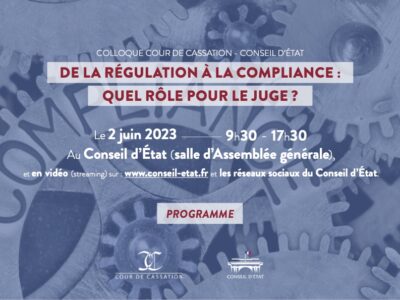
► Full Reference: M.-A. Frison-Roche, Le rôle du Juge dans le déploiement du Droit de la Régulation en Droit de la Compliance (The role of the Judge in the deployment of Regulatory Law in Compliance Law), in Conseil d'État (French Administrative Supreme Court) and Cour de cassation (French Judiciaire Supreme Court of cassation), De la Régulation à la Compliance : quel rôle pour le Juge ? ("From Regulatory to Compliance : what role for the judge?"), speech constituting the "closing session" of the bi-annual joint symposium of the two High Courts, held at the Conseil d'État, Salle d'Assemblée générale, 2 June 2023. The event was held in French. - 🧮See the full programme of this event (in French) - 🎥watch the interview given about the conclusion, done after the speech (in French) - 🧮read the general programme of the manifestation (in French) - 📚read the bibliographical dossier du participant. (participant's file made in French) - 🎥watch the general introductory speechs of Didier-Roland Tabuteau, Vice-Président du Conseil d'État, de Christophe Soulard, Premier Président de la Cour de cassation, and of François Molins, Procureur général près la Cour de cassation ;  and the interventions in the first session devoted to the path from the Regulatory to the Compliance with Marie-Anne Barbat-Layani, présidente de l'AMF, Jean-Yves Ollier, conseiller d'Etat, Daniel Calleja-Crespo, directeur général du service juridique de la Commission européenne andChristine Guegen, , première avocate générale de la chambre commerciale de la Cour de cassation - 🎥watch the speechs in the second session devoted to the office of the judge with  Vincent Vigneau, président de la chambre commerciale de la Cour de cassation, François Ancel, conseiller à la première chambre civile de la Cour de cassatin, Astrid Mignon-Colombet, avocate à la Cour, Lucien Rapp, professeur à Toulouse-Capitol and Alain Seban, conseiller d'Etat ; the speechs of the third session dedicated to the Compliance new frontiers, with Christophe Chantepy, président de la section du contentieux du Conseil d'État, Roch-Olivier Maistre, président de l'Arcom, Paul Nihoul, juge au Tribunal de l'Union européenne, Jean-François Bohnert, procureur de la République financier, Joëlle Tolédano, professeure émérite à Dauphine ; the final session with Marie-Anne Frison-Roche - 🎥watch this final speech by Marie-Anne Frison-Roche, which formed the closing session of the event - 🚧read the bilingual Working Paper used as basis for the article to be published later - 💬read the interview given by Marie-Anne Frison-Roche and Alain Seban after the colloquia and entitled "Compliance : les cours suprêmes s’emparent de la question de ses enjeux juridictionnels" ("Compliance : the Supreme Courts take up the issue of its jurisdictional implications") - ► English presentation of this general conclusion: Having a definition of Compliance Law in mind, a definition around which there still seems to be so much dispute, is not required to understand that this Law is what will enable us to enter and deal with a new world and if this subject is so fascinating to young people who want to become lawyers, prosecutors, regulators or judges, even though they are not taught this subject, it is because they have understood that with Compliance Law they will be able to actively participate in this new world and build it. This is the way we want it to take it, with force and courage in a sort of collective adventure. In this way, the Judges have a monumental role to play, which is at the very heart of Compliance Law. They will necessarily be so because demands and claims will converge on them from all sides, from Internet users, consumers, investors, associations and companies, and the Judge will have to respond. This has already started and is only just beginning. Judges must be prepared. Four expectations are emerging as to what their role should be. Firstly, judges must persist in their role as guardians of the Rule of Law, in a Compliance Law impregnated with technologies (algorithms) that could be described as insensitive. Secondly, beyond this vital role as guardian of the Rule of Law, the Judge has a new role in the extraordinary deployment of Compliance Law, which is measured in terms of the novelty of the normative control it exercises, the commitments it supports, the remedies it finds and the sustainability it reinforces. Thirdly, in the natural space of justice, the judge responds to parties who make claims of compliance, both as plaintiff and defendant, because the causes of compliance are systemic causes that deserve a new jurisdictional treatment. Fourthly, given the novelty and scope of this innovative approach, all judges must converge in terms of content, qualifications, and methods if they are both to continue their traditional role as guardians of the Rule of Law and to be able to endure their new role, a dialogue in which they have so much to contribute to each other. - 🌐follow Marie-Anne Frison-Roche on LinkedIn 🌐follow Marie-Anne Frison-Roche on Instagram 🌐subscribe to the Newsletter MAFR Regulation, Compliance, Law 

Texts

RÈGLEMENT (UE) 2023/1115, du 31 mai 2023, relatif à la mise à disposition sur le marché de l’Union et à l’exportation à partir de l’Union de certains produits de base et produits associés à la déforestation et à la dégradation des forêts, et abrogeant le règlement (UE) n° 995/2010

► Full Reference: Regulation (EU) 2023/1115 of the European Parliament and of the Council of 31 May 2023 on the making available on the Union market and the export from the Union of certain commodities and products associated with deforestation and forest degradation and repealing Regulation (EU) N° 995/2010. - ► read the text -

Conferences

conference

🎤Conclusions, in 🧮le devoir de vigilance des entreprises : l’âge de la maturité ?

🌐 flollow Marie-Anne Frison-Roche on LinkedIn 🌐subscribe to the Newsletter MAFR Regulation, Compliance, Law  - ► Full Reference: M.-A. Frison-Roche, "Conclusions", in Ch. Maubernard et A. Brès (dir.), Institut de droit européen des droits de l'homme et Centre de droit de l'entreprise, Université de Montpellier, Le devoir de vigilance des entreprises : l'âge de la maturité?("The Entreprises duty of vigilance: the maturity age?") , Montpellier, May 25, 2023. The conference is held in French. - 🧮see the manifestation programme (in French) - 🌐 read the report done on LinkedIn (in French) - ► English summary of this final speech of the manifestation: It is rather difficult to draw a conclusion after listening so many contributions. For three reasons: firstly, because of their richness and extreme diversity; secondly, because of the fact that we do not know whether the duty of vigilance is under the French law of 2017 (known as the Vigilance Law) or in other national, European and international texts or beyond or below the legal rules; thirdly, because we do not know what is meant by the "maturity" of a legal concept. But in the end, since the question posed by the title itself of the colloquium is Duty of Vigilance: the age of maturity? the answer is clearly: no. But this is regrettable. It is therefore essential to explore the ways in which the duty of vigilance can mature.  If we find merit in this duty which has now entered the legal system, there are eight intersecting avenues, which must be exploited. The first path is progression through the passage of time, rediscovering what in the past was already vigilance and what in the future will be its deployment. The second way is to progress by fixing the vocabulary, because we are witnessing a great battle of words, overtly or covertly, in French or English. The third path is progression through the emergence of principles, or even a principle, rediscovered or invented. The fourth path is progression through coherence brought to the legal system(s), which at present suffer from gaps and inconsistencies, which could be remedied by methods such as centralising litigation or, more radically, ignoring borders. The fifth path is progression through the fact that it works, because vigilance techniques are those of Compliance, of which vigilance is the leading edge, and the challenge is to find solutions. The sixth path is progression through using power of the legal system not only to create new areas of relevance – starting with the notion of vigilance, but also that of the value chain – but also to impose new indifferences, namely indifference to the figure of the market (to which laws prefer the company and the value chain) and indifference to borders. The seventh path is progression through bringing perspectives closer together, in order to find solutions even when interests are opposed. This is where the two techniques of contract and mediation are very welcome. The eighth path is progression through culture, because the culture of vigilance, like the culture of compliance, must be developed within companies and supply chains, and must become common to them and their stakeholders. - 🚧read the Working Paper written just after this oral conclusion in preparation for the article to be published. -  

Breaking news

📧Le PNF devrait avoir ouvertement compétence en matière de CJIP environnementale : la CJIP “Guy Dauphin Environnement” du 17 mai 2023

🌐 follow Marie-Anne Frison-Roche on LinkedIn 🌐 subscribe to the Newsletter MAFR Regulation, Compliance, Law - ► Full Reference: M.-A. Frison-Roche, "Le PNF devrait avoir ouvertement compétence en matière de CJIP environnementale : la CJIP "Guy Dauphin Environnement" du 17 mai 2023" ("The French National Financial Prosecutor’s Office should have open jurisdiction over environmental Judicial Public Interest Agreement: the "Guy Dauphin Environnement" Judicial Public Interest Agreement of 17 May 2023"), Newsletter MAFR Law, Compliance, Regulation, 20 May 2023. - 📧Read by freely subscribing other news of the Newsletter MAFR – Law, Compliance, Regulation - 🔴 The Judicial Public Interest Agreement GDE of 15 May 2023 or how the French National Prosecutor's Office is rightly meddling in Environmental Compliance The Parquet National Financier (French National Financial Prosecutor’s Office) does not have jurisdiction over environmental matters, and this is regrettable. For it is very well placed to obtain, in particular for the benefit of associations, adequate measures for the future, which refers to the definition of Compliance Law. This is what he is actually achieving through the Convention judiciaire d'intérêt public – CJIP (Judicial Public Interest Agreement) GDE. - 📧read the article ⤵️

Texts

🏛️Convention judiciaire d’intérêt public du 15 mai 2023 entre LE PROCUREUR DE LA REPUBLIQUE FINANCIER et La société GUY DAUPHIN ENVIRONNEMENT

► Full Reference: Convention judiciaire d'intérêt public – CJIP (Judicial Public Interest Agreement), Parquet national financier – PNF (French National Financial Prosecutor's office) and Guy Dauphin Environnement, 15 May 2023. - 🏛️read the agreement (in French) - 📧read the article published in the Newsletter MAFR – Law, Compliance, Regulation, entitled "Le PNF devrait avoir ouvertement compétence en matière de CJIP environnementale : la CJIP "Guy Dauphin Environnement" du 17 mai 2023" ("The French National Financial Prosecutor’s Office should have open jurisdiction over environmental Judicial Public Interest Agreement: the "Guy Dauphin Environnement" Judicial Public Interest Agreement of 17 May 2023") -

MAFR Chronicles Compliance Law

📚chronique MAFR Compliance Law

📝La loi, la compliance, le contrat et le juge : places et alliances (Regulations, Compliance, Contracts, and Judges: places and alliances”)

🌐 follow Marie-Anne Frison-Roche on LinkedIn 🌐 subscribe to the Newsletter MAFR Regulation, Compliance, Law - ► Full Reference: M.-A. Frison-Roche, "La loi, la compliance, le contrat et le juge : places et alliances" ("Regulations, Compliance, Contracts, and Judges: places and alliances"), Chronique of Compliance Law, D. 2023, pp. 906-908. - 📝read the article (in French) - ► English summary of this article: Compliance Law brings together the forces of regulations, contracts, and judges' decisions to achieve monumental goals so that in the future human beings will not be crushed by systems but will instead benefit from them. In this teleological and systemic branch of Law, legislators, regulators, companies, stakeholders, and judges must find their place. This can lead to bonds of obedience, a vision of 'conformity'. But conformity is only a tool of compliance, whose vigilance is the advanced point of this new branch of Law in which the alliance makes it possible to find solutions, the contract being then a usual mode of elaborating means under the control of the judge. - 🚧read the bilingual Working Paper which is the basis of this article, with additional developments, technical references and hyperlinks - 📚read the other articles published in this chronique of Compliance Law published in the Recueil Dalloz -

Reports

📓Report of the Committee on Legal affairs of the European Parliament on the proposal for a directive of the European Parliament and of the Council on Corporate Sustainability Due Diligence and amending Directive (EU) 2019/1937

► Full Reference: Committee on Legal Affairs of the European Parliament, Report on the proposal for a directive of the European Parliament and of the Council on Corporate Sustainability Due Diligence and amending Directive (EU) 2019/1937, 8 May 2023. - 📓read the report -

Working papers

Working Paper

🚧Use of private companies by Compliance Law to serve Human Rights

► Full reference: M.-A. Frison-Roche, Use of private companies by Compliance Law to serve Human Rights, Working Paper, May 2023. - This Working Paper is the basis of: 🎤a conference done in French in Toulouse on June 16, 2023 📝an article previously written before and for this conference, and subsequently published in the book Puissances privées et droits de l'homme ("Private Powers and Human Rights") - ►Summary of this Working Paper: Following the legal tradition, Law creates a link between power with a legitimate source, the State, public power being its prerogative, while private companies exercise their power only in the shadow of this public power exercised ex ante.  The triviality of Economic Law, of which Competition Law is at the heart, consisting of the activity of companies that use their power on markets, relegates the action of the State to the rank of an exception, admissible if the State, which claims to exercise this contrary power, justifies it.  The distribution of roles is thus reversed, in that the places are exchanged, but the model of opposition is shared. This model of opposition exhausts the forces of the organisations, which are relegated to being the exception. However, if we want to achieve great ambitions, for example to give concrete reality to human rights beyond the legal system within which the public authorities exercise their normative powers, we must rely on a new branch of Law, remarkable for its pragmatism and the scope of the ambitions, including humanist ambitions, that it embodies: Compliance Law. Compliance Law is thus the branch of Law which makes the concern for others, concretised by human rights, borne by the entities in a position to satisfy it, that is to say the systemic entities, of which the large companies are the direct subjects of law (I). The result is a new division between Public Authorities, legitimate to formulate the Monumental Goal of protecting human beings, and private organisations, which adjust to this according to the type of human rights and the means put in place to preserve them. Corporations are sought after because they are powerful, in that they are in a position to make human rights a reality, in their indifference to territory, in the centralisation of Information, technologies and economic, human, and financial means. This alliance is essential to ensure that the system does not lead to a transfer of political choices from Public Authorities to private companies; this alliance leads to systemic efficiency. The result is a new definition of sovereignty as we see it taking shape in the digital space, which is not a particular sector since it is the world that has been digitalised, the climate issue justifying the same new distribution of roles (II).  -   🔓read the full developments below⤵️ - 🌐 follow Marie-Anne Frison-Roche on LinkedIn 🌐follow Marie-Anne Frison-Roche on Instagram 🌐 subscribe to the Newsletter MAFR Regulation, Compliance, Law