All news

Working papers

Working Paper

🚧Duty of vigilance: the way forward

► Full Reference: M.-A. Frison-Roche, Duty of vigilance: the way forward, Working Paper, December 2023/July 2024. - 🎤 This working paper has been drawn up to serve as a basis for the conclusions of the colloquium Le devoir de vigilance: l'âge de la maturité? ("The duty of vigilance: the age of maturity?") organised by the University of Montpellier on 25 May 2023. - 📝 Updated and developed, it serves as the basis for the article that concludes the book Le devoir de vigilance des entreprises : l'âge de la maturité? ("The duty of vigilance: the age of maturity?"), Editions Bruylant, 2024.   - ► Working Paper summary: In 2017 in France the so-called Vigilance law expressed great ambition. So did the draft directive. But in 2024 the European institutions moderated this ambition by refusing to increase either the type of companies subject and the constraints to which the duty of vigilance is associated. The directive has essentially halted what was for some the "march of progress". Does the ambition no longer exist? Does the future lie in an extension of the philosophy of the duty of vigilance, i.e. companies that should always be more concerned about others? This would undoubtedly be reaching the "age of maturity", where others see the age of madness, because it would be a contradiction in terms to ask a company to be concerned about anything other than its own development. It is therefore appropriate to consider this very hypothesis of an "age of maturity" as being an ambition maintained despite a European directive which, in its adopted version, is weakened and while the oppositions are intact (I). First of all, it must be admitted that the notion of "maturity" most often conceals a value judgment when applied to a legal concept (I.A.) and that this is blatantly obvious with regard to the duty of vigilance, which is considered by some and by nature by some as a good and by others as an evil (I.B). In order not to remain in what appears to be trench warfare, we must not get too bogged down in the reference French legislation of 2017 and what appears to be a European stutter in 2024, arguing so loudly that we can hear them reasoning in print, by paying attention to less visible and now more promising avenues of progress (II). In fact, the duty of vigilance can progress simply by the passage of time (II.A), by a better definition of the vocabulary (II.B), by the consolidation of the principles of Responsibility and Dialogue (II.C), by the uniqueness of the jurisdictional route (II.D). This last perspective of the progress that will be made possible in France by the uniqueness of the judicial route leads to a final avenue of progress. By their very nature, laws are jolts, all the more violent for being disputed. At the moment, if we want to make progress, these two other sources – the contract and the judge – must be favoured (III). The European directive is rightly concerned with access to the courts and takes a measured view of the effectiveness of contracts as a means of making the duty of vigilance effective, with the courts having to ensure that the contract does not destroy the spirit of the system. This is what the law already organises about the relationship between the contract, the judge and the duty of compliance (III.A). What is new in Europe in 2024 is the introduction of a Supervisor (III.B). Here again, vigilance is the "cutting edge" of Compliance Law, as it is an extension of Regulatory Law.  The result is that, through interpretation and the handling of principles, and to formulate a more general conclusion, it is the judge who holds and will hold the balance of the duty of vigilance.     - 🔓read the Working Paper below⤵️ - 🌐follow Marie-Anne Frison-Roche on LinkedIn 🌐follow Marie-Anne Frison-Roche on Instagram 🌐subscribe to the Newsletter MAFR Regulation, Compliance, Law

Articles

📧Comment articuler Compliance et droits de la défense ? (How to articulate Compliance and the rights of the defence ?)

► Full Reference: M.-A. Frison-Roche, "Comment articuler Compliance et droits de la défense ?" ("How to articulate Compliance and rights of the defence"), Newsletter MAFR Law, Compliance, Regulation, December 10, 2023 - 📧Read by freely subscribing other news of the Newsletter MAFR – Law, Compliance, Regulation - 🧱Acknowledging their specific characteristics to better articulate Compliance and the rights of the defence The book, Compliance et droits de la défense (Compliance and the rights of the defence), co-edited by the Journal of Regulation & Compliance (JoRC) and Dalloz, deals with their relationship per se, a relationship illustrated by the internal investigation, the CJIP and the CRPC. Its aim is to explain what Compliance Law is and what the rights of the defence are, in order to find better ways of articulating them: sometimes to rank them, more often to find their points of contact and increase them. Above all, the starting point must be practice. - 📧read the article published on 10 December 2023 on this topic in the Newsletter MAFR – Law, Compliance, Regulation ⤵️ - 🌐follow Marie-Anne Frison-Roche on LinkedIn 🌐follow Marie-Anne Frison-Roche on Instagram 🌐subscribe to the Newsletter MAFR Regulation, Compliance, Law

Conferences

🏗️Cycle of symposiums 2023 on Compliance Obligation

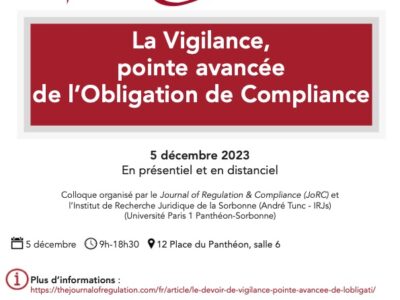
🧮Vigilance, advanced point of the Compliance Obligation

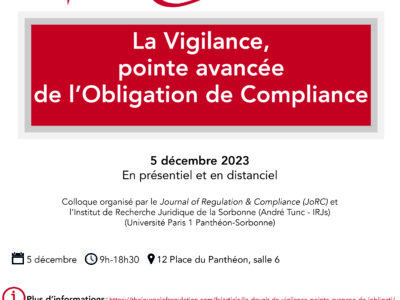
► Full Reference: Journal of Regulation & Compliance (JoRC) and Institut de Recherche Juridique de la Sorbonne (André Tunc – IRJS) of Paris 1 Panthéon-Sorbonne University, La Vigilance, pointe avancée de l'Obligation de Compliance (Vigilance, advanced point of the Compliance Obligation), Paris 1 Panthéon-Sorbonne University, December 5, 2023, 12 place du Panthéon, salle 6. - -  🏗️ This symposium takes place in the cycle of symposiums organised by the Journal of Regulation & Compliance (JoRC) and its partner Universities, focusing in 2023 on the general theme of Compliance Obligation. - - ► This symposium is organised by the Journal of Regulation & Compliance (JoRC) and Paris 1 Panthéon-Sorbonne University, through its Institut de Recherche Juridique de la Sorbonne (André Tunc – IRJS).  This symposium is held in French. the symposium is under the scientific direction of 🕴️Marie-Anne Frison-Roche, 🕴️Mustapha Mekki , and 🕴️Jean-Christophe Roda. - To register for a physical presence: anouk.leguillou@mafr.fr (as places are limited, you will be asked to confirm 48 hours in advance). To register for an online presence, via Zoom: Click HERE  🧮 The event will take place at Paris 1 Panthéon-Sorbonne University, 12 place du Panthéon 75005, in Salle 6, on 5 December 2023. - ► Présentation of the theme : The Vigilance Obligation is difficult to define because of the multiplicity of texts and cases in which it can be understood. This is particularly true of the Vigilance mechanism, which illustrates, and even emphasises, the Vigilance Obligation. Through international texts, French law and European texts that have been adopted or are in the process of being adopted, the constraints of vigilance, but also the structures and actions that companies have put in place and the actions that stakeholders have taken, Vigilance has highlighted aspects of the Compliance Obligation, and even modified it.  The revelatory effect thus produced and the movement thus unleashed, whose roots run deep and whose systemic effects are very significant, justify a greater focus on mechanisms that are interconnected, whereas they are sometimes perceived in silos, which makes it difficult to understand the whole picture. In the same way, because Vigilance is the advanced point of the Compliance Obligation, we can better distinguish and articulate what is sector-specific, in particular in banking and finance or in digital matters, and articulate them with what Vigilance has, like Compliance, of a more general nature. What's more, the intensity of Vigilance varies according to its ambitions and the position of the company subject to it, which is reflected in the variations in legal qualification, ranging from a duty to a criminally sanctioned obligation.  The different legal systems reflect these developments in their legislation, case law and the practice of companies and stakeholders in specific ways, because these different techniques express standards of behaviour and accountability, which are directly reflected in evidential requirements, concepts of responsibility and institutional translations through possible regulatory bodies. As a result, the symposium is divided into three parts. After a general introduction on the systemic relationships between Vigilance and Compliance, the first part will focus on the variation in Vigilance Intensities, the advanced point of Compliance, the second part will look at the Tensions that Vigilance generates or exacerbates, and the third part will look at the Modalities that Vigilance uses in Compliance systems. - The proceedings of this colloquium will form the basis of one chapter in the books:  📕L'obligation de Compliance, in the collection 📚Régulations & Compliance, copublished by the Journal of Regulation & Compliance (JoRC) and Dalloz. 📘Compliance Obligation, in the collection 📚Compliance & Regulation, copublished by the Journal of Regulation & Compliance (JoRC) and Bruylant. - Speakers:   🎤Laurence Dubin, Professor at Paris 1 Panthéon-Sorbonne University 🎤Marie-Anne Frison-Roche, Professor of Regulatory & Compliance Law, director of the Journal of Regulation & Compliance (JoRC) 🎤Bernard Haftel, Professor at Paris-Nord University 🎤Marie Lamoureux, Professor at Aix-Marseille University 🎤Grégoire Loiseau, Professor at Paris 1 Panthéon-Sorbonne University 🎤Véronique Magnier, Professor at Paris-Saclay University 🎤Gilles J. Martin, Emeritus Professor at Côte d'Azur University, member of the Groupe de Recherche en Droit, Économie, Gestion (GREDEG) of the CNRS 🎤Mustapha Mekki, Professor at Paris 1 Panthéon-Sorbonne University 🎤Jean-Christophe Roda, Professor at Jean Moulin Lyon 3 University 🎤Anne-Claire Rouaud, Professor at Paris 1 Panthéon-Sorbonne University - 🔻 read a detailed presentation of the manifestation below 🔻

Working papers

Working Paper for an article

🚧Compliance, Vigilance and Civil Liability: put in order and keep the sense of Reason

► Full Reference : M.-A. Frison-Roche, Compliance, Vigilance and Civil Liability: put in order and keep the sense of Reason, Working Paper, June 2024 - 📝 In its French version, this Working Paper is the basis of the contribution "Compliance, Vigilance et Responsabilité civile : mettre en l'ordre et raison garder", in 📕L'Obligation de Compliance - ► Summary of this Working Paper:  The descriptions of the Liability incurred by large companies as a result of their compliance obligations are very diverse, even contradictory, going beyond the wishes that may be expressed as to what this liability should be. The first part of this study therefore sets out the various liabilities incurred by companies, which differ in the conditions under which they are implemented and in their scope, so as not to confuse them. Indeed, as the various laws establish specific legal compliance obligations, they give rise to liabilities of varying conditions and scope, and it is not possible to avail of the regime of one in a situation that falls within the scope of another. It is therefore necessary to review the various bodies of compliance legislation, the GDPR, the ALM-FT regulations, the French so-called Sapin 2 law, the French so-called Vigilance law , the European IA Act , the European European DGA Act, etc., to recall the inflexion that each of these bodies of legislation has made to the liability rules applied to the companies subject to them. Nevertheless, the unicity of the Compliance Obligation, overcoming this necessary diversity of situations, regulations and liability regimes,  can provide grouping lines to indicate beyond this diversity the extent of the liability incurred by companies. Once this classification has been made, the second part of the study develops the observation that none of this can create any principle of general liability on large companies in terms of compliance, and in particular not in terms of vigilance. It is not possible to deduce a general principle of specific obligations of liability or specific obligations to reparation, for example in the area of vigilance, as the texts creating specific vigilance obligation refer to the conditions of commun Tort Law (proof damage and causality), and International Public Law does not have the force to generate a general principle binding companies in this respect. The third part stresses that it is nevertheless always possible to invoke Tort Law, and companies cannot claim to escape this. This may involve contractual liability, a situation  becoming increasingly frequent as companies contractualise their legal compliance obligations, reproducing them but also modifying them, and as Vigilance duty is an obligation that goes beyond the specific situations covered by the regulations.  But it is essential, and this is the subject of the fourth part, not to make companies pure and simple guarantors of the state of the world, present and future. Indeed, if we were to transform sectoral compliances into illustrations of what would then be a new general principle, but one that applied only to them, they would consequently exercise the other side of this coin, namely power over others. - 🔓read the Working Paper below⤵️ - 🌐follow Marie-Anne Frison-Roche sur LinkedIn 🌐follow Marie-Anne Frison-Roche on Instagram 🌐subscribe to the Newsletter MAFR Regulation, Compliance, Law 🌐subscribe to the Video Newsletter MAFR Surplomb

Conferences

final speech of a scientific manifestation

🎥 5 leçons en conclusions ouvertes (5 Lessons in Open Conclusions), in 🧮Compliance, vigilance et médiation

► Full Reference: M.-A. Frison-Roche, "Conclusion", in M. Boissavy, H. Dehghani-Azar, and M.-A. Frison-Roche (dir.), Journal of Regulation & Compliance (JoRC) and Conseil national des Barreaux (CNB), Compliance, vigilance et médiation (Compliance, Vigilance and Mediation), Amphitheatre of the Conseil national des Barreaux, November 30, 2023. - 🧮see the full programme of this event - 🌐follow Marie-Anne Frison-Roche on LinkedIn 🌐follow Marie-Anne Frison-Roche on Instagram 🌐subscribe to the Newsletter MAFR Regulation, Compliance, Law

Working papers

Working Paper basis for an article

🚧Births of a new branch of Law: Compliance Law

► Full Reference: M.-A. Frison-Roche, Births of a branch of Law: Compliance Law, Working Paper, November 2023. - 📕This Working Paper was drawn up as a basis for a contribution to the collective book given to Professor Louis Vogel, published in 2024 - ► Summary of this Working Paper: The study looks at the various movements that have given birth to Compliance Law, with particular emphasis on Competition Law. After a preliminary reflection on the construction of the legal system into branches of Law, their classification in relation to each other, the difficulty encountered in this respect by Economic Law, and the various movements that give birth to one of them, the diversity of which the branch subsequently keeps track of, the study is constructed in 4 parts. To find out what gave rise to Compliance Law, the first part invites us to reject the narrow perspective of a definition that is content to define it by the fact of "being conform" with all the applicable regulations. This has the effect of increasing the efficacy of the regulations, but it does not produce a branch of Law, being just a set of tools like others. The second part of the study aims to shed some light on what appears to be an "enigma", as it is often claimed that this is the result of a soft method, or of an American political decision, or of as many regulations as there are occasions to make. Instead, it appears that in the United States, in the aftermath of the 1929 crisis, it was a decision of establishing an authority and rules to prevent another atrocious collapse of the system, while in Europe in 1978, in memory of the use of files of personal and racial information, it was a question of establishing an authority and rules to prevent an atrocious attack on human rights. A common element that aims for the future ("never again") but not the same object of preventive rejection. This difference between the two births explains the uniqueness and diversity of the two Compliance Laws, the tensions that can exist between the two, and the impossibility of obtaining a global Law. The third part analyses the way in which Competition Law has given rise to conformity: a secondary branch which is a guarantee of conformity with competition rules. Developed in particular through the soft law issued by the competition authorities, the result is a kind of soft obedience, a well-understood collaboration of the procedural type through which the firm educates, monitors and even sanctions, without leaving  the cercle of Competition Law, of which conformity is an appendix. The distance between a culture of conformity and the substantial Compliance Law can be measured here. The fourth part aims to show that Competition Law and Compliance Law are two autonomous and articulated branches of Law. Since Compliance Law is a branch of Law built on Monumental Goals, in particular the sustainability of systems and the preservation of the human beings involved so that they are not crushed by them but benefit from them, the current challenge of European integration is to build the pillar of Compliance Law alongside the competitive pillar. Jurisdictions are in the process of doing this and of linking the two.   - 🔓read the Working Paper below⤵️ - 🌐follow Marie-Anne Frison-Roche on LinkedIn 🌐follow Marie-Anne Frison-Roche on Instagram 🌐subscribe to the Newsletter MAFR Regulation, Compliance, Law  🌐subscribe to the Video Newsletter MAFR Surplomb

Conferences

🧮Compliance, Vigilance and Mediation

► Full Reference: Journal of Regulation & Compliance (JoRC) and Conseil national des Barreaux (CNB), Compliance, vigilance et médiation (Compliance, Vigilance and Mediation), November 30, 2023, Amphithéâtre du Conseil national des barreaux. - - ► The symposium is organised by the Journal of Regulation & Compliance (JoRC) and the Conseil national des barreaux (CNB).  This symposium is held in French. The symposium is placed under the scientific direction of 🕴️Matthieu Boissavy, 🕴️Hirbod Dehghani-Azar and 🕴️Marie-Anne Frison-Roche. - ► Presentation of the theme: To increase respect for human rights and the environment in the context of corporate social responsibility and compliance, public authorities and companies have for several years been implementing instruments and processes for dialogue between companies on the one hand and stakeholders inside and outside the company on the other. Among these, mediation is regularly highlighted as a necessary and fruitful process for reaching agreements that benefit employees and civil society players, as well as the environment and society as a whole. John Ruggie, Special Representative of the Secretary-General on human rights and transnational corporations and other business enterprises, in his report of 21 March 2011, Guiding Principles on Business and Human Rights, recommends mediation as an effective and appropriate non-judicial grievance mechanism. The ISO 26000 standard on social responsibility also explicitly refers to the use of mediation in the section Actions and related expectations (6.3.2.6) and say that an organisation should establish or ensure the availability of redress mechanisms for its own use and for that of its stakeholders. For these mechanisms to be effective, they should be […] based on dialogue and mediation: the process should aim to remedy breaches through mutually agreed solutions reached through dialogue between the parties. Where a judgment is desirable, the parties should retain the right to reach it through separate, independent mechanisms. Similarly, the French law No. 2017-399 of 21 March 2017 relative au devoir de vigilance des sociétés mères et des entreprises donneuses d’ordre (on the duty of vigilance of parent companies and ordering companies) has given rise to disputes relating to the design and application of vigilance plans by certain companies subject to this law. Mediation has been proposed by the courts, sometimes accepted, and we know that some have been successful. At the same time, the draft European Directive on Corporate Sustainability Due Diligence (CS3D) is likely to impose or extend obligations relating to the duty of vigilance on a large number of companies in the European Union, for the respect of human rights and the environment by companies in global value chains. The result of all this is that respect for human rights within organisations and companies depends on recourse to the courts, on cooperation processes such as mediation, both project mediation and mediation specific to the resolution of disputes, while recourse to the courts will not suffice to rapidly make respect for these obligations effective. The legislator and the parties concerned are aware of this, and they refer to the use of mediation as necessary to help both civil society actors committed to respect for human rights and the environment and companies to reach agreements on compliance with these obligations. Lawyers, mediators and people assisting stakeholders and companies have an important role to play in the success of these mediations. In collaboration with the Journal of Regulation and Compliance (JoRC), the Conseil national des barreaux (CNB) is organising a half-day conference on "Compliance, vigilance et médiation" ("Compliance, Vigilance and Mediation") to train lawyers to this activity, which will develop either as an extension of another activity or as its own activity, and which has major implications for individual rights, society and the environment. - ► Construction of the symposium:  After a general introduction to the triptych of Compliance, Vigilance and Mediation and the links that it implies, the first part of the event will focus on the contribution of Mediation to the effectiveness of Compliance and, more particularly, to its most advanced aspect, the duty of vigilance. After a debate on this topic, the second part of the event will focus on the conduct of project mediation or dispute resolution in such a context. A conclusion will enable us to draw immediate lessons from the information and exchanges that have taken place. - Speakers:   🎤Matthieu Boissavy, attorney at the Paris Bar, vice-president of the Commission Liberté et droits de l'homme of the CNB 🎤Matthieu Brochier, attorney at the Paris Bar 🎤Stéphanie Brunengo, attorney at the Aix-en-Provence Bat, mediator 🎤Malik Chapuis, judge in the 3rd chamber of the Tribunal judiciaire de Paris (Paris First Instance Civil Court) 🎤Bruno Deffains, professor at Paris Panthéon-Assas University 🎤Hirbod Dehghani-Azar, attorney at the Paris Bar, president of the Commission Modes alternatifs de règlements des Règlements (MARD) of the CNB 🎤Marie-Anne Frison-Roche, professor of Regulatory Law and Compliance Law, director of the Journal of Regulation & Compliance (JoRC) 🎤Jérôme Gavaudan, president of the CNB 🎤Thibault Goujon-Bethan, professor at Jean Moulin Lyon 3 University 🎤Céline Haye Kioussis, legal director if the BPCE Group 🎤Stéphane de Navacelle, attorney at the Paris Bar 🎤Lori Roussey, Data Protection Officer, founder and Director of Data Rights 🎤Stephanie Smatt Pinelli, litigation legal director, Orano Group - 🔻 Read a detailed presentation of the event below:
Articles in a legal collective publication

article in a collective publication

📝The deployment of Regulatory Law through Compliance Law in the European project

► Full Reference: M.-A. Frison-Roche, "The deployment of Regulatory Law through Compliance Law in the European project", in G. Hardy & F. Picod, Compliance Regulation from a European Perspective, Law and European Affairs (L.E.A.), 2023/2, pp. 345-352. - 🚧read the bilingual Working Paper which is the basis of this article, with additional developments, technical references and hyperlinks  - ► English Summary of the article: Compliance Law is neither a method of obeying regulations, nor a simple neutral method of ensuring the effectiveness of norms, nor a means of enforcement displaced from Ex Post to Ex Ante. It is an extension of Regulatory Law and goes beyond it. Like it, it aims to build spaces according to a political project specific to an area, such as Europe. Branch of Law looking to the future as Regulatory Law does, it constructs and maintains, in a systemic way, sustainable, albeit unstable, balances to achieve the ‘Monumental Goals’ in which its normativity resides: security, sustainability, probity, truth, and dignity. By internalising these Monumental Goals in the companies that are in a position to achieve them, the “crucial companies”, Compliance Law preserves the logic of Regulatory Law, offering it a prodigious expansion since it frees it from the condi- tion of a sector and territorial borders, which seemed tautological, by associating private powers and public will, which remains primary. In this way, Compliance can regulate the digital space and climate issue through political choices made by a sovereign Europe. - 🌐follow Marie-Anne Frison-Roche on LinkedIn 🌐follow Marie-Anne Frison-Roche on Instagram 🌐subscribe to the Newsletter MAFR Regulation, Compliance, Law

Monographs

📝La compliance, socle de la confidentialité nécessaire des avis juridiques élaborés en entreprise

► Full Reference: M.-A. Frison-Roche, "La compliance, socle de la confidentialité nécessaire des avis juridiques élaborés en entreprise" ("Compliance, the cornerstone of the confidentiality required for in-house legal opinions"), D. 2023, p. - 📝read the article (in French) - ► English Summary of the article: The French Law about the Ministry of Justice's 2023-2027 Orientation and Programming  ("loi d'orientation et de programmation du ministère de la justice 2023-2027") had introduced into the French legal system the confidentiality of in-house lawyers' opinions (before the  French Constitutional Council, on a question of parliamentary procedure, annulled this disposition, thus leaving the question still open).  This development is necessary in order to respond to the injunction for companies to comply more and more with the regulations, which is itself only one of the tools of a wider movement: Compliance Law. This branch of the law, notably through the French so-called Sapin 2 Act of 2016, the French Vigilance Act of 2017 and the European Digital Services Act (DSA), requires companies to implement the necessary means to satisfy the Monumental Goals contained in the laws or regulations. This presupposes, firstly, that companies have information (via alerts, risk mapping, vigilance, sustainability reports, etc.), enabling them to identify their conformity and non-conformity, so that they can, secondly, take effective action to put an end to current breaches, prevent future breaches and achieve the goals set by the Legislator. This Compliance System requires that the information made available to managers is reliable and honest. However, if non-conformity is not analysed and communicated in a way that is protected by confidentiality, the company will prefer not to know about it and will therefore be unable to take appropriate action, which will deprive the social community of its power to act in the future. This is why the confidentiality of in-house lawyers' opinions is based on the very definition of Compliance Law itself. - 🌐follow Marie-Anne Frison-Roche on LinkedIn 🌐follow Marie-Anne Frison-Roche on Instagram 🌐subscribe to the Newsletter MAFR Regulation, Compliance, Law