Activities

Conferences

introductory conference

🎥Le juriste, requis et bien placé pour le futur ((The lawyer needed and well placed for the future), in 🧮Les Eclaireurs du Droit

► Full Reference : M.-A. Frison-Roche, "Le juriste, requis et bien placé pour le futur" (The lawyer needed and well placed for the future), in Groupe Lamy Liaisons, Les Éclaireurs du Droit,  Hôtel de l’Industrie, Place Saint Germain des Près, Paris, 11 March 2025, 16h. - This speech opens a series of 4 workshops on the following themes: – The challenge of Trust – The challenge of Risk – The challenge of Transmission – The challenge of  leadership - 🧮see the full programme of this manifestation (in French) - ⬜see the slides basis made for this speech (which were not projected) (in French) - 🎥 watch the short video made after the conference (in French) - ► English Summary of this introductory conference: The 4 sessions will address the successive themes of trust, risk, transmission and leadership, which legal professionals are facing, particularly as a result of algorithms. For an introductory analysis, it is possible to make a distinction inside the Future. The future has a part of Stability: the jurist can contribute to this stability, i.e. the preservation of the past (I). The future has an part of Predictability: the lawyer must increase this part in the present itself (II). The future has a part of radical novelty (III): at this point, which may correspond to a precipice, if no one had imagined it, the lawyer can also be there. Until now, we think of lawyers more in the first 2 hypotheses, less in this one. Is it pertinent? In each of these dimensions, the algorithmic system (AI) is presented as replacing or dominating the human. In each of these 3 dimensions, Lawyers must be present, as they form a community that must remain united around the very idea of Law (algorithms do not conceive ideas, it is humans who transmit them to other humans, and the algorithmic system must remain a medium). As far as the Stability of the future is concerned, the Lawyer can and must contribute to it, in particular through Transmission, because there is less of a blank page as algorithmic 'creation' is based on past data, and training, where the human being will be all the more central as machines have to be handled. As far as the Predictability of the future is concerned, it is a question of assessing the Risks, whether specific or systemic, legal or non-legal, in order not to take them or on the contrary to take them. The more the Lawyer is involved in risk-taking, the more he or she will be in the right place, before and during the action. As far as the Radically New future is concerned, it is not easy to qualify AI as such or not, but now the possible disappearance of the Rule of Law in the United States is one of them. All Lawyer are expected. Every lawyer must have two virtues (which the algorithm cannot not have): the virtue of Justice and the virtue of Courage. It is these virtues that we must pass on and share.       - Current events have led me to devote the time available to me to focusing on a single perspective, the third, to say what is expected of Lawyers if we perceive something radically new in the near future, what everyone does. Indeed, in the United States, on the one hand there is a head of state for whom the Law does not exist and who uses the power of regulation to express his absolute indifference to other states, companies and human beings, and on the other an entrepreneur who claims that he is going to become the master of algorithmic technology, a system over which he already wields great power. Faced with this Radical Novelty, we expect the community of Lawyers, all lawyers, whatever their place, their technical mastery, their level, their nationality, to speak out and say No. As Kelsen, Cassin or Ginsberg did. Say No and help others to say No. To do this, Lawyers, as human beings who care about other human beings, must be aware of the twofold virtue expected of them: the virtue of commitment to Justice and the virtue of Courage.       - 🌐follow Marie-Anne Frison-Roche sur LinkedIn 🌐follow Marie-Anne Frison-Roche on Instagram 🌐subscribe to the Newsletter MAFR Regulation, Compliance, Law 🌐subscribe to the Video Newslette MAFR Surplomb

Conferences

conference

🎥La qualification juridique du système de noms de domaine comme infrastructure et ses conséquences juridiques (“The legal status of the domain name system as an infrastructure and its legal consequence”), in 🧮Durabilité de l’Internet : le rôle des opérateurs du système des noms de domaine. Compliance et régulation de l’espace numérique (Sustainability of the Internet: the role of the operators of the domain name system. Compliance and regulation of the digital space)

► Full Reference: M.-A. Frison-Roche, La qualification juridique du système de noms de domaine comme infrastructure et ses conséquences juridiques ("The legal status of the domain name system as an infrastructure and its legal consequence"), in M.-A. Frison-Roche et G. Loiseau (dir.), Durabilité de l'Internet : le rôle des opérateurs du système des noms de domaine (Sustainability of the Internet: the role of the operators of the domain name system. Compliance and regulation of the digital space). Compliance et régulation de l'espace numérique, 21 février 2025, organisé par le Journal of Regulation & Compliance et l'Institut de la Recherche en Droit de la Sorbonne (André Tunc – IRDJS), 12 place du Panthéon, Paris. - 🧮see the full programme of this colloquium (in French) - ► Summary of this conference:  "Domain names" are a technical reality. This technical reality has come to the fore, seeming to have been both little "thought out" and little "conceived" in Law and, perhaps because it is little coveted, Competition Law, which neutralises the concreteness of things and services in order to focus on exchange, hardly qualifies them. It is rather from the 'Competition Policy' perspective that 'domain names' are apprehended. However, Competition Policy expresses wishes and perspectives, while Competition aw must make way for the perspective of Regulatory Law inside the liberal economic system. Looking at the technicalities of the domain name system, we can proceed in 3 stages. Firstly, if a domain name is taken in isolation, it may appear as property and/or a projection of a person, and has rightly been described as such by the courts. But domain names only exist in relation to each other, the addressing system on which the Internet itself and the digital space that enables everyone to spread, reach and be reached were built. In this way, they constitute an Infrastructure in their plurality, in a uniqueness (I). The legal system must take account of this technological reality through the concept of Essential Infrastructure, which is well known in Regulatory legal perspective(I). Secondly, the legal consequences of this legal qualification of Infrastructure must be detailed (II). Regulatory Law does not necessarily imply institutions, a regulatory authority being an indication rather than a criterion. Rather, it requires specific charges, powers and controls to ensure that the Infrastructure is established and operates to fulfill, now and in the future, the function that is crucially expected of it. Because the digital space was born of the Internet, an a-sectional and a-territorial space, Compliance Law, which is an extension of Regulatory Law, outside the sectors and internalised in the crucial operators, is essential as it is appropriate without diminishing the public dimension of the organisation. Thirdly, the evidential dimension should be emphasised (III). Indeed, because we need to ensure that the Domain Names Infrastructure is always solid and reliable, so as not to risk a systemic failure of the Internet, and therefore of the digital space, we must not remain with the traditional system of burden of proof that rests on the person making the complaint. Because there is a Compliance Obligation, it is up to the crucial operators to credibly show their ability to ensure the technical sustainability of this infrastructure on which the digital space in which we live is based. It shall be different if the issue is one of non-technical Sustainability, for example that which is linked to a particular societal project, in which the operators of the domain name system are not at the origin and are required on an ad hoc basis because they are in a good position to help the Authorities or because they wish to do so. - 🌐suivre Marie-Anne Frison-Roche sur LinkedIn 🌐suivre Marie-Anne Frison-Roche sur Instagram 🌐s'abonner à la Newsletter MAFR Regulation, Compliance, Law 🌐s'abonner à la Newsletter en vidéo MAFR Surplomb

Conferences

conference

🎥La clé de la proportionnalité pour établir l’équilibre des obligations, pouvoirs et droits – Exemple de l’inclusion technique assurée par les opérateurs des noms de domaine, , in 🧮Durabilité de l’Internet : le rôle des opérateurs du système des noms de domaine. Compliance et régulation de l’espace numérique (Sustainability of the Internet: the role of the operators of the domain name system. Compliance and regulation of the digital space)

► Full Reference: M.-A. Frison-Roche, "La clé de la proportionnalité pour établir l’équilibre des obligations, pouvoirs et droits –  Exemple de l’inclusion technique  assurée par les  opérateurs des noms  de domaine" (The key to proportionality in balancing obligations, powers and rights – Example of technical inclusion by domain name operators), in M.-A. Frison-Roche et G. Loiseau (dir.), Durabilité de l'Internet : le rôle des opérateurs du système des noms de domaine (Sustainability of the Internet: the role of the operators of the domain name system. Compliance and regulation of the digital space). Compliance et régulation de l'espace numérique, 21 février 2025, organisé par le Journal of Regulation & Compliance et l'Institut de la Recherche en Droit de la Sorbonne (André Tunc – IRDJS), 12 place du Panthéon, Paris.   - 🧮see the full programme of this colloquium (in French) - ► Summary of this conference:  The domain name operators operate in a liberal system and have internalised the tasks being technically inherent in the very architecture of the Internet, while the Public Authorities, because they recognise this nature, ensure in Ex Ante that there are no global failures. This translates into a system of obligations. All the more so since domain name operators not only bear multiple obligations but also, by order of the laws and regulations, impose them on others, for example on their co-contractors and users. It is from this perspective that  the Principle of Proportionality, which is central here, must be considered. It is another expression of the legal Principle of Necessity, which must be conceived in terms of goals: what is proportionate is what is necessary to achieve the objective with regard to which the duties and prerogatives are entrusted and/or exercised. This is why it is first necessary to recall and explain what the Principle of Proportionality is with regard to the operators obligations covered by Compliance Law, which goes beyond jurisdictional powers such as sanctions or dispute resolution, to explain the teleological control of obligations and powers (I).  From this practical framework, the most relevant example is the technical obligation of inclusion (II) In the technical sense, Inclusion means that anyone who wants to enter the digital space must be able to do so and must be able to reach those who are there and be reached by others. This gives everyone the right to reach and be reached. Is it possible to go  further and ask for comfort for everyone and equality in this comfort and advantages to rebalance this accessibility? For instance, to know everything about everyone beyond this simple digital adresse? To ask domains names operators to help everyone to develop his/her personality in the digital space, compensating his/her lack of initial chance?  This is social and political inclusion. It is not the same thing. It does not have the same sources. It does not follow the same paths. Not the same forces. The Sustainability that is then projected can be cumulative. A distinction has to be made on the one hand, and a link made on the other. Moreover, in the name of mistreated social inclusion, can we mistreat technical inclusion, i.e. exclude a person from the digital space?  (III). - 🌐suivre Marie-Anne Frison-Roche sur LinkedIn 🌐suivre Marie-Anne Frison-Roche sur Instagram 🌐s'abonner à la Newsletter MAFR Regulation, Compliance, Law 🌐s'abonner à la Newsletter en vidéo MAFR Surplomb

Organisation of events

⚙️Co-organisation of the symposium 🧮Durabilité de l’Internet : le rôle des opérateurs du système des noms de domaine. Compliance et Régulation de l’espace numérique (Sustainability of the Internet: the role of the operators of the domain name system. Compliance and regulation of the digital space)

  - ► Full Reference: M.-A. Frison-Roche & G. Loiseau (dir.), Durabilité de l'Internet : le rôle des opérateurs du système des noms de domaine. Compliance et régulation de l'espace numérique (Sustainability of the Internet: the role of the operators of the domain name system. Compliance and regulation of the digital space), Journal of Regulation & Compliance (JoRC) and Institut de Recherche Juridique de la Sorbonne (André Tunc – IRJS), Paris 1 Panthéon-Sorbonne University, 21 Fabruary 2025 - ► General presentation of this symposium: The digital space has been built on and as a system. Its primary interest is of a negative nature: it consists of to be preserved against the prospect of systemic failure, of not collapsing. Like all other systems, this 'Monumental Goal' specific to the digital system justifies resources that incorporate this concern for the future. As with all systems, it integrates and relies on the specific technical nature of this system. The digital space is largely based on the invention, technology and architecture of domain names. Domain names, as an addressing system, enable users to enter the digital space and find other Internet users. The uniqueness and solidity of the domain name system, entrusted to a single root and decentralisation, makes this community possible for those who use the digital space and ensures the technical durability required, without which the digital space would be compromised. The architecture, operation, operators and what they do under the control of legislators, regulators, judges and legal subjects are therefore examined from a dual technical and legal perspective, in the light of the imperative of sustainability. This allows to progress in 4 stages. Firstly, to examine the permanence in time and space of the domain name system, insofar as it is the foundation of the Internet and the digital system. This technical construction gives rise to legal qualifications, not only for the present but also for the future, since the Web3 offers new technical solutions. Secondly, this technical sustainability is an imperative that is built into the operators of the domain names themselves, which are inter-linked not only at national level but also at global level, this cross-linking being necessary for the security of the system. The State is present through public law techniques that enable surveillance, control and possible recovery. Thirdly, it imposes constraints on the operators subject to them in order to serve this monumental goal of technical sustainability, and these constraints themselves generate as many powers as they need to usefully achieve this mission. This proportionality must be at the heart of the method and the requirements. The relationship between constraints and powers also stems from it. Fourthly, this imperative of technical sustainability, which is global in nature, gives way to imperatives of societal sustainability, more localised in space and time, when domain name operators are called upon by the legitimate authors of binding standards, legislators in the first instance, to express concerns such as the protection of people involved in the digital space and whose rights are compromised or who are in danger. This second type of sustainability, which is more localised and less inherent in the architecture of the Internet, is justified by the available power of the operators concerned and their adherence to social imperatives. The resulting constraints and powers are therefore not the same. The 2 sustainabilities must then be articulated in a conception that is both teleological and pragmatic. - - ► Speakers (they will speak in French, but the book to be published will be in English):  🎤Pierre Bonis, Chief Executive Officer of the Association française pour le nommage Internet en coopération (Afnic) 🎤Lucien Castex, Adviser of the Afnic Chief Executive Officer for Research internet and society and Internet governance 🎤Marie-Anne Frison-Roche, Full Professor of Regulatory and Compliance Law, Director of the Journal of Regulation & Compliance (JoRC) 🎤Claire Leveneur, Senior Lecturer at Paris-Est Créteil University 🎤Grégoire Loiseau, Full Professor at Paris 1 Panthéon-Sorbonne University 🎤Samir Merabet, Full Professor at the University of West Indies 🎤Antoine Oumedjkane, Senior Lecturer at Lille University 🎤Frédéric Sardain, attorney at law, Jeantet law firm - read below a detailed presentation of this event⤵️ - 🌐follow Marie-Anne Frison-Roche on LinkedIn 🌐follow Marie-Anne Frison-Roche on Instagram 🌐subscribe to the Newsletter MAFR. Regulation, Compliance, Law 🌐subscribe to the Newsletter Surplomb, par MAFR

Conferences

🏛️Hearing before a public body

🏛️ hearing before the French Working Group on the modernisation of French Arbitration Law, about the issue Arbitrage et Droit de la Compliance : est-il besoin d’un texte ? (“Arbitration and Compliance Law: is a text required?”)

► Full Reference: M.-A. Frison-Roche, hearing before the French working group on the modernisation of French Arbitration Law, about the issue Arbitrage et Droit de la Compliance : est-il besoin d'un texte ? ("Arbitration and Compliance Law: is a text required?"), Directorate of Civil Affairs' French Ministry of Justice, 13 February 2025. - ► Result of this presentation and the ensuing discussion, recorded in the working group's report published in March 2025 (published in French, translated her: "This report on the guiding principles would not be complete without mentioning the discussions in the working group on the introduction of a guiding principle requiring the arbitral tribunal to take into account "human, environmental and compliance issues, as well as respect for the fundamental rights and freedoms of the parties".This proposal gave rise to particularly heated discussions. Some saw it as a scarecrow likely to make French Arbitration Law less attractive and to weaken Arbitration awards, opening up cases of recourse on the pretext of bad faith, even though these values would already be taken into account in the review of domestic or international public policy.  Others, on the other hand, felt that such a text would have the advantage of enshrining an Arbitration Law connected to values that are not exclusively economically oriented, pointing out, moreover, that such a principle would not be redundant with the control of public policy, which intervenes ex post, whereas this text imposes Ex Ante responsability, and that this principle would allow a noteworthy introduction of Compliance Law in rbitration.  They added that the promotion of such values could make it possible to demonstrate a commitment to virtuous arbitration practice. In the light of these differences, after much hesitation, the decision was made not to include it in the draft Code, considering that the final choice was more a question of political dimension that the working group felt it could not decide on its own. ". (p. 36).   - ► English Summary of the presentation: My presentation deals with the relationship between Compliance Law and Arbitration, particularly International Arbitration. It is built around 12 successive points. The work I have carried out on these various points is associated with it. It precedes the answers I shall give to the questions put by the members of the working group and the ensuing discussion.   1. stagnation in the relationship between Arbitration and Compliance Law, due to continuing misunderstandings about Compliance 2. progress towards a better understanding of Compliance and the appropriateness of the arbitrator's role within Compliance Law 3. prospects for the growing relationship between Compliance Law and Arbitration, particularly with regard to the value chains built up by international companies 4. educational issues 5. time required to build a "culture of place" in this matter 6. "Doctrinal" difficulties 7. benefit from the production of a "doctrine of place" on this subject 8. going beyond the continental summa divisio of Public Law and Private Law 9. practical assimilation of Regulatory Contracts in sustainable sectors and chains 10. opening up the Arbitration World to this articulation with Compliance Law 11.  Can an official legal text contribute to this? 12.  example of the guiding principles of the French Code of Civil Procedure. -   🔓read the presentation developments below⤵️ - 🌐follow Marie-Anne Frison-Roche on LinkedIn 🌐follow Marie-Anne Frison-Roche on Instagram 🌐subscribe to the Newsletter MAFR Regulation, Compliance, Law 🌐 subscribe to the Video Newsletter MAFR Overhang/Surplomb

Conferences

conference

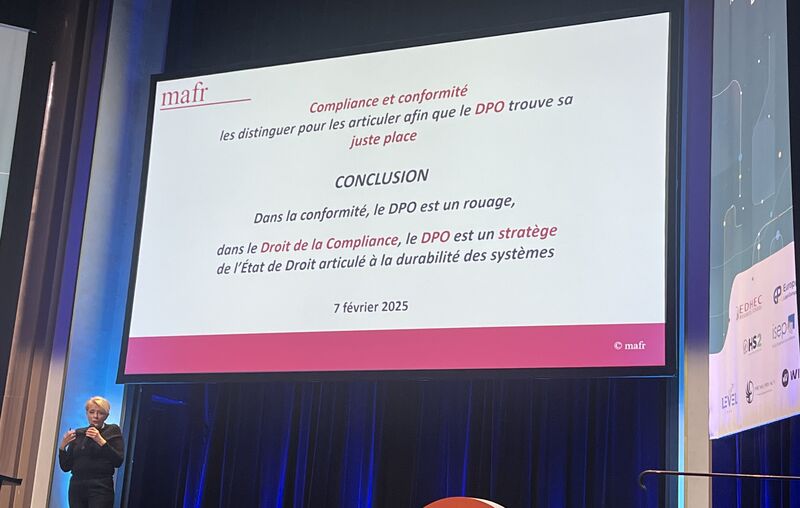
🎥”Compliance” et “conformité” : les distinguer/mieux les articuler afin que le DPO trouve sa juste place (Compliance Law” and “conformity” : distinguish between them/better articulate them so that the DPO finds their rightful place), in 🧮19ème Université AFCDP des DPO, in 🧮19ème Université AFCDP des DPO, in 🧮19ème Université AFCDP des DPO

► Full Reference: M.-A. Frison-Roche, "Compliance" et "conformité" : les distinguer/mieux les articuler afin que le DPO trouve sa juste place" ("Compliance Law" and "conformity" : distinguish between them/better articulate them so that the DPO finds their rightful place"), , in  Association française des correspondants à la protection des données à caractère personnel (AFCDP),  19ème Université AFCDP des DPO – La gouvernance des données ("Data Governance"), Maison de la Chimie, Paris, 7 February 2025 , 10h-10h45. - 🧮 see this manifestation full program (in French) - ⬜ see les slides on which this conference is done (in French)  - ► English Presentation of this conference: 'Compliance' and 'conformité' are often considered to be synonymous, notably in French in which the term "Compliance" is so often used to express only the "conformity" (conformité). This is a misunderstanding and a reduction, particularly of the role of professionals, notably DPOs. In fact, 'conformity' consists solely of ensuring that regulations are respected. Of course, an"active" conformity and "proven" conformity with these regulations, in particular the European GDPR. That and only that. If that's the case, then on the one hand this task impossible, because no one can comply with all the regulations, and it's the obsession with avoiding or reducing penalties that actually replaces the desire to do the right thing. On the other hand, algorithms are going to replace the DPO, a human being, because algorithms will identify 'non-conformity', then conformity, then write it down by "smart" contracts. But Compliance Law is more than conformity, which is only one of its tools. Compliance Law aim is to protect the human beings involved in the systems. Data protection is one of the best examples of this, and it underpins all the other areas of Compliance Law. Companies are asked to do less (obligation of means) and more: to help protect, by distinguishing between what must be revealed and what must be kept secret, sometimes to resolve conflicts between the 2 prescriptions, to educate, to make alliances. To built a real "governance". In this human and humanist mission that anchors Europe, the algorithm is flat. We are waiting for the DPO. In this human and humanist mission that anchors Europe, the algorithm is flat. We are waiting for the DPO. There is the role of guardian of the spirit of the texts, of strategic aid for the data controller, of adjuster of complementary or contradictory subjective rights, of adjustment of the texts in the European puzzle of a Regulatory Europe, which is being put in place in the humanist tradition which is its own to preserve the durability of the systems to protect the people who are forcibly or voluntarily involved in them. - 🌐suivre Marie-Anne Frison-Roche sur LinkedIn 🌐suivre Marie-Anne Frison-Roche sur Instagram 🌐s'abonner à la Newsletter MAFR Regulation, Compliance, Law 🌐s'abonner à la Newsletter en vidéo MAFR Surplomb/Overhang

Surplomb - Notion

Serie of videos on Regulation, Compliance and Vigilance 📺Surplomb/Overhang

🎬Monumental Goals, normative anchoring of Compliance Law

► Full Reference: M.-A. Frison-Roche, "Monumental Goals, normative anchoring of Compliance Law", in Series of videos Overhang / Surplomb, 1st February 2025 - 🌐watch on LinkedIn this video of the Series Surplomb/Overhang - 🌐watch on LinkedIn this video of the Serie Surplomb/Overhang, published in the Newsletter Surplomb/Overhang, by MAFR - 🎬watch below this video of the Serie Surplomb/Overhang⤵️ - Surplomb/Overhang, by mafr the Serie of videos dedicated to Regulation, Compliance and Vigilance - 🌐follow Marie-Anne Frison-Roche on LinkedIn 🌐follow Marie-Anne Frison-Roche on Instagram 🌐subscribe to the Newsletter MAFR. Regulation, Compliance, Law 🌐subscribe to the Video Newsletter MAFR. Overhang / Surplomb

Articles

Interview in a newspaper

« La compliance est avant tout une affaire humaine » (Compliance is first and foremost a human issue)

► Full Reference: M.-A. Frison-Roche,  « La compliance est avant tout une affaire humaine» (Compliance is first and foremost a human issue), interview conducted by Olivia Dufour for Actu-juridique, Lextenso, 23 January 2025.   - ► read the interview: 💬in French) - 🏛️🏛️🏛️🏛️this interview was organised following a number of official opening hearings of Parisian courts, in particular that of the Paris Judicial Court on 21 January 2025, at which the presidents of these courts explained the role now played by systemic litigation and compliance and/or vigilance law, in particular in the internal organisation of their courts. - ► presentation of this interview:  Q. (translated): At the start of the new session of the official opening hearings of Paris Court of First Instance on 21 January, President Stéphane Noël spoke at length about the creation of a 34th chamber dedicated to handling cases relating to companies' obligation of vigilance. What are the advantages of this new specialisation? MAFR Answer Summary: It corresponds to the jurisdiction given to the Paris Court of First Instance by the French 2020 so-called Confidence Act, which extends the French 2017 so-called Vigilance Act. It reflects the importance of Compliance Law, of which Vigilance is the leading edge.   Q. (translated): The court president points out that this new litigation raises questions about the role of the courts, which is to "concilier le respect des buts fondamentaux pour la protection de l’humanité avec la possibilité pour les entreprises d’apprécier la maitrise des risques et leur éventuelle responsabilité" ("reconcile respect for the monumental goals of protecting humanity with the ability of companies to assess the control of risks and their potential liability"). What do you think?   MAFR Answer Summary: the role of the judge has been renewed, as they take charge of the future of the systems and participates in the achievement of the Monumental Goals of Compliance Law. Companies are subject by law to a new compliance obligation and must demonstrate their diligence. They may be held liable under the general ordinary legal regime, as set out in the French 2017 Act on Vigilance duty, if the claimant demonstrates the existence of fault or negligence, damage and a causal link between the 2.   Q. (translated): All this comes under the heading of compliance, a concept you've been working on for 10 years and which is still not fully understood and is too often confused with conformity….   MAFR Answer Summary: The 2 aforementioned concepts ("conformity" and "compliance") were identified in the article I published in 2016 entitled Le droit de la compliance"Compliance law". This notion has taken a long time to mature because, on the one hand, it is a radically new branch of law that has an impact on the other branches. On the other hand, indeed,  there is confusion between 'compliance' and 'conformity'. Conformity is the obedience to applicable regulations; compliance is the active participation in the achievement of monumental goals to preserve or save systems in which humans are involved. Conformity is, and is only, a tool of Compliance Law.   Q. (translated):  The Nanterre Court has just created a chamber for Emerging Systemic and Regulatory Litigation. Does this confirm the interest of the courts in this fundamental development?   MAFR Answer Summary: This statement by the President of the Nanterre Court of Appeal at his hearing on 20 January 2025 illustrates the Regulation – Compliance – Vigilance continuum. He involves training for judges and dialogue between judges. Training and dialogue are being put in place.   Q. (translated):  Y a-t-il d’autres initiatives en ce sens ? MAFR Answer Summary:Le président du Tribunal de commerce Paris à son audience du 15 janvier 2025 a annoncé la création d'une chambre des contentieux complexe. Les contentieux systémiques émergents, que le Droit de la Compliance peut engendrer, ont vocation à y être présentés. Là  aussi, formation et dialogue se mettent en place.   Q. (translated):  Que manque-t-il encore ? MAFR Answer Summary: puisque le Droit de la compliance se contractualise de plus en plus, notamment dans les chaines de valeur concernées par les techniques de vigilance, l'arbitrage international est concerné. Des arbitres internationaux intégrant le droit de la compliance, et pas seulement attaché à telle et telle réglementation sectorielle, sont un enjeu d'attractivité de la Place de Paris. Cela va émerger, notamment par le dynamisme de la Cour internationale d'arbitrage, dont le siège est à Paris. - 🌐suivre Marie-Anne Frison-Roche sur LinkedIn 🌐suivre Marie-Anne Frison-Roche sur Instagram 🌐s'abonner à la Newsletter MAFR Regulation, Compliance, Law 🌐s'abonner à la Newsletter en vidéo MAFR Surplomb

Conferences

Conference

🎤Identifier et anticiper la pratique du Contentieux Systémique Émergent ; Présentation de 🧮L’expérience des juridictions dans le Contentieux Systémique Émergent

► Full Reference: M.-A. Frison-Roche, Identifier et anticiper la pratique du Contentieux Systémique Émergent (Identifying and anticipating the practice of Emerging Systemic Litigation) ; Presentation of L’expérience des juridictions dans le Contentieux Systémique Émergent (Courts Experience in Emerging Systemic Litigation), in cycle of conference-debates "Contentieux Systémique Émergent" ("Emerging Systemic Litigation"), organised on the initiative of the Cour d'appel de Paris (Paris Cour of Appeal), with the Cour de cassation (French Court of cassation), the Cour d'appel de Versailles (Versailles Court of Appeal), the École nationale de la magistrature – ENM (French National School for the Judiciary) and the École de formation des barreaux du ressort de la Cour d'appel de Paris – EFB (Paris Bar School), under the scientific direction of Marie-Anne Frison-Roche, 16 December 2024, 2pm.-6pm., Cour d'appel de Paris, Première Chambre (First Chamber). - 🧮see the full programme of this event - ⚙️This event has been conceived as a part of the cycle of conference-debates "Contentieux Systémique Émergent" ("Emerging Systemic Litigation"), organised on the initiative of the Cour d'appel de Paris (Paris Cour of Appeal), with the Cour de cassation (French Court of cassation), the Cour d'appel de Versailles (Versailles Court of Appeal), the École nationale de la magistrature – ENM (French National School for the Judiciary) and the École de formation des barreaux du ressort de la Cour d'appel de Paris – EFB (Paris Bar School), under the scientific direction of Marie-Anne Frison-Roche - ► English Summary of the conference:  - 🌐follow Marie-Anne Frison-Roche on LinkedIn 🌐follow Marie-Anne Frison-Roche on Instagram 🌐subscribe to the Newsletter MAFR Regulation, Compliance, Law 🌐subscribe to the Newsletter Surplomb, par MAFR

Organisation of events

🧱⚙️scientific organisation of 🧮L’expérience des juridictions dans le Contentieux Systémique Émergent (Courts Experience in Emerging Systemic Litigation), in cycle of conference-debates “Contentieux Systémique Émergent” (“Emerging Systemic Litigation”)

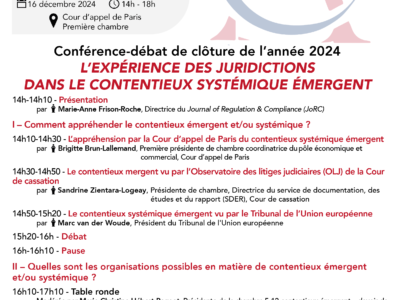
► Full Reference: L’expérience des juridictions dans le Contentieux Systémique Émergent (Courts Experience in Emerging Systemic Litigation), in cycle of conference-debates "Contentieux Systémique Émergent" ("Emerging Systemic Litigation"), organised on the initiative of the Cour d'appel de Paris (Paris Cour of Appeal), with the Cour de cassation (French Court of cassation), the Cour d'appel de Versailles (Versailles Court of Appeal), the École nationale de la magistrature – ENM (French National School for the Judiciary) and the École de formation des barreaux du ressort de la Cour d'appel de Paris – EFB (Paris Bar School), under the scientific direction of Marie-Anne Frison-Roche, 16 December 2024, 2pm.-6pm., Cour d'appel de Paris, Première Chambre (First Chamber) - ► Presentation of the conference:  - 🧮Programme of this event:  Closing conference-debate of 2024 L'EXPÉRIENCE DES JURIDICTIONS DANS LE CONTENTIEUX SYSTÉMIQUE ÉMERGENT  (COURTS EXPERIENCE IN EMERGING SYSTEMIC LITIGATION) Paris Court of Appeal, First Chamber   🕰️2pm.-2.10pm. Présentation (Introduction), by 🕴️Marie-Anne Frison-Roche, Professor of Regulatory Law and  Compliance Law, Director of the Journal of Regulation & Compliance (JoRC), Scientific Director of the Cycle of conferences-debates on the Emerging Systemic Litigation – ESL)   I – Comment appréhender le contentieux émergent et/ou systémique ?  (I – How to deal with Emerging and/or Systemic Litigation?) 🕰️2.10pm.-2.30pm. 🎤L’appréhension par la Cour d’appel de Paris du Contentieux Systémique Émergent (The Paris Court of Appeal's approach to Emerging Systemic Litigation), by 🕴️Brigitte Brun-Lallemand, Première présidente de chambre coordinatrice du pôle économique et commercial, Cour d’appel de Paris (First President of Chamber, Coordinator of the Economic and Commercial Division, Paris Court of Appeal) 🕰️2.30pm.-2.50pm. 🎤Le contentieux émergent vu par l’Observatoire des litiges judiciaires (OLJ) de la Cour de cassation, par 🕴️Sandrine Zientara-Logeay, Présidente de chambre, Directrice du service de documentation, des études et du rapport – SDER, Cour de cassation (President of Chamber, Director of the Department of Documentation, Studies and Reports – SDER, French Court of cassation)  🕰️2.50pm.-3.20pm. 🎤Le contentieux systémique Eémergent vu par le Tribunal de l’Union européenne (Emerging Systemic Litigation as seen by the General Court of the European Union), par 🕴️Marc van der Woude, President of the General Court of the European Union  🕰️3.20pm.-4pm. Debate 🕰️4pm.-4.20pm. Break   II – Quelles sont les organisations possibles en matière de contentieux émergent et/ou systémique ?  (II – How to organise with Emerging and/or Systemic Litigation?) 🕰️4.10pm.-5.10pm. 🎤Table ronde (Round Table) Moderated by 🕴️Marie-Christine Hébert-Pageot, Présidente de la chambre 5-12 contentieux émergent – devoir de vigilance et responsabilité écologique, Cour d‘appel de Paris (President of the 5-12 Chamber emerging litigation – duty of vigilance and ecological liability, Paris Court of Appeal) Speakers: 🕴️Stéphane Noël, Président du Tribunal judiciaire de Paris (President of the Paris First Instance Civil Court) 🕴️Patrick Sayer, Président du Tribunal de commerce de Paris (President of the Paris First Instance Commercial Court) 🕴️Jean-François Beynel, Premier président de la Cour d’appel de Versailles (First President of the Versailles Court of Appeal) and 🕴️Benjamin Deparis, Président du Tribunal judiciaire de Nanterre (President of the Nanterre First Instance Civil Court) 🕰️5.10pm.-5.40pm. Debate   🕰️5.40pm.-6pm. 🎤Conclusion. Le Contentieux Systémique Émergent : dialogues (Conclusion. Emerging Systemic Litigation: Dialogues), by 🕴️Jacques Boulard, Premier Président de la Cour d’appel de Paris (First President of the Paris Court of Appeal) - 🔴Registrations and information requests can be sent to: inscriptionscse@gmail.com 🔴For the attorneys, registrations have to be sent to the following address: https://evenium.events/cycle-de-conferences-contentieux-systemique-emergent/  ⚠️The conference-debates are held in person only, in the Cour d’appel de Paris (Paris Court of Appeal). -

Surplomb - Notion

🎬Regulation and Compliance