About

Monographs

📝Le contentieux systémique (The Systemic Litigation)

► Full Reference: M.-A. Frison-Roche, "Le contentieux systémique" ("The Systemic Litigation"), D. 2024, chron., pp. 1633-1635 - 📝read the article (in French) - 🚧read the bilingual Working Paper which is the basis of this article, with additional developments, technical references and hyperlinks - ► English Summary of the article: We are seeing the Emergence of a category of its own and must be designated by a singular expression: 'Systemic Litigation' (I). This category is composed of concrete cases, "Systemic Cases", in which a system is entirely involved. The interest in these systems, insofar as they are all a system, unifies the category and justifies its own procedural, institutional and jurisdictional treatment. This type of Litigation is Emerging for three reasons, which are recorded in the Systemic Cases (II). Systemic Litigation must be dealt with in a way that is both specific and unified. This is beginning to happen and must be expanded (III). - 🌐follow Marie-Anne Frison-Roche on LinkedIn 🌐follow Marie-Anne Frison-Roche on Instagram 🌐subscribe to the Newsletter MAFR Regulation, Compliance, Law 🌐subscribe to the Newsletter Surplomb, par MAFR

Publication director

🏗️ direction of the collection: 📚Cours Dalloz – Série Droit privé

📚Publication of : 🕴️Pierre-Grégoire MARLY, 📕Droit des assurances (Insurance Law), 2nd ed.

► Full Reference : P.-Gr. Marly, Droit des assurances (Insurance Law), 1st ed. 2013 – 2nd ed., 2024, Dalloz, “Cours Dalloz-Série Droit privé” Series, 330 p. - ► General presentation of the book (written in French) : Insurance law: the meeting of a conjuring act and a predictive art. Insurance undertakes to grasp the future by organising the meeting of a conjuring act and a predictive art. Legally, this meeting emerges from a contract whose regime is set out in Book One of the French Insurance Code. The purpose of this book is to go through this Book in order to discover or deepen a normative corpus whose technicality is matched only by its richness. In the light of case law and legal scholarship, insurance law calls for constantly renewed reflection, which this course aims both to present and to nourish. Structured in three parts, it examines the rules common to all insurance contracts before studying the provisions specific to property and casualty insurance and then to personal insurance. This pedagogical book will be of interest to Master 1 and specialised Master 2 students as well as to insurance professionals. - 📚See the entire collection in which the book is published. -

Conferences

Conference

🎤Devoir de vigilance et litiges commerciaux : Anticiper l'”incidence” et s’organiser (Duty of vigilance and Commercial Litigation: Anticipating the “impact” and getting organised), in 🧮L’incidence du devoir de vigilance sur les litiges commerciaux (The Impact of the Duty of Vigilance on Commercial Litigation)

► Full Reference: M.-A. Frison-Roche, "Devoir de vigilance et litiges commerciaux : Anticiper l'"incidence" et s’organiser" ("Duty of vigilance and Commercial Litigation: Anticipating the "impact" and getting organised"), in L'incidence du devoir de vigilance sur les litiges commerciaux (The Impact of the Duty of Vigilance on Commercial Litigation), Tribunal de commerce de Paris (Paris Commercial Court), Droit & Commerce and Association Française en Faveur de l'Institution Consulaire (AFFIC), Tribunal de commerce de Paris, September 25, 2024, 17.15pm to 20pm - 🌐read the report of this speech on LinkedIn (in French) - 🧮see the full programme of this event (in French) - 🧱consult the scientific coordination sheet of this event - 🌐consult on LinkedIn a general presentation of this event (in French) - ► English Summary of the conference: After listening to the enlightening speeches of François Ancel and Jean-Christophe Roda, I had the great opportunity to emphasise, as they did, that the duty of vigilance, in the respect of French laws of 2017 and 2021, with a view to the transposition of the CS3D, does not imply, so brutally as has been said, a lack of knowledge by judges other than those of the Tribunal judiciaire de Paris (Paris First Instance Civil Court) of this new Law, which is the extension of Compliance Law, as François Ancel reminded us. Because Commercial Court judges deal with Contract Law on a daily basis, and because companies build their value chains through contracts that should be described as "regulatory contracts", the duty of vigilance has an "impact" on these disputes. These disputes may be of a "systemic" nature. This can only result not in jurisdictional trenches, but in "shared jurisdiction", along the lines drawn by François Ancel. This sharing must be built through a dialogue between judges, a necessary method on which Patrick Sayer concluded this elaborate conference on an essential and forward-looking subject. - 🌐follow Marie-Anne Frison-Roche on LinkedIn 🌐follow Marie-Anne Frison-Roche on Instagram 🌐subscribe to the Newsletter MAFR Regulation, Compliance, Law 🌐subscribe to the Video Newsletter MAFR Surplomb

Organisation of events

🧱⚙️scientific organisation of 🧮L’incidence du devoir de vigilance sur les litiges commerciaux (The impact of the duty of vigilance on commercial litigation)

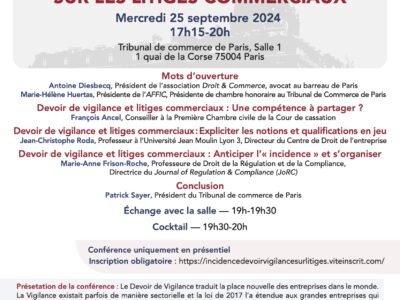
► Full Reference: M.-A. Frison-Roche, coordination of the conference L'incidence du devoir de vigilance sur les litiges commerciaux (The impact of the duty of vigilance on commercial litigation), Tribunal de commerce de Paris (Paris Commercial Court), Droit & Commerce and Association Française en Faveur de l'Institution Consulaire (AFFIC), Tribunal de commerce de Paris, 25 September 2024, 5.15p.m. to 8p.m. - 🧮see the full programme of this event - 🌐consult on LinkedIn a general présentation of this event (in French) - ► General presentation of the conference: The Duty of Vigilance reflects the new role of firms in the world. Vigilance sometimes existed on a sectoral basis, but the 2017 French law extended it to large companies that control value chains. The French so-called "confiance" law gave the Tribunal judiciaire de Paris (Paris First Instance Civil Court) jurisdiction to hear "actions relatives" ("actions relating") to this duty. This does not mean, however, that the commercial courts will no longer have jurisdiction. Firstly, vigilance may go beyond the scope of the 2017 French law. Secondly, vigilance may concern not only the plan drawn up by the firm, but also Commercial Contract Law or Liability Law, special Distribution Law, etc. Commercial courts will have to develop a doctrine for dividing up and coordinating disputes, in particular by staying proceedings within certain disputes. To build a unified or at least non-contradictory case law on vigilance, we need to imagine a dialogue between judges and new procedures. - 🧮Programme of this event:  L'INCIDENCE DU DEVOIR DE VIGILANCE SUR LES LITIGES COMMERCIAUX (THE IMPACT OF THE DUTY OF VIGILANCE ON COMMERCIAL LITIGATION) Paris First Instance Commercial Court, room 1 🕰️5.15pm.-5.30pm. Welcome 🕰️5.30pm.-5.40pm. 🎤Mots d'ouverture (Opening words), by 🕴️Antoine Diesbecq, President of Droit & Commerce, attorney at the Paris Bar and 🕴️Marie-Hélène Huertas, President of AFFIC, Honorary President of Chamber of the Paris First Instance Commercial Court 🕰️5.40pm.-6pm. 🎤Devoir de vigilance et litiges commerciaux : Une compétence à partager ? (Duty of Vigilance and Commercial Litigation: A jurisdiction to share?), by 🕴️François Ancel, Judge at the Première Chambre civile de la Cour de cassation (First Civil Chamber of the French Court of cassation) 🕰️6pm.-6.20pm. 🎤Devoir de vigilance et litiges commerciaux : Expliciter les notions et qualifications en jeu (Duty of Vigilance and Commercial Litigation: Explain the concepts and qualifications involved?), by 🕴️Jean-Christophe Roda, Full Professor at Jean Moulin Lyon 3 University, Director of the Centre de Droit de l’entreprise 🕰️6.20pm.-6.40pm. 🎤Devoir de vigilance et litiges commerciaux : Anticiper l''incidence" et s’organiser (Duty of Vigilance and Commercial Litigation: Anticipating the "impact" and getting organised), by 🕴️Marie-Anne Frison-Roche, Professor of Regulatory Law and Compliance Law, Director of the Journal of Regulation & Compliance (JoRC) 🕰️6.40pm.-7pm. 🎤Conclusion (Conclusion), by 🕴️Patrick Sayer, President of the Tribunal de commerce de Paris (Paris First Instance Commercial Court) 🕰️7pm.-7.30pm. Discussion with the audience 🕰️7.30pm.-8pm. Cocktail - 🌐follow Marie-Anne Frison-Roche on LinkedIn 🌐follow Marie-Anne Frison-Roche on Instagram 🌐subscribe to the Newsletter MAFR Regulation, Compliance, Law

Videos

Conference

💻Comment s’adapter au Contentieux Émergent de la Compliance (How to adapt to Emerging Compliance Litigation)

► Full Reference: M.-A. Frison-Roche, "Comment s’adapter au Contentieux Émergent de la Compliance" ("How to adapt to Emerging Compliance Litigation"), in , Association nationale des juristes de banque (ANJB), September 19, 2024, Paris, - This conference is being held with another speaker, Maître Jean-Pierre Picca. It is followed by a discussion with the audience. - 🧮see the full programme of this manifestation - ► English Summary of this conference: Compliance Law is a new branch of Law, teleological in nature, whose legal normativity is rooted in its goals.These are systemic goals of preserving systems by detecting the risks that weaken them and preventing the failures that can destroy them. It is therefore an Ex Ante branch of Law, the implementation of which will weigh on the "entities" in a position to detect risks and prevent failures so that these systemic goals are achieved.  As such, they are "Monumental Goals" in that they are political goals aimed at complete systems. It is therefore essential to distinguish between "conformity Law", which simply consists of "complying" with the applicable regulations, and Compliance Law, which consists of contributing to the achievement of these "Monumental Goals", either by force (legal obligation) or by choice (raison d'être, company with mission, contractual obligation, CSR). In this respect, Compliance Law is both much more limited in its aims and much more ambitious, since it is about building the future rather than mechanically complying with regulations. The banking sector, which can be considered an exception to the principle of Competition, which is based on extreme mobility and the absence of rents, the destruction of the weakest, risk-taking, the lack of solidity of the operator posing no problem, appears to be the paragon of the principle of Compliance, which is based on the sustainability of systems ensured by the solidity of the operators themselves, their solidarity, the exchange of information, and integrated supervisors. For example, the duty of vigilance and the information about others, and the Regulation through Supervision were born in this sector, which has internalised this sectoral concern in the banks, itself the bearer of a general concern, particularly in the European conception of continental banking. the European Banking Union  increasing this concern. As a result, banks will internalise concerns about the future that go beyond safeguarding the banking sector, such as preventing systemic climate risk or educating the population or safeguarding people in vulnerable situations. - The litigation that shall ensue is itself highly specific. The topic of this conference is to provide the keys to understanding how banks must play their part. Emerging Compliance Litigation is systemic in nature. It is a reflection of the Ex Ante organisation whereby entities are asked to make a contribution to the achievement of Monumental Goals. In a dispute between two opposing parties, an individual or an NGO or a trade union or a municipality or a State and a bank, a conflict arises between what might be called the party claiming to represent the present and future interests of a system, for example the climate system or the social relations system, and the bank which has a legally imposed "compliance obligation" to help protect this system. The author who described this perfectly was Chaïm Perelman, particularly in his 1978 book, Logique juridique, which describes audience circles. We need to understand the systemic construction of the judicial instance. The bank must not let to be confined itself solely to its role as litigant, while the other party, for example an NGO, in its role as guardian of "civil society" or the "climate system" or the "effective equality between human beings", going beyond this first circle between the litigants and brings the system itself into the proceedings.  This is where the adaptation has to take place.  - This adaptation is procedural, evidentiary and substantive. The procedural adaptation must take place even before any litigation, since there is a continuum between Ex Ante and Ex Post, with the Judicial System itself being just one accountability method (rendering of accounts) among others. This accountability takes place in relation to a ‘mission’ that is entrusted to the banks in relation to the goals: prevention, detection and the fight against corruption, money laundering, climate change, etc., by building alliances, making good use of information (knowing how to take it, knowing how not to pass it on, knowing how to pass it on). The procedure, i.e. the way in which something is done, must reflect a substantial element, in that it engenders a ‘sense of responsibility’: the purpose of Compliance Law is to ‘make powers accountable’ and to build on positions of power. The proper procedure is to make ‘good use of one's power’ for the benefit of others. Techniques for ‘taking others into consideration’ are an essential element. Consideration by the person who agrees to exercise power (the power to finance, the power to gather information, the power to organise together, the power to contract). Evidentiary’ adaptation: indifference of evidentiary obligations and rights to the procedural position of the parties. The firm has a ‘Compliance Obligation’ even if it is the defendant in the proceedings. The object of proof is given to it by the Monumental Goals that the Law or its own will require it to help achieve. Its burden is to show that it is helping to achieve these goals, by acting for the future (for example, by knowing its customers, or by taking into account the interests of its stakeholders, etc.). - ► Structure of the speech:  I. The current situation: suffering the harmful consequences of reducing Compliance Law to the mechanics of "conformity". II. The opportunity for banks to adapt by understanding Compliance Law and going beyond the mechanics of conformity: the European puzzle, its apparent complexity, its architectural clarity (CSRD/CS3D/DSA). III. The opportunity for banks not to allow themselves to be trapped in proceedings that are merely sanctions, transferred from Ex Post to Ex Ante: the emergence of Systemic Compliance Litigations before the Ordinary Law Courts (French Law of 2017 on Vigilance; Paris Court of appeal decisions of 18 June 2024). IV. What is expected of banks in Systemic Compliance and Vigilance Litigations before the Ordinary Courts, reflecting the dialogue and action required by Compliance Law (article to be published).  V. The opportunity for banks to adapt to the new evidentiary dimension of emerging Compliance and Vigilance Litigation (article to be published). VI. The opportunity for banks to adapt to the new Ex Ante dimension of Systemic Compliance and Vigilance Litigation, Litigation which deals with the future (article to be published). - ► A few bibliographical references:    🕴️M.-A. Frison-Roche, 📝Compliance Law, 2016 🕴️M.-A. Frison-Roche, 📝Compliance and conformity: distinguish them in order to articulate them, 2024 🕴️M.-A. Frison-Roche, 📝Duty of Vigilance: the way forward, 2024 🕴️M.-A. Frison-Roche, 📝Systemic Litigation, 2024 - 🌐follow Marie-Anne Frison-Roche on LinkedIn 🌐follow Marie-Anne Frison-Roche on Instagram 🌐subscribe to the Newsletter MAFR Regulation, Compliance, Law
Publication director

🏗️ direction of the collection: 📚Cours Dalloz – Série Droit privé

📚Publication of : 🕴️François GAUDU & 🕴️Florence BERGERON, 📕Droit du travail (Labour Law), 11th ed.

► Full Reference : F. Gaudu & F. Bergeron-Canut, Droit du travail 2025 (Labour Law 2025), 11th ed., 2024, Dalloz, “Cours Dalloz-Série Droit privé” Series, 720 p. - ► General presentation of the book (written in French) : This textbook, up to date with the latest texts, is intended for all law students and all practitioners updating their knowledge. In a first part it develops « individual employment relations » (formation of the contractual relationship, performance and termination of the employment contract), devoting its second part to « collective employment relations » (collective labour disputes, employee representation, collective bargaining and collective agreements). - 📚See the entire collection in which the book is published. - 📚Books in the collection directly related to this one : 🕴️F. Kessler, 📕Droit de la protection sociale (Social Protection Law) 🕴️V. Magnier, 📕Droit des sociétés (Company Law) -

Publication director

🏗️ direction of the collection: 📚Cours Dalloz – Série Droit privé

📚Publication of : 🕴️Xavier PIN, 📕Droit pénal général (General Criminal Law), 16th ed.

► Full Reference : X. Pin, Droit pénal général 2025 (General Criminal Law 2025), 16th ed., 2024, Dalloz, “Cours Dalloz-Série Droit privé” Series, 722 p. - ► General presentation of the book (written in French) : The new 2024 edition of this book, up to date with the latest reforms, first deals with the « criminal law » in its determination and application; it then deals with « the offence », its characterisation and its attribution, and ends, in a third part, with « the penalty », distinguishing between the penalty incurred, the penalty imposed and the penalty enforced. - 📚See the entire collection in which the book is published. - 📚Books in the collection directly related to this one : 🕴️Ch. André, 📕Droit pénal spécial (Special Criminal Law) 🕴️É. Verny, 📕Procédure pénale (Criminal Procedure) 🕴️G. Beaussonie, 📕Droit pénal des affaires (Business Criminal Law) -

Conferences

conference

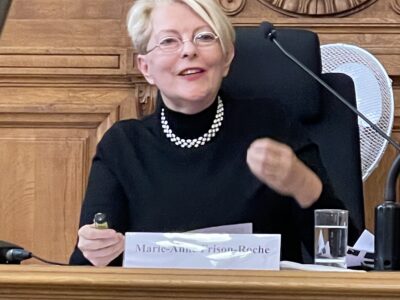
🎤Pourquoi les textes et la pratiques sur le rapport de durabilité vont engendrer un Contentieux Systémique (Why the texts and practices on sustainability reporting will give rise to Systemic Litigation), in 🧮Le rapport de durabilité : obligation et Contentieux Systémiques Émergents (The Sustainability Report: Emerging Systemic Obligation and Litigation), in cycle of conference-debates “Contentieux Systémique Émergent” (“Emerging Systemic Litigation”)

► Full Reference: M.-A. Frison-Roche, "Pourquoi les textes et la pratiques sur le rapport de durabilité vont engendrer un Contentieux Systémique" ("Why the texts and practices on sustainability reporting will give rise to Systemic Litigation"), in Le rapport de durabilité : obligation et Contentieux Systémiques Émergents (The Sustainability Report: Emerging Systemic Obligation and Litigation), in cycle of conference-debates "Contentieux Systémique Émergent" ("Emerging Systemic Litigation"), organised on the initiative of the Cour d'appel de Paris (Paris Cour of Appeal), with the Cour de cassation (French Court of cassation), the Cour d'appel de Versailles (Versailles Court of Appeal), the École nationale de la magistrature – ENM (French National School for the Judiciary) and the École de formation des barreaux du ressort de la Cour d'appel de Paris – EFB (Paris Bar School), under the scientific direction of Marie-Anne Frison-Roche, September 19, 2024, 11h-12h30, Cour d'appel de Paris, Cassin courtroom - 🧮see the full programme of this event - ► English summary of the conference: Systemic Litigation refers to a specific category whose proposed category in 2021 refers to "cases" brought before the courts, sometimes specialised, sometimes under ordinary law courts: these are cases in which not only are the parties involved in their dispute but also a system is itself involved, with the procedure and the judge having to allow the interests of the system to be taken into consideration. However, what is also the subject of new terminology, namely the "Sustainability Report", reflects the same legal revolution: the company must be able to assess not only its economic and financial performance, which is the subject of accounting, but also its development in terms of what it does externally in terms of ESG and what the outside world does about it. In this perspective, the whole Information System is being transformed, and in different ways depending on the standards adopted, in the United States, Europe or elsewhere, either it is sufficient to obtain Information, no more, so that third parties can adjust their behaviour, mainly investments, or, as in Europe, Law includes a more substantial perspective, so that the company itself adjusts its own behaviour, its Governance, its position in the world, in a renewed relationship with its stakeholders. In Europe, saying and doing are intertwined, CSRD being twinned with CS3D. Moreover, we can therefore consider that non-financial information, through the sustainability report, its assurance of credibility and the regulation of the audit carried out on it, is itself a system. The sustainability report, inside the sustainability system, is then interwoven with other systems, which are themselves the subject of Emerging Systemic Litigation: firstly Vigilance, which has been studied as a field of systemic litigation, and then artificial intelligence field, which has been studied in the same way. The Sustainability Report, insofar as it intersects with the sustainability obligation implied by the duty of Vigilance, may be attracted to the Systemic Litigation to which Vigilance gives rise. In the same way, algorithms can be a tool for data accumulating and matching ESG criteria, which could have the same attraction effect. If this happens, this dimension will have to be present and understood, for example through amici curiae mechanism, in conjunction with the Regulators and the professions concerned. In addition, as in any emerging mechanism, and as we have seen for example in relation to rating agencies, Tort Law may interfere if the liability of either the company or the person who carried out the audit were to be appreciated, the systemic perspective then having to be integrated into the handling of the case, even before the non-specialised judge.   - 🌐follow Marie-Anne Frison-Roche on LinkedIn 🌐follow Marie-Anne Frison-Roche on Instagram 🌐subscribe to the Newsletter MAFR Regulation, Compliance, Law

Organisation of events

🧱⚙️scientific organisation and moderation of 🧮Le rapport de durabilité : obligation et Contentieux Systémiques Émergents (The Sustainability Report: Emerging Systemic Obligation and Litigation), in cycle of conference-debates “Contentieux Systémique Émergent” (“Emerging Systemic Litigation”)

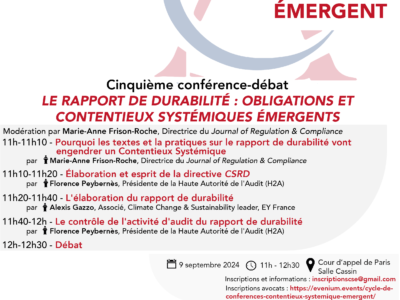
► Full Reference: M.-A. Frison-Roche, Scientific direction of the conference Le rapport de durabilité : obligation et Contentieux Systémiques Émergents (The Sustainability Report: Emerging Systemic Obligations and Litigation), in cycle of conference-debates "Contentieux Systémique Émergent" ("Emerging Systemic Litigation"), organised on the initiative of the Cour d'appel de Paris (Paris Cour of Appeal), with the Cour de cassation (French Court of cassation), the Cour d'appel de Versailles (Versailles Court of Appeal), the École nationale de la magistrature – ENM (French National School for the Judiciary) and the École de formation des barreaux du ressort de la Cour d'appel de Paris – EFB (Paris Bar School) and MAFR, September 19, 2024, 11h-12h30, Cour d'appel de Paris, Cassin courtroom - ► Presentation of the conférence: Sustainability is a new legal concept, the lineaments of which can be found in certain sectors and branches of Law, and which today has both multiple resulting obligations and a definition that is sufficiently unified to allow it to be grasped through the technique and the requirement of the "Sustainability Report", which translates a requirement linked to the systems themselves. The dual materiality mechanism illustrates this. The Litigation that will ensue shall be imbued with this systemic dimension, since this report was required from this perspective, and the notion of Sustainability itself was conceived in the same way. What is commonly referred to as "ESG" reflects this perspective, which is both structural and long-term: Information is central here, since it is a Report, anchored in  the new conception of Corporate Law that is imbued with Governance, where internal and external stakeholders are present. The various Supervisors and Regulators, who go beyond supervising professionals to regulate activities, are also bound to have a role to play in this Emerging Systemic Litigation. In order to understand and anticipate this, this conference is built around an analysis of the construction of the Sustainability Report and an analysis of the role of the Regulatory and Supervisory Authority, the French Audit Authority, the Haute Autorité de l'Audit – H2A. These analyses are carried out with a view to the Systemic Litigation that will arise from these new requirements and practices, in correlation with Litigation linked to other fields of Systemic Litigation such as Vigilance field. - 🧮Programme of this event:  Fith conference-debate LE RAPPORT DE DURABILITÉ : OBLIGATIONS ET CONTENTIEUX SYSTÉMIQUES ÉMERGENTS (THE SUSTAINABILITY REPORT: EMERGING SYSTEMIC OBLIGATIONS AND LITIGATION) Paris Court of Appeal, Cassin courtroom 🕰️11am.-11.10am. 🎤Pourquoi les textes et la pratiques sur le rapport de durabilité vont engendrer un Contentieux Systémique (Why the texts and practices on sustainability reporting will give rise to Systemic Litigation), by 🕴️Marie-Anne Frison-Roche, Professor of Regulatory Law and Compliance Law, Director of the Journal of Regulation & Compliance (JoRC) ➡️read the presentation of this speech 🕰️11.10am.-11.20am. 🎤Élaboration et esprit de la directive CSRD (Elaboration and spirit of the CSRD), by 🕴️Florence Peybernès, President of the Haute Autorité de l'Audit – H2A (French High Audit Authority) 🕰️11.20am.-11.40am. 🎤Comment construire un rapport de durabilité ? (How to build a sustainability report?), by 🕴️Alexis Gazzo, Partner, Climate Change & Sustainability leader, EY France 🕰️11.40am.-12pm. 🎤Le contrôle de l'activité d'audit du rapport de durabilité (The control of the audit of the sustainability report), by 🕴️Florence Peybernès, President of the Haute Autorité de l'Audit – H2A (French High Audit Authority) 🕰️12pm.-12.30pm. Debate - 🔴Registrations and information requests can be sent to: inscriptionscse@gmail.com 🔴For the attorneys, registrations have to be sent to the following address: https://evenium.events/cycle-de-conferences-contentieux-systemique-emergent/  ⚠️The conference-debates are held in person only, in the Cour d’appel de Paris (Paris Court of Appeal). -

Publication director

🏗️ direction of the collection: 📚Cours Dalloz – Série Droit privé

📚Publication of : 🕴️Claude BRENNER, 📕Procédures civiles d’exécution (Civil Enforcement Procedures), 12th ed.

► Full Reference : Cl. Brenner, Procédures civiles d’exécution (Civil Enforcement Procedures), 1st ed. 1998 – 12th ed., 2024, Dalloz, “Cours Dalloz-Série Droit privé” Series, 330 p. - ► General presentation of the book (written in French) : In the 12th edition of this textbook, up to date with the reform of the law of security interests, Claude Brenner sets out the rules on civil enforcement procedures as a complement to the Law of Obligations, since they make effective the binding force of contracts and the liability of persons. Up to date with all the successive reforms, this textbook makes it possible to understand the subject as a whole, in its common rules and in the specific procedures that have developed within it. The book is built in two titles, the first dealing with enforcement procedures, the second with distribution procedures. - 📕Read the back cover (in French) - 📕Read the table of contents (in French) - 📚See the entire collection in which the book is published. - 📚Books in the collection directly related to this one : 🕴️N. Cayrol, 📕Procédure civile (Civil Procedure) 🕴️J.-B. Seube, 📕Droit des sûretés (Law of Security Interests) -

Working papers

🚧The invention of the ‘right to a child’. The consequences of contractual practice as a source of childbearing

► Full reference : M.-A. Frison-Roche, The invention of the 'right to a child'. The consequences of contractual practice as a source of filiation, working document, Sept. 2024 – Oct. 2025. - 🎤This working document forms the basis of a presentation entitled, "Le "droit à l'enfant" est-il concevable, pourquoi et avec quelles conséquences" (Is the 'right to a child' conceivable, why and with what consequences", in Les nouvelles filiations. Diifférentes perspectives (New parentage. Different perspectives." held at the Paris Court of Appeal on 12 September 2024. - 📝Revised, this working document forms the basis of the article published in the dossier "Les nouvelles filiations. Regards croisés" (New parentage. Different perspectives), Act. jur. Dalloz Droit de la famille (in French). - ► Summary of this working document  :  Every legal system is built on concepts that form its pillars. Filiation is one such concept. A cas-law solution, presented as pragmatic and casuistic, can overturn this concept. Whether one agrees with it or not, it must first be acknowledged and assessed. Through a series of rulings on surrogacy, notably a ruling by its First Civil Chamber granting exequatur to a judgment recognising the filiation established by surrogacy between a child and persons with no biological link to the child and without recourse to adoption, the French Cour de Cassation has introduced the possibility of creating parentage by contract. This not only changes the concept of filiation but also changes the very structure of the French legal system, which is based on the distinction between persons and things. One may agree or disagree with this, but it must be said. Since the judge gives force to such a contract establishing filiation, with the foreign judge simply recognising it and the French judge ensuring only that the contract is balanced, the prospect opens up of a society in which individuals will be able to contractually create institutions at their disposal, within the private normative space of the contract, with the State's only function being to give effect to their right to legal recognition of their unique "project". Parentage is only a first example. Thus constructed on what was "inconceivable", i.e. a "right to a child", thanks to the contractual power to which the State should lend its force a posteriori, the judge makes parentage resulting from a contract technically "admissible" and opens up a contractually governed society. - 🔓read the working document below⤵️ - 🌐Follow Marie-Anne Frison-Roche on LinkedIn 🌐follow Marie-Anne Frison-Roche on Instagram 🌐Subscribe to the Newsletter MAFR Regulation, Compliance, Law 🌐Subscribe to the video newsletter MAFR Overhang 🌐Subscribe to the Newsletter MaFR Law & Art
Publication director

🏗️ direction of the collection: 📚Cours Dalloz – Série Droit privé

📚Publication of : 🕴️Philippe NEAU-LEDUC & 🕴️Ariane PÉRIN-DUREAU, 📕Droit bancaire (Banking Law), 7th ed.

► Full Reference : Ph. Neau-Leduc & A. Périn-Dureau, Droit bancaire (Banking Law), 7th ed., 2024, Dalloz, “Cours Dalloz-Série Droit privé” Series, 350 p. - ► General presentation of the book (written in French) : This new edition of Droit bancaire, of which Philippe Neau-Leduc was the author, is intended for all Master 1 law students but also for practitioners wishing to update their knowledge of banking law. In a first part it develops « the banking system » (the banking sector and banking status), and in a second part « the banking service » (banking and ancillary operations). - 📕Read the back cover (in French) - 📕Read the table of contents (in French) - 📚See the entire collection in which the book is published. - 📚Books in the collection directly related to this one : 🕴️S. Piédelièvre, 📕Instruments de crédit et de paiement (Credit and Payment Instruments) -

Publication director

🏗️ direction of the collection: 📚Cours Dalloz – Série Droit privé

📚Publication of : 🕴️Rémy CABRILLAC, 📕Droit des obligations (Law of Obligations), 16th ed.

► Full Reference : R. Cabrillac, Droit des obligations (Law of Obligations), 16th ed., 2024, Dalloz, “Cours Dalloz-Série Droit privé” Series, 484 p. - ► General presentation of the book (written in French) : Fully up to date with recent reforms, Rémy Cabrillac’s textbook tells, in 450 pages, the law of obligations as a living, everyday subject. So that the subject remains understandable, its presentation remains classic: the first part of the book is devoted to the sources, the second dealing with the regime. To do so, this now classic book sets out juridical acts, quasi-contracts, extra-contractual civil liability, and then the modalities, transfer and extinction of obligations. - 📚See the entire collection in which the book is published. - 📚Books in the collection directly related to this one : 🕴️D. Mainguy, 📕Contrats spéciaux (Specific Contracts) 🕴️J.-B. Seube, 📕Droit des sûretés (Law of Security Interests) 🕴️J.-D. Pellier, 📕Droit de la consommation (Consumer Law) -