Conferences

Conferences

🏗️Cycle of symposiums 2023 on Compliance Obligation

🧮Vigilance, advanced point of the Compliance Obligation

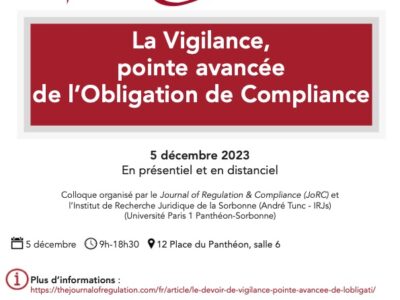
► Full Reference: Journal of Regulation & Compliance (JoRC) and Institut de Recherche Juridique de la Sorbonne (André Tunc – IRJS) of Paris 1 Panthéon-Sorbonne University, La Vigilance, pointe avancée de l'Obligation de Compliance (Vigilance, advanced point of the Compliance Obligation), Paris 1 Panthéon-Sorbonne University, December 5, 2023, 12 place du Panthéon, salle 6. - -  🏗️ This symposium takes place in the cycle of symposiums organised by the Journal of Regulation & Compliance (JoRC) and its partner Universities, focusing in 2023 on the general theme of Compliance Obligation. - - ► This symposium is organised by the Journal of Regulation & Compliance (JoRC) and Paris 1 Panthéon-Sorbonne University, through its Institut de Recherche Juridique de la Sorbonne (André Tunc – IRJS).  This symposium is held in French. the symposium is under the scientific direction of 🕴️Marie-Anne Frison-Roche, 🕴️Mustapha Mekki , and 🕴️Jean-Christophe Roda. - To register for a physical presence: anouk.leguillou@mafr.fr (as places are limited, you will be asked to confirm 48 hours in advance). To register for an online presence, via Zoom: Click HERE  🧮 The event will take place at Paris 1 Panthéon-Sorbonne University, 12 place du Panthéon 75005, in Salle 6, on 5 December 2023. - ► Présentation of the theme : The Vigilance Obligation is difficult to define because of the multiplicity of texts and cases in which it can be understood. This is particularly true of the Vigilance mechanism, which illustrates, and even emphasises, the Vigilance Obligation. Through international texts, French law and European texts that have been adopted or are in the process of being adopted, the constraints of vigilance, but also the structures and actions that companies have put in place and the actions that stakeholders have taken, Vigilance has highlighted aspects of the Compliance Obligation, and even modified it.  The revelatory effect thus produced and the movement thus unleashed, whose roots run deep and whose systemic effects are very significant, justify a greater focus on mechanisms that are interconnected, whereas they are sometimes perceived in silos, which makes it difficult to understand the whole picture. In the same way, because Vigilance is the advanced point of the Compliance Obligation, we can better distinguish and articulate what is sector-specific, in particular in banking and finance or in digital matters, and articulate them with what Vigilance has, like Compliance, of a more general nature. What's more, the intensity of Vigilance varies according to its ambitions and the position of the company subject to it, which is reflected in the variations in legal qualification, ranging from a duty to a criminally sanctioned obligation.  The different legal systems reflect these developments in their legislation, case law and the practice of companies and stakeholders in specific ways, because these different techniques express standards of behaviour and accountability, which are directly reflected in evidential requirements, concepts of responsibility and institutional translations through possible regulatory bodies. As a result, the symposium is divided into three parts. After a general introduction on the systemic relationships between Vigilance and Compliance, the first part will focus on the variation in Vigilance Intensities, the advanced point of Compliance, the second part will look at the Tensions that Vigilance generates or exacerbates, and the third part will look at the Modalities that Vigilance uses in Compliance systems. - The proceedings of this colloquium will form the basis of one chapter in the books:  📕L'obligation de Compliance, in the collection 📚Régulations & Compliance, copublished by the Journal of Regulation & Compliance (JoRC) and Dalloz. 📘Compliance Obligation, in the collection 📚Compliance & Regulation, copublished by the Journal of Regulation & Compliance (JoRC) and Bruylant. - Speakers:   🎤Laurence Dubin, Professor at Paris 1 Panthéon-Sorbonne University 🎤Marie-Anne Frison-Roche, Professor of Regulatory & Compliance Law, director of the Journal of Regulation & Compliance (JoRC) 🎤Bernard Haftel, Professor at Paris-Nord University 🎤Marie Lamoureux, Professor at Aix-Marseille University 🎤Grégoire Loiseau, Professor at Paris 1 Panthéon-Sorbonne University 🎤Véronique Magnier, Professor at Paris-Saclay University 🎤Gilles J. Martin, Emeritus Professor at Côte d'Azur University, member of the Groupe de Recherche en Droit, Économie, Gestion (GREDEG) of the CNRS 🎤Mustapha Mekki, Professor at Paris 1 Panthéon-Sorbonne University 🎤Jean-Christophe Roda, Professor at Jean Moulin Lyon 3 University 🎤Anne-Claire Rouaud, Professor at Paris 1 Panthéon-Sorbonne University - 🔻 read a detailed presentation of the manifestation below 🔻

Conferences

final speech of a scientific manifestation

🎥 5 leçons en conclusions ouvertes (5 Lessons in Open Conclusions), in 🧮Compliance, vigilance et médiation

► Full Reference: M.-A. Frison-Roche, "Conclusion", in M. Boissavy, H. Dehghani-Azar, and M.-A. Frison-Roche (dir.), Journal of Regulation & Compliance (JoRC) and Conseil national des Barreaux (CNB), Compliance, vigilance et médiation (Compliance, Vigilance and Mediation), Amphitheatre of the Conseil national des Barreaux, November 30, 2023. - 🧮see the full programme of this event - 🌐follow Marie-Anne Frison-Roche on LinkedIn 🌐follow Marie-Anne Frison-Roche on Instagram 🌐subscribe to the Newsletter MAFR Regulation, Compliance, Law

Conferences

🧮Compliance, Vigilance and Mediation

► Full Reference: Journal of Regulation & Compliance (JoRC) and Conseil national des Barreaux (CNB), Compliance, vigilance et médiation (Compliance, Vigilance and Mediation), November 30, 2023, Amphithéâtre du Conseil national des barreaux. - - ► The symposium is organised by the Journal of Regulation & Compliance (JoRC) and the Conseil national des barreaux (CNB).  This symposium is held in French. The symposium is placed under the scientific direction of 🕴️Matthieu Boissavy, 🕴️Hirbod Dehghani-Azar and 🕴️Marie-Anne Frison-Roche. - ► Presentation of the theme: To increase respect for human rights and the environment in the context of corporate social responsibility and compliance, public authorities and companies have for several years been implementing instruments and processes for dialogue between companies on the one hand and stakeholders inside and outside the company on the other. Among these, mediation is regularly highlighted as a necessary and fruitful process for reaching agreements that benefit employees and civil society players, as well as the environment and society as a whole. John Ruggie, Special Representative of the Secretary-General on human rights and transnational corporations and other business enterprises, in his report of 21 March 2011, Guiding Principles on Business and Human Rights, recommends mediation as an effective and appropriate non-judicial grievance mechanism. The ISO 26000 standard on social responsibility also explicitly refers to the use of mediation in the section Actions and related expectations (6.3.2.6) and say that an organisation should establish or ensure the availability of redress mechanisms for its own use and for that of its stakeholders. For these mechanisms to be effective, they should be […] based on dialogue and mediation: the process should aim to remedy breaches through mutually agreed solutions reached through dialogue between the parties. Where a judgment is desirable, the parties should retain the right to reach it through separate, independent mechanisms. Similarly, the French law No. 2017-399 of 21 March 2017 relative au devoir de vigilance des sociétés mères et des entreprises donneuses d’ordre (on the duty of vigilance of parent companies and ordering companies) has given rise to disputes relating to the design and application of vigilance plans by certain companies subject to this law. Mediation has been proposed by the courts, sometimes accepted, and we know that some have been successful. At the same time, the draft European Directive on Corporate Sustainability Due Diligence (CS3D) is likely to impose or extend obligations relating to the duty of vigilance on a large number of companies in the European Union, for the respect of human rights and the environment by companies in global value chains. The result of all this is that respect for human rights within organisations and companies depends on recourse to the courts, on cooperation processes such as mediation, both project mediation and mediation specific to the resolution of disputes, while recourse to the courts will not suffice to rapidly make respect for these obligations effective. The legislator and the parties concerned are aware of this, and they refer to the use of mediation as necessary to help both civil society actors committed to respect for human rights and the environment and companies to reach agreements on compliance with these obligations. Lawyers, mediators and people assisting stakeholders and companies have an important role to play in the success of these mediations. In collaboration with the Journal of Regulation and Compliance (JoRC), the Conseil national des barreaux (CNB) is organising a half-day conference on "Compliance, vigilance et médiation" ("Compliance, Vigilance and Mediation") to train lawyers to this activity, which will develop either as an extension of another activity or as its own activity, and which has major implications for individual rights, society and the environment. - ► Construction of the symposium:  After a general introduction to the triptych of Compliance, Vigilance and Mediation and the links that it implies, the first part of the event will focus on the contribution of Mediation to the effectiveness of Compliance and, more particularly, to its most advanced aspect, the duty of vigilance. After a debate on this topic, the second part of the event will focus on the conduct of project mediation or dispute resolution in such a context. A conclusion will enable us to draw immediate lessons from the information and exchanges that have taken place. - Speakers:   🎤Matthieu Boissavy, attorney at the Paris Bar, vice-president of the Commission Liberté et droits de l'homme of the CNB 🎤Matthieu Brochier, attorney at the Paris Bar 🎤Stéphanie Brunengo, attorney at the Aix-en-Provence Bat, mediator 🎤Malik Chapuis, judge in the 3rd chamber of the Tribunal judiciaire de Paris (Paris First Instance Civil Court) 🎤Bruno Deffains, professor at Paris Panthéon-Assas University 🎤Hirbod Dehghani-Azar, attorney at the Paris Bar, president of the Commission Modes alternatifs de règlements des Règlements (MARD) of the CNB 🎤Marie-Anne Frison-Roche, professor of Regulatory Law and Compliance Law, director of the Journal of Regulation & Compliance (JoRC) 🎤Jérôme Gavaudan, president of the CNB 🎤Thibault Goujon-Bethan, professor at Jean Moulin Lyon 3 University 🎤Céline Haye Kioussis, legal director if the BPCE Group 🎤Stéphane de Navacelle, attorney at the Paris Bar 🎤Lori Roussey, Data Protection Officer, founder and Director of Data Rights 🎤Stephanie Smatt Pinelli, litigation legal director, Orano Group - 🔻 Read a detailed presentation of the event below:

Conferences

conference

🎤Participation in the🏛️Law Day🧮Normes de Responsabilité Sociale des Entreprises /RSE & Devoir de Vigilance (Corporate Social Responsibility Standards /CSR & Duty of Vigilance)

🌐follow Marie-Anne Frison-Roche on LinkedIn 🌐subscribe to the Newsletter MAFR Regulation, Compliance, Law - ► Full Reference: M.-A. Frison-Roche, Participation à la Table ronde "Normes de Responsabilité Sociale des Entreprises (RSE & Devoir de Vigilance)" (Participation in the Round Table "Corporate Social Responsibility Standards (CSR & Duty of Vigilance)"), in Fribourg University, Journée du Droit, Fribourg University, Pérolles site, room C230, October 2, 2023. - 🧮see the full programme of this event 🎥​watch the video of this event (in French) - 🌐read the report written in French with photos, tags and links on LinkedIn and also with links to each the speech - ► General presentation of the event : This conference, build around 4 presentations and a debate between the speakers and then with the audience, aimed at explaining and understanding this fundamental movement and the new texts that express it in Switzerland, even if it is French law, such as the so-called 'Vigilance' law of 2017 and the draft European CS3D directive, because on the one hand it is a movement that begins with legal technique and on the other hand the texts in question are extraterritorial in scope, if only because of the notion of 'value chain'. In the first part of this round table, and to set the scene, I will outline the origin and content of the French 'Vigilance' law, the way in which the draft directive draws heavily on it, its relationship with Compliance Law, of which it constitutes the 'advanced point', and the decisive role it gives to the courts, in the general movement of the jurisdictionalisation of compliance. The purpose of this is to allow the discussion to get underway. 🕴️Idris Abdelkhalek, PhD candidate and lawyer, introduced the speakers and led the debate between them and the audience. He took questions from the audience on the intensity of the obligation weighing on companies, in particular between civil liability and criminal liability, between the obligation of means and the obligation of result, and on the way in which the duty of vigilance is applied to specific sectors such as defence. - ► Presentation of my speech : the subject of which was Presentation of French Vigilance law, European perspective and European Compliance System. My presentation was divided into four points. Firstly, I outlined the state of Law in France, in the novelty represented by the 2017 law known as the "Vigilance" law, whose principles are simple and strong, principles that are situated in the aims pursued, and the way in which this law inspires what is currently being negotiated: the CS3D Directive. Secondly, I stressed the need for companies to master these often technically complicated corpus, especially if we take into account the link between Vigilance and the CSRD directive on sustainability reporting and extra-financial information.  Thirdly, I have shown that an overall understanding can nevertheless be achieved, and that the technical nature of the 'tools' is better mastered if we place the duty of vigilance within Compliance Law, of which it constitutes the 'advanced point'. All of this anchors its legal normativity in the 'Monumental Goals' it serves, which in Europe are humanistic, since the aim is to protect, now but above all in the future because it is a branch of ex ante Law, the human beings involved in the systems (banking, finance, energy, digital, climate, etc.). Fourthly, I emphasised that this understanding enables everyone to play their part: political and public authorities, businesses and stakeholders. Even more, and at the heart of the matter, the judge plays an essential role, even in countries with so-called 'continental' Law. I have used current cases as examples. This is just the beginning, and judges need to train, specialise and work in dialogue to achieve this. - ► Presentation of the other speakers contributions : 🕴️Marion Paradas, Ambassador of France to Switzerland and Liechtenstein, opened the conference and gave a general presentation of the theme. Ambassador Marion Paradas presented the international challenge represented by Law, illustrated here by the duty of vigilance. She emphasised that this is a major issue, both now and in the future, for Swiss companies and French companies based in Switzerland, particularly as this duty extends throughout the "value chain" and in view of the CS3D directive, which will also have consequences for both. 🕴️Isabelle Chabloz Waidacher, Professor at the Faculty of Law in Fribourg and holder of the Chair of Economic Law at the University of Fribourg, gave a Presentation of Swiss Law. In particular, she emphasised the state of Swiss Law, which could have gone further than the 2017 French law known as the "Vigilance" law if the popular initiative reference had led to the adoption of a law, and which currently focuses more on information and transparency obligations, with CSR taking over from there. But she stresses that the reality of value chains will force Swiss companies to take into account the requirements of the European directive currently being adopted. 🕴️Renaud Roussel, Managing Director of Colas Switzerland, presented an entrepreneurial view of the subject. He began by outlining the concrete steps taken by his industrial group in Switzerland and around the world to implement its commitments to protect the environment, for example by ensuring the proper use of materials used in road construction. He also stressed the importance of human rights, particularly in labour relations, in the context of CSR and vigilance. He went on to point out that it was not always easy for a large company to meet its own requirements, or the requirements imposed on it by the law, because in the construction and public works sector in particular it is often small companies that are competing, competitors who do not bear the costs of such obligations. -

Conferences

🎤Conclusion, in 🧮L’eau : entre protection de la ressource et conflits d’usage

🌐follow Marie-Anne Frison-Roche on LinkedIn 🌐subscribe to the Newsletter MAFR Regulation, Compliance, Law - ► Full Reference: M.-A. Frison-Roche, "Conclusion", in Club des avocats environnementalistes, L’eau : entre protection de la ressource et conflits d’usage, Maison des Avocats, Auditorium, September 28, 2023. - 🧮see the full programme of this event -

Conferences

🎤Favoriser ou pas la « contractualisation » du Droit (“To favour or not the “contractualisation” of the Law”), in 🧮La contractualisation du droit. Acte II

🌐follow Marie-Anne Frison-Roche on LinkedIn 🌐subscribe to the Newsletter MAFR Regulation, Compliance, Law  - ► Full Reference: M.-A. Frison-Roche, "Favoriser ou pas la « contractualisation » du Droit" ("To favour or not the "contractualisation" of the Law"), final speech in Société de législation comparée (SLC) and Procuradoria Geral do Estado do Rio de Janeiro (PGE-RJ), La contractualisation du droit. Acte II, Paris, 21 June 2023. - 🧮See the full programme of this event (in French). The conference is held in French -

Conferences

🎤Participation in the panel “Vigilance (due diligence)”, in 🧮150th Anniversary Symposium of the ILA/ADI

🌐 follow Marie-Anne Frison-Roche sur LinkedIn 🌐subscribe to the Newsletter MAFR Regulation, Compliance, Law  - ► Full Reference: M.-A. Frison-Roche, participation in the panel "Vigilance (due diligence)", in International Law Association (ILA), 150th Anniversary Symposium of the ILA/ADI, Paris, 19 June 2023. - 🧮See the full programme of this event -

Conferences

🖥️L’usage des puissances privées par le droit de la compliance pour servir les droits de l’homme, in 🧮Puissances privées et droits de l’homme

🌐 follow Marie-Anne Frison-Roche on LinkedIn 🌐 subscribe to the Newsletter MAFR Regulation, Compliance, Law - ► Full Reference: M.-A. Frison-Roche, "L'usage des puissances privées par le droit de la compliance pour servir les droits de l’homme" ("The use of private forces by Compliance Law to serve human rights"), in Joel Andriantsimbazovina (dir.), Puissances privées et droits de l'homme, University of Toulouse, 16 June 2023. - 🧮Read the full programme of this event -

Conferences

🎥L’esprit des Lois en matière de vigilance (“Spirit of Law in Vigilance (Due Diligences) matters”), in 🧮Réalités et défis de la CSRD – Perspectives du devoir de vigilance

► Full Reference: M.-A. Frison-Roche, "L'esprit des Lois en matière de vigilance" ("Spirit of Law in Vigilance (Due Diligences) matters"), in Haut Conseil du Commissariat aux Comptes (H3C), Réalités et défis de la CSRD – Perspectives du devoir de vigilance, Paris, 14 June 2023. - 🎥watch the video of a part of the speech (in French) - 🧱read the description of the speeches of other speakers of this panel (in French) -   The speech took place during the third-round table devoted to the Perspectives du devoir de vigilance (Perspectives of the duty of vigilance), the first round table having been devoted to the lessons that the DPEF can provide for the CSRD, and the second to the transposition work of the CSRD. 🧮See the full programme of this annual event (in French) - ► English summary of the speech: In consideration of and in addition to what has been said, explained and even affirmed by other speakers, I have emphasised that 'vigilance" laws is not a 'regulation' like any other, but the leading edge of a very vast movement, Compliance Law, in which the 2017 French law is the driving force. For its application, the Judge, who is at the centre because of the will of the Legislator, is already taking into consideration the CS3D, the twin text of the CSRD. The texts must not be seen in isolation. If we isolate them from each other, they become almost incomprehensible, their meaning appearing uncertain, even threatening: we need to understand the spirit of these texts, which are indeed new, because they aim to provide answers to the new world we have entered. We must all rejoice in this political ambition, which is taking a legal form, and work to make it efficient: Legislators, companies, auditors, Regulators and Judges. If we do not stop at the letter, which would be to reduce Compliance to conformity, whereas Compliance Law, particularly Vigilance, is the extension of Regulation, finds its meaning in the Goals, we see that the French law of 2017, known as the "Vigilance law", which copies all the techniques of the French law known as "Sapin 2", gives goals simple to understand to the companies subject to the Legislator's will: detect and prevent environmental and human rights abuses in the value chains. The logic is therefore Ex-Ante. This Ex-Ante logic is retained by the CS3D directive. The Judge is central to it. But the responsibility which the NGOs will ask him to trigger is itself an "Ex Ante responsibility", the Compliance trials being like "accountability" trials, to ensure that companies act in accordance with the Goals set by the Legislator. This is transforming the role of the Judge, who must find effective solutions for the future. The discussion and the adversarial principle will become more important. Mediation will be encouraged. Stakeholders and the company will have to work together, and this method, which was intended by the Legislator for drawing up the vigilance plan, will be continued in the supporting legal proceedings. This will also transform the company, and the role played by those who accredit the information on the company's actions and long-term strategies: auditors therefore have a central role to play. - 🌐follow Marie-Anne Frison-Roche on LinkedIn 🌐follow Marie-Anne Frison-Roche on Instagram 🌐subscribe to the Newsletter MAFR Regulation, Compliance, Law

Conferences

🎤Compliance et droit processuel (Compliance and Procedural Law), in🧮Compliance : Obligation, devoir, pouvoir, culture

🌐follow Marie-Anne Frison-Roche on LinkedIn 🌐subscribe to the Newsletter MAFR Regulation, Compliance, Law - ► Full Reference: M.-A. Frison-Roche, "Compliance et droit processuel" ("Compliance and Procedural Law"), in B. Deffains, M.-A. Frison-Roche and J.-B. Racine (dir.), Journal of Regulation & Compliance (JoRC) and University Panthéon-Assas (Paris II), Compliance : Obligation, devoir, pouvoir, culture (Compliance : obligation, duty, power, culture), University Panthéon-Assas, Salle des Conseils, 14 June 2023. - 🧮See the full programme of this event - 🎤see the other speech made during the first day of this symposium : "L'obligation de compliance, entre volonté et consentement : obligation sur obligation vaut" ("Compliance Obligation, between will and consent: obligation on obligation works")   - ► Summary of the conference: After referring to the chapter in the book Compliance Jurisdictionalisation, which deals more specifically with Procedural Law1See the articles that are part of the Second chapter of the book 🕴️M.-A. Frison-Roche (ed.), 📘Compliance jurisdictionalisation, 2023 : 🕴️N. Cayrol, 📝General Procedural Law in Compliance Law,, the conference is built around 5 developments, each of which represents a progression. The first development relates to the fact that the relationship between Compliance Law and Procedural Law is very difficult because it is often said that they simply have nothing to do with each other, or that they have everything to dislike each other. This is because Compliance is often reduced to processes, and to the mechanical place that algorithms could take in it, in taking care of everything. Compliance would even have the purpose and effect of ensuring that the company and its managers never come into contact with a judge, the public prosecutor being their best ally in this respect. Secondly, I recalled the very common idea that Procedural Law is a kind of 'tribute' that the rule of Law demands, which certainly weighs down companies when compared with companies living in systems in which there's not not such a price. But many stress that Procedural Law could become a model. This can be justified and technically anticipated because it has already happened in Regulation Law, and Compliance Law is the deployment of it2🕴️M.-A. Frison-Roche, 🚧From Regulation Law to Compliance Law, 2017. 🕴️M.-A. Frison-Roche, 🎤Le rôle du Juge dans le déploiement du Droit de la Régulation en Droit de la Compliance (The role of the Judge in the deployment of Regulatory Law in Compliance Law), in 🧮De la Régulation à la Compliance : quel rôle pour le Juge ?, 2023.. In the third stage, I worked on the alliance between the two, with the procedure (rather than the process) modifying compliance and thereby reinforcing it, evoking the way in which this can manifest itself technically3Notably in this perspective, 🕴️M.-A. Frison-Roche and 🕴️M. Boissavy, 📕Compliance et droits de la défense. Enquête interne - CJIP - CRPC (Compliance and Due Process. Internal Investigation - DPA), 2024.. In the fourth step, I looked for what would be the "naturally appropriate procedure" for Compliance: one that takes into account the duration and the development of "solutions", to which the notion of "sustainability", which is central in the substantive Law of Compliance, refers. In a fifth stage, and devoting more time to this, I have pointed out where innovation should be the strongest: the proof, the probatory obligation being the "part totale" ("total part") of the compliance obligation. This major issue will be the subject of a series of symposiums held in 2024. -

Conferences

🏗️Cycle of symposiums 2023 on Compliance Obligation

🧮Compliance : Obligation, devoir, pouvoir, culture (Compliance: obligation, duty, culture, power)

► Full Reference: Journal of Regulation & Compliance (JoRC), Centre de recherche sur la justice et le règlement des conflits (CRJ) and Centre de recherche en économie (CRED) of University Paris Panthéon-Assas (Paris II), Compliance: Obligation, devoir, pouvoir, culture, ("Compliance: obligation, duty, power, culture"), Salle des Conseils, University Panthéon-Assas, Place du Panthéon, 12, Paris, June 13 & 14, 2023. -  🏗️ This symposium takes place in the cycle of symposiums organised by the Journal of Regulation & Compliance (JoRC) and its partner Universities, focusing in 2023 on the general theme of Compliance Obligation. ► This symposium is organised by the Journal of Regulation & Compliance (JoRC) and the University of Panthéon-Assas (Paris II), through its Centre de recherche sur la justice et le règlement des conflits (CRJ) and its Centre de recherches en économie et droit (CRED).  This symposium is held in French. the symposium is under the scientific direction of 🕴️Bruno Deffains,🕴️Marie-Anne Frison-Roche and 🕴️Jean-Baptiste Racine.   To registrer for a physical presence: anouk.leguillou@mafr.fr (the number of places is limited, you will be asked to confirm 48 hours before). To register for a online presence: Click HERE    🧮The event takes place in the buildings  Salle des Conseils of the Panthéon-Assas University (Paris II), Place du Panthéon, 12, 75005 Paris, on 14 June 2023 from 9:00 to 18:30. - ► Presentation of the theme:  "The "Obligation" is at the heart of many disciplines. Compliance techniques very often take the form of obligations. But to mention only the first questions that come to mind and in cases, especially those that are referred to the courts, it is paradoxically not so much Contract Law and Tort Law that have been used, since Compliance Law is on the one hand often assimilated to the mass of applicable regulations and its unilaterality characteristic of Regulatory Law, the branch of Law that Compliance Law extends, and on the other hand it is often associated with ethics, morality, a shared culture, everything that seems to distance it from Obligation. The notions of "duty" and "commitment" are increasingly taking their place in Compliance Law, although their scope is still uncertain. This is why, beyond the multiplicity of "compliance obligations", one may ask whether there is an "obligation to comply", what its definition would be and its relationship with everything that, in Compliance Law, is not one obligation.  It is the topic of this conference and the articles that will follow to identify what will be this hypothesis, which is becoming more and more frequent and could become the standard. - Method chosen to deal with the topic: For contributing to what will later become the book on the Compliance Obligation, constituting its first chapter aimed at identifying what could be a definition of Compliance Obligation, the method is not to start from the legal instruments of compliance but rather for each of the contributors to draw on their discipline, which they has mastered technically, in order to project it and formulate what, on the basis of this previous mastery and according to his or her own conception, is or should be, or should not be, the Compliance Obligation. Each speaker gives a half-hour presentation on his topic, which is followed by a 15-minute debate. - The proceedings of this colloquium will form the basis of the first chapter in the books:  📕L'obligation de Compliance, in the collection 📚Régulations & Compliance, copublished by the Journal of Regulation & Compliance (JoRC) and Dalloz. 📘Compliance Obligation, in the collection 📚Compliance & Regulation, copublished by the Journal of Regulation & Compliance (JoRC) and Bruylant. - Speakers:   🎤Jean-Sébastien Borghetti, professor of Law at the Panthéon-Assas University (Paris II) 🎤Louis d'Avout, professeur à l'Université Paris Panthéon-Assas (Paris II) 🎤Bruno Deffains, professor of Law & Economics at the Panthéon-Assas University (Paris II) 🎤Benoît Frydman, professor at the Université Libre de Bruxelles (ULB) 🎤Marie-Anne Frison-Roche, professor of Regulation & Compliance Law, director of the Journal of Regulation & Compliance (JoRC) 🎤Daniel Gutmann, professor at the Law School of the Panthéon-Sorbonne University (Paris I) 🎤Anne-Valérie Le Fur, professor at the Saclay University 🎤Gilles Lhuilier, professor at the ENS of Rennes, director of the department Droit, Economie, Gestion 🎤Etienne Maclouf, professor of gestion at the Panthéon-Assas University (Paris II) 🎤Stéphane Mouton, professor of Law at the Toulouse 1-Capitole University 🎤Jean-Baptiste Racine, professor of Law at the Panthéon-Assas University (Paris II) 🎤René Sève, director of the Association française de philosophie du droit – AFPD and of the Archives de Philosophie du Droit – APD 🎤Marta Torre-Schaub, director of research at the CNRS, Institute of legal and philosophical sciences of the Sorbonne, University Panthéon-Sorbonne (Paris I) - 🔻 read a detailed presentation of the manifestation below:

Conferences

🎥Le rôle du Juge dans le déploiement du Droit de la Régulation en Droit de la Compliance (The role of the Judge in the deployment of Regulatory Law in Compliance Law), in 🧮De la Régulation à la Compliance : le rôle du juge ?

► Full Reference: M.-A. Frison-Roche, Le rôle du Juge dans le déploiement du Droit de la Régulation en Droit de la Compliance (The role of the Judge in the deployment of Regulatory Law in Compliance Law), in Conseil d'État (French Administrative Supreme Court) and Cour de cassation (French Judiciaire Supreme Court of cassation), De la Régulation à la Compliance : quel rôle pour le Juge ? ("From Regulatory to Compliance : what role for the judge?"), speech constituting the "closing session" of the bi-annual joint symposium of the two High Courts, held at the Conseil d'État, Salle d'Assemblée générale, 2 June 2023. The event was held in French. - 🧮See the full programme of this event (in French) - 🎥watch the interview given about the conclusion, done after the speech (in French) - 🧮read the general programme of the manifestation (in French) - 📚read the bibliographical dossier du participant. (participant's file made in French) - 🎥watch the general introductory speechs of Didier-Roland Tabuteau, Vice-Président du Conseil d'État, de Christophe Soulard, Premier Président de la Cour de cassation, and of François Molins, Procureur général près la Cour de cassation ;  and the interventions in the first session devoted to the path from the Regulatory to the Compliance with Marie-Anne Barbat-Layani, présidente de l'AMF, Jean-Yves Ollier, conseiller d'Etat, Daniel Calleja-Crespo, directeur général du service juridique de la Commission européenne andChristine Guegen, , première avocate générale de la chambre commerciale de la Cour de cassation - 🎥watch the speechs in the second session devoted to the office of the judge with  Vincent Vigneau, président de la chambre commerciale de la Cour de cassation, François Ancel, conseiller à la première chambre civile de la Cour de cassatin, Astrid Mignon-Colombet, avocate à la Cour, Lucien Rapp, professeur à Toulouse-Capitol and Alain Seban, conseiller d'Etat ; the speechs of the third session dedicated to the Compliance new frontiers, with Christophe Chantepy, président de la section du contentieux du Conseil d'État, Roch-Olivier Maistre, président de l'Arcom, Paul Nihoul, juge au Tribunal de l'Union européenne, Jean-François Bohnert, procureur de la République financier, Joëlle Tolédano, professeure émérite à Dauphine ; the final session with Marie-Anne Frison-Roche - 🎥watch this final speech by Marie-Anne Frison-Roche, which formed the closing session of the event - 🚧read the bilingual Working Paper used as basis for the article to be published later - 💬read the interview given by Marie-Anne Frison-Roche and Alain Seban after the colloquia and entitled "Compliance : les cours suprêmes s’emparent de la question de ses enjeux juridictionnels" ("Compliance : the Supreme Courts take up the issue of its jurisdictional implications") - ► English presentation of this general conclusion: Having a definition of Compliance Law in mind, a definition around which there still seems to be so much dispute, is not required to understand that this Law is what will enable us to enter and deal with a new world and if this subject is so fascinating to young people who want to become lawyers, prosecutors, regulators or judges, even though they are not taught this subject, it is because they have understood that with Compliance Law they will be able to actively participate in this new world and build it. This is the way we want it to take it, with force and courage in a sort of collective adventure. In this way, the Judges have a monumental role to play, which is at the very heart of Compliance Law. They will necessarily be so because demands and claims will converge on them from all sides, from Internet users, consumers, investors, associations and companies, and the Judge will have to respond. This has already started and is only just beginning. Judges must be prepared. Four expectations are emerging as to what their role should be. Firstly, judges must persist in their role as guardians of the Rule of Law, in a Compliance Law impregnated with technologies (algorithms) that could be described as insensitive. Secondly, beyond this vital role as guardian of the Rule of Law, the Judge has a new role in the extraordinary deployment of Compliance Law, which is measured in terms of the novelty of the normative control it exercises, the commitments it supports, the remedies it finds and the sustainability it reinforces. Thirdly, in the natural space of justice, the judge responds to parties who make claims of compliance, both as plaintiff and defendant, because the causes of compliance are systemic causes that deserve a new jurisdictional treatment. Fourthly, given the novelty and scope of this innovative approach, all judges must converge in terms of content, qualifications, and methods if they are both to continue their traditional role as guardians of the Rule of Law and to be able to endure their new role, a dialogue in which they have so much to contribute to each other. - 🌐follow Marie-Anne Frison-Roche on LinkedIn 🌐follow Marie-Anne Frison-Roche on Instagram 🌐subscribe to the Newsletter MAFR Regulation, Compliance, Law 

Conferences

conference

🎤Conclusions, in 🧮le devoir de vigilance des entreprises : l’âge de la maturité ?

🌐 flollow Marie-Anne Frison-Roche on LinkedIn 🌐subscribe to the Newsletter MAFR Regulation, Compliance, Law  - ► Full Reference: M.-A. Frison-Roche, "Conclusions", in Ch. Maubernard et A. Brès (dir.), Institut de droit européen des droits de l'homme et Centre de droit de l'entreprise, Université de Montpellier, Le devoir de vigilance des entreprises : l'âge de la maturité?("The Entreprises duty of vigilance: the maturity age?") , Montpellier, May 25, 2023. The conference is held in French. - 🧮see the manifestation programme (in French) - 🌐 read the report done on LinkedIn (in French) - ► English summary of this final speech of the manifestation: It is rather difficult to draw a conclusion after listening so many contributions. For three reasons: firstly, because of their richness and extreme diversity; secondly, because of the fact that we do not know whether the duty of vigilance is under the French law of 2017 (known as the Vigilance Law) or in other national, European and international texts or beyond or below the legal rules; thirdly, because we do not know what is meant by the "maturity" of a legal concept. But in the end, since the question posed by the title itself of the colloquium is Duty of Vigilance: the age of maturity? the answer is clearly: no. But this is regrettable. It is therefore essential to explore the ways in which the duty of vigilance can mature.  If we find merit in this duty which has now entered the legal system, there are eight intersecting avenues, which must be exploited. The first path is progression through the passage of time, rediscovering what in the past was already vigilance and what in the future will be its deployment. The second way is to progress by fixing the vocabulary, because we are witnessing a great battle of words, overtly or covertly, in French or English. The third path is progression through the emergence of principles, or even a principle, rediscovered or invented. The fourth path is progression through coherence brought to the legal system(s), which at present suffer from gaps and inconsistencies, which could be remedied by methods such as centralising litigation or, more radically, ignoring borders. The fifth path is progression through the fact that it works, because vigilance techniques are those of Compliance, of which vigilance is the leading edge, and the challenge is to find solutions. The sixth path is progression through using power of the legal system not only to create new areas of relevance – starting with the notion of vigilance, but also that of the value chain – but also to impose new indifferences, namely indifference to the figure of the market (to which laws prefer the company and the value chain) and indifference to borders. The seventh path is progression through bringing perspectives closer together, in order to find solutions even when interests are opposed. This is where the two techniques of contract and mediation are very welcome. The eighth path is progression through culture, because the culture of vigilance, like the culture of compliance, must be developed within companies and supply chains, and must become common to them and their stakeholders. - 🚧read the Working Paper written just after this oral conclusion in preparation for the article to be published. -