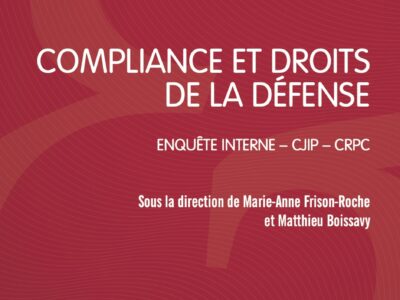
► Full Reference: M.-A. Frison-Roche & M. Boissavy (eds.),
Compliance et droits de la défense. Enquête interne – CJIP – CRPC (Compliance and rights of the defence. Internal investigation – French Judicial Public Interest Agreement – French guilty plea procedure),
Journal of Regulation & Compliance (JoRC) and Dalloz, "
Régulations & Compliance" Serie, 2024, 362 p. -
► General presentation of the book: We do not have an overall view of the relationship between Compliance and the rights of the defence in the continuum of internal investigations and DPA, or in the French legal system the
convention judiciaire d'intérêt public (CJIP) and the
comparution immédiate avec reconnaissance de culpabilité (CRPC), in particular because the texts, whether hard law or soft law, decisions and academic analyses segment them, making it difficult to build a pertinent appreciation of each one. This is made all the more difficult by the fact that we know little about how each of them is applied in practice, both within each of them and in relation to each other. As a result, it is difficult to express overall satisfaction, or total rejection, or to suggest some specific reforms and to precise on what points, to identify the appropriate source of these improvements, legislation, case law, professions, or spontaneous ways of doing. The first ambition of this book is therefore to restore an overall vision, because this is the vision of practice. If shortcomings are found to exist, then they can be more easily denounced. However, some of the situations described may be described as flawed, or even dramatic, by some, while others may consider that they should be approved as they stand. This applies, for example, to the question of whether or not the investigation report should be secret from the prosecuting authority, which may propose a DPA (or in the French legal system a
CJIP), whether or not this
CJIP should be extended to individuals, whether or not a lawyer should be present from the internal investigation stage onwards, whether or not the lawyer should support the interests of the company he/she is investigating and continue to do so before the regulator or the prosecutor, whether or not the investigation is delegated from the public authorities to the company, whether or not the lawyer-investigator and then the lawyer-defendant are both lawyers, whether or not the victims are represented in the the
CIPC process, etc. Depending on what one thinks the relation between Compliance and due process should be in principle and in practice, one expresses a more or less approving or severe judgement on the state of the texts, the soft law nature of most of them making the exercise complicated, and then if there is a gap between them and what one thinks should be the right standard, one asserts that in practice things happen differently from what the texts say, or one considers that the texts should be changed. From point to point, a veritable kaleidoscope emerges in this book. Indeed, the result is a series of contributions that sometimes clash with one another, with a sort of contradictionary principle creeping into the very structure of this book, thus establishing the readesr as a sort of judges themselves , that character who is so absent. He/she will be able to do so, since the book lists texts, describes practices and gives an illustration of everything that can be thought of, in visions that are sometimes analytical and sometimes global, with proposals of reforms of texts, jurisprudence or conduct. The aim of the book is to enable readers to form their own opinions and to take part in what is undoubtedly being strongly debated today: the confrontation between
Compliance and rights of the defence. -
► Summary of the book: The rights of the defence are one of the pillars of our Rule of Law. On the face of it, compliance techniques are not concerned with this under the pretext of efficiency. This would be particularly true in a trilogy that unfolds over time: internal investigation,
convention judiciaire d'intérêt public – CJIP (French Judicial Public Interest Agreement) and
comparution sur reconnaissance préalable de culpabilité – CRPC (French guilty plea procedure). However, because Compliance Law is also the expression of the Rule of Law, in that its ambition is to detect and prevent systemic risks in order to protect present and future human beings, we must go beyond this opposition and articulate
Compliance and rights of the defence. The Monumental Goals of Compliance, which justify its power, for example to obtain information, and the fundamental rights of the defence, which for example impose the presumption of innocence, must be adjusted to each other; by interpreting texts, or even adopting new ones. The book analyses each of these three techniques, in particular the still largely unregulated internal investigation, and sheds light on them in relation to each other, in order to formulate proposals. -
🏗️General construction of the book: The book opens with an
overview divided into three sections. The
first Title compares the challenges of the internal investigation with the rights of the defence. The
second Title compares the issues at stake in the
convention judiciaire d'intérêt public – CJIP (French Judicial Public Interest Agreement) and the
comparution sur reconnaissance préalable de culpabilité – CRPC (French guilty plea procedure) with these same rights of the defence. -
TABLE OF CONTENTS COMPLIANCE ET DROITS DE LA DÉFENSE : VISION D'ENSEMBLE (COMPLIANCE AND RIGHTS OF THE DEFENCE : OVERVIEW) Section 1
♦️ Connaître les pratiques pour redessiner les frontières et accroître les points de contact entre Compliance et droits de la défense dans l’enquête interne, la CJIP et la CRPC. Lignes de force de l'ouvrage Compliance et droits de la défense (Understanding practices to redraw the boundaries and increase the points of contact between Compliance and the rights of the defense in internal investigation, French Judicial Public Interest Agreement and French guilty plea procedure. Main Aspects of the Book Compliance and rights of the defence), by
🕴️Marie-Anne Frison-Roche
Section 2
♦️ Compliance et droits de la défense : toujours pour le respect des droits humains (Compliance and rights of the defence: always for the respect of human rights), by
🕴️Matthieu Boissavy Section 3
♦️ Circuler dans le temps pour mettre en phase Compliance et droits de la défense (Moving through Time to align Compliance and rights of the defence), by
🕴️Marie-Anne Frison-Roche
TITRE I. LES ENJEUX PROCÉDURAUX DE L'ENQUETE INTERNE CONFRONTÉE AUX DROITS DE LA DÉFENSE (TITLE I. PROCEDURAL CHALLENGES OF THE INTERNAL INVESTIGATION IN RELATION TO THE RIGHTS OF THE DEFENCE) CHAPITRE I : VISION GÉNÉRALE DES DROITS DE LA DÉFENSE DANS L'ENQUÊTE INTERNE (
CHAPTER I: OVERVIEW OF THE RIGHTS OF THE DEFENCE IN INTERNAL INVESTIGATION) Section 1
♦️ Approche doctrinale de l’enquête interne et de l’enquête pénale privée (Doctrinal approach to internal investigation and private criminal investigation), by
🕴️Benjamin Fiorini Section 2
♦️ Regard critique : La place des droits de la défense dans l'enquête interne selon le guide AFA/PNF (A critical look: The place of the rights of the defence in the internal investigation according to the AFA/PNF Guide), by
🕴️Margaux Durand-Poincloux,
🕴️David Apelbaum and
🕴️Paola Sardi-Antasan Section 3
♦️ Les conditions de réussite de l'enquête interne dans les rapports entre le Parquet national financier et l’entreprise mise en cause – l’enquête interne au soutien de la défense de l’entreprise (The conditions for a successful internal investigation in the relationship between the French Financial Public Prosecutor's Office and the accused company – the internal investigation in support of the company's defence), by
🕴️Jean-François Bohnert
CHAPITRE II : LES DROITS DE LA DÉFENSE À CHAQUE ÉTAPE DE L'ENQUÊTE INTERNE (CHAPTER II: THE RIGHTS OF THE DEFENCE AT EACH STAGE OF THE INTERNAL INVESTIGATION) Section 1
♦️ La réception des alertes par l'avocat (Reception of alerts by the lawyer), by
🕴️Maria Lancri Section 2
♦️ Collecte et traitement des informations dans les enquêtes internes à l'ère numérique : processus et enjeux (Collecting and processing information for internal investigations in the digital age: processes and challenges), by
🕴️Uriel Goldberg Section 3
♦️ L’apport de la psychologie pour l'effectivité des droits de la défense dans l'enquête interne pour harcèlement au travail (The contribution of psychology to the effectiveness of the rights of the defence in internal investigation for harassment in the workplace), by
🕴️Nathalie Leroy &
🕴️Danièle Zucker Section 4
♦️ Le respect des droits de la défense lors des auditions des enquêtes internes : un gage d’efficacité (Respecting the rights of the defence during hearings in internal investigations: a guarantee of efficacy), by
🕴️Emmanuel Daoud &
🕴️Ghita Khalid Rouissi Section 5
♦️ L’enquête interne au cœur des enjeux de conformité et de justice négociée : analyse de la position de l'AFA et du PNF (The internal investigation at the heart of conformity and negotiated justice issues: analysis of the position of the AFA and the PNF), by
🕴️Éric Russo Section 6
♦️ Le rapport d’enquête interne à l’épreuve des droits de la défense (The internal investigation report put to the test of defence rights), by
🕴️Samuel Sauphanor
CHAPITRE III : LA SPÉCIFICITÉ DES ENQUÊTES INTERNES DANS LES ENTREPRISES INTERNATIONALES ET LA PLACE DES DROITS DE LA DÉFENSE (
CHAPTER III : SPECIFICITY OF INTERNAL INVESTIGATIONS IN INTERNATIONAL COMPANIES AND THE PLACE OF THE RIGHTS OF THE DEFENCE) Section 1
♦️ La spécificité des enquêtes internes pratiquées par les groupes internationaux (Specificity of internal investigations carried out by international groups), by
🕴️Olivier Catherine Section 2
♦️ Garantir la valeur probatoire d’un rapport dans le cadre d’une enquête interne opérée dans une entreprise internationale (Guaranteeing the evidential value of a report in an internal investigation carried out in an international company), by
🕴️Monique Figueiredo Section 3
♦️ La responsabilité de l'entreprise dans la conception et la menée de l'enquête interne (The company's responsibility in designing and conducting an internal investigation), by
🕴️Lydia Meziani Section 4
♦️ Enquêtes internes, enquêtes pénales et droits de la défense : que nous disent les jurisprudences américaine et anglaise (l’affaire Connolly et l’affaire ENRC) ? (Internal investigations, criminal investigations and rights of the defence: what do the US and UK case law tell us (the Connolly case and the ENRC case)?), by
🕴️Victoire Chatelin
CHAPITRE IV : LE RÔLE SINGULIER DE L'AVOCAT DANS L'ENQUÊTE INTERNE (
CHAPTER IV: THE SPECIAL ROLE OF THE LAWYER IN THE INTERNAL INVESTIGATION) Section 1
♦️ La méthodologie propre à l'avocat enquêteur (The investigating lawyer's own methodology), by
🕴️William Feugère Section 2
♦️ L'enquête interne façonnée par la déontologie de l'avocat (The internal investigation shaped by the lawyer's deontology), by
🕴️Stéphane De Navacelle,
🕴️Julie Zorrila and
🕴️Laura Ragazzi Section 3
♦️ Préserver le secret professionnel de l'avocat dans l'enquête interne et son résultat (Preserving the lawyer's professional secrecy in the internal investigation and its outcome), by
🕴️Bénédicte Graulle &
🕴️Yanis Rahim Section 4
♦️ L’avocat-enquêteur en droit du travail : un janséniste au milieu du Far West (The lawyer-investigator in employment law: a Jansenist in the Wild West), by
🕴️Richard Doudet Section 5
♦️ La défense des personnes physiques dans les enquêtes internes (Defending individuals in internal investigations), by
🕴️Dorothée Hever
TITRE II. LES ENJEUX PROCÉDURAUX DE LA CJIP ET DE LA CRPC CONFRONTÉES AUX DROITS DE LA DÉFENSE (
TITLE II. PROCEDURAL CHALLENGES OF THE FRENCH JUDICIAL PUBLIC INTEREST AGREEMENT AND THE FRENCH GUILTY PLEA PROCEDURE IN RELATION TO THE RIGHTS OF THE DEFENCE)
CHAPITRE I : VISION GÉNÉRALE DES DROITS DE LA DÉFENSE DANS LA CJIP ET LA CRPC (
CHAPTER I: OVERVIEW OF THE RIGHTS OF THE DEFENCE IN THE FRENCH JUDICIAL PUBLIC INTEREST AGREEMENT AND THE FRENCH GUILTY PLEA PROCEDURE) Section 1
♦️ Théorie et pratique de la négociation dans la justice pénale (Theory and practice of negotiation in criminal justice), by
🕴️Sarah-Marie Cabon Section 2
♦️ La lutte anti-corruption : l’emprunt au modèle américain et à ses récentes évolutions (The fight against corruption: borrowing from the American model and its recent developments), by
🕴️Stephen L. Dreyfuss Section 3
♦️ Justice pénale négociée : avantages présents, risques à venir (Negotiated criminal justice: curent benefits, future risks), by
🕴️Alexis Bavitot
CHAPITRE II : FORMES ACTIVES DES DROITS DE LA DÉFENSE, LES DIALOGUES À L'OEUVRE OU À PARFAIRE DANS LA CJIP ET LA CRPC (
CHAPTER II: ACTIVE FORMS OF THE RIGHTS OF THE DEFENCE, DIALOGUES AT WORK OR TO BE PERFECTED IN THE FRENCH JUDICIAL PUBLIC INTEREST AGREEMENT AND THE FRENCH GUILTY PLEA PROCEDURE) Section 1
♦️ Combinaison des CRPC et des CJIP : le cas particulier des affaires de fraude fiscale (Combination of the French guilty plea procedure and the French Judicial Public Interest Agreement: the special issue of tax fraud cases), by
🕴️Marion David Section 2
♦️ Pour une justice pénale négociée plus équitable (For a fairer negotiated criminal justice), by
🕴️Astrid Mignon Colombet Section 3
♦️ Les impacts, sur les droits de la défense, des disparités de la justice pénale négociée dans l’Union européenne (The impact on the rights of the defence of the disparities in negotiated criminal justice in the European Union), by
🕴️Emmanuel Moyne Section 4
♦️ L'évolution des rapports entre avocats et autorités de poursuites depuis l'introduction de la CJIP (Developments in relations between lawyers and prosecuting authorities since the introduction of the French Judicial Public Interest Agreement), by
🕴️Thomas Baudesson
CHAPITRE III : LE RÔLE SINGULIER DE L'AVOCAT DANS LA CJIP ET LA CRPC (
CHAPTER III: THE SINGULAR ROLE OF THE LAWYER IN THE FRENCH JUDICIAL PUBLIC INTEREST AGREEMENT AND THE FRENCH GUILTY PLEA PROCEDURE) Section 1
♦️ Quand se justifie et quand s'arrête la collaboration ? À propos de la CJIP (When is collaboration justified and when does it end? About the French Judicial Public Interest Agreement),
by
🕴️Philippe Goossens Section 2
♦️ Le dialogue de l’avocat et de son client, chef d’entreprise, face à la proposition d’une CRPC et d’une CJIP (The dialogue between the lawyer and his client, a company director, faced with the proposal of a French guilty plea procedure or a French Judicial Public Interest Agreement), by
🕴️François Saint-Pierre Section 3
♦️ Le dilemme de l'avocat pénaliste face à la CRPC (The criminal lawyer's dilemma when faced with the French guilty plea procedure), by
🕴️Jean Boudot Section 4
♦️ Défendre les intérêts de la personne physique confrontée à la justice négociée : préserver l’effectivité des droits de la défense et le respect de la présomption d’innocence (Defending the interests of individuals faced with negotiated justice: preserving the effectiveness of the rights of the defence and respect for the presumption of innocence), by
🕴️Capucine Lanta de Bérard &
🕴️Pauline Dufourq Section 5
♦️ Défendre les intérêts des victimes dans la justice pénale économique négociée (Defending victims' interests in negotiated economic criminal justice), by
🕴️Jérôme Karsenti -
🌐follow Marie-Anne Frison-Roche on LinkedIn 🌐follow Marie-Anne Frison-Roche on Instagram 🌐subscribe to the Newsletter MAFR Regulation, Compliance, Law