Vigilance

Couverture – L’Obligation de Compliance

Articles in a JoRC book

📝Contrats et clauses, mise en œuvre et modalités de l’Obligation de Vigilance, in 🕴️M.-A. Frison-Roche (dir.), Collection Régulations & Compliance L’obligation de Compliance

Couverture – L’Obligation de Compliance

Articles in a JoRC book

📝La preuve de la bonne exécution de la Vigilance au regard du système probatoire de Compliance (Proof that Vigilance has been properly carried out with regard to the Compliance evidence system), in 🕴️M.-A. Frison-Roche (dir.), Collection Régulations & Compliance L’obligation de Compliance (“Compliance Obligation”)

► Full Reference: J.-Ch. Roda “La preuve de la bonne exécution de la Vigilance au regard du système probatoire de Compliance (Proof that Vigilance has been properly carried out with regard to the Compliance evidence system)”, in M.-A. Frison-Roche (ed.), L’Obligation de Compliance, Journal of Regulation & Compliance (JoRC) and Éditions Lefebvre – Dalloz, coll. “Régulations & Compliance“, 2025, pp. 679-689. - read a general presentation of the book, L’Obligation de Compliance, in which this article is published - ► English summary of this contribution : Taking the Duty of Vigilance as an illustration, the first part of the article examines the question of who must prove about that and in what order. There are no rules in the legal dispositions specific to the Vigilance Duty duty that expressly reverse the burden of proof, to the extent of placing it on the company that should demonstrate that it has correctly fulfilled its obligation. Instead, it is needed to return to general law, which makes the burden of proof vary according to the nature of the obligations incumbent on the company as a result of its Duty of Vigilance, in particular between simplly drawing up a plan and drawing it up such that its effectiveness can be expected to give rise to an obligation on those who dispute it to demonstrate its ineffectiveness. In any event, the 2 litigant parties immediately seek to fuel the debate with elements in their favour, whatever their position in the process. This brings us to the second part of the article, devoted to the question of what constitutes proof of proper performance of the Vigilance Duty. Requiring proof of a positive fact and the constitution of a self-evidence of conformity would both be excessive and would distance the company from the Monumental Goals that are its compass. Instead, it is pertinent to distinguish between Compliance Structures, for which the proof requirements must be high, and Expected Compliance Actions, for which proof of efforts is sufficient, the obligation being only of means. In fact, companies will be wise to provide proof of their efforts as early as possible. The third part therefore deals logically with the means of proof available to the parties. Claimants act on the principle of freedom of evidence and benefit from numerous sources of information, but the most serious difficulties arise when the facts to be proven are located outside the European Union. The company can establish that the plan has been implemented using various types of evidence, but it would appear that the standard of proof is high, even if the Vigilance Plan were to be regarded as an act of management. - 🦉This article is available in full texte for people who follow Professor Marie-Anne Frison-Roche teaching
Couverture – L’Obligation de Compliance

Articles in a JoRC book

📝La Vigilance, pointe avancée et part totale de l’Obligation de Compliance (Vigilance, the cutting edge and a full part of the Compliance Obligation​), in 🕴️M.-A. Frison-Roche (dir.), 📕L’obligation de Compliance

► Full Reference: M.-A. Frison-Roche, "La Vigilance, pointe avancée et part totale de l’Obligation de Compliance" (Vigilance, the cutting edge and a full part of the Compliance Obligation), in M.-A. Frison-Roche (ed.), L'Obligation de Compliance, Journal of Regulation & Compliance (JoRC) and Dalloz, coll. "Régulations & Compliance" 2025, pp. 511-536. - 📝read the article (in French) - 🚧read the bilingual Working Paper on the basis this contribution has been built, with  more developments, technical references and hyperlinks.  - 📕read a general presentation of the book, L'Obligation de Compliance, in which this article is published  - ► English summary of this contribution : The "duty of vigilance" unleashes all the more radical and passionate positions, sometimes among Law professors, because it has not been precisely defined. One word is used for another, either inadvertently or deliberately, deliberately if it can attract this or that element from one legal corpus and import it into another.  The very exercise of definition is therefore required in practice. There are specific obligations of vigilance that come under such and such a body of regulations and are imposed on such and such a category of operators to fulfill such and such a function. These are precise circles which are not confused and must not be confused. This is superimposed on what the French 2017 law so-called "Vigilance law", which is much more encompassing since it applies to all large companies in the operation of the value chains they have set up. The European 2024 directive is in the same way. But there is no general duty or obligation of Vigilance. Such a claim would be based on confusing or shifting each of these 3 levels, which must be avoided because no positive law does support this (I). If the duty of vigilance is attracting so much attention, whether or not the European CS3D is fully effective, it is because Vigilance is the "cutting edge" of Compliance Obligation (II). Vigilance requires companies, by consideration of their power and without reproaching them for it or demanding that it be reduced, to detect risks of damage to the environment and climate, but also to human rights, because they are in a position to do so in order to prevent them from turning into disasters. In this respect, the  Vigilance duty makes clearer the exact legal nature of the Compliance Obligation. Moreover, Vigilance appears as the Total Part of the Compliance Obligation (III). Indeed, although it is restricted to one area, the value chain, and to two types of risk, deterioration of the environment and deterioration of human rights, it expresses the totality of the Compliance Obligation by means of tools that the 2017 French "Vigilance law" had itself duplicated from the 2016 so-called "Sapin 2 law": to preserve systems today, but above all tomorrow, in order they do not collapse (Negative Monumental Goals), or even consolidate them (Positive Monumental Goals), so that the human beings who are willingly or unwillingly involved in them are not crushed by them but benefit from them. This is why large companies are subject to the Obligation of Compliance and Vigilance, particularly in the humanist conception that Europe is developing. The result is a new type of Litigation, of a systemic nature, for which the Courts have spontaneously become specialised, and for which the procedures will have to be adapted and the office  of the Judge shall have to evolve. - follow Marie-Anne Frison-Roche on LinkedIn follow Marie-Anne Frison-Roche on Instagram subscribe to the Newsletter MAFR Regulation, Compliance, Law subscribe to the Video Newsletter MAFR Surplomb
Couverture – L’Obligation de Compliance

Articles in a JoRC book

contribution dans a collective legal publication

📝Compliance et Responsabilité civile : comprendre et raison garder (Compliance, Vigilance and Civil Liability: put in Order and keep the sense of Reason), in 🕴️M.-A. Frison-Roche (dir.), 📕L’Obligation de Compliance

► Full Reference: M.-A. Frison-Roche, "Compliance, Vigilance et Responsabilité civile : mettre en ordre et raison garder" (Compliance, Vigilance and Civil Liability: put in Order and keep the sense of Reason), in M.-A. Frison-Roche (dir.), L'Obligation de Compliance, Journal of Regulation & Compliance (JoRC) and Lefebvre-Dalloz, coll. "Régulations & Compliance", 2025, pp. 635-659. - 📝read the article (in French) - 🚧read the bilingual Working Paper on which this article is based, with additional developments, technical references and hyperlinks - 📕read the general presentation of the book, L'Obligation de Compliance, in which this article is published 📚see the general presentation of the series "Régulations & Compliance" in which this book is published - ► English summary of this article: The descriptions of the Liability incurred by large companies as a result of their compliance obligations are very diverse, even contradictory, going beyond the wishes that may be expressed as to what this liability should be. The first part of this study therefore sets out the various liabilities incurred by companies, which differ in the conditions under which they are implemented and in their scope, so as not to confuse them. Indeed, as the various laws establish specific legal compliance obligations, they give rise to liabilities of varying conditions and scope, and it is not possible to avail of the regime of one in a situation that falls within the scope of another. It is therefore necessary to review the various bodies of compliance legislation, the GDPR, the ALM-FT regulations, the French so-called Sapin 2 law, the French so-called Vigilance law , the European IA Act , the European European DGA Act, etc., to recall the inflexion that each of these bodies of legislation has made to the liability rules applied to the companies subject to them. Nevertheless, the unicity of the Compliance Obligation, overcoming this necessary diversity of situations, regulations and liability regimes,  can provide grouping lines to indicate beyond this diversity the extent of the liability incurred by companies. Once this classification has been made, the second part of the study develops the observation that none of this can create any principle of general liability on large companies in terms of compliance, and in particular not in terms of vigilance. It is not possible to deduce a general principle of specific obligations of liability or specific obligations to reparation, for example in the area of vigilance, as the texts creating specific vigilance obligation refer to the conditions of commun Tort Law (proof damage and causality), and International Public Law does not have the force to generate a general principle binding companies in this respect. The third part stresses that it is nevertheless always possible to invoke Tort Law, and companies cannot claim to escape this. This may involve contractual liability, a situation  becoming increasingly frequent as companies contractualise their legal compliance obligations, reproducing them but also modifying them, and as Vigilance duty is an obligation that goes beyond the specific situations covered by the regulations.  But it is essential, and this is the subject of the fourth part, not to make companies pure and simple guarantors of the state of the world, present and future. Indeed, if we were to transform sectoral compliances into illustrations of what would then be a new general principle, but one that applied only to them, they would consequently exercise the other side of this coin, namely power over others. - follow Marie-Anne Frison-Roche on LinkedIn follow Marie-Anne Frison-Roche on Instagram subscribe to the Newsletter MAFR Regulation, Compliance, Law subscribe to the Video Newsletter MAFR Surplomb subscribe to the Newsletter MaFR Droit & Art
Couverture – L’Obligation de Compliance

Articles in a JoRC book

GAUVAIN, Raphaël🕴️ & BALIAN, Blanche🕴️

📝Opposition et convergence des systèmes juridiques américains et européens dans les règles et cultures de compliance (Opposition and Convergence of American and European Legal Systems in Compliance Rules and Cultures), in 🕴️M.-A. Frison-Roche (dir.), Collection Régulations & Compliance L’Obligation de Compliance

► Full Reference: R. Gauvain & B. Balian, “Opposition et convergence des systèmes juridiques américains et européens dans les règles et cultures de compliance” (“Opposition and Convergence of American and European Legal Systems in Compliance Rules and Cultures”), in M.-A. Frison-Roche (ed.), L’Obligation de Compliance, Journal of Regulation & Compliance (JoRC) and Editions Lefebvre – Dalloz, “Régulations & Compliance” Serie, 2025, pp. 401-417. - read the general presentation of the book, L’Obligation de Compliance, in which this article is published - ► English Summary of this contribution (done by the Journal of Regulation & Compliance – JoRC) : The authors approach Compliance Law through its tools, mainly compliance programmes through which companies comply with regulations and investigations conducted by companies at the request of public authorities to identify risks and new modes of defence consisting of entering into agreements with prosecuting authorities. The article highlights the American inspiration behind this movement, whereby the State, primarily for the sake of efficiency, transfers the responsibility for pursuing “Monumental Goals” to businesses. Based on this, the article first shows how American mechanisms have been imported into Europe, particularly France, with the Convention judiciaire d’intérêt public, taking on many of the characteristics of the DPA, even if some specific features remain, for example in the alert mechanisms. Secondly, the convergence between the two systems is shown, because through the compliance obligations that form the core of these compliance tools, it is always Western values that are expressed, values that are common to American Law and European Law and European countries. It has enabled this importation, and we can now see that these values are more strongly upheld by Europe, particularly through the Vigilance duty and the DSA. - 🦉This article is available in full text (in French) to those registered for Professor Marie-Anne Frison-Roche’s courses -

Articles in a legal collective publication

article in a collective book

📝Compliance, in 🕴️J.-Fr. Kerléo & 🕴️E. Lemaire (dir.), 📗Dictionnaire de l’éthique publique

► Full Reference:: M.-A. Frison-Roche, "Compliance", in J.-Fr. Kerléo & E. Lemaire (dir.), Dictionnaire de l'éthique publique, LexisNexis, 2025, pp.  - 📗 read the general presentation of the Dictionary. - 📝read the article (in French). - ► English Summary of the article defining what is Compliance: The article explains Compliance in 7 points. Firstly, it states that Compliance oscillates between a weak and a strong definition. It can be defined weakly as the demonstration of obedience to all applicable regulations, or it can be defined strongly as active participation in the achievement of 'monumental' ambitions for the future of the social group. Positive legal rules and case law are increasingly revealing the relevance of the strong definition, with the weak definition referring only to conformity to the Law. Secondly, this understanding of the new branch of Law known as Compliance Law will enable us to master the regulations specifically relating to compliance (RGPD, French laws such as Sapin 2 Act and Vigilance Act, AML/FT, European AI Act, etc.), which are both more specific and more restrictive than the general obligation to comply with the applicable legal rules. Thirdly, everyone can see the move from "extraterritoriality" to another thing which is the indifference to territoryd: Compliance is the right instrument for the digital space and for chains of activities. Fourthly, this is due to the very nature of Compliance, which consists in internalising in companies in a position to be active the “Monumental Negative Goal” of preventing the collapse of systems (energy, climate, digital, banking, financial, algorithmic, etc.). Fifthly, this internalisation is carried out by States and public authorities in entities in a position to act, i.e. in concrete terms in companies in a position to be active to reach the “Monumental Goals” by contributing to the improvement of systems so that these systems benefit in the present and the future the people who are de jure and de facto involved in them. Sixthly, these goals become positive when it comes to educating people about probity and effective equality between human beings, notably through training policies. In this respect, Vigilance is the “cutting edge” of Compliance. Seventhly, an “ex ante responsibility” of Crucial Operators subject to Compliance is emerging, and is articulated by Systemic Litigation which aims to balance and maintain systems, carried by States and these crucial companies. - 📝read the preentation of the other article written by Marie-Anne Frison-Roche for this Dictionary: "Régulation" - follow Marie-Anne Frison-Roche on LinkedIn follow Marie-Anne Frison-Roche on Instagram subscribe to the Newsletter MAFR Regulation, Compliance, Law subscribe to the Video Newsletter MAFR Surplomb subscribe to the Newsletter MaFR Droit & Art

Working papers

Working Paper serving as the basis for an article concluding a book

🚧Taking into account the legal landscape in Africa to fulfil the Vigilance Obligation

► Full reference : M.-A. Frison-Roche, Taking African legal geography into account to achieve an efficient vigilance system, working paper, August 2025/February 2026 - 🎤This working paper follows on from the closing address at the symposium Devoir de vigilance, quelles perspectives africaines ? Regards croisés en droit international, droit comparé et droit OHADA (Vigilance Duty: what are the prospects in Africa? Perspectives from international law, comparative law and OHADA Law, organised by the Faculty of Law of Bordeaux, through its Institut de Recherches en Droit des Affaires et du Patrimoine – IRDAP (Institute for Research in Business and Property Law), held on 15 November 2024.  - 📝This working paper forms the basis of the article "Considérer la géographie juridique africaine pour y réussir l'obligation de vigilance", which concludes the volume edited by Eustache da Allada in 2026 by Éditions Lefebvre-Dalloz, in the “Thèmes & Commentaires” collection,📗Devoir de vigilance, quelles perspectives africaines ? Regards croisés en droit international, droit comparé et droit OHADA (Vigilance Duty: what are the African perspectives? Comparative perspectives in international law, comparative law and OHADA Law). To this end, following an initial draft in August 2025, it was revised a second time to better incorporate the written contributions that make up the book, since the article on which it is based sets out a personal approach drawing on external research whilst also needing to synthesise these contributions. - ► Summary of the working paper :  The French “Vigilance” Act of 2017 incorporated the technical provisions and the spirit of the “Sapin 2” Act of 2016. They share a common goal. They have been and remain a common source of controversy and passion. At their heart lies the establishment of a “compliance obligation”, for which vigilance techniques form the “edge ” in serving a grand ambition: to protect systems from risks, both now and in the future, in order to protect the people involved in them. The passion that continues to surround the Vigilance Act, which gave rise to the European CS3D , is misguided, because the law and passion are never allies. Some would passionately want to see vigilance triumph by condemning companies to perform miracles; others would passionately want to see the destruction of all the texts that established the very concept of this Compliance Law, built upon these Humanist Monumental Goals. But let us acknowledge that in these debates on the Vigilance Obligation, which is being legally implemented across value chains, Africa is often cited as an example in a general discussion. It is not often considered as a distinct case with its own legal landscape. No reliance is placed on its strengths or on its own legal mechanisms, even though value chains – particularly industrial ones – so often lead to it, both now and in the future. Through analyses of the Vigilance Obligation, Africa is perceived as a place of retribution or of a new form of paternalism, and when its future is envisaged, prospects seem to be lacking, even though the very essence of compliance—and therefore of Vigilance—is the future.  If we take a less confrontational view and focus instead on the ‘legal geography’ of African countries and their social and inter-state structures, we see that the concern for others, both present and future – which ultimately constitutes the Monumental Goal of Compliance Law and thus of the Vigilance Obligation – is more prevalent in Africa than it is in Europe, which is now built upon legal individualism. This concern for others is reflected in legal mechanisms akin to mediation and various legal structures that our own institutions would do well to heed: our legislators before adopting bills, and our judges who might listen to them as amici curiae before reaching a decision. If we turn our attention to the African continent, which is exploited by certain segments of value chains, and to labour organisations, it becomes clear that here too, legislation and sanctions are not the whole story. Compliance techniques that make use of soft law and the contractual frameworks underpinning the chains themselves can remove the element of abstraction that is, by nature, inherent in general legislation. Moving forward through contracts under the supervision and with the support of the courts is an approach that could prove more fruitful than well-intentioned legislation, which has served as a catalyst, in line with the privileged position of contract law within OHADA. This serves to enhance the judge’s authority. The Compliance Judicialisation is also linked to the growing connection between Compliance and Contracts. However, it appears that not only can European judges specialising in Compliance Law and Vigilance Obligation thus rule on matters concerning Africa, which they can only know from a distance – though it is the lot of every judge to be an outsider – but African and inter-state Courts, notably through OHADA, can address the Vigilance Obligation because value chains are constituted by contracts. By developing it not as a foreign concept to be assimilated, but as that which expresses the very heart of the Law in Africa: concern for others, solidarity, the search for compromises and solutions so that the social and environmental system – that is to say, the human system – may endure into the Future. - 🔓Read the developments below⤵️ - Follow Marie-Anne Frison-Roche on LinkedIn follow Marie-Anne Frison-Roche on Instagram Subscribe to the newsletter MAFR Regulation, Compliance, Law Subscribe to the video newsletter MAFR Surplomb Subscribe to the newsletter MaFR Law & Art

Working papers

Working Paper for 📺Overhang (News)

🚧The Contract, a Compliance tool: the Obligation for a platform to control content (French Supreme Judicial Court, 15 January 2025) :

► Full Reference: M.-A. Frison-Roche, The Contract, a Compliance tool: the Obligation for a platform to control content CE, 27 January 2025, B. c/ CNIL, Working Paper, March 2025. - 🎤 This Working Paper was developed as a basis for the Overhang👁 video  on 29 March 2025 : click HERE (in French) - 🎬🎬🎬In the collection of the Overhangs👁 It falls into the News category. ►Watch the complete collection of the Overhangs👁 : click HERE - ► Summary of this Working Paper: The ruling handed down on 15 January 2025 by the Commercial, Economic and Financial Chamber of the French Judicial Supreme Court (Cour de cassation) provides a solution to the issue of content control in the digital environment. It resolves what appears to be the aporia so often emphasised, and even claimed, namely the impossibility of developing an effective controlling technology. To do this, the Court disregarded the applicable laws and referred to the electronic payment contract between the bank and the platform, which contained a clause on Vigilance against unlawful content, linked to a termination clause. It held that this clause was fully effective. This solution, so simple and so strong, can make a major contribution to regulating the digital space, if the banks so wish, because what platform can do without reliable electronic payment services?   - 🔓read the developments below⤵️ - follow Marie-Anne Frison-Roche sur LinkedIn follow Marie-Anne Frison-Roche on Instagram subscribe to the Newsletter MAFR Regulation, Compliance, Law  subscribe to the Video Newsletter MAFR Surplomb

Working papers

Working Paper for 📺Overlook

🚧The puzzle of Institutional Compliance Law and Substantive Compliance Law: the example of the European Regulations of 31 May 2024 on AMLA and enterprises compliance obligations

► Full Reference: M.-A. Frison-Roche, The puzzle of Institutional Compliance Law and Substantive Compliance Law: the example of the European Regulations of 31 May 2024 on AMLA and enterprises compliance obligations​, Working Paper, January 2025.   - 🎤 This Working Paper was developed as a basis for the Overhang👁 video  on 11 January 2024 :   - 🎬🎬🎬In the collection of the Overhangs👁 It falls into the News category. ►Watch the complete collection of the Overhangs👁 : click HERE - ► Summary of this Working Paper: Compliance Law is built on 2 legs, Institutions on the one hand and substantive rules on the other. For example in the United States, the 1934 Act established at the same time the prohibition and prevention of financial market abuse and the SEC. In Europe, in 2013, the Banking Union established institutions to build this Union and increased the obligations on banks. This is perfectly illustrated by the 2 European Regulations of 31 May 2024, one creating the AMLA and the other reinforcing the compliance obligations of crucial economic operators, one text referring to the other. Indeed, Institutional Compliance Law and Substantive Compliance Law are like 2 articulated legs. You have to know both and make them work together. This is part of the "European puzzle", a positive expression which implies that, when assessing and interpreting a text, we should always bear in mind that it is only one element of a general picture, which is coloured by its Monumental Goal: in this case to obtain a European area where money laundering is efficiently prevented thanks to the action of the companies themselves under the supervision and support of a Supervisory Authority which coordinates the actions of the States. If we consider only one element, we find everything 'complicated', whereas the overall picture is simple, because the Goal is simple and in Compliance Law, a branch of Teleological Law, everything is in the Monumental Goal.   - 🔓read the developments below ⤵️ - suivre Marie-Anne Frison-Roche sur LinkedIn suivre Marie-Anne Frison-Roche sur Instagram s'abonner à la Newsletter MAFR Regulation, Compliance, Law  s'abonner à la Newsletter en vidéo MAFR Surplomb

Organisation of events

🧱⚙️scientifi organisation and moderation of 🧮Le Droit processuel de la Vigilance (Vigilance General Procedural Law), in cycle de conférences-débats “Contentieux Systémique Émergent”

► Full Reference: Le Droit processuel de la Vigilance (Vigilance General Procedural Law), in cycle of conference-debates "Contentieux Systémique Émergent" ("Emerging Systemic Litigation"), organised on the initiative of the Cour d'appel de Paris (Paris Cour of Appeal), with the Cour de cassation (French Court of cassation), the Cour d'appel de Versailles (Versailles Court of Appeal), the École nationale de la magistrature – ENM (French National School for the Judiciary) and the École de formation des barreaux du ressort de la Cour d'appel de Paris – EFB (Paris Bar School), under the scientific direction of Marie-Anne Frison-Roche, November 18, 2024, 11h-12h30, Cour d'appel de Paris, Cassin courtroom - ► Presentation of the conférence:  - 🧮Programme of this event:  Seventh conference-debate LE DROIT PROCESSUEL DE LA VIGILANCE (VIGILANCE GENERAL PROCEDURAL LAW) Paris Court of Appeal, Cassin courtroom Presentation and moderation par Marie-Anne Frison-Roche, Professor of Regulatory and Compliance Law, Director ot the Journal of Regulation & Compliance (JoRC) 🕰️11h-11h20. 🎤, by 🕴️Marie-Anne Frison-Roche, Professor of Regulatory and Compliance Law, Director ot the Journal of Regulation & Compliance (JoRC) 🕰️11h20-11h40. 🎤, by 🕴️Natalie Fricero, Emeritus Professor of Law at Côte d'Azur University 🕰️11h40-12h30. Debate - 🔴Registrations and information requests can be sent to: inscriptionscse@gmail.com 🔴For the attorneys, registrations have to be sent to the following address: https://evenium.events/cycle-de-conferences-contentieux-systemique-emergent/  ⚠️The conference-debates are held in person only, in the Cour d’appel de Paris (Paris Court of Appeal). -

Conferences

Conference

🎤Choix et embranchements de compétences lorsqu’un enjeu de vigilance est allégué (Choice and Branching of Jurisdiction when a Vigilance issue is Alleged), in 🧮Le Droit processuel de la Vigilance (Vigilance General Procedural Law)

► Full Reference: M.-A. Frison-Roche, "Choix et embranchements de compétences lorsqu'un enjeu de vigilance est allégué" ("Choice and Branching of Jurisdiction when a Vigilance issue is Alleged"), in Le Droit processuel de la Vigilance (Vigilance General Procedural Law), in cycle of conference-debates "Contentieux Systémique Émergent" ("Emerging Systemic Litigation"), organised on the initiative of the Cour d'appel de Paris (Paris Cour of Appeal), with the Cour de cassation (French Court of cassation), the Cour d'appel de Versailles (Versailles Court of Appeal), the École nationale de la magistrature – ENM (French National School for the Judiciary) and the École de formation des barreaux du ressort de la Cour d'appel de Paris – EFB (Paris Bar School), under the scientific direction of Marie-Anne Frison-Roche, November 18, 2024, 11h-12h30, Cour d'appel de Paris, Cassin courtroom - 🕴️An other speaker to this conference is Natalie Fricero, Emeritus Professor at Côte d'Azur University 🧮see the full programme of this event - ⚙️This event was conceived as part of the "Emerging Systemic Litigation" cycle of conference-debates, organized by the Paris Court of appeal, in conjunction with the French Court of cassation, the Versailles Court of appeal, the French National School for the Judiciary and the Paris Bar School, under the scientific direction of Marie-Anne Frison-Roche. - ► English Summary of the conference: This speech opens the conference. It therefore logically focuses on the question of "jurisdictional competence". It is divided into successive points which are progressively linked to each other. The first point consists to insist on this rule : the organisation of the courts and their jurisdiction can never be detached from the substance of the matter in dispute. This explains why the issue of jurisdiction is such a source of passion for as long as the very definition of Vigilance remains so contentious, and why the 2021 legislature's belief that it could put out the fire has only served to exacerbate it. The second point relates to the first proposed solution, i.e. maintaining the exclusivity of the Paris First Judicial Court, which is acceptable in principle because by specialising judges acquire a "technical competence" but which presents a very damaging "Bibendum risk". The third point relates to the second solution proposed, namely the reference to the Motulskian notion of the 'basis of demand', which provokes a fork in the road, with the risk of interminable conflicts and divergent interpretations. The fourth point is the need to find the best solution, i.e. the least bad solution, consisting above all of forming practical alliances, without requiring new texts, for this particular type of litigation which does not come under any branch of Law and which justifies a dialogue between the heads of the courts.           - 🔓read the key points of this speech below ⤵️ - follow Marie-Anne Frison-Roche on LinkedIn follow Marie-Anne Frison-Roche on Instagram subscribe to the Newsletter MAFR Regulation, Compliance, Law subscribe to the Newsletter Surplomb, par MAFR
Conferences

Conference

🎤Les spécificités à concevoir dans l’audience publique des contentieux systémiques de vigilance (The Specific Features of Public Hearings to conceive on Vigilance Systemic Litigation), in 🧮Le Droit processuel de la Vigilance (Vigilance General Procedural Law)

► Full Reference: M.-A. Frison-Roche, "Les spécificités à concevoir dans l'audience publique des contentieux systémiques de vigilance" ("The Specific Features of Public Hearings to conceive on Vigilance Systemic Litigation"), in Le Droit processuel de la Vigilance (Vigilance General Procedural Law), in cycle of conference-debates "Contentieux Systémique Émergent" ("Emerging Systemic Litigation"), organised on the initiative of the Cour d'appel de Paris (Paris Cour of Appeal), with the Cour de cassation (French Court of cassation), the Cour d'appel de Versailles (Versailles Court of Appeal), the École nationale de la magistrature – ENM (French National School for the Judiciary) and the École de formation des barreaux du ressort de la Cour d'appel de Paris – EFB (Paris Bar School), under the scientific direction of Marie-Anne Frison-Roche, November 18, 2024, 11h-12h30, Cour d'appel de Paris, Cassin courtroom - 🕴️An other speaker to this conference is Natalie Fricero, Emeritus Professor at Côte d'Azur University 🧮see the full programme of this event - ⚙️This event was conceived as part of the "Emerging Systemic Litigation" cycle of conference-debates, organized by the Paris Court of appeal, in conjunction with the French Court of cassation, the Versailles Court of appeal, the French National School for the Judiciary and the Paris Bar School, under the scientific direction of Marie-Anne Frison-Roche. - ► English Summary of the conference:  - follow Marie-Anne Frison-Roche on LinkedIn follow Marie-Anne Frison-Roche on Instagram subscribe to the Newsletter MAFR Regulation, Compliance, Law subscribe to the Newsletter Surplomb, par MAFR

Conferences

Conference

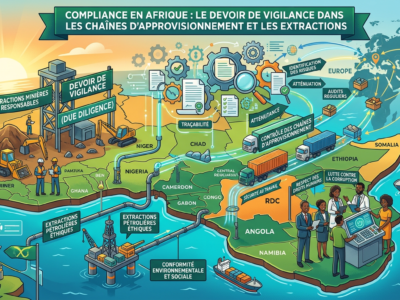
🎤Considérer la géographie pour réussir le Devoir de Vigilance (Taking Geography into account for a successful Vigilance Duty), in 🧮Devoir de vigilance, quelles perspectives africaines ? Regards croisés en droit international, droit comparé et droit OHADA

► Full Reference: M.-A. Frison-Roche, "Considérer la géographie pour réussir le Devoir de Vigilance" ("Taking Geography into account for a successful Vigilance Duty"), concluding speech in Devoir de vigilance, quelles perspectives africaines ? Regards croisés en droit international, droit comparé et droit OHADA (Vigilance Duty : what African perspectives? Cross-analysis of International Law, Comparative Law and OHADA Law), Institut de Recherche en Droit des Affaires et du Patrimoine (IRDAP), Bordeaux, 15 November 2024. - 🧮see the full programme of this manifestation (in French) - ► English summary of this concluding speech: This concluding speech was made "on the bench", i.e. directly after listening to all the day's speakers. It is not, therefore, based on an a priori conception of the subject, but on the impression that emerged from the whole, as one speaker followed another. The general impression is that these compliance instruments, of which the vigilance tool is the spurred head, are only appropriate if they fulfill the purpose for which they were devised and imposed, which presupposes that they are appropriate to the concrete situations to which they apply: to the country, to the legislation that shapes and expresses this country, to its economy, to its population. There is certainly room for improvement. But Vigilance legal instruments, like Compliance Law, are new mechanisms that are in the process of taking shape: we must seek to improve them and find solutions: 🧱🕴🏻mafr, 🚧Duty of Vigilance: the way forward, 2024   This is not easy, especially if we get lost in the jigsaw puzzle of texts and decisions in which the vigilance technique fits, particularly at French, European and international level: 🧱🕴🏻mafr, 🚧Vigilance, a piece of the European puzzle, 2023   Listening to all the many and varied speakers, it is clear that progress needs to be made to ensure that the Vigilance instrument takes greater account of the concrete situations reflected in the various legal systems of African countries, and in particular the unified OHADA legal system. It can be done, as long as everyone is willing to bear it in mind. 🧱🕴🏻J.-B. Racine, 📝Geographical dominance in the choice and the use of compliance tools. Introductory remarks, in 🧱🕴🏻mafr (ed.), 📘Compliance Tools, 2021   The speakers demonstrated that the good feelings of Paris or Brussels can pave the way for African hell, for example when about the children labour. The same is true of the fight against corruption, as Mohamed Salah showed. 🧱🕴🏻M.M. Salah ,📝Conception and Application of Compliance in Africa, in 🧱🕴🏻mafr (ed.), 📘Compliance Tools, 2021 - Meanwhile, listening to each other, it appears that often, despite using the same words, the speakers were not talking about the same thing, particularly not in terms of what the very term "Vigilance" refers to, the difference between the French and English being a challenge because "due diligences" are not the same than Vigilance duty . This is a sign that what we call a duty, or an obligation, or a spontaneous commitment, or a legal order criminally sanctioned, which are not at all the same thing, shows the immaturity of this notion of "Vigilance". What's more, we sometimes talk about the climate, or human rights, or the need to fight corruption or money laundering. These latter concerns are undoubtedly covered by texts classified under Compliance Law, some of which assert that Vigilance is the cutting edge, while others claim that Compliance is alien to or merely a component of Vigilance, because Vigilance embraces ethics, while Compliance is merely obedience to the norm ('conformity'). It is clear that the absence of an agreement on definitions is a handicap in practice, as we do not know which legal regime will apply. This uncertainty is problematic in practice because the regulations don't  lay down definitions which alone make it possible to deduce the outline of the obligations of each party, particularly not those of the companies, which ask for instructions for use. Companies receive contradictory interpretations for the same situation, depending on who you are dealing with (a regulator or an NGO for example) or depending on the text (a text specific to the industrial activity, a text specific to the country, or a text from the country of the ordering company on the duty of vigilance, or a text from ordinary contract law or a text that will come from a soft law that remains rather mysterious).   This uncertainty feeds the passion that surrounds the issue of vigilance, with everyone speaking out, the specialists who want to talk about it being suspected of being a technocrat or captured, and those who don't speak out being the local population for whom others speak out. As a result, two phenomena are set to persist, which we had hardly anticipated but which are set to increase: the contractualisation of all vigilance mechanisms and the jurisdictionalisation of all vigilance organisation. - The first phenomenon is the contracting of Vigilance. This contractualisation is the means by which companies have been carrying out their legal compliance obligations for years, using a contractual art that is becoming increasingly sophisticated. We have very little information on these contracts, which are nonetheless what allow companies to obey the regulations and also to add to them, a combination of obedience and contractual freedom, the effects of which in practice have not yet been fully measured. 🧱🕴🏻mafr, 🚧Will, Heart and Calculation, the Three Traits Encercling the Compliance Obligation, 2024 🧱🕴🏻mafr (ed.), 📘Compliance and Contract, 2025   But they do raise essential questions. Firstly, they will bring back the jurisdiction of general courts , for example the commercial courts (tribunaux de commerce) in France, and the courts of the countries where the industrial operations take place: moreover, they are the natural route to international arbitration. They are a new type of contract, since they structure "value chains" (a managerial concept). 🧱🕴🏻mafr, 🚧Compliance Contract, Compliance Clauses, 2022   There are two key issues concerning these contracts: they directly concern African countries, their economic activity and their populations, as described throughout all the speeches. The first is to know who governs the structural apparatus constituted by these 'regulatory contracts' through which chains of activity are built as durable structures. Who is strong and who is weak, between companies and states? The second is to find out how much of the reality of the country and of local economic activity is taken into account by the subsidiary, and how much consideration is given to the local people involved: are the people who are actually involved really "taken into consideration" when we speak for them? Who is best placed to speak on their behalf, to defend them, to get to know them? If we want to contextualise, refine and get to know the situation as closely as possible, in other words if we want to have definitions so that we know what we are talking about, but at the same time start from geographical and human realities, then it is the Judge who appears because the court starts from the facts. - This is the second phenomenon that has emerged and is set to increase: the jurisdictionalisation of Vigilance. 🧱🕴🏻mafr (ed.), 📘Compliance Jurisdictionalisation, 2023 This is understandable, since the judge is able to take cognisance of the facts, the situation in Uganda or Tanzania, and what is often referred to as the "extraterritoriality" of the Compliance mechanisms being thus compensated for. However, the exclusive jurisdiction of the Paris Court of First Instance (decided in France by a 2021 law) may become more difficult, as it is even further away from Africa than the ordering company is. But it is precisely the contract judges who can be called upon to rule on the basis of Contract Law. This central role of the judge raises a number of procedural difficulties that have either not yet been resolved, moreover are not still being perceive 🧱🕴🏻mafr (dir.), 🧮Le Droit processuel de la Vigilance (Vigilance Genreral Procedural Law), 2024   At the interface between procedure and substance, evidentiary issues require the development of a new evidentiary system. When the relevant facts are in Africa but the company accountable for them is in France under legislation adopted in Europe, this must be taken into account. 🧱🕴🏻mafr, 📝The Judge, the Compliance Obligation and the Company. The Compliance Evidence System, in 🧱🕴🏻mafr (ed.), 📘Compliance Jurisdictionalisation, 2023   What's more, since the Monumental Goal is to prevent, manage and detect risks, it is the future that is the main object of proof. A difficult subject by its very nature of the future, which calls for caution. Caution is to be expected from Judges, who may prefer the solution of an agreement: the contract and the commitment come back, for example through mediation, among the methods of conflict resolution. But as close as possible to where it happens, OHADA's courts can then be called upon to hear States and populations.   What is more, in contractualisation (at which point the two major phenomena, contractualisation and jurisdictionalisation, enter into a dialectic), the clauses work together to activate the natural judge of the international contract, including vigilance clauses: the international arbitrator. 🧱🕴🏻L. Aynès, 📝How international arbitration can reinforce the Compliance Obligation, in 🧱🕴🏻mafr (ed.), 📘Compliance Obligation, 2025   OHADA has institutional arbitration mechanisms. Now is the time to guide them so that they open up Africa to Vigilance and open up Vigilance to Africa. In concrete terms. - follow Marie-Anne Frison-Roche on LinkedIn follow Marie-Anne Frison-Roche on Instagram subscribe to the Newsletter MAFR Regulation, Compliance, Law subscribe to the Newsletter Surplomb, par MAFR
Articles in a legal collective publication

Article in a collective legal publication

📝Devoir de vigilance : progresser (“Duty of Vigilance: the Way Forward), in 🕴️Ch. Maubernard & 🕴️A. Brès (eds.), 📗Le devoir de vigilance des entreprises. L’âge de la maturité ?

► Full Reference: M.-A. Frison-Roche, "Devoir de vigilance : progresser" ("Duty of Vigilance: the Way Forward"), in Ch. Maubernard & A. Brès (eds.), Le devoir de vigilance des entreprises. L'âge de la maturité ? (The duty of vigilance. The age of maturity?), Bruylant, "Droit & Economie" Serie, 2024, pp. 221-251 - 📝read the article (in French)  - 🚧 read the bilingual Working Paper which is the basis of this article, with additional developments, technical references and hyperlinks - ► English Summary of the article: In 2017 in France the so-called Vigilance law expressed great ambition. So did the draft directive. But in 2024 the European institutions moderated this ambition by refusing to increase either the type of companies subject and the constraints to which the duty of vigilance is associated. The directive has essentially halted what was for some the "march of progress". Does the ambition no longer exist? Does the future lie in an extension of the philosophy of the duty of vigilance, i.e. companies that should always be more concerned about others? This would undoubtedly be reaching the "age of maturity", where others see the age of madness, because it would be a contradiction in terms to ask a company to be concerned about anything other than its own development. It is therefore appropriate to consider this very hypothesis of an "age of maturity" as being an ambition maintained despite a European directive which, in its adopted version, is weakened and while the oppositions are intact (I). First of all, it must be admitted that the notion of "maturity" most often conceals a value judgment when applied to a legal concept (I.A.) and that this is blatantly obvious with regard to the duty of vigilance, which is considered by some and by nature by some as a good and by others as an evil (I.B). In order not to remain in what appears to be trench warfare, we must not get too bogged down in the reference French legislation of 2017 and what appears to be a European stutter in 2024, arguing so loudly that we can hear them reasoning in print, by paying attention to less visible and now more promising avenues of progress (II). In fact, the duty of vigilance can progress simply by the passage of time (II.A), by a better definition of the vocabulary (II.B), by the consolidation of the principles of Responsibility and Dialogue (II.C), by the uniqueness of the jurisdictional route (II.D). This last perspective of the progress that will be made possible in France by the uniqueness of the judicial route leads to a final avenue of progress. By their very nature, laws are jolts, all the more violent for being disputed. At the moment, if we want to make progress, these two other sources – the contract and the judge – must be favoured (III). The European directive is rightly concerned with access to the courts and takes a measured view of the effectiveness of contracts as a means of making the duty of vigilance effective, with the courts having to ensure that the contract does not destroy the spirit of the system. This is what the law already organises about the relationship between the contract, the judge and the duty of compliance (III.A). What is new in Europe in 2024 is the introduction of a Supervisor (III.B). Here again, vigilance is the "cutting edge" of Compliance Law, as it is an extension of Regulatory Law.  The result is that, through interpretation and the handling of principles, and to formulate a more general conclusion, it is the judge who holds and will hold the balance of the duty of vigilance. - follow Marie-Anne Frison-Roche on LinkedIn follow Marie-Anne Frison-Roche on Instagram subscribe to the Newsletter MAFR. Regulation, Compliance, Law s'abonner à la Newsletter Surplomb, par MAFR
Organisation of events

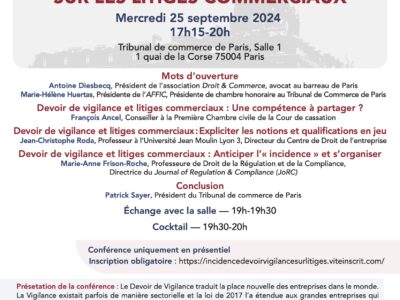
🧱⚙️scientific organisation of 🧮L’incidence du devoir de vigilance sur les litiges commerciaux (The impact of the duty of vigilance on commercial litigation)

► Full Reference: M.-A. Frison-Roche, coordination of the conference L'incidence du devoir de vigilance sur les litiges commerciaux (The impact of the duty of vigilance on commercial litigation), Tribunal de commerce de Paris (Paris Commercial Court), Droit & Commerce and Association Française en Faveur de l'Institution Consulaire (AFFIC), Tribunal de commerce de Paris, 25 September 2024, 5.15p.m. to 8p.m. - 🧮see the full programme of this event - consult on LinkedIn a general présentation of this event (in French) - ► General presentation of the conference: The Duty of Vigilance reflects the new role of firms in the world. Vigilance sometimes existed on a sectoral basis, but the 2017 French law extended it to large companies that control value chains. The French so-called "confiance" law gave the Tribunal judiciaire de Paris (Paris First Instance Civil Court) jurisdiction to hear "actions relatives" ("actions relating") to this duty. This does not mean, however, that the commercial courts will no longer have jurisdiction. Firstly, vigilance may go beyond the scope of the 2017 French law. Secondly, vigilance may concern not only the plan drawn up by the firm, but also Commercial Contract Law or Liability Law, special Distribution Law, etc. Commercial courts will have to develop a doctrine for dividing up and coordinating disputes, in particular by staying proceedings within certain disputes. To build a unified or at least non-contradictory case law on vigilance, we need to imagine a dialogue between judges and new procedures. - 🧮Programme of this event:  L'INCIDENCE DU DEVOIR DE VIGILANCE SUR LES LITIGES COMMERCIAUX (THE IMPACT OF THE DUTY OF VIGILANCE ON COMMERCIAL LITIGATION) Paris First Instance Commercial Court, room 1 🕰️5.15pm.-5.30pm. Welcome 🕰️5.30pm.-5.40pm. 🎤Mots d'ouverture (Opening words), by 🕴️Antoine Diesbecq, President of Droit & Commerce, attorney at the Paris Bar and 🕴️Marie-Hélène Huertas, President of AFFIC, Honorary President of Chamber of the Paris First Instance Commercial Court 🕰️5.40pm.-6pm. 🎤Devoir de vigilance et litiges commerciaux : Une compétence à partager ? (Duty of Vigilance and Commercial Litigation: A jurisdiction to share?), by 🕴️François Ancel, Judge at the Première Chambre civile de la Cour de cassation (First Civil Chamber of the French Court of cassation) 🕰️6pm.-6.20pm. 🎤Devoir de vigilance et litiges commerciaux : Expliciter les notions et qualifications en jeu (Duty of Vigilance and Commercial Litigation: Explain the concepts and qualifications involved?), by 🕴️Jean-Christophe Roda, Full Professor at Jean Moulin Lyon 3 University, Director of the Centre de Droit de l’entreprise 🕰️6.20pm.-6.40pm. 🎤Devoir de vigilance et litiges commerciaux : Anticiper l''incidence" et s’organiser (Duty of Vigilance and Commercial Litigation: Anticipating the "impact" and getting organised), by 🕴️Marie-Anne Frison-Roche, Professor of Regulatory Law and Compliance Law, Director of the Journal of Regulation & Compliance (JoRC) 🕰️6.40pm.-7pm. 🎤Conclusion (Conclusion), by 🕴️Patrick Sayer, President of the Tribunal de commerce de Paris (Paris First Instance Commercial Court) 🕰️7pm.-7.30pm. Discussion with the audience 🕰️7.30pm.-8pm. Cocktail - follow Marie-Anne Frison-Roche on LinkedIn follow Marie-Anne Frison-Roche on Instagram subscribe to the Newsletter MAFR Regulation, Compliance, Law

Conferences

Conference

🎤Devoir de vigilance et litiges commerciaux : Anticiper l'”incidence” et s’organiser (Duty of vigilance and Commercial Litigation: Anticipating the “impact” and getting organised), in 🧮L’incidence du devoir de vigilance sur les litiges commerciaux (The Impact of the Duty of Vigilance on Commercial Litigation)

► Full Reference: M.-A. Frison-Roche, "Devoir de vigilance et litiges commerciaux : Anticiper l'"incidence" et s’organiser" ("Duty of vigilance and Commercial Litigation: Anticipating the "impact" and getting organised"), in L'incidence du devoir de vigilance sur les litiges commerciaux (The Impact of the Duty of Vigilance on Commercial Litigation), Tribunal de commerce de Paris (Paris Commercial Court), Droit & Commerce and Association Française en Faveur de l'Institution Consulaire (AFFIC), Tribunal de commerce de Paris, September 25, 2024, 17.15pm to 20pm - read the report of this speech on LinkedIn (in French) - 🧮see the full programme of this event (in French) - 🧱consult the scientific coordination sheet of this event - consult on LinkedIn a general presentation of this event (in French) - ► English Summary of the conference: After listening to the enlightening speeches of François Ancel and Jean-Christophe Roda, I had the great opportunity to emphasise, as they did, that the duty of vigilance, in the respect of French laws of 2017 and 2021, with a view to the transposition of the CS3D, does not imply, so brutally as has been said, a lack of knowledge by judges other than those of the Tribunal judiciaire de Paris (Paris First Instance Civil Court) of this new Law, which is the extension of Compliance Law, as François Ancel reminded us. Because Commercial Court judges deal with Contract Law on a daily basis, and because companies build their value chains through contracts that should be described as "regulatory contracts", the duty of vigilance has an "impact" on these disputes. These disputes may be of a "systemic" nature. This can only result not in jurisdictional trenches, but in "shared jurisdiction", along the lines drawn by François Ancel. This sharing must be built through a dialogue between judges, a necessary method on which Patrick Sayer concluded this elaborate conference on an essential and forward-looking subject. - follow Marie-Anne Frison-Roche on LinkedIn follow Marie-Anne Frison-Roche on Instagram subscribe to the Newsletter MAFR Regulation, Compliance, Law subscribe to the Video Newsletter MAFR Surplomb