State

Articles in The Journal of Regulation & Compliance « JoRC »

SILVA-ROMERO, Eduardo🕴🏿 and LEGRU, Raphaëlle🕴🏿

📝Quelle place pour la Compliance dans l’arbitrage d’investissement ?, in🕴🏿M.-A. Frison-Roche (ed.), 📕La juridictionnalisation de la Compliance

► Full Reference: E. Silva-Romero and R. Legru, "Quelle place pour la Compliance dans l'arbitrage d'investissement ?" ("What place for Compliance in investment arbitration?"), in M.-A. Frison-Roche (dir.), La juridictionnalisation de la Compliance, coll. "Régulations & Compliance", Journal of Regulation & Compliance (JoRC) and Dalloz, 2023, pp. 281-293.  - 📕read a general presentation of the book, La juridictionnalisation de la Compliance, in which this article is published - ► The summary below describes an article that follows an intervention in the scientific manifestation Compliance et Arbitrage, co-organised by the Journal of Regulation & Compliance (JoRC) and the University Panthéon-Assas (Paris II). This conference was designed by Marie-Anne Frison-Roche and Jean-Baptiste Racine, scientific co-directors, and took place in Paris II University on March 31, 2021.  In the book, the article will be published in Title II, devoted to: Compliance et Arbitrage. - ► Summary of the article (done by the Journal of Regulation & Compliance): The authors emphasize the new and growing place of Compliance in International Arbitration, particularly in the requirement of respect for ethical values, since arbitrators can implement Ethics, sometimes lacking in international trade, or even must put their power only at the service of investors who respect the Rule of Law. Thus, Compliance is deployed through the classic control by the arbitrators of the legality of the investment, which applies both to the establishment of the treaty itself and to the investor. In a more recent way, the arbitrator can control about an investment project a sort of "social license to operate" of the investor, concept related to the social responsibility of the companies, appeared for the protection of the peoples indigenous. Moreover, Compliance can justify a substantial assessment by the arbitrator of the effective respect of the human rights and the environment protection via an investment treaty, the State party remaining able to act for the effectiveness of these concerns. -

Jurisprudence

Tribunal administratif de Paris (Paris administrative court)

Judgment Oxfam France, Notre Affaire à tous, Fondation pour la Nature et l’Homme et Greenpeace France of 3rd of February 2021

Full reference: Tribunal administratif de Paris (Paris administrative court), 4th section, 1st Chamber, Oxfam France, Notre Affaire à tous, Fondation pour la Nature et l’Homme et Greenpeace France, 3rd of February 2021, n°1904967, 1904968, 1904972, 1904976/4-1   Read the judgment (in French) Read the press release from Tribunal administratif de Paris (in French)

Working papers

Compliance Law, Health crisis and Future

This interview was conducted in French with Olivia Dufour, for an article published in French in the digital publication Actualité Juridique. Its subject is  the confrontation between the current health crisis situation and the Compliance Law.    Summary. After defining Compliance Law, distinguishing the procedural and poor definition and the substantial and rich definition, the starting point is to admit the aporia: the type of health crisis caused by Covid-19 will be renewed and it is imperative to prevent it, even to manage it, then to organize the crisis exit. Public Authorities are legitimate to do so, but because this type of crisis being global and the State being consubstantially linked to borders, States are hardly powerful. Their traditional International Law shows their  limits in this current crisis and one cannot hope that this configulration will improve radically. In contrast, some companies and markets, notably the financial markets, are global. But the markets are not legitimate to carry out such missions and counting on the generosity of certain large companies is far too fragile in front of the "monumental goal" that is the prevention of the next health crisis, crisis which must never happen. How to get out of this aporia? By Compliance Law, basis of, in a literal and strong sense, the "Law of the Future".  We need to be inspired by the Banking and Financial Compliance Law. Designed in the United States after the 1929 crisis to tend towards the "monumental goal" of the absence of a new devastating crisis in the country and the world,  this set of new legal mechanisms gave duty and power of supervision, regulation and compliance to market authorities and central bankers. These are independent of governments but in constant contact with them. Today, they claim to have as first priority the fight against climate change. Now and for the future, they must also be given the responsibility and the powers to prevent a global health disaster, similar to a global ecological disaster, similar to a global financial disaster. This does not require a modification of the texts because their mandate consists in fighting instability. Stability must become a primary legal principle, of which the fight against monetary instability was only a first example. By the new use that central banks must make of it by preventing and managing health crises, Compliance Law will ensure that the future will be not catastrophic.

Working papers

The part and the all: the Amazon is related to what? For Brazil and the United States, the “part”; for France, the “All”. The issue is here

  Summary : In August 2019, about the fire devastating the Amazon, the French Minister of Ecology says that this fact "is not just the business of a state" (n'est pas que l'affaire d'un Etat). This assertion denies the postulates of Public International Iaw (I). This supposes a new system, based on the idea that the power of the State on its territory is erased when the object that is there is no longer related to this "part" but to the All that is Universe (II). Let's accept the augur. First question: if it is not only the case of a State, whose business is it? (III). Second question: to anticipate the other cases that fall under this regime, what should be the criteria in the name of which the All will have to prevail over the part and who will then take care of the case of which the "local" State is divested? (IV). Because the perspective goes beyond the environment, beyond Brazil, beyond the States. It leads to Compliance Law animated by "monumental goals" that are the concern for the Universe and humans, in a humanist spirit. Let's go.   - On August 27, 2019, on the French radio France Inter, Elisabeth Borne, French Minister of Ecology (Transition écologique) expresses it clearly:  "Quand on est sur un enjeu tel que l'Amazonie, ça n'est pas que l'affaire d'un État", that can be translated : "When we are on a stake such as the Amazon, it is not only the business of one State ". Starting from one case, "the Amazon", the Minister, thus taking up the position of the French President, associates a general consequence: "it is not only the affair of one State". This is not a trivial sentence.   This affirmation denies, and why not, the entire system of Public International Law (I). By a new reasoning based on the idea that the All prevails, as by an effect of nature, on the Part (II).   Admitting this, it leads to opening two sets of questions. The first is related to the following main question: if it is not only the case of one State, of which is this the concern (III)? The second set of questions revolves around the questioning of the criteria on behalf of which other cases must be seized in the name of "All " and how to do it (IV).     I. THE QUESTIONING OF THE CLASSIC SYSTEM OF PUBLIC INTERNATIONAL LAW   Since forever, but this is not suffcient to keep the system only for that, the world is legally organized around the concept of territory, which has as for corollary the notion – already more legal – of border. On this basis rests the postulate of International Law: parties, taking the legal form of States, which, if they have common interests, come into contact (A). Admittedly, the notion of "right of interference" has called into question that (B), but in the name of an altruism that does not destroy the territory. The new idea that appears here is that the territory would be no more than a part of an All, in the name of which one would be legitimate to speak, even to decide in the place of the State in whose territory an event takes place (C).   A. The postulate of Public (and Private) International Law: parties (States) which, because of common interests, are in contact The notion of State includes in its very definition the notion of territory (a territory, a population, institutions). Thus the State governs through its institutions what is happening on its territory. For example, if there is a fire, or a risk of fire, the State makes arrangements through all legal, financial, technical and human instruments available to it. It is accountable for what it does through its political and legal responsibility. When what is happening on its territory exceeds this one, in fact (epidemic, catastrophe with the consequences exceeding the borders, migrations, etc.) either according to its own opinion or according to that of the other States, the States, being sovereign subjects of Law in  the international system, act together on a pre-built legal basis: bilateral or/and multilateral treaties, having created legal integrated zones (like the European Union or the United States) or international institutions (like the IMF). A particular technique has been developed for several millennia – but here again the seniority is not sufficient to keep the system: diplomacy, anchored in each state in a particular ministry: the Ministry of Foreign Affairs, which each national government has. If one State totally excludes one phenomenon in the territory of another, the progressive procedure of ceasing diplomatic ties begins. This can result in wars. In the "case of the Amazon" both the President of Brazil and the President of the United States stick to the classical construction of Law. Indeed, the former asserted that the Amazon is in the territory of Brazil, thus falls under the jurisdiction of the power of the Brazilian State and the Brazilian Law, from which it follows that another State does not have to come to interfere. However, the French President takes the floor not as this forest extends also on a French territory but as it is the business of the World. On the contrary, the President of Brazil claims the closing effect, which excludes a third State from taking over directly something – even a difficulty – that takes place in the territory of another. The President of the US federal State has said that these are joint decisions between the President of Brazil and other heads of State, sovereign subjects of Law, who must agree to organize a solution to solve a local problem . Because in the same way that States can declare war, they can help each other. The whole Public (and Private) International Law is therefore based on this assumption: "parts" of the world, on which sovereign parties (States) have taken contact, because circumstances make something that falls within one of them or several others. This is precisely what is called into question. The notion of the "right of interference", whose evocation we hardly hear any more, had already done so. But on another basis.   B. The "right of interference": idea that somebody can directly interfere with what happens in a country , an idea that does not question the postulate of the International Maw, an idea that rests on something else: a " right for the other " The "right of interference" is the idea that in certain territories, things happen that are inadmissible. In memory of the jus cogens, a kind of "Natural Law" of Public International Law, Another, that could be another state, can come to meddle with what is happening in a territory that is closed, without declaring war. to the state that keeps its borders. It is the need of others, for example those who die in mass on this territory, or the nature that is devastated in the indifference of the State on whose soil the disaster is happening, which founds this "right" of another state to come and take charge. The foundation of this "right" is therefore a "duty".   C. The new idea: a territory is only part of the Globe, whose fate is everyone's concern The idea is new because it is not based on altruism. And no more about self-interest. Yet, de facto and de jure , the Amazon is not on the sole territory of Brazil. France is particularly well placed to say something about it since part of the Amazon is on French territory. Thus the inaction of the main concerned Brazil directly affects the interest of France, a "forest" being a block that can not be divided. If we were in Property Law, we would say that we are in indivision with Brazil and that in this respect, with the other States on whose territories this forest extends, a solution must be found. Because of the indivisibility of this particular object which is this particular fores, it is necessary that the States whose territory is concerned have a say in the matter. But this is not the argument put forward by France, particularly by the President of the Republic. It is said that the whole world is concerned about the fate of the Amazon. It could be said that, in this respect, when what could be described as a "global forest" is well treated, its management does indeed fall within the power of Brazil, Brazilian companies and the Brazilian State, but when it is abused to the point of seeing its future compromised, when fires may make it disappear, then this forest appears not to be localized in Brazil but being located in the World, of which Brazil is only a part. This reasoning, which then gives voice to everyone, for in the world every state is included in it, is a new reasoning. The economic-political theory of the "commons" does not account for it because it is not a very legal theory.    II. THE NEW REASONING THAT COVERS THE CLASSIC REASONING OF PUBLIC INTERNATIONAL LAW The new reasoning adopted by the Minister consists in saying that the Amazon does not concern only Brazil. This forest should therefore be directly related to the World (A). This is a welcome change in the system but based on a paradox (B).   A. When the Amazon is in danger of death, then it should no longer be attached to this part of the World that is Brazil, but directly to the World This forest is presented as the "lung" of the planet, it is the "future" of humanity. In this, it can concern only one State, not even the one on whose territory this "Humanity good" is located.  As such, without the need to declare war to Brazil, another State may speak, for example the French State through the one that represents it in the international order, that is to say its President, to say what to do, since according to him the President of Brazil does not say or do what it is absolutely necessary to do for the whole planet and for the future of Humanity. This induces a complete renewal of international institutions. Indeed a direct attachment to the World and no longer to Brazil gives the forest object a special status because of a goal that exceeds Brazil: save the Amazon would impose because it would save the world. Therefore, it can no longer be the subject of Brazil, which would be like "dispossessed" by a goal that is imposed on it: to save the Amazon rainforest, even though it is mainly on its territory, while other States become legitimate to dispose of this object, even if the forest would not be in part in their territory, even if they would not be affected in their own interests. This contradicts all Public International Law; because the agreement of the political representatives of Brazil is no longer required and no one yet evokes the need to declare war to Brazil, and fortunately! Such an upheaval justifies that such an affirmation is accepted with difficulty. One understands better than first consequence, which is not so innocuous, one of the first rules of diplomacy which is the politeness, between the heads of state, with regard to the spouses of these , have be broken, that the remarks have slipped on personal questions, etc.   B. A welcome but paradoxical change in the system Why not change the system? This is difficult to admit, not only because it is brutal, but because it is paradoxical. The paradox is the following. It is recognized that the theme of the disappearance of borders by "globalization" no longer reproduces the reality of facts, especially not the Chinese situation, the digitalization having on the contrary allowed the construction of even stronger boundaries. What we called "globalization" now belongs to the pastWhat we called "globalization" now belongs to the past. So today we should recognize on one side the reality of borders – which had not disappeared or are reborn – but only to better step over them, since – based on the concern of the world – states, yet each in their borders, would be legitimate to go directly to intervene in the business of others.  The paradox is therefore, on the one hand, the rejection of the allegation of a de facto disappearance of borders by an economic interdependence, technology having denied "globalization" as a fact  and the linked resurgence of borders allowing States to affirm more than ever that they would be "sovereign masters at home", which should logically lead to let Brazil decide for the Amazon, while yet on the other side we witness the questioning of the postulate of Public International Law as recognition of sovereignty and construction from agreements between states, requiring the agreement of the state whose territory is concerned (except war), questioning which leads to allow all to meddle with the fate of the Amazon, as if there was no border. This paradox leads to two questions. The first question is: if "it's not juste one State affair", who's concerned? The second question is: after the "case of the Amazon", what are the other cases? And how are we going to provide solutions, if we no longer have the solutions of Public International Law, that is to say, the agreement of the country whose territory is concerned and which we do not want not go to war? If we have clear ideas on the answers to be given to these two sets of questions, then because indeed when the future of all is in progress it can not be the affair of a single State, it is necessary to question Public International Law. But do we have clear ideas on these two questions? And what are the possibilities for possible solutions?   See the text following below.

Working papers

THE USE OF INTELLECTUAL PROPERTY AS A TOOL FOR REGULATORY AND COMPLIANCE PERSPECTIVES

This working document serves as a basis for a contribution to the Grands Arrêts de la Propriété intellectuelle (major cases in Intellectual Property), published under the direction of Michel Vivant, in the new section devoted to Regulatory perspective. Conceived as a "regulatory tool", intellectual property is then used by the State as an "incentive for innovation". Public authorities adopt solutions that stem from sectoral concerns that permeate intellectual property. Because the economic sectors become prime, the systemic perspective then prevails in the solutions retained in the judgments passed by the courts.   One can see it through three French court decisions:    ► Civ., 1ière, 28 février 2006, named Mulholland Drive ; ► Paris, 11 décembre 2012, Sanofi-Aventis ; ► Civ., 1ière, 6 juillet 2017, SFR, Orange, Free, Bouygues télécom et autres.   Summary: Intellectual property, derived from the State and inserted in a public policy, can be conceived, not to reward a posteriori the creator but to incite others to innovate. It is then an Ex Ante tool of Regulation, alternative to subsidies. If private copying is an exception, it is not in relation to the principle of competition but in an insertion in a system of incentives, starting from the costs borne by the author of the first innovation: the owner of the rights is then protected , not only according to a balance of interests, but in order not to discourage innovative potentials and the sector itself. (1st decision). The sectoral policy then pervades the intellectual property used to regulate a sector, for example that of the drug. While it is true that a laboratory wishing to market a generic medicine did not wait for the patent expiry of the original medicine to do so, it is not relevant to sanction this anticipation of a few days because investments made by the holder of the intellectual property right have been made profitable by it and because the public authorities favor generics for the sake of public health (2nd decision). The systemic interest provides and that is why Internet service providers have to bear the costs of access blocking while they are irresponsible because of the texts. This obligation to pay is internalized by Compliance because they are in the digital system best able to put an end to the violation of intellectual property rights that the ecosystem requires to be effective. (3rd decision).     It is necessary to underline the paradox represented by the infatuation of the theoreticians of Regulation with intellectual property, whose legal nature it transforms by an exogenous reasoning(I). Influenced, the case law uses reasoning based on incentives, investments, returns and costs, so that the State obtains the operators expected behaviors (II). As a natural result, there is a sectoral segmentation, for example  in telecommunications or pharmacy, which ends up calling into question the uniqueness of intellectual property, according to the technologies and public policies that affect them  (III). There are still imputations of new obligations on operators just because they are in the technical position of implementing intellectual property rights: the transition from Regulation to Compliance is thus taking place (IV).

Articles in The Journal of Regulation & Compliance « JoRC »

COMPLIANCE: COLLABORATE FULLY, A LITTLE, OR NOT AT ALL? DAIMLER’S CHOICE: NOT AT ALL

 It is often observed, even theorized, even advised and touted, that Compliance is a mechanism by which public authorities internalize political (eg environmental) concerns in big companies, which accept them, in Ex Ante, because they are rather in agreement with these "monumental goals" (eg saving the planet) and that this shared virtue is beneficial to their reputation. It is observed that this could be the most successful way in new configurations, such as digital. But, and the Compliance Mechanism has often been brought closer to the contractual mechanism, this is only relevant if both parties are willing to do so. This is technically true, for example for the Deferred Prosecution, which requires explicit consent. This is true in a more general sense that the company wants to choose itself how to structure its organization to achieve the goals politically pursued by the State. Conversely, the compliance mechanisms work if the State is willing to admit the economic logic of the global private players and / or, if there are possible breaches, not to pursue its investigations and close the file it has opened, at a price more or less high. But just say No. As in contractual matters, the first freedom is negative and depends on the ability to say No. The State can do it. But the company can do it too. And Daimler just said No. -   Publicly, including through an article in the Wall Street Journal of June 28, 2019. The company sets out in a warning to the market that it is the object of a requirement on the part of the German Motor Authority (Kraftfahrt-Bundesamt)  of an allegation of fraud, by the installation of a software, aimed at misleading instruments for measuring emissions of greenhouse gases on cars using diesel. It is therefore an environmental compliance mechanism that would have been intentionally countered. On this allegation, the Regulator both warns the company of what it considers to be a fact, ie compliance fraud, and attaches it to an immediate measure, namely the removal of the circulation of 42,000 vehicles sold or proposed by Daimler with such a device. And the firm answers : "No". -   Which is probably only beginning, since a No ends the dialogue of Ex Ante to project in the Ex Post sanction procedures, calls 6 observations:   1. No doubt Daimler, a German car manufacturing company, has it in mind in this allegation of fraud calculating pollution of its diesel cars what happened to his competitor Volkswagen: namely a multi-billion dollar fine, for lack of compliance in a similar hypothesis (so-called dieselgate). The strategic choice that is then made depends on education through the experience of the company, which benefits as such from a previous case that has had a very significant cost. Thus educated, the question is to measure the risk taken to refuse any cooperation, when the company can anticipate that it will still result in such an amount ….   2. In addition, we find the difficulty of the distinction of Ex Ante and Ex Post. Indeed, saying No will involve for the company a cost of confrontation with the Regulator, then the peripheral jurisdictions or review courts. But in Germany, the Government itself, concerning a bank threatened with compliance proceedings and almost summoned by the US regulator to pay "of its own free will" a transactional fine, felt that this was not normal, because it must be the judges who punish, after a contradictory procedure with due process and after established facts.    3.  However, this is only an allegation, of probable assertions, of what legally allows to continue, but which does not allow to condemn. The confusion between the burden of proof, which presupposes the obligation to prove the facts before being able to sanction, and the burden of the allegation, which only supposes to articulate plausibility before being able to prosecute, is very damaging, particularly if we are committed to the principles of Repressive Law, such as the presumption of innocence and the due process. This distinction between these two probationary charges is at the heart of the probatory system in the Compliance Law. Because Compliance Law always looks for more efficiency, tends to go from the first to the second, to give the Regulator more power, since businesses are so powerful ….   4. But the first question then arises: what is the nature no so much of the future measure to be feared, namely a sanction that could be taken later, against Daimler, if the breach is proven, or which will not be applied to the firm if the breach is not established; but what is the nature of the measure immediately taken, namely the return of 42,000 vehicles?   This may seem like an Ex Ante measurement. Indeed, the Compliance assumes non-polluting cars. The Regulator may have indications that these cars are polluting and that the manufacturer has not made the necessary arrangements for them to be less polluting (Compliance) or even organized so that this failure is not detected ( Compliance fraud).   This allegation suggests that there is a risk that thiese cars will polluting. They must immediately be removed from circulation for the quality of the environment. Here and now. The question of sanctions will arise after that, having its procedural apparatus of guarantees for the company that will be pursued. But see the situation on the side of the company: having to withdraw 42,000 vehicles from the market is a great damage and what is often called in Repressive Law a "security measure" taken while the evidence is not yet met could deserve a requalification in sanction. Jurisprudence is both abundant and nuanced on this issue of qualification.   5. So to withdraw these cars, it is for the company to admit that it is guilty, to increase itself the punishment. And if at this game, taken from the "cost-benefit", as much for the company immediately assert to the market that this requirement of Regulation is unfounded in Law, that the alleged facts are not exacts, and that all this the judges will decide. It is sure at all whether these statements by the company are true or false, but before a Tribunal no one thinks they are true prima facie, they are only allegations.  And before a Court, a Regulator appears to have to bear a burden of proof in so far as he has to defend the order he has issued, to prove the breach which he asserts exists, which justifies the exercise he made of his powers. The fact that he exercises his power for the general interest and impartially does not diminish this burden of proof.   6. By saying "No", Daimler wants to recover this classic Law, often set aside by Compliance Law, classic Law based on burden of proof, means of proof, and prohibition of punitive measures – except imminent and future imminente and very serious damages  – before 'behavior could be sanctioned following a sanction procedure. Admittedly, one would be tempted to make an analogy with the current situation of Boeing whose aircraft are grounded by the Regulator in that he considers that they do not meet the conditions of safety, which the aircraft manufacturer denies , Ex Ante measurement that resembles the retraction measure of the market that constitutes the recall request of cars here operated. But the analogy does not work on two points. Firstly, flight activity is a regulated activity that can only be exercised with the Ex Ante authorization of several Regulators, which is not the case for offering to sell cars or to drive with. This is where Regulatory Law and Compliance Law, which often come together, here stand out.Secundly, the very possibility that planes of which it is not excluded that they are not sure is enough, as a precaution, to prohibit their shift. Here (about the cars and the measure of the pollution by them), it is not the safety of the person that is at stake, and probably not even the overall goal of the environment, but the fraud with respect to the obligation to obey Compliance. Why force the withdrawal of 42,000 vehicles? If not to punish? In an exemplary way, to remind in advance and all that it costs not to obey the Compliance? And there, the company says: "I want a judge".   ​ -  

Books

🏗️ direction of the collection: 📚Droit et Économie

L’ordre public économique (Economic Public Order)

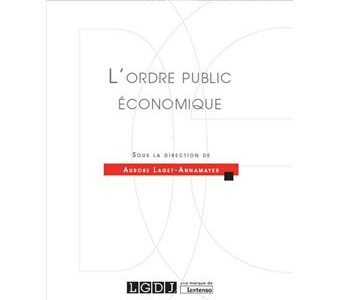
Full reference : Laget-Annamayer, A. (ed.), L'ordre public économique ("Economic Public Order"), coll. "Droit et Économie", Lextenso – LGDJ éditions, 2018, 397p.   This collective book is published in French.    This is the 32nd volume published in this collection.   Often launched as an all-encompassing expression, both by the doctrine and by the judge, public economic order remains a mysterious concept whose substance and contours are difficult to know, simply because it is liable to fluctuate according to its apprehension and depending on the economic and social context. Yet the expression has become widely used, almost incantatory, like a label, and there is therefore undoubtedly a gap between its invocation and its meaning in Law. It is to this discrepancy, and in an attempt to reduce the mystery, that this work is devoted. Not stopping at the only vision of public economic order in internal Public Law, he tries to seek the meanings of it in Comparative Law, in European and International Law, without omitting the historical, privatist or economic vision. It is therefore to this rich overview treated by specialists from different legal fields and beyond that this book invites. It does not aim to put an end to the debate, but on the contrary to arouse it in the context of reflections on the relationship between Law and Economics of which everyone knows the importance. Authors are : Olivier Baillet, Jacques Caillosse, Aurélien Camus, Jacques Chevallier, Dominique Custos, Pierre Delvolvé, Samuel Ferey, Sébastien Hourson, Pascale Idoux, Jean-Philippe Kovar, Aurore Laget-Annamayer, Jérémy Martinez, Francesco Martucci, Jeanne Mesmin d’Estienne, Claire Mongouachon, Eric Naim-Gesbert, Guillaume Richard, Jean-Marc Sorel, Pascal de Vareilles-Sommières.   Read the forth of cover. Read the Table of Contents.   See the whole collection in which this book is published

Articles in a legal collective publication

Le juge, le régulateur et le Droit

Breaking news

In the inaugural conference of March 2, 2018, Koen Lenaerts brings the “Europe of Compliance” to life

Among all the things that were important to remember, one of the things that struck me most in the extraordinary conference of the President of the Court of Justice of the European Union Koen Lenaerts on "Europe of the Compliance "held on March 2, 2018 was his ability to make" live Europe ". Not only to make it understand but also to make it "live". Here is the challenge: that compliance is not an accumulation of processes without reason and without flesh, but a living whole taking its meaning into consideration of the human being, a person whose judge is concerned. On 2 March 2018, Koen Lenaerts therefore came to an amphitheater at the University Panthéon-Assas (Paris 2) to inaugurate the series of conferences organized by the Journal of Regulation & Compliance (JoRC), a cycle that has the general title: Pour une Europe de la Compliance (For the Europe of Compliance). The School of Public Affairs of Sciences Po, the Department of Economics of Sciences Po, the Ecole doctorale de droit privé  (Doctoral School of Private Law) at the Université Panthéon-Assas- Paris 2 (Panthéon-Assas University – Paris 2) and the School of Law of the University Panthéon-Sorbonne (Paris I), are associated with this cycle. Many personalities will take the floor. Presented by Professor Thierry Bonneau, the conference made by President Koen Lenaerts was extremely rich and solid, perfectly constructed. Everyone had known the quality of the conference to be delivered by the President of the CJEU. The content of his demonstration will be found in the article he will give for the book that will be published in the Régulations & Compliance Series edited by Marie-Anne Frison-Roche at Éditions Dalloz. And the reader will find all the strength of this demonstration. This is necessary to venture into this area of "Compliance" : Koen Lenaerts recalled that we were still looking for the definition and a French term that would do justice to a satisfactory definition1Frison-Roche, M.-A., Compliance Law, 2016.. This question was echoed by Antoine Garapon in his discussion. Embodying the firmness that must be shown when words are uncertain, President Koen Lenaerts emphasized that the European Union is based on "Rule of Law". This means that the behaviors must respect Law. For that, – and that is why it is necessary to take in the literal sense the English expression "to comply with", the enterprise must not be passive but to make sure that its behavior is actually respectful of legal prescriptions. In this, there is a general paradigm shift, which inverses the relation betwenn the operator and the rules, from the Ex Post to the Ex Ante2On this passage, which internalises the "Regulatory Law" in the company, c. not. Frison-Roche, M.-A., From Regulation Law to Compliance Law, 2017, and the book, Régulation, Supervision, Compliance (Regulation, Supervision, Compliance), 2017.  as the entreprise has to be itself active to secure the effectiveness of the rule of Law. This internalization of the rule by the company develops both a procedural culture and a behavioral culture, in which companies can express an ethical dimension and build a "Trust Pact" 3About this notion, s. Frison-Roche, M.-A., Compliance and Trust, 2017 ; Drawing the Circles of Compliance Law, 2017. with states and public authorities. This change has been brought about by globalization, since states no longer have the means to impose ethical norms of behavior on businesses through the Ex Post intervention of their jurisdiction, but States like companies are gaining the benefit of this internalisation of rules in compagnies because the Compliance is inseparable from the accountability by which the company is compelled to justify that it actually tends to achieve the overall goals assigned by the public authority. Thus, after exposing the general movement by which Europe opened up to this upheaval, President Koen Lenaerts took on three technical dimensions crossed by this new conception. The first is the Financial Markets Law. The second is Competition Law, about which the President has notably developed the Court's reflections on whether the adoption of a compliance program by an enterprise found to have violated Competition Law, in particular by "negligence" is neutral, or constitutes a mitigating circumstance or constitutes an aggravating circumstance. This question was taken up after the presentation in the discussion with the room. The third is that of personal data. Taking again as in a waltz with three times his remarks, the president of the Court of Justice found that the compliance, whereas it consists in transforming the Ex Post into Ex Ante becomes juridicalised and in this the Court of justice holds its not only in Europe but also in relation to the world, without however ever forgetting that it is the States that are drawing up the rules that are the foundation of Europe. We will find in the article that will be published all these precious elements and no doubt that the elegance of the pen will be equal to that of speech. But, written exercise requires, the reader will not find what we had the chance to attend: the story of two cases by the one I would prefer to name the "Professor Koen Lenaerts". Two famous cases, which we teachers, comment and remind in our courses, that students learn and recite, quote in their copies. But never that way. The first case is the Schrerms case, where the court said that Facebook could not transfer this person's personal data to the United States since he was opposed to it. To make it clear, the President revived it through the litigant, who was a student and for this reason he spoke directly to the students present in the amphitheater. He pointed out that the plaintiff at the origin of the case was a law student, like them. He detailed his situation in Austria, making some quotes in perfect German, pointing out that this student was now at the doctoral stage, inviting students to be brave, as he was. At each episode of the story, the speaker told the students, making some detours on his own student life because finally we were all in family … Alma Mater. But his hands were telling the story even more: they were thrown themselves into the story, they brewed the space, it seemed as if they themselves were no more grandiloquent than the speaker but found their place exactly , in a magisterial position. Yes, here is a president in front of which companies have a hard time hiding the truth, a president with such firm hands and whose torso does not move but turns to the left and right to talk to everyone. The second story was even more beautiful. The Google Spain case, I know it. I even know it by heart. I read it, commented on it, cited it a lot of times … But all of a sudden that's what happened to a small Spanish merchant: President Koen Lenaerts told us his story, and I rediscovered the case. A small Spanish shopkeeper, whose name the speaker uttered in perfect Spanish, obtained from the Court of Justice that his "right to be forgotten" was recognized. President underlined the apparent paradox of his  insistence for the appearance of his surname in the judgment by which this person had thus obtained the erasing of his surname! Yes, I did not notice … Why did he ask for the mention of his name in the right to have his name deleted? Because it's a matter of honor. This is what the speaker insisted: do not joke with honor. And if you do, even Google will lose. The merchant had been subject to a forced property sale procedure because of financial difficulty, which spanish newspapers had echoed. His honor was been trampled. Then, by a happy return of fortune, he had recovered his property, his prosperity, his reputation. But from that, the press had not talked about it. Some lines in a newspaper of legal announcements, but that it is nothing for the human soul. That's why he wanted these mechanical digital links to disappear, which always and for all end up with articles presenting him as a wretch without ever ending up with articles presenting him as a prosperous merchant (because of the non-existence of these second articles). The speaker emphasized this dimension very much. And we know that the General Regulations that will come into force in May 2018 on personal data, which intrigues so much the Americans, draws in the judgment Google Spain its main solution in the matter: this "right to be forgotten" , subjective right so strange. He emphasized this dimension very much. And we know that the General Regulations that will come into force in May 2018 on personal data, which intrigues so much the Americans, draws in the judgment Google Spain its main solution in the matter: this "right to be forgotten" , subjective right so strange. Listening to President Koen Lenaerts, how not to think of Carbonnier? to  his articles of it, especially on sociological rule : "small causes, great effects"? From this conference, it will remain a great article, but as in the theater, where the ephemeral is part of the beauty of this art, what were these two stories, told by the one who knew how to listen when it was necessary to decide the two cases, stories told with the two firm hands that danced inviting students to enter this round, even as the President of the Court of Justice had to leave immediately to Luxembourg to hold such heavy obligations, yes it was simply beautiful .    

Articles

Jesus legally replaces Caesar. The image of currencies and the idea of security

Cryptocurrencies seem to be admitted, delivered from the State. And many rejoiced. Let's take the question on the side of Law. In France, we remember an article written in 1968 by the great lawyer Carbonnier : L'imagerie des monnaies  (Imagery of Coins), seeing in Caesar's face engraved on the coin the image of the State itself, guarantor of the entire monetary and exchange system. In Europe, we remember the discussions on the image of the euro, how each state in the zone could express its existence while the guarantee was common and concentrated in the same central bank, preferring a public building to a character. Today the currencies to be virtual do not have less an "image". One could even say that they have only that, since it is no longer the State which, by the face of Caesar is inserted there. But other faces can be imbued. Could the law find fault with it, because some figures would be "reprochable" because only Caesar would be beyond reproach? Could the Law draw any consequences from it, because some figures would be "engaging", less than that of Caesar but still a little? Certainly, not faces that the Criminal Law rejects, not that of Jack the Ripper, not that of Hitler. But other historical figures less clearly banned, in this period where it is easily argued that everything would be "questionable" and therefore admissible and that besides everything would be "to discuss", the currency thus expressing this flow of discussion , speech that goes from hand to hand, from post to post on virtual networks? Still, figures are block around them. This is particularly true in communities that can thus elect them to trust each other: just like their "Caesar", and knowing each other well, lend themselves more easily with confidence, to pay each other, while they would not lend to others, they would not buy from others. Why no. Since we accept the principle of this currency, based on the only technical security (double encryption) and trust between people (intersubjectivity of a circle that has been chosen), without mentioning the issue of the debtor as a last resort, in order to challenge Caesar and public finances. But let us take the hypothesis that the figure embedded in the virtual currency is that of Jesus. And the hypothesis is not fancy. Indeed, the "religious currencies" are multiplying. And the platforms that offer them insist on the fact that these tokens that are exchanged between people who believe in Jesus place great trust in the "son of God" and are therefore particularly trusting each other, for example in their respective capacity to keep their commitment. Outside the Law. On their respective ability to help each other. Outside the Law. Is it necessary to forget the affirmation that it was necessary "to render to Caesar what was Caesar's"? Let's ask some questions in Law. – Reflections on what could or should be the "regulation" of non-state currencies, whether we call them virtual or not (in what does this change the nature of the currency?), That we secure them by encryption technology and / or by the decentralization of information, should they also relate to images? – Are non-state currencies so much that the religious image, as long as it is not contrary to public order, is permissible, notably in legal systems where the constitutional principle of secularism has as its object and effect not only to neutralize the religious significance of religious objects but also to protect religious freedom? – Can "religious currencies" be protected and have specific economic and financial significance, as the United States Supreme Court admitted in the Hobby Lobby judgment of June 30, 2014? Europe is not the United States. – If the image of Jesus is encrusted on the currency, can we consider that the corpus is also inserted so that the platform that attracts a particularly interesting clientele (solvent, "responsible", holding its commitments, etc.) ? This insertion of the religious corpus, as the state was through the face of Caesar would operate not de jure but de facto, so that the company holding the platform should respond to third parties by the factual belief that this may have generated in third parties. – Moreover, do not these "religious currencies" produce a specific systemic risk? Not that such and such a religion could collapse, or this or that religious effigy to undergo a haircut with a domino effect on all the saints, waves of doubt provoking a mistrust of all the faithful ones because the various religions are doing well, but precisely because the mark of these religious communities to which these platforms specifically appeal is to make "their own law" prevailing over the law of the Dtate, considered inferior since it comes only from men and not from God. And now the churches are starting to coin money… At the very least, it will be necessary in Ex Post that the faithful do not come to seek the state by guaranteeing if there is bankruptcy, because Caesar does not meddle in the affairs of Jesus. To each his currency and each to reread Carbonnier, one of the finest readers of the Bible -  

Glossary

Bank (Banking Regulation)

Banks are regulated because they do not engage in an ordinary economic activity, as their are likely to create systemic risk. In the real economy indeed, banks play the role of providing credit to entrepreneurs who operate on the markets for goods and services. These credits are mainly financed through deposits made by depositors and, to a lesser extent, by shareholders (i.e., capitalists). That is how liberalism and capitalism are bound up. However, banks also have the power to create money by the book entries they make when they grant loans ('book money'). As such, the banks share with the State this extraordinary power to exercise monetary authority, which some describe as sovereign power. It is possible that the digital eventually calls this power into question, since the Regulation currently hesitates to seize control over new instruments that are called "virtual currency" and that are used as proper "currency" or as an ordinary instrument for cooperative relation. Banks' prominent sovereign character justifies, first and foremost, that the State is granted the power to choose the institutions which benefit from the privilege of creating book money- in this regard, the banking industry has always been a monopoly. Hence, Banking Regulation is first an ex ante control to enter the profession, and also a careful monitor of the people and institutions that claim they are in. In addition, banks and credit institutions lend more money than their own funds can allow: the whole banking system is necessarily based on the trust that each creditors place within the bank, including depositaries who leave their funds at the banks' disposal for it to use them. That is where Bank Regulation intervenes to establish what is called 'prudential ratios', i.e., ratios that ensure the soundness of the institution by determining the amount of money that banks can lend based on the equity and quasi-equity they actually have. Moreover, banks are constantly monitored by their supervisory Regulator, the Central Bank (in France, the Banque de France) that ensures the safety of the whole system by setting the State as the lender of last resort. This can, however, incentivize a large financial institution to take excessive risks based on its reliance on the fact that the State will save it eventually- that is what the 'moral hazard' theory systematized. All monetary and financial systems are built on these central banks that are independent from governments, which are far too reliant on political strategies and which cannot generate the same trust that a Central Bank inspires. Since the missions of central banks have increased over the years, and since the notions of Regulation and Supervision have come together, we tend to consider that Central Banks are now fully fledged Regulators. Besides, Banking Regulation has become all the more central since banking is no longer primarily about loaning but rather about financial intermediation.  Banking Regulation and Financial Regulation are mixing. In Europe , European Central Bank is in the center.