Soft law

Couverture bleue de l'ouvrage de Marie-Anne Frison-Roche, The Legal System of Internet Addressing. A Multi-Stakeholder Structure, the Pledge of its Sustainability

Publication director

🏗️ copublishing and direction of the collection: 📘Compliance & Regulation

📚Forthcoming: 🕴️M.-A. Frison-Roche, 📘The Legal System of Internet Addressing. A Multi-Stakeholder Structure, the Pledge of its Sustainability

► Full reference: M.-A. Frison-Roche, The Legal System of Internet Addressing. A Multi-Stakeholder Structure, the Pledge of its Sustainability, Journal of Regulation & Compliance (JoRC) and Lefebvre-Bruylant, “Compliance & Regulation” series, forthcoming. - 📕 This book is published in English. It is also published in French, in the “Régulations & Compliance” series: Le système juridique de l’adressage de l’Internet. Une structure multi-acteurs, gage de durabilité (The Legal System of Internet Addressing. A Multi-Stakeholder Structure, the Pledge of its Sustainability), Journal of Regulation & Compliance (JoRC) and Lefebvre-Dalloz, forthcoming. - ► Read the presentations of the other books in the “Compliance & Regulation” series - ► General presentation of the book: The Internet is a space based on a technical system consisting of IP addresses, all of which can reach one another. This simple technical principle is essential because it is the foundation on which the digital space rests, in that it allows anyone to enter it, move within it and reach others. It is this principle of the open Internet that made possible the construction of the digital space in which we live. This technical system of IP addresses was made easily manageable by domain names. This manageability of IP addresses made the open character of the Internet effective and enabled the expansion of a space that was global from the outset, forming the basis of the digital space. These technical elements were directly translated into the addressing system through domain names, which was built by the Law. The resulting legal system of addressing reflects this technical foundation, and no one can either deny or undo this link: indeed, the Law enables the domain name infrastructure to function effectively on a global scale and in an open manner, where everyone can reach the other. Technical architecture and legal architecture are thus inseparable. This freedom for everyone to create and circulate in the digital space is made possible by technology and guaranteed by the legal organisation of the domain name architecture. This study is structured in two parts. Its first part aims to describe the legal framework of the global domain name system. Its second part examines how to improve this system: it first examines the technical effects produced by scenarios involving changes to the legal framework of addressing, namely a high risk of capture and/or fragmentation of the domain name system by regional zone. It then aims to demonstrate that if the legal organisation of the global domain name system were significantly altered, notably through the establishment of legal addressing zones that are autonomous from one another, the technical imperative of globality remaining paramount, interconnection between the different zones would be necessary and would then be ensured by a public or private actor who could thus effectively seize control of the technical system via these proposed new legal structures of the system, thereby taking over the whole. - PROVISIONAL TABLE OF CONTENTS   In Perspective   PART ONE HOW THE GLOBAL LEGAL SYSTEM OF NAMING IS BUILT   CHAPTER I: ICANN: A LEGAL STRUCTURE OF CLASSIC HARD-LAW FORM, REQUIRED BY THE TECHNICAL INFRASTRUCTURE OF THE ADDRESSING SYSTEM, TRANSPOSED THROUGH STATUTES THAT SEPARATE THE POWER TO PROPOSE FROM THE POWER TO ADOPT IN ORDER TO ESTABLISH A “MULTI-STAKEHOLDER” SYSTEM WHOSE PURPOSE AND EFFECT ARE TO PREVENT CAPTURE CHAPTER II: THE EXERCISE BY STATES OF THEIR PREROGATIVES THROUGH NATIONAL PUBLIC LAWS: ARTICULATION BETWEEN THE TWO GEOGRAPHICAL SPACES OF HARD LAW CHAPTER III: INTERNATIONAL SPACES OF HARD AND SOFT LAW: UN, WIPO, ITU, WSIS CHAPTER IV: MIRRORING THE TECHNICAL INFRASTRUCTURE OF THE ADDRESSING SYSTEM, THE INTERMESHED GLOBAL LEGAL STRUCTURE, ARTICULATING THE SPACE OF HARD LAW AND THE SPACE OF SOFT LAW CHAPTER V: INTERNALISATION WITHIN CRUCIAL OPERATORS THROUGH COMPLIANCE TECHNIQUES LINKED TO THE OBLIGATION OF SUSTAINABILITY   PART TWO HOW TO IMPROVE THE GLOBAL LEGAL SYSTEM OF NAMING   CHAPTER I: ASSESSMENT OF THE RADICAL TECHNICAL TRANSFORMATIONS THAT PROPOSALS TO CHANGE THE LEGAL SYSTEM OF ADDRESSING COULD BRING ABOUT Section 1 ♦️ Assessment of the technical consequences of the legal proposal to transfer the current complex and specific system into an ordinary mechanism of Public International Law Section 2 ♦️ Assessment of the technical consequences of the indirect proposal to establish separate blocks of systems by zone CHAPTER II: MAINTAINING THE LEGAL SYSTEM OF ADDRESSING, GLOBAL, PROTECTED FROM CAPTURE AND ABLE TO ENSURE TECHNICAL SUSTAINABILITY? BY FOSTERING AN INCREMENTAL PROCEDURAL IMPROVEMENT TOWARDS BETTER UNDERSTANDING AND THUS BETTER ACCOUNTABILITY Section 1 ♦️ A grievance, factual but central: the legal system of domain names is hard to understand. Causes and consequences Section 2 ♦️ Making the legal system of domain names more easily understandable to the parties concerned Ex Ante Section 3 ♦️ Explaining clearly, starting from the purposes, the share of technical sustainability and the share of societal sustainability, the former firmly preserved, the latter handled as a debated project Section 4 ♦️ Enhancing soft-law instruments for their discursive, that is explanatory, scope regarding the domain name system within the global governance of the Internet Section 5 ♦️ Making the legal system of domain names understandable to the parties concerned Ex Post: thereby increasing the value of accountability   Selected Bibliographical Sources Index - 🌐follow Marie-Anne Frison-Roche on LinkedIn 🌐follow Marie-Anne Frison-Roche on Instagram 🌐subscribe to the Newsletter MAFR Regulation, Compliance, Law 🌐subscribe to the Video Newsletter MAFR Surplomb 🌐subscribe to the Newsletter MaFR Droit & Art

Conferences

🎤Concevoir une raison d’être et l’expliciter (Conceiving a raison d’être and explaining it), in🪑🪑🪑Dire sa raison d’être (Expressing your Raison d’être)

► Full reference : M.-A. Frison-Roche, "Concevoir une Raison d'être et l'explicitre (Conceiving a Raison d'être and explaining it)", speech at the round table discussion "Dire sa Raison d'être (Expressing your Raison d'être)", National Conference of the Géomètres Expert (French Chartered Surveyors), 6 November 2025, Paris. - ► Presentation of the Round Table : This round table opens two days of work bringing together all the leaders, members of the Council of the Order of Chartered Surveyors and Regional Councils of Chartered Surveyors, in the presence of the relevant Ministry, in specific sessions during which the two Raison d'être that have been developed over several years of work and adopted, the Raison d'être of the profession and the Raison d'être of the Order, are presented. 🪑🪑🪑Other participants in the round table discussion, moderated by Hervé Grélard, General Deputy of the French Order of Chartered Surveyors: 🕴🏻Thomas Bonnel, chartered surveyor 🕴🏻Luc Lanoy, chartered surveyor, 🕴🏻Séverine Vernet, Chairwoman of the French Order of Chartered Surveyors - ► Summary of my presentation : Firstly, I spoke to remind everyone what a "raison d'être" is, in itself, and why it is particularly important when the entity that embodies it also constitutes a "profession", the raison d'être expressing this hybrid nature that is destined to endure in today's societies. It moves those who uphold the raison d'être – the professional, the profession, the umbrella organisation that is the Order – from the past to the future. To effectively carry this raison d'être, its bearer cannot remain isolated. Unlike the agent who operates in a market and whose strategy is solitary dynamism against others, the bearer of the raison d'être must find allies who share similar or compatible ideas and develop points of contact to carry out a collective project (the "Monumental Goals"). This is why it is just as important to communicate, explain and share the raison d'être with the outside world. Secondly, as the discussion surrounding the statement of purpose of the French Order of Surveyors and the profession progressed, I was led to point out that the raison d'être is not, or not only, ethical in nature, but also legal in nature, constituting at the very least a legal fact that can become enforceable against those who recognise themselves in it and claim it. This kind of reward, which is the "ex ante responsibility" expressed by the raison d'être and relayed by Compliance Law, anchored in its monumental goals of sustainability and responsibility, justifies that the profession that embraces its raison d'être is not simply an efficient profession in a supply and demand market, but establishes the Order as a regulator. This places both in the long term. - ⛏️Further reading on the subject: (with English Summaries) 🕴🏻M.-A. Frison-Roche, 💬"Géomètres-experts : une profession qui assume concrètement sa responsabilité territoriale", 2025 🕴🏻M.-A. Frison-Roche, 📝A quoi engagent les engagements, 2025 🕴🏻M.-A. Frison-Roche et 🕴🏻S. Vernet, 📝La profession investit le Droit de la compliance et détermine sa Raison d'être, 2023 🕴🏻M.-A. Frison-Roche, 📧Quels sont les points de contact entre la Raison d'être des entreprises et le Droit de la Compliance ?, 2022   - 🌐Follow Marie-Anne Frison-Roche on LinkedIn 🌐follow Marie-Anne Frison-Roche on Instagram 🌐Subscribe to the Newsletter MAFR Regulation, Compliance, Law 🌐Subscribe to the video newsletter MAFR Overhang 🌐Subscribe to the Newsletter MaFR Law & Art

Articles in The Journal of Regulation & Compliance « JoRC »

ROUAUD, Anne-Claire🕴️

📝L’intensité de l’obligation de vigilance selon les secteurs : le cas des opérateurs financiers (“The intensity of the obligation of vigilance depending on the sector: the case of financial operators”), in 🕴️M.-A. Frison-Roche (ed.), 📕L’Obligation de Compliance

► Full Reference: A.-C. Rouaud, "L’intensité de l’obligation de vigilance selon les secteurs : le cas des opérateurs financiers" (The intensity of the obligation of vigilance depending on the sector: the case of financial operators), in M.-A. Frison-Roche (dir.), L'Obligation de Compliance, Journal of Regulation & Compliance (JoRC) an Dalloz, coll. "Régulations & Compliance", 2025, pp. 539-550. - 📕read the general presentation of the book, L'Obligation de Compliance, in which this contribution is published - ► English summary of this contribution (done by the Journal of Regulation & Compliance – JoRC) : The author develops the case of financial operators and shows that if they are subject to very heavy obligations of vigilance, it is above all because of the systemic risks of the markets, obligations which are consubstantial with their activities, because these operators are often in charge of market infrastructures or operating services, which make them all belong to the category of regulated professions. Despite this uniqueness, the obligation of vigilance has many facets, ranging from policing and customer surveillance to warning and protection, which can be very limited, as the fight against money laundering aims to protect the system (kyc). In addition, this obligation to exercise vigilance serves different goals, which explains the diversity of sanctions, because the intensity of the obligation also varies. The fight against systemic risk is certainly a common goal, but there are also concerns about protecting specific categories, such as investors (from a more European perspective). However, the general interest is now being renewed, as market protection is coupled with a concern for Sustainability. This is reflected in the variability of sanctions, ranging from disciplinary sanctions, handled by the financial markets regulatory bodies, to the obligation to put in place compliance programmes against which breaches are sanctioned per se. Private enforcement is developing in tandem with public enforcement, with a transformation of the litigation risk for companies, which is highly sensitive to extraterritoriality and the scope of soft law.     -

Articles in a legal collective publication

Article in a collective book dedicated to an Amicorum

📝Naissance d’une branche du Droit : le Droit de la Compliance (Births of a branch of Law: Compliance Law), in 📗Mélanges en l’honneur de Louis Vogel

► Full Reference: M.-A. Frison-Roche, "Naissance d'une branche du Droit : le Droit de la Compliance" ("Birth of a branch of Law: Compliance Law"), in Mélanges offerts à Louis Vogel. La vie du droit, LexisNexis – Dalloz – LawLex – LGDJ, 2024, pp. 177-188. - 📝read the article (in French) - 🚧read the bilingual Working Paper which is the basis of this article, with additional developments, technical references and hyperlinks - ► English Summary of the article:  The study focuses on the various movements that have given rise to Compliance Law, with particular emphasis on Competition Law. After a preliminary reflection on the construction of the legal system into branches of Law, their classification in relation to each other, the difficulty encountered in this respect by Economic Law, and the various movements that give rise to one of them, the diversity of which the branch subsequently keeps track of, the study is constructed in 4 parts. To find out what gave rise to Compliance Law, the first part invites everyone to reject the narrow perspective of a definition that is content to define it by the fact of "complying" with the applicable regulations in the sens to obey them automatically. This has the effect of increasing the effectiveness of the regulations, but it does not produce a branch of Law, being only an efficiency tool like any other. The second part of the study aims to shed light on what appears to be an "enigma", because it is often claimed that this is the result of a flexible method through the "soft law", or of an American regulation (for instance FCPA), or of as many regulations as there are occasions to make. Instead, it appears that in the United States, in the aftermath of the 1929 crisis, it was a question of establishing an authority and rules to prevent another atrocious collapse of the system, while in Europe, in 1978, in memory of the use of files about Jews, it was a question of establishing an authority and rules to prevent an atrocious attack on human rights. A common element that aims for the future ("never again"), but not the same object of preventive rejection. This difference between the two births explains the uniqueness and diversity of the two Compliance Law, the tensions that can exist between the two, and the impossibility of obtaining a global Compliance Law. The third part analyses the way in which Competition Law has given rise to conformity mechanisms: they had only constituted a secondary branch which is a guarantee of conformity with competition regulations. Developed in particular through the soft law issued by the competition authorities, the result is a kind of "soft obedience", a well-understood collaboration of a procedural type through which the company educates, monitors and even sanctions, without going outside Competition Law, of which compliance  (in the sens of conformity) is the appendix. The distance between a conformity culture and Compliance Law can be measured here. The fourth part aims to show that Competition Law and Compliance Law are two autonomous and articulated branches of Law. Since Compliance Law is a autonomous and strong branch of Law built around Monumental Goals, in particular the sustainability of systems and the preservation of the human beings involved so that they are not crushed by these systems  but benefit from them : the current challenge of European integration is to build the pillar of Compliance Law alongside the competitive pillar. Jurisdictions are in the process of doing this and articulating them. - 🌐follow Marie-Anne Frison-Roche on LinkedIn 🌐follow Marie-Anne Frison-Roche on Instagram 🌐subscribe to the Newsletter MAFR Regulation, Compliance, Law

Organisation of events

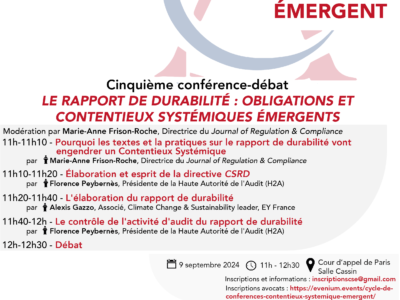
🧱⚙️scientific organisation and moderation of 🧮Le rapport de durabilité : obligation et Contentieux Systémiques Émergents (The Sustainability Report: Emerging Systemic Obligation and Litigation), in cycle of conference-debates “Contentieux Systémique Émergent” (“Emerging Systemic Litigation”)

► Full Reference: M.-A. Frison-Roche, Scientific direction of the conference Le rapport de durabilité : obligation et Contentieux Systémiques Émergents (The Sustainability Report: Emerging Systemic Obligations and Litigation), in cycle of conference-debates "Contentieux Systémique Émergent" ("Emerging Systemic Litigation"), organised on the initiative of the Cour d'appel de Paris (Paris Cour of Appeal), with the Cour de cassation (French Court of cassation), the Cour d'appel de Versailles (Versailles Court of Appeal), the École nationale de la magistrature – ENM (French National School for the Judiciary) and the École de formation des barreaux du ressort de la Cour d'appel de Paris – EFB (Paris Bar School) and MAFR, September 19, 2024, 11h-12h30, Cour d'appel de Paris, Cassin courtroom - ► Presentation of the conférence: Sustainability is a new legal concept, the lineaments of which can be found in certain sectors and branches of Law, and which today has both multiple resulting obligations and a definition that is sufficiently unified to allow it to be grasped through the technique and the requirement of the "Sustainability Report", which translates a requirement linked to the systems themselves. The dual materiality mechanism illustrates this. The Litigation that will ensue shall be imbued with this systemic dimension, since this report was required from this perspective, and the notion of Sustainability itself was conceived in the same way. What is commonly referred to as "ESG" reflects this perspective, which is both structural and long-term: Information is central here, since it is a Report, anchored in  the new conception of Corporate Law that is imbued with Governance, where internal and external stakeholders are present. The various Supervisors and Regulators, who go beyond supervising professionals to regulate activities, are also bound to have a role to play in this Emerging Systemic Litigation. In order to understand and anticipate this, this conference is built around an analysis of the construction of the Sustainability Report and an analysis of the role of the Regulatory and Supervisory Authority, the French Audit Authority, the Haute Autorité de l'Audit – H2A. These analyses are carried out with a view to the Systemic Litigation that will arise from these new requirements and practices, in correlation with Litigation linked to other fields of Systemic Litigation such as Vigilance field. - 🧮Programme of this event:  Fith conference-debate LE RAPPORT DE DURABILITÉ : OBLIGATIONS ET CONTENTIEUX SYSTÉMIQUES ÉMERGENTS (THE SUSTAINABILITY REPORT: EMERGING SYSTEMIC OBLIGATIONS AND LITIGATION) Paris Court of Appeal, Cassin courtroom 🕰️11am.-11.10am. 🎤Pourquoi les textes et la pratiques sur le rapport de durabilité vont engendrer un Contentieux Systémique (Why the texts and practices on sustainability reporting will give rise to Systemic Litigation), by 🕴️Marie-Anne Frison-Roche, Professor of Regulatory Law and Compliance Law, Director of the Journal of Regulation & Compliance (JoRC) ➡️read the presentation of this speech 🕰️11.10am.-11.20am. 🎤Élaboration et esprit de la directive CSRD (Elaboration and spirit of the CSRD), by 🕴️Florence Peybernès, President of the Haute Autorité de l'Audit – H2A (French High Audit Authority) 🕰️11.20am.-11.40am. 🎤Comment construire un rapport de durabilité ? (How to build a sustainability report?), by 🕴️Alexis Gazzo, Partner, Climate Change & Sustainability leader, EY France 🕰️11.40am.-12pm. 🎤Le contrôle de l'activité d'audit du rapport de durabilité (The control of the audit of the sustainability report), by 🕴️Florence Peybernès, President of the Haute Autorité de l'Audit – H2A (French High Audit Authority) 🕰️12pm.-12.30pm. Debate - 🔴Registrations and information requests can be sent to: inscriptionscse@gmail.com 🔴For the attorneys, registrations have to be sent to the following address: https://evenium.events/cycle-de-conferences-contentieux-systemique-emergent/  ⚠️The conference-debates are held in person only, in the Cour d’appel de Paris (Paris Court of Appeal). -

Conferences

🎤Synthèse, in 🧮Concurrence : les enjeux de la Compliance

► Full Reference: M.-A. Frison-Roche, "Synthèse" ("Synthesis"), in Concurrence : les enjeux de la Compliance​, May 24, 2024, Paris, Collège européen de Paris, Paris Panthéon-Assas University, 28 rue Saint-Guillaume - 🧮see the full programme of this event (in French):  🌐read the  la newsletter MAFR Law, Compliance, Regulation on 26 Mai 2024 about this colloquium and this synthesis (in English) - ► Summary of this concluding conference:The conference was based on the 'framework document' on conformity programmes published by the French Competition Authority, the Autorité de la concurrence, on 24 May 2022 and focused on one of the tools used, namely risk mapping. The care taken to bring together academics whose job it is to give an account of reality by classifying and naming it, which makes it easier to handle, and people who every day in enterprises find solutions to anticipate difficulties so that they can be resolved, or even prevented from arising, has borne fruit. - From all the presentations and discussions, 4 perspectives emerge, each showing what has been achieved, what may still emerge in interaction with all the other mechanisms in Compliance Law that incorporate risk mapping (for instance ,the French 2016 so-called "Sapin 2" law, the French 2017 so-called "Vigilance" law, the CS3D European directive, etc.) and the other mechanisms that are correlated with risk mapping (audit, internal investigations, evidence likely to be raised before a judge by the enterprise and/or by a stakeholder and what remains uncertain in this 2022 framework document.   - The first perspective is the basis of these recommendations, encouragement, methods, advice, etc. The second perspective is the means developed to establish and implement these compliance programmes. The third perspective is the scope of this framework document, which also depends to a large extent on the scope of the compliance programmes adopted by the firms themselves. The fourth perspective is that of the subjects of law who are obliged, or who benefit from the adoption of such  compliance programmes in Competition Law.   - During this conclusion, based solely on what each speaker had to say, I continued my reflections in each of these 4 directions. This reminded me of some of my work made in English on this subject:  M.-A. Frison-Roche (ed.), 📘Compliance Tools, ,2022   M.-A. Frison-Roche, 🚧 Support from Compliance Law for day-to-day management of Competition Law, 2021   M.-A. Frison-Roche, 🚧 Competition Law and Compliance Law, 2018   - 🌐follow Marie-Anne Frison-Roche on LinkedIn 🌐follow Marie-Anne Frison-Roche on Instagram 🌐subscribe to the Newsletter MAFR Regulation, Compliance, Law

Working papers

Working Paper basis for an article

🚧Births of a new branch of Law: Compliance Law

► Full Reference: M.-A. Frison-Roche, Births of a branch of Law: Compliance Law, Working Paper, November 2023. - 📕This Working Paper was drawn up as a basis for a contribution to the collective book given to Professor Louis Vogel, published in 2024 - ► Summary of this Working Paper: The study looks at the various movements that have given birth to Compliance Law, with particular emphasis on Competition Law. After a preliminary reflection on the construction of the legal system into branches of Law, their classification in relation to each other, the difficulty encountered in this respect by Economic Law, and the various movements that give birth to one of them, the diversity of which the branch subsequently keeps track of, the study is constructed in 4 parts. To find out what gave rise to Compliance Law, the first part invites us to reject the narrow perspective of a definition that is content to define it by the fact of "being conform" with all the applicable regulations. This has the effect of increasing the efficacy of the regulations, but it does not produce a branch of Law, being just a set of tools like others. The second part of the study aims to shed some light on what appears to be an "enigma", as it is often claimed that this is the result of a soft method, or of an American political decision, or of as many regulations as there are occasions to make. Instead, it appears that in the United States, in the aftermath of the 1929 crisis, it was a decision of establishing an authority and rules to prevent another atrocious collapse of the system, while in Europe in 1978, in memory of the use of files of personal and racial information, it was a question of establishing an authority and rules to prevent an atrocious attack on human rights. A common element that aims for the future ("never again") but not the same object of preventive rejection. This difference between the two births explains the uniqueness and diversity of the two Compliance Laws, the tensions that can exist between the two, and the impossibility of obtaining a global Law. The third part analyses the way in which Competition Law has given rise to conformity: a secondary branch which is a guarantee of conformity with competition rules. Developed in particular through the soft law issued by the competition authorities, the result is a kind of soft obedience, a well-understood collaboration of the procedural type through which the firm educates, monitors and even sanctions, without leaving  the cercle of Competition Law, of which conformity is an appendix. The distance between a culture of conformity and the substantial Compliance Law can be measured here. The fourth part aims to show that Competition Law and Compliance Law are two autonomous and articulated branches of Law. Since Compliance Law is a branch of Law built on Monumental Goals, in particular the sustainability of systems and the preservation of the human beings involved so that they are not crushed by them but benefit from them, the current challenge of European integration is to build the pillar of Compliance Law alongside the competitive pillar. Jurisdictions are in the process of doing this and of linking the two.   - 🔓read the Working Paper below⤵️ - 🌐follow Marie-Anne Frison-Roche on LinkedIn 🌐follow Marie-Anne Frison-Roche on Instagram 🌐subscribe to the Newsletter MAFR Regulation, Compliance, Law  🌐subscribe to the Video Newsletter MAFR Surplomb

Books

Agence française anticorruption - AFA (French Anti-Corruption Agency) and Parquet national financier - PNF (French National Financial Prosecutor's Office))

📜Internal anti-corruption investigations. Practical Guide

► Full Reference: Agence française anticorruption – AFA (French Anti-Corruption Agency) and Parquet national financier – PNF (French National Financial Prosecutor's Office), Internal anti-corruption investigations. Practical Guide, march 2023.  - 📜read the guide -  

Articles in The Journal of Regulation & Compliance « JoRC »

RAYNAUD, Fabien🕴️

📝Le juge administratif et la compliance, in 🕴️M.-A. Frison-Roche (ed.), 📕La juridictionnalisation de la Compliance

► Full Reference: F. Raynaud, "Le juge administratif et la compliance" ("The Administrative Judge and the Compliance Law"), ​in M.-A. Frison-Roche (ed.), La juridictionnalisation de la Compliance, coll. "Régulations & Compliance", Journal of Regulation & Compliance (JoRC) and Dalloz, 2023, pp. 473-478. - 📕read a general presentation of the book, La juridictionnalisation de la Compliance, in which this article is published - ► Summary of the article (done par the Journal of Regulation & Compliance): The author studies the close relationship between Compliance Law and Soft Law, such as the Administrative Judge has made room for it in his case law. This was particularly the case with the judgments of the Conseil d'État (French Council of State) in 2016, relating to legal topic of Regulatory Law, which is extended by Compliance Law. This concern to internalize in companies what the public authorities want had also been taken into consideration by the Conseil d'État by small touches from 2010 and has continually expanded. This is particularly the case when the document issued is "de nature à produire des effets notables, notamment de nature économique, ou ont pour objet d'influer de manière significative sur les comportements des personnes auxquelles ils s'adressent" ("likely to produce significant effects, in particular of an economic nature, or are intended to significantly influence the behavior of the people to whom they are addressed"), which is related to compliance issues directly. This new concept adopted by the Conseil d'État has led it to review and control numerous "positions", "recommendations", "guidelines", etc., adopted by multiple authorities, to protect the persons on whom these acts have a "notable effect", the Conseil sometimes not hesitating to censor the issuing body. In Banking compliance, the Soft Law, more specifically issued by the European Banking Authority, gave the Administrative Judge the opportunity to adjust his control with that exercised by the Court of Justice seized by a preliminary question. Thus, "Par sa jurisprudence sur la justiciabilité des actes de droit de souple, le Conseil d’État s’affirme donc comme un acteur de la compliance en permettant aux entités visées par ces actes et soumises à leur égard à une obligation de compliance de saisir le juge administratif d’un recours en annulation contre ces actes, afin qu’ils puissent être soumis à un contrôle de légalité et, le cas échéant, annulés" ("Through its case law on the justiciability of Soft Law acts, the Conseil d'État therefore asserts itself as a compliance actor by allowing the entities covered by these acts and subject to a compliance obligation in their regard to seize the administrative judge of an action for annulment against these acts, so that these acts can be subjected to a control of legality and, if necessary, annulled"). But must the administrative judge be seized. It can be the case in new fields, for example in climate matters, as he we in the Grande Synthe case. By its decision, "Le Conseil d’État va ainsi au bout de la logique du dispositif mis en place par le législateur et par le pouvoir réglementaire pour mettre en œuvre les accords de Paris, lesquels reposent sur une forme de compliance à l’échelle mondiale, chaque Etat signataire s’engageant, en quelque sorte, à faire le nécessaire pour atteindre un objectif commun à une date donnée, à charge pour chacun de s’organiser pour l’atteindre. En l’absence d’un juge international capable de vérifier le respect de ces engagements, le juge national apparait le plus naturel pour accepter de vérifier, lorsqu’il est saisi d’un litige en ce sens, que ces engagements ne restent pas lettre morte. " ("The Conseil d'État thus goes to the end of the logic of the system put in place by the legislator and by the administrative power to implement the Paris Agreements, which are based on a form of compliance at the worldwide scale, each signatory State undertaking, in a way, to do what is necessary to achieve a common goal by a given date, it being up to each to organize itself to achieve it. to verify compliance with these commitments, the national judge seems the most natural to accept to verify, when seized of a dispute in this sense, that these commitments do not remain a dead letter".). Through this general movement,  "La compliance est devenue un nouveau mode de régulation d’un nombre croissant d’activités. " ("Compliance has become a new way of regulating a growing number of activities."). -

Articles in a legal collective publication

📝L’appui du Droit de la Compliance pour la maîtrise quotidienne du Droit de la concurrence, in 🕴️C. Lemaire & 🕴️F. Martucci (dir.), 📗Liber Amicorum Laurence Idot. Concurrence et Europe

► Full Reference: M.-A. Frison-Roche, "L'appui du Droit de la Compliance pour la maîtrise quotidienne du Droit de la concurrence" ("The support of Compliance Law for the daily mastery of Competition Law"), in C. Lemaire & F. Martucci (eds.), Liber Amicorum Laurence Idot. Concurrence et Europe, vol. I, pref. C. Lemaire & F. Martucci, foreword B. Lasserre, Concurrences, 2022, pp. 369-374 - ► English Summary of the article: Competition Law has become so huge and has included so many regulations and "regulatory" perspective that we end up giving up trying to grasp it as a whole, preferring to become a specialist in one of its parts.  That would be to lose sight of the simple and strong reason that unites the whole and gives it its breath: Freedom. Freedom experienced by the persons in their daily economic action, Freedom guarded by Competition Law, always returning to its principle: Free Competition. Therefore, the European Union places great emphasis on Competition. To make effective and to keep it in this state, “Competition Policy” is based on Competition Law, but if authorities and judges do not blame companies for their power, they do not rely on it. To do this, Competition Law must be supported by Compliance Law, which strongly encourages companies to act for the effectiveness and the promotion of competitive principles. Competition Law is thus slipping from the Ex-Post towards the Ex-Ante, the commitments of companies leading them to cease being passive, even punished, to become convinced actors and themselves pedagogues. Something to please a great Professor of Competition Law, to whom homage is paid here. - 📗read the Table of Contents of the book in which this article is published (in French) - 🚧read the bilingual Working Paper which is the basis of this article, with additional developments, technical references and hyperlinks - 📝read the article (in French) - 🌐follow Marie-Anne Frison-Roche sur LinkedIn 🌐follow Marie-Anne Frison-Roche on Instagram 🌐subscribe to the Newsletter MAFR Regulation, Compliance, Law

Articles

Compliance & Regulatory Soft Law, legal Certainty and Cooperation: example of the U.S. Financial Crimes Enforcement Network new Guidelines on AML/FT.

Full reference: Frison-Roche, M.-A., Compliance & Regulatory Soft Law, legal Certainty and Cooperation: example of the U.S. Financial Crimes Enforcement Network new Guidelines on AML/FT, Newsletter MAFR – Law, Compliance, Regulation, 2nd of September 2020 Read by freely subscribing other news of the Newsletter MAFR – Law, Compliance, Regulation   Summary of the news The Financial Crimes Enforcement Network (FinCEN) is an organ, depending on the American Treasury, in charge of fighting against financial criminality and especially against money laundering and terrorism financing. For this, it has large control and sanction powers.  In August 2020, the FinCEN published a document untitled "Statement on Enforcement" which aimed to explicit its control and sanction methods. It reveals what firms risk in case of offense (from the simple warning letter to criminal pursuits passing through financial fines) and the different criteria on which FinCEN is based to use one sanction rather than another. Among these criteria, we find for examples the nature and the seriousness of committed violations or the firm's history but also the implementation of compliance program or the quality and the spread of the cooperation with FinCEN durning the investigation.  One of the objectives of the publication of such an information document is to obtain the cooperation of firms by creating a confidence relationship between the regulator and the regulated firm. However, it is very difficult to ask to the firms to cooperate and to furnish information if they can fear that this same information can be used later as proof against them by the FinCEN.  Another objective is to reinforce legal security and transparency. However, the FinCEN's declaration does not seem to commit it, because it is not presented as a chart but as a simple declaration. Indeed, the list of the possible sanctions and the criteria used by the FinCEN are far from being exhaustive and can be completed in concreto by the FinCEN without any justification.

Books

📜Guide. L’avocat français et les enquêtes internes

► Full Reference: Conseil national des barreaux (CNB) and Centre de recherche et d'étude des avocats (CREA), Guide. L'avocat français et les enquêtes internes (Guide. The French attorney and the internal investigations), June 2020. - ► read the guide (in French) -

Articles

La compliance a-t-elle une valeur ?

Full reference : Augagneur, L.-M., La compliance a-t-elle une valeur ?, JCP E, n° 40, 5 octobre 2017, p. 1522. Sciences Po students can read the article via the drive, folder "MAFR-Régulation & Compliance".