risk mapping

Articles in a legal collective publication

contribution in a Round Table

📝De l’obligation de compliance à l’obligation de vigilance : le rôle du juge

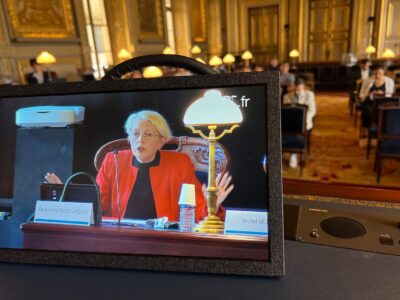
► Full reference : M.-A. Frison-Roche, "De l'obligation de compliance à l'obligation de vigilance : le rôle du juge (From the obligation of compliance to the obligation of vigilance: the role of the judge)", in Round table De la compliance au devoir de vigilance. Une nouvelle responsabilité des entreprises (From Compliance to the Vigilance duty. A new responsibility for businesses," Lettre des juristes d'affaires, Oct. 2025. - 📝read the article reproducing the entire discussion (in French) - ► Summary of my contribution:  In this debate, the terms of which have been reproduced in the journal, I was asked to explain how the legal system had evolved, first by establishing Compliance Law, built on systemic ambitions to prevent sectoral disasters (banking, finance, energy), ambitions that constitute "Monumental Negative Goals", and then evolving on the one hand "Monumental Positive Goals", namely the protection of human beings involved willingly or unwillingly in these systems, on the other hand, outside even sectors with clearly defined boundaries, such as environmental or digital ambitions. The duty of vigilance extends this regulatory law and gives concrete form to the "compliance obligation" to which companies are subject. It is important to maintain a sense of proportion in the conception of the responsibility attached to it so as not to lose everything. Companies are bound by the goals but must remain free in their choice of means, and in particular be encouraged to use contractual techniques. This measure is entrusted to the judge because, due to the Compliance Jurisdictionalisation, it is at the heart of this new branch of Law, which is developing independently of fluctuations in the regulations. During the discussion, I was asked for my opinion on the ruling handed down by the Paris Court of Appeal on 17 June 2025, known as La Poste case. I pointed out that the comments had often focused only on the developments regarding risk mapping, whereas this ruling first establishes the principle that the vigilance plan is the work of the company's decision-making bodies and is not co-constructed, as consultation is a process of discussion and taking in consideration, which is not the same thing, with the judge himself pointing out that they must not interfere in management. In the discussion, I emphasised that if we were to highlight the essence of what would be a "new responsibility", it would primarily concern a new probative dimension that the company must implement in Ex Ante. The implementation of the CSRD, even if it has been excessively standardised, is in line with this, and this probative culture must be developed. - ⛏️Further reading on the subject : 🕴️M.-A. Frison-Roche (ed.), 📘Compliance Obligation, 2026 🕴️M.-A. Frison-Roche, 📝Vigilance, the front line and integral part of the compliance obligation, 2025 🕴️M.-A. Frison-Roche, 📝Compliance, Vigilance and Civil Liability: put in Order and keep the sense of Reason, 2025 🕴️M.-A. Frison-Roche (ed.), 📘Compliance Jurisdictionalisation, 2024 -   -   - ► Article summary : The  - 🌐Follow Marie-Anne Frison-Roche on LinkedIn 🌐follow Marie-Anne Frison-Roche on Instagram 🌐Subscribe to the Newsletter MAFR Regulation, Compliance, Law 🌐Subscribe to the video newsletter MAFR Overhang 🌐Subscribe to the Newsletter MaFR Law & Art

Working papers

Working Paper, basis for an article (in French)

🚧Compliance Law and Systemic Litigation

► Full Reference: M.-A. Frison-Roche, Compliance Law and Systemic Litigation, Working Paper, August 2025. - 📝 This bilingual Working Paper is the basis of the article published in French "Droit de la compliance et contentieux systémique" - ► Summary of this Working Paper: Legal systems have changed, and Compliance Law, in its uniqueness, reflects this change and plays a powerful role in it. New sets of compliance rules, particularly at European Union level, covering data protection (GDPR), anti-money laundering (AMLA), climate balance protection (CS3D) and banking and financial system sustainability (Banking Union), have been developed and imposed on large companies, which must implement them: alerts, mapping, assessment, sanctions, etc. These new regulatory frameworks only make sense in relation to their ‘Monumental Goals’: to detect systemic risks ex ante and prevent crises so that the systems in question do not collapse, but ‘last’. All the legal instruments in the corpus are normatively rooted in these monumental goals, which are the core that unifies Compliance Law (I). The judge is the guardian of this new and highly ambitious regulatory framework, which relies on the practical ability of companies to implement it (II). Courts ensure that the legal technical provisions are applied in a teleological manner in each of these compliance blocks and that the regulations support each other, because all compliance regulations serve the same systemic goal: to ensure that the systems (banking, financial, climate, digital, energy, etc.) do not collapse, but sustains, and that present and future human beings are not crushed by them, but rather benefit from them. This unity is still little perceived because so meticulous regulations pulverise this profound unity of Compliance Law into a myriad of changing provisions. Entrusting the ‘regulatory mass’ to algorithms increases this fragmentation, making the whole even more incomprehensible and therefore impossible to handle. On the contrary, recognising the judge's place, i.e. at the centre, makes it possible to master this new branch of law. But the judge's sole function is not to restore clarity to a body of law covered by the dust of its own technicality. There is a transfer to Litigation of the systemic object of Compliance Law. Indeed, the litigation that emerges from the new Compliance Law is itself fundamentally new, by transitivity. Indeed, the purpose of Compliance Law is to make systems sustainable (or resilient, or robust, depending on the terminology used). This results in litigation that is itself ‘Systemic Litigation’ (III), most often brought by an organisation against a systemic operator. The place and role of each party are transformed (IV). - 🔓read the developments below⤵️ - 🌐follow Marie-Anne Frison-Roche on LinkedIn 🌐follow Marie-Anne Frison-Roche on Instagram 🌐subscribe to the Newsletter MAFR Regulation, Compliance, Law 🌐subscribe to the Video Newsletter MAFR Surplomb 🌐subscribe to the Newsletter MaFR Droit & Art

Conferences

🎤Synthèse, in 🧮Concurrence : les enjeux de la Compliance

► Full Reference: M.-A. Frison-Roche, "Synthèse" ("Synthesis"), in Concurrence : les enjeux de la Compliance​, May 24, 2024, Paris, Collège européen de Paris, Paris Panthéon-Assas University, 28 rue Saint-Guillaume - 🧮see the full programme of this event (in French):  🌐read the  la newsletter MAFR Law, Compliance, Regulation on 26 Mai 2024 about this colloquium and this synthesis (in English) - ► Summary of this concluding conference:The conference was based on the 'framework document' on conformity programmes published by the French Competition Authority, the Autorité de la concurrence, on 24 May 2022 and focused on one of the tools used, namely risk mapping. The care taken to bring together academics whose job it is to give an account of reality by classifying and naming it, which makes it easier to handle, and people who every day in enterprises find solutions to anticipate difficulties so that they can be resolved, or even prevented from arising, has borne fruit. - From all the presentations and discussions, 4 perspectives emerge, each showing what has been achieved, what may still emerge in interaction with all the other mechanisms in Compliance Law that incorporate risk mapping (for instance ,the French 2016 so-called "Sapin 2" law, the French 2017 so-called "Vigilance" law, the CS3D European directive, etc.) and the other mechanisms that are correlated with risk mapping (audit, internal investigations, evidence likely to be raised before a judge by the enterprise and/or by a stakeholder and what remains uncertain in this 2022 framework document.   - The first perspective is the basis of these recommendations, encouragement, methods, advice, etc. The second perspective is the means developed to establish and implement these compliance programmes. The third perspective is the scope of this framework document, which also depends to a large extent on the scope of the compliance programmes adopted by the firms themselves. The fourth perspective is that of the subjects of law who are obliged, or who benefit from the adoption of such  compliance programmes in Competition Law.   - During this conclusion, based solely on what each speaker had to say, I continued my reflections in each of these 4 directions. This reminded me of some of my work made in English on this subject:  M.-A. Frison-Roche (ed.), 📘Compliance Tools, ,2022   M.-A. Frison-Roche, 🚧 Support from Compliance Law for day-to-day management of Competition Law, 2021   M.-A. Frison-Roche, 🚧 Competition Law and Compliance Law, 2018   - 🌐follow Marie-Anne Frison-Roche on LinkedIn 🌐follow Marie-Anne Frison-Roche on Instagram 🌐subscribe to the Newsletter MAFR Regulation, Compliance, Law

Articles in The Journal of Regulation & Compliance « JoRC »

MERABET, Samir🕴️

📝Vigilance, being a judge and not judge, in 🕴️M.-A. Frison-Roche (ed.), 📘Compliance Jurisdictionalisation

► Full Reference: S. Merabet, "Vigilance, being a judge and not judge", in M.-A. Frison-Roche (ed.), Compliance Jurisdictionalisation, Journal of Regulation & Compliance (JoRC) and Bruylant, "Compliance & Regulation" Serie, 2024, pp. 218-228 - 📘read a general presentation of the book, Compliance Jurisdictionalisation, in which this article is published - ► Summary of the article: - 🦉This article is available in full text to those registered for Professor Marie-Anne Frison-Roche's courses -

Organisation of events

🧱Co-organisation of the Symposium 🧮Compliance et contrats publics (Compliance and public contracts)

► Full Reference: M.-A. Frison-Roche, C. Gilles and A. Oumedjkane (dir.), Compliance et contrats publics (Compliance and public contracts), Journal of Regulation & Compliance (JoRC), Centre de recherches et d’études administratives de Montpellier (CREAM) and Centre d’Études et de Recherches Comparatives Constitutionnelles et Politiques (CERCOP) of the Montpellier University, Faculté de droit et de science politique de Montpellier, January 12, 2024 - 🌐consult a general presentation of this event on LinkedIn, linking to a presentation of each speech (in French) - 🏗️This symposium takes place in the cycle of symposiums organised by the Journal of Regulation & Compliance (JoRC) and its partners Universities, focusing in 2023-2024 on the general theme of the Compliance Obligation - 📚The works will then be inserted in the books:  📕Compliance et contrat, to be published in the 📚Régulations & Compliance Serie, co-published by the Journal of Regulation & Compliance (JoRC) and Dalloz, published in French. 📘Compliance & Contract, to be published on the 📚Compliance & Regulation Serie, co-published by the Journal of Regulation & Compliance (JoRC) and Dalloz, published in English. - ► General presentation of the symposium: Compliance is developing throughout the legal system, through both Public and Private Law techniques. Public Contract Law bears witness to this in two ways: through its scope, in that Compliance applies to economic relationships entered into by public bodies, and through its object, which internalises a reconciliation between their economic interests and a set of other general interest objectives, or "Monumental Goals", a reconciliation for which public bodies have traditionally been responsible. In addition to unilateral acts, contracts have their rightful place as a practical means of achieving this reconciliation. Its flexibility allows for negotiation and adjustment of the burdens to be placed on the co-contracting parties. The aim of this symposium is to link the different manifestations of the Compliance Obligation in public contracts and thus give coherence to policies which are still too often considered in a watertight manner because they relate to very different aims and areas. Firstly, at the procurement stage, the promotion of responsible or innovative procurement, particularly from an environmental point of view, is one of the signs of Compliance's presence. On a completely different note, the same is true of the CJEU's challenge to the automatic application of bans on tendering, which prevent contracting authorities from ruling on a candidate's reliability by taking into account the compliance programmes implemented by companies since their conviction. Secondly, at the litigation stage, the Conseil d'État's (French Council of State) recent broad recognition of the illegality of an administrative contract on the grounds of a breach of ethical obligations has tempered the drive to make contracts more secure, drawing the consequences of the major drive for transparency in public life that has been underway since 2013. The aim of the morning session will be to understand the various forms of the Compliance Obligation in public contracts. This overview will make it possible, in the afternoon, to aim to unify the Compliance Obligation in public contracts. - - ► Speakers:  🎤Ugo Assouad, PhD student at the Montpellier University, CREAM 🎤Philippe Augé, President of the Montpellier University 🎤Clémence Ballay-Petizon, PhD student at the Montpellier University, CREAM  🎤Yannisse Benrahou, PhD student at Paris-Nanterre University, CRDP 🎤Léon Boijout, PhD student at the Montpellier University, CREAM 🎤Julien Bonnet, Full Professor at the Montpellier University, CERCOP 🎤Guylain Clamour, Dean of the Montpellier Faculty of Law and Political Science 🎤Marie-Anne Frison-Roche, Professor of Regulatory and Compliance Law, Director of the Journal of Regulation & Compliance (JoRC) 🎤Pierre-Yves Gadhoun, Professor at the Montpellier University, CERCOP 🎤Pascale Idoux, Professor at the at the Montpellier University, CREAM 🎤Nedjma Kontoukas, PhD student at the Montpellier University, CREAM 🎤Valentin Lamy, Senior Lecturer at the Lorraine University, IRENEE 🎤Antoine Oumedjkane, Senior Lecturer at Lille University, ERDP 🎤Lucien Rapp, Emeritus Professor at Toulouse Capitole University 🎤Marion Ubaud-Bergeron, Full Professor at the Montpellier University, CREAM  - 🧮Read a detailed presentation of the event below⤵️ - 🌐follow Marie-Anne Frison-Roche on LinkedIn 🌐follow Marie-Anne Frison-Roche on Instagram 🌐subscribe to the Newsletter MAFR Regulation, Compliance, Law

Conferences

🎥La place de l’Intelligence artificielle dans le respect de la Compliance dans l’entreprise : la juste mesure (“Compliance, Artificial Intelligence and Business Management: the right measure”), in M. Mekki (coord.), 🧮L’intelligence artificielle et la gestion des entreprises (“Artificial Intelligence and Business Management”)

🌐follow Marie-Anne Frison-Roche on LinkedIn 🌐subscribe to the  Newsletter MAFR Regulation, Compliance, Law - ► Full Reference: M.-A. Frison-Roche, "Compliance, Artificial Intelligence and Business Management: the right measure" ("Compliance, Intelligence artificielle et gestion des entreprises : la juste mesure"), participation to the Conference coordinated by Mustapha Mekki, L'intelligence artificielle et la gestion des entreprises. July 1st, 2022.  - 🎥 see the conference (in French) -  consult the slides having been used as brief notes for deliver the lecture (inf French) - 🚧read the bilingual Working Paper having been used as basis for this conference - 📝This work will be the basis for an article. - ► Summary of the Lecture: Of the next European Regulation on artificial intelligence, the European Commission has a quite neutral conception of AI for obtaining a consensus between the Member States, while the Regulators and certain States have a more substantial conception of technology, wanting its power to be used to protect people, firstly from these new tools themselves, secondly from what is an amplification of the evils of the classic world, such as hate or misinformation. This is the reflection of two conceptions of Compliance. Firstly, Compliance can be defined as neutral processes that increase the effectiveness of what would be the obligation for companies or their desire for efficient risk management (in particular the consideration of "legal risks") to prove being "conform" to all regulations that are applicable to itself and all persons to whom the firm is accountable. This is often referred to as the "compliance obligation" or "obligation of conformity". This conception implies considerable practical consequences for the company which, in order to succeed in this "total exploit", would then have to resort to artificial intelligence tools constituting a "total and infallible solution", which mechanically generate for it the obligation to "know " all the "regulatory mass", to detect all "non-compliances", to conceive its relationship to the Law in terms of "risk of non-compliance", fully supported by Compliance by Design which could, without human intervention , eliminate legal risk and ensure "compliance total efficiency" in Ex Ante. The "legal price" of this technological dream is extremely high because all the "regulatory" requirements will then be transformed into obligations of result, any failure generating liability. The Compliance probationary system will become overwhelming for the company, both in terms of burden of proof, means of proof, and transfers, without exemption from proof. Objective responsibilities for others will multiply. The "law of conformity" will multiply Ex Ante systemic penalties, the border with criminal law being less and less preserved. It is essential to avoid this, both for businesses and for the Rule of Law. For this, we must use Artificial Intelligence to its proper extent: it may constitute a "massive aid", without ever claiming to be a total and infallible solution, because it is the human who must be at the center of the compliance system functioning thank to the firms and not the machinery. For this, it is necessary to adopt a substantial conception of Compliance Law (and not a sort of Conformity Law or Obedience Law). It does not at all cover all the applicable regulations and it is not at all "neutral", being in no way a series of processes. This new branch of Law is substantially built on Monumental Goals. These are either of a negative nature (preventing a systemic crisis from happening, in many but specific perspectives: banking, financial, health, climate, etc.), or of a positive nature (building a better balance, in particular between human beings, in the company and beyond). In this conception which appears more and more strongly, artificial intelligence finds its place, more modest. As Compliance Law is based on information, Artificial Intelligence is essential to capture it and make first connections, first stages for successive analyses, done by human beings, making what is essential: the commitment of the company, both by the leaders and by all those who are "embarked" by a "culture of Compliance" which is at both built and common. This restores the required seal between Criminal Law and what can be asked of the mechanical use of Artificial Intelligence; this puts the obligation of means back as a principle. This restores the principal place to the lawyer and the compliance officer, so that the culture of compliance is articulated with the specificities of a sector and the identity of the company itself. Indeed, the culture of compliance being inseparable from a culture of values, Compliance by design requires a dual technique, both mathematical and legal culture. It is why European Compliance Law, because it is rooted in the European humanist tradition, is a model. - For further: 📘Frison-Roche, M.-A. (ed.), Compliance Monumental Goals, 2022 📘Frison-Roche, M.-A. (ed.), Compliance Jurisdictionalisation, 2022 📘Frison-Roche, M.-A. (ed.), Compliance Tools, 2021 📓Frison-Roche, M.-A., L'apport du Droit de la Compliance à la Gouvernance d'Internet, 2019  📕Frison-Roche, M.-A. (ed.), Pour une Europe de la Compliance, 2019 📕Frison-Roche, M.-A. (ed.), Régulation, Supervision, Compliance, 2017 📕 Frison-Roche, M.-A. (ed.), Internet, espace d'interrégulation, 2016 📝 Frison-Roche, M.-A., Compliance Monumental Goals, beating heart of Compliance law,  2022, 📝 Frison-Roche, M.-A., Role and Place of Companies in the Creation and Effectiveness of Compliance Law in Crisis, 2022 📝 Frison-Roche, M.-A., Assessment of Whistleblowing, and the duty of Vigilance, 2022 📝Frison-Roche, M.-A., Drawing up Risk Maps as an obligation and the paradox of he "compliance risks", 2021 -

Articles in The Journal of Regulation & Compliance « JoRC »

RAPP, Lucien🕴️

📝Conformité, proportionnalité et normativité, in 🕴️M.-A. Frison-Roche (ed.), 📕Les Buts Monumentaux de la Compliance

► Full Reference: L. Rapp, "Conformité, proportionnalité et normativité" ("Compliance, proportionality and normativity"), in M.-A. Frison-Roche (ed.), Les Buts Monumentaux de la Compliance, coll. "Régulations & Compliance", Journal of Regulation & Compliance (JoRC) and Dalloz, 2022, pp. 177-198. - 📕read a general presentation of the book, Les Buts Monumentaux de la Compliance, in which this article is published - ► Summary of the article (done by the Author): Proportionality is to the exercise of powers what subsidiarity is to the exercise of competences: an indicator as well as a limit. It determines the scope and allows for control at the same time. It sets the standard, before being a standard itself. This may explain why, in principle, it is part of the judge's office and his methods of assessment. But a study of its recent evolution shows that it is gradually moving from the ex-post to the ex-ante, which makes it possible to anticipate that it will soon become an effective tool of compliance policies and a useful normative reference. The article developments demonstrate this, by explaining how one slides from the principle of proportionality to proportionality control, from proportionality control to proportional reasoning, from proportional reasoning to compliance control, and finally, in a last desirable evolution, from compliance control to the necessary proportionality of control.  -

Articles in The Journal of Regulation & Compliance « JoRC »

📝Dresser des cartographies des risques comme obligation et le paradoxe des “risques de conformité”, in 🕴️M.-A. Frison-Roche (ed.), 📕Les outils de la Compliance

► Full Reference: M.-A. Frison-Roche, "Dresser des cartographies des risques comme obligation et le paradoxe des "risques de conformité"" ("Drawing up risk maps as an obligation and the paradoxe of the "compliance risks""), in M.-A. Frison-Roche (ed.), Les outils de la Compliance, coll. "Régulations & Compliance", Journal of Regulation & Compliance (JoRC) and Dalloz, 2021, pp. 53-62. - 📝read the article (in French) - 🚧read the bilingual Working Paper which is the basis of this article, with additional developments, technical references and hyperlinks - 📕read a general presentation of the book, Les outils de la Compliance, in which this article is published - ► Summary of the article (done by the Journal of Regulation & Compliance): There are few synthetic or theoretical studies on Risk Mapping even though it is in fact the Compliance central tool, perhaps because it is more a management tool than a legal one. Risk Mapping is often described but does not receive any other legal qualifications than being a "modality", suffering in this respect from an evil which affects the whole of Compliance, still little understood by Law, attention often so focused on the Ex Post (sanctions) while Compliance is by nature in the Ex Ante. Going from disarray to incomprehension, everyone can note the existence of "compliance risks" among the mapped risks, because if as so many affirm that it would be necessary to speak only of simple conformity as obedience, demonstrated in Ex Ante, to Law, how a sub-set of a tool would therefore have the same object as the set of Law that this tool serves … This aporia can only be resolved if Compliance Law is defined substantially by its "monumental goals" which exceed obedience to regulations. Consequently, Law taking up Risk Mapping, this mechanism may first appear as an ancillary obligation to the main obligation consisting in achieving "monumental goals". The ancillary obligation to draw up the maps is an obligation of result, while the main obligation to achieve the monumental goals is an obligation of means. These cartographies being very diverse and being only occasionally targeted by specific laws, it can also constitute only a legal fact or, through the play of various charters, a unilateral legal commitment. But it isnbecoming the basis of an autonomous legal obligation incumbent on enterprises in position to know certain risks, obligation referring to the existence of a subjective right tof knowing and measuring them ("right to be worried") which the third parties who are going to run them would hold, thus allowing them to choose to run them, or not.   -

Analyses

Comparaison des versions 2017 et 2020 des recommendations de l’Agence Française Anti-corruption sur la cartographie des risques de corruption (Mechanical Comparison of 2017 and 2020 versions of French Anti-Corruption Authority recommendations about Corruption Risk Mapping)

Full reference: Coeurquetin, R., Comparaison mécanique des versions 2017 et 2020 des recommendations de l'Agence Française Anti-corruption sur la cartographie des risques de corruption, October 2020, 9 p.  Read the mechanical comparison (in French) To go further on the question of risk mapping, read Marie-Anne Frison-Roche's working papers: Drawing up Risk Maps a an Obligation and the Paradoxe of "Compliance Risks" and Anchor Points of the Risk Mapping in the Legal System

Articles

Risk Mapping: is it legally different when it is made by Regulatory Bodies or by Regulated Enterprises?

Full reference: Frison-Roche, M.-A., Risk Mapping: is it legally different when it is made by Regulatory Bodies or by Regulated Enterprises?, in  Newsletter MAFR – Law, Compliance, Regulation, 17th of August 2020 Read, by freely subscribing, other news of the Newsletter, MAFR – Law, Compliance, Regulation   Summary of the news Each year, the Autorité des marchés financiers (French financial markets regulator), the European Central Bank and the Agence française anti-corruption (French anti-corruption agency) publish risk maps. At first glance, risk maps established by the regulator aim to both help regulator and the regulated company to face risks by anticipating them. These documents would only be an assistance brought to firms in their Compliance mission and not an injunction from the regulator to take into account the risks that it emphasizes.   However, Law forces firms to do their own risk maps under penalty of sanctions. Since the regulator has previously published its own risk map, can companies, obliged to write theirs, deviate from it? If the firm follows the map published by the regulator, can it protect itself against this if it is accused of not having fulfilled its compliance obligations? On the contrary, if the operator does not follow regulator's risk map, can this be blamed on it? Formally, regulator's risk maps do not come with an injunction to take it into account but, as everyone knows, any recommendation from a regulator or supervisor must be taken into account. The legal solution could here be the implementation of a system of "comply or explain" which would mean that if the firm decides to no follow the risk map established by the regulator, it must be able to justify its choice.    To go further, read: Frison-Roche, M.-A., Legal Theory of Risk Mapping, center of Compliance Law, working paper, 2020

MAFR Chronicles Compliance Law

article published in French in the Chronicle MAFR Compliance Law (Recueil Dalloz)

📝La cartographie des risques, centre du Droit de la Compliance (Risk Mapping, center of Compliance Law)

► Full Reference : M.-A. Frison-Roche, "Théorie juridique de la cartographie des risques, centre du Droit de la Compliance (Legal Theory of Risk Mapping, center of Compliance Law)", D. 2019, chronique Compliance, p.  - ► English Summary of this article : The act of mapping risks is not currently defined by Law. It is only described in special laws. While risks mapping is central to preventing in Ex Ante the occurrence of crises or behaviors from which the occurrence is excluded, no legal regime is available, due to the lack of a legal definition available. This legal definition is proposed here in 5 stages, starting from special laws and specific cases to go towards a general conception. Risk mapping then appears as a concern for others taken care of willingly or by force by crucial operators, through a new subjective right: the “right to be alarmed”, the map being the structural counterpart of the character of the whistleblower. Two articulated systems of Compliance Law. - Read the article, published in French.   Read its translation in English.    Read the English Working Paper  on which this article is based, working paper with additional developpments, technical references and hypertext links.    -

Conferences

Legal theory of Risk Mapping, in “Risk Mapping, as Compliance Tool” (conference made in French)

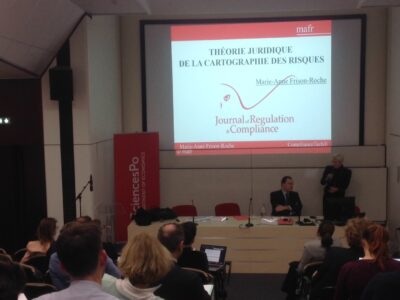
Reference : Frison-Roche, M.-A., General presentation of the cycle of conferences on Les outils de la Compliance  (Compliance Tools) and  "Théorie générale de la cartographie des risques" (Legal Theory of Risk Mapping), conference made in French, in Département d'Economie de Sciences Po & Journal of Regulation & Compliance (JoRC),  La cartographie des risques, outil de la Compliance (Risk Mapping, as Compliance Tool), November 28th, 2019, Sciences Po, Paris.    Read the  General Presentation ot the cycle of conferences about the Compliance Tools   Read the General Presentation of the book written in English to be published   Read the General Presentation of the serie Régulations & Compliance in which the book will be published   Summary of the conference Risk mapping is both central to the obligations or practices of companies and little apprehended by the legal systems. It is not expressly referred to by the French legal system, except for the special national laws known as "Sapin 2" and "Vigilance". But if we are out of this field, because there is only a description and not a legal definition, even less a legal notion, we do not know what legal regime to apply to the action of mapping risks. It is therefore useful, indeed compelling, to define the legal concept of risk mapping. Starting from what is still the safest ground, namely these two special laws, to go towards less secure legal grounds, such as the doctrine of the authorities or the commitments of the companies, even the ISO certifications obtained in this matter. Through a few judicial decisions and legal reasoning, a legal notion of the action of mapping risks emerges. It is advisable to proceed in 5 steps (the working document follows another approach). The first, based directly on the two available laws, apprehends the action of mapping when it comes into execution of a special legal obligation. The decision rendered in 2019 by the French Commission des sanctions of the Agence Française Anticorruption (French Corruption Agency's Sanctions Commission) draws probate games as to the demonstration of the execution of the obligation and the probationary system can be extended. In the same way the decision of the French Conseil constitutionnel (Constitutional Council) in 2017 on the "Vigilance Act" shows that a mechanism referred to as a "modality" is legitimate with regard to the goal, which is, concerning this tool, the establishment of a responsibility for others. It is therefore the concern for the situation of others that can be targeted by the Law thanks to Compliance Tool, especially Risk Mapping. The second theme aims to map risks as a fact of good management for a company, while the enterprise is not constrained by a legal obligation. This fact is a paradox because the Regulatory Authority and the Judge may, where the conduct that was to be prevented occurs, for example a market abuse or an anti-competitive behavior, either qualify as an aggravating circumstance or as an attenuating circumstance. Consideration of the theory of incentives should lead to the adoption of the American solution, that is to say the qualification of an effective cartography as a mitigating fact. European case law is not yet fixed, especially in terms of Competition Law's compliance. The third theme is the mapping action carried out by an entity which, in doing so, exercises power over a third party. Because cartography is as much an obligation as a power, possibly on a third party. The Conseil d'État (French Council of State) in 2017 qualified risk mapping as an act of grievance, but doing so legitimately, since it was to prevent forest fires efficiently. This solution based on the teleology attached to Compliance Law can be transposed to other areas. Going further, one may consider transforming this action from de facto status to legal status on the part of the company, if it thus identifies risks for third parties. It would thus give third-party creditors the right to be in a position to measure the risks that weigh on them. Risk mapping would thus be part of a broader unilateral commitment by powerful companies, recognizing the existence of risks for third parties to enable them to know their nature and extent. If this responsibility Ex Ante (characteristic of Compliance Law) is fulfilled, then the Ex Post liability of the company could no longer be retained. This is the ongoing issue of the Johnson & Johnson trial (2019 American judgment), in terms of medical compliance. Because if one can argue that there exists through this kind of risk mapping that the posology a "subjective right to be worried about the risks related to the taking of the drug", the patient remains free in the use of it. The question of whether third-party education is included in the mapping, since the alert is already included in it, is an open question. For now, the answer is negative. Indeed and in a fifth time, appears the liberal definition of Compliance Law through the apprehension that the Law must make of the cartography of the risks. Beyond the rational act that any person has to control their risks for their own interest, by preventing the damaging effects of that from the crystallization of risk has in fact proved, it is a question of preserving an external interest for the preservation of which the Law must intervene because the subject of law, in particular the company will be less likely to be concerned. By the imprint of the law, risk mapping expresses the concern for an external interest, either of a system or of a third party. But this support in Ex Ante implies force (Sapin 2, Vigilance, financial market information obligation) or will (social responsibility, ethical commitment, adoption of non-financial standards) relates only to information, its constitution, its intelligibility and its hierarchy. Then it is the actors exposed to the risks, able to understand in Ex Ante the extent as far as they are concerned, either the entity itself, or the thirds, to choose to run them to no.     Consult the two sets of slides as basis of the conference:    Slides served as basis for the General Presentation of the cycle of conference on the Compliance Tools (in French)  Slides served as basis for the specific contribution "Théorie générale de la cartographie des risques / Legal Theory of Risk Mapping" (in French).   Read the working paper served as basis for the conference -

Working papers

Anchor points of the risk mapping process in the legal system

  This Working Paper served as the basis for an intervention in the conference organized in the conference cycle organized by the Journal of Regulation & Compliance (JoRC) on the theme: Compliance Tools, in collaboration with many university partners: this first conference is organized in collaboration with the Sciences po Economics Department and is held on November 28, 2019 at Sciences po and deals with the more specific theme of Risk mapping. It also serves as the basis for the book edited by Marie-Anne Frison-Roche, Compliance Tools, which will be released in the Regulations & Compliance collection.   -    Is the consideration by Law of the Risk Mapping mechanism so new? At first glance yes, and one might even be surprised at this novelty, since this rational anticipation of risks should have been recognized for a long time. But this is perhaps due to the more general fact that Risk itself has only recently become an autonomous legal object in Economic Law, in particular because Risk does not have at all the same position in Competition Law and in Regulation Law (I) .. Its position is even opposed in the both, Risk becoming central in Regulation Law. Compliance Law being the extension of Regulatory Law, it is also built on the "concern" of Risk and the internalization of this consideration in enterprises therefore takes the form of mapping. A closer look maybe not,even  before the specific  French laws, called "Sapin 2" and "Vigilance" and beyond them, case law decisions giving a general scope to maps drawn up by operators, or increasing the obligation that 'they have to do it (II). In this, general and precise technical Law offers points of support for Compliance Law, strengthening it in its tools.  

Working papers

Drawing up Risk Maps as an Obligation and the paradoxe of the “Compliance Risks”

This working paper has been the basis for the introduction in the presentation made in the conference organized by the Journal of Regulation & Compliance (JoRC) on the topic : Compliance Tools, in collaboration with many Universities partners.  This first conference has been organized with the Sciences po Economic Department on November 28, 2019 on Risks Mapping.    This working paper is articulated with a second working paper, being the basis of the first development of this conference, on the caractère nouveau ou non en Droit de l'obligation de cartographie des risques.   These two working papers are the basis for two articles published in the collective book, Compliance Tools, in the Series Regulations & Compliance. 

Articles

COLLARD, Christophe and Roquilly, Christophe

Les risques juridiques et leur cartographie : proposition de méthodologie (Legal Risks and Their Mapping: proposition of Methodology)

Full reference: Collard, C., and Roquilly, C., Les risques juridiques et leur cartographie : proposition de méthodologie (Legal Risks and Their Mapping: proposition of Methodology), La Revue des Sciences de Gestion, vol. 263-264, no. 5, 2013, pp. 45-55. Sciences Po's students can read this article via Sciences Po's Drive in the folder MAFR – Regulation & Compliance

Articles

BON-MICHEL, Béatrice

La cartographie des risques : de la rationalisation du futur à l’apprentissage du risque (Risks Mapping: from Rationalization of the Future to Risk Learning)

Full reference: Bon-Michel, B., La cartographie des risques : de la rationalisation du futur à l'apprentissage du risque. Cas de l'identification du risque opérationnel au sein d'un établissement de crédit (Risks Mapping: from Rationalization of the Future to Risk Learning. Case of the Identification of the Operational Risk in a Credit Establishment), Management & Avenir, vol. 48, no. 8, 2011, pp. 326-341. Sciences Po's students can read this article in the Sciences Po Drive in the folder MAFR – Regulation & Compliance