Regulatory law

Articles in a legal collective publication

📝 Se tenir bien dans l’espace digital (Having a good behavior in the digital space), in 📙Penser le droit de la pensée

Full reference: M.-A. Frison-Roche, Se tenir bien dans l'espace numérique, in Penser le droit de la pensée. Mélanges en l'honneur de Michel Vivant, Lexis Nexis and Dalloz, 2020, pp. 155-168. - 📝Read the article (in French) - 🚧Read the working paper, written in English, on which this article is based, with additional developments, technical references, and hyperlinks   English summary of the article: The digital space is one of the scarce spaces not framed by a specific branch of Law, Freedom also offering opportunity to its actors to not "behave well", that is to express and diffuse broadly and immediately hateful thoughts through Hate speechs, which remained before in private or limited circles. The intimacy of Law and of the legal notion of Person is broken: Digital permits to individuals or organizations to act as demultiplied and anonymous characters, digital depersonalized actors who carry behaviors that are hurtful to other's dignity.  Against that, Compliance Law offers an appropriate solution: internalizing in digital crucial operators the mission to disciplinary and substantially hold the digital space. The digital space has been structured by powerful firms able to maintain order. Because Law must not reduce digital space to be only a neutral market of digital prestations, these crucial operators, like social networks or search engines, must be forced to substantially control behaviors. It could be about an obligation of internet users to act with their face uncover, "real identity" policy controlled by firms, and to respect others' rights, privacy rights, dignity, intellectual property rights. In their Regulatory function, digital crucial firms must be supervised by public authorities.  Thus, Compliance law substantially defined is the protector of the person as "subject of law" in the digital space, by the respect that others must have, this space passing from the status of free space to the one of civilized space, in which everyone is obliged to behave well.  -   Read to go further:  Frison-Roche, M.-A., L'apport du Droit de la Compliance à la gouvernance d'Internet, 2019 Frison-Roche, M.-A. (dir.), Internet, un espace d'interrégulation, 2016 - 🌐follow Marie-Anne Frison-Roche on LinkedIn 🌐follow Marie-Anne Frison-Roche on Instagram 🌐subscribe to the Newsletter MAFR Regulation, Compliance, Law 
Articles

For regulating or supervising, technical competence is required: example of the French creation of the “Pôle d’expertise de la régulation numérique “​

Full reference: Frison-Roche, M.-A., For regulating or supervising, technical competence is required: example of the French creation of the "Pôle d'expertise de la régulation numérique"​, Newsletter MAFR – Law, Regulation, Compliance, 2nd of September 2020 Lire par abonnement gratuit d'autres news de la Newsletter MAFR – Law, Regulation, Compliance   Summary of the news Through a decree of 31st of August 2020, the government created a national service, the "Pôle d'expertise de la régulation numérique" (digital regulation expertise pole). It has to furnish to State services a technical expertise in computer science, data science and algorithm processes in order to assist them in their role of control, investigation and study. The aim is to favor information sharing between researchers and State services in charge of regulating digital space.  As its acronym indicates, this pole of expertise aims to represents constance in a changing world. Moreover, more than being a national service, this organism must adopt a transversal dimension, its creation decree being signed by the Prime Minister, Minister of Economy, Minister of Culture and Minister of Digital Transition. The creation of such a pole shows the awareness of the government of the importance of technical competency in the regulation of digital space and of the necessity to centralize these expertises in one organ.  However, as the decree indicates, this pole of expertise could be consulted only by "State services", that excludes regulators which are independent from the State and which could put the pole in conflict of interest, and courts even if they are supposed to play a central role in the regulation of digital space and even if they are allowed to ask the advice of the regulator about some cases. But if regulators cannot size the pole, to whom does it benefit except the legislator and a few officials?  It would therefore have been better for this pole of expertise to be placed under the direction of regulatory and supervisory bodies, which would have enabled it to be able to be consulted both by regulators and by judges, both of whom are key players in digital regulation.

Articles

Compliance Law to Regulate the Internet

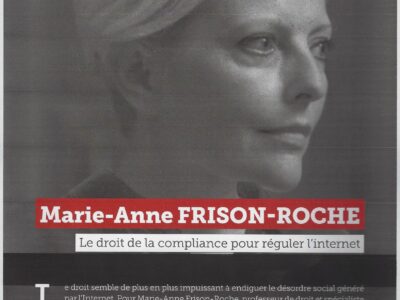
Reference Frison-Roche, M.-A., Le droit de la compliance pour réguler l'internet  (Compliance Law to Regulate the Internet), Interview given in French to Sylvie Rozenfeld, Expertises, December 2019, pp. 385-390.   Summary. Law seems increasingly powerless to stem the social disorder generated by the Internet. For Marie-Anne Frison-Roche, Law professor and specialist in Regulatory Law, the solution is to be found in Law, and more particularly in Compliance Law. This specific Law is already applied in the banking and finance sector, or in the area of ​​personal data. As it has done for green finance and through the GDPR, Europe could impose a compliance system which internalizes concern for the individual in large digital operators. It is up to them to put in place the means and bear the cost, such as the right to be forgotten erected by the CJEU. Marie-Anne Frison-Roche does not offer anything revolutionary, she is content to take elements of positive law that already exist and to correlate them.   Read the interview (in French)   Read the presentation of the official Report for the French Government about which this interview is given:: The contribution of Compliance Law to the Governance of Internet. 

Articles in a legal collective publication

The use of Intellectual Property as Regulatory and Compliance Tool (Le maniement de la propriété intellectuelle comme outil de régulation et de compliance), in “Major cases in Intellectual Property” (“Les Grands Arrêts de la propriété intellectuelle”

Référence complète : Frison-Roche, M.-A., Le maniement de la propriété intellectuelle comme outil de régulation et de compliance, in Vivant, M. (dir.), Les Grands Arrêts de la propriété intellectuelle, 3ième éd., 2019, 9-11, pp. 43-53. This contribution is written in French. Summary:  Intellectual Property, which comes from the State and is incorporated into public policy, can be designed not to reward the creator a posteriori, but to encourage others to innovate. It is then an Ex Ante regulatory tool, an alternative to the subsidy. If private copying is an exception, it is not in relation to the principle of Competition but in an insertion into a system of incentives, starting from the costs borne by the creator of the first innovation: the rights holder is then protected , not only according to a balance of interests involved but in order not to discourage innovative potentials and the sector itself. (1st decision) ; The sectoral policy then permeates Intellectual Property, used to regulate a sector, for example that of the drug. While it is true that a laboratory wishing to market a generic drug did not wait for the expiration of the patent for the original drug to do so, it is however not relevant to sanction this anticipation by a few days because the investments made by the holder of the Intellectual Property right have been made profitable by this one and because the public authorities favor the generics in a concern of public health (2nd decision). Systemic interest prevails and therefore Internet service providers have to bear the costs of blocking access while they are irresponsible because of the texts. This obligation to pay is internalized by Compliance Law because they are in the digital system best able to put an end to the violation of Intellectual Property rights which the ecosystem requires to be effective. (3rd decision).   Read the contribution (in French).   Read the Working Paper written in English having served as a basis for this contribution and endowed with additional developments, technical references and hypertext links.  -

Publication director

🏗️ copublishing and direction of the collection: 📚Régulations & Compliance

📚Publication of🕴️M.-A. Frison-Roche (ed.), 📕Pour une Europe de la Compliance (For the Europe of the Compliance), 2019

🌐 follow Marie-Anne Frison-Roche on LinkedIn 🌐 subscribe to the Newsletter MAFR Regulation, Compliance, Law - ► Full Reference: M.-A. Frison-Roche (ed.), Pour une Europe de la Compliance (For the Europe of the Compliance), series “Régulations & Compliance“, Dalloz, 2019, 124 p.  - This volume is the continuation of the books dedicated to Compliance in this collection. ► Read the presentations of the other books in the series: the following books: 🕴️M.-A. Frison-Roche (ed.), 📕Les outils de la Compliance, 2021 🕴️M.-A. Frison-Roche (ed.), 📕Les Buts Monumentaux de la Compliance, 2022 🕴️M.-A. Frison-Roche (ed.), 📕La juridictionnalisation de la Compliance, 2023 🕴️M.-A. Frison-Roche and M. Boissavy (eds.), 📕Compliance et droits de la défense. Enquête interne – CJIP – CRPC, 2024 🕴️M.-A. Frison-Roche (ed.), 📕L’Obligation de Compliance, 2025 🕴️M.-A. Frison-Roche (ed.), 📕Compliance et Contrat, forthcoming 🕴️L. Laref (ed.), 📕Compliance et vigilance bancaire, forthcoming 🕴️M.-A. Frison-Roche, 📕Le système juridique de l’adressage de l’Internet. Une structure multi-acteurs, gage de durabilité (The Legal System of Internet Addressing. A Multi-Stakeholder Structure, the Pledge of its Sustainability), forthcoming 🕴️M.-A. Frison-Roche (ed.), 📕Le système probatoire de la Compliance, forthcoming   the previous books: 🕴️N. Borga, J.-Cl. Marin and J.-Ch. Roda (eds.), 📕Compliance : l’entreprise, le régulateur et le juge, 2018 🕴️M.-A. Frison-Roche (ed.), 📕Régulation, Supervision, Compliance, 2017 🕴️M.-A. Frison-Roche (ed.), 📕Internet, espace d’interrégulation, 2016 📚Read the presentations of the other titles of the collection. - ► General presentation of the book: This book is written in French. The topic is : “For the Europe of the Compliance“. See below its general presentation in English.  The political dimension is intrinsic to the Compliance Law. Indeed, compliance mechanisms consist of internalizing in certains companies the obligation to implement goals of general interest set by Public Authorities. These public bodies control the Ex Ante reorganization that implies for these companies and punish Ex Post the possible structural inadequacy of these compagnies, becoming transparent for this purpose.  This new mode of governance establishes a continuum between Regulation, Supervision, Compliance (book published in 2017) and renew the links between Companies, Regulators and Judges1Frison-Roche, M.-A., Compliance, see.  This political dimension must be increased: the Compliance Law of Compliance must today be used to build Europe. One can observe not only the construction of the  European Compliance Law, object-by-object, sector-by-sector, purpose-by-purpose, but also the construction of the European Compliance Law that transcends and unifies them. Becoming independent of American Law and ceasing to be in reaction, even on the defensive, the Compliance Law contributes to the European project, offering it a higher ambition, that Europe can carry and, by this way, can carry the Europe itself, not only to preserve the European economy from corruption or money laundering, but by claiming the protection of nature and human beings. This is why the book describes the “reasons and objectives” of the Europe of the Compliance, which makes it possible to describe, detect and even predict the ways and means. - ► Understand the book through the Table of Contents and the summaries of each article:  🕴️M.-A. Frison-Roche, 📝Avant propos  🕴️K. Lenaerts, 📝Le juge de l’Union européenne dans une Europe de la compliance 🕴️M.-A. Frison-Roche, 📝Un droit substantiel de la compliance, appuyé sur la tradition européenne humaniste   I. LES RAISONS ET LES OBJECTIFS D’UNE EUROPE DE LA COMPLIANCE (THE REASONS AND OBJECTIVES OF THE EUROPE OF THE COMPLIANCE)  🕴️X. Musca, 📝Construire une Europe de la compliance en donnant une meilleure place aux entreprises 🕴️P. Vimont, 📝La place de la diplomatie dans l’avancée d’une Europe de la compliance 🕴️P. Sellal, 📝Les vertus de la compliance : une réponse possible aux faiblesses de l’Union européenne ? 🕴️J.-J. Daigre, 📝Compliance, entreprise et Europe   II. LES VOIES ET MOYENS D’UNE EUROPE DE LA COMPLIANCE  (THE WAYS AND MEANS OF THE EUROPE OF THE COMPLIANCE) 🕴️J.-Cl. Marin, 📝Quels outils pour la construction du droit de la compliance en Europe ? 🕴️M. Canto-Sperber, 📝La compliance et les définitions traditionnelles de la vertu 🕴️T. Bonneau, 📝Compliance et secteur bancaire et financier en Europe 🕴️C. Duchaine, 📝L’Agence française anticorruption, à l’appui de l’Europe de la compliance 🕴️D. Martin, 📝Les contraintes et les vertus de la compliance 🕴️A. de La Cotardière, 📝Construire une Europe de la compliance lisible pour les entreprises -
Articles in a non-legal collective publication

FRISON-ROCHE, Marie-Anne

Creating “Regulation Law” at Dauphine

Full reference: Frison-Roche, M.-A., Creating "Regulation Law" at Dauphine, in Huault, I. and Bouchard, B. (ed.), 50 years of Research in Dauphine. 1968-2019, 2019, pp. 110-114 Read Marie-Anne Frison-Roche's article (in French)   Read also:  The foreword of the book written by Bruno Bouchard (in French) The preface of the book written by Ivar Ekeland (in French) The table of contents of the book (in French)

MAFR Chronicles Compliance Law

📝 Le Droit de la Compliance au-delà du Droit de la Régulation (Compliance Law beyond Regulation Law)

Full reference : Frison-Roche, M.-A., Le Droit de la Compliance au-delà du Droit de la Régulation, Recueil Dalloz, 2018, chronique, pp. 1561-1563.   Summary : A movement started from precise legal requirements linked to identified actors, as the financial or banking sector, to transform itself in legal norms of Compliance. Compliance Law is thus the extension of Regulation Law. But Compliance Law is taking its full autonomy with regards with Regulation Law, while retaining its violence, its radicalisé, and even its archaism, even though it concerns companies which do not act on regulated sectors, putting down, for instance, notions linked to territoriality (I). How companies should react face to this unequaled news (II)?  Read the article (in French) Read the table of contents of the Review (in French). This document is based on a working paper with footnotes, technical references and hypertext links.   

Articles in a legal collective publication

La société et l’entreprise

Working papers

Is the French legal system an asset or a handicap for the competitiveness of our companies and our territory?

This working document served as a basis for a lecture given in French at the Académie des Sciences morales et politiques  (French Academy of Moral and Political Sciences) on September 25, 2017, in the cycle of conferences conducted under the presidency of Michel Pébereau,  Quelles réformes ? (What reforms?) Consult the presentation (in French) of the conference cycle (2017). It served as the basis for the publication of an article published  in French in 2018 in the book directed by Michel Pébereau Réformes et transformations (Reforms and transformations).

Conferences

SAUVÉ, Jean-Marc

Les entreprises publiques

Full reference: Sauvé, J. M., Les entreprises publiques, Introductive speech to the conference "les entretiens du Conseil d'État en Droit public économique" (Conseil d'État's colloquium in Economic Public Law), 10 juin 2016 Read the speech (in French)

Articles

BON-MICHEL, Béatrice

La cartographie des risques : de la rationalisation du futur à l’apprentissage du risque (Risks Mapping: from Rationalization of the Future to Risk Learning)

Full reference: Bon-Michel, B., La cartographie des risques : de la rationalisation du futur à l'apprentissage du risque. Cas de l'identification du risque opérationnel au sein d'un établissement de crédit (Risks Mapping: from Rationalization of the Future to Risk Learning. Case of the Identification of the Operational Risk in a Credit Establishment), Management & Avenir, vol. 48, no. 8, 2011, pp. 326-341. Sciences Po's students can read this article in the Sciences Po Drive in the folder MAFR – Regulation & Compliance 

I-1.31: The Competition Authority between “regulation” and competition policiy

Translated Summaries ENGLISH Two and a half years after having been established by the LME, the French Competition Authority has uncontestably acquired its “place in the sun” amongst the competition authorities of other countries, as demonstrated by multiple indicators.   ITALIAN Articolo: L’Autorità garante della concorrenza tra “regolazione” e politica in materia di concorrenza Due anni e mezzo dopo l’instaurazione da parte del LME, l’Autorità francese garante della libera concorrenza ha trovato il suo posto tra le diverse autorità degli altri paesi, così come è stato dimostrato da diversi indicatori. SPANISH Artículo: La Autoridad de la competencia, entre “regulación” y política competitiva.   Después de dos años y medio de haber sido establecido por el LME, la Autoridad francesa de la competencia ha incontestablemente adquirido su “lugar bajo el sol” entre las autoridades de la competencia de otros países, como demostrado por varios indicadores. ………………… Other translations forthcoming.