Regulatory law

Articles

Article in a Newsletter MAFR

📝Asset freezing in the legal saga between American power and Venezuelan wealt

► Full reference: M.-A. Frison-Roche, "Asset freezing in the legal saga between American power and Venezuelan wealth", MAFR Law, Compliance, Regulation Newsletter, 23 January 2026 - 🌐read this article published on LinkedIn the 23 January 2026  - 📧Read other articles from the MAFR Newsletter – Law, Compliance, Regulation for free with a subscription. - ► Summary of this article  : It is often emphasised that the  law is merely a masquerade in the series of events we are witnessing. This is not entirely true. For three reasons. 1. Much will depend on the judge who will rule on the Madura couple's case. The energy sector has always similarly mixed regulation, public policies of states and businesses, both articulated by States and companies, both articulated by  international contracts, always organising international arbitration 3. If ExxonMobil now refuses to make the investments desired by Trump, it is also because this enterprise remembers that many years ago the freeze  of assets granted by the arbitrators was not very successful, and now the company manager believes that investment in  Venezuala's infrastructure is therefore "impossible". And given the current state of the law in the US, there is little Trump can do about it.. - 📝⤵Read the complete article below⤵ - 🌐Follow Marie-Anne Frison-Roche on LinkedIn 🌐follow Marie-Anne Frison-Roche on Instagram 🌐Subscribe to the Newsletter MAFR Regulation, Compliance, Law 🌐Subscribe to the video newsletter MAFR Overhang 🌐Subscribe to the Newsletter MaFR Law & Art

Articles in The Journal of Regulation & Compliance « JoRC »

BLANC, Jean-Baptiste🕴️

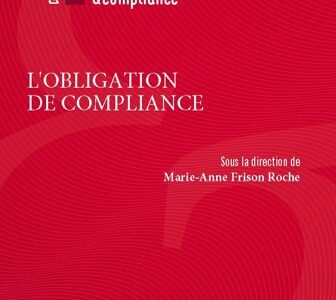
📝La loi, source de l’Obligation de Compliance (The Law, source of the Compliance Obligation), in 🕴️M.-A. Frison-Roche (ed.), 📕L’Obligation de Compliance

► Full Reference: J.-B. Blanc, "La loi, source de l’Obligation de Compliance" ("The Law, source of the Compliance Obligation"), in M.-A. Frison-Roche (ed.), L'Obligation de Compliance, Journal of Regulation & Compliance (JoRC) and Dalloz, "Régulations & Compliance" Serie, 2025, pp. 393-400. - 📕read the general presentation of the book, L'Obligation de Compliance, in which this article is publish - ► Summary of this contribution  (done by the Journal of Regulation & Compliance) : - 🦉This article is available in full text to those registered for Professor Marie-Anne Frison-Roche's courses -

Articles in a legal collective publication

📝Compliance, in 🕴️J.-Fr. Kerléo et 🕴️E. Lemaire (dir.), 📗Dictionnaire de l’éthique publique

► Full Reference: M.-A. Frison-Roche, "Régulation" (Regulatory Law), in J.-Fr. Kerléo et E. Lemaire (dir.), Dictionnaire de l'éthique publique, LexisNexis, 2025, pp.  - 📗read the general presentation of the Dictionary. - 📝read the article  (in French) - ► English Summary of this article defining Regulation: To define Regulation (Regulatory Law), the article begins with its origins, which were a source of misunderstanding, since the term Regulation might refer to simple regulations, thus masking the real branch of Law which is the Law of Regulation. But this confusion with simple and formal regulations has diminished Regulatory Law its importance, its novelty and its originality, and, by placing it within Public Law, equated Regulation on the one hand with the transition from public monopolies to a competitive organisation, and on the other hand privileged the legal study of what fell within the remit of the Administrative Courts, i.e. telecommunications, transport and energy, leaving out the Regulatory Law of banking and financial sector . As a result, the unity and strength of Regulatory Law is still difficult to perceive and manage today, while its relationship with competition and Europe remains difficult. Regulatory Law is all the more difficult to define because it is still common to oppose, as was the case in the 1980s, "Economic Regulatory Law", which would aim to set economic efficiency objectives within the State, and "Public Liberties Regulatory Law", which would be alternatives to each other, preventing the audiovisual, media and digital sectors in particular from being legally perceived as an industry. We are still paying for this initial conception. All the more so since Regulatory Law is the second pillar on which Europe is built, along with Competition, with which it is linked. It can be identified by the existence of a regulated 'sector', most often through the establishment of a regulatory authority, generally in the form of an Independent Administrative Body. But it is defined by the prevalence of the technical and political goals pursued, which are not spontaneously achieved and which aim to favour the human beings involved in economic organisations. While the function of Competition Authorities is to maintain the dynamism of competitive markets and to punish behaviour that hinders them without creating that dynamism, Regulatory Law, through its own rules, principles, institutions, procedures and decisions, will create non-spontaneous équilibra and maintain them over time.  To do this, it will inject non-spontaneous procedures, such as transparency, or generate obligations and powers because these are necessary for this balance to be achieved. This can take the form of exclusive rights, which can go as far as the creation of monopolies, particularly on transport infrastructures, or the form of pricing and tarification, which can go as far as free access. Access rights are essential, whether technical or political (access to networks, access to healthcare). The political dimension of Regulatory Law is very much in evidence, as Europe is developing its own form of Regulation compared with the USA or China, demonstrating the link between Regulation and Sovereignty, the criterion? of the technical sector becoming less significant. This is illustrated by the clash over algorithmic systems (AI).  In this way, regulation is not a technical reaction to a "market failure", but the manifestation of a zone's political power both internally and externally. The DSA (2022) is an example of this, imposing this same logic extraterritoriality in the digital space through the Digital Services Act (DSA) adopted in 2022. - 📝read the presentation of the other article written by Marie-Anne Frison-Roche for this Dictionary: "Compliance" - 🌐follow Marie-Anne Frison-Roche on LinkedIn 🌐follow Marie-Anne Frison-Roche on Instagram 🌐subscribe to the Newsletter MAFR Regulation, Compliance, Law 🌐subscribe to the Video Newsletter MAFR Surplomb 🌐subscribe to the Newsletter MaFR Droit & Art

Articles in a non-legal collective publication

article in a non-legal collective publication

📝Le Droit de la compliance, voie royale pour réguler l’espace numérique (Compliance Law as a Royal Road for regulating the Digital Space​), in📚Enjeux numérique,📗Régulation et Compliance

► Full Reference: M.-A. Frison-Roche, "Le Droit de la compliance, voie royale pour réguler l'espace numérique" (Compliance Law as a Royal Road for regulating the Digital Space), in P. Bonis et L. Castex (dir.), Compliance et nouvelles régulation, Annales des Mines, coll. "Enjeux numériques", juin 2025, pp. 69-77. - 📝 read the article (in French)  - 🚧This article is underpinned by a English Working Paper in English, with additional technical developments and hypertext links. : Compliance Law as a Royal Road for regulating the Digital Space - ► English Summary of this article:  In order to describe the role of Compliance Law in regulating the digital space and to conclude that this new branch of Law is the 'royal road' to this end, this study proceeds in 6 stages.  Firstly, at first sight and conceptually, there is a gap between the political idea of Regulating and the ideas (freedom and technology as 'law') on which the digital space has been built and is unfolding.  Secondly, in practice, there is such a huge gap between the ordinary methods of Regulatory Law, which are backed by a State, and the organisation of the Digital Space by these economic operators, that are both American and global.  Thirdly, the political claim to civilise the Digital Space remains and is growing, relying on the very strength of the entities capable of realising this ambition, these entities being the crucial digital operators themselves, seized as Ex Ante.  Fourthly, it corresponds to the conception and practice of a new branch of Law, Compliance Law, which should not be confused with "conformity" and which is normatively anchored in its "Monumental Goals".  Fifthly, Compliance Law internalises Monumental Goals in the digital operators which disseminate them through structures and behaviours in the digital space.  Sixthly, through the interweaving of legislation, court rulings and corporate behaviour, the Monumental Goals are given concrete expression, willingly or by force, in ways that can civilise the digital space without undermining the primacy of freedom. - 🌐follow Marie-Anne Frison-Roche on LinkedIn 🌐follow Marie-Anne Frison-Roche on Instagram 🌐subscribe to the Newsletter MAFR Regulation, Compliance, Law 🌐subscribe to the Video Newsletter MAFR Surplomb 🌐subscribe to the Newsletter MaFR Droit & Art
Articles in a non-legal collective publication

Article in a non-legal collective publication

📝Réguler le numérique, ou Sisyphe heureux (Regulating Digital, or a happy Sisyphus), in 📚Enjeux numérique, 📗Compliance et nouvelles régulations (Compliance and New Regulations)

► Full Reference: P. Bonis & M.-A. Frison-Roche, "Réguler le numérique, ou Sisyphe heureux" (Regulating Digital, or a happy Sisyphus), in P. Bonis & L. Castex (dir.), Compliance et Nouvelles Régulations, Les Annales des Mines, series "Enjeux numériques, June 2025, pp. 5-7. - 📝read the article (in French) - 📗read the table of content of this special issue of Enjeux numérique, Régulation et Compliance (in French), in which this introductory article is published. - ► English Summary of this article: This introduction to the collective publication on Regulation and Compliance, which aims to bring order to the Digital space, takes up the idea expressed by Camus when he referred to 'happy' Sisyphus, and expresses the idea that Regulation and Compliance are applied to this area with difficulty, relentlessness and failure, with texts constantly being adopted, modified and amplified on all sides, while the Digital Space is constantly changing, and the slope is constantly being climbed again. But this should not be seen as a failure, not even a flaw, because it is in the nature of digital regulation to always place the regulatory apparatus on our shoulders. This weight is shared by all, by the Authorities of all countries, because there is something common to all and also because there is something specific for each, because the techniques differ and because the visions of the world that the Politicians print in the texts and project in the Digital will always differ. This weight is also shared by companies, which internalise the rules through Compliance mechanisms, making them necessary agents for the efficiency and sustainability of the digital system, but also players in it, in articulation with Internet users in a permanent and unstable articulation with the local to the finest and this global that the Internet has invented. This presentation opens the series of contributions to the collective publication Régulation et Compliance, which makes up this special issue of Enjeux numériques in Annales des Mines. - 🌐read also the English presentation of:🕴️Marie-Anne Frison-Roche, 📝Le Droit de la compliance, voie royale pour réguler l'espace numérique (Compliance Law as a Royal Road for regulating the Digital Space) - 🌐follow Marie-Anne Frison-Roche on LinkedIn 🌐follow Marie-Anne Frison-Roche on Instagram 🌐subscribe to the Newsletter MAFR Regulation, Compliance, Law 🌐subscribe to the Video Newsletter MAFR Surplomb 🌐subscribe to the Newsletter MaFR Droit & Art

Working papers

Working Paper basis for an article in a collective publication

🚧Compliance Law as the Royal Road for regulatinf the Digital Space

► Full Reference: M.-A. Frison-Roche, Compliance law as a Royal Road for regulating the Digital Space, Working Paper, May 2025 - 📝 This Working Paper is the English basis for an article written in French "Le Droit de la compliance, voie royale pour réguler l'espace numérique", in 📕 - ► Summary of this Working Paper: In order to describe the role of Compliance Law in regulating the digital space and to conclude that this new branch of Law is the 'royal road' to this end, this study proceeds in 6 stages. Firstly, at first sight and conceptually, there is a gap between the political idea of Regulating and the ideas (freedom and technology as 'law') on which the digital space has been built and is unfolding. Secondly, in practice, there is such a huge gap between the ordinary methods of Regulatory Law, which are backed by a State, and the organisation of the Digital Space by these economic operators, that are both American and global. Thirdly, the political claim to civilise the Digital Space remains and is growing, relying on the very strength of the entities capable of realising this ambition, these entities being the crucial digital operators themselves, seized as Ex Ante. Fourthly, it corresponds to the conception and practice of a new branch of Law, Compliance Law, which should not be confused with "conformity" and which is normatively anchored in its "Monumental Goals". Fifthly, Compliance Law internalises Monumental Goals in the digital operators which disseminate them through structures and behaviours in the digital space. Sixthly, through the interweaving of legislation, court rulings and corporate behaviour, the Monumental Goals are given concrete expression, willingly or by force, in ways that can civilise the digital space without undermining the primacy of freedom. - 🔓read the Working Paper below⤵️ - 🌐follow Marie-Anne Frison-Roche on LinkedIn 🌐follow Marie-Anne Frison-Roche on Instagram 🌐subscribe to the Newsletter MAFR Regulation, Compliance, Law 🌐subscribe to the Video Newsletter MAFR Overhang 🌐subscribe to the Newsletter MaFR Droit & Art

Conferences

conference

🎥La qualification juridique du système de noms de domaine comme infrastructure et ses conséquences juridiques (“The legal status of the domain name system as an infrastructure and its legal consequence”), in 🧮Durabilité de l’Internet : le rôle des opérateurs du système des noms de domaine. Compliance et régulation de l’espace numérique (Sustainability of the Internet: the role of the operators of the domain name system. Compliance and regulation of the digital space)

► Full Reference: M.-A. Frison-Roche, La qualification juridique du système de noms de domaine comme infrastructure et ses conséquences juridiques ("The legal status of the domain name system as an infrastructure and its legal consequence"), in M.-A. Frison-Roche et G. Loiseau (dir.), Durabilité de l'Internet : le rôle des opérateurs du système des noms de domaine (Sustainability of the Internet: the role of the operators of the domain name system. Compliance and regulation of the digital space). Compliance et régulation de l'espace numérique, 21 février 2025, organisé par le Journal of Regulation & Compliance et l'Institut de la Recherche en Droit de la Sorbonne (André Tunc – IRDJS), 12 place du Panthéon, Paris. - 🧮see the full programme of this colloquium (in French) - ► Summary of this conference:  "Domain names" are a technical reality. This technical reality has come to the fore, seeming to have been both little "thought out" and little "conceived" in Law and, perhaps because it is little coveted, Competition Law, which neutralises the concreteness of things and services in order to focus on exchange, hardly qualifies them. It is rather from the 'Competition Policy' perspective that 'domain names' are apprehended. However, Competition Policy expresses wishes and perspectives, while Competition aw must make way for the perspective of Regulatory Law inside the liberal economic system. Looking at the technicalities of the domain name system, we can proceed in 3 stages. Firstly, if a domain name is taken in isolation, it may appear as property and/or a projection of a person, and has rightly been described as such by the courts. But domain names only exist in relation to each other, the addressing system on which the Internet itself and the digital space that enables everyone to spread, reach and be reached were built. In this way, they constitute an Infrastructure in their plurality, in a uniqueness (I). The legal system must take account of this technological reality through the concept of Essential Infrastructure, which is well known in Regulatory legal perspective(I). Secondly, the legal consequences of this legal qualification of Infrastructure must be detailed (II). Regulatory Law does not necessarily imply institutions, a regulatory authority being an indication rather than a criterion. Rather, it requires specific charges, powers and controls to ensure that the Infrastructure is established and operates to fulfill, now and in the future, the function that is crucially expected of it. Because the digital space was born of the Internet, an a-sectional and a-territorial space, Compliance Law, which is an extension of Regulatory Law, outside the sectors and internalised in the crucial operators, is essential as it is appropriate without diminishing the public dimension of the organisation. Thirdly, the evidential dimension should be emphasised (III). Indeed, because we need to ensure that the Domain Names Infrastructure is always solid and reliable, so as not to risk a systemic failure of the Internet, and therefore of the digital space, we must not remain with the traditional system of burden of proof that rests on the person making the complaint. Because there is a Compliance Obligation, it is up to the crucial operators to credibly show their ability to ensure the technical sustainability of this infrastructure on which the digital space in which we live is based. It shall be different if the issue is one of non-technical Sustainability, for example that which is linked to a particular societal project, in which the operators of the domain name system are not at the origin and are required on an ad hoc basis because they are in a good position to help the Authorities or because they wish to do so. - 🌐suivre Marie-Anne Frison-Roche sur LinkedIn 🌐suivre Marie-Anne Frison-Roche sur Instagram 🌐s'abonner à la Newsletter MAFR Regulation, Compliance, Law 🌐s'abonner à la Newsletter en vidéo MAFR Surplomb

Organisation of events

⚙️Co-organisation of the symposium 🧮Durabilité de l’Internet : le rôle des opérateurs du système des noms de domaine. Compliance et Régulation de l’espace numérique (Sustainability of the Internet: the role of the operators of the domain name system. Compliance and regulation of the digital space)

  - ► Full Reference: M.-A. Frison-Roche & G. Loiseau (dir.), Durabilité de l'Internet : le rôle des opérateurs du système des noms de domaine. Compliance et régulation de l'espace numérique (Sustainability of the Internet: the role of the operators of the domain name system. Compliance and regulation of the digital space), Journal of Regulation & Compliance (JoRC) and Institut de Recherche Juridique de la Sorbonne (André Tunc – IRJS), Paris 1 Panthéon-Sorbonne University, 21 Fabruary 2025 - ► General presentation of this symposium: The digital space has been built on and as a system. Its primary interest is of a negative nature: it consists of to be preserved against the prospect of systemic failure, of not collapsing. Like all other systems, this 'Monumental Goal' specific to the digital system justifies resources that incorporate this concern for the future. As with all systems, it integrates and relies on the specific technical nature of this system. The digital space is largely based on the invention, technology and architecture of domain names. Domain names, as an addressing system, enable users to enter the digital space and find other Internet users. The uniqueness and solidity of the domain name system, entrusted to a single root and decentralisation, makes this community possible for those who use the digital space and ensures the technical durability required, without which the digital space would be compromised. The architecture, operation, operators and what they do under the control of legislators, regulators, judges and legal subjects are therefore examined from a dual technical and legal perspective, in the light of the imperative of sustainability. This allows to progress in 4 stages. Firstly, to examine the permanence in time and space of the domain name system, insofar as it is the foundation of the Internet and the digital system. This technical construction gives rise to legal qualifications, not only for the present but also for the future, since the Web3 offers new technical solutions. Secondly, this technical sustainability is an imperative that is built into the operators of the domain names themselves, which are inter-linked not only at national level but also at global level, this cross-linking being necessary for the security of the system. The State is present through public law techniques that enable surveillance, control and possible recovery. Thirdly, it imposes constraints on the operators subject to them in order to serve this monumental goal of technical sustainability, and these constraints themselves generate as many powers as they need to usefully achieve this mission. This proportionality must be at the heart of the method and the requirements. The relationship between constraints and powers also stems from it. Fourthly, this imperative of technical sustainability, which is global in nature, gives way to imperatives of societal sustainability, more localised in space and time, when domain name operators are called upon by the legitimate authors of binding standards, legislators in the first instance, to express concerns such as the protection of people involved in the digital space and whose rights are compromised or who are in danger. This second type of sustainability, which is more localised and less inherent in the architecture of the Internet, is justified by the available power of the operators concerned and their adherence to social imperatives. The resulting constraints and powers are therefore not the same. The 2 sustainabilities must then be articulated in a conception that is both teleological and pragmatic. - - ► Speakers (they will speak in French, but the book to be published will be in English):  🎤Pierre Bonis, Chief Executive Officer of the Association française pour le nommage Internet en coopération (Afnic) 🎤Lucien Castex, Adviser of the Afnic Chief Executive Officer for Research internet and society and Internet governance 🎤Marie-Anne Frison-Roche, Full Professor of Regulatory and Compliance Law, Director of the Journal of Regulation & Compliance (JoRC) 🎤Claire Leveneur, Senior Lecturer at Paris-Est Créteil University 🎤Grégoire Loiseau, Full Professor at Paris 1 Panthéon-Sorbonne University 🎤Samir Merabet, Full Professor at the University of West Indies 🎤Antoine Oumedjkane, Senior Lecturer at Lille University 🎤Frédéric Sardain, attorney at law, Jeantet law firm - read below a detailed presentation of this event⤵️ - 🌐follow Marie-Anne Frison-Roche on LinkedIn 🌐follow Marie-Anne Frison-Roche on Instagram 🌐subscribe to the Newsletter MAFR. Regulation, Compliance, Law 🌐subscribe to the Newsletter Surplomb, par MAFR

Surplomb - Notion

🎬Regulation and Compliance

Surplomb - Notion

🎬Procedural Law of Regulation and Compliance

Books

Conseil d'État🏛️ & Cour de cassation🏛️

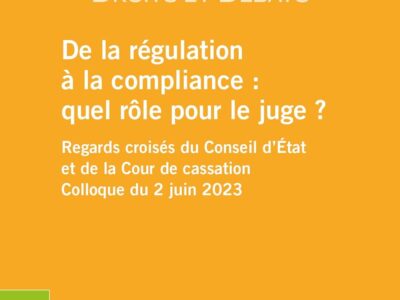
📗De la régulation à la compliance : quel rôle pour le Juge ?. Regards croisés du Conseil d’État et de la Cour de cassation (From Regulatory Law to Compliance Law: what role for the Judge?. Viewpoints of the Conseil d’État (French Administrative Supreme Court) and Cour de Cassation (French Judiciairy Supreme Court)

► Full Reference: Conseil d'État (French Administrative Supreme Court) & Cour de cassation (French Judiciary Supreme Court), De la régulation à la compliance : quel rôle pour le juge ? Regards croisés du Conseil d'État et de la Cour de cassation, ("From Regulatory Law to Compliance Law: what role for the Judge?"), La Documentation française, coll. "Droits et Débats", 2024, 241 p. - 📗read the  coverback (in French) - 📗read the table of content (in French) - ► Summary of this book : "Compliance, sometimes translated in French by the word "conformité" ("conformity"), is an extension of Regulatory Law and represents from it a new and decisive step forward. Compliance brings together all the mechanisms implemented within an organisation to achieve general interest goals (security, sustainability), thereby countering systemic risks. By relying on the rules, legal and ethical standards that embody these values, which are imposed on them and internalised by them, enterprises can both prevent the risk of sanctions and participate in this alliance between public authorities, economic operators and stakeholders to detect and prevent future systemic disasters.  Organisé par le Conseil d’État et la Cour de cassation, le colloque du 2 juin 2023 analyse ce changement de paradigme créé par cette nouvelle branche du droit.".  Organised by the Conseil d'État (French Administrative Supreme Court) and the Cour de cassation (French Judiciary Supreme Court), the conference on 2 June 2023, basis of this book, has analysed this paradigm shift created by this new branch of law: Compliance Law.  - 📝read the presentation in English of the concluding contribution of  Marie-Anne Frison-Roche : "Le rôle du juge dans le déploiement du droit de la régulation par le droit de la compliance" - 📝read the presentation in English of the contribution of François Ancel : "Quel rôle pour le juge aujourd’hui dans la compliance ? Quel office processuel du juge dans la compliance ?" -

Articles in a legal collective publication

📝Le rôle du juge dans le déploiement du droit de la régulation par le droit de la compliance (The role of the Judge in the deployment of Regulatory Law through Compliance Law), synthesis in 🏛️Conseil d’État and 🏛️Cour de cassation, 📗De la régulation à la compliance : quel rôle pour le juge ?

► Full Reference: M.-A. Frison-Roche, "Le rôle du juge dans le déploiement du droit de la régulation par le droit de la compliance" ("Synthesis: The role of the Judge in the deployment of Regulatory Law through Compliance Law"), Synthesis in Conseil d'État (French Council of State) and Cour de cassation (French Court of cassation), De la régulation à la compliance : quel rôle pour le juge ? Regards croisés du Conseil d'État et de la Cour de cassation – Colloque du 2 juin 2023, La Documentation française, "Droits et Débats" Serie, 2024, pp. 173-182 - 🎥this article follows the closing speech of the biannual symposium organised by the Council of State and the Court of cassation, which in 2023 was entitled De la régulation à la compliance : quel rôle pour le juge ? (From Regulation to Compliance, what role for the judge ?) - 🚧read the bilingual Working Paper which is the basis of this article, with additional developments, technical references and hyperlinks - ► Presentation of this concluding article: It is remarkable to note the unity of conception and practice between professionals who tend to work in administrative jurisdictions and professionals who tend to work in judicial jurisdictions: they all note, in similar terms, an essential movement: what Regulatory Law is, how it has been transformed into Compliance Law, and how in one and even more so in the other the Judge is at the centre of it. Judges, as well as Regulators and European officials, explain this and use different examples to illustrate the far-reaching changes it brings to the Law and to the companies responsible for increasing the systemic effectiveness of the rules through the practice and dissemination of a Culture of Compliance. The role of the judge participating in this Ex Ante transformation is renewed, whether he/she is a judge of Public Law or a judge of Private Law, in a greater unity of the legal system. - ► English Summary of this article: The tug-of-war between 'Compliance' and 'conformity', which is exhausting us, obscures what is essential, i.e. the great novelty of a branch of law that assumes a humanist vision expressing the ambition to shape the future so that it is not catastrophic (preventing systems from collapsing), or even better (protecting human beings in these systems). The article begins by describing the emergence of Compliance Law, as an extension of Regulatory Law and going beyond it. This new branch of law takes account of our new world, brings its benefits and seeks to counter these systemic dangers so that human beings could be their beneficiaries and are not crushed by them. This branch of Ex Ante Law is therefore political, often supported by public Authorities, such as Regulatory Authorities, but today it goes beyond sectors, as shown by its cutting edge, the Obligation of Vigilance. The "Monumental Goals" in which Compliance Law is normatively anchored imply a teleological interpretation, leading to an "empowerment" of the crucial operators, not only States but also companies, responsible for the effectiveness of the many new Compliance Tools. The article goes on to show that Judges are increasingly central to Compliance Law. Lawsuits are designed to make companies more accountable. In this transformation, the role of the judge is also to remain the guardian of the Rule of Law, both in the protection of the rights of the defence and in the protection of secrets. Efficiency is not what defines Compliance, which should not be reduced to a pure and simple method of efficiency, which would lead to being an instrument of dictatorship. This is why the principle of Proportionality is essential in the judge's review of the requirements arising from this so powerful branch of Law.  The courts are thus faced with a new type of dispute, of a systemic nature, in their own area, which must not be distorted: the Area of Justice. - 📝read article (in French) - 🌐follow Marie-Anne Frison-Roche on LinkedIn 🌐follow Marie-Anne Frison-Roche on Instagram 🌐subscribe to the Newsletter MAFR Regulation, Compliance, Law

Working papers

Working Paper

🚧Duty of vigilance: the way forward

► Full Reference: M.-A. Frison-Roche, Duty of vigilance: the way forward, Working Paper, December 2023/July 2024. - 🎤 This working paper has been drawn up to serve as a basis for the conclusions of the colloquium Le devoir de vigilance: l'âge de la maturité? ("The duty of vigilance: the age of maturity?") organised by the University of Montpellier on 25 May 2023. - 📝 Updated and developed, it serves as the basis for the article that concludes the book Le devoir de vigilance des entreprises : l'âge de la maturité? ("The duty of vigilance: the age of maturity?"), Editions Bruylant, 2024.   - ► Working Paper summary: In 2017 in France the so-called Vigilance law expressed great ambition. So did the draft directive. But in 2024 the European institutions moderated this ambition by refusing to increase either the type of companies subject and the constraints to which the duty of vigilance is associated. The directive has essentially halted what was for some the "march of progress". Does the ambition no longer exist? Does the future lie in an extension of the philosophy of the duty of vigilance, i.e. companies that should always be more concerned about others? This would undoubtedly be reaching the "age of maturity", where others see the age of madness, because it would be a contradiction in terms to ask a company to be concerned about anything other than its own development. It is therefore appropriate to consider this very hypothesis of an "age of maturity" as being an ambition maintained despite a European directive which, in its adopted version, is weakened and while the oppositions are intact (I). First of all, it must be admitted that the notion of "maturity" most often conceals a value judgment when applied to a legal concept (I.A.) and that this is blatantly obvious with regard to the duty of vigilance, which is considered by some and by nature by some as a good and by others as an evil (I.B). In order not to remain in what appears to be trench warfare, we must not get too bogged down in the reference French legislation of 2017 and what appears to be a European stutter in 2024, arguing so loudly that we can hear them reasoning in print, by paying attention to less visible and now more promising avenues of progress (II). In fact, the duty of vigilance can progress simply by the passage of time (II.A), by a better definition of the vocabulary (II.B), by the consolidation of the principles of Responsibility and Dialogue (II.C), by the uniqueness of the jurisdictional route (II.D). This last perspective of the progress that will be made possible in France by the uniqueness of the judicial route leads to a final avenue of progress. By their very nature, laws are jolts, all the more violent for being disputed. At the moment, if we want to make progress, these two other sources – the contract and the judge – must be favoured (III). The European directive is rightly concerned with access to the courts and takes a measured view of the effectiveness of contracts as a means of making the duty of vigilance effective, with the courts having to ensure that the contract does not destroy the spirit of the system. This is what the law already organises about the relationship between the contract, the judge and the duty of compliance (III.A). What is new in Europe in 2024 is the introduction of a Supervisor (III.B). Here again, vigilance is the "cutting edge" of Compliance Law, as it is an extension of Regulatory Law.  The result is that, through interpretation and the handling of principles, and to formulate a more general conclusion, it is the judge who holds and will hold the balance of the duty of vigilance.     - 🔓read the Working Paper below⤵️ - 🌐follow Marie-Anne Frison-Roche on LinkedIn 🌐follow Marie-Anne Frison-Roche on Instagram 🌐subscribe to the Newsletter MAFR Regulation, Compliance, Law

Articles in a legal collective publication

article in a collective publication

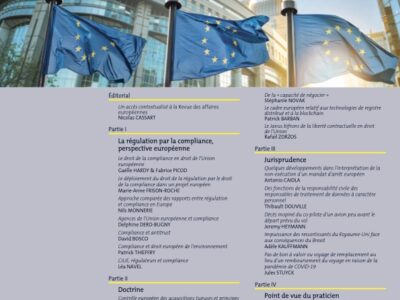
📝The deployment of Regulatory Law through Compliance Law in the European project

► Full Reference: M.-A. Frison-Roche, "The deployment of Regulatory Law through Compliance Law in the European project", in G. Hardy & F. Picod, Compliance Regulation from a European Perspective, Law and European Affairs (L.E.A.), 2023/2, pp. 345-352. - 🚧read the bilingual Working Paper which is the basis of this article, with additional developments, technical references and hyperlinks  - ► English Summary of the article: Compliance Law is neither a method of obeying regulations, nor a simple neutral method of ensuring the effectiveness of norms, nor a means of enforcement displaced from Ex Post to Ex Ante. It is an extension of Regulatory Law and goes beyond it. Like it, it aims to build spaces according to a political project specific to an area, such as Europe. Branch of Law looking to the future as Regulatory Law does, it constructs and maintains, in a systemic way, sustainable, albeit unstable, balances to achieve the ‘Monumental Goals’ in which its normativity resides: security, sustainability, probity, truth, and dignity. By internalising these Monumental Goals in the companies that are in a position to achieve them, the “crucial companies”, Compliance Law preserves the logic of Regulatory Law, offering it a prodigious expansion since it frees it from the condi- tion of a sector and territorial borders, which seemed tautological, by associating private powers and public will, which remains primary. In this way, Compliance can regulate the digital space and climate issue through political choices made by a sovereign Europe. - 🌐follow Marie-Anne Frison-Roche on LinkedIn 🌐follow Marie-Anne Frison-Roche on Instagram 🌐subscribe to the Newsletter MAFR Regulation, Compliance, Law