Regulatory law

Working papers

🚧The deployment of Regulatory Law through Compliance Law in the European project

🌐follow Marie-Anne Frison-Roche on LinkedIn 🌐subscribe to the  Newsletter MAFR Regulation, Compliance, Law - ► Full Reference: M.-A. Frison-Roche, The deployment of Regulatory Law through Compliance Law in the European project, Working Paper, July 2023. - 📝this Working Paper is the basis for the article "Le déploiement du Droit de la Régulation par le Droit de la Compliance dans le projet européen" ("The deployment of Regulatory Law through Compliance Law in the European project"), which is part of the special issue La régulation par la compliance, perspective européenne, published in French by the Revue des affaires européennes (Law and European Affairs). - ► Summary of this Working Paper: Compliance Law is neither a method of obeying regulations, nor a simple neutral method of ensuring the effectiveness of norms, nor a means of enforcement displaced from Ex Post to Ex Ante.  It is an extension of Regulatory Law and goes beyond it. Like it, it aims to build spaces according to a political project specific to an area, such as Europe. Branch of Law looking to the future as Regulatory Law does, it constructs and maintains, in a systemic way, sustainable, albeit unstable, balances to achieve the 'Monumental Goals' in which its normativity resides: : security, sustainability, probity, truth, and dignity. By internalising these Monumental Goals in the companies in a position to achieve them, the "crucial companies", Compliance Law preserves the logic of Regulatory Law, offering it a prodigious expansion since it frees it from the condition of a sector and territorial borders, which seemed tautological, by associating private powers and public will, which remains primary. In this way, Compliance can regulate the digital space and climate issue through political choices made by a sovereign Europe. -   🔓read the developments below⤵️

Breaking news

💬Compliance : les cours suprêmes s’emparent de la question de ses enjeux juridictionnels (Compliance : the Supreme Courts take up the issue of its jurisdictional implications)

🌐follow Marie-Anne Frison-Roche on LinkedIn 🌐subscribe to the Newsletter MAFR Regulation, Compliance, Law  - ► Full Reference:  M.-A. Frison-Roche et A. Seban, "Compliance : les cours suprêmes s’emparent de la question de ses enjeux juridictionnels" ("Compliance : the Supreme Courts take up the issue of its jurisdictional implications"), interview with Olivia Dufour, Actu-Juridique, 5 July 2023. - 💬read the interview (in French) - ► Presentation of the interview by the journal (in French): "Le 2 juin dernier s’est tenu au Conseil d’État un colloque fondateur sur le rôle du juge dans la compliance. Le professeur Marie-Anne Frison-Roche et le conseiller d’État Alain Seban, qui ont tout deux contribué aux débats, ont accepté de commenter les principaux enseignements des travaux de cette journée." - ► Questions asked (in French):  Le colloque « De la régulation à la compliance, quel rôle pour les juges » qui s’est tenu au Conseil d’État le 2 juin dernier a rassemblé juges civils et administratifs. En quoi le juge administratif est-il concerné par la compliance qui semble plutôt une affaire d’entreprises et donc de justice civile et commerciale ?  ​Vincent Vigneau, président de la chambre commerciale de la Cour de cassation rappelle que la compliance a plutôt vocation à éviter le juge en se situant ex ante, pourtant on découvre que le juge lui-même accepte de plus en plus de se prononcer en ex ante… qu’en est-il ?  Quel peut donc être le rôle du juge dans la compliance ? Peut-il contribuer à faire émerger un droit de la compliance et à l’harmoniser ?  ​ ​François Ancel semble considérer que le rôle juge va devoir adapter son office à la compliance, il évoque trois concepts : téléologique, soutenabilité et efficacité… Le juge dispose-t-il en l’état de tous les outils nécessaires ? Si tel n’est pas le cas, que faut-il créer ? En quoi le dialogue des juges, civil/administratif, national/européen, national/international, est-il important ? Que veut dire F. Ancel quand il déclare que le juge doit évoluer du constat à la trajectoire ? Existe-t-il des domaines où la compliance entre en conflit avec des principes processuels, par exemple le principe de légalité des peines ? En quoi la notion de « buts monumentaux », que vous avez créée en 2016, a-t-elle trouvé sa place dans le droit ? -

Conferences

🎤Compliance et droit processuel (Compliance and Procedural Law), in🧮Compliance : Obligation, devoir, pouvoir, culture

🌐follow Marie-Anne Frison-Roche on LinkedIn 🌐subscribe to the Newsletter MAFR Regulation, Compliance, Law - ► Full Reference: M.-A. Frison-Roche, "Compliance et droit processuel" ("Compliance and Procedural Law"), in B. Deffains, M.-A. Frison-Roche and J.-B. Racine (dir.), Journal of Regulation & Compliance (JoRC) and University Panthéon-Assas (Paris II), Compliance : Obligation, devoir, pouvoir, culture (Compliance : obligation, duty, power, culture), University Panthéon-Assas, Salle des Conseils, 14 June 2023. - 🧮See the full programme of this event - 🎤see the other speech made during the first day of this symposium : "L'obligation de compliance, entre volonté et consentement : obligation sur obligation vaut" ("Compliance Obligation, between will and consent: obligation on obligation works")   - ► Summary of the conference: After referring to the chapter in the book Compliance Jurisdictionalisation, which deals more specifically with Procedural Law1See the articles that are part of the Second chapter of the book 🕴️M.-A. Frison-Roche (ed.), 📘Compliance jurisdictionalisation, 2023 : 🕴️N. Cayrol, 📝General Procedural Law in Compliance Law,, the conference is built around 5 developments, each of which represents a progression. The first development relates to the fact that the relationship between Compliance Law and Procedural Law is very difficult because it is often said that they simply have nothing to do with each other, or that they have everything to dislike each other. This is because Compliance is often reduced to processes, and to the mechanical place that algorithms could take in it, in taking care of everything. Compliance would even have the purpose and effect of ensuring that the company and its managers never come into contact with a judge, the public prosecutor being their best ally in this respect. Secondly, I recalled the very common idea that Procedural Law is a kind of 'tribute' that the rule of Law demands, which certainly weighs down companies when compared with companies living in systems in which there's not not such a price. But many stress that Procedural Law could become a model. This can be justified and technically anticipated because it has already happened in Regulation Law, and Compliance Law is the deployment of it2🕴️M.-A. Frison-Roche, 🚧From Regulation Law to Compliance Law, 2017. 🕴️M.-A. Frison-Roche, 🎤Le rôle du Juge dans le déploiement du Droit de la Régulation en Droit de la Compliance (The role of the Judge in the deployment of Regulatory Law in Compliance Law), in 🧮De la Régulation à la Compliance : quel rôle pour le Juge ?, 2023.. In the third stage, I worked on the alliance between the two, with the procedure (rather than the process) modifying compliance and thereby reinforcing it, evoking the way in which this can manifest itself technically3Notably in this perspective, 🕴️M.-A. Frison-Roche and 🕴️M. Boissavy, 📕Compliance et droits de la défense. Enquête interne - CJIP - CRPC (Compliance and Due Process. Internal Investigation - DPA), 2024.. In the fourth step, I looked for what would be the "naturally appropriate procedure" for Compliance: one that takes into account the duration and the development of "solutions", to which the notion of "sustainability", which is central in the substantive Law of Compliance, refers. In a fifth stage, and devoting more time to this, I have pointed out where innovation should be the strongest: the proof, the probatory obligation being the "part totale" ("total part") of the compliance obligation. This major issue will be the subject of a series of symposiums held in 2024. -

Working papers

Working Paper

🚧The role of the Judge in the deployment of Regulatory Law through Compliance Law

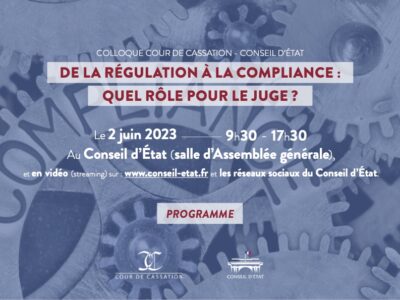
► Full Reference: M.-A. Frison-Roche, The role of the Judge in the deployment of Regulatory Law through Compliance Law, Working Paper, April  2023. - 🎤 This working paper was drawn up to serve as the basis for the concluding summary session of the colloquium organised by the Conseil d'État (French Administrative Supreme Court) and the Cour de cassation (French Judicial Supreme Court), De la régulation à la compliance: quel rôle pour le juge? ("From Regulation to Compliance: what role for the Judge?") held on 2 June 2023 at the Conseil d'État.  - 📝 This working paper also served as the basis for the article that concludes the book De la régulation à la compliance : quel rôle pour le juge, published by the La Documentation Française, 2024. - ► Working Paper Summary: It is remarkable to note the unity of conception and practice between professionals who tend to work in administrative jurisdictions and professionals who tend to work in judicial jurisdictions: they all note, in similar terms, an essential movement: what Regulatory Law is, how it has been transformed into Compliance Law, and how in one and even more so in the other the Judge is at the centre of it. Judges, as well as regulators and European officials, explain this and use different examples to illustrate the profound transformation this has brought about for the law and for the companies responsible for increasing the systemic effectiveness of the rules through the practice and dissemination of a culture of compliance. The role of the judge participating in this Ex Ante transformation is renewed, whether he is a public law judge or a private law judge, in a greater unity of the legal system.   - 🔓read the Working Paper below⤵️ - 🌐follow Marie-Anne Frison-Roche on LinkedIn 🌐follow Marie-Anne Frison-Roche on Instagram 🌐subscribe to the Newsletter MAFR Regulation, Compliance, Law

Articles in The Journal of Regulation & Compliance « JoRC »

RAYNAUD, Fabien🕴️

📝Le juge administratif et la compliance, in 🕴️M.-A. Frison-Roche (ed.), 📕La juridictionnalisation de la Compliance

► Full Reference: F. Raynaud, "Le juge administratif et la compliance" ("The Administrative Judge and the Compliance Law"), ​in M.-A. Frison-Roche (ed.), La juridictionnalisation de la Compliance, coll. "Régulations & Compliance", Journal of Regulation & Compliance (JoRC) and Dalloz, 2023, pp. 473-478. - 📕read a general presentation of the book, La juridictionnalisation de la Compliance, in which this article is published - ► Summary of the article (done par the Journal of Regulation & Compliance): The author studies the close relationship between Compliance Law and Soft Law, such as the Administrative Judge has made room for it in his case law. This was particularly the case with the judgments of the Conseil d'État (French Council of State) in 2016, relating to legal topic of Regulatory Law, which is extended by Compliance Law. This concern to internalize in companies what the public authorities want had also been taken into consideration by the Conseil d'État by small touches from 2010 and has continually expanded. This is particularly the case when the document issued is "de nature à produire des effets notables, notamment de nature économique, ou ont pour objet d'influer de manière significative sur les comportements des personnes auxquelles ils s'adressent" ("likely to produce significant effects, in particular of an economic nature, or are intended to significantly influence the behavior of the people to whom they are addressed"), which is related to compliance issues directly. This new concept adopted by the Conseil d'État has led it to review and control numerous "positions", "recommendations", "guidelines", etc., adopted by multiple authorities, to protect the persons on whom these acts have a "notable effect", the Conseil sometimes not hesitating to censor the issuing body. In Banking compliance, the Soft Law, more specifically issued by the European Banking Authority, gave the Administrative Judge the opportunity to adjust his control with that exercised by the Court of Justice seized by a preliminary question. Thus, "Par sa jurisprudence sur la justiciabilité des actes de droit de souple, le Conseil d’État s’affirme donc comme un acteur de la compliance en permettant aux entités visées par ces actes et soumises à leur égard à une obligation de compliance de saisir le juge administratif d’un recours en annulation contre ces actes, afin qu’ils puissent être soumis à un contrôle de légalité et, le cas échéant, annulés" ("Through its case law on the justiciability of Soft Law acts, the Conseil d'État therefore asserts itself as a compliance actor by allowing the entities covered by these acts and subject to a compliance obligation in their regard to seize the administrative judge of an action for annulment against these acts, so that these acts can be subjected to a control of legality and, if necessary, annulled"). But must the administrative judge be seized. It can be the case in new fields, for example in climate matters, as he we in the Grande Synthe case. By its decision, "Le Conseil d’État va ainsi au bout de la logique du dispositif mis en place par le législateur et par le pouvoir réglementaire pour mettre en œuvre les accords de Paris, lesquels reposent sur une forme de compliance à l’échelle mondiale, chaque Etat signataire s’engageant, en quelque sorte, à faire le nécessaire pour atteindre un objectif commun à une date donnée, à charge pour chacun de s’organiser pour l’atteindre. En l’absence d’un juge international capable de vérifier le respect de ces engagements, le juge national apparait le plus naturel pour accepter de vérifier, lorsqu’il est saisi d’un litige en ce sens, que ces engagements ne restent pas lettre morte. " ("The Conseil d'État thus goes to the end of the logic of the system put in place by the legislator and by the administrative power to implement the Paris Agreements, which are based on a form of compliance at the worldwide scale, each signatory State undertaking, in a way, to do what is necessary to achieve a common goal by a given date, it being up to each to organize itself to achieve it. to verify compliance with these commitments, the national judge seems the most natural to accept to verify, when seized of a dispute in this sense, that these commitments do not remain a dead letter".). Through this general movement,  "La compliance est devenue un nouveau mode de régulation d’un nombre croissant d’activités. " ("Compliance has become a new way of regulating a growing number of activities."). -

Articles in The Journal of Regulation & Compliance « JoRC »

BRUNEAU, Alain🕴️

📝L’entreprise juge d’elle-même: la fonction compliance dans la banque, in 🕴️M.-A. Frison-Roche (ed.), 📕La juridictionnalisation de la Compliance

► Full Reference: A. Bruneau, "L'entreprise juge d'elle-même : la fonction compliance dans la banque" ("The company judge of itself: the compliance function inside the bank"), in M.-A. Frison-Roche (ed.), La juridictionnalisation de la Compliance, coll. "Régulations & Compliance", Journal of Regulation & Compliance (JoRC) and Dalloz, 2023, pp. 115-131.  - 📕read a general presentation of the book, La juridictionnalisation de la Compliance, in which this article is published     - ► Summary of the article (done by the author): First of all, it should be remembered that the compliance function was born within finance, and that by being structured, it has evolved to support the transition from regulatory law to compliance law. Through these changes, compliance has gone from an ex-post controlling function to an ex-ante binding function. The LIBOR crisis imperfectly illustrates the primacy of this transition. The evolution of this role is illustrated by concrete examples Firstly, the management of reputational risk is a fundamental part of the company as prosecutor and judge of itself. Reputational risk is a significant element for a financial institution, because it can have negative consequences on its capitalization, or even culminate in a systemic crisis. Avoiding a large-scale financial crisis is also part of the monumental goals of compliance. In order to avoid complex and inopportune scenarios, compliance law intervenes as early as possible and identifies issues that may impact reputation. The regulations require the implementation of certain ex ante mechanisms. The French law known as "Sapin 2" requires the implementation of tools that concern all companies (and not just banks). Indeed, beyond the risk of reputation, it is essential to consider the risk of corruption. Consideration of reputational risk may justify refusing to execute certain transactions. From this perspective, compliance must assess the potential consequences of entering into a relationship with a new client upstream, sometimes to decline the provision of services. The compliance function therefore unilaterally judges the relationship with a view to managing the company reputational risk. Secondly, the internal sanction mechanism established by compliance law is also discussed in this article, in particular the internal sanctions adopted by compliance in a financial institution. Compliance can act as a prosecutor via management committees set up within the business lines. In addition, compliance can determine and apply sanctions against employees. In this way, there is a dual role of prosecutor and judge for the compliance function within the framework of an extraordinary mechanism of ordinary law. Finally, the analysis deals with the case of the "judge-judged": following a decision by the bank, the regulator may take an even stricter position by believing that the bank is applying its guidelines incorrectly. Thus, the compliance law, which takes hold within the banking enterprise, finds itself under the judgment of its own regulator. The company finds itself judged and comes to be a prosecutor and judge of itself, but also of its clients. -

Books

📕Droit de la concurrence (Competition Law)

► Full Reference: M.-A. Frison-Roche & J.-Ch. Roda, Droit de la concurrence (Competition Law), 2nd ed., Paris, Dalloz, "Précis" Serie, 2022, 842 p. - ► This second edition follows on from the first, written with Marie-Stéphane Payet. 📝read the foreword written in dedication to Marie-Stéphane (in French) - 📕read the 4th cover of the book (in French) - ► English Summary of the book: Even if reforms follow one another and upheavals are incessant, whether de facto (digital) or political (apprehension of foreign investment, controversies over objectives), the framework of Competition Law is stable, with French Law and European Law in harmony. Competition Law combines both the Law of competitive markets and the Law of relations between economic players. Its age and homogeneity increase its capacity to find solutions. This book restores the coherence and strength of Competition Law, which, once clarified, is easier to master and anticipate. The first part therefore sets out the blocks of rules that "protect competitive markets", through mechanisms that are increasingly ex ante, not only merger control but also the control of buyer power, leading to the governance of markets by authorities working together, while sanctions for anti-competitive behaviour restore markets that have been damaged by abuse. The second part sets out the blocks of rules that "rebalance economic relations". The tools used are often older, but their handling is no less innovative.   - 📕read the table of contents of the book (in French) - 📝read the review of the book made by the Professor Walid Chaiehloudj in the Concurrences review -