Power

Articles in The Journal of Regulation & Compliance « JoRC »

article in a legal collective book

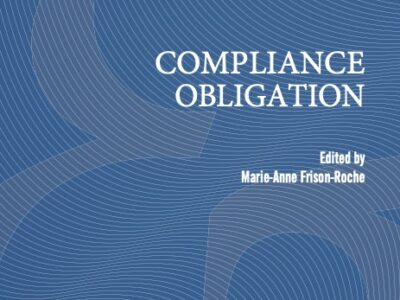
📝Conceiving the Compliance Obligation: Using its Position to take part in achieving the Compliance Monumental Goals, in 🕴️M.-A. Frison-Roche (ed.), 📘Compliance Obligation

► Full Reference: M.-A. Frison-Roche, "Conceiving the Compliance Obligation: Using its Position to take part in achieving the Compliance Monumental Goals", in M.-A. Frison-Roche (ed.), Compliance Obligation, Journal of Regulation & Compliance (JoRC) and Bruylant, "Compliance & Regulation" Serie, 2026, forthcoming. - 📝read the article - 🚧read the bilingual Working Paper on the basis this article has been written, with more developments, technical references and hyperlinks - 📘read a general presentation of the book, Compliance Obligation, in which this article is published - ► Summary of this article: This article explains what companies' Compliance Obligation" is. Delving into the mass of compliance obligations, it uses the method of classification of those that are subject to an obligation of result and those that are subject to an obligation of means. It justifies the choice of this essential criterion, which changes the objects and the burden of proof of companies that are subject to an obligation of result when it comes to setting up "compliance structures" and are subject to an obligation of means when it comes to the effects produced by these compliance structures. Indeed, rather than getting bogged down in definitional disputes, given that Compliance Law is itself a nascent branch of Law, the idea of this contribution is to take as a starting point the different legal regimes of so many different compliance obligations to which laws and regulations subject large companies: sometimes they have to apply them to the letter and sometimes they are only sanctioned in the event of fault or negligence. This brings us back to the distinction between obligations of result and obligations of means. Although it would be risky to transpose the expression and regime of contractual obligations to legal obligations put by legislation, starting from this observation in the evidentiary system of compliance of a plurality of obligations of means and of result, depending on whether it is a question of this or that technical compliance obligation, we must first classify them. It would then appear that this plurality will not constitute a definitive obstacle to the constitution of a single definition of the Compliance Obligation. On the contrary, it makes it possible to clarify the situation, to trace the paths through what is so often described as a legal jumble, an unmanageable "mass of regulations". Indeed, insofar as the company obliged under Compliance Law participates in the achievement of the Monumental Goals on which this is normatively based, a legal obligation which may be relayed by contract or even by Ethics, it can only be an obligation of means, by virtue of this very teleological nature and the scale of the goals targeted, for example the happy outcome of the climate crisis which is beginning or the desired effective equality between human beings. This established principle leaves room for the fact that the behaviour required is marked out by processes put in place by structured tools, most often legally described, for example the establishment of a vigilance plan or regularly organised training courses (effectiveness), are obligations of result, while the positive effects produced by this plan or these training courses (effaciety) are obligations of means. This is even more the case when the Goal is to transform the system as a whole, i.e. to ensure that the system is solidly based, that there is a culture of equality, and that everyone respects everyone else, all of which come under the heading of efficiency. The Compliance Obligation thus appears unified because, gradually, and whatever the various compliance obligations in question, their intensity or their sector, its structural process prerequisites are first and foremost structures to be established which the Law, through the Judge in particular, will require to be put in place but will not require anything more, whereas striving towards the achievement of the aforementioned Monumental Goals will be an obligation of means, which may seem lighter, but corresponds to an immeasurable ambition, commensurate with these Goals. In addition, because these structures (alert mechanisms, training, audits, contracts and clauses, etc.)  have real meaning if they are to produce effects and behaviours that lead to changes converging towards the Monumental Goals, it is the obligations of means that are most important and not the obligations of result. The judge must also take this into account. Finally, the Compliance Obligation, which therefore consists of this interweaving of multiple compliance obligations of result and means of using the entreprise's position, ultimately Goals at system efficiency, in Europe at system civilisation, for which companies must show not so much that they have followed the processes correctly (result) but that this has produced effects that converge with the Goals sought by the legislator (effects produced according to a credible trajectory). This is how a crucial company, responsible Ex Ante, should organise itself and behave. - 🌐Follow Marie-Anne Frison-Roche on LinkedIn 🌐follow Marie-Anne Frison-Roche on Instagram 🌐Subscribe to the Newsletter MAFR Regulation, Compliance, Law 🌐Subscribe to the video newsletter MAFR Overhang 🌐Subscribe to the Newsletter MaFR Law & Art

Articles

article published in the MAFR Law, Compliance, Regulation Newsletter

📝”juge modeste” ou “check and balance” : alternative aux Etats-Unis, alternative en France (“modest judge” or “check and balance”: alternative in the United States, alternative in France)

► Full Reference: M.-A. Frison-Roche, ""Juge modeste" ou "check and balance" :alternative aux Etats-Unis, alternative en France" ("modest judge" or "check and balance": alternative in the United States, alternative in France), Newsletter MAFR Law, Compliance, Regulation, 6 October 2025.. - 📧Read by free subscription other news from the MAFR Newsletter – Law, Compliance, Regulation - ► Summary of this article: Recent, if not forthcoming, decisions by the US Supreme Court show that the American political system that was based on the unwritten principle of Check and Balance, requiring the Justices to constitute one Power facing the other two could be replaced by a political system based on the principle of a "modest Justice" enforcing decisions made by the Federal Executive. They would then have a new Constitution. In Western Europe and especially in France, it is possible that the letter of the Constitution, which states that judges are not an autonomous power vis-à-vis the other two powers, will be abandoned and that, in the name of an unwritten principle, the Rule of Law, its transformation into an autonomous Power facing the executive in its own right will be adopted. The path would be exactly the opposite. We would then have changed the Constitution. That's conceivable, and there are many arguments in favour of it. We have to say so. And draw all the consequences. - 📧read below the article published the 6 October dans the Newsletter MAFR – Law, Compliance, Regulation ⤵️ - 🌐follow Marie-Anne Frison-Roche on LinkedIn 🌐follow Marie-Anne Frison-Roche on Instagram 🌐subscribe to the Newsletter MAFR Regulation, Compliance, Law 🌐subscribe to the Video Newsletter MAFR Surplomb 🌐subscribe to the Newsletter MaFR Droit & Art
Articles in The Journal of Regulation & Compliance « JoRC »

📝Concevoir l’Obligation de Compliance : faire usage de sa position pour participer à la réalisation des Buts Monumentaux de la Compliance (Conceiving the Compliance Obligation: Using its Position to take part in achieving the Compliance Monumental Goals), in 🕴️M.-A. Frison-Roche (ed.), 📕L’Obligation de Compliance

► Full Reference: M.-A. Frison-Roche, "Concevoir l'Obligation de Compliance : faire usage de sa position pour participer à la réalisation des Buts Monumentaux de la Compliance" ("Conceiving the Compliance Obligation: Using its Position to take part in achieving the Compliance Monumental Goals"), in M.-A. Frison-Roche (ed.), L'Obligation de Compliance, Journal of Regulation & Compliance (JoRC) and Dalloz, "Régulations & Compliance" Serie, 2025, pp. 3-44. - 📝read the article (in French) - 🚧read the bilingual Working Paper on the basis this contribution has been built, with  more developments, technical references and hyperlinks.  - 📕read a general presentation of the book, L'Obligation de Compliance, in which this article is published  - ► English summary of this contribution: Rather than getting bogged down in definitional disputes, given that Compliance Law is itself a incipient branch of Law, the idea of this contribution is to take as a starting point the different regimes of so many different compliance obligations to which laws and regulations subject large companies: sometimes they must apply them to the letter and sometimes they are only penalised in the event of fault or negligence. This brings us back to the distinction between obligations of result and obligations of means. Although it might be risky to transpose the expression and regime of contractual obligations to legal obligations, starting from this observation in the Compliance Evidentiary System of a plurality of obligations of means and of result, depending on whether we are dealing with this or that technical compliance obligation, we must first classify them. It would appear that this plurality does not constitute a definitive obstacle to the creation of a single definition of the Compliance Obligation. On the contrary, it makes it possible to clarify the situation, to trace the paths through what is so often described as a legal jumble, an unmanageable mass of regulations. Indeed, insofar as the company obliged under Compliance Law participates in the achievement of the Monumental Goals on which this branch of Law is normatively based, a legal obligation which may be relayed by contract or even by ethics, it can only be an obligation of means, by virtue of this very teleological nature and the scale of the goals targeted, for example the happy outcome of the climate crisis which is beginning or the desired effective equality between human beings. This established principle leaves room for the fact that the behaviour required is marked out by processes put in place by structured tools, most often legally described, for example the establishment of a vigilance plan or regularly organised training courses (effectiveness), are obligations of result, while the positive effects produced by this plan or these training courses (efficacy) are obligations of means. This is even more the case when the aim is to transform the system as a whole, i.e. to ensure that the system is solidly based, that there is a culture of equality, and that everyone respects everyone else – all of which come under the heading of efficiency. The Compliance Obligation thus appears unified because, gradually, and whatever the various compliance obligations in question, their intensity or their sector, its structural process prerequisites are first and foremost structures to be established which the Law, through the Judge in particular, will require to be put in place but will not require anything more, whereas striving towards the achievement of the aforementioned Monumental Goals will be an obligation of means, which may seem lighter, but corresponds to an immeasurable ambition, linked with these Goals. Moreover, because these structures (warning platforms, training, audits, contracts and clauses, etc.) only have meaning in order to produce effects and behaviour leading to changes converging towards the Monumental Goals, it is the obligations of means that are most important and not the obligations of result. The judge must also take this into account. Finally, the Compliance Obligation, which therefore consists of this interweaving of multiple compliance obligations of result and means of using the Entreprise's position, ultimately aims at system efficiency, in Europe at system civilisation, for which companies must show not so much that they have followed the processes correctly (result) but that this has produced effects that converge with the Goals sought by the legislator (effects produced according to a credible trajectory). This is how a crucial economic operator, responsible Ex Ante, should organise itself and behave.           - 🌐follow Marie-Anne Frison-Roche on LinkedIn 🌐follow Marie-Anne Frison-Roche on Instagram 🌐subscribe to the Newsletter MAFR Regulation, Compliance, Law

Articles in The Journal of Regulation & Compliance « JoRC »

FRYDMAN, Benoît🕴️ & BRIEGLEB, Alice🕴️

📝L’obligation de compliance en Droit global (“Compliance Obligation in Global Law), in 🕴️M.-A. Frison-Roche (dir.), 📕L’obligation de Compliance

► Full Reference: B. Frydman & A. Briegleb, "L'obligation de compliance en Droit global ("Compliance Obligation in Global Law)", in M.-A. Frison-Roche (ed.), L'Obligation de Compliance, Journal of Regulation & Compliance (JoRC) and Éditions Lefebvre – Dalloz, coll. "Régulations & Compliance", 2025, pp. 299-311. - 📕read a general presentation of the book, L'Obligation de Compliance, in which this contribution is published  - ► English summary of this contribution (done by the Journal of Regulation & Compliance – JoRC): The authors stress that the Contracts Law and Tort Law are essential in Compliance Law, particularly in its global legal perspective, since it goes beyond the legal systems of States and develops new normativities, at the level of each company, but also allows a new expression of public power through the Monumental Goals that Compliance Law claims to achieve globally. The weaker the States, the greater the delegation to the first level is operating. In concrete terms, the authors examine a series of situations in which various organisations use compliance techniques to appropriate global power over things or people, which has the effect, and sometimes the purpose, of reducing the freedoms of people controlled in this way. Thus CSR, which was initially non-binding, is now the source of binding obligations, and the moral obligation expressed in codes of conduct can become a civil obligation, as the Supreme Court of California decided in 2002 in the Nike case.  In addition, "Comply or Explain" clauses are now commonplace, allowing the person subject to the legislation not to comply if they can justify it, which is the basis of the many information reports that companies are now required to publish. Then, returning to the issue of liability, particularly in the digital environment, the article stresses the importance of 'conditional immunity from liability', taking the view from the European DSA that certain operators, such as hosting providers, are not liable unless they take on obligations, such as monitoring functions on contents published. Finally, with regard to the duty of vigilance, it tends for the first time to align the scope of "responsibility" with the scope of "power", moral responsibility thus becoming legal responsibility, which would be like a new responsibility for others. The result of all this is an "obligation to regulate others". - 🦉This article is available for people who follow the Professor Marie-Anne Frison-Roche teaching

Articles in a legal collective publication

📝L’usage des puissances privées par le droit de la compliance pour servir les droits de l’homme (Use of private companies by Compliance Law to serve Human Rights), in 🕴️J. Andriantsimbazovina (dir.), 📗Puissances privées et droits de l’Homme. Essai d’analyse juridique

► Full reference: M.-A. Frison-Roche, "L’usage des puissances privées par le droit de la compliance pour servir les droits de l’homme" (Use of private companies by Compliance Law to serve Human Rights) , in J. Andriantsimbazovina (dir.), Puissances privées et droits de l'Homme. Essai d'analyse juridique, Mare & Martin,  coll. "Horizons européens", 2024, pp. 279-295 - 🚧read the  Bilingual Working Paper on which this article is based, with more technical developments, references and hypertext links - ► English Summary of this article: Following the legal tradition, Law creates a link between power with a legitimate source, the State, public power being its prerogative, while private companies exercise their power only in the shadow of this public power exercised ex ante.  The triviality of Economic Law, of which Competition Law is at the heart, consisting of the activity of companies that use their power on markets, relegates the action of the State to the rank of an exception, admissible if the State, which claims to exercise this contrary power, justifies it.  The distribution of roles is thus reversed, in that the places are exchanged, but the model of opposition is shared. This model of opposition exhausts the forces of the organisations, which are relegated to being the exception. However, if we want to achieve great ambitions, for example to give concrete reality to human rights beyond the legal system within which the public authorities exercise their normative powers, we must rely on a new branch of Law, remarkable for its pragmatism and the scope of the ambitions, including humanist ambitions, that it embodies: Compliance Law. Compliance Law is thus the branch of Law which makes the concern for others, concretised by human rights, borne by the entities in a position to satisfy it, that is to say the systemic entities, of which the large companies are the direct subjects of law (I). The result is a new division between Public Authorities, legitimate to formulate the Monumental Goal of protecting human beings, and private organisations, which adjust to this according to the type of human rights and the means put in place to preserve them. Corporations are sought after because they are powerful, in that they are in a position to make human rights a reality, in their indifference to territory, in the centralisation of Information, technologies and economic, human, and financial means. This alliance is essential to ensure that the system does not lead to a transfer of political choices from Public Authorities to private companies; this alliance leads to systemic efficiency. The result is a new definition of sovereignty as we see it taking shape in the digital space, which is not a particular sector since it is the world that has been digitalised, the climate issue justifying the same new distribution of roles (II).  - 📝read the article (in French) - 🌐follow Marie-Anne Frison-Roche on LinkedIn 🌐follow Marie-Anne Frison-Roche on Instagram 🌐subscribe to the Newsletter MAFR Regulation, Compliance, Law 🌐subscribe to the Video Newsletter MAFR Surplomb

Working papers

Working Paper

🚧Use of private companies by Compliance Law to serve Human Rights

► Full reference: M.-A. Frison-Roche, Use of private companies by Compliance Law to serve Human Rights, Working Paper, May 2023. - This Working Paper is the basis of: 🎤a conference done in French in Toulouse on June 16, 2023 📝an article previously written before and for this conference, and subsequently published in the book Puissances privées et droits de l'homme ("Private Powers and Human Rights") - ►Summary of this Working Paper: Following the legal tradition, Law creates a link between power with a legitimate source, the State, public power being its prerogative, while private companies exercise their power only in the shadow of this public power exercised ex ante.  The triviality of Economic Law, of which Competition Law is at the heart, consisting of the activity of companies that use their power on markets, relegates the action of the State to the rank of an exception, admissible if the State, which claims to exercise this contrary power, justifies it.  The distribution of roles is thus reversed, in that the places are exchanged, but the model of opposition is shared. This model of opposition exhausts the forces of the organisations, which are relegated to being the exception. However, if we want to achieve great ambitions, for example to give concrete reality to human rights beyond the legal system within which the public authorities exercise their normative powers, we must rely on a new branch of Law, remarkable for its pragmatism and the scope of the ambitions, including humanist ambitions, that it embodies: Compliance Law. Compliance Law is thus the branch of Law which makes the concern for others, concretised by human rights, borne by the entities in a position to satisfy it, that is to say the systemic entities, of which the large companies are the direct subjects of law (I). The result is a new division between Public Authorities, legitimate to formulate the Monumental Goal of protecting human beings, and private organisations, which adjust to this according to the type of human rights and the means put in place to preserve them. Corporations are sought after because they are powerful, in that they are in a position to make human rights a reality, in their indifference to territory, in the centralisation of Information, technologies and economic, human, and financial means. This alliance is essential to ensure that the system does not lead to a transfer of political choices from Public Authorities to private companies; this alliance leads to systemic efficiency. The result is a new definition of sovereignty as we see it taking shape in the digital space, which is not a particular sector since it is the world that has been digitalised, the climate issue justifying the same new distribution of roles (II).  -   🔓read the full developments below⤵️ - 🌐 follow Marie-Anne Frison-Roche on LinkedIn 🌐follow Marie-Anne Frison-Roche on Instagram 🌐 subscribe to the Newsletter MAFR Regulation, Compliance, Law 

MAFR Chronicles Compliance Law

📝 La responsabilité ex ante, pilier du droit de la compliance (“Ex-Ante Responsibility, Compliance Law Pillar”)

🌐 follow Marie-Anne Frison-Roche on LinkedIn 🌐 subscribe to the Newsletter MAFR Regulation, Compliance, Law  - ► Full Reference: FM.-A. Frison-Roche, La responsabilité ex ante, pilier du droit de la compliance ("Ex-Ante Responsibility, Compliance Law Pillar"), D. 2022, chronique MAFR – Droit de la Compliance, Recueil Dalloz, March 31, 2022. - ► Article English Summary: The Law must help to face the future, which can be totally catastrophic in terms of climate and digital issues. Courts are s best placed for this, without “governing”, only relying on the commitments made by companies, governments, and legislators.  On the ordinary Tort Law, court decisions oblige these different entities to be consistent in the commitments they have made, obliging them to act in the future, formal “compliance” with the regulations cannot be sufficient. This ex-ante responsibility, founding the powers, thus constitutes a pillar of a substantial Compliance Law, showing the part that CSR and the companies with a raison d'être play in it. -   📝 read the article. (written in French) - 📚go to the presentation of the other articles published in this Chronique Droit de la Compliance made in the Recueil Dalloz.  -

Working papers

🚧 Conceiving Power

► Full reference: M.-A. Frison-Roche, Conceiving Power, Working Paper, December 2021 - 📝 This Working Paper serves as the basis for an article to be published in the collective book drawn up in tribute to Professor Emmanuel Gaillard.    - ► Working Paper summary: In 1985, Emmanuel Gaillard's central work came out under the title Le pouvoir en droit privé  (The Power in Private Law)📎1Gaillard, E., Le pouvoir en droit privé, préf. Cornu. G., coll. ..., Economica, 1985., but when it was defended in 1981, his thesis directed by Dean Cornu was entitled La notion de pouvoir en droit privé (The notion of Power in Private Law) 📎2Gaillard, E., La notion de pouvoir en droit privé, thèse .... ; . Let's give full force to the original title of the thesis.   The deletion of the term notion perhaps implies that by defining something the essential is done, that there would be something of a pleonasm in aiming at The notion of Power and The Power, as Law likes to economise on words.   But it was indeed a renewed, simpler and more powerful conception of the notion of Power, containing the entire regime necessarily imputed, that this work imposed, henceforth illuminating positive Law. Emmanuel Gaillard's definition, on the other hand, goes beyond Private Law. We would gladly have argued in favour of retaining the heading for the term Notion, proposing instead to dispense with the reference to Private Law alone …. Perhaps it was because the concept is so vast that in this seminal thesis its scope was restricted to Private Law, since the author already had to account for the sheer multiplicity of manifestations in this part of the legal system; Or perhaps it was because the concept of 'Power' is so familiar in Public Law that it would have needed less definition in Public Law (which, moreover, is so diversely proposed in this more political area, which is already careful on principle to distinguish between powers, which must always be plural in order to be separated), and that it was therefore reasonable to want to arrive at a single concept of Power in Private Law, where the notion of subjective rights is more familiar.  However, Emmanuel Gaillard's definition of Power as a prerogative placed, by legal rule or contract, in the hands of the person invested with them for the benefit, at least in part, of others, covers both Public and Private Law. This even contributes to the solidity of this thesis and explains why it flourishes today in legal systems where the distinction between Private Law and Public Law is weakening. The power of this definition lies in its simplicity. Simple and brave minds are often the most fruitful. As Dean Gérard Cornu points out in his preface, the author, in particular because he bases himself more on positive law, for example that relating to the powers of corporate officers, does not get bogged down in discussions between authors only to end up preferring one over the other. He arrives at a definition that is close to our everyday experience: the one we experience when we collect an envelope on behalf of someone else and the agent asks us in what capacity we claim to be doing this on his behalf. We then show him our 'power', the legal power to do so for the benefit of the person to whom the letter is addressed, and can thus exercise the power to withdraw the letter, even though it is personal. When legal and common sense come together, it is a good omen, not only in terms of form, because everyone can understand it and the Law must remain comprehensible, but also in terms of substance, because everyone must be able to control the exercise of a power that is exercised for and over others. For this letter addressed to someone else, the person who has been able to take it by virtue of the power conferred on him/her, could just as easily open it and read it, then destroy it or give it to the worst enemy of the person to whom it was addressed. In Power, there is always might to do, and the danger to others that Power contains therefore.  This highly legal definition of Power not only distances the holder from his/her own interests, but also channels the Power thus granted to the person who benefits from it. In this respect, Emmanuel Gaillard not only distinguished between Power and subjective right, but also identified the right amount of power required for this power to effectively fulfill this 'Mission', through the notion of abuse of power, when the holder uses for other beneficiaries this power that was conferred on him/her for this sole purpose. What is more, this concept makes it possible to distinguish Power from discretionary force, because the holder of Power thereby exercises factual , by acting for others, deciding for others, deciding on others. Because Power is inseparable from might, but might must remain the means of power and no more, the Law shall produce the antibodies that are not only the theory of abuse of power but also an Ex Ante responsibility that accounts must always be rendered, either to the other for whom everything is done or to a third party. For this third party is often there from the outset, the guardianship judge for example: because the Power was put in place because of the beneficiary's weakness, both in himself/herself and because of the situation, an impartial and disinterested third party is needed to ensure proper execution from the outset, without there even being a dispute. In this respect, how useful this thesis is for thinking about what Supervision is today!   This thesis, so clear, so simple and so strong, goes beyond Private or Civil Law. It is both much more restrictive than the more factual and political definition of Oower, which would be the ability to do something, and much broader than the usual definitions, since it embraces and legitimises de jure all situations where a person acts legally for the benefit of another.  Dean Cornu shows, moreover, in two sentences that such a notion of power also captures the office of the judge, who has power over others only to serve them 📎3"En droit processuel, l'office du juge aurait donné à l'auteur un renfort. Pour le juge, il n'est point de pouvoir sans devoir. Au-delà de la distinction de ce qu'il a obligation de faire ou faculté d'apprécier, il y a toujours, au creux de ce qu'il peut, le sceau de ce qu'il doit, un devoir gardien - comme un âme - de l'exercice du pouvoir." (p.5).. The definition corresponds to the mission of one who has power only to fulfill his office. It suits so well the conception we have today of Administration, especially if it takes the form of independent authorities. Moreover, Power thus contains its own limit in its very definition, since others are present in it: the holder has power only to serve others. From then on, it is only a power because it is a kind of Charge. Emmanuel Gaillard immediately uses the term: "Un individu se voit confier une charge qu'il exerce dans un intérêt au moins partiellement distinct du sien propre"  ("An individual is entrusted with an office which he exercises in an interest at least partially distinct from his own") 📎4n°3, p.9. . Dean Carbonnier, who reformed the legislation in this area 📎5🕴️J. Carbonnier, 📗Essai sur les lois, 1992 (on the guardianship).,, emphasised that the guardian has a public duty because the State entrusts him/her with a child. In the same way parental authority is a charge on the parents for the benefit of the children. More generally, Power is a burden that the Law places on a person to satisfy the interests of another. This definition offered by Emmanuel Gaillard in 1981, anchored in Private Law only insofar as it is the entire legal system, is premonitory of the Regulatory and Compliance Law as it unfolds today. It would be enough to continue the Gaillard's sentences, as if they had been half-written, to finish them 40 years later and find in them the mechanisms of Supervision of companies by public authorities which are now in place not to reduce their power but to ensure that they exercise it for the benefit of others 📎6S. in a general way, 🕴️M.-A. Frison-Roche (ed.), 📕Régulation, Supervision, Compliance, 2017.. The whole evolution of Company Law and Financial Law is here. Between the lines of this thesis, which develops the notion of duty 📎7Cornu, préface précitée : "Tous les pouvoirs sont, à double face, des pouvoirs-devoirs" (p.5)., we can also see what positive Law is developing today, in particular through the 'duty of Vigilance', this personal responsibility for the benefit of others (I). The definition of Power thus conceived contains within itself its regime and enables us to anticipate it better today: because the holder exercises Power only for others, at least partially, he is consubstantially accountable for it, responsibility being only one form of this accountability; because this service must be effective and others must benefit fully from it, because unlike the subjective right which allows the holder freely not to use his might, Power has never been the 'most absolute' availability to use his/her might: it is even the opposite. It is the expression of a Power assigned to a purpose, compelling the holder to use his/her Power to that end.  But it is equally necessary for the holder to have all the might to do so, otherwise the very notion of 'Power' is meaningless. This is the definition that should be given to the principle of Proportionality: the person on whom the Power rests must have not more power than is necessary, but all the power necessary to achieve the Monumental Goals for which the Power has been entrusted to him/her, so that others may derive full benefit from it (II).  In today's positive Law, the definition of Power as a Duty is found not only in Private Law but also in Public Law, not least because pure might, i.e. those that do not account for the use of their might, are in decline while concern for others is on the increase. The days of discretionary powers are over, and the increased independence of those who exercise Power over others requires them to be accountable. Beyond this Accountability, the personal Responsibility of those who have the Power to serve others is being established. But, no doubt because the Law is slow to evolve, the correlative idea that the holder of Power must have all the powers required to carry out his/her mission is less entrenched:  As Emmanuel Gaillard has shown, the Law has only gone part of the way in sanctioning excesses of power, when the holder uses his/her power for other goals, but it has not yet clearly established that the holder – sometimes forced – of a Power is legitimate in using all the means required to achieve the result for which this Power, i.e. a charge and a duty, has been conferred on him/her.   No doubt we need to read Emmanuel Gaillard's thesis again in all its potential, to imagine the reading we could do today of what he could have written as if on blank pages that would write themselves, a magical thesis where everything is already there, a thesis so short (250 pages) and so beautiful, so dense that it already contains the Law of the Future. The Law of the Future 📎8On Compliance Law as a Law of the Future, s. 🕴️M.-A. Frison-Roche, 📝Compliance Monumental Goals, beating heart of Compliance Law, in 🕴️M.-A. Frison-Roche (ed.), 📘Compliance Monumental Goals, 2023. On the consequences for Liability Law, which is now looking to the Future, s. 🕴️M.-A. Frison-Roche, 🚧Ex Ante Responsibility, 2021.  where there must be much more responsibility for the benefit of others📎9Sur la notion de "Responsabilité Ex Ante", v. Frison-Roche, M.-A., La responsabilité Ex Ante", in Archives de Philosophie du Droit, La responsabilité, 2022. and powers since this notion includes others who are the beneficiaries. Droit de l'Avenir where Emmanuel Gaillard will be present, in particular thanks to this work of doctrine offered in 1981.  So that, in practical terms, those who are entrusted with looking after others – for example, today all companies obliged by Compliance Law to look after others so that they are not destroyed by hatred in the digital space, by corruption in the economic system or by climate change in a projected future – do not find themselves challenged by the same Law for the means of exercising this power for the benefit of others, for example when this involves 'judging'. Dean Cornu himself emphasised the identity of the two offices. -                         Lire les développement ci-dessous⤵ - 🌐 follow Marie-Anne Frison-Roche on LinkedIn 🌐follow Marie-Anne Frison-Roche on Instagram 🌐subscribe to the Newsletter MAFR Regulation, Compliance, Law 

Articles in a legal collective publication

La société et l’entreprise