Monumental Goals

Conferences

🕴️MaFR interviews 🕴️Jacques Beyssade

🎥Compliance and governance (example of a banking group), interview with 🕴️Jacques Beyssade by Marie-Anne Frison-Roche, 🎬 Series of talks on Compliance Law, in 📺 Open windows on management

► Full reference: J. Beyssade, "Compliance et gouvernance (exemple d'un groupe bancaire)" (Compliance and governance (example of a banking group)), interview conducted by M.-A. Frison-Roche on the occasion of a series of interviews on Compliance Law, in Fenêtres ouvertes sur la gestion (Open windows on management), broadcast by J.-Ph. Denis, Xerfi Canal, recorded December 12, 2023, recorded February 24, 2024 - 🌐consult the presentation of Jacques Beyssade's interview on LinkedIn - 🎥view the full interview on Xerfi Canal - ► Starting point: In 2022, Jacques Beyssade wrote a contribution on 📝Feminisation of positions of responsibility in the workplace as a goal of Compliance, in 📘Compliance Monumental Goals 🧱read the presentation of this contribution ➡️click HERE - ► Summary of interview:  Marie-Anne Frison-Roche. Question: Compliance and governance are often linked. Can you explain how, in the strategy of a banking group like BPCE, this link between compliance and governance is articulated? Jacques Beyssade. Answer. Compliance is not just a matter of obeying the rules, but also, and perhaps even more so, of respecting customers, suppliers, stakeholders and members. For a mutualist structure, customers and member-policyholders are closer, they are the same social body, and so it's a matter of governance. - MaFR. Q.: Let's take a concrete example, where Compliance and governance serve a specific purpose: effective equality between men and women, for example. How does this work in your Group? J.B. R.: This objective is in the genes of BPCE, and in particular of the savings banks. The Copé-Zimmermann law requires it. We go beyond this constraint, at the level of governance. The management board, or executive committee, is egalitarian, and this also works as an example. Compliance takes up the baton, for example, by identifying talent, particularly female talent, and correcting any anomalies.  - MaFR. Q.: In the future, can we hope that this alliance between new governance and the power of Compliance, with the same Monumental Goals, will transform our societies? J.B. R.: Changes in society come from the behavior of individuals and companies, as demonstrated by the opening of savings accounts to women in the 19th century. Both can do a great deal, within the framework of regulations, by going beyond them. Through governance, for example in a mutual bank like BPCE, it's the members who set the rules, reflecting social movements because they themselves are representative of society as a whole. In this way, through the alliance of governance and compliance, they can act to give concrete expression to the fundamental social movements they themselves represent, through the broad representation of the social body that the member-policyholders constitute. -

Working papers

Working Paper

🚧Compliance and conformity: distinguishing them to articulate them

► Full Reference: M.-A. Frison-Roche, Compliance and conformity: distinguishing them to articulate them, Working Paper, February 2024. - 📝 this working paper was drawn up to serve as a basis for the article published in French in the Chronique MAFR –  Compliance Law, published in the Recueil Dalloz.   - ► Summary of this Working Paper: The words "conformité" and "compliance" are sometimes used interchangeably, presenting "conformité" as the translation into good legal French vocabulary of "compliance", which would come from the American system. This is not true, however, because each of these terms refers to two distinct and even opposing concepts.  "conformity"' would require companies to show that they are actively obeying all the 'regulations' applicable to them, regardless of their content. "Compliance Law" is a new substantial branch of Law that derives its normativity from the "Monumental Goals" targeted by the political and public authorities: these monumental goals are intended to ensure that systems do not collapse in the future (Negative Monumental Goals), or even improve (Positive Monumental Goals). The systems concerned are banking, finance, energy, health, transport, digital and climate systems. The scope of Compliance Law is therefore both much more limited and more ambitious. Distinguishing between the two allows us to put conformity back where it belongs, as a tool of Compliance Law. As such, conformity justifies the collation and correlation of information, with the algorithmic system playing a major role in this. On the other hand, the human concern that underpins Compliance Law justifies making training and the actions of in-house lawyers, attorneys and judges, central to it. The evidentiary system of Compliance that is currently being developed is based on evidentiary techniques rooted on the one hand in the tool of conformity and on the other in the culture of Compliance, which can be articulated as soon as they are no longer confused. -   🔓read the working paper below⤵️ - 🌐 follow Marie-Anne Frison-Roche on LinkedIn 🌐follow Marie-Anne Frison-Roche on Instagram 🌐subscribe to the Newsletter MAFR Regulation, Compliance, Law

Conferences

🎤Préalable : ce qu’est l’obligation de Compliance (Prerequisite: the Compliance Obligation), in 🧮L’arbitrage international en renfort de l’obligation de Compliance

► Full Reference: M.-A. Frison-Roche, "Préalable : ce qu'est l'obligation de Compliance" ("Prerequisite: the Compliance Obligation"), in L. Aynès, M.-A. Frison-Roche, J.-B. Racine and E. Silva-Romero (dir.), L'arbitrage international en renfort de l'obligation de Compliance (International Arbitration in support of the Compliance Obligation), Journal of Regulation & Compliance (JoRC) and Institute of World Business Law of the ICC (Institute), Conseil Économique Social et Environnemental (CESE), Paris, February 9, 2024 - 🧮see the full programme of this event - 🌐consult on LinkedIn a general presentation of this event, which links to a presentation of each speech (in French) - 🧱consult the scientific direction sheet of this event, which gives an account of the various speeches made - 🔲see the slides used to support the presentation (in French) - 🎤see a presentation of the conference "Préalable : ce qu'est un engagement" ("Prerequisite: the Commitment"), given at the same symposium - 🎤see a presentation of the conference "Le renforcement des engagements de Compliance par le renvoi Ex Ante à l'arbitrage international" ("Reinforcing Compliance commitments by referring Ex Ante to International Arbitration") which was finally not pronounced but will be the subject of an 📝article in the forthcoming book 📘Compliance Obligation  - ► Presentation of the conference: I have first dealt with the very definition of the Compliance Obligation. After showing that the relationship between Compliance Law and International Arbitration will naturally develop, because the companies subject to it are international, because they contractualise their legal Compliance obligations and because Compliance is being jurisdictionalised📎1🕴️M.-A. Frison-Roche (ed.), 📘Compliance Jurisdictionalisation, 2024., the arbitrator being the natural judge since he is a global judge and the judge of the contract, I pointed out that Compliance Law does not simply entrust arbitration with the task of preventing evils, such as corruption pacts, but that it creates positive obligations for companies: to detect and prevent behaviour whose systemic effect is deleterious. This culture of compliance is achieved either through compliance contracts📎2🕴️M.-A. Frison-Roche, 🚧Compliance contract, compliance clauses, 2022. (which outsource the handling of audits, alerts, the drawing up of plans, etc.), or through compliance clauses📎2🕴️M.-A. Frison-Roche, 🚧Compliance contract, compliance clauses, 2022., which are inserted into distribution or supply contracts, etc.; arbitration clauses are linked to these. Thus, the alliance between Compliance and Contract is an indirect mode of alliance between Arbitration and Compliance Obligation. The obligation of Compliance which then takes concrete form consists for the company not in making effective Ex Ante all the regulations which apply to it (conception of conformity which is at once unreasonable, blind and impossible), but in making its best efforts, which it must make visible (see Compliance Evidence System📎3🕴️M.-A. Frison-Roche, 📝The Judge, the Compliance Obligation and the Company. The Compliance Evidence System, in 🕴️M.-A. Frison-Roche (ed.), 📘Compliance Jurisdictionalisation, 2024.) to achieve Monumental Goals. These Monumental Goals are systemic. The aim is to protect systems from collapse (Negative Monumental Goals) or to make them better (Positive Monumental Goals)📎4🕴️M.-A. Frison-Roche, 📝Compliance Monumental Goals, Beating Heart of Compliance Law, in🕴️M.-A. Frison-Roche (ed.), 📘Compliance Monumental Goals, 2023.. By making companies accountable, via this Ex Ante Law whose object is the future, the systemic evils of corruption, money laundering, discrimination, climate change and hatred are combated, thus finding substantial unity. The Positive Monumental Goals aim to engender sustainability, security, respect for human beings, etc. in systems, be they banking, financial, digital, climatic, etc. The role of the Judge, and therefore also that of the Arbitrator, is renewed. - 🌐follow Marie-Anne Frison-Roche on LinkedIn 🌐follow Marie-Anne Frison-Roche on Instagram 🌐subscribe to the Newsletter MAFR Regulation, Compliance, Law

Organisation of events

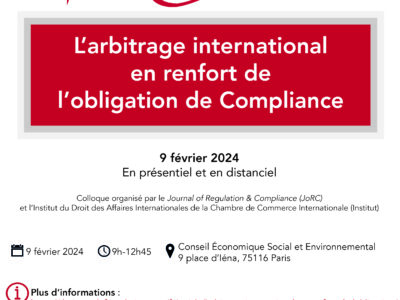
🧱Co-organisation of the Symposium 🧮L’arbitrage international en renfort de l’Obligation de Compliance (International Arbitration in support of the Compliance Obligation)

► Full Reference: L. Aynès, M.-A. Frison-Roche, J.-B. Racine and E. Silva-Romero (dir.), L'arbitrage international en renfort de l'obligation de Compliance (International Arbitration in support of the Compliance Obligation), Journal of Regulation & Compliance (JoRC) and Institute of World Business Law of the ICC (Institute), Conseil Économique Social et Environnemental (CESE), Paris, February 9, 2024 - 🌐consult on LinkedIn a general présentation of this event, which links to a presentation and a report of each speech  - 🏗️This symposium takes place in the cycle of symposiums organised by the Journal of Regulation & Compliance (JoRC) and its partners Universities, focusing in 2023-2024 on the general theme of the Compliance Obligation - 📚The works will then be inserted in the books:  📕L'obligation de Compliance, to be published in the 📚Régulations & Compliance Serie, co-published by the Journal of Regulation & Compliance (JoRC) and Dalloz, published in French. 📘Compliance Obligation, to be published on the 📚Compliance & Regulation Serie, co-published by the Journal of Regulation & Compliance (JoRC) and Dalloz, published in English. - ► General presentation of the symposium: "Compliance Obligation" appears to be far from International Arbitration if Compliance Law is only understood in terms of binding regulations or even Criminal Law. Arbitration would only have contact with Compliance Obligation in a repulsive way, when a person claims to have enforced a contract before an arbitration court that disregards a compliance prohibition, e.g. corruption or money laundering. It is therefore from a negative angle that the cross-over has taken place. The fact that Arbitration Law respects the requisite of Criminal Law is nothing new.  Moreover, the power of Compliance in its detection and prevention tools, particularly in terms of evidence, no doubt increases the global efficiency. But Compliance Obligation is based on Monumental Goals, notably linked to global human rights and active ambitions about environment and climate which, particularly in the value chain economy, take the legal form of compliance clauses, or even compliance contracts, or various commitments and plans, which the parties can ask the international arbitrator to enforce. They will do so even more as arbitrators are often the only international, or even global, judges available. The use they will do of Contract Law, Quasi-Contract Law, Enforcement Law, Tort Law, reinforces Compliance Law in a global dimension. - - ► Interviennent :  🎤 Laurent Aynès, emeritus Professor at Paris 1 Panthéon-Sorbonne University, Attorney, Darrois Villey Maillot Brochier (Paris) 🎤 Marie-Anne Frison-Roche, Professor of Regulatory and Compliance Law, Director of the Journal of Regulation & Compliance (JoRC) 🎤 Jean-François Guillemin, former General Secretary of the Bouygues Group 🎤 Christophe Lapp, Attorney, Advant Altana (Paris) 🎤 Jean-Baptiste Racine, Full Professor at Paris Panthéon-Assas University (Paris 2) 🎤 Eduardo Silva-Romero, President of the Institute of World Business Law of the ICC (Institute), Attorney, Wordstone (Paris) - 🧮Read a detailed presentation of the event below⤵️ - 🌐follow Marie-Anne Frison-Roche on LinkedIn 🌐follow Marie-Anne Frison-Roche on Instagram 🌐subscribe to the Newsletter MAFR Regulation, Compliance, Law

Conferences

🎤Droit de la compliance : tour d’horizon (Compliance Law: Overview), in 🧮Droit de la compliance (Compliance Law)

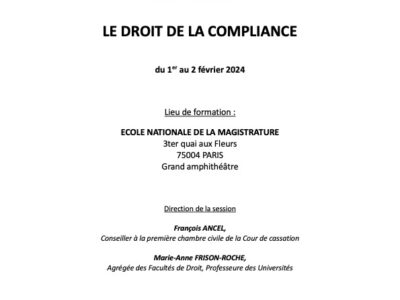
► Full Reference: M.-A. Frison-Roche, "Droit de la compliance : tour d'horizon" ("Compliance Law: Overview"), in Droit de la compliance (Compliance Law), École nationale de la magistrature – ENM (French National School for the Judiciary) in collaboration with the École de Formation professionnelle des Barreaux du ressort de la cour d'appel de Paris – EFB (Paris Bar School), Paris, February 1, 2024. - ► This conference is given in French - 🧮see the full programme of this event (in French) - 🌐consult on LinkedIn a general presentation of this event, which links to a presentation of each speech (in French) - 🧱consult the scientific direction sheet of this event, which gives an account of the various speeches made - 🔲see the slides used to support the presentation (in French) - 🎤see a presentation of the other speech about "Compliance et Responsabilité civile : comprendre et raison garder" ("Compliance and Civil Liability: understanding and keeping our heads"), given at the same symposium - ► Presentation of the conference: Compliance Law is mysterious in itself, because it is still in creation1🕴️M.-A. Frison-Roche, 📝Naissance d'une branche du Droit : le Droit de la Compliance (Birth of a branch of Law : Compliance Law), to be published., because its presence and power are felt, but it is difficult to grasp it. It is necessary, however, because it deals with the most important, even the most dramatic, facts and carries with it the greatest ambitions. Magistrates must also "make the effort" to participate in the "adventure of Compliance Law", because it affects, and even overturns, all subjects, and because the Prosecutor and the Judge play an increasing role in it2🕴️M.-A. Frison-Roche (ed.), 📘Compliance Jurisdictionalisation, 2023.. Because the purpose of this conference is to introduce the two days of a training course designed for magistrates and open to lawyers, it only provides an "overview" of, so that we do not get lost in the sprawling regulations, the global mechanisms and the political ambitions that permeate them. Therefore, without going into any of the subjects, it is about opening up four ways of entering what is a branch of Law that is being born before our eyes: 1. Understanding Compliance Law through "regulations" 2. Understanding Compliance Law through "tools"3🕴️M.-A. Frison-Roche (ed.), 📘Compliance Tools, 2020. 3. Understanding Compliance Law through "methods" 4. Understanding Compliance Law through "goals"4🕴️M.-A. Frison-Roche (ed.), 📘Compliance Monumental Goals, 2023. The four approches are legitimate because the four dimensions are articulated in the legal system, notably case law. But the more positive Law is consolidated, the more its normativity through the goals that give normativity, or even a simplicity without which the whole is not humanly controllable. These Goals are Monumental and Europe bears them more and better than other areas of the world5🕴️M.-A. Frison-Roche (ed.), 📕Pour une Europe de la Compliance (For the Europe of the Compliance), 2019.. - 🌐follow Marie-Anne Frison-Roche on LinkedIn 🌐follow Marie-Anne Frison-Roche on Instagram 🌐subscribe to the Newsletter MAFR Regulation, Compliance, Law

Articles in a legal collective publication

article in a collective publication

📝The deployment of Regulatory Law through Compliance Law in the European project

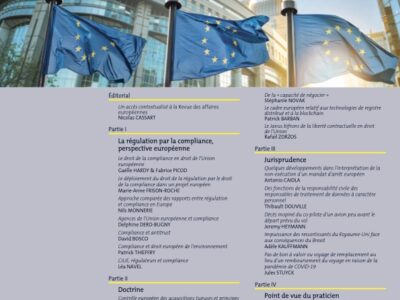
► Full Reference: M.-A. Frison-Roche, "The deployment of Regulatory Law through Compliance Law in the European project", in G. Hardy & F. Picod, Compliance Regulation from a European Perspective, Law and European Affairs (L.E.A.), 2023/2, pp. 345-352. - 🚧read the bilingual Working Paper which is the basis of this article, with additional developments, technical references and hyperlinks  - ► English Summary of the article: Compliance Law is neither a method of obeying regulations, nor a simple neutral method of ensuring the effectiveness of norms, nor a means of enforcement displaced from Ex Post to Ex Ante. It is an extension of Regulatory Law and goes beyond it. Like it, it aims to build spaces according to a political project specific to an area, such as Europe. Branch of Law looking to the future as Regulatory Law does, it constructs and maintains, in a systemic way, sustainable, albeit unstable, balances to achieve the ‘Monumental Goals’ in which its normativity resides: security, sustainability, probity, truth, and dignity. By internalising these Monumental Goals in the companies that are in a position to achieve them, the “crucial companies”, Compliance Law preserves the logic of Regulatory Law, offering it a prodigious expansion since it frees it from the condi- tion of a sector and territorial borders, which seemed tautological, by associating private powers and public will, which remains primary. In this way, Compliance can regulate the digital space and climate issue through political choices made by a sovereign Europe. - 🌐follow Marie-Anne Frison-Roche on LinkedIn 🌐follow Marie-Anne Frison-Roche on Instagram 🌐subscribe to the Newsletter MAFR Regulation, Compliance, Law

Articles in a legal collective publication

PEICUTI, Cristina🕴️ and BEYSSADE, Jacques🕴️

📝 Feminisation of positions of responsibility in the workplace as a goal of Compliance, in Frison-Roche, M.-A. (ed.), 📘Compliance Monumental Goals

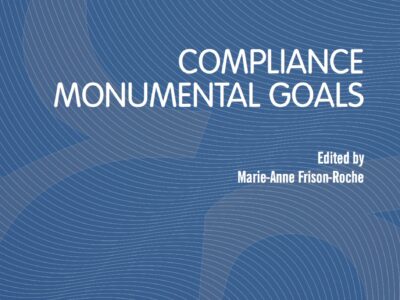
► Full Reference: Peicuti, C. et Beyssade, J., Feminisation of positions of responsibility in the workplace as a goal of Compliance, in Frison-Roche, M.-A. (ed.), Compliance Monumental Goals, series "Compliance & Regulation", Journal of Regulation & Compliance (JoRC) and Bruylant, 2023,pp. 117-135. - ► Article Summary:  If the Compliance techniques are conceived as taking their meaning by their Goal, the latter being in particular the protection and the effective promotion of human beings, to be reinforced in the future thanks to Compliance Law tools, the example of the effective promotion of efficient equality between women and men in the banking sector to exercise responsible functions is clear. strongly feminized, the image of banking sector remains masculine and in fact too few women exercise positions of responsibility, although no text is opposed to it and all rights have been allocated for this. To move from this situation to a future where equality will be effective, it is therefore in terms of regulatory mechanisms that we should think of the necessary transformation and even more of "transition" so that one day a de facto equality will be established. and appears natural to all. The bank must then structurally integrate this Goal, which corresponds to the definition of Compliance. To do this, the banking company is part of a long-term voluntary Compliance process, relying in particular on human resources and on the public authorities of the European Banking Union which, by further implementing the concept of sustainable economy, facilitated this long-term action. In this transition, each action and result must be considered in relation to this sought-after goal of effective equality: each progress must be valued not so much in relation to the past but in relation to the future. This Ex Ante perspective justifies these self-binding Compliance techniques, such as plans, commitments, quotas, stakeholder implications, and more flexible techniques such as examples given by managers, internal training and joint affirmations with the public authorities, are all used by the company to achieve this Monumental Goal of effective equality between human beings. The banking sector is all the more exemplary for this because the banking authorities themselves deploy incentives in this direction, the definition of Compliance Law as an alliance between the Authorities and the Companies therefore corresponding to such an action clearly in progress, structurally in the BPCE group. -     📝 see the general presentation of the book 📘Compliance Monumental Goals in which this article is published -

Videos

🎥L’avenir du Droit de la compliance (The futur of Compliance Law), in🧮 Nuit du Droit

► Full Reference: M.-A. Frison-Roche, "L'avenir du Droit de la compliance" (The futur of Compliance Law), in Cour de cassation (French Court of cassation), La Nuit du Droit 2023, October 4, 2023.  - 🎥 Watch the video (in French) - 🧮read the full programme of this event The Cour de cassation (French Court of cassation) had presented 4 successive themes insofar as they affect the future of Law: filiation, artificial intelligence, the environment and compliance. The President of the Chambre sociale de la Cour de cassation (Social Chamber of the Court of Cassation) gave a presentation on Compliance and the essential role played by the Judge. Then, the Parquet général (Prosecutor General's Office) then asked Fabien Raynaud, Conseiller d'État, about the importance of 'systemic cases' in Compliance Law and the dialogue between judges that it implies, using the Youporn case currently being examined by the judges. - ► General presentation of the speech: As my work has been seminal for Compliance Law, I was asked about the future of Compliance Law. - 🌐follow Marie-Anne Frison-Roche on LinkedIn 🌐follow Marie-Anne Frison-Roche on Instagram 🌐subscribe to the Newsletter MAFR Regulation, Compliance, Law

Conferences

🎤Conclusion, in 🧮L’eau : entre protection de la ressource et conflits d’usage

🌐follow Marie-Anne Frison-Roche on LinkedIn 🌐subscribe to the Newsletter MAFR Regulation, Compliance, Law - ► Full Reference: M.-A. Frison-Roche, "Conclusion", in Club des avocats environnementalistes, L’eau : entre protection de la ressource et conflits d’usage, Maison des Avocats, Auditorium, September 28, 2023. - 🧮see the full programme of this event -

Monographs

📝Compliance : demandez le programme ! (Compliance: ask for the programme!)

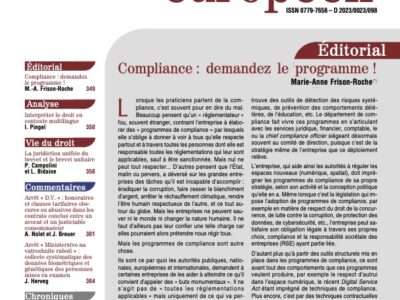
► Full Reference: M.-A. Frison-Roche, "Compliance : demandez le programme !" ("Compliance: ask for the programme!), J.D.E., 2023/7, No. 301, p. 349. - 📝read the article (in French) - 🌐see the LinkedIn post presenting this article - ► Summary of the article: Compliance programmes are neither constraints imposed by a 'mad regulator' forcing companies to show in advance that they comply with all the regulations applicable to them, nor are they a delegation by the State of tasks it is incapable of accomplishing, such as eradicating corruption or stopping global warming. On the contrary, they are a tool in the service of the alliance between public authorities and companies in the pursuit of the Monumental Goals of Compliance Law. Through them, the company implements actions to prevent the systemic risks associated with its activity. It thus assists the authorities in regulating new areas (digital, space) while adopting a sustainable strategy. As a result, it does not suffer from regulations, but participates in shaping the future. In this future, the judge plays a central role in shaping the compliance programmes that will be raised or challenged in 'systemic cases'. - 🌐follow Marie-Anne Frison-Roche on LinkedIn 🌐follow Marie-Anne Frison-Roche on Instagram 🌐subscribe to the Newsletter MAFR Regulation, Compliance, Law

Articles in a legal collective publication

📝Droit de la compliance et climat. Pour prévenir le risque et construire l’équilibre climatiques, in 🕴️M. Torre Schaub, 🕴️A. Stevignon et 🕴️B. Lormeteau (ed.), 📗Les risques climatiques à l’épreuve du droit

► Full Reference: M.-A. Frison-Roche, "Droit de la compliance et climat. Pour prévenir le risque et construire l'équilibre climatiques" ("Compliance Law and climate. Prevent the climate risk and build the climate balance"), in M. Torre Schaub, A. Stevignon and B. Lormeteau (ed.), Les risques climatiques à l'épreuve du droit, Mare & Martin, coll. "Collection de l'Institut des sciences juridique et philosophique de la Sorbonne", 2023, pp. 73-83 - 📝read the article (in French) - 🚧read the bilingual Working Paper which is the basis of this article, with additional developments, technical references and hyperlinks - ► Summary of the article: Compliance Law is beginning to emerge in climate topic, through the expression  "Climate Compliance Law", but the climate issue itself is the most perfect example of why General Compliance Law is made for.  It is indeed a new branch of Law, a global Law claiming to provide Ex Ante solutions here and now for global issues, so that in the future systemic catastrophies will not occur, will not happen: it is these "Monumental Goals" that give meaning, coherence, and simplicity to Compliance Law. Compliance Law, linked to the Rule of Law principle, makes it possible to go beyond the choice often presented between the effectiveness of the protection of the planet and the renunciation of freedoms, in particular the freedom to do business and the freedom of individuals, especially the protection of their data. Climate is thus exemplary of the object of Monumental Goals of Compliance Law (I). The systemic risk that it now constitutes is analogous to Banking or Digital Systemic Risks and therefore calls for the application of identical legal Compliance Tools, formerly put in place for Banking Regulatory and Compliance Law, recently invented for Digital. Compliance Law, extending Regulation Law, itself from the precondition of the Sector and the Territory, is therefore the branch which makes it possible to put in place new legal solutions, either by force (judicial agreements, compliance programs, etc.), or by will (commitments, global charters, etc.). Therefore, an alliance can exist between political and public authorities, and crucial economic operators (II), that the rise in power of the "raison d'être" is the sight and whose technical challenge is the collection of information that must be put in correlation. Scientists pooling Information, this public good, provided by public and private entities. The courts are at the center of this articulation between Compliance Law and Climate, which object is the Future. - 🌐follow Marie-Anne Frison-Roche on LinkedIn 🌐follow Marie-Anne Frison-Roche on Instagram 🌐subscribe to the Newsletter MAFR Regulation, Compliance, Law

Articles in a legal collective publication

📝Penser et manier la vigilance par ses buts monumentaux de compliance (Thinking and using Vigilance through its Compliance Monumental Goals), in 📙La société vigilante

🌐follow Marie-Anne Frison-Roche on LinkedIn 🌐subscribe to the Newsletter MAFR Regulation, Compliance, Law - ► Full Reference: M.-A. Frison-Roche, "Penser et manier la vigilance par ses buts monumentaux de compliance" ("Thinking and using Vigilance through its Compliance Monumental Goals"), in I.Grossi (ed.), La société vigilante, JCP E, No. 31-35, 3 August 2023, pp. 16-20. - 📙this article is the introduction of this special issue. It is linked to the concluding article of this special issue: 📝La vigilance, pièce d'un puzzle européen (Vigilance, a piece of the European puzzle) - 🧮the 2 articles follow on from the introductory and concluding speeches in the colloquium La Société vigilante, held at the University of Aix Marseille on 24 March 2023 - 🚧read the bilingual Working Paper which is the basis of this article, with additional developments, technical references and hyperlinks - ► Summary of the article: The concept of "Vigilance" is difficult to define. Probably because even as it is becoming a standard, it has just entered the legal systems. And what a splash it is! To understand it, it must not be isolated. Neither in the only French law attracting all the attention, all the fears, all the hopes, the so-called Loi Vigilance ("Vigilance Law"), nor in the only technical mechanisms that make Vigilance a reality. Vigilance is itself only a part of a deeper movement, of which it is the advanced point, allowing us to anticipate the evolution of the whole: Compliance Law. In this light and for not getting lost in it, because the stakes are so high that one quickly loses the measure of things, with each party lashing out at the others, so Vigilance, the key element of Compliance, requires above all alliances,  that we can first examine the entry of Vigilance into the legal system and then understand it through the Monumental Goals which give the measure of it, i.e. both the scope and the limit, each one having to act within the margins that are theirs, States, companies, stakeholders, and judges. A Will for tomorrow can then emerge today, carried by Europe. - 📝read the article (in French) -

Breaking news

💬Compliance : les cours suprêmes s’emparent de la question de ses enjeux juridictionnels (Compliance : the Supreme Courts take up the issue of its jurisdictional implications)

🌐follow Marie-Anne Frison-Roche on LinkedIn 🌐subscribe to the Newsletter MAFR Regulation, Compliance, Law  - ► Full Reference:  M.-A. Frison-Roche et A. Seban, "Compliance : les cours suprêmes s’emparent de la question de ses enjeux juridictionnels" ("Compliance : the Supreme Courts take up the issue of its jurisdictional implications"), interview with Olivia Dufour, Actu-Juridique, 5 July 2023. - 💬read the interview (in French) - ► Presentation of the interview by the journal (in French): "Le 2 juin dernier s’est tenu au Conseil d’État un colloque fondateur sur le rôle du juge dans la compliance. Le professeur Marie-Anne Frison-Roche et le conseiller d’État Alain Seban, qui ont tout deux contribué aux débats, ont accepté de commenter les principaux enseignements des travaux de cette journée." - ► Questions asked (in French):  Le colloque « De la régulation à la compliance, quel rôle pour les juges » qui s’est tenu au Conseil d’État le 2 juin dernier a rassemblé juges civils et administratifs. En quoi le juge administratif est-il concerné par la compliance qui semble plutôt une affaire d’entreprises et donc de justice civile et commerciale ?  ​Vincent Vigneau, président de la chambre commerciale de la Cour de cassation rappelle que la compliance a plutôt vocation à éviter le juge en se situant ex ante, pourtant on découvre que le juge lui-même accepte de plus en plus de se prononcer en ex ante… qu’en est-il ?  Quel peut donc être le rôle du juge dans la compliance ? Peut-il contribuer à faire émerger un droit de la compliance et à l’harmoniser ?  ​ ​François Ancel semble considérer que le rôle juge va devoir adapter son office à la compliance, il évoque trois concepts : téléologique, soutenabilité et efficacité… Le juge dispose-t-il en l’état de tous les outils nécessaires ? Si tel n’est pas le cas, que faut-il créer ? En quoi le dialogue des juges, civil/administratif, national/européen, national/international, est-il important ? Que veut dire F. Ancel quand il déclare que le juge doit évoluer du constat à la trajectoire ? Existe-t-il des domaines où la compliance entre en conflit avec des principes processuels, par exemple le principe de légalité des peines ? En quoi la notion de « buts monumentaux », que vous avez créée en 2016, a-t-elle trouvé sa place dans le droit ? -

MAFR Chronicles Compliance Law

📚chronique MAFR Compliance Law

📝La loi, la compliance, le contrat et le juge : places et alliances (Regulations, Compliance, Contracts, and Judges: places and alliances”)

🌐 follow Marie-Anne Frison-Roche on LinkedIn 🌐 subscribe to the Newsletter MAFR Regulation, Compliance, Law - ► Full Reference: M.-A. Frison-Roche, "La loi, la compliance, le contrat et le juge : places et alliances" ("Regulations, Compliance, Contracts, and Judges: places and alliances"), Chronique of Compliance Law, D. 2023, pp. 906-908. - 📝read the article (in French) - ► English summary of this article: Compliance Law brings together the forces of regulations, contracts, and judges' decisions to achieve monumental goals so that in the future human beings will not be crushed by systems but will instead benefit from them. In this teleological and systemic branch of Law, legislators, regulators, companies, stakeholders, and judges must find their place. This can lead to bonds of obedience, a vision of 'conformity'. But conformity is only a tool of compliance, whose vigilance is the advanced point of this new branch of Law in which the alliance makes it possible to find solutions, the contract being then a usual mode of elaborating means under the control of the judge. - 🚧read the bilingual Working Paper which is the basis of this article, with additional developments, technical references and hyperlinks - 📚read the other articles published in this chronique of Compliance Law published in the Recueil Dalloz -

Working papers

Working Paper

🚧Use of private companies by Compliance Law to serve Human Rights

► Full reference: M.-A. Frison-Roche, Use of private companies by Compliance Law to serve Human Rights, Working Paper, May 2023. - This Working Paper is the basis of: 🎤a conference done in French in Toulouse on June 16, 2023 📝an article previously written before and for this conference, and subsequently published in the book Puissances privées et droits de l'homme ("Private Powers and Human Rights") - ►Summary of this Working Paper: Following the legal tradition, Law creates a link between power with a legitimate source, the State, public power being its prerogative, while private companies exercise their power only in the shadow of this public power exercised ex ante.  The triviality of Economic Law, of which Competition Law is at the heart, consisting of the activity of companies that use their power on markets, relegates the action of the State to the rank of an exception, admissible if the State, which claims to exercise this contrary power, justifies it.  The distribution of roles is thus reversed, in that the places are exchanged, but the model of opposition is shared. This model of opposition exhausts the forces of the organisations, which are relegated to being the exception. However, if we want to achieve great ambitions, for example to give concrete reality to human rights beyond the legal system within which the public authorities exercise their normative powers, we must rely on a new branch of Law, remarkable for its pragmatism and the scope of the ambitions, including humanist ambitions, that it embodies: Compliance Law. Compliance Law is thus the branch of Law which makes the concern for others, concretised by human rights, borne by the entities in a position to satisfy it, that is to say the systemic entities, of which the large companies are the direct subjects of law (I). The result is a new division between Public Authorities, legitimate to formulate the Monumental Goal of protecting human beings, and private organisations, which adjust to this according to the type of human rights and the means put in place to preserve them. Corporations are sought after because they are powerful, in that they are in a position to make human rights a reality, in their indifference to territory, in the centralisation of Information, technologies and economic, human, and financial means. This alliance is essential to ensure that the system does not lead to a transfer of political choices from Public Authorities to private companies; this alliance leads to systemic efficiency. The result is a new definition of sovereignty as we see it taking shape in the digital space, which is not a particular sector since it is the world that has been digitalised, the climate issue justifying the same new distribution of roles (II).  -   🔓read the full developments below⤵️ - 🌐 follow Marie-Anne Frison-Roche on LinkedIn 🌐follow Marie-Anne Frison-Roche on Instagram 🌐 subscribe to the Newsletter MAFR Regulation, Compliance, Law 

Working papers

Working Paper

🚧The role of the Judge in the deployment of Regulatory Law through Compliance Law

► Full Reference: M.-A. Frison-Roche, The role of the Judge in the deployment of Regulatory Law through Compliance Law, Working Paper, April  2023. - 🎤 This working paper was drawn up to serve as the basis for the concluding summary session of the colloquium organised by the Conseil d'État (French Administrative Supreme Court) and the Cour de cassation (French Judicial Supreme Court), De la régulation à la compliance: quel rôle pour le juge? ("From Regulation to Compliance: what role for the Judge?") held on 2 June 2023 at the Conseil d'État.  - 📝 This working paper also served as the basis for the article that concludes the book De la régulation à la compliance : quel rôle pour le juge, published by the La Documentation Française, 2024. - ► Working Paper Summary: It is remarkable to note the unity of conception and practice between professionals who tend to work in administrative jurisdictions and professionals who tend to work in judicial jurisdictions: they all note, in similar terms, an essential movement: what Regulatory Law is, how it has been transformed into Compliance Law, and how in one and even more so in the other the Judge is at the centre of it. Judges, as well as regulators and European officials, explain this and use different examples to illustrate the profound transformation this has brought about for the law and for the companies responsible for increasing the systemic effectiveness of the rules through the practice and dissemination of a culture of compliance. The role of the judge participating in this Ex Ante transformation is renewed, whether he is a public law judge or a private law judge, in a greater unity of the legal system.   - 🔓read the Working Paper below⤵️ - 🌐follow Marie-Anne Frison-Roche on LinkedIn 🌐follow Marie-Anne Frison-Roche on Instagram 🌐subscribe to the Newsletter MAFR Regulation, Compliance, Law

Articles

📧Pour un consommateur “vigilant” : l’éduquer. Analyse juridique

🌐 follow Marie-Anne Frison-Roche on LinkedIn 🌐 subscribe to the Newsletter MAFR Regulation, Compliance, Law  - ► Full Reference: M.-A. Frison-Roche, "Pour un consommateur "vigilant" : l'éduquer. Analyse juridique" ("For a "vigilant" consumer: educate him. Legal analysis"), Newsletter MAFR – Law, Compliance, Regulation, 18 April 2023. - 📧Read by freely subscribing other news of the Newsletter MAFR – Law, Compliance, Regulation - 🔴For an efficient Compliance Law: an Ex Ante responsibility in alliance with consumer expectations  A survey confirms that consumers integrate the monumental goals that generate compliance duties and obligations on the companies that sell them products. But this does not create a duty on them to prefer these products over others: they do not feel "responsible" for them. Compliance Law is based on ex ante responsibility and shared duty. So, faced with this attitude, what can the Law do? - 📧read the article ⤵️ 

Articles

📧Deliberative rationality” and the proper use of the vigilance imperative

► Full Reference: M.-A. Frison-Roche, "La "rationalité délibérative" et l'usage adéquat de l'impératif de vigilance" (""Deliberative rationality" and the proper use of the vigilance imperative"), Newsletter MAFR – Law, Compliance, Regulation, 6 April 2023. - 📧Read by freely subscribing other news of the Newsletter MAFR – Law, Compliance, Regulation - 🔴The deliberative public space, a model method for the implementation of the duty of vigilance In this new article of April 6, 2023 of the Newsletter MAFR – Law, Compliance, Regulation, the political philosophy construction that Habermas exposes about social networks and the method that the implementation of the duty of vigilance requires are correlated. Indeed, Habermas continues to advocate a space for discussion, contradiction, deliberation, opinion that can act with rationality. Communication and mediation are essential to ensure that the future, which is the object of vigilance, will not be a catastrophe: this monumental goal of compliance, of which Vigilance is a part, implies it. - 📧read the article ⤵️  - 🌐 follow Marie-Anne Frison-Roche on LinkedIn 🌐follow Marie-Anne Frison-Roche on Instagram 🌐 subscribe to the Newsletter MAFR Regulation, Compliance, Law