Monumental Goals

Organisation of events

⚙️Co-organisation of the symposium 🧮Durabilité de l’Internet : le rôle des opérateurs du système des noms de domaine. Compliance et Régulation de l’espace numérique (Sustainability of the Internet: the role of the operators of the domain name system. Compliance and regulation of the digital space)

  - ► Full Reference: M.-A. Frison-Roche & G. Loiseau (dir.), Durabilité de l'Internet : le rôle des opérateurs du système des noms de domaine. Compliance et régulation de l'espace numérique (Sustainability of the Internet: the role of the operators of the domain name system. Compliance and regulation of the digital space), Journal of Regulation & Compliance (JoRC) and Institut de Recherche Juridique de la Sorbonne (André Tunc – IRJS), Paris 1 Panthéon-Sorbonne University, 21 Fabruary 2025 - ► General presentation of this symposium: The digital space has been built on and as a system. Its primary interest is of a negative nature: it consists of to be preserved against the prospect of systemic failure, of not collapsing. Like all other systems, this 'Monumental Goal' specific to the digital system justifies resources that incorporate this concern for the future. As with all systems, it integrates and relies on the specific technical nature of this system. The digital space is largely based on the invention, technology and architecture of domain names. Domain names, as an addressing system, enable users to enter the digital space and find other Internet users. The uniqueness and solidity of the domain name system, entrusted to a single root and decentralisation, makes this community possible for those who use the digital space and ensures the technical durability required, without which the digital space would be compromised. The architecture, operation, operators and what they do under the control of legislators, regulators, judges and legal subjects are therefore examined from a dual technical and legal perspective, in the light of the imperative of sustainability. This allows to progress in 4 stages. Firstly, to examine the permanence in time and space of the domain name system, insofar as it is the foundation of the Internet and the digital system. This technical construction gives rise to legal qualifications, not only for the present but also for the future, since the Web3 offers new technical solutions. Secondly, this technical sustainability is an imperative that is built into the operators of the domain names themselves, which are inter-linked not only at national level but also at global level, this cross-linking being necessary for the security of the system. The State is present through public law techniques that enable surveillance, control and possible recovery. Thirdly, it imposes constraints on the operators subject to them in order to serve this monumental goal of technical sustainability, and these constraints themselves generate as many powers as they need to usefully achieve this mission. This proportionality must be at the heart of the method and the requirements. The relationship between constraints and powers also stems from it. Fourthly, this imperative of technical sustainability, which is global in nature, gives way to imperatives of societal sustainability, more localised in space and time, when domain name operators are called upon by the legitimate authors of binding standards, legislators in the first instance, to express concerns such as the protection of people involved in the digital space and whose rights are compromised or who are in danger. This second type of sustainability, which is more localised and less inherent in the architecture of the Internet, is justified by the available power of the operators concerned and their adherence to social imperatives. The resulting constraints and powers are therefore not the same. The 2 sustainabilities must then be articulated in a conception that is both teleological and pragmatic. - - ► Speakers (they will speak in French, but the book to be published will be in English):  🎤Pierre Bonis, Chief Executive Officer of the Association française pour le nommage Internet en coopération (Afnic) 🎤Lucien Castex, Adviser of the Afnic Chief Executive Officer for Research internet and society and Internet governance 🎤Marie-Anne Frison-Roche, Full Professor of Regulatory and Compliance Law, Director of the Journal of Regulation & Compliance (JoRC) 🎤Claire Leveneur, Senior Lecturer at Paris-Est Créteil University 🎤Grégoire Loiseau, Full Professor at Paris 1 Panthéon-Sorbonne University 🎤Samir Merabet, Full Professor at the University of West Indies 🎤Antoine Oumedjkane, Senior Lecturer at Lille University 🎤Frédéric Sardain, attorney at law, Jeantet law firm - read below a detailed presentation of this event⤵️ - 🌐follow Marie-Anne Frison-Roche on LinkedIn 🌐follow Marie-Anne Frison-Roche on Instagram 🌐subscribe to the Newsletter MAFR. Regulation, Compliance, Law 🌐subscribe to the Newsletter Surplomb, par MAFR
Conferences

conference

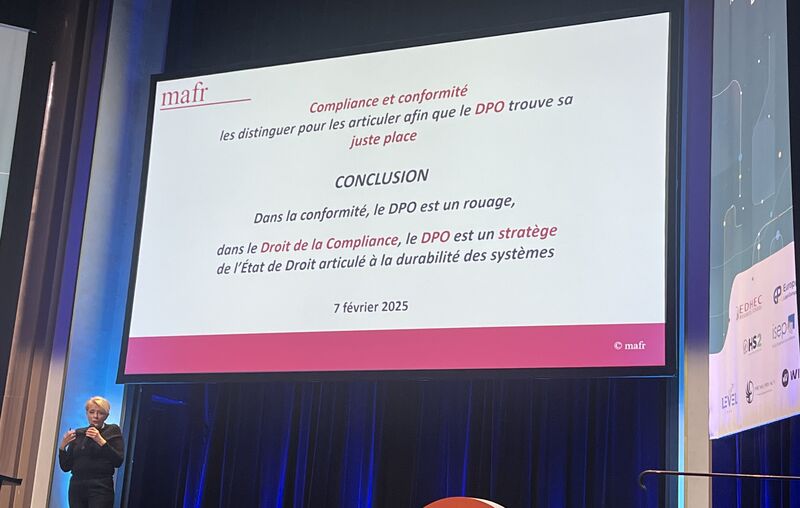
🎥”Compliance” et “conformité” : les distinguer/mieux les articuler afin que le DPO trouve sa juste place (Compliance Law” and “conformity” : distinguish between them/better articulate them so that the DPO finds their rightful place), in 🧮19ème Université AFCDP des DPO, in 🧮19ème Université AFCDP des DPO, in 🧮19ème Université AFCDP des DPO

► Full Reference: M.-A. Frison-Roche, "Compliance" et "conformité" : les distinguer/mieux les articuler afin que le DPO trouve sa juste place" ("Compliance Law" and "conformity" : distinguish between them/better articulate them so that the DPO finds their rightful place"), , in  Association française des correspondants à la protection des données à caractère personnel (AFCDP),  19ème Université AFCDP des DPO – La gouvernance des données ("Data Governance"), Maison de la Chimie, Paris, 7 February 2025 , 10h-10h45. - 🧮 see this manifestation full program (in French) - ⬜ see les slides on which this conference is done (in French)  - ► English Presentation of this conference: 'Compliance' and 'conformité' are often considered to be synonymous, notably in French in which the term "Compliance" is so often used to express only the "conformity" (conformité). This is a misunderstanding and a reduction, particularly of the role of professionals, notably DPOs. In fact, 'conformity' consists solely of ensuring that regulations are respected. Of course, an"active" conformity and "proven" conformity with these regulations, in particular the European GDPR. That and only that. If that's the case, then on the one hand this task impossible, because no one can comply with all the regulations, and it's the obsession with avoiding or reducing penalties that actually replaces the desire to do the right thing. On the other hand, algorithms are going to replace the DPO, a human being, because algorithms will identify 'non-conformity', then conformity, then write it down by "smart" contracts. But Compliance Law is more than conformity, which is only one of its tools. Compliance Law aim is to protect the human beings involved in the systems. Data protection is one of the best examples of this, and it underpins all the other areas of Compliance Law. Companies are asked to do less (obligation of means) and more: to help protect, by distinguishing between what must be revealed and what must be kept secret, sometimes to resolve conflicts between the 2 prescriptions, to educate, to make alliances. To built a real "governance". In this human and humanist mission that anchors Europe, the algorithm is flat. We are waiting for the DPO. In this human and humanist mission that anchors Europe, the algorithm is flat. We are waiting for the DPO. There is the role of guardian of the spirit of the texts, of strategic aid for the data controller, of adjuster of complementary or contradictory subjective rights, of adjustment of the texts in the European puzzle of a Regulatory Europe, which is being put in place in the humanist tradition which is its own to preserve the durability of the systems to protect the people who are forcibly or voluntarily involved in them. - 🌐suivre Marie-Anne Frison-Roche sur LinkedIn 🌐suivre Marie-Anne Frison-Roche sur Instagram 🌐s'abonner à la Newsletter MAFR Regulation, Compliance, Law 🌐s'abonner à la Newsletter en vidéo MAFR Surplomb/Overhang

Surplomb - Notion

Serie of videos on Regulation, Compliance and Vigilance 📺Surplomb/Overhang

🎬Monumental Goals, normative anchoring of Compliance Law

► Full Reference: M.-A. Frison-Roche, "Monumental Goals, normative anchoring of Compliance Law", in Series of videos Overhang / Surplomb, 1st February 2025 - 🌐watch on LinkedIn this video of the Series Surplomb/Overhang - 🌐watch on LinkedIn this video of the Serie Surplomb/Overhang, published in the Newsletter Surplomb/Overhang, by MAFR - 🎬watch below this video of the Serie Surplomb/Overhang⤵️ - Surplomb/Overhang, by mafr the Serie of videos dedicated to Regulation, Compliance and Vigilance - 🌐follow Marie-Anne Frison-Roche on LinkedIn 🌐follow Marie-Anne Frison-Roche on Instagram 🌐subscribe to the Newsletter MAFR. Regulation, Compliance, Law 🌐subscribe to the Video Newsletter MAFR. Overhang / Surplomb

Articles in a legal collective publication

Article in a collective book dedicated to an Amicorum

📝Naissance d’une branche du Droit : le Droit de la Compliance (Births of a branch of Law: Compliance Law), in 📗Mélanges en l’honneur de Louis Vogel

► Full Reference: M.-A. Frison-Roche, "Naissance d'une branche du Droit : le Droit de la Compliance" ("Birth of a branch of Law: Compliance Law"), in Mélanges offerts à Louis Vogel. La vie du droit, LexisNexis – Dalloz – LawLex – LGDJ, 2024, pp. 177-188. - 📝read the article (in French) - 🚧read the bilingual Working Paper which is the basis of this article, with additional developments, technical references and hyperlinks - ► English Summary of the article:  The study focuses on the various movements that have given rise to Compliance Law, with particular emphasis on Competition Law. After a preliminary reflection on the construction of the legal system into branches of Law, their classification in relation to each other, the difficulty encountered in this respect by Economic Law, and the various movements that give rise to one of them, the diversity of which the branch subsequently keeps track of, the study is constructed in 4 parts. To find out what gave rise to Compliance Law, the first part invites everyone to reject the narrow perspective of a definition that is content to define it by the fact of "complying" with the applicable regulations in the sens to obey them automatically. This has the effect of increasing the effectiveness of the regulations, but it does not produce a branch of Law, being only an efficiency tool like any other. The second part of the study aims to shed light on what appears to be an "enigma", because it is often claimed that this is the result of a flexible method through the "soft law", or of an American regulation (for instance FCPA), or of as many regulations as there are occasions to make. Instead, it appears that in the United States, in the aftermath of the 1929 crisis, it was a question of establishing an authority and rules to prevent another atrocious collapse of the system, while in Europe, in 1978, in memory of the use of files about Jews, it was a question of establishing an authority and rules to prevent an atrocious attack on human rights. A common element that aims for the future ("never again"), but not the same object of preventive rejection. This difference between the two births explains the uniqueness and diversity of the two Compliance Law, the tensions that can exist between the two, and the impossibility of obtaining a global Compliance Law. The third part analyses the way in which Competition Law has given rise to conformity mechanisms: they had only constituted a secondary branch which is a guarantee of conformity with competition regulations. Developed in particular through the soft law issued by the competition authorities, the result is a kind of "soft obedience", a well-understood collaboration of a procedural type through which the company educates, monitors and even sanctions, without going outside Competition Law, of which compliance  (in the sens of conformity) is the appendix. The distance between a conformity culture and Compliance Law can be measured here. The fourth part aims to show that Competition Law and Compliance Law are two autonomous and articulated branches of Law. Since Compliance Law is a autonomous and strong branch of Law built around Monumental Goals, in particular the sustainability of systems and the preservation of the human beings involved so that they are not crushed by these systems  but benefit from them : the current challenge of European integration is to build the pillar of Compliance Law alongside the competitive pillar. Jurisdictions are in the process of doing this and articulating them. - 🌐follow Marie-Anne Frison-Roche on LinkedIn 🌐follow Marie-Anne Frison-Roche on Instagram 🌐subscribe to the Newsletter MAFR Regulation, Compliance, Law

Articles in a legal collective publication

Article in a collective legal publication

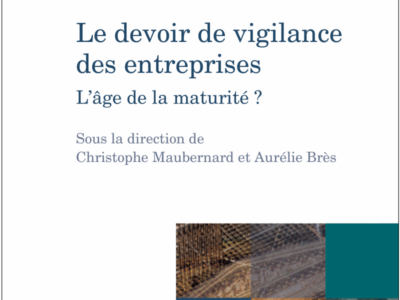
📝Devoir de vigilance : progresser (“Duty of Vigilance: the Way Forward), in 🕴️Ch. Maubernard & 🕴️A. Brès (eds.), 📗Le devoir de vigilance des entreprises. L’âge de la maturité ?

► Full Reference: M.-A. Frison-Roche, "Devoir de vigilance : progresser" ("Duty of Vigilance: the Way Forward"), in Ch. Maubernard & A. Brès (eds.), Le devoir de vigilance des entreprises. L'âge de la maturité ? (The duty of vigilance. The age of maturity?), Bruylant, "Droit & Economie" Serie, 2024, pp. 221-251 - 📝read the article (in French)  - 🚧 read the bilingual Working Paper which is the basis of this article, with additional developments, technical references and hyperlinks - ► English Summary of the article: In 2017 in France the so-called Vigilance law expressed great ambition. So did the draft directive. But in 2024 the European institutions moderated this ambition by refusing to increase either the type of companies subject and the constraints to which the duty of vigilance is associated. The directive has essentially halted what was for some the "march of progress". Does the ambition no longer exist? Does the future lie in an extension of the philosophy of the duty of vigilance, i.e. companies that should always be more concerned about others? This would undoubtedly be reaching the "age of maturity", where others see the age of madness, because it would be a contradiction in terms to ask a company to be concerned about anything other than its own development. It is therefore appropriate to consider this very hypothesis of an "age of maturity" as being an ambition maintained despite a European directive which, in its adopted version, is weakened and while the oppositions are intact (I). First of all, it must be admitted that the notion of "maturity" most often conceals a value judgment when applied to a legal concept (I.A.) and that this is blatantly obvious with regard to the duty of vigilance, which is considered by some and by nature by some as a good and by others as an evil (I.B). In order not to remain in what appears to be trench warfare, we must not get too bogged down in the reference French legislation of 2017 and what appears to be a European stutter in 2024, arguing so loudly that we can hear them reasoning in print, by paying attention to less visible and now more promising avenues of progress (II). In fact, the duty of vigilance can progress simply by the passage of time (II.A), by a better definition of the vocabulary (II.B), by the consolidation of the principles of Responsibility and Dialogue (II.C), by the uniqueness of the jurisdictional route (II.D). This last perspective of the progress that will be made possible in France by the uniqueness of the judicial route leads to a final avenue of progress. By their very nature, laws are jolts, all the more violent for being disputed. At the moment, if we want to make progress, these two other sources – the contract and the judge – must be favoured (III). The European directive is rightly concerned with access to the courts and takes a measured view of the effectiveness of contracts as a means of making the duty of vigilance effective, with the courts having to ensure that the contract does not destroy the spirit of the system. This is what the law already organises about the relationship between the contract, the judge and the duty of compliance (III.A). What is new in Europe in 2024 is the introduction of a Supervisor (III.B). Here again, vigilance is the "cutting edge" of Compliance Law, as it is an extension of Regulatory Law.  The result is that, through interpretation and the handling of principles, and to formulate a more general conclusion, it is the judge who holds and will hold the balance of the duty of vigilance. - 🌐follow Marie-Anne Frison-Roche on LinkedIn 🌐follow Marie-Anne Frison-Roche on Instagram 🌐subscribe to the Newsletter MAFR. Regulation, Compliance, Law 🌐s'abonner à la Newsletter Surplomb, par MAFR

Working papers

Working Paper for 📺Overhang

🚧Monumental Goals, normative anchoring of Compliance

► Full Reference: M.-A. Frison-Roche, Monumental Goals, normative anchoring of Compliance, Working Paper, February 2025.   - 🎬This working document has been drawn up to serve as basis to the video Overhang👁 of  the 1st February 2025: click HERE - 🎬🎬🎬In the collection of the Overhangs👁 It falls into the Notions category. ►Watch the complete collection of the Overhangs👁 : click HERE - ► Summary of this  Working Paper: Compliance, of which conformity is only one instrument (the 2 should not be confused), must be understood through the ‘Monumental Goals’ : political ambitions pursued by the public authorities and internalised in the entities in a position to achieve them, i.e. large companies. These Goals are Monumental in that they concern systems: ensuring that these systems do not collapse in the future = ‘Negative Monumental Goals’ (e.g. fight against corruption, against climate change); more ambitious still, they may aim to improve systems = ‘Positive Monumental Goals’ (e.g. effective equality between women and men). Their systemic nature gives rise to Systemic Litigation. - 🔓read the developments below⤵️ - 🌐follow Marie-Anne Frison-Roche sur LinkedIn 🌐follow Marie-Anne Frison-Roche on Instagram 🌐subscribe to the Newsletter MAFR Regulation, Compliance, Law  🌐subscribe to the Video Newsletter MAFR Overhang/Surplomb

Videos

Conference

💻Comment s’adapter au Contentieux Émergent de la Compliance (How to adapt to Emerging Compliance Litigation)

► Full Reference: M.-A. Frison-Roche, "Comment s’adapter au Contentieux Émergent de la Compliance" ("How to adapt to Emerging Compliance Litigation"), in , Association nationale des juristes de banque (ANJB), September 19, 2024, Paris, - This conference is being held with another speaker, Maître Jean-Pierre Picca. It is followed by a discussion with the audience. - 🧮see the full programme of this manifestation - ► English Summary of this conference: Compliance Law is a new branch of Law, teleological in nature, whose legal normativity is rooted in its goals.These are systemic goals of preserving systems by detecting the risks that weaken them and preventing the failures that can destroy them. It is therefore an Ex Ante branch of Law, the implementation of which will weigh on the "entities" in a position to detect risks and prevent failures so that these systemic goals are achieved.  As such, they are "Monumental Goals" in that they are political goals aimed at complete systems. It is therefore essential to distinguish between "conformity Law", which simply consists of "complying" with the applicable regulations, and Compliance Law, which consists of contributing to the achievement of these "Monumental Goals", either by force (legal obligation) or by choice (raison d'être, company with mission, contractual obligation, CSR). In this respect, Compliance Law is both much more limited in its aims and much more ambitious, since it is about building the future rather than mechanically complying with regulations. The banking sector, which can be considered an exception to the principle of Competition, which is based on extreme mobility and the absence of rents, the destruction of the weakest, risk-taking, the lack of solidity of the operator posing no problem, appears to be the paragon of the principle of Compliance, which is based on the sustainability of systems ensured by the solidity of the operators themselves, their solidarity, the exchange of information, and integrated supervisors. For example, the duty of vigilance and the information about others, and the Regulation through Supervision were born in this sector, which has internalised this sectoral concern in the banks, itself the bearer of a general concern, particularly in the European conception of continental banking. the European Banking Union  increasing this concern. As a result, banks will internalise concerns about the future that go beyond safeguarding the banking sector, such as preventing systemic climate risk or educating the population or safeguarding people in vulnerable situations. - The litigation that shall ensue is itself highly specific. The topic of this conference is to provide the keys to understanding how banks must play their part. Emerging Compliance Litigation is systemic in nature. It is a reflection of the Ex Ante organisation whereby entities are asked to make a contribution to the achievement of Monumental Goals. In a dispute between two opposing parties, an individual or an NGO or a trade union or a municipality or a State and a bank, a conflict arises between what might be called the party claiming to represent the present and future interests of a system, for example the climate system or the social relations system, and the bank which has a legally imposed "compliance obligation" to help protect this system. The author who described this perfectly was Chaïm Perelman, particularly in his 1978 book, Logique juridique, which describes audience circles. We need to understand the systemic construction of the judicial instance. The bank must not let to be confined itself solely to its role as litigant, while the other party, for example an NGO, in its role as guardian of "civil society" or the "climate system" or the "effective equality between human beings", going beyond this first circle between the litigants and brings the system itself into the proceedings.  This is where the adaptation has to take place.  - This adaptation is procedural, evidentiary and substantive. The procedural adaptation must take place even before any litigation, since there is a continuum between Ex Ante and Ex Post, with the Judicial System itself being just one accountability method (rendering of accounts) among others. This accountability takes place in relation to a ‘mission’ that is entrusted to the banks in relation to the goals: prevention, detection and the fight against corruption, money laundering, climate change, etc., by building alliances, making good use of information (knowing how to take it, knowing how not to pass it on, knowing how to pass it on). The procedure, i.e. the way in which something is done, must reflect a substantial element, in that it engenders a ‘sense of responsibility’: the purpose of Compliance Law is to ‘make powers accountable’ and to build on positions of power. The proper procedure is to make ‘good use of one's power’ for the benefit of others. Techniques for ‘taking others into consideration’ are an essential element. Consideration by the person who agrees to exercise power (the power to finance, the power to gather information, the power to organise together, the power to contract). Evidentiary’ adaptation: indifference of evidentiary obligations and rights to the procedural position of the parties. The firm has a ‘Compliance Obligation’ even if it is the defendant in the proceedings. The object of proof is given to it by the Monumental Goals that the Law or its own will require it to help achieve. Its burden is to show that it is helping to achieve these goals, by acting for the future (for example, by knowing its customers, or by taking into account the interests of its stakeholders, etc.). - ► Structure of the speech:  I. The current situation: suffering the harmful consequences of reducing Compliance Law to the mechanics of "conformity". II. The opportunity for banks to adapt by understanding Compliance Law and going beyond the mechanics of conformity: the European puzzle, its apparent complexity, its architectural clarity (CSRD/CS3D/DSA). III. The opportunity for banks not to allow themselves to be trapped in proceedings that are merely sanctions, transferred from Ex Post to Ex Ante: the emergence of Systemic Compliance Litigations before the Ordinary Law Courts (French Law of 2017 on Vigilance; Paris Court of appeal decisions of 18 June 2024). IV. What is expected of banks in Systemic Compliance and Vigilance Litigations before the Ordinary Courts, reflecting the dialogue and action required by Compliance Law (article to be published).  V. The opportunity for banks to adapt to the new evidentiary dimension of emerging Compliance and Vigilance Litigation (article to be published). VI. The opportunity for banks to adapt to the new Ex Ante dimension of Systemic Compliance and Vigilance Litigation, Litigation which deals with the future (article to be published). - ► A few bibliographical references:    🕴️M.-A. Frison-Roche, 📝Compliance Law, 2016 🕴️M.-A. Frison-Roche, 📝Compliance and conformity: distinguish them in order to articulate them, 2024 🕴️M.-A. Frison-Roche, 📝Duty of Vigilance: the way forward, 2024 🕴️M.-A. Frison-Roche, 📝Systemic Litigation, 2024 - 🌐follow Marie-Anne Frison-Roche on LinkedIn 🌐follow Marie-Anne Frison-Roche on Instagram 🌐subscribe to the Newsletter MAFR Regulation, Compliance, Law

Articles in The Journal of Regulation & Compliance « JoRC »

GUTMANN, Daniel🕴️

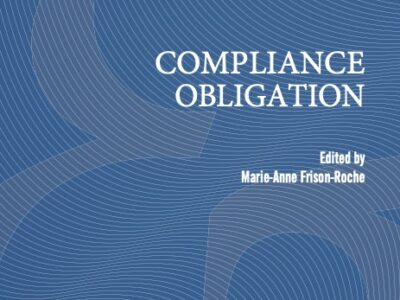
📝Tax Law and Compliance Obligation, in 🕴️M.-A. Frison-Roche (ed.), 📘Compliance Obligation

► Full Reference: D. Gutmann, "Tax Law and Compliance Obligation", in M.-A. Frison-Roche (ed.), Compliance Obligation, Journal of Regulation & Compliance (JoRC) and Bruylant, "Compliance & Regulation" Serie, to be published - 📘read a general presentation of the book, Compliance Obligation, in which this article is published - ► Summary of the article (done by the Journal of Regulation & Compliance – JoRC): The author takes up the hypothesis of a Compliance Law defined by its Monumental Goals, the realisation of which is entrusted to "crucial operators" and confronts it with Tax Law. The link is particularly effective since these operators possess what governments need in this area: relevant Information. Going further, Compliance Law can give rise to two types of obligations on the part of these operators, either towards others operators who need to be monitored, corrected or denounced, or towards themselves, when they need to make amends. In the first part of this contribution, the author shows that Compliance Obligation reproduces the mechanism of a Tax Law which, for large companies, is embroiled in a process of increasing Globalisation. It enables Governments to aspire to the "Monumental Goals" of combating tax optimisation and impoverishing governments, victims of the erosion of the tax base, in the face of the strategies of companies that are more powerful than they are themselves, by using this very power of firms to turn it against them. Companies become the willing or de facto allies of governments, particularly when it comes to recovering tax debts, or assist them in their stated ambition to achieve social justice.  In this way, the State "manages" Tax Law by cooperating with companies. In the second part, the author outlines the contours of this business Compliance Obligation, which is no longer simply a matter of paying tax. Beyond this financial obligation, it is more a question of mastering Information, particularly when multinational companies are subject to specific tax reporting obligations and are required to reveal their tax strategy, presumed to be transparent and coherent within the group : this legal presumption gives rise to obligations to seek information and ensure coherence, since a single tax strategy is not self-evident in a group. The author emphasises that companies have accepted the principles governing these new compliance obligations and are tending to transform these obligations, particularly Transparency, into a communication strategy, in line with the ESG criteria that have been developed and a desire for fruitful relations with stakeholders. Therefore the tax relations developed by major companies are being extended not only to the tax authorities, but also to NGOs, by incorporating a strong ethical dimension. This is leading to new strategies, particularly in the area of Vigilance. The author concludes: "A n’en pas douter, l’obligation de compliance existe bel et bien en matière fiscale." ("There is no doubt that the Compliance Obligation does exist in tax matters"). - 🦉This article is available in full text to those registered for Professor Marie-Anne Frison-Roche's courses -

Videos

Interview

🎥Companies and compliance: more aggressive justice and judges, in the 🎬series of talks on Compliance Law, in 📺Open windows on management

► Full reference:  M.-A. Frison-Roche, "Entreprises et compliance : une justice et des juges plus offensifs" ("Companies and compliance: more aggressive courts and judges"), interview conducted by Jean-Philippe Denis as part of a series of interviews on Compliance Law, in Fenêtres ouvertes sur la gestion (Open windows on management), broadcast by J.-Ph. Denis, Xerfi Canal, recorded December 12, 2023, released on June 14, 2024. - 🌐consult the December 2023 presentation of the interview on LinkedIn - 🎥watch the interview video on LinkedIn, with English subtitles - 🧱consult the general presentation of this series of interviews on Compliance Law - ► Starting point: Since 2016, Marie-Anne Frison-Roche has been building Compliance Law, notably through a collection co-published in French with Editions Dalloz and co-published in English with Editions Bruylant:  🧱read the presentation in English of the series in French, Régulations & Compliance ➡️click HERE  🧱read the presentation of the series in English, Compliance & Regulation ➡️click HERE - ► Summary of interview:   Jean-Philippe Denis. Question :  Marie-Anne Frison-Roche.  Answer. :  - J.-Ph D. Q. : Thus MaFR. A. : Yes,  - J.-Ph. D. Q. : Thus MaFR. A. : Yes,  -

Articles in a legal collective publication

📝L’usage des puissances privées par le droit de la compliance pour servir les droits de l’homme (Use of private companies by Compliance Law to serve Human Rights), in 🕴️J. Andriantsimbazovina (dir.), 📗Puissances privées et droits de l’Homme. Essai d’analyse juridique

► Full reference: M.-A. Frison-Roche, "L’usage des puissances privées par le droit de la compliance pour servir les droits de l’homme" (Use of private companies by Compliance Law to serve Human Rights) , in J. Andriantsimbazovina (dir.), Puissances privées et droits de l'Homme. Essai d'analyse juridique, Mare & Martin,  coll. "Horizons européens", 2024, pp. 279-295 - 🚧read the  Bilingual Working Paper on which this article is based, with more technical developments, references and hypertext links - ► English Summary of this article: Following the legal tradition, Law creates a link between power with a legitimate source, the State, public power being its prerogative, while private companies exercise their power only in the shadow of this public power exercised ex ante.  The triviality of Economic Law, of which Competition Law is at the heart, consisting of the activity of companies that use their power on markets, relegates the action of the State to the rank of an exception, admissible if the State, which claims to exercise this contrary power, justifies it.  The distribution of roles is thus reversed, in that the places are exchanged, but the model of opposition is shared. This model of opposition exhausts the forces of the organisations, which are relegated to being the exception. However, if we want to achieve great ambitions, for example to give concrete reality to human rights beyond the legal system within which the public authorities exercise their normative powers, we must rely on a new branch of Law, remarkable for its pragmatism and the scope of the ambitions, including humanist ambitions, that it embodies: Compliance Law. Compliance Law is thus the branch of Law which makes the concern for others, concretised by human rights, borne by the entities in a position to satisfy it, that is to say the systemic entities, of which the large companies are the direct subjects of law (I). The result is a new division between Public Authorities, legitimate to formulate the Monumental Goal of protecting human beings, and private organisations, which adjust to this according to the type of human rights and the means put in place to preserve them. Corporations are sought after because they are powerful, in that they are in a position to make human rights a reality, in their indifference to territory, in the centralisation of Information, technologies and economic, human, and financial means. This alliance is essential to ensure that the system does not lead to a transfer of political choices from Public Authorities to private companies; this alliance leads to systemic efficiency. The result is a new definition of sovereignty as we see it taking shape in the digital space, which is not a particular sector since it is the world that has been digitalised, the climate issue justifying the same new distribution of roles (II).  - 📝read the article (in French) - 🌐follow Marie-Anne Frison-Roche on LinkedIn 🌐follow Marie-Anne Frison-Roche on Instagram 🌐subscribe to the Newsletter MAFR Regulation, Compliance, Law 🌐subscribe to the Video Newsletter MAFR Surplomb

Articles in a legal collective publication

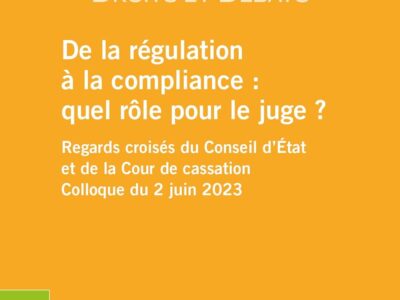
📝Le rôle du juge dans le déploiement du droit de la régulation par le droit de la compliance (The role of the Judge in the deployment of Regulatory Law through Compliance Law), synthesis in 🏛️Conseil d’État and 🏛️Cour de cassation, 📗De la régulation à la compliance : quel rôle pour le juge ?

► Full Reference: M.-A. Frison-Roche, "Le rôle du juge dans le déploiement du droit de la régulation par le droit de la compliance" ("Synthesis: The role of the Judge in the deployment of Regulatory Law through Compliance Law"), Synthesis in Conseil d'État (French Council of State) and Cour de cassation (French Court of cassation), De la régulation à la compliance : quel rôle pour le juge ? Regards croisés du Conseil d'État et de la Cour de cassation – Colloque du 2 juin 2023, La Documentation française, "Droits et Débats" Serie, 2024, pp. 173-182 - 🎥this article follows the closing speech of the biannual symposium organised by the Council of State and the Court of cassation, which in 2023 was entitled De la régulation à la compliance : quel rôle pour le juge ? (From Regulation to Compliance, what role for the judge ?) - 🚧read the bilingual Working Paper which is the basis of this article, with additional developments, technical references and hyperlinks - ► Presentation of this concluding article: It is remarkable to note the unity of conception and practice between professionals who tend to work in administrative jurisdictions and professionals who tend to work in judicial jurisdictions: they all note, in similar terms, an essential movement: what Regulatory Law is, how it has been transformed into Compliance Law, and how in one and even more so in the other the Judge is at the centre of it. Judges, as well as Regulators and European officials, explain this and use different examples to illustrate the far-reaching changes it brings to the Law and to the companies responsible for increasing the systemic effectiveness of the rules through the practice and dissemination of a Culture of Compliance. The role of the judge participating in this Ex Ante transformation is renewed, whether he/she is a judge of Public Law or a judge of Private Law, in a greater unity of the legal system. - ► English Summary of this article: The tug-of-war between 'Compliance' and 'conformity', which is exhausting us, obscures what is essential, i.e. the great novelty of a branch of law that assumes a humanist vision expressing the ambition to shape the future so that it is not catastrophic (preventing systems from collapsing), or even better (protecting human beings in these systems). The article begins by describing the emergence of Compliance Law, as an extension of Regulatory Law and going beyond it. This new branch of law takes account of our new world, brings its benefits and seeks to counter these systemic dangers so that human beings could be their beneficiaries and are not crushed by them. This branch of Ex Ante Law is therefore political, often supported by public Authorities, such as Regulatory Authorities, but today it goes beyond sectors, as shown by its cutting edge, the Obligation of Vigilance. The "Monumental Goals" in which Compliance Law is normatively anchored imply a teleological interpretation, leading to an "empowerment" of the crucial operators, not only States but also companies, responsible for the effectiveness of the many new Compliance Tools. The article goes on to show that Judges are increasingly central to Compliance Law. Lawsuits are designed to make companies more accountable. In this transformation, the role of the judge is also to remain the guardian of the Rule of Law, both in the protection of the rights of the defence and in the protection of secrets. Efficiency is not what defines Compliance, which should not be reduced to a pure and simple method of efficiency, which would lead to being an instrument of dictatorship. This is why the principle of Proportionality is essential in the judge's review of the requirements arising from this so powerful branch of Law.  The courts are thus faced with a new type of dispute, of a systemic nature, in their own area, which must not be distorted: the Area of Justice. - 📝read article (in French) - 🌐follow Marie-Anne Frison-Roche on LinkedIn 🌐follow Marie-Anne Frison-Roche on Instagram 🌐subscribe to the Newsletter MAFR Regulation, Compliance, Law

Books

Conseil d'État🏛️ & Cour de cassation🏛️

📗De la régulation à la compliance : quel rôle pour le Juge ?. Regards croisés du Conseil d’État et de la Cour de cassation (From Regulatory Law to Compliance Law: what role for the Judge?. Viewpoints of the Conseil d’État (French Administrative Supreme Court) and Cour de Cassation (French Judiciairy Supreme Court)

► Full Reference: Conseil d'État (French Administrative Supreme Court) & Cour de cassation (French Judiciary Supreme Court), De la régulation à la compliance : quel rôle pour le juge ? Regards croisés du Conseil d'État et de la Cour de cassation, ("From Regulatory Law to Compliance Law: what role for the Judge?"), La Documentation française, coll. "Droits et Débats", 2024, 241 p. - 📗read the  coverback (in French) - 📗read the table of content (in French) - ► Summary of this book : "Compliance, sometimes translated in French by the word "conformité" ("conformity"), is an extension of Regulatory Law and represents from it a new and decisive step forward. Compliance brings together all the mechanisms implemented within an organisation to achieve general interest goals (security, sustainability), thereby countering systemic risks. By relying on the rules, legal and ethical standards that embody these values, which are imposed on them and internalised by them, enterprises can both prevent the risk of sanctions and participate in this alliance between public authorities, economic operators and stakeholders to detect and prevent future systemic disasters.  Organisé par le Conseil d’État et la Cour de cassation, le colloque du 2 juin 2023 analyse ce changement de paradigme créé par cette nouvelle branche du droit.".  Organised by the Conseil d'État (French Administrative Supreme Court) and the Cour de cassation (French Judiciary Supreme Court), the conference on 2 June 2023, basis of this book, has analysed this paradigm shift created by this new branch of law: Compliance Law.  - 📝read the presentation in English of the concluding contribution of  Marie-Anne Frison-Roche : "Le rôle du juge dans le déploiement du droit de la régulation par le droit de la compliance" - 📝read the presentation in English of the contribution of François Ancel : "Quel rôle pour le juge aujourd’hui dans la compliance ? Quel office processuel du juge dans la compliance ?" -

Conferences

🎤Les voies d’innovations juridiques face aux nouveaux “défis climatiques” (“Innovative legal solutions to the new “climate challenges””), in 🧮Nouveaux défis – Regards croisés : Droit, Économie et Finance. Quel Droit face au Changement Climatique ? (“New challenges – Crossed perspectives : Law, Economics and Finance. What Law in the Face of Climate Change?”)

► Full Reference: M.-A. Frison-Roche, "Les voies d'innovations juridiques face aux nouveaux "défis climatiques" ("Innovative legal solutions to the new "climate challenges""), in C. Arnaud, O. de Bandt et B. Deffains (dir.), Nouveaux défis – Regards croisés : Droit, Économie et Finance. Quel Droit face au Changement Climatique ? (("New challenges – Crossed perspectives : Law, Economics and Finance. What Law in the Face of Climate Change?"), Banque de France (French Central Bank) and CRED/Paris Panthéon-Assas University, Paris, Centre de Conférence de la Banque de France, April 2, 2024 - 🧮See the full programme of this event - 🔲see the slides, basis of this conference (in French) - ► Summary of this conference: In response to the question of how the Law can produce 'innovations' to meet the 'climate challenges', the process is based on the three traditional sources of Law, which are, firstly, laws and regulations, secondly, the commitments of individuals, mainly contracts, and thirdly, court rulings. At first sight, the Law in its traditional conception and practice is weak in the face of climate change. This weakness is inherent in the nature of climate change, which is at once future, global and systemic, in the face of these three sources of Law, which do not address all three dimensions at once. The scale of the legal innovation required to ensure that one or more articulated sources can grasp the future, the global and the systemic is therefore clear. And yet this is what is happening. As far as laws and regulations are concerned, they do not seem very appropriate because they are, by their very nature, a territorial limit, and international treaties are very difficult to negotiate. The interweaving of European regulations, for example the CSRD and the CS3D, which mirror each other, may be more effective. As far as 'commitments' are concerned, a concept which in Law is not very precise outside of contracts and liability cases📎1🕴️M.-A. Frison-Roche, 📝What a commitment is, in 🕴️M.-A. Frison-Roche (ed.), 📘Compliance Obligation, 2024., contracts are above all a means for companies to fulfill their legal obligations, and a contract always implies a judge. At first sight, however, the judge is the least well placed to respond to 'climate challenges', particularly in France where he is said or wished to be powerless, where he rules on the past and where, especially the civil judge, he settles a one-off dispute between two singular parties. But a major change has occurred with the emergence of a new branch of law: the Compliance Law, a teleological branch of Law whose legal normativity is lodged in the Monumental Goals📎2🕴️M.-A. Frison-Roche, 📝Compliance Monumental Goals, beating heart of Compliance Law, in 🕴️M.-A. Frison-Roche (ed.), 📘Compliance Monumental Goals, 2023. that it pursues, namely the preservation of systems, for example the climate system. In France, the so-called "Sapin 2" law in 2016, followed by the so-called "Vigilance" law in 2017, illustrate this. And the Judge is at the centre of it all. In this global, systemic, extraterritorial perspective, the object of which is the future – Compliance Law is, moreover, rejected by many legal experts – the legislative innovation is major. Indeed, the law of 23 March 2017, known as "Vigilance" designated large companies, because they are "powerful", because they are "in a position to act" to "detect and prevent" breaches of the environment and human rights. The 2017 law copied the "compliance tools"📎3🕴️M.-A. Frison-Roche (ed.), 📘Compliance Tools, 2021. put in place by the Sapin 2 anti-corruption law: risk mapping, plans, alerts, audits, internal investigations, and so on.  Only large companies are subject to the Compliance Law, notably the Vigilance Law, since they are the only ones in a position to act, in this case "parent companies or principals", and borders are no longer limits since the obligation, creating personal liability for the company📎4🏛️Conseil constitutionnel (French Constitutional Council), March 23, 2017, decision No. 2017-750 DC, Loi relative au devoir de vigilance des sociétés mères et des entreprises donneuses d’ordre., extends throughout the "value chain". The notion and fact of "systemic dispute" is emerging before the courts. In France, the Paris Court of First Instance has exclusive jurisdiction. European legislation is proving more difficult to draw up, because although it is compulsory to provide information on these "extra-financial" subjects (CSRD), the directive on the duty of vigilance, which has just been adopted, does not go any further than the French law of 2017. On the second point, that of commitments, we are only at the beginning. Judges do not transform ethical statements into "unilateral legal commitments", and vigilance does not transform company law into co-management. But contracts do form a global network through which companies adjust their various legal obligations. This is why arbitrators, the only "global judges", will soon be involved in this systemic litigation📎5🕴️M.-A. Frison-Roche (ed.), 📘Compliance Obligation, 2024, of which a chapter is dedicated to "International Arbitration in support of the Compliance Obligation"., and more general case law is to come on "compliance contracts and clauses"📎6🕴️M.-A. Frison-Roche, 🚧Compliance contract, compliance clauses, 2022 ; 🕴️M.-A. Frison-Roche (ed.), 📘Contrat and Contract, 2024.. But the most innovative aspect undoubtedly comes from the courts. Perhaps and notably in France because it is from where we least expect it, the civil courts, that the imagination comes, but also the guarding of the great principles of the Rule of Law, because for the moment the case law is reasonable. This innovation has not come about proprio motu: the judges are not taking action, it is the NGOs that are conducting a kind of litigation policy, systematically giving formal notice to the major energy companies, but also to the major banks and insurers on climate issues, alleging non-compliance with their vigilance plans. The interim relief judge at the Paris Court of First Instance must then provide answers in systemic disputes, of which the so-called "Total Uganda"📎7🏛️Tribunal judiciaire de Paris (Paris First Instance Civil Court), summary rulings, February 28, 2023, No. RG 22/53943 and 22/53942, Total Ouganda. case is an example. The courts are demonstrating a great deal of innovation. The Court of First Instance's interim relief judge has appointed amici curiae📎8🕴️N. Cayrol, 📝L'amicus curiae, mesure d'instruction ordinaire, 2022., the Paris Court of Appeal has set up a specialised chamber📎9On the creation on the new 5-12 Chamber, Contentieux émergent – Devoir de vigilance et responsabilité écologique see 🕴️J. Boulard, 💬Contentieux systémique : "Il est important, pour les magistrats, de rester au plus près des réalités" (Systemic litigation: "It is important for judges to remain as close as possible to reality"), March 28, 2024., and training conferences have been set up on this "Emerging Systemic Litigation"📎10🕴️M.-A. Frison-Roche, 💬"Nous voyons émerger aujourd’hui le contentieux systémique" ("We are now seeing the emergence of the Systemic Litigation"), March 28, 2024 ; 🕴️M.-A. Frison-Roche, Coordination and animation of cycle of conference-debates 🧮Contentieux Systémique Émergent (Emerging Systemic Litigation). . In conclusion, Law is in the process of being rebuilt through a new branch of Law, Compliance Law, whose the very purpose, as an extension of and going beyond Regulatory Law📎11🏛️Conseil d'État (French Council of State) and 🏛️Cour de cassation (French Court of cassation), 📗De la régulation à la compliance : quel rôle pour le juge ? (From Regulation to Compliance: what role for the Judge?), 2024; 🕴️M.-A. Frison-Roche, 🚧The deployment of Regulatory Law through Compliance Law in the European project, 2023 ; 🚧Compliance Law loses the ties of Regulation Law but retains its principles : consequences for companies, 2018 ; 🚧From Regulation Law to Compliance Law, 2017., is to preserve systems, in particular the climate system, in a profoundly renewed role for judges📎12🕴️M.-A. Frison-Roche, 📝Le rôle du juge dans le déploiement du droit de la régulation par le droit de la compliance et ;🕴️Fr. Ancel, 📝Quel rôle pour le juge aujourd’hui dans la compliance ? Quel office processuel du juge dans la compliance ?, in 🏛️Conseil d'État et 🏛️Cour de cassation, 📗De la régulation à la compliance : quel rôle pour le juge ?, 2024 ; 🕴️Fr. Ancel, 📝Le principe processuel de compliance, un nouveau principe directeur du procès ?, in M.-A. Frison-Roche (dir.), 📕La juridictionnalisation de la Compliance, 2023 ; 🕴️M.-A. Frison-Roche, 📝Le Juge requis pour une Obligation de Compliance effective, in 🕴️M.-A. Frison-Roche (dir.), 📕L'Obligation de Compliance, 2024.. - 🌐follow Marie-Anne Frison-Roche on LinkedIn 🌐follow Marie-Anne Frison-Roche on Instagram 🌐subscribe to the Newsletter MAFR Regulation, Compliance, Law

MAFR Chronicles Compliance Law

🔄Chronique MAFR Compliance Law

📝Compliance et conformité : les distinguer pour les articuler (Compliance and conformity: distinguish them in order to articulate them)

► Full Reference: M.-A. Frison-Roche, "Compliance et conformité : les distinguer pour les articuler" ("Compliance and conformity: distinguish them in order to articulate them"), D. 2024, chron., pp. 497-499 - 📝read the article (in French) - 🚧read the bilingual Working Paper which is the basis of this article, with additional developments, technical references and hyperlinks - ► English Summary of the article: "Compliance" and "conformité" ("conformity") are sometimes presented as synonyms, with "conformité" simply being the translation of "compliance". On the contrary, they are two opposing concepts. "Conformity" refers to the obligation to obey all applicable regulations, regardless of their content. A godsend for the regulator… Compliance Law is quite different! Political and public authorities set systemic 'Monumental Goals' to ensure that systems do not collapse tomorrow, or even improve, and then entrust large companies with the task of activating the means to achieve these goals. Conformity then resumes its place in Compliance Law: being one of its tools. - 📚read the other articles published in this chronique of Compliance Law published in the Recueil Dalloz   - 🌐follow Marie-Anne Frison-Roche on LinkedIn 🌐follow Marie-Anne Frison-Roche on Instagram 🌐subscribe to the Newsletter MAFR Regulation, Compliance, Law

Conferences

📝L’enjeu de la confidentialité des avis juridiques internes au regard des « Buts Monumentaux » de la Compliance

► Full Reference: M.-A. Frison-Roche, "L’enjeu de la confidentialité des avis juridiques internes au regard des « Buts Monumentaux » de la Compliance" ("The issue of confidentiality of in-house legal opinions with regard to the "Monumental Goals" of Compliance"), in L’instauration d’un Legal Privilege à la française. Le temps de l’action au service de la souveraineté et de la compétitivité de nos entreprises, Association française des juristes d'entreprise (AFJE), Association nationale des juristes de banque (ANJB) et Cercle Montesquieu, March 7, 2024, Maison de la Chimie, 28 rue Saint Dominique Paris - 📝On the same topic, read the article of Marie-Anne Frison-Roche "La compliance, socle de la confidentialité nécessaire des avis juridiques élaborés en entreprise" ("Compliance, the cornerstone of the confidentiality required for in-house legal opinions") - 🌐follow Marie-Anne Frison-Roche on LinkedIn 🌐follow Marie-Anne Frison-Roche on Instagram 🌐subscribe to the Newsletter MAFR Regulation, Compliance, Law

Working papers

Working Paper, basis for an article

🚧Compliance Obligation: build a compliance structure producing credible effects in the perspective of the Monumental Goals targeted by the Legislator

► Full Reference: M.-A. Frison-Roche, Compliance Obligation: build a compliance structure producing credible effects in the perspective of the Monumental Goals targeted by the Legislator, Working Paper, March 2024. - 📝 This Working Paper is the basis of the article "Compliance Obligation: build a compliance structure producing credible effects in the perspective of the Monumental Goals targeted by the Legislator", in📘 Compliance 'Obligation de Compliance,   - ► Summary of this Working Paper: This article explains what companies' Compliance Obligation" is. Delving into the mass of compliance obligations, it uses the method of classification of those that are subject to an obligation of result and those that are subject to an obligation of means. It justifies the choice of this essential criterion, which changes the objects and the burden of proof of companies that are subject to an obligation of result when it comes to setting up "compliance structures" and are subject to an obligation of means when it comes to the effects produced by these compliance structures. Indeed, this article goes on to analyse each body of regulations ("Sapins 2", "Vigilance", CSRD, CS3D, DSA, NIS2, DMA, DORA, AML-FT, ….) and the technical compliance obligations they impose, dividing them into obligations of result or obligations of means, depending on the text. This table of positive law thus drawn up, with reference to all the articles of the texts, shows that in positive law the Compliance Obligation has above all an evidential dimension, which is developed in the third part of the article: the company must show that it has put in place the compliance structures (obligations of result) required by the texts and it is up to third parties who criticise it for the unsatisfactory effects that these structures would have produced, according to them, to show that there is a fault or negligence on the part of the company (obligation of means). Indeed, rather than getting bogged down in definitional disputes, given that Compliance Law is itself a nascent branch of Law, the idea of this contribution is to take as a starting point the different legal regimes of so many different compliance obligations to which laws and regulations subject large companies: sometimes they have to apply them to the letter and sometimes they are only sanctioned in the event of fault or negligence. This brings us back to the distinction between obligations of result and obligations of means. Although it would be risky to transpose the expression and regime of contractual obligations to legal obligations put by legislation, starting from this observation in the evidentiary system of compliance of a plurality of obligations of means and of result, depending on whether it is a question of this or that technical compliance obligation, we must first classify them. It would then appear that this plurality will not constitute a definitive obstacle to the constitution of a single definition of the Compliance Obligation. On the contrary, it makes it possible to clarify the situation, to trace the paths through what is so often described as a legal jumble, an unmanageable "mass of regulations". Indeed, insofar as the company obliged under Compliance Law participates in the achievement of the Monumental Goals on which this is normatively based, a legal obligation which may be relayed by contract or even by ethics, it can only be an obligation of means, by virtue of this very teleological nature and the scale of the goals targeted, for example the happy outcome of the climate crisis which is beginning or the desired effective equality between human beings. This established principle leaves room for the fact that the behaviour required is marked out by processes put in place by structured tools, most often legally described, for example the establishment of a vigilance plan or regularly organised training courses (effectiveness), are obligations of result, while the positive effects produced by this plan or these training courses (effaciety) are obligations of means. This is even more the case when the Goal is to transform the system as a whole, i.e. to ensure that the system is solidly based, that there is a culture of equality, and that everyone respects everyone else, all of which come under the heading of efficiency. The Compliance Obligation thus appears unified because, gradually, and whatever the various compliance obligations in question, their intensity or their sector, its structural process prerequisites are first and foremost structures to be established which the Law, through the Judge in particular, will require to be put in place but will not require anything more, whereas striving towards the achievement of the aforementioned Monumental Goals will be an obligation of means, which may seem lighter, but corresponds to an immeasurable ambition, commensurate with these Goals. In addition, because these structures (alert mechanisms, training, audits, contracts and clauses, etc.)  have real meaning if they are to produce effects and behaviours that lead to changes converging towards the Monumental Goals, it is the obligations of means that are most important and not the obligations of result. The judge must also take this into account. Finally, the Compliance Obligation, which therefore consists of this interweaving of multiple compliance obligations of result and means of using the entreprise's position, ultimately Goals at system efficiency, in Europe at system civilisation, for which companies must show not so much that they have followed the processes correctly (result) but that this has produced effects that converge with the Goals sought by the legislator (effects produced according to a credible trajectory). This is how a crucial company, responsible Ex Ante, should organise itself and behave. - 🔓read the developments below⤵️ - 🌐follow Marie-Anne Frison-Roche on LinkedIn 🌐follow Marie-Anne Frison-Roche on Instagram 🌐subscribe to the Newsletter MAFR Regulation, Compliance, Law 🌐subscribe to the video Newsletter MAFR Surplomb