Law and Order

Articles in The Journal of Regulation & Compliance « JoRC »

article in a legal collective book

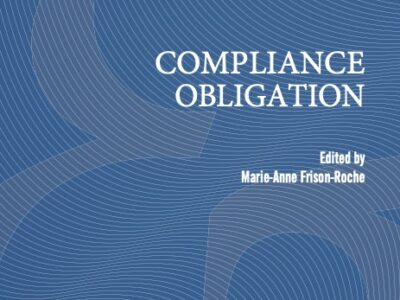
📝Arbitration consideration of Compliance Obligation for a sustainable Arbitration Place, in 🕴️M.-A. Frison-Roche (dir.), 📘Compliance Obligation,

► Full Reference: M.-A. Frison-Roche, Arbitration consideration of Compliance Obligation for a sustainable Arbitration Place", in M.-A. Frison-Roche (ed.), Compliance Obligation, Journal of Regulation & Compliance (JoRC) and Bruylant, "Compliance & Regulation" Serie, 2026, forthcoming. - 📝read the article - 📘read a general presentation of the book, Compliance Obligation, in which this article is published - ► Summary of this article: The first part of this study assesses the evolving relationship between Arbitration Law and Compliance Law, which depends on the very definition of the Compliance Obligation (I). Indeed, these relations have been negative for as long as Compliance has been seen solely in terms of "conformity", i.e. obeying the rules or being punished. These relationships are undergoing a metamorphosis, because the Compliance Obligation refers to a positive and dynamic definition, anchored in the Monumental Goals that companies anchor in the contracts that structure their value chains. Based on this development, the second part of the study aims to establish the techniques of Arbitration and the office of the arbitrator to increase the systemic efficiency of the Compliance Obligation, thereby strengthening the attractiveness of the Place (II). First and foremost, it is a question of culture: the culture of Compliance must permeate the world of Arbitration, and vice versa. To achieve this, it is advisable to take advantage of the fact that in Compliance Law the distinction between Public and Private Law is less significant, while the concern for the long term of contractually forged structural relationships is essential. To encourage such a movement to deploy the Compliance Obligation, promoting the strengthening of a Sustainable Arbitration Place (III), the first tool is the contract. Since contracts structure value chains and enable companies to fulfill their legal Compliance Obligation but also to add their own will to it, stipulations or offers relating to Arbitration should be included in them. In addition, the adoption of non-binding texts can set out a guiding principle to ensure that concern for the Monumental Goals is appropriate in order the Compliance Obligation to be taken into account by Arbitrators. - 🌐Follow Marie-Anne Frison-Roche on LinkedIn 🌐follow Marie-Anne Frison-Roche on Instagram 🌐Subscribe to the Newsletter MAFR Regulation, Compliance, Law 🌐Subscribe to the video newsletter MAFR Overhang 🌐Subscribe to the Newsletter MaFR Law & Art
Articles in The Journal of Regulation & Compliance « JoRC »

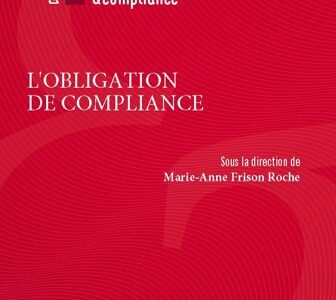
📝L’arbitre, juge, superviseur, accompagnateur ? (The arbitrator, judge, supervisor, coach?),, in 🕴️M.-A. Frison-Roche (dir.), 📕L’obligation de Compliance

► Full Reference: J.-B. Racine, "L’arbitre, juge, superviseur, accompagnateur ?" (The arbitrator, judge, supervisor, coach?), in M.-A. Frison-Roche (dir.), L'Obligation de Compliance, Journal of Regulation & Compliance (JoRC) and Dalloz, coll. "Régulations & Compliance", 2025, pp. 489-502. - 📕read the general presentation of the book, L'Obligation de Compliance, in which this article is published - ► English Summary of this article (done by the Journal of Regulation & Compliance – JoRC) : From the outset, the author sets out what is at stake in these terms:  "Quel rôle peut ou pourrait jouer l’arbitre dans les dispositifs de compliance ? Selon le rôle qu’il est amené à jouer, il peut ou pourrait venir en renfort de l’obligation de compliance. Poser cette question, c’est poser la question des pouvoirs de l’arbitre et de son office. C’est aussi, d’une certaine manière, renvoyer à la notion même d’arbitrage." (What role can or could the arbitrator play in compliance systems? Depending on the role he/she is called upon to play, he/she can or could reinforce the compliance obligation. Asking this question raises the question of the powers of the arbitrator and his/her office. In a way, it also goes back to the very notion of arbitration).  In practice, arbitrators deal with compliance issues in their office as judges. This is illustrated by disputes involving allegations of corruption, where the arbitrators' ruling obviously cannot give effect to a corrupt practice unless they violate themselves international public order. But in this, the arbitrator is only applying a legal standard, the main issue being then the question of evidence, with compliance tools often serving as indicators of the corruption itself. Leaving behind the strict legal source and coming to the standards issued by the ICC about the fight against corruption, we really enter into the "compliance obligation", in the strict sense, when a contract appears. International business practices standards are emerging, not only in the area of probity but also in the protection of human rights, for which arbitrators can now act as guarantors. Arbitrators can do this, in particular, through the emerging litigation relating to vigilance obligation, either directly when vigilance plans are at issue,, even if a legal rule gives a specific competence to a State court (as the French 2017 law does) or if we imagine that a plan itself includes a system for recourse to arbitration, which would imply a change in culture, or if we consider that soft law is in the process of emerging from the practices of international trade laying down a duty of vigilance that arbitrators could take up. In the second part of his contribution, the author takes a second, bolder approach, namely that of an arbitrator who understands Compliance Law in that he/she would be more than a Judge, i.e. he/she would do more than settle a dispute by applying the law. This would be conceivable given the tendency to consider that the arbitrator could modify contracts and if example is taken from the technique of arbitration practised for concentration disputes in merger law. To give arbitration the required regulatory dimension, this third party would have to be able to exercise a supervisory function, which the notion of "dispute" hardly lends itself to, especially as an arbitrator is only set up to be a judge, and if he/she ceases to be one it is difficult for him/her to remain an arbitrator…. However, it is conceivable that in Ex Post the arbitrator could perform the monitoring function often required in Compliance Law. The technique of disputes boards is inspiring in this respect. The two fields, Arbitration and Compliance, are thus destined to move closer together, as the two traditional limits, arbitrability and litigation, are in the process of evolving so that they no longer stand in the way of such rapprochements. The author can therefore conclude: "C’est aux différents acteurs de la compliance de penser à l’arbitrage, et à la souplesse, la plasticité et la liberté qu’il offre, pour éventuellement le configurer spécialement au service des buts de la compliance." (It is up to the various players in Compliance to think about Arbitration, and the flexibility, plasticity and freedom it offers, in order to configure it specifically to serve the goals of Compliance Law). -

Videos

🕴️MaFR interviews 🕴️Eduardo Silva-Romero

🎥Compliance Law: International Arbitration and geopolitics, Interview with 🕴️Eduardo Silva Romero by🕴️Marie-Anne Frison-Roche, 🎬 Series of talks on Compliance Law, in 📺 Open windows on management

► Full reference: E. Silva-Romero, "Droit de la Compliance : Arbitrage International et géopolitique" ("Compliance Law: International Arbitration and Geopolitics"), interview conducted by M.-A. Frison-Roche as part of a series of interviews on Compliance Law, in Fenêtres ouvertes sur la gestion (Open windows on management), broadcast by J.-Ph. Denis, Xerfi Canal, recorded December 12, 2023, recorded April 27, 2024 - 🌐consult the presentation of Eduardo Silva-Romero's interview on LinkedIn - 🎥view the full interview on Xerfi Canal -   ► Starting point: In 2023, Eduardo Silva-Romero wrote a contribution:📝What place is there for compliance in investment arbitration?, in the book 📘Compliance Jurisdictionalisation 🧱read the presentation of this contribution ➡️click HERE - ► Summary of interview: Marie-Anne Frison-Roche. Question: What is the place of Compliance in international investment arbitration and, first of all, what is its specificity?   Edouardo Silva-Romero. Answer: International investment arbitration is based on a treaty, generally signed between two States, which agree to protect the investments that companies make in the host State. The resulting disputes may give rise to this specific type of arbitration.   Compliance has a special place here, because if the investment is tainted by corruption or fails to respect human rights, it will not be protected by the arbitrators, as the host state is no longer bound. - MaFR. Q.: So, through Compliance, states can assert their sovereignty?   E.S-R. A.: Yes, through the social dimension of Compliance, States can assert their social conception and impose it in investment arbitration. - MaFR. Q.: Is the attractiveness of the Paris marketplace enhanced?   E.S-R. A.: The International Court of Arbitration is headquartered in Paris, and it's clear that this presence, combined with Compliance's humanistic approach to investment arbitration, is an essential element of attractiveness. Because of the technicalities involved, it is essential for international arbitrators to master compliance law in order to participate in this new element of attractiveness, as it takes the form of rules of public order, and this is also how the Paris Court of Appeal exercises its control over awards. -

Conferences

🎤 Note taken during the colloquium “Compliance and Arbitration” for doing its conclusion: a backing (Conclusion, in “Compliance and Arbitration))

Full reference: Frison-Roche, M.-A., Compliance et arbitrage. Rapport de synthèse: un adossement (Compliance and Arbitration: a Backing. Conclusion), in Frison-Roche, M.-A. & Racine, J.-B., Compliance et Arbitrage (Compliance and Arbitration), Colloquium co-organised by the Journal of Regulation & Compliance (JoRC) and the Centre de recherches sur la Justice et le Règlement des Conflits (CRJ) of Panthéon-Assas University (Paris II), with the support avec the International Court of Arbitration, Paris, 31st of March 2021 -   Read the program of this colloquium See Marie-Anne Frison-Roche's conclusion in video (in French, with English subtitles) These notes of the conclusion have been written as the colloquium took place.  See the video of the entire colloquium (in French, with English subtitles) - This colloquium is part of the Cycle of colloquium 2021 organized by the Journal of Regulation & Compliance (JoRC) and its partners around the topic Compliance Juridictionnalization.   This manifestation is in French but the interventions will be the basis for a specific chapter of the English collective book directed by Marie-Anne Frison-Roche, Compliance Juridictionnalization, co-published by the JoRC and Bruylant. An equivalent book in French, La Juridictionnalisation de la Compliance, directed by Marie-Anne Frison-Roche, will be co-published by the JoRC and Dalloz.    Read the notes established for the conclusion below ⤵️

Articles in a legal collective publication

📝 Se tenir bien dans l’espace digital (Having a good behavior in the digital space), in 📙Penser le droit de la pensée

Full reference: M.-A. Frison-Roche, Se tenir bien dans l'espace numérique, in Penser le droit de la pensée. Mélanges en l'honneur de Michel Vivant, Lexis Nexis and Dalloz, 2020, pp. 155-168. - 📝Read the article (in French) - 🚧Read the working paper, written in English, on which this article is based, with additional developments, technical references, and hyperlinks   English summary of the article: The digital space is one of the scarce spaces not framed by a specific branch of Law, Freedom also offering opportunity to its actors to not "behave well", that is to express and diffuse broadly and immediately hateful thoughts through Hate speechs, which remained before in private or limited circles. The intimacy of Law and of the legal notion of Person is broken: Digital permits to individuals or organizations to act as demultiplied and anonymous characters, digital depersonalized actors who carry behaviors that are hurtful to other's dignity.  Against that, Compliance Law offers an appropriate solution: internalizing in digital crucial operators the mission to disciplinary and substantially hold the digital space. The digital space has been structured by powerful firms able to maintain order. Because Law must not reduce digital space to be only a neutral market of digital prestations, these crucial operators, like social networks or search engines, must be forced to substantially control behaviors. It could be about an obligation of internet users to act with their face uncover, "real identity" policy controlled by firms, and to respect others' rights, privacy rights, dignity, intellectual property rights. In their Regulatory function, digital crucial firms must be supervised by public authorities.  Thus, Compliance law substantially defined is the protector of the person as "subject of law" in the digital space, by the respect that others must have, this space passing from the status of free space to the one of civilized space, in which everyone is obliged to behave well.  -   Read to go further:  Frison-Roche, M.-A., L'apport du Droit de la Compliance à la gouvernance d'Internet, 2019 Frison-Roche, M.-A. (dir.), Internet, un espace d'interrégulation, 2016 - 🌐follow Marie-Anne Frison-Roche on LinkedIn 🌐follow Marie-Anne Frison-Roche on Instagram 🌐subscribe to the Newsletter MAFR Regulation, Compliance, Law 

Books

🏗️ direction of the collection: 📚Droit et Économie

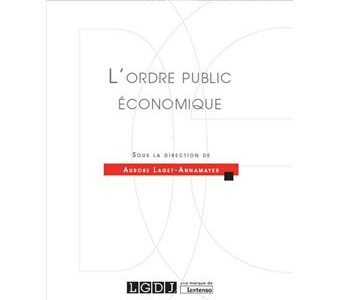
L’ordre public économique (Economic Public Order)

Full reference : Laget-Annamayer, A. (ed.), L'ordre public économique ("Economic Public Order"), coll. "Droit et Économie", Lextenso – LGDJ éditions, 2018, 397p.   This collective book is published in French.    This is the 32nd volume published in this collection.   Often launched as an all-encompassing expression, both by the doctrine and by the judge, public economic order remains a mysterious concept whose substance and contours are difficult to know, simply because it is liable to fluctuate according to its apprehension and depending on the economic and social context. Yet the expression has become widely used, almost incantatory, like a label, and there is therefore undoubtedly a gap between its invocation and its meaning in Law. It is to this discrepancy, and in an attempt to reduce the mystery, that this work is devoted. Not stopping at the only vision of public economic order in internal Public Law, he tries to seek the meanings of it in Comparative Law, in European and International Law, without omitting the historical, privatist or economic vision. It is therefore to this rich overview treated by specialists from different legal fields and beyond that this book invites. It does not aim to put an end to the debate, but on the contrary to arouse it in the context of reflections on the relationship between Law and Economics of which everyone knows the importance. Authors are : Olivier Baillet, Jacques Caillosse, Aurélien Camus, Jacques Chevallier, Dominique Custos, Pierre Delvolvé, Samuel Ferey, Sébastien Hourson, Pascale Idoux, Jean-Philippe Kovar, Aurore Laget-Annamayer, Jérémy Martinez, Francesco Martucci, Jeanne Mesmin d’Estienne, Claire Mongouachon, Eric Naim-Gesbert, Guillaume Richard, Jean-Marc Sorel, Pascal de Vareilles-Sommières.   Read the forth of cover. Read the Table of Contents.   See the whole collection in which this book is published