Labor law

Publication director

🏗️ direction of the collection: 📚Cours Dalloz – Série Droit privé

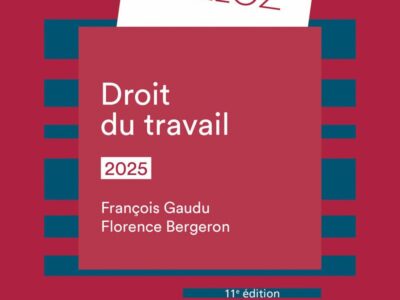
📚Publication of : 🕴️François GAUDU & 🕴️Florence BERGERON, 📕Droit du travail (Labour Law), 11th ed.

► Full Reference : F. Gaudu & F. Bergeron-Canut, Droit du travail 2025 (Labour Law 2025), 11th ed., 2024, Dalloz, “Cours Dalloz-Série Droit privé” Series, 720 p. - ► General presentation of the book (written in French) : This textbook, up to date with the latest texts, is intended for all law students and all practitioners updating their knowledge. In a first part it develops « individual employment relations » (formation of the contractual relationship, performance and termination of the employment contract), devoting its second part to « collective employment relations » (collective labour disputes, employee representation, collective bargaining and collective agreements). - 📚See the entire collection in which the book is published. - 📚Books in the collection directly related to this one : 🕴️F. Kessler, 📕Droit de la protection sociale (Social Protection Law) 🕴️V. Magnier, 📕Droit des sociétés (Company Law) -

Organisation of events

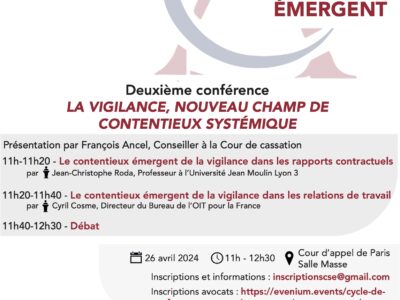
Second conference-debate of the cycle "Contentieux Systémique Émergent" ("Emerging Systemic Litigation")

🧮La vigilance, nouveau champ de contentieux systémique (Vigilance, new field of Systemic Litigation), in cycle of conference-debates “Contentieux Systémique Émergent” (Emerging Systemic Litigation)

► Full Reference: La vigilance, nouveau champ de contentieux systémique (Vigilance, new field of Systemic Ligation), in cycle of conference-debates "Contentieux Systémique Émergent" ("Emerging Systemic Litigation"), organised on the initiative of the Cour d'appel de Paris (Paris Cour of Appeal), with the Cour de cassation (French Court of cassation), the Cour d'appel de Versailles (Versailles Court of Appeal), the École nationale de la magistrature – ENM (French National School for the Judiciary) and the École de formation des barreaux du ressort de la Cour d'appel de Paris – EFB (Paris Bar School), under the scientific direction of Marie-Anne Frison-Roche, 26 April 2024, 11am.-12.30am., Cour d'appel de Paris, Massé courtroom - 🧮see the full programme of the cycle Contentieux Systémique Émergent (Emerging Systemic Litigation) - 🌐see on LinkedIn the report of this event - 🧱read below the report of this event⤵️ - ► Presentation of the conference: The duty of vigilance imposed by the 2017 French law is being contractualised, either by ad hoc contracts or by stipulations that reproduce the legal provisions, adjust them or go beyond them. This adoption by the Contract and Tort Law is valuable but not without risk. The systemic scope of the underlying law on the one hand and of economic structures on the other, the firm or the value chain, will permeate litigation. The example of labour relations is instructive in this respect. - 🧮Programme of this event:  Second conference-debate LA VIGILANCE, NOUVEAU CHAMP DE CONTENTIEUX SYSTÉMIQUE (VIGILANCE, NEW FIELD OF SYSTEMIC LITIGATION)   Paris Court of Appeal, Massé courtroom General presentation of the topic and moderation by 🕴️François Ancel, Judge at the Première Chambre civile de la Cour de cassation (First Civil Chamber of the French Court of cassation) 🕰️11am.-11.20am. 🎤Le contentieux émergent de la Vigilance dans les rapports contractuels (Emerging Vigilance Litigation in Contractual Relationships), by 🕴️Jean-Christophe Roda, Full Professor at Jean-Moulin Lyon 3 University 🕰️11.20am.-11.40am. 🎤Le contentieux émergent de la Vigilance dans les relations de travail (Emerging Vigilance Litigation in Employment Relationships), by 🕴️Cyril Cosme, Director of the French Office of the International Labour Organization (ILO) 🕰️11.40am.-12.30am. Debate - 🔴Registrations and information requests can be sent to: inscriptionscse@gmail.com 🔴For the attorneys, registrations have to be sent to the following address: https://evenium.events/cycle-de-conferences-contentieux-systemique-emergent/  ⚠️The conference-debates are held in person only, in the Cour d’appel de Paris (Paris Court of Appeal). - 🧱read below a detailed presentation of this event⤵️ -

Articles in The Journal of Regulation & Compliance « JoRC »

SEGONDS, Marc🕴️

📝Compliance, proportionnalité et sanction, in 🕴️M.-A. Frison-Roche (ed.), 📕Les Buts Monumentaux de la Compliance

► Référence complète : M. Segonds, "Compliance, proportionnalité et sanction" ("Compliance, proportionality and sanction"), in M.-A. Frison-Roche (ed.), Les Buts Monumentaux de la Compliance, coll. "Régulations & Compliance", Journal of Regulation & Compliance (JoRC) and Dalloz, 2022, pp. 231-244. - 📕read a general presentation of the book, Les Buts Monumentaux de la Compliance, in which this article is published - ► Summary of the article (done by the Journal of Regulation & Compliance): Before devoting the developments of his article to the sole perspective of sanctions imposed under "Anti-corruption Compliance", the author recalls in a more general way that, as is the sanction, Compliance is in essence proportional: Proportionality is inherent to Compliance as it conditions any sanction, including a sanction imposed under Compliance. This link between Proportionality and Compliance has been underlined by the French Anti-Corruption Agency (Agence française anticorruption – AFA) with regard to risk mapping, which must measure risks to arrive at effective and proportional measures. This same spirit of proportionality animates the recommendations of the AFA which are intended to apply according to the size of the company and its concrete organisation. It governs sanctions even more, in that punitive sanctions refer on one hand to Criminal Law, centered on the requirement of proportionality. Punitive sanctions It governs sanctions even more, in that punitive sanctions refer on the other hand to the disciplinary power of the manager who, from other sources of law, must integrate the legal requirement of proportionality when he/she applies external and internal compliance norms. -

Breaking news

📧 Compliance and Ethics. Technologies may be inacceptable “in themselves” and designing their “ethical use” is therefore not acceptable: practical case on the control of workers’ emotions

► An article from March 3, 2021, Smile for the camera: the dark side of China's emotion-recognition tech, then an article from June 16, 2021, "Every smile you fake" – an AI emotion – recognition system can assess how "happy" China's workers are in the office describes how a new technology of emotional recognition is able, through what will soon be out of fashion to call "facial recognition", to distinguish a smile that reflects a mind state of real satisfaction from a smile which does not correspond to it. This allows the employer to measure the suitability of the human being for his or her work. It is promised that it will be used in an ethical way, to improve well-being at work. But isn't it in itself that this technology is incompatible with any compensation through ethical support? The technology developed by a Chinese technology company and acquired by other Chinese companies with many employees, allows to have information on the actual state of mind of the person through and beyond his or her facial expressions and bodily behavior. Previously, the technology of emotional recognition had been developed to ensure security, by fighting against people with hostile plans, public authorities using it for example in the controls at airports to detect the criminal plans which some passengers could have. It is now affirmed that it is not about fighting against some evil people ("dangerousness") to protect the group before the act is committed ("social defense”) but that it is about helping all workers. Indeed, the use that will be made of it will be ethical, because first the people who work for these Chinese companies with global activity, like Huawaï, do it freely and have accepted the operation of these artificial intelligence tools (which is not the case with people who travel, control being then a kind of necessary evil that they do not have to accept, which is imposed on them for the protection of the group), but even and above all, the purpose is itself ethical: if it turns out that the person does not feel well at work, that they are not happy there, even before they are perhaps aware, the company can assist. Let’s take this practical case from the perspective of Law and let’s imagine that it is contested before a judge applying the principles of Western Law. Would this be acceptable? No, and for three reasons. 1. An "ethical use" cannot justify an unethical process in itself 2. The first freedoms are negative 3. "Consent" should not be the only principle governing the technological and digital space   I. AN "ETHICAL USE" CAN NEVER LEGITIMATE AN UNETHICAL PROCESS IN ITSELF These unethical processes in themselves cannot be made "acceptable" by an "ethical use" which will be made of them. This principle was especially reminded by Sylviane Agacinski in bioethics: if one cannot dispose of another through a disposition of his or her body which makes his or her very person available (see not. Agacinski, S., ➡️📗Le tiers-corps. Réflexions sur le don d’organes, 2018). Except to make the person reduced to the thing that his or her body is, which is not ethically admissible in itself, that is excluded, and Law is there in order to this is not possible. This is even why the legal notion of "person", which is not a notion that goes without saying, which is a notion built by Western thought, acts as a bulwark so that human beings cannot be fully available to others, for example by placing their bodies on the market (see Frison-Roche, M.-A., ➡️📝To protect human beings, the ethical imperative of the legal notion of person, 2018). This is why, for example, as Sylviane Agacinski emphasizes, there is no ethical slavery (a slave who cannot be beaten, who must be well fed, etc.). That the human being agrees ("and what about if it pleases me to be beaten?") does not change anything.   II. THE FIRST FREEDOM IS THE ONE TO SAY NO, FOR EXAMPLE BY REFUSING TO REVEAL YOUR EMOTIONS: FOR EXAMPLE HIDING IF YOU ARE HAPPY OR NOT TO WORK The first freedom is not positive (being free to say Yes); it is negative (being free to say No). For example, the freedom of marriage is having the freedom not to marry before having the freedom to marry: if one does not have the freedom not to marry, then the freedom to marry loses any value. Likewise, the freedom to contract implies the freedom not to contract, etc. Thus, freedom in the company can take the form of freedom of speech, which allows people, according to procedures established by Law, to express their emotions, for example their anger or their disapproval, through the strike. But this freedom of speech, which is a positive freedom, has no value unless the worker has the fundamental freedom not to express his or her emotions. For example if he or she is not happy with his or her job, because he or she does not appreciate what he or she does, or he or she does not like the place where he or she works, or he or she does not like people with whom he or she works, his or her freedom of speech demands that he or she have the right not to express it. If the employer has a tool that allows him or her to obtain information about what the worker likes and dislikes, then the employee loses this first freedom. In the Western legal order, we must be able to consider that it is at the constitutional level that the infringement is carried out through Law of Persons (on the intimacy between the Law of Persons and the Constitutional Law, see Marais , A., ➡️📕Le Droit des personnes, 2021).   III. CONSENT SHOULD NOT BE THE ONLY PRINCIPLE GOVERNING THE TECHNOLOGICAL AND DIGITAL SPACE   We could consider that the case of the company is different from the case of the controls operated by the State for the monitoring of airports, because in the first case observed people are consenting. "Consent" is today the central notion, often presented as the future of what everyone wants: the "regulation" of technology, especially when it takes the form of algorithms ("artificial intelligence"), especially in digital space. "Consent" would allow "ethical use" and could establish the whole (on these issues, see Frison-Roche, M.-A., ➡️📝Having a good behavior in the digital space, 2019). "Consent" is a notion from which Law is today moving away in Law of Persons, in particular as regards the "consent" given by adolescents on the availability of their body, but not yet on digital. No doubt because in Contract Law, "consent" is almost synonymous with "free will", whereas they must be distinguished (see Frison-Roche, M.-A., ➡️📝Remarques sur la distinction entre la volonté et le consentement en Droit des contrats, 1995). But we see through this case, which precisely takes place in China, that "consent" is in Law as elsewhere a sign of submission. It is only in a probative way that it can constitute proof of a free will; this proof must not turn into an irrebuttable presumption. The Data Regulatory Authorities (for example in France the CNIL) seek to reconstitute this probative link between "consent" and "freedom to say No" so that technology does not allow by "mechanical consents", cut off from any connection with the principle of freedom which protects human beings, from dispossessing themselves (see Frison-Roche, M.-A., Yes to the principle of will, No to pure consents, 2018). The more the notion of consent will be peripheral, the more human beings will be able to be active and protected. -

Articles in a legal collective publication

📝The impossible legal unicity of the category of “whistleblowers” (“L’impossible unicité juridique de la catégorie des “lanceurs d’alertes” “)

Full reference: Frison-Roche, M.-A., L'impossible unicité juridique de la catégorie des "lanceurs d'alertes" ("The impossible legal unicity of the category of "whistleblowers""), in Chacornac, J. (dir.), Lanceurs d'alertes, regards comparatistes, ("Whistleblowers, comparative perspectives"), Publications of the Centre français de droit comparé ("French Comparative Law Center"), May 2020, Volume 21, pp. 13-31.    Read the article (in French).    Read the general presentation of the collective book in which this article is published Read the bilingual working paper which had served of basis for this article.  Read the presentation of the conference "Les lanceurs d'alertes: glose" (Whistleblowers: glose") and especially the slides elabored for the colloquium organized by the Centre français de droit comparé ("French Comparative Law Center") on 23th of November 2018 under the direction of Jérôme Chacornac - Introduction of the article "Whistleblowers". This is a new expression. Which is a great success. Barely heard once, we hear it everywhere … A topic not of course or knowledge test, but rather a topic of daily conversation. Because it is spoken to us every day, in more or less gracious terms. For example President Donald Trump on October 1, 2019 declared to the press "want to question" the whistleblower who would have illegally denounced him and would not, according to him, have the right to conceal his identity, proof in this according to him of the lying character of his assertions against him, while his lawyer indicates on October 6, 2019 that he is not speaking on behalf of a single whistleblower thus taken to task but of a plurality of people who gave information against the President of the United States. Even the most imaginative screenwriters would not have written such brutal and rapid twists and turns. Spectators, we are waiting for the next episode, secretly hoping for the escalation. And precisely if we go to the cinema, it is still a whistleblower whose dedication and success, we are told about, even the drama, for the benefit of global society, and in particular democracy, since the secrets are fought for the benefit of the truth. The Secret Man designates Mark Felt as the first whistleblower. Returning to what we often present as being a more "serious" media1On the more general fact that cinema is undoubtedly the medium which most seriously restores the state of the Law, c. Frison-Roche, M.-A., Au coeur du Droit, du cinéma et de la famille : la vie, 2016., we listen to France-Culture and here is another story told by a historian who worked as an archivist on events that political power would have liked to keep hidden by possibly destroying their traces but which its trade led to preserve: here it is expressly presented to the studious listeners like a "whistleblower" …. While the same radio tries to find the one who could well be, as in a kind of contest the "first whistleblower"2L'histoire du premier lanceur d'alerte, France Culture, septembre 2019. ? …. This rewriting of History can be defended because ultimately what did other Voltaire do for Calas, or Zola for Dreyfus? It is also a subject of legislative discussion since in the United States the Dodd-Frank law of 2010 inserted in the law of 1934 which established the Securities & Exchanges Commission a complete device of remuneration and remuneration of the whistleblowers, whereas after having developed flexible but guiding lines in this regard in 20123European Commission, Guidelines on Whistleblowing, 6 of December 2012, SEC(2012) 679 final, updated on 23 of April 2018. , the European Commission published on November 20, 2018 the text of what will become a Directive intended to give a unified European status to the character, in the system gradually developed to protect the one who was presented in 2018 as that "cannot be punished for having done what is right". In Europe, the Directive first approved by a Resolution of the European Parliament on April 16, 2019 on the protection of persons denouncing breaches of Union Law and then adopted on October 7, 2019 (Directive of the European Parliament and of the Council of European Union on the Protection of Persons who Report Violations of European Union Law, different title, it should be noted, will have to be transposed into the laws of the Member States within the next two years. , since only "violations of Union Law" are targeted, but the character of the "whistleblower" is more generally targeted: he is "whole"4However, precisely the so common use of plurality ("whistleblowers") raises doubts about the uniqueness of the character. On this question, see. all the first part of the developments of this study, which leads to the conclusion rather than beyond the multitude of particular cases, there are rather two kinds of whistleblowers. V. infra I.. In short, the whistleblower is a star5The director of the film La fille de Brest says that she considers the whistleblower at the origin of the case of the Pick as a "movie character".. A sort of historical figure, covered in blows and glory, going from Voltaire to Snowden, both of whom find themselves embodied on the screens6Thus, the adventures of Snowden were brought to the screen by Oliver Stone in 2016, Snowden. On the question of knowing whether this film "faithfully reproduces" or not the case, Schetizer, P., Le film Snowden est-il à la hauteur de la réalité?, 2017. This article is favorable to the whistleblower, and to the film which tells us with emotion his case, in particular because (sic), it is easier than to read the Washington Post. …., Consecrated by law, which associates with it a legal regime of protection to such an extent that, like a Nessus tunic, it is this legal regime which will define the character and not the reverse. When we read the law of December 9, 2016 relating to transparency in the fight against corruption and the modernization of economic life, known as "Sapin 2", we notice that the Legislator makes much of this character, since 'he dedicates its chapter II to him7Underlined by us.: "From the protection of whistleblowers", and that it is by his very protection that he formally opens the door of Right to him. But why a plural? Admittedly when we read the recitals of the Community Directive of October 7, 2019 on the protection of whistleblowers8About this directive, v. the developments infra, it is only a list of all the subjects on which it is a good idea to protect them, which therefore prompts us to see in this plural only the index of this non-exhaustive list of subjects which it is good to tell us, a sign of the lack of definition of who should alert us. Reading the French law known as "Sapin 2" makes it less severe but more perplexing. Indeed, this plurality referred to by the title of the chapter devoted to "whistleblowers", there is no longer any question in the rest of the law, in the very definition which follows, article 6 which opens this chapter devoted to "whistleblowers" offering the reader immediately a singular since it begins as follows: "A9Underlined by us. whistleblower is a person …". No mention of diversity. The art of legislative writing would however have required that the qualifying article not only be singular but that it should not yet be undefined. Stendhal if he had still deigned to have the law for bedside book would have wanted to find at the beginning of chapter a sentence like: "The10Underlined by us. whistleblower is a person …". Thus seem to contradict themselves within the law "Sapin 2 the very title which presents the character, in that it uses a defined plural (the) while the defining article which presents it is in the undefined singular (one). … Here is a first reason not to advance any more but in a very careful way, in this "step by step" that constitutes a reading word for word: a gloss. This consists of taking the expression itself literally. The second reason for this technical choice is that the gloss is well suited to the introduction of a collective work, thus allowing more targeted developments to take place in other contributions, on the techniques, the difficulties and the limits of this protection, or on its history, or the reasons for the arrival in French law of these whistleblowers and the way they develop, or not, elsewhere. I am therefore going to content myself with taking this already legal expression to the letter: The (I) whistle (III). blowers (II).       
Books

ADAM, Patrice👤, LE FRIANT, Martine👤 et TARASEWICZ, Yasmine👤 (dir.)

📕 Intelligence artificielle, gestion algorithmique du personnel et droit du travail: les travaux de l’AFDT

Full reference: Adam, P., Le Friant, M. et Tarasewicz, Y. (ed.), Intelligence artificielle, gestion algorithmique du personnel et droit du travail (written in French), serie "Les travaux de l'AFDT", Coll. "Thèmes et Commentaires", Dalloz, 2020, 241p. Read the fourth of cover

Working papers

🚧 THE IMPOSSIBLE UNICITY OF THE LEGAL CATEGORY OF WHISTLEBLOWERS

This working paper served as a basis for a conference done in French for the Centre de droit comparé (Center for Comparative Law) in Paris on 23 November 2018. Updated, it has served as a basis for an article published in French in a book of the Société de Législation comparé (Society of Comparative Legislation).   -   "The whistleblowers". This is a new expression. Which wins a full success. Barely heard once, we hear it everywhere … A theme not only of academic teaching, but rather a topic of daily conversation. Because it is every day that we speak about it, in terms more or less graceful. For example President Donald Trump on October 1, 2019 told the press he "wants to interrogate" the whistleblower who would have unlawfully denounced him and would not have, according to him, the right to conceal his own identity, evidence in this according Donald Trump of the false character of his assertions against him, while his lawyer indicates on October 6, 2019 that he does not speak on behalf of a single whistleblower thus taken apart but of a plurality people who gave information against the President of the United States. Even the most imaginative scriptwriters would not have written twists as abruptly or so fast. Spectators, we wait for the next episode, secretly hoping for climbs and slashs. Precisely if we go to the cinema, it is still a whistleblower whose dedication and success, or even drama, we are told, for the benefit of the global society, and especially of Democracy, since the secrets are fought for the benefit of the truth. Thus, the movie The Secret Man designates Mark Felt as the first whistleblower. Returning to what is often presented as a more "serious" media, for example in France the radio "France Culture" we can learn the story of a historian who worked as an archivist on events that the political power would have wanted to keep hidden by possibly destroying their traces but that his profession led to preserve1On the more general fact that cinema is undoubtedly the medium which most seriously restores the state of the Law, c. Frison-Roche, M.-A., Au coeur du Droit, du cinéma et de la famille : la vie, 2016.: here it is expressly presented to the studious listeners as a "whistleblower" … While the same radio is trying to find the one that could be, as in a kind of contest, the "first whistleblowers"2L'histoire du premier lanceur d'alerte, France Culture, septembre 2019. ?. This rewriting of History can be made because finally Voltaire for Calas, or Zola for Dreyfus did they anything else?  It is also a topic of legislative debate since in the United States the Dodd-Frank Act of 2010 inserted in the 1934 law that established the Securities & Exchanges Commission (SEC) a complete system for retribution and remuneration of whistleblowers, while after elaborating guidelines about about in 20123European Commission, Guidelines on Whistleblowing, 6 of December 2012, SEC(2012) 679 final, updated on 23 of April 2018. , the European Commission has published the text on November 20, 2018 in order to give the character a unified European status, in the device gradually developed to protect the one that was presented in 2018 as who  like that : ""The new whistleblowers' protection rules will be a game changer. In the globalised world where the temptation to maximise profit sometimes at the expense of the law is real we need to support people who are ready to take the risk to uncover serious violations of EU law. We owe it to the honest people of Europe.". Step for the Directive of October 7, 2019.  In Europe, the Directive first approved by a Resolution of the European Parliament on 16 April 2019 on protection of persons reporting breaches of Union law and then adopted on 7 October 2019 (Directive 2019/78 (EU) of the European Parliament European Union and the Council of the European Union on the Protection of Persons Reporting Breaches of Union law, will have to be transposed in the next two years to the legal systems of the Member States. is not general, since only "violations of European Union Law" are targeted but the character of the "whistleblower" is more generally referred to: it is "whole"4However, precisely the so common use of plurality ("whistleblowers") raises doubts about the uniqueness of the character. On this question, see. all the first part of the developments of this study, which leads to the conclusion rather than beyond the multitude of particular cases, there are rather two kinds of whistleblowers. V. infra I.. In short, the whistleblower is a star 5The director of the film La fille de Brest says that she considers the whistleblower at the origin of the case of the Pick as a "movie character".. A kind of historical character, covered with blows and glory, going from Voltaire to Snowden, one as the other being incarnated on the screens6Thus, the adventures of Snowden were brought to the screen by Oliver Stone in 2016, Snowden. On the question of knowing whether this film "faithfully reproduces" or not the case, Schetizer, P., Le film Snowden est-il à la hauteur de la réalité?, 2017. This article is favorable to the whistleblower, and to the film which tells us with emotion his case, in particular because (sic), it is easier than to read the Washington Post. …. Recognized by national legislations, which associate to him a legal regime of protection to such a point that, like a tunic of Nessus, it is this legal regime which will define his character and not the opposite. When we read the French law of December 9, 2016 relative à la transparence à la lutte contre la corruption et à la modernisation de la vie économique (on transparency in the fight against corruption and the modernization of economic life), usually known as "Sapin 2 Act", we note that the lawmaker makes much of this character, because he devotes to him the chapter II: "De la protection des7Underlined by us. lanceurs d'alerte" ("The protection of7Underlined by us. whistle-blowers") and that it is by his very protection that the French Parliament formally opens the door of Law to him and throws it openly. But why a plural? Certainly when we read the recitals of the European Directive of 7 October 2019 on the protection of whistleblowers8About this directive, v. the developments infra, this is only an enumeration of all the subjects about which it is a good idea to to protect them, which encourages us to see in this plural only the index of this non-exhaustive list of topics about which it is good that we are alerted, sign of the lack of definition … Reading the French law known as "Sapin 2" makes us less severe but more perplex. Indeed, from this plurality covered by the title of the chapter devoted to Les lanceurs d'alerte ("The whistleblowers"), there is no longer any question in the rest of the law, in the very definition that follows, Article 6 which opens this chapter devoted the "whistleblowers" offering the player immediately a singular since it begins as follows:  "Un9Underlined by us. lanceur d'alerte est une personne …" (A! footnote-1684 whistleblower is a person …"). No more mention of diversity. The art of legislative writing would have even required that the qualifying article should not be singular but not yet indefinite.  Thus seem to contradict in this law "Sapin 2" itself the very title which presents the character, in that it uses a definite plural ("the whistleblowers") while the article of definition which presents the topic does it by using the singular indefinite : "a whistleblower….". This is a first reason to move forward only in a very cautious way, in this "step by step" that constitutes a word-by-word reading: a gloss. This method consists in taking literally the expression itself. The second reason for this technical choice is that the gloss is well suited to an introduction of a collective work, allowing more specific developments to take place in other contributions, for example on the techniques, the difficulties and the limits of this protection, or the history of it, or the reasons for the arrival in French law of these American or Brithish whistleblowers and the way they develop, or not, in other legal systems or other countries. I will therefore content myself with taking again literally this already legal expression: The (I) launchers (II) of alert (III). See below developments.  

Books

Réformes et transformations

Analyses

Hayao Miyazaki explains that the drawings of video games made by machines are “insults to life”

Through the Open Culture website, it is possible to listen to Hayao Miyazaki who, in March 2017, claimed that video games whose drawings are made on Artificial Intelligence basis are "insults to life". Read below the history, the words that the Master has held, his conception of what is creation and "truly human" work, which is echoed by the definitions given by Alain Supiot, who also reflected on what robots do. This brings us back to the very notion of "creation" and creative work.   - Read below

Books

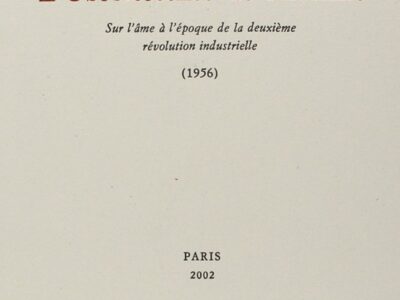
L’Obsolescence de l’homme. Sur l’âme à l’époque de la deuxième révolution industrielle

General reference :  Anders, G., L'Obsolescence de l'homme. Sur l'âme à l'époque de la deuxième révolution industrielle, Traduction de l'allemand par Christophe David 1956, éd. l'Encyclopédie des Nuisances,  coll." Editions IVREA", Paris, 2002, 360 p. Read the table of contents. Read the back cover.