Judge

Articles in a legal collective publication

📝Si l’heureux stratagème probatoire du Roi Salomon n’avait pas fonctionné (If King Solomon’s probationary strategy hadn’t worked), in📗Liber Amicorum, Mélanges en l’honneur de Pierre Crocq,

► Full reference: M.-A. Frison-Roche, “Si l'heureux stratagème probatoire du Roi Salomon n'avait pas fonctionné (If King Solomon's probationary strategy hadn't worked)”, in Collective Book dedicated to Professor Pierre Crocq, Liber Amicorum, Lextenso – LGDJ, 2026, pp. 713-723. - 📝Read the article (in French) - 🚧Read the bilingual working document on which this article is based - ► Introduction to the article: As renowned and significant in biblical scholarship as it is in legal culture and imagination, Solomon’s Judgement is a procedural measure, an evidential stratagem (I). But even a King cannot be certain of the success of an investigative measure that his authority allows him to impose; nothing guarantees the success of the evidential stratagem he has devised, that is to say, the discovery of the truth. The investigative measure he devised presupposes a maternal love that leads the woman – who might prefer to continue disputing – to choose instead not to keep the child and to leave him in a state of death, a mere inert prey to the claim of appropriation made by the plaintiff. It is the woman’s virtue that enables the Judge’s wisdom. The evidence stratagem might not have worked (II). This is scarcely considered, as King Solomon is always portrayed as wise and the mother as preferring the child to herself. But if we step outside the Book of Kings, where virtue reigns – that of the mother as well as that of the judge – to confront the passion of the woman who smothered her newborn in the night and now seeks the force of justice to seize the second, one might reflect, whilst wandering through the lobby of a courthouse, that it is all too often the case that adults put themselves before children. What if the second mother had put herself before the child? What would have happened if the judge’s order, already being carried out, had not been halted by the virtue of the defendant? (III). What would the King then have done to exercise his office as Judge justly, since the truth would not have been accessible to him? (IV). If one changes an element of the narrative, because justice is human, because passions drive the parties, because children are often the silent victims on both sides, is justice still possible? - 🌐Follow Marie-Anne Frison-Roche on LinkedIn 🌐follow Marie-Anne Frison-Roche on Instagram 🌐subscribe to the Newsletter MAFR Regulation, Compliance, Law 🌐Subscribe to the Video Newsletter MAFR Surplomb 🌐Subscribe to the MaFR Law & Art Newsletter

Articles

article published in the MAFR Law, Compliance, Regulation Newsletter

📝”juge modeste” ou “check and balance” : alternative aux Etats-Unis, alternative en France (“modest judge” or “check and balance”: alternative in the United States, alternative in France)

► Full Reference: M.-A. Frison-Roche, ""Juge modeste" ou "check and balance" :alternative aux Etats-Unis, alternative en France" ("modest judge" or "check and balance": alternative in the United States, alternative in France), Newsletter MAFR Law, Compliance, Regulation, 6 October 2025.. - 📧Read by free subscription other news from the MAFR Newsletter – Law, Compliance, Regulation - ► Summary of this article: Recent, if not forthcoming, decisions by the US Supreme Court show that the American political system that was based on the unwritten principle of Check and Balance, requiring the Justices to constitute one Power facing the other two could be replaced by a political system based on the principle of a "modest Justice" enforcing decisions made by the Federal Executive. They would then have a new Constitution. In Western Europe and especially in France, it is possible that the letter of the Constitution, which states that judges are not an autonomous power vis-à-vis the other two powers, will be abandoned and that, in the name of an unwritten principle, the Rule of Law, its transformation into an autonomous Power facing the executive in its own right will be adopted. The path would be exactly the opposite. We would then have changed the Constitution. That's conceivable, and there are many arguments in favour of it. We have to say so. And draw all the consequences. - 📧read below the article published the 6 October dans the Newsletter MAFR – Law, Compliance, Regulation ⤵️ - 🌐follow Marie-Anne Frison-Roche on LinkedIn 🌐follow Marie-Anne Frison-Roche on Instagram 🌐subscribe to the Newsletter MAFR Regulation, Compliance, Law 🌐subscribe to the Video Newsletter MAFR Surplomb 🌐subscribe to the Newsletter MaFR Droit & Art

Articles in The Journal of Regulation & Compliance « JoRC »

📝Le rapport entre le Droit de la responsabilité civile et l’Obligation de Compliance (The Relation between Tort Law and Compliance Obligation), in 🕴️M.-A. Frison-Roche (dir.), 📕L’obligation de Compliance

► Full Reference: J.-S. Borghetti, "Le rapport entre le Droit de la responsabilité civile et l'Obligation de Compliance" (The Relation between Tort Law and Compliance Obligation), in M.-A. Frison-Roche (dir.), L'obligation de Compliance, Journal of Regulation & Compliance (JoRC) and Dalloz, coll. "Régulations & Compliance", 2025, pp. 589-598. - 📕read the general presentation of the book, L'obligation de Compliance, in which this article is published - ► English Summary of this Article (done by the Journal of Regulation & Compliance – JoRC) : The Author points out that in order to establish civil liability, it is first necessary to find fault, i.e. a deviation from an obligation, which will trigger a secondary obligation, that of reparation. But it can also be argued that it is from liability that this primary obligation arises, civil liability then revealing an obligation which existed only implicitly. That establishes a two-way relationship between liability and obligation. The Compliance Obligation illustrates this, in particular through the Obligation of Vigilance conceived by the French law of 2017. The author therefore devotes the first part of his contribution to civil liability as a result of an Compliance Obligation, especially the Obligation of Vigilance. issued of the French law of 2017. After discussing whether the constraints generated by compliance should be classified as 'obligations', since there is no creditor, which therefore opens the way to liability in tort, he examines the conditions for incurring such liability, which are difficult, particularly with regard to the burden of proof and the demonstration of the causal link. The requirement concerning the latter may evolve in French law towards the admission of proportional causality, as is now accepted in certain cases in German case law. In the second part of his contribution, the author deals with the hypothesis of civil liability as an indicator of a Compliance Obligation. He points out that the claims made, particularly in the cases of TotalOuganda  (France) and Milieudefensie v. Shell (Netherlands) seek to obtain from the judge a such "revelation". The author considers that it is not possible to draw from the  French 2017 law which refers to article 1240 of the French Civil Code on the liability because this article is referred to only in order to organise the consequences of a breach of article L.225-102-4 of the French Commercial Code organising the Obligation of Vigilance (article 1240 being therefore under the secondary obligation described above) and not to feed what this article L.225-102-4 requires under the primary obligation (defined above).  -

Articles in The Journal of Regulation & Compliance « JoRC »

📝L’arbitre, juge, superviseur, accompagnateur ? (The arbitrator, judge, supervisor, coach?),, in 🕴️M.-A. Frison-Roche (dir.), 📕L’obligation de Compliance

► Full Reference: J.-B. Racine, "L’arbitre, juge, superviseur, accompagnateur ?" (The arbitrator, judge, supervisor, coach?), in M.-A. Frison-Roche (dir.), L'Obligation de Compliance, Journal of Regulation & Compliance (JoRC) and Dalloz, coll. "Régulations & Compliance", 2025, pp. 489-502. - 📕read the general presentation of the book, L'Obligation de Compliance, in which this article is published - ► English Summary of this article (done by the Journal of Regulation & Compliance – JoRC) : From the outset, the author sets out what is at stake in these terms:  "Quel rôle peut ou pourrait jouer l’arbitre dans les dispositifs de compliance ? Selon le rôle qu’il est amené à jouer, il peut ou pourrait venir en renfort de l’obligation de compliance. Poser cette question, c’est poser la question des pouvoirs de l’arbitre et de son office. C’est aussi, d’une certaine manière, renvoyer à la notion même d’arbitrage." (What role can or could the arbitrator play in compliance systems? Depending on the role he/she is called upon to play, he/she can or could reinforce the compliance obligation. Asking this question raises the question of the powers of the arbitrator and his/her office. In a way, it also goes back to the very notion of arbitration).  In practice, arbitrators deal with compliance issues in their office as judges. This is illustrated by disputes involving allegations of corruption, where the arbitrators' ruling obviously cannot give effect to a corrupt practice unless they violate themselves international public order. But in this, the arbitrator is only applying a legal standard, the main issue being then the question of evidence, with compliance tools often serving as indicators of the corruption itself. Leaving behind the strict legal source and coming to the standards issued by the ICC about the fight against corruption, we really enter into the "compliance obligation", in the strict sense, when a contract appears. International business practices standards are emerging, not only in the area of probity but also in the protection of human rights, for which arbitrators can now act as guarantors. Arbitrators can do this, in particular, through the emerging litigation relating to vigilance obligation, either directly when vigilance plans are at issue,, even if a legal rule gives a specific competence to a State court (as the French 2017 law does) or if we imagine that a plan itself includes a system for recourse to arbitration, which would imply a change in culture, or if we consider that soft law is in the process of emerging from the practices of international trade laying down a duty of vigilance that arbitrators could take up. In the second part of his contribution, the author takes a second, bolder approach, namely that of an arbitrator who understands Compliance Law in that he/she would be more than a Judge, i.e. he/she would do more than settle a dispute by applying the law. This would be conceivable given the tendency to consider that the arbitrator could modify contracts and if example is taken from the technique of arbitration practised for concentration disputes in merger law. To give arbitration the required regulatory dimension, this third party would have to be able to exercise a supervisory function, which the notion of "dispute" hardly lends itself to, especially as an arbitrator is only set up to be a judge, and if he/she ceases to be one it is difficult for him/her to remain an arbitrator…. However, it is conceivable that in Ex Post the arbitrator could perform the monitoring function often required in Compliance Law. The technique of disputes boards is inspiring in this respect. The two fields, Arbitration and Compliance, are thus destined to move closer together, as the two traditional limits, arbitrability and litigation, are in the process of evolving so that they no longer stand in the way of such rapprochements. The author can therefore conclude: "C’est aux différents acteurs de la compliance de penser à l’arbitrage, et à la souplesse, la plasticité et la liberté qu’il offre, pour éventuellement le configurer spécialement au service des buts de la compliance." (It is up to the various players in Compliance to think about Arbitration, and the flexibility, plasticity and freedom it offers, in order to configure it specifically to serve the goals of Compliance Law). -

Articles in The Journal of Regulation & Compliance « JoRC »

📝Les enjeux présents et à venir de l’articulation des principes de procédure civile et commerciale avec la logique de compliance (Current and future challenges for articulating civil and commercial procedural principles with Compliance Logic), in 🕴️M.-A. Frison-Roche (dir.), 📕L’Obligation de Compliance

► Full reference : Th. Goujon-Bethan, "Les enjeux présents à venir de l’articulation des principes de procédure civile et commerciale avec la logique de compliance (Current and future challenges for articulating civil and commercial procedural principles with Compliance Logic)", in  M.-A. Frison-Roche (ed.), L'Obligation de Compliance, Journal of Regulation & Compliance (JoRC) and Dalloz, coll. "Régulations & Compliance", 2025, pp. 693-719. - 📕Read a general presentation of the book, L'Obligation de Compliance, in which this article is published. - ► Summary of this article (by the Journal of Regulation & Compliance – JoRC): The author shows that the French Code of Civil Procedure, because it is exceptionally well designed and managed, can respond to the scale of transformation brought about by Compliance Law. Compliance Law is normatively anchored in its Monumental Goals: these are brought as such before the judge in 'Systemic Cases'. However, the French Code of Civil Procedure distinguishes between litigation and conflict, as demonstrated by the work of the academic authors of the Code, who were very famous legal scholars. Indeed, in a "Systemic Case" such as Compliance Law, which necessarily takes precedence (climate, protection of internet users, effective equality of human beings, sustainability of banking systems, etc.), it is the parties who are in dispute, while the conflict encompasses the systems themselves and other entities. The procedure must incorporate not only the dispute but also the conflict. This means, in particular, that we must deal not only with the dispute, but also with the conflict, which does not necessarily end with the dispute and does not find the same solutions as those sought by the dispute. It is particularly in this latter perspective, essentially in a "Systemic Compliance Case" procedure, that the techniques of mediation, amicus curiae, with a judge who takes an ex ante position, etc., are required. They are available through legal dispositions of this French Code of Civil Procedure: judges who understand what "Systemic Compliance Cases" are need only apply them. - 🦉this  article is available in full text for people who follow the professor Marie-Anne Frison-Roche's teaching  -

Articles in The Journal of Regulation & Compliance « JoRC »

Article in the Journal of Regulation & Compliance (JoRC)

📝Le juge adéquat pour l’effectivité de l’Obligation de Compliance (The Adequate Judge for the Effectiveness of the Compliance Obligation), in 🕴️M.-A. Frison-Roche (ed.), 📕L’Obligation de Compliance

► Full Reference: M.-A. Frison-Roche, "Le juge adéquat pour l'effectivité de l'Obligation de Compliance" ("The Adequate Judge for the Effectiveness of the Compliance Obligation"), in M.-A. Frison-Roche (ed.), L'Obligation de Compliance, Journal of Regulation & Compliance (JoRC) and Dalloz, coll. "Régulations & Compliance" 2025, pp. 741-775. - 📝read the article (in French) - 🚧read the bilingual Working Paper on the basis this contribution has been built, with  more developments, technical references and hyperlinks.  - 📕read the general presentation of the book, L'Obligation de Compliance, in which this article is published 📚see the general presentation of the series "Régulations & Compliance" in which this book is published - ► English summary of this contribution : The Judge is a character who seems weak in a Compliance Law that seems so powerful in a world where Technology is developing even a more impressive power. But present and future cases show, on the contrary, that he or she has a central role to play and that his/her role must be to use his/her own strength to remain what he/she is: the guardian of the Rule of Law, which is not so obvious because many Compliance tools, which are technological in nature, are in a way 'insensitive' to what we hold dear, the protection of human beings, which is based on the diligence of companies (I).  The second role that we can expect of the Judge is that not only does he/she help to ensure the permanence of this Rule of Law, which relies to a large extent on him:Her in the face of a future world that is unknown to us, mainly in its digital and climatic dimensions, perspectives that Compliance Law seeks to grasp, by renewing Regulation Law, by acting in relation to companies whose role is active, which leads the Judge to control them and to be aware of the claims that can be made against them, without taking the place of their management powers (II). This presupposes a new method (III), and all the judges, however diverse, will converge in an active dialogue between the judges, which will enable, firstly, the traditional role of the judge, linked to the Rule of Law, to endure in a rapidly changing world and, secondly, each judge to take on this new role implied by Compliance Law (IV). The perfect triangle will then be established, the strength and simplicity of which allows the use of the singular and the retention of capital letters for each of these three terms: Regulation Compliance Judge. - 🌐follow Marie-Anne Frison-Roche on LinkedIn 🌐follow Marie-Anne Frison-Roche on Instagram 🌐subscribe to the Newsletter MAFR Regulation, Compliance, Law 🌐subscribe to the Video Newsletter MAFR Surplomb

Articles in The Journal of Regulation & Compliance « JoRC »

BARBIÈRI, Jean-Baptiste🕴️

📝Les juges du droit des entreprises en difficulté et les obligations de compliance (Judges of Insolvency Law and Compliance Obligations), in 🕴️M.-A. Frison-Roche (ed.), 📕L’Obligation de Compliance

► Full Reference: , J.-B. Barbièri, "Les juges du droit des entreprises en difficulté et les obligations de compliance (Judges of Insolvency Law and Compliance Obligations), in M.-A. Frison-Roche (ed.), L'Obligation de Compliance, Journal of Regulation & Compliance (JoRC) and Éditions Lefebvre – Dalloz, coll. "Régulations & Compliance", 2025, pp. 313-323. - 📕read a general presentation of the book, L'Obligation de Compliance, in which this contribution is published  - ► English summary of this contribution (done by the Journal of Regulation & Compliance – JoRC): Describing at first sight the intersection of Compliance and Insolvency procedures as the "marriage of the carp and the rabbit", the Author shows that the logic is in many ways the same, particularly in terms of the role played by the Judge, since it is always a question of the State delegating Monumental Goals, with Insolvency procedures giving concrete expression to the desire to save a company, jobs, an industry, a region, etc., in what is always a "public interest".  In his/her office, the insolvency judge is confronted with compliance clauses, relating to commitments, or information, or organising monitoring. The author begins by examining the cases in which the insolvency judge is confronted with the principle of primacy of the insolvency proceedings over this compliance contractual organisation, either under current contracts, which may contain compliance obligations, in particular because audits and controls will have been strengthened or automatic termination will be provided for (which would then be deactivated?), or because the nullity of the suspect period comes into play, because the compliance clauses are often unbalanced. The second part examines the hypothesis that compliance techniques will support insolvency proceedings themselves and the purpose they serve. Indeed, because they are preventive in nature, contractual compliance mechanisms can also prevent failures, by means of audit and monitoring clauses and the introduction of reporting, if necessary under the supervision of the Judge, associated with conciliation mechanisms. What is more, they should be used to restructure companies in difficulty. The plan, which can be imposed on creditors, must open up the range of instruments, and could perhaps be articulated at this class of parties, which would only be made up of creditors benefiting from compliance clauses, if we consider that they constitute a "sufficient community of economic interest". They could then also be delegated the task of monitoring the survival of the company, which is the main goal served by the plan. In the case of a disposal plan, an offer including compliance undertakings should not be favoured, since the law expressly states that the sole purpose of such a plan is to ensure the maintenance of activities and to clear the past. But time will tell whether the judge will go beyond this. - 🦉This article is available for people who follow the Professor Marie-Anne Frison-Roche teaching
Marie-Anne Frison-Roche au General Counsel Forum Europe (ECLA), Madrid, 15 septembre 2025

Conferences

opening speech

🎥Compliance Law and Systemic Litigation, in 🧮General Counsel Forum Europe 2025

► Full Reference: M.-A. Frison-Roche, "Compliance Law and Systemic Litigation", 15 September 2025, Madrid. - This speech is the opening speech of the event. 🧮 See the general program of the event - 📅See the slides (not used), basis for this speechs - ► Summary of the conference: This  manifestation, made fo many interventions, is about the role and the evolution of the in-house lawyers in the Europe on the move. I opened the event by focusing on the importance of the Compliance which drives the companies now, in the future and for the future. It is quite difficile because currently Compliance Law is quite misunderstund by almost every. Therefore the first part of my intervention has been the explanation of what is the very new branch of Law, built of political Monumental Goals (Compliance Law is not just the obligation to be conform with, just to obey), the specificity of European Compliance Monumental Goals (not only the sustainability of systems, but also the concern for present and future human beins implied in them).  This systemic new branch of Law, humanist branch of Law in Europe put the Judge at its center. Par translation, this is creating a new sort of Litigation : the Compliance Systemic Litigation. Its object is the future (as Compliance Law itselft). Contrary to the "conformity", which might be left to algorithms, Compliance Law, inseparable to Systemic Litigation, are giving new role for Judges, for external lawyers and for internal lawyers. - 🌐follow Marie-Anne Frison-Roche on LinkedIn 🌐follow Marie-Anne Frison-Roche on Instagram 🌐subscribe to the Newsletter MAFR Regulation, Compliance, Law 🌐subscribe to the Video Newsletter MAFR Surplomb 🌐subscribe to the Newsletter MaFR Droit & Art

Working papers

Working Paper for📺MAFR - OverHang (Notion)

🚧Arbitration, a highly appropriate technique for deploying Compliance Law, in particular to satisfy the Vigilance Obligation

► Full Reference: M.-A. Frison-Roche, Arbitration, a highly appropriate technique for deploying Compliance Law, in particular to satisfy the Vigilance Obligation, Working Paper, March 2025. - 🎤 This Working Paper was developed as a basis for the Overhang👁 video  on …  April 2025 : click HERE  - 🎬🎬🎬In the collection of the Overhangs👁 It falls into the Notion category. ►Watch the complete collection of the Overhangs👁 : click HERE - ► Summary of this Working Paper: If Arbitration has so far not developed much in Compliance Law, it is because this new branch of Law is not well known. Indeed, if it were simply a matter of 'conformity' with mandatory regulations, then Arbitration involving rights that are freely available to the parties and Compliance would be 2 worlds that must ignore each other. But Compliance Law is defined quite differently. Its normativity lies in the Monumental Goals set by the political authorities, which oblige large companies, because these compagnies are in a position to do so, to contribute to achieving these Goals, namely the future preservation of the Systems (banking, digital, climate, energy, etc.) and human beings involved. While the Goal is constrained, the company is free to choose the means, as long as these means  are credible. Arbitration is one of them. From the arbitration clause to the appropriate award. One example is the Duty of Vigilance, the cutting edge of Compliance. In order to effectively find solutions in the value chain that the company governs, Arbitration is a suitable means of achieving the Monumental Goals of environmental protection and human rights, under the control of the Judge.       - 🔓read the developments below⤵️ - 🌐follow Marie-Anne Frison-Roche sur LinkedIn 🌐follow Marie-Anne Frison-Roche on Instagram 🌐subscribe to the Newsletter MAFR Regulation, Compliance, Law  🌐subscribe to the Video Newsletter MAFR Surplomb

Conferences

introductory conference

🎥Le juriste, requis et bien placé pour le futur ((The lawyer needed and well placed for the future), in 🧮Les Eclaireurs du Droit

► Full Reference : M.-A. Frison-Roche, "Le juriste, requis et bien placé pour le futur" (The lawyer needed and well placed for the future), in Groupe Lamy Liaisons, Les Éclaireurs du Droit,  Hôtel de l’Industrie, Place Saint Germain des Près, Paris, 11 March 2025, 16h. - This speech opens a series of 4 workshops on the following themes: – The challenge of Trust – The challenge of Risk – The challenge of Transmission – The challenge of  leadership - 🧮see the full programme of this manifestation (in French) - ⬜see the slides basis made for this speech (which were not projected) (in French) - 🎥 watch the short video made after the conference (in French) - ► English Summary of this introductory conference: The 4 sessions will address the successive themes of trust, risk, transmission and leadership, which legal professionals are facing, particularly as a result of algorithms. For an introductory analysis, it is possible to make a distinction inside the Future. The future has a part of Stability: the jurist can contribute to this stability, i.e. the preservation of the past (I). The future has an part of Predictability: the lawyer must increase this part in the present itself (II). The future has a part of radical novelty (III): at this point, which may correspond to a precipice, if no one had imagined it, the lawyer can also be there. Until now, we think of lawyers more in the first 2 hypotheses, less in this one. Is it pertinent? In each of these dimensions, the algorithmic system (AI) is presented as replacing or dominating the human. In each of these 3 dimensions, Lawyers must be present, as they form a community that must remain united around the very idea of Law (algorithms do not conceive ideas, it is humans who transmit them to other humans, and the algorithmic system must remain a medium). As far as the Stability of the future is concerned, the Lawyer can and must contribute to it, in particular through Transmission, because there is less of a blank page as algorithmic 'creation' is based on past data, and training, where the human being will be all the more central as machines have to be handled. As far as the Predictability of the future is concerned, it is a question of assessing the Risks, whether specific or systemic, legal or non-legal, in order not to take them or on the contrary to take them. The more the Lawyer is involved in risk-taking, the more he or she will be in the right place, before and during the action. As far as the Radically New future is concerned, it is not easy to qualify AI as such or not, but now the possible disappearance of the Rule of Law in the United States is one of them. All Lawyer are expected. Every lawyer must have two virtues (which the algorithm cannot not have): the virtue of Justice and the virtue of Courage. It is these virtues that we must pass on and share.       - Current events have led me to devote the time available to me to focusing on a single perspective, the third, to say what is expected of Lawyers if we perceive something radically new in the near future, what everyone does. Indeed, in the United States, on the one hand there is a head of state for whom the Law does not exist and who uses the power of regulation to express his absolute indifference to other states, companies and human beings, and on the other an entrepreneur who claims that he is going to become the master of algorithmic technology, a system over which he already wields great power. Faced with this Radical Novelty, we expect the community of Lawyers, all lawyers, whatever their place, their technical mastery, their level, their nationality, to speak out and say No. As Kelsen, Cassin or Ginsberg did. Say No and help others to say No. To do this, Lawyers, as human beings who care about other human beings, must be aware of the twofold virtue expected of them: the virtue of commitment to Justice and the virtue of Courage.       - 🌐follow Marie-Anne Frison-Roche sur LinkedIn 🌐follow Marie-Anne Frison-Roche on Instagram 🌐subscribe to the Newsletter MAFR Regulation, Compliance, Law 🌐subscribe to the Video Newslette MAFR Surplomb

Organisation of events

🧱⚙️scientific organisation of 🧮L’expérience des juridictions dans le Contentieux Systémique Émergent (Courts Experience in Emerging Systemic Litigation), in cycle of conference-debates “Contentieux Systémique Émergent” (“Emerging Systemic Litigation”)

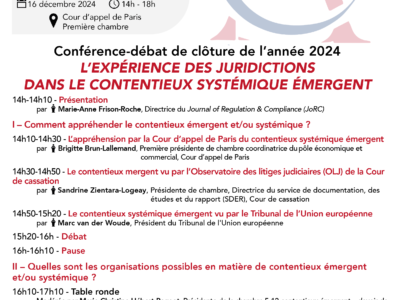
► Full Reference: L’expérience des juridictions dans le Contentieux Systémique Émergent (Courts Experience in Emerging Systemic Litigation), in cycle of conference-debates "Contentieux Systémique Émergent" ("Emerging Systemic Litigation"), organised on the initiative of the Cour d'appel de Paris (Paris Cour of Appeal), with the Cour de cassation (French Court of cassation), the Cour d'appel de Versailles (Versailles Court of Appeal), the École nationale de la magistrature – ENM (French National School for the Judiciary) and the École de formation des barreaux du ressort de la Cour d'appel de Paris – EFB (Paris Bar School), under the scientific direction of Marie-Anne Frison-Roche, 16 December 2024, 2pm.-6pm., Cour d'appel de Paris, Première Chambre (First Chamber) - ► Presentation of the conference:  - 🧮Programme of this event:  Closing conference-debate of 2024 L'EXPÉRIENCE DES JURIDICTIONS DANS LE CONTENTIEUX SYSTÉMIQUE ÉMERGENT  (COURTS EXPERIENCE IN EMERGING SYSTEMIC LITIGATION) Paris Court of Appeal, First Chamber   🕰️2pm.-2.10pm. Présentation (Introduction), by 🕴️Marie-Anne Frison-Roche, Professor of Regulatory Law and  Compliance Law, Director of the Journal of Regulation & Compliance (JoRC), Scientific Director of the Cycle of conferences-debates on the Emerging Systemic Litigation – ESL)   I – Comment appréhender le contentieux émergent et/ou systémique ?  (I – How to deal with Emerging and/or Systemic Litigation?) 🕰️2.10pm.-2.30pm. 🎤L’appréhension par la Cour d’appel de Paris du Contentieux Systémique Émergent (The Paris Court of Appeal's approach to Emerging Systemic Litigation), by 🕴️Brigitte Brun-Lallemand, Première présidente de chambre coordinatrice du pôle économique et commercial, Cour d’appel de Paris (First President of Chamber, Coordinator of the Economic and Commercial Division, Paris Court of Appeal) 🕰️2.30pm.-2.50pm. 🎤Le contentieux émergent vu par l’Observatoire des litiges judiciaires (OLJ) de la Cour de cassation, par 🕴️Sandrine Zientara-Logeay, Présidente de chambre, Directrice du service de documentation, des études et du rapport – SDER, Cour de cassation (President of Chamber, Director of the Department of Documentation, Studies and Reports – SDER, French Court of cassation)  🕰️2.50pm.-3.20pm. 🎤Le contentieux systémique Eémergent vu par le Tribunal de l’Union européenne (Emerging Systemic Litigation as seen by the General Court of the European Union), par 🕴️Marc van der Woude, President of the General Court of the European Union  🕰️3.20pm.-4pm. Debate 🕰️4pm.-4.20pm. Break   II – Quelles sont les organisations possibles en matière de contentieux émergent et/ou systémique ?  (II – How to organise with Emerging and/or Systemic Litigation?) 🕰️4.10pm.-5.10pm. 🎤Table ronde (Round Table) Moderated by 🕴️Marie-Christine Hébert-Pageot, Présidente de la chambre 5-12 contentieux émergent – devoir de vigilance et responsabilité écologique, Cour d‘appel de Paris (President of the 5-12 Chamber emerging litigation – duty of vigilance and ecological liability, Paris Court of Appeal) Speakers: 🕴️Stéphane Noël, Président du Tribunal judiciaire de Paris (President of the Paris First Instance Civil Court) 🕴️Patrick Sayer, Président du Tribunal de commerce de Paris (President of the Paris First Instance Commercial Court) 🕴️Jean-François Beynel, Premier président de la Cour d’appel de Versailles (First President of the Versailles Court of Appeal) and 🕴️Benjamin Deparis, Président du Tribunal judiciaire de Nanterre (President of the Nanterre First Instance Civil Court) 🕰️5.10pm.-5.40pm. Debate   🕰️5.40pm.-6pm. 🎤Conclusion. Le Contentieux Systémique Émergent : dialogues (Conclusion. Emerging Systemic Litigation: Dialogues), by 🕴️Jacques Boulard, Premier Président de la Cour d’appel de Paris (First President of the Paris Court of Appeal) - 🔴Registrations and information requests can be sent to: inscriptionscse@gmail.com 🔴For the attorneys, registrations have to be sent to the following address: https://evenium.events/cycle-de-conferences-contentieux-systemique-emergent/  ⚠️The conference-debates are held in person only, in the Cour d’appel de Paris (Paris Court of Appeal). -

Conferences

Conference

🎤Identifier et anticiper la pratique du Contentieux Systémique Émergent ; Présentation de 🧮L’expérience des juridictions dans le Contentieux Systémique Émergent

► Full Reference: M.-A. Frison-Roche, Identifier et anticiper la pratique du Contentieux Systémique Émergent (Identifying and anticipating the practice of Emerging Systemic Litigation) ; Presentation of L’expérience des juridictions dans le Contentieux Systémique Émergent (Courts Experience in Emerging Systemic Litigation), in cycle of conference-debates "Contentieux Systémique Émergent" ("Emerging Systemic Litigation"), organised on the initiative of the Cour d'appel de Paris (Paris Cour of Appeal), with the Cour de cassation (French Court of cassation), the Cour d'appel de Versailles (Versailles Court of Appeal), the École nationale de la magistrature – ENM (French National School for the Judiciary) and the École de formation des barreaux du ressort de la Cour d'appel de Paris – EFB (Paris Bar School), under the scientific direction of Marie-Anne Frison-Roche, 16 December 2024, 2pm.-6pm., Cour d'appel de Paris, Première Chambre (First Chamber). - 🧮see the full programme of this event - ⚙️This event has been conceived as a part of the cycle of conference-debates "Contentieux Systémique Émergent" ("Emerging Systemic Litigation"), organised on the initiative of the Cour d'appel de Paris (Paris Cour of Appeal), with the Cour de cassation (French Court of cassation), the Cour d'appel de Versailles (Versailles Court of Appeal), the École nationale de la magistrature – ENM (French National School for the Judiciary) and the École de formation des barreaux du ressort de la Cour d'appel de Paris – EFB (Paris Bar School), under the scientific direction of Marie-Anne Frison-Roche - ► English Summary of the conference:  - 🌐follow Marie-Anne Frison-Roche on LinkedIn 🌐follow Marie-Anne Frison-Roche on Instagram 🌐subscribe to the Newsletter MAFR Regulation, Compliance, Law 🌐subscribe to the Newsletter Surplomb, par MAFR

Conferences

conference

🎥Synthèse (Synthesis), in 🧮Les pratiques juridictionnelles au service d’un espace juridique pour le futur (In the Space of Justice, Jurisdictional Practices at the Service of the Future)

► Full Reference: M.-A. Frison-Roche, "Synthèse" ("Synthesis"), in M.-A. Frison-Roche (dir.), Dans l’espace de justice, les pratiques juridictionnelles au service du futur (In the Space of Justice, Jurisdictional Practices at the Service of the Future), in Cour de cassation, cycle of conferences "Penser les pratiques juridictionnelles au service d’un espace de justice" ("Thinking about jurisdictional practices in the service of an area of justice"), 21 November 2024, 4pm.-6pm. - 🧮see the program of this manifestation (in French) - ► English summary of this conference:  The topic covered takes account of the fact that this scientific event comes almost last in this cycle of conferences Penser les pratiques juridictionnelles au service d’un espace de justice ("Thinking about jurisdictional practices in the service of an area of justice"). Indeed, 'jurisdictional practices' have previously been addressed insofar as they are 'at the service of a European area of justice' (February 2023), enlightened (March 2023), attractive (June 2023), interactive (September 2023), peacemaking (December 2023). The approach here is different and complementary. The conference's starting point is the observation that, today, many new claims are made before Judges that relate directly to the Future. Admittedly, in their traditional role, Judges deal with the Future of disputed situations, but today it is the Future of Systems in their entirety that is sometimes submitted to them through a dispute or a claim. Moreover, they may be asked to find a systemic solution. The possible presence of future generations is just one sign of this change. The courtroom may seem unsuitable for trials of such gigantic proportions, both in terms of their subject matter and their impact. No doubt a distinction must be drawn between judges, some of whom may appear more familiar than others with the systemic issues that the Future brings with itself. Perhaps the judge's prudence should guide him/her in the use they make of their powers when they relate to the future, for example in the handling of sanctions, because the future by its very nature contains an element of the unknown, a fundamental prudence that the principle of the legality of offences and penalties expresses. But the future is not a blank page and Judges, without inventing it, can, indeed must, monitor the coherence of those who write the legal rules, if they are constitutional judges, and of those who write contracts and commitments, if they are civil and commercial judges. In order to fulfill their role, particularly with regard to the demands of stakeholders, judges need to think about and deal with this new systemic object before them: the future. To understand it, Judges draw on available jurisdictional practices, adjust others and combine them, using new methods. - 🧮see below the complete programme of this manifestation⤵️ - 🌐follow Marie-Anne Frison-Roche on LinkedIn 🌐follow Marie-Anne Frison-Roche on Instagram 🌐subscribe to the Newsletter MAFR Regulation, Compliance, Law

Conferences

Conference

🎤Choix et embranchements de compétences lorsqu’un enjeu de vigilance est allégué (Choice and Branching of Jurisdiction when a Vigilance issue is Alleged), in 🧮Le Droit processuel de la Vigilance (Vigilance General Procedural Law)

► Full Reference: M.-A. Frison-Roche, "Choix et embranchements de compétences lorsqu'un enjeu de vigilance est allégué" ("Choice and Branching of Jurisdiction when a Vigilance issue is Alleged"), in Le Droit processuel de la Vigilance (Vigilance General Procedural Law), in cycle of conference-debates "Contentieux Systémique Émergent" ("Emerging Systemic Litigation"), organised on the initiative of the Cour d'appel de Paris (Paris Cour of Appeal), with the Cour de cassation (French Court of cassation), the Cour d'appel de Versailles (Versailles Court of Appeal), the École nationale de la magistrature – ENM (French National School for the Judiciary) and the École de formation des barreaux du ressort de la Cour d'appel de Paris – EFB (Paris Bar School), under the scientific direction of Marie-Anne Frison-Roche, November 18, 2024, 11h-12h30, Cour d'appel de Paris, Cassin courtroom - 🕴️An other speaker to this conference is Natalie Fricero, Emeritus Professor at Côte d'Azur University 🧮see the full programme of this event - ⚙️This event was conceived as part of the "Emerging Systemic Litigation" cycle of conference-debates, organized by the Paris Court of appeal, in conjunction with the French Court of cassation, the Versailles Court of appeal, the French National School for the Judiciary and the Paris Bar School, under the scientific direction of Marie-Anne Frison-Roche. - ► English Summary of the conference: This speech opens the conference. It therefore logically focuses on the question of "jurisdictional competence". It is divided into successive points which are progressively linked to each other. The first point consists to insist on this rule : the organisation of the courts and their jurisdiction can never be detached from the substance of the matter in dispute. This explains why the issue of jurisdiction is such a source of passion for as long as the very definition of Vigilance remains so contentious, and why the 2021 legislature's belief that it could put out the fire has only served to exacerbate it. The second point relates to the first proposed solution, i.e. maintaining the exclusivity of the Paris First Judicial Court, which is acceptable in principle because by specialising judges acquire a "technical competence" but which presents a very damaging "Bibendum risk". The third point relates to the second solution proposed, namely the reference to the Motulskian notion of the 'basis of demand', which provokes a fork in the road, with the risk of interminable conflicts and divergent interpretations. The fourth point is the need to find the best solution, i.e. the least bad solution, consisting above all of forming practical alliances, without requiring new texts, for this particular type of litigation which does not come under any branch of Law and which justifies a dialogue between the heads of the courts.           - 🔓read the key points of this speech below ⤵️ - 🌐follow Marie-Anne Frison-Roche on LinkedIn 🌐follow Marie-Anne Frison-Roche on Instagram 🌐subscribe to the Newsletter MAFR Regulation, Compliance, Law 🌐subscribe to the Newsletter Surplomb, par MAFR

Articles in a legal collective publication

💬”Les droits de la défense sont au bénéfice de tout le monde, y compris de l’entreprise elle-même” (The rights of defence benefit everyone, including the company itself)

► Full Reference: M.-A. Frison-Roche, "Les droits de la défense sont au bénéfice de tout le monde, y compris de l’entreprise elle-même" (The rights of defence benefit everyone, including the company itself), interview by Chloé Lassel, in Guide Compliance Fraudes Investigations, edition 2024, ed. Décideurs, Oct. 2024, pp. - 💬read the interview (in French) 🌐its  présentation on LinkedIn (in French) - ► Presentation of this interview by Décideurs juridiques : "Directrice du Journal of Regulation & Compliance (JoRC) et fondatrice de l’École européenne de droit de la régulation et de la compliance, Marie-Anne Frison-Roche revient sur la révolution du droit de la compliance, son articulation avec les enquêtes internes et les droits de la défense, la place que vont y prendre les contrats et l’arbitrage international." ("Marie-Anne Frison-Roche, Director of the Journal of Regulation & Compliance (JoRC) and founder of the European School of Regulatory and Compliance Law, looks back at the revolution in Compliance Law, its relationship with internal investigations and the rights of the defence, and the role that contracts and international arbitration will play in it. - ► Questions asked, Answers given:  Décideurs. Question : La compliance est au cœur des préoccupations des entreprises depuis plusieurs années. Pouvez-vous expliquer ce que c’est exactement ? (Compliance has been a key concern for companies for several years. Can you explain what it is exactly?) Marie-Anne Frison-Roche. English summary Answer: 'Compliance' should not be confused with 'Compliance', which I defined in 2016. Compliance Law is an extension of Regulatory Law, by freeing the latter from the existence of a sector as a prerequisite and a regulatory authority as an indicator. Internalised in the company, it manifests itself, for example, in Vigilance mechanisms, which are its cutting edge. Through Compliance, the political authority asks companies to help it achieve "Monumental Goals", as I have suggested, standards in which this new branch of Law is anchored (anti-money laundering, anti-corruption, sustainability, etc.).   D. Q. : Les entreprises doivent désormais être enquêtrices et juges de ce qu’il leur arrive. Voire transmettre aux autorités, lorsqu’il le faut, des informations pouvant les incriminer. Comment concilier ces obligations avec les droits de la défense ? (Companies must now be investigators and judges of what happens to them. When necessary, they can even pass on incriminating information to the authorities. How do you reconcile these obligations with the rights of the defence?) MaFR. English summary A.: In 2023, I proposed this expression of companies as "prosecutors and judges of themselves", and the place that this should give to the rights of the defence, and in 2024 I will work out the right balance between internal investigations and the rights of the defence. For the moment, this balance has not been achieved.   D. Q. : Dans l’un de vos ouvrages, François Ancel, conseiller à la première chambre civile de la Cour de cassation, écrit que la compliance renouvelle l’office du juge. Comment concilier cette idée avec l’office habituel du juge qui est celui de se prononcer sur des faits avérés et non pas futurs ? (In one of your books, François Ancel, judge in the First Civil Chamber of the French Court of Cassation, writes that Compliance is renewing the role of the judge. How do you reconcile this idea with the judge's usual role, which is to rule on proven facts rather than future ones?) MaFR. English summary A.: Indeed, In this book La juridictionnalisation de la compliance (Compliance Jurisdictionalisation), he stresses that the role of the civil and commercial courts is being profoundly renewed, in particular because they must deal with what I described in 2021 as "Systemic Litigation" and must rule on the future. From then on, the ordinary courts will take centre stage.   D. Q. : Le recours aux clauses de compliance est-il une solution pour être à la hauteur des ambitions de la compliance et de ses exigences ? (Is the use of compliance clauses a solution for living up to the ambitions and requirements of compliance?) MaFR. English summary A.: Indeed, in 2022, I developed the concepts of 'Compliance Contract' and 'Compliance clauses', by which companies implement their legal compliance obligations. This gives rise to Regulatory Contracts, particularly in business chains. This gives a great deal of leeway and power, but also Responsibility, to the companies that invent them.   D. Q. : Le recours aux arbitrages doit-il être privilégié ? (D. Q. Should recourse to arbitration be preferred?) MaFR. English summary A.: It has to be. Because there is a contract. Even though Compliance is closely bound up with the legal obligations and public order, and possibly international public order. Even if this is not yet apparent, Compliance and International Arbitration are natural allies. - 🌐follow Marie-Anne Frison-Roche on LinkedIn 🌐follow Marie-Anne Frison-Roche on Instagram 🌐subscribe to the Newsletter MAFR. Regulation, Compliance, Law 🌐subscribe to the Newsletter Surplomb, par MAFR

Articles in a legal collective publication

Article in a collective legal publication

📝Devoir de vigilance : progresser (“Duty of Vigilance: the Way Forward), in 🕴️Ch. Maubernard & 🕴️A. Brès (eds.), 📗Le devoir de vigilance des entreprises. L’âge de la maturité ?

► Full Reference: M.-A. Frison-Roche, "Devoir de vigilance : progresser" ("Duty of Vigilance: the Way Forward"), in Ch. Maubernard & A. Brès (eds.), Le devoir de vigilance des entreprises. L'âge de la maturité ? (The duty of vigilance. The age of maturity?), Bruylant, "Droit & Economie" Serie, 2024, pp. 221-251 - 📝read the article (in French)  - 🚧 read the bilingual Working Paper which is the basis of this article, with additional developments, technical references and hyperlinks - ► English Summary of the article: In 2017 in France the so-called Vigilance law expressed great ambition. So did the draft directive. But in 2024 the European institutions moderated this ambition by refusing to increase either the type of companies subject and the constraints to which the duty of vigilance is associated. The directive has essentially halted what was for some the "march of progress". Does the ambition no longer exist? Does the future lie in an extension of the philosophy of the duty of vigilance, i.e. companies that should always be more concerned about others? This would undoubtedly be reaching the "age of maturity", where others see the age of madness, because it would be a contradiction in terms to ask a company to be concerned about anything other than its own development. It is therefore appropriate to consider this very hypothesis of an "age of maturity" as being an ambition maintained despite a European directive which, in its adopted version, is weakened and while the oppositions are intact (I). First of all, it must be admitted that the notion of "maturity" most often conceals a value judgment when applied to a legal concept (I.A.) and that this is blatantly obvious with regard to the duty of vigilance, which is considered by some and by nature by some as a good and by others as an evil (I.B). In order not to remain in what appears to be trench warfare, we must not get too bogged down in the reference French legislation of 2017 and what appears to be a European stutter in 2024, arguing so loudly that we can hear them reasoning in print, by paying attention to less visible and now more promising avenues of progress (II). In fact, the duty of vigilance can progress simply by the passage of time (II.A), by a better definition of the vocabulary (II.B), by the consolidation of the principles of Responsibility and Dialogue (II.C), by the uniqueness of the jurisdictional route (II.D). This last perspective of the progress that will be made possible in France by the uniqueness of the judicial route leads to a final avenue of progress. By their very nature, laws are jolts, all the more violent for being disputed. At the moment, if we want to make progress, these two other sources – the contract and the judge – must be favoured (III). The European directive is rightly concerned with access to the courts and takes a measured view of the effectiveness of contracts as a means of making the duty of vigilance effective, with the courts having to ensure that the contract does not destroy the spirit of the system. This is what the law already organises about the relationship between the contract, the judge and the duty of compliance (III.A). What is new in Europe in 2024 is the introduction of a Supervisor (III.B). Here again, vigilance is the "cutting edge" of Compliance Law, as it is an extension of Regulatory Law.  The result is that, through interpretation and the handling of principles, and to formulate a more general conclusion, it is the judge who holds and will hold the balance of the duty of vigilance. - 🌐follow Marie-Anne Frison-Roche on LinkedIn 🌐follow Marie-Anne Frison-Roche on Instagram 🌐subscribe to the Newsletter MAFR. Regulation, Compliance, Law 🌐s'abonner à la Newsletter Surplomb, par MAFR