Internet

Articles in a JoRC book

The Government itself collects personal data on social networks, without the consent of the parties concerned, but for a good cause: the fight against tax fraud. What should we think about it legally?

The Finance Bill has proposed to the Parliament to vote an article 57 whose title is: Possibilité pour les administrations fiscales et douanières de collecter et exploiter les données rendues publiques sur les sites internet des réseaux sociaux et des opérateurs de plateformes (translation: Possibility for the tax and customs administrations to collect and exploit the data made public on the websites of social networks and platform operators). Its content is as is in the text voted on in the National Assembly as follows: "(1) I. – On an experimental basis and for a period of three years, for the purposes of investigating the offenses mentioned in b and c of 1 of article 1728, in articles 1729, 1791, 1791 ter, in 3 °, 8 ° and 10 ° of article 1810 of the general tax code, as well as articles 411, 412, 414, 414-2 and 415 of the customs code, the tax administration and the customs administration and indirect rights may, each as far as it is concerned, collect and exploit by means of computerized and automated processing using no facial recognition system, freely accessible content published on the internet by the users of the online platform operators mentioned in 2 ° of I of article L. 111-7 of the consumer code. (2) The processing operations mentioned in the first paragraph are carried out by agents specially authorized for this purpose by the tax and customs authorities.   (3) When they are likely to contribute to the detection of the offenses mentioned in the first paragraph, the data collected are kept for a maximum period of one year from their collection and are destroyed at the end of this period. However, when used within the framework of criminal, tax or customs proceedings, this data may be kept until the end of the proceedings. (4) The other data are destroyed within a maximum period of thirty days from their collection. (5) The right of access to the information collected is exercised with the assignment service of the agents authorized to carry out the processing mentioned in the second paragraph under the conditions provided for by article 42 of law n ° 78-17 of January 6, 1978 relating to data processing, the files and freedoms. (6) The right to object, provided for in article 38 of the same law, does not apply to the processing operations mentioned in the second paragraph. (7) The terms of application of this I are set by decree of the Council of State. (8) II. – The experiment provided for in I is the subject of an evaluation, the results of which are forwarded to Parliament as well as to the National Commission for Data Protection at the latest six months before its end. "   This initiative provoked many comments, rather reserved, even after the explanations given by the Minister of Budget to the National Assembly. What to think of it legally? Because the situation is quite simple, that is why it is difficult: on the one hand, the State will collect personal information without the authorization of the persons concerned, which is contrary to the very object of the law of 1978 , which results in full disapproval; on the other hand, the administration obtains the information to prosecute tax and customs offenses, which materializes the general interest itself. So what about it? Read below.


Reports

Council of the European Union

INFORMATION NOTE FROM THE EUROPEAN COMMISSION TO THE PERMANENT REPRESENTATIVES COMMITTEE ABOUT THE PROGRESS ON COMBATTING HATE SPEECH ONLINE THROUGH THE EU CODE OF CONDUCT

Full reference: Information Note From the European Commission to the Permanent Representatives Committee About the Progress on Combatting Hate Speech Online Through the EU Code of Conduct, Council of the European Union, 27th of September 2019, 7p. Read the note

Conferences

The solutions offered by Compliance Law to fight effectively against mass counterfeiting

Generale Reference : Frison-Roche, M.-A., Les solutions offertes par le Droit de la Compliance pour lutter effectivement contre les contrefaçons de masse (The solutions offered by Compliance Law  to fight effectively against mass counterfeiting) , in Seminar of the Association des Praticiens du Droit Droit des Marques et des Modèles (APRAM), La contrefaçon de masse : va-t-on un jour réussi à y mettre un frein ? Quelques nouvelles pistes de réflexion (How to stop the mass Counterfeiting?, some new ideas), Paris, September 27, 2019.  Read the program of the Seminar. (in French) This conference is based on the report given to the French Government and published in July2019 : The contribution of Compliance Law to the Governance of Internet. It is also based on the new contribution to the new edition of the Grands Arrêts de la propriété intellectuelle : "Le maniement de la propriété intellectuelle comme outil de régulation et de compliance"(in French).  This publication is based on this Working Paper : The use of Intellectuel Property as a tool for Regulatory and Compliance Perspectives.      Summary : In this seminar devoted to new ways of reacting to "mass counterfeiting", the idea here is to start from the observation of an increase in the ineffectiveness of intellectual property rights – and thus of the I.P. Law. Law being a practical art, it is not a simple inconvenience, it is a central question. This can be remedied by improving the Ex Post legal process, but we can think of finding Ex Ante mechanisms. The Regulatory Law is Ex Ante, but digital world is not a sector, it is the world itself. A promising direction is therefore Compliance Law, in that it is both Ex Ante and non-sectoral. The contribution shows how Compliance Law is already useful, could be developed and how it could be applied so that these specific rights could be effectively protected in a digital world, where for the moment counterfactors have in fact the means to ignore them.   See the slides. (in French)  

Breaking news

BY BASIC TECHNOLOGY, MANY SITES BLOCKTHE INTERNET USERS THE POSSIBILITY TO SAY “NO”:THEY “CONSENT” TO TRANSFER THEIR PERSONAL DATA, WITHOUT OTHER TECHNOLGICAL CHOICES THAN THAT OF “ALL ACCEPT”. THE LINK BETWEEN “CONSENT” AND “FREE WILL” IS THEREFORE BROKEN

Experience shows that in the digital the legal technique of consent is not protective enough.   If only because a simplest technology neutralizes the link that should exist between the "consent" of the user and the "free will" of the latter: the consent of the user only protects the latter to the extent that this one can in Law and in fact to say "no.     I. THE EXPERIENCE    For example I found on my Facebook New an access to an unknown web site which puts online an article on "the rights of trees" … I go. In accordance with the European Regulation (GDPR) transposed into French legal system, the site informs that there is possibility for the user to accept or refuse the use of their personal data for the benefit of "partners". If they continue reading, the user is supposed to accept everything, but they can click to "customize". I click: there I find two options: "accept everything" or "reject everything". But the "reject all" option is disabled. It is only possible to click on the "accept all" option.   It is also possible, because the law obliges, to consult the list of the partners of this website: I click and find a list of unknown companies, with foreign denominations, which without doubt once will collect my personal data (and those of my contacts) , having their own head office outside the European Union. It is stated in a text, which can not be copied, that these "partners" can use my data without my consent and for purposes that they do not have to inform me. But, again, these things I can "refuse everything". Here again the "reject all" mention exists but the fonctionality is not active, while the mention "accept all" is an active fonctionality.   As I can not refuse (since it's disabled), and as 99% of Internet users have never clicked on the first two buttons, all their data has been fed into the data market that allows the targeting of products that spill out in the digital space, to their detriment and that of their contact. While believing to read a free article on the "right of the trees". At the end, I do not read this article, since I did not click on the only active buttons: "accept everything".   In more than 50% of cases, the "reject all" or "customize" options are only images but are not active. And data absorption is also about contacts. In exchange for a whimsical article about trees and their rights, or creams to be always young, or celebrities who change spouses, or about so-called tests to find what king or queen you should be if the all recognized all your merits, etc. Proposed on the digital news feed by unknown sites; in partnership with foreign companies that you will never reach. And mass-viewed by Internet users who are also told that "consent" is the proven solution for effective protection …. While these are just panels hastily built by new Potemkins …   II. WHAT TO DO ?    1. Not be satisfied with "consent" from the moment that it is a mechanism that may not be the expression of a free will: how could it be if the option "to refuse" is not active?   2. The link between will and consent must therefore be "presumed" only in a simple presumption and in a non-irrefutable way, because we must refuse to live in a dehumanized society, operating on "mechanical consents", to which the digital does not lead necessarily.   3. Entrust by the Compliance Law to the "crucial digital operators" (in the case of Facebook thanks to which these proposals for free reading are made on the thread of news of the Net surfers) the care to verify in Ex Ante the effectiveness of the link between Will and Consent: Here and concretely the possibility for the user to read while refusing the capture of all its data (for the benefit of operators who do not even have the concrete obligation to give the information of the use that will be made of these personal data).   -

Reports

📓 L’apport du Droit de la Compliance dans la Gouvernance d’Internet (The contribution of Compliance Law in the Governance of Internet))

► Full Reference: M.-A. Frison-Roche, L'apport du Droit de la Compliance dans la Gouvernance d'Internet  (The contribution of Compliance Law to the Internet Governance), Report asked by the French Government, published the 15th of July 2019, 139 p. - ► Report Summary. Governing the Internet? Compliance Law can help. Compliance Law is for the Policy Maker to aim for global goals that they require to be achieved by companies in a position to do so. In the digital space built on the sole principle of Liberty, the Politics must insert a second principle: the Person. The respect of this One, in balance with the Freedom, can be required by the Policy Maker via Compliance Law, which internalises this specific pretention in the digital companies. Liberalism and Humanism become the two pillars of Internet Governance. The humanism of European Compliance Law then enriches US Compliance law. The crucial digital operators thus forced, like Facebook, YouTube, Google, etc., must then exercise powers only to better achieve these goals to protect persons (against hatred, inadequate exploitation of data, terrorism, violation of intellectual property, etc.). They must guarantee the rights of individuals, including intellectual property rights. To do this, they must be recognized as "second level regulators", supervised by Public Authorities. This governance of the Internet by Compliance Law is ongoing. By the European Banking Union. By green finance. By the GDPR. We must force the line and give unity and simplicity that are still lacking, by infusing a political dimension to Compliance: the Person. The European Court of Justice has always done it. The European Commission through its DG Connect is ready.   ► 📓 Read the reporte (in French) 📝 Read the Report Summary in 3 pages (in English) 📝 Read the Report Summary in 6 pages (in English) -   ►  Plan of the Report (4 chapters): an ascertainment of the digitization of the world (1), the challenge of civilization that this constitutes (2), the relations of Compliance mechanisms as it should be conceived between Europe and the United States, not to mention that the world is not limited to them, with the concrete solutions that result from this (3) and concrete practical solutions to better organize an effective digital governance, inspired by what is particularly in the banking sector, and continuing what has already been done in Europe in the digital field, which has already made it exemplary and what it must continue, France can be force of proposal by the example (4). -   📝  Read the written presentation of the Report done by Minister Cédric O (in French). 🏛 Listen to the oral  presentation of the Report by Minister Cédric O durant the parliamentary discussion of the law against hate contente on the Internet (in French). -   💬 Read the interview published the 18 July 2019 : "Gouvernance d'Internet : un enjeu de civilisation" ( "Governing Internet: an Issue of Civilization"), given in French,  📻 Listen the Radio broadcast of July 21, 2019 during which its consequences are applied to the cryptocurrency "Libra" (given in French) 🏛 Presentation of the Report to the Conseil Supérieur de l'Audiovisuel- CSA (French Council of Audiovisual) on Septembre 5, by a discussion with its members presentation (in French) 💬 Read the  Interview published the 20 December 2019 : "Le droit de la compliance pour réguler l'Internet" ("Compliance Law for regulate Internet"), given in French -     read below the 54 propositions of the Report ⤵️ - 🌐 follow Marie-Anne Frison-Roche on LinkedIn 🌐follow Marie-Anne Frison-Roche on Instagram 🌐subscribe to the Newsletter MAFR Regulation, Compliance, Law 

Publication director

🏗️ copublishing and direction of the collection: 📚Régulations & Compliance

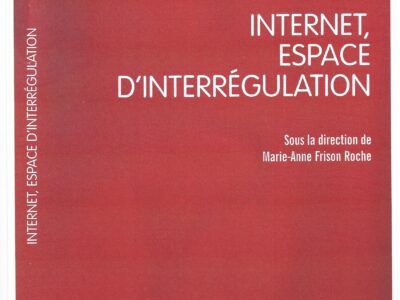
📕Internet, espace d’interrégulation (dir.)

Complete references :  Frison-Roche, M.-A. (dir.), Internet, espace d’interrégulation, Serie “Régulations”, coll. “Thèmes & Commentaires”, Dalloz, Paris, 2016. ► Read the presentations of the other books in the series: the following books: 🕴️M.-A. Frison-Roche (ed.), 📕Régulation, Supervision, Compliance, 2017 🕴️N. Borga, J.-Cl. Marin and J.-Ch. Roda (eds.), 📕Compliance : l’entreprise, le régulateur et le juge, 2018 🕴️M.-A. Frison-Roche (ed.), 📕Pour une Europe de la Compliance, 2019 🕴️M.-A. Frison-Roche (ed.), 📕Les outils de la Compliance, 2021 🕴️M.-A. Frison-Roche (ed.), 📕Les Buts Monumentaux de la Compliance, 2022 🕴️M.-A. Frison-Roche (ed.), 📕La juridictionnalisation de la Compliance, 2023 🕴️M.-A. Frison-Roche and M. Boissavy (eds.), 📕Compliance et droits de la défense. Enquête interne – CJIP – CRPC, 2024 🕴️M.-A. Frison-Roche (ed.), 📕L’Obligation de Compliance, 2025 🕴️M.-A. Frison-Roche (ed.), 📕Compliance et Contrat, forthcoming 🕴️L. Laref (ed.), 📕Compliance et vigilance bancaire, forthcoming 🕴️M.-A. Frison-Roche, 📕Le système juridique de l’adressage de l’Internet. Une structure multi-acteurs, gage de durabilité (The Legal System of Internet Addressing. A Multi-Stakeholder Structure, the Pledge of its Sustainability), forthcoming 🕴️M.-A. Frison-Roche (ed.), 📕Le système probatoire de la Compliance, forthcoming Read the presentation of the book (written in French). Read the presentation of the  authors of the contributions (written in French) “Regulate the Internet”. Some argue that any regulation is contrary to the nature of digital. Others argue that this is indispensable, for its economic deployment and for public freedoms. Internet renews conceptions and practices. Notably those of the Law of the Regulation. Indeed, the Internet makes it possible to offer and obtain services that are in often regulated sectors: financial, audiovisual, healthcare, gaming. Moreover, they converge in new objects: the connected objects. Often described as a “legal desert”, digital appears as a kind of jumble of systems of various regulations that overlap, deform and contradict each other. In reaction, an “interregulation”, de facto or de jure, in law more or less flexible, is in the process of being established. Who will be the Regulator: The States? The judge? The Internet users? The future is open. The book first determines the “Interregulation Needs” and then describes and conceives solutions for the interregulation of the digital space. Read the presentation of the two articles written by Marie-Anne Frison-Roche:      Thinking the world from the notion of “data”      To draw the regulatory consequences of a rethinked world from the notion of “data” The working papers which are the base of these articles are written in English.        

Articles in a legal collective publication

📝Rethinking the world from the notion of “data” (Penser le monde à partir de la notion de “données”)

Référence complète : Frison-Roche, M.-A., Penser le monde à partir de la notion de "donnée", in Frison-Roche, M.-A. (dir.), Internet, espace d'interrégulation, série "Régulation", 2016, pp. 7-16.   English summary : Law is a reconstruction of the world through definitions and categories, expressed in words, to which are imputed rules. There is always a share of invention in Law, articulated to a share of fidelity to the concrete world that it retranscribes, a combination enabling Law to regulate the latter. Law is put in difficulty by what the term "data", quite new, is not easy to define. The fact that it is strangely formulated in Latin to show that there is plurality, the data, before associating it with an English adjective when there are many, the "big data", does not advance us more on what a "data" is. Law is a practical art that works well only if it manipulates categories whose definition is mastered. This is why, in a first stage, we must recognize the uncertainties of the very notions of "data" (I), in order to orientate the adequate rules in the second step towards what is a given, namely a "pure" value in our consumer information society (II).   Read the article (in French)   This article is linked to another article published in the same book : Les conséquences régulatoires d'un monde repensé à partir de la notion de "donnée" ("the regulatory consequences of a word redesigned from the notion of "data")

Texts

European Parliament and Council of the European Union

Regulation of 25 November 2015 laying down measures concerning open internet access

Full reference: Regulation (EU) 2015/2120 of the European Parliament and of the Council of 25 November 2015 laying down measures concerning open internet access and amending Directive 2002/22/EC on universal service and users’ rights relating to electronic communications networks and services and Regulation (EU) No 531/2012 on roaming on public mobile communications networks within the Union Read the regulation 

Working papers

THE REGULATORY CONSEQUENCES OF A WORLD REDESIGNED FROM THE CONCEPT OF “DATA”

This Working paper will be used to support an  French written article to be published in a book, set in the Regulations Series, Dalloz Publishing This working paper was the basis for intervention in the symposium organized by the Journal of Regulation, Internet, Space of Interregulation. View the slides used as support at the conference (in French). -   After emphasizing that the concept of "data" is uncertain, the first perspective is to draw the regulatory consequences of the fact that what is often referred to as the "object" of the data item (the person, the company for financial data, the economy for rating data, etc.), is only its source, "underlying", the data which is manufactured by a company : the real objet of the data is  its purpose being the use for which the data is intended. The data is independent its underlying, is consolidated in the affected masses, takes an economic value based on the desires that have users, becomes available outside of time and space in the digital. This implies a specific interregulation. But the data is also the Janus of digital because new black gold, pure financial instrument, immaterial by nature, the data also keep a record of people, the underlying that would protect, that we would like inseparable, or the structure that one would want legitimately to attack thank to the new mechanism of compliance. This double-sided of the data item leads to shocks of regulatory mechanisms in Internet In addition, any Internet links back to the user, in whom we would gladly see "The Grand Interregulato" ". But is it so appropriate, legitimate and effective? The "consent" which refers this interregulation provided by the user himself raises doubts. However, as the displaced term of "right to be forgotten" hides a very effective weapon that can strike those who monopolize the data in a digital economy that seems to be in an ante-market mechanism. This regression pulverizes the market self-regulation itself to replace the legal acts of exchange by connective legal acts, that for now Law and Regulation are struggling to understand, lack of legal qualifications to do so.