Environment

Articles in The Journal of Regulation & Compliance « JoRC »

TORRE-SCHAUB, Marta🕴️

📝La compliance environnementale et climatique (Environmental and Climate Compliance), in 🕴️M.-A. Frison-Roche (dir.), 📕L’Obligation de Compliance

► Full Reference: M. Torre-Schaub, "La compliance environnementale et climatique" ("Environmental and Climate Compliance"), in M.-A. Frison-Roche (dir.), L'Obligation de Compliance, Journal of Regulation & Compliance (JoRC) and Dalloz, coll. "Régulations & Compliance", 2025, pp. 271-286. - 📕lire une présentation générale de l'ouvrage, L'Obligation de Compliance, dans lequel cet article est publié - ► Summary of this contribution  (done by the Journal of Regulation & Compliance) : The author starts from the fact that Compliance Law, in that it is not limited to conformity process, and Environmental Law are complementary, both based above all on the prevention of risks and harmful behaviour, environmental crises and the right to a healthy environment involving the strengthening of Environmental Vigilance. It is all the more important to do this because definitions remain imprecise, not least those of Environment and Climate, which are diffuse concepts. Firstly, the contribution sets out the purpose of Environmental Compliance, which is to ensure that companies are vigilant with regard to all kinds of risks: they put in place and follow a series of processes to obtain "progress" in accordance with a standard of "reasonable vigilance". This requires them to go beyond mere conformity and encourages them to develop their own soft law tools within a framework of information and transparency, so that the climate system itself benefits in accordance with its own objectives. Then the author stresses the preventive nature of Environmental Vigilance mechanisms, which go beyond providing Information to managing risks upstream, in particular through the vigilance plan, which may be unified or drawn up risk by risk, and which must be adapted to the company, particularly in the risk mapping drawn up, with assessment being carried out on a case-by-case basis. Lastly, in the light of recent French case law, the author describes the implementation of the system, which may bring the parties before the Tribunal judiciaire de Paris (Paris Court of First Instance) and then the specialised chamber of the Paris Court of Appeal. The author believes that judges must clarify the obligation of Environmental Vigilance so that companies can adjust to it, and these 2 courts are in the process of doing so. - 🦉This article is available in full text to those registered for Professor Marie-Anne Frison-Roche's courses -

Articles

Interview

💬Compliance & arbitrage : les prémices d’une symbiose (💬Compliance & Arbitration: the beginnings of a symbiosis)

► Full Reference: M.-A. Frison-Roche, E. Silva Romero, G. Filhol, V. Autret, B. Sillaman et K. Hennessee, Compliance & arbitrage : les prémices d’une symbiose, propos recueillis par O. Delaunay, LJA Magazine, septembre-octobre 2024, pp. 12-20 - 💬read the collective interview (in French) - 🌐read the presentation of this interview on LinkedIn - ► Topics covered during this collective interview:  The development of Compliance in an international environment The Arbitrator and the concept of Compliance Linking Arbitration and Compliance systems - ► Summary of my interventions: Compliance Law appears to be developing in the context of international trade and Arbitration. For my part, I placed particular emphasis on the fact that the first reports were the result of "negative reports" between Compliance and Arbitration, through Criminal Law and the obligation of arbitrators to ensure that they don't give effectivity to pacts of corruption. But the future lies in a more 'positive' and fruitful relationship between this new branch of law, Compliance Law, and the solid prospect offered by Arbitration, in that the arbitrator, this natural judge of international trade, will be able to support the contractualisation of Compliance obligations, particularly about due diligences in structural chains of activities and duty of vigilance. Thus competent, the international arbitrator must respond to what the Monumental Goals in which Compliance Law is rooted expect of him/her: to provide solutions and remedies to issues that often concern an entire chain of activity or an entire sector in a more systemic perspective than in a traditional conception. This applies not only to investment arbitration, but also, for instance, to infrastructure arbitration. The concern for sustainability and the systemic perspective must be integrated into the reasoning and produce appropriate case law, a sort of new doctrine in the arbitration order, that will make more attractive the arbitration place that will most solidly link the skills of specialists in Compliance Law and Arbitration Law. - 🌐follow Marie-Anne Frison-Roche on LinkedIn 🌐follow Marie-Anne Frison-Roche on Instagram 🌐subscribe to the Newsletter MAFR. Regulation, Compliance, Law 🌐subscribe to the Newsletter Surplomb, by MAFR

Articles in The Journal of Regulation & Compliance « JoRC »

TORRE-SCHAUB, Marta🕴️

📝Environmental and Climate Compliance, in 🕴️M.-A. Frison-Roche (ed.), 📘Compliance Obligation

► Full Reference: M. Torre-Schaub, "Environmental and Climate Compliance", in M.-A. Frison-Roche (ed.), Compliance Obligation, Journal of Regulation & Compliance (JoRC) and Bruylant, "Compliance & Regulation" Serie, to be published - 📘read a general presentation of the book, Compliance Obligation, in which this article is published - ► Summary of the article (done by the Journal of Regulation & Compliance – JoRC):  The author starts from the fact that Compliance Law, in that it is not limited to conformity process, and Environmental Law are complementary, both based above all on the prevention of risks and harmful behaviour, environmental crises and the right to a healthy environment involving the strengthening of Environmental Vigilance. It is all the more important to do this because definitions remain imprecise, not least those of Environment and Climate, which are diffuse concepts. Firstly, the contribution sets out the purpose of Environmental Compliance, which is to ensure that companies are vigilant with regard to all kinds of risks: they put in place and follow a series of processes to obtain "progress" in accordance with a standard of "reasonable vigilance". This requires them to go beyond mere conformity and encourages them to develop their own soft law tools within a framework of information and transparency, so that the climate system itself benefits in accordance with its own objectives. Then the author stresses the preventive nature of Environmental Vigilance mechanisms, which go beyond providing Information to managing risks upstream, in particular through the vigilance plan, which may be unified or drawn up risk by risk, and which must be adapted to the company, particularly in the risk mapping drawn up, with assessment being carried out on a case-by-case basis. Lastly, in the light of recent French case law, the author describes the implementation of the system, which may bring the parties before the Tribunal judiciaire de Paris (Paris Court of First Instance) and then the specialised chamber of the Paris Court of Appeal. The author believes that judges must clarify the obligation of Environmental Vigilance so that companies can adjust to it, and these 2 courts are in the process of doing so. - 🦉This article is available in full text to those registered for Professor Marie-Anne Frison-Roche's courses -

Texts

🏛️Directive (EU) of 13 June 2024 on corporate sustainability due diligence (CS3D)

► Full Reference: Directive (EU) 2024/1760 of the European Parliament and of the Council of 13 June 2024 on corporate sustainability due diligence and amending Directive (EU) 2019/1937 and Regulation (EU) 2023/2859 (CS3D) - ► read the text of the directive - 📧see on LinkedIn the article published by Marie-Anne Frison-Roche in the Newsletter MAFR. Regulation, Compliance, Law, on the occasion of the publication of this directive in the Official Journal of the European Union -

Conferences

conference

🎤Participation au panel “Une Gouvernance responsable : vers un mieux vivre ensemble ?” (“Responsible corporate governance: towards a better way of living together”), in 🧮Grenelle du Droit 5

► Full Reference: M.-A. Frison-Roche, Participation in the panel "Une Gouvernance responsable : vers un mieux vivre ensemble ?" ("Responsible governance: towards a better way of living together"), in Grenelle du Droit 5. L'avenir de la filière juridique, Association française des juristes d'entreprise ("The future of the legal profession"), AFJE), Cercle Montesquieu and Paris Panthéon-Sorbonne University, Campus Port-Royal Université Paris 1 Panthéon-Sorbonne, 1 rue de la Glacière, 75013 Paris, June 12, 2024 - 🧮See the full programme of this event (in French) - 🎥watch the interview made just after this round-table discussion (in French) - 🪑🪑🪑🪑🪑 will also be taking part in this round-table discussion: 🕴️Yves Garagnon, Chairman of Dilitrust, 🕴️Pierrick Le Goff, lawyer, partner at De Gaulle Fleurance, 🕴️Sabine Lochmann, Chairman of Ascend, 🕴️Vincent Vigneau, President of the Commercial, Economic and Financial Chamber of the Cour de cassation (French Judicial Supreme Court) - ► English presentation of my intervention in this event's opening plenary  round-table: In this plenary round table which opens the event, devoted to the theme of 'responsible corporate governance', for my interventions based on my work I will have the opportunity to address more particularly these different perspectives: How the new Compliance Law, which gives concrete expression to the responsibility of enterprises in a new relationship with States and with civil society, constitutes a 'legal revolution 💡for the record, mafr,📝Compliance Law, 2016 ; (ed.) 📘Compliance Monumental Goals, 2022   how the judgment handed down by the Tribunal judiciaire de Paris (Paris First Instance Civil Court) on 28 February 2023 (Total Ouganda case) is remarkable and already constitutes a turning point in case law 💡for the record, mafr, 🎤audition as amica curiae, hearing of 26 October 2022 before the first instance Paris Court; (ed)📘Compliance Jurisdictionalisation, 2024   how the relationship between States and enterprises is being renewed by this profound legal movement expressed by Compliance Law 💡for the record, mafr et M. Boissavy (ed.), 📕Compliance et droits de la défense – Enquêtes internes, CJIP, CRPC, mafr (dir.), 📘 Compliance Obligation, 2025   how internal lawyers have a decisive and central role to play in this movement, particularly in the mechanism of vigilance / corporate sustainability due diligence, the "cutting edge" of Compliance Law, 💡for the record, mafr, 📝Contract of Compliance, Compliance stipulations, 2023 ; (ed.), 📘Compliance and Contract, 2025   what is meant by the "Ex Ante responsibility" of enterprises, which does not necessarily entail their Ex Post liability, a distinction which lawyers are the guardians of 💡for the record, mafr, 📝La responsabilité Ex Ante, pilier du Droit de la Compliance ("Ex-Ante Responsability, Compliance Law Pillar"), 2021   how European Compliance Law is profoundly humanist, an identity that distinguishes European Compliance from American Compliance and, above all, from Chinese Compliance. 💡for the record, mafr (ed.), 📕Pour une Europe de la Compliance ("For the Europe of the Compliance"), 2017 - read the  article about this round table written by Delphine Bauer in Actu-Juridique (in French) - 🌐follow Marie-Anne Frison-Roche on LinkedIn 🌐follow Marie-Anne Frison-Roche on Instagram 🌐subscribe to the Newsletter MAFR Regulation, Compliance, Law
Conferences

🎤Les voies d’innovations juridiques face aux nouveaux “défis climatiques” (“Innovative legal solutions to the new “climate challenges””), in 🧮Nouveaux défis – Regards croisés : Droit, Économie et Finance. Quel Droit face au Changement Climatique ? (“New challenges – Crossed perspectives : Law, Economics and Finance. What Law in the Face of Climate Change?”)

► Full Reference: M.-A. Frison-Roche, "Les voies d'innovations juridiques face aux nouveaux "défis climatiques" ("Innovative legal solutions to the new "climate challenges""), in C. Arnaud, O. de Bandt et B. Deffains (dir.), Nouveaux défis – Regards croisés : Droit, Économie et Finance. Quel Droit face au Changement Climatique ? (("New challenges – Crossed perspectives : Law, Economics and Finance. What Law in the Face of Climate Change?"), Banque de France (French Central Bank) and CRED/Paris Panthéon-Assas University, Paris, Centre de Conférence de la Banque de France, April 2, 2024 - 🧮See the full programme of this event - 🔲see the slides, basis of this conference (in French) - ► Summary of this conference: In response to the question of how the Law can produce 'innovations' to meet the 'climate challenges', the process is based on the three traditional sources of Law, which are, firstly, laws and regulations, secondly, the commitments of individuals, mainly contracts, and thirdly, court rulings. At first sight, the Law in its traditional conception and practice is weak in the face of climate change. This weakness is inherent in the nature of climate change, which is at once future, global and systemic, in the face of these three sources of Law, which do not address all three dimensions at once. The scale of the legal innovation required to ensure that one or more articulated sources can grasp the future, the global and the systemic is therefore clear. And yet this is what is happening. As far as laws and regulations are concerned, they do not seem very appropriate because they are, by their very nature, a territorial limit, and international treaties are very difficult to negotiate. The interweaving of European regulations, for example the CSRD and the CS3D, which mirror each other, may be more effective. As far as 'commitments' are concerned, a concept which in Law is not very precise outside of contracts and liability cases📎1🕴️M.-A. Frison-Roche, 📝What a commitment is, in 🕴️M.-A. Frison-Roche (ed.), 📘Compliance Obligation, 2024., contracts are above all a means for companies to fulfill their legal obligations, and a contract always implies a judge. At first sight, however, the judge is the least well placed to respond to 'climate challenges', particularly in France where he is said or wished to be powerless, where he rules on the past and where, especially the civil judge, he settles a one-off dispute between two singular parties. But a major change has occurred with the emergence of a new branch of law: the Compliance Law, a teleological branch of Law whose legal normativity is lodged in the Monumental Goals📎2🕴️M.-A. Frison-Roche, 📝Compliance Monumental Goals, beating heart of Compliance Law, in 🕴️M.-A. Frison-Roche (ed.), 📘Compliance Monumental Goals, 2023. that it pursues, namely the preservation of systems, for example the climate system. In France, the so-called "Sapin 2" law in 2016, followed by the so-called "Vigilance" law in 2017, illustrate this. And the Judge is at the centre of it all. In this global, systemic, extraterritorial perspective, the object of which is the future – Compliance Law is, moreover, rejected by many legal experts – the legislative innovation is major. Indeed, the law of 23 March 2017, known as "Vigilance" designated large companies, because they are "powerful", because they are "in a position to act" to "detect and prevent" breaches of the environment and human rights. The 2017 law copied the "compliance tools"📎3🕴️M.-A. Frison-Roche (ed.), 📘Compliance Tools, 2021. put in place by the Sapin 2 anti-corruption law: risk mapping, plans, alerts, audits, internal investigations, and so on.  Only large companies are subject to the Compliance Law, notably the Vigilance Law, since they are the only ones in a position to act, in this case "parent companies or principals", and borders are no longer limits since the obligation, creating personal liability for the company📎4🏛️Conseil constitutionnel (French Constitutional Council), March 23, 2017, decision No. 2017-750 DC, Loi relative au devoir de vigilance des sociétés mères et des entreprises donneuses d’ordre., extends throughout the "value chain". The notion and fact of "systemic dispute" is emerging before the courts. In France, the Paris Court of First Instance has exclusive jurisdiction. European legislation is proving more difficult to draw up, because although it is compulsory to provide information on these "extra-financial" subjects (CSRD), the directive on the duty of vigilance, which has just been adopted, does not go any further than the French law of 2017. On the second point, that of commitments, we are only at the beginning. Judges do not transform ethical statements into "unilateral legal commitments", and vigilance does not transform company law into co-management. But contracts do form a global network through which companies adjust their various legal obligations. This is why arbitrators, the only "global judges", will soon be involved in this systemic litigation📎5🕴️M.-A. Frison-Roche (ed.), 📘Compliance Obligation, 2024, of which a chapter is dedicated to "International Arbitration in support of the Compliance Obligation"., and more general case law is to come on "compliance contracts and clauses"📎6🕴️M.-A. Frison-Roche, 🚧Compliance contract, compliance clauses, 2022 ; 🕴️M.-A. Frison-Roche (ed.), 📘Contrat and Contract, 2024.. But the most innovative aspect undoubtedly comes from the courts. Perhaps and notably in France because it is from where we least expect it, the civil courts, that the imagination comes, but also the guarding of the great principles of the Rule of Law, because for the moment the case law is reasonable. This innovation has not come about proprio motu: the judges are not taking action, it is the NGOs that are conducting a kind of litigation policy, systematically giving formal notice to the major energy companies, but also to the major banks and insurers on climate issues, alleging non-compliance with their vigilance plans. The interim relief judge at the Paris Court of First Instance must then provide answers in systemic disputes, of which the so-called "Total Uganda"📎7🏛️Tribunal judiciaire de Paris (Paris First Instance Civil Court), summary rulings, February 28, 2023, No. RG 22/53943 and 22/53942, Total Ouganda. case is an example. The courts are demonstrating a great deal of innovation. The Court of First Instance's interim relief judge has appointed amici curiae📎8🕴️N. Cayrol, 📝L'amicus curiae, mesure d'instruction ordinaire, 2022., the Paris Court of Appeal has set up a specialised chamber📎9On the creation on the new 5-12 Chamber, Contentieux émergent – Devoir de vigilance et responsabilité écologique see 🕴️J. Boulard, 💬Contentieux systémique : "Il est important, pour les magistrats, de rester au plus près des réalités" (Systemic litigation: "It is important for judges to remain as close as possible to reality"), March 28, 2024., and training conferences have been set up on this "Emerging Systemic Litigation"📎10🕴️M.-A. Frison-Roche, 💬"Nous voyons émerger aujourd’hui le contentieux systémique" ("We are now seeing the emergence of the Systemic Litigation"), March 28, 2024 ; 🕴️M.-A. Frison-Roche, Coordination and animation of cycle of conference-debates 🧮Contentieux Systémique Émergent (Emerging Systemic Litigation). . In conclusion, Law is in the process of being rebuilt through a new branch of Law, Compliance Law, whose the very purpose, as an extension of and going beyond Regulatory Law📎11🏛️Conseil d'État (French Council of State) and 🏛️Cour de cassation (French Court of cassation), 📗De la régulation à la compliance : quel rôle pour le juge ? (From Regulation to Compliance: what role for the Judge?), 2024; 🕴️M.-A. Frison-Roche, 🚧The deployment of Regulatory Law through Compliance Law in the European project, 2023 ; 🚧Compliance Law loses the ties of Regulation Law but retains its principles : consequences for companies, 2018 ; 🚧From Regulation Law to Compliance Law, 2017., is to preserve systems, in particular the climate system, in a profoundly renewed role for judges📎12🕴️M.-A. Frison-Roche, 📝Le rôle du juge dans le déploiement du droit de la régulation par le droit de la compliance et ;🕴️Fr. Ancel, 📝Quel rôle pour le juge aujourd’hui dans la compliance ? Quel office processuel du juge dans la compliance ?, in 🏛️Conseil d'État et 🏛️Cour de cassation, 📗De la régulation à la compliance : quel rôle pour le juge ?, 2024 ; 🕴️Fr. Ancel, 📝Le principe processuel de compliance, un nouveau principe directeur du procès ?, in M.-A. Frison-Roche (dir.), 📕La juridictionnalisation de la Compliance, 2023 ; 🕴️M.-A. Frison-Roche, 📝Le Juge requis pour une Obligation de Compliance effective, in 🕴️M.-A. Frison-Roche (dir.), 📕L'Obligation de Compliance, 2024.. - 🌐follow Marie-Anne Frison-Roche on LinkedIn 🌐follow Marie-Anne Frison-Roche on Instagram 🌐subscribe to the Newsletter MAFR Regulation, Compliance, Law

Conferences

🎤Conclusion, in 🧮L’eau : entre protection de la ressource et conflits d’usage

🌐follow Marie-Anne Frison-Roche on LinkedIn 🌐subscribe to the Newsletter MAFR Regulation, Compliance, Law - ► Full Reference: M.-A. Frison-Roche, "Conclusion", in Club des avocats environnementalistes, L’eau : entre protection de la ressource et conflits d’usage, Maison des Avocats, Auditorium, September 28, 2023. - 🧮see the full programme of this event -

Articles in a legal collective publication

📝Droit de la compliance et climat. Pour prévenir le risque et construire l’équilibre climatiques, in 🕴️M. Torre Schaub, 🕴️A. Stevignon et 🕴️B. Lormeteau (ed.), 📗Les risques climatiques à l’épreuve du droit

► Full Reference: M.-A. Frison-Roche, "Droit de la compliance et climat. Pour prévenir le risque et construire l'équilibre climatiques" ("Compliance Law and climate. Prevent the climate risk and build the climate balance"), in M. Torre Schaub, A. Stevignon and B. Lormeteau (ed.), Les risques climatiques à l'épreuve du droit, Mare & Martin, coll. "Collection de l'Institut des sciences juridique et philosophique de la Sorbonne", 2023, pp. 73-83 - 📝read the article (in French) - 🚧read the bilingual Working Paper which is the basis of this article, with additional developments, technical references and hyperlinks - ► Summary of the article: Compliance Law is beginning to emerge in climate topic, through the expression  "Climate Compliance Law", but the climate issue itself is the most perfect example of why General Compliance Law is made for.  It is indeed a new branch of Law, a global Law claiming to provide Ex Ante solutions here and now for global issues, so that in the future systemic catastrophies will not occur, will not happen: it is these "Monumental Goals" that give meaning, coherence, and simplicity to Compliance Law. Compliance Law, linked to the Rule of Law principle, makes it possible to go beyond the choice often presented between the effectiveness of the protection of the planet and the renunciation of freedoms, in particular the freedom to do business and the freedom of individuals, especially the protection of their data. Climate is thus exemplary of the object of Monumental Goals of Compliance Law (I). The systemic risk that it now constitutes is analogous to Banking or Digital Systemic Risks and therefore calls for the application of identical legal Compliance Tools, formerly put in place for Banking Regulatory and Compliance Law, recently invented for Digital. Compliance Law, extending Regulation Law, itself from the precondition of the Sector and the Territory, is therefore the branch which makes it possible to put in place new legal solutions, either by force (judicial agreements, compliance programs, etc.), or by will (commitments, global charters, etc.). Therefore, an alliance can exist between political and public authorities, and crucial economic operators (II), that the rise in power of the "raison d'être" is the sight and whose technical challenge is the collection of information that must be put in correlation. Scientists pooling Information, this public good, provided by public and private entities. The courts are at the center of this articulation between Compliance Law and Climate, which object is the Future. - 🌐follow Marie-Anne Frison-Roche on LinkedIn 🌐follow Marie-Anne Frison-Roche on Instagram 🌐subscribe to the Newsletter MAFR Regulation, Compliance, Law

Books

📗Les risques climatiques à l’épreuve du droit

► Full Reference:  M. Torre Schaub, A. Stevignon and B. Lormeteau (ed.), Les risques climatiques à l'épreuve du droit, Mare & Martin, coll. "Collection de l'Institut des sciences juridique et philosophique de la Sorbonne", 2023, 362 p. - ► read the table of content (in French) - ► read the backcover (in French) - ► Summary of the book (done by the publisher, in French): "Le présent ouvrage explore l’appréhension juridique d’un nouveau concept : le « risque de transition », concept découlant du changement climatique. En effet, le phénomène du changement climatique crée et amplifie des aléas qui sont à l’origine de plusieurs périls encore peu considérés par le droit (risques contentieux, financiers et réglementaires). Pour assurer la pérennité de nos sociétés, toutes les dimensions de ces dangers doivent être identifiées et traitées. Les contributions proposées ont pour objectif de dresser une typologie des risques climatiques et de présenter des pistes juridiques pour y faire face. À l’échelon global, national et territorial, se pose la question de la reformulation de la responsabilité des États, mais également des acteurs privés (entreprises, banques, sociétés d’investissement), face aux aléas non maîtrisés. De nouvelles législations et réglementations internationales, européennes et nationales émergent, tendant à aborder ces risques. Cet ouvrage en fait état, ainsi que des développements contentieux climatiques inédits que s’y rattachent.". - 📝read the article of Marie-Anne Frison-Roche : "Droit de la compliance et climat. Pour prévenir le risque et construire l'équilibre climatiques" ("Compliance Law and climate. Prevent the climate risk and build the climate balance") -

Texts

RÈGLEMENT (UE) 2023/1115, du 31 mai 2023, relatif à la mise à disposition sur le marché de l’Union et à l’exportation à partir de l’Union de certains produits de base et produits associés à la déforestation et à la dégradation des forêts, et abrogeant le règlement (UE) n° 995/2010

► Full Reference: Regulation (EU) 2023/1115 of the European Parliament and of the Council of 31 May 2023 on the making available on the Union market and the export from the Union of certain commodities and products associated with deforestation and forest degradation and repealing Regulation (EU) N° 995/2010. - ► read the text -

Breaking news

📧Le PNF devrait avoir ouvertement compétence en matière de CJIP environnementale : la CJIP “Guy Dauphin Environnement” du 17 mai 2023

🌐 follow Marie-Anne Frison-Roche on LinkedIn 🌐 subscribe to the Newsletter MAFR Regulation, Compliance, Law - ► Full Reference: M.-A. Frison-Roche, "Le PNF devrait avoir ouvertement compétence en matière de CJIP environnementale : la CJIP "Guy Dauphin Environnement" du 17 mai 2023" ("The French National Financial Prosecutor’s Office should have open jurisdiction over environmental Judicial Public Interest Agreement: the "Guy Dauphin Environnement" Judicial Public Interest Agreement of 17 May 2023"), Newsletter MAFR Law, Compliance, Regulation, 20 May 2023. - 📧Read by freely subscribing other news of the Newsletter MAFR – Law, Compliance, Regulation - 🔴 The Judicial Public Interest Agreement GDE of 15 May 2023 or how the French National Prosecutor's Office is rightly meddling in Environmental Compliance The Parquet National Financier (French National Financial Prosecutor’s Office) does not have jurisdiction over environmental matters, and this is regrettable. For it is very well placed to obtain, in particular for the benefit of associations, adequate measures for the future, which refers to the definition of Compliance Law. This is what he is actually achieving through the Convention judiciaire d'intérêt public – CJIP (Judicial Public Interest Agreement) GDE. - 📧read the article ⤵️
Articles in The Journal of Regulation & Compliance « JoRC »

BENZONI, Laurent🕴️

📝International Trade, Competitivity and Sovereignty: Towards a Political Economy of Compliance, in 🕴️M.-A. Frison-Roche (ed.), 📘Compliance Monumental Goals

► Full Reference: L. Benzoni, "International Trade, Competitivity and Sovereignty: Towards a Political Economy of Compliance", in M.-A. Frison-Roche (ed.), Compliance Monumental Goals, coll. "Compliance & Regulation", Journal of Regulation & Compliance (JoRC) and Bruylant, 2023, pp. 447-458. - 📘read a general presentation of the book, Compliance Monumental Goals, in which this article is published. - ► Summary of the article:  -

Working papers

🚧 Place and Role of Companies in the Creation and Effectiveness of Compliance Law in Crisis

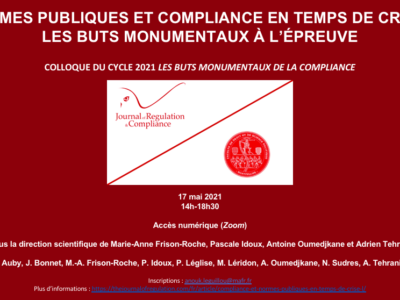
Full Reference: Frison-Roche, M.-A. Place and Role of Companies in the Creation and Effectiveness of Compliance Law in Crisis, Working Paper, May 2021.  -   This Working Paper has been elaborated as basis for a conference in the colloquium of Mai 17, 2021 (done in French: Normes publiques et Compliance en temps de crise : les buts monumentaux à l'épreuve. This video is made with English substitutes.  It is also the basis for an article in the book Compliance Monumental Goals, the English version of which is co-published by the Journal of Regulation & Compliance (JoRC) and Bruylant. Summary: This article has a very topic: the place of private Companies, with regard to the chapter's issue: "the ordeal of a crisis". The crisis constitutes a "test", that is to say, it brings evidence. Let us take it as such. Indeed, during the health crisis, it appears that Companies have helped the Public Authorities to resist the shock, to endure and to get out of the Crisis. They did so by force, but they also took initiatives in this direction. From this too, we must learn lessons for the next crisis that will come. It is possible that this has already started in the form of another global and systemic crisis: the environmental crisis. In view of what we have been able to observe and the evolution of the Law, of the standards adopted by the Authorities but also by the new case law, what can we expect from Companies in the face of this next Crisis, willingly and strength    Lire ci-dessous les développements.

Articles in a legal collective publication

RACINE, Jean-Baptiste🕴🏿

📝Compliance et Arbitrage. Essai de problématisation, in🕴🏿M.-A. Frison-Roche (ed.), 📕La juridictionnalisation de la Compliance

► Full Reference: J.-B. Racine, "Compliance et Arbitrage. Essai de problématisation" ("Compliance and Arbitration : Problematisation", in M.-A. Frison-Roche (ed.), La juridictionnalisation de la Compliance, coll. "Régulations & Compliance", Journal of Regulation & Compliance (JoRC) and Dalloz, 2023, pp. 265-279.  - 📕read a general presentation of the book, La juridictionnalisation de la Compliance, in which this article is published - ► The summary below describes an article that follows an intervention in the scientific manifestation Compliance et Arbitrage, co-organised by the Journal of Regulation & Compliance (JoRC) and the University Panthéon-Assas (Paris II). This conference was designed by Marie-Anne Frison-Roche and Jean-Baptiste Racine, scientific co-directors, and took place in Paris II University on March 31, 2021.  In the book, the article will be published in Title II, devoted to: Compliance et Arbitrage. - ► Summary of the article (done by the author): Under the consideration of the "Compliance Juridictionalisation", it is necessary to study in the links between Compliance and Arbitration. The arbitrator is a judge, he is even the natural judge of international trade. Arbitration is therefore naturally intended to meet compliance which transforms the action of companies in an international context. However, the links between compliance and arbitration are not obvious. It is not a question of providing firm and definitive answers, but rather, and above all, of asking questions. We are at the start of reflection on this topic, which explains why there is, for the time being, little legal literature on the subject of the relationship between Compliance and Arbitration. It doesn't mean there aren't connections.  Quite simply, these relations may not have come to light, or they are in the making. We should research  the existing or potential bridges between two worlds that have long gravitated separately: Compliance on the one hand, Arbitration on the other. The central question is: is or can the arbitrator be a compliance judge, and, if so, how? In any event, the Arbitrator is thus in contact with matters requiring the methods, tools and logic of Compliance. In addition to the prevention and suppression of corruption, three examples can be given. Arbitration has been facing economic sanctions (notably embargoes) for several years. The link with Compliance is obvious, insofar as texts providing for economic sanctions are often accompanied by compliance mechanisms, as in the United States. The arbitrator is concerned as to the fate he reserves in the treatment of the dispute with the measures of economic sanctions. Competition Law is a branch that came into contact with Arbitration from the end of the 1980s. The arbitrability of this type of dispute is now established and arbitrators apply it regularly. At the same time, Compliance has also entered Competition Law, admittedly more strongly in the United States than in France. The existence, absence or insufficiency of a compliance program aimed at preventing violations of the competition rules are thus circumstances which may assist the arbitrator in the assessment of anti-competitive behavior. Environmental Law is also concerned. There is environmental Compliance, for example with regard to the French law of March 27, 2017 on the duty of vigilance. Companies are thus responsible for participating in the protection of the environment, by internalizing these concerns in their internal and external operations (in their sphere of influence). As soon as an arbitrator is in charge for settling a dispute relating to Environmental Law, the question of the relationship to Compliance, from this angle, naturally arises. It is therefore the multiple interactions between Compliance and Arbitration, actual or potential, which are thus open. -