Education

Des étudiants perplexes autour d’une table, deux ouvrages rouges posés devant eux, la chatte Nobelle au premier plan

Videos

Series of drawn videos on Compliance Law — Compliance in Motion

🎭The Mystery of the Monumental Goals

▶ click on the image to watch the episode on YouTube - ► Full reference: M.-A. Frison-Roche, “The Mystery of the Monumental Goals”, in series of drawn videos Compliance in Motion, episode 2, 2 October 2026 - ► Summary of this episode of Compliance in Motion: Students sit around a table; on the table, two books. Three words are given to them — Compliance Monumental Goals — and nobody really sees what that means. The Compliance Ogre, of course, is certain: “Me, me, me! I know what the Monumental Goals are!” And yet, it is no riddle. A Monumental Goal is an edifice: protecting the climate, stopping corruption, respecting others. Compliance Law does not merely forbid, it aims; and because the goal is monumental, no one builds it alone — the judge, the lawyer, the company, the teacher, each brings a stone. That is where Compliance Law draws its normativity, and that is what separates it from mere conformity. They are not decreed. They are built. At the end, the Ogre: “Yes, yes, yes — I said so!” He had not said so. Less than a minute, not a word spoken. One episode every two weeks, in French and in English. - 🌐 watch this episode of the series on YouTube: Compliance in Motion watch this episode of the series on Instagram: Compliance in Motion 🎬 watch this episode of the series below Compliance in Motion ⬇️ - Compliance in Motion, by mafr the series of drawn videos devoted to Compliance Law ComplianceTech® - follow Marie-Anne Frison-Roche on LinkedIn follow Marie-Anne Frison-Roche on Instagram subscribe to the Newsletter MAFR Regulation, Compliance, Law subscribe to the Video Newsletter MAFR Surplomb subscribe to the Newsletter MaFR Droit & Art

Organisation of events

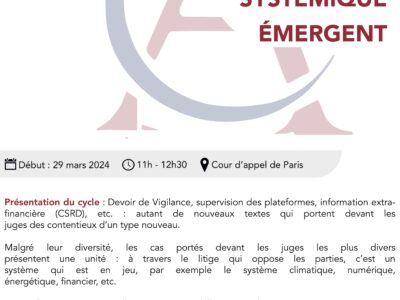
🧱⚙️Coordination of the cycle of conference-debates 🧮Contentieux Systémique Émergent – CSE (Emerging Systemic Litigation – ESL)

► Full Reference: M.-A. Frison-Roche, Coordination of the cycle of conference-debates Contentieux Systémique Émergent (Emerging Systemic Litigation), organised on the initiative of the Cour d'appel de Paris (Paris Cour of Appeal), with the Cour de cassation (French Court of cassation), the Cour d'appel de Versailles (Versailles Court of Appeal), the École nationale de la magistrature – ENM (French National School for the Judiciary) and the École de formation des barreaux du ressort de la Cour d'appel de Paris – EFB (Paris Bar School), under the scientific direction of Marie-Anne Frison-Roche - ► This Cycle in few words: Duty of vigilance, supervision of platforms, non-financial information (CSRD), etc.: as many new texts that bring new types of disputes before the courts. Despite their diversity, the cases brought before the most diverse judges present a unity: through the dispute that pits the parties against each other, it is a system that is at stake, for example the climate system, digital system, energy system, financial system, etc. New regulations are just the illustration of this "Emerging Systemic Litigation"; the conference-debates aiming at showing the new fields, new techniques, new standards, etc., in relation to the scale and diversity of stakeholders' expectations. This cycle is designed to encourage cross-fertilisation, so as to provide judges with food for thought ahead of the litigation they will be called upon to deal with. Les réglementations nouvelles ne sont que l’illustration de ce « contentieux systémique émergent » dont la formation a pour objet de montrer les nouveaux champs, les nouvelles techniques, les nouvelles normes, etc., en lien avec l’ampleur et la diversité des attentes des parties prenantes. Le cycle vise à favoriser les échanges croisés, afin d’alimenter la réflexion des magistrats en amont des litiges qui leurs seront soumis. - 🔴Registrations and information requests can be sent to: inscriptionscse@gmail.com 🔴For the attorneys, registrations have to be sent to the following address: https://evenium.events/cycle-de-conferences-contentieux-systemique-emergent/  ⚠️The conference-debates are held in person only, in the Cour d’appel de Paris (Paris Court of Appeal). - ► General Presentation of the Cycle: In 2024, the Cour d’appel de Paris (Paris Court of Appeal) created a new specialised chamber: chamber 5-12 Contentieux émergent – Devoir de vigilance et responsabilité écologique (Emerging litigation – Duty of vigilance and environmental liability). Vigilance litigation is an example of what is emerging more generally: Systemic Litigation, often linked to technologies. This calls for a new way of judging, organising procedures and relations between professionals. A series of conference-debates on Emerging Systemic Litigation (ESL) is being organised jointly by the Paris Court of Appeal, the Versailles Court of Appeal, the Cour de cassation (French Court of cassation), the École nationale de la magistrature – ENM (French National School for the Judiciary) and the École de formation des barreaux du ressort de la Cour d'appel de Paris – EFB (Paris Bar School), under the scientific responsibility of Professor Marie-Anne Frison-Roche. In this context, a series of conference-debates involving professionals from a wide range of backgrounds is being proposed on the following themes: 🧮the very notion of "Emerging Systemic Litigation" and the role of the judiciary in it (29 March 2024): read the report of this event   🧮vigilance, insofar as it gives rise to Systemic Litigation, notably because it takes legal form in numerous contracts, for example in employment relationships (26 April 2024): read the report of this event   🧮the inclusion in Emerging Systemic Litigation of information reliability techniques, particularly with regard to content available on platforms (27 May 2024): read the report of this event   🧮the way in which artificial intelligence is generating Systemic Litigation and the influence of new specific texts (24 June 2024): read the report of this event   🧮sustainability, a principle of systems found in reports and transitively in disputes concerning their development, their standards and even their control (9 September 2024): read the programme of this event   🧮new evidentiary techniques required by Emerging Systemic Litigation, to account for systemic needs, e.g. climate and digital systems, and how firms respond to them (14 October 2024): read the programme of this event   🧮Vigilance General Procedural Law, in that it incorporates the Systemic dimension of Vigilance Litigation (18 November 2024): read the programme of this event   🧮institutional and case law feedback from courts on Emerging Systemic Litigation (16 December 2024): read the programme of this event - 🧮read below the full programme of this cycle of conference-debates⤵️

Articles in a legal collective publication

📝L’appui du Droit de la Compliance pour la maîtrise quotidienne du Droit de la concurrence, in 🕴️C. Lemaire & 🕴️F. Martucci (dir.), 📗Liber Amicorum Laurence Idot. Concurrence et Europe

► Full Reference: M.-A. Frison-Roche, "L'appui du Droit de la Compliance pour la maîtrise quotidienne du Droit de la concurrence" ("The support of Compliance Law for the daily mastery of Competition Law"), in C. Lemaire & F. Martucci (eds.), Liber Amicorum Laurence Idot. Concurrence et Europe, vol. I, pref. C. Lemaire & F. Martucci, foreword B. Lasserre, Concurrences, 2022, pp. 369-374 - ► English Summary of the article: Competition Law has become so huge and has included so many regulations and "regulatory" perspective that we end up giving up trying to grasp it as a whole, preferring to become a specialist in one of its parts.  That would be to lose sight of the simple and strong reason that unites the whole and gives it its breath: Freedom. Freedom experienced by the persons in their daily economic action, Freedom guarded by Competition Law, always returning to its principle: Free Competition. Therefore, the European Union places great emphasis on Competition. To make effective and to keep it in this state, “Competition Policy” is based on Competition Law, but if authorities and judges do not blame companies for their power, they do not rely on it. To do this, Competition Law must be supported by Compliance Law, which strongly encourages companies to act for the effectiveness and the promotion of competitive principles. Competition Law is thus slipping from the Ex-Post towards the Ex-Ante, the commitments of companies leading them to cease being passive, even punished, to become convinced actors and themselves pedagogues. Something to please a great Professor of Competition Law, to whom homage is paid here. - 📗read the Table of Contents of the book in which this article is published (in French) - 🚧read the bilingual Working Paper which is the basis of this article, with additional developments, technical references and hyperlinks - 📝read the article (in French) - 🌐follow Marie-Anne Frison-Roche sur LinkedIn 🌐follow Marie-Anne Frison-Roche on Instagram 🌐subscribe to the Newsletter MAFR Regulation, Compliance, Law

Articles

LUGURI, Jamie and STRAHILEVITZ, Lior Jacob

Shining a Light on Dark Patterns

Full reference: Luguri, J. and Strahilevitz, L. J., Shining a Light on Dark Patterns, Journal of Legal Analysis, Vol. 13, Issue 1, 2021, 67p.  Sciences Po's students can read this article via Sciences Po's Drive in the folder MAFR – Regulation & Compliance. 

Articles in a legal collective publication

Pour une conception humaniste du Droit des affaires et de son enseignement (For a humanist conception of Business Law and of its teaching), in “Un juriste pluriel. Mélanges en l’honneur d’Alain Couret”

Full reference : Frison-Roche, M.A., Pour une conception humaniste du Droit des affaires et de son enseignement (For a humanist conception of Business Law and of its teaching), in Un juriste pluriel. Mélanges en l'honneur d'Alain Couret, Editions Francis Lefebvre and Dalloz, 2020, pp. 985-990.   Read the article   Read the working paper, with additional developments, technical references and hyperlinks on which this article is based   Read the general presentation of the book in which this article has been published

Working papers

🚧 Training, content and container of Compliance

This working document served as the basis for an article, contribution in the collective book Compliance Tools, 2020 - Summary of this working paper: Training is a specific Compliance tool and a dimension that each Compliance tool expresses.  Firstly, as a training it is a specific Compliance Tool, it is supervised by Regulators. It even becomes compulsory when it is contained in Compliance programs. Since the effectivity and the efficiency are legal requirements, what is therefore the margin of companies to design it and how can we measure its result? Secondly, as each Compliance Tool contains, more and more, an educational dimension, we can take back each of them to detect this perspective. Thus, even sanctions and prescriptions, are lessons: lessons given, lessons to follow. The question is then to know who, in this so pedagogic Compliance Law, are the "instructors"? -       Introduction: Training is akin to these things – and very precious – that we do, or even dream of doing, but so poorly expressed from the moment we take them as an object of technical writing. Just do it. It would be however unfortunate to publish a book on Compliance Tools without giving a particular place to training, the piece would miss in the puzzle. So much money spent by companies, by fair or foul means, especially when Compliance programs imposed as sanctions contain heavy training obligations leading people to retain word for word everything that is forbidden to them, in order to always abstain from now on. Training is thus the sharp point of such Hard Law appearing under the steel of Criminal Law's sword in amphitheaters and e-learnings.  But also so much speeches about the necessity of a "Compliance culture" which should be instilled to firms, Compliance spousing with joy in an harmony with their "raison d'être" and the historical identity of this group of people which is the company itself through trainings which tell Compliance as a link, an outstretched hand toward those with whom managers want to renew a moral contract in an ethic for which they give the good example. It is not Prohibition anymore but Communication and Community that set the tone of a human dialogue with employees, stakeholders, administration and judges.  It is possible to assume that the former does not exclude the latter, that Training should target all of this, the learning of mandatory prescriptions to follow without discussion but also the adhesion to guidelines, and this because everyone has understood that they are funded. Everything and its contrary, then. "Learning by heart" takes here its full sense: get everyone to remember mechanically in order for no one to misstep (with always more machines which massively teach us the regulatory corpus on our mobile screens) but also succeed in bringing our "heart" in Compliance, thanks to specific training methods (with always smaller groups, with always less public discussions in pleasant places). Everything and its contrary, then. It would be imperative but also sufficient to cumulate. Doing everything. Those who propose training softwares as those who organize conferences, meetings and travels and are favorable to this addition of face-to-face and distancing methods, of mechanic and of human relations. Concretely, at the end companies observe that since the first does not replace the second, costs add up. But, in Compliance, costs constitute a grave default of it, training taking a large part of this default. Managers end up finding the addition too heavy, especially if they thought that training of people is one of the public school's mission and not one of private companies' purpose. Moreover, training to Compliance is not outside Compliance Law, which makes it specific. Indeed, Compliance Law, corpus of Ex Ante mechanisms, targets to concretize "monumental goals". Set by public authorities, these monumental goals are internalized in companies in order for them to implement expected means in order for them to be reached in the future. These monumental goals can be negative (that corruption, money laundering, human rights violations, financial system crisis, etc. shall not occur), or positive (that ecological equilibrium shall be restored, that education shall be supplied, that healthcare shall be provided, etc.). Compliance Law takes as criteria of effectivity for implemented mechanisms, their reality, but also their efficiency, that is their ability to make sure their goal is achieved.Training must achieve its goal. Thus, in Compliance, the purpose is not only the one of every training, that is transmitting a knowledge in order to making the student more learned, but it is to contribute to the "monumental goal" of Compliance Law itself, which is a practical goal and not a scholar goal. For example, training about the applicable rules concerning corruption should have an effect to reduce corruption. And because corruption is itself a part of Compliance Law, in the same way the Regulation Authority can force to educate oneself or train others, the Supervision Authority should control not only the reality but also the effectivity and the efficiency of trainings.  However, the effectivity and the efficiency of Compliance training, because they are full part of Compliance Law, should be controlled by the Authority not only in their reality but also in their concrete ability to participate in the pursued goal. Thus, to keep the example of fight against corruption, training plays in it an essential role because the firm faces an alternative: either a mechanic solution consisting in setting literal interdictions, for example the interdiction to give up a value greater than a certain amount (according to the "anti-gift" rule) with the risk of getting around that every literal prescription offers, or a a solution by training consisting in explaining to everybody that it is wrong to corrupt but that it is acceptable to give samples. Training rather bets on spirit while the machine integrates the letter.  But this refers to the Regulation and Supervision Authority which will appreciate the company due diligences to reach the goals. One observes that, more and more, Authorities economize one step: rather than explain to the companies how educate people that work for them or with them, regulators educate directly.  Is on this point remarkable the "guide" published in 2012, whose second edition of 2019 has been updated in 2020, jointly by the Department of Justice (DoJ) and the financial regulator (Securities &Exchanges Commission – SEC) to know everything about the Foreign Corruption Practices Act (FCPA). Through the explanations offered to everyone of the principles, the reminded definitions, the told cases, they are behaviors prescriptions which are formulated especially for foreign companies by the prosecutor authority and the American sanction authority, allied in this handbook which has such weight that we can consider that it is as valuable as a guideline, soft law creator of Law and rights.  In the concentration of all powers which is often reproached to the Regulator, there is also the magisterium of the teacher, the one who educates stakeholders. After having assumed, on the American model, that the regulator should be the "advocate" of the rules for companies, proving to them the interest  that they have to respect them, it is logical that, in what some have called "Regulation, Act 2" this Regulator's pleading about the good news of Regulation for the firm justifying thus that this one integrates it in Ex Ante was prolonged in magistral lesson: the "regulator-institutor" explains to everybody how using rules for an always still in progress Law ("Better Regulation").  While training was before only peripheral, it is now at the heart. If it is so important, as every other "Compliance tool", it should take what we expect from it. The publications about training most often exhibit what it should be and a sorrowful spirit measures what sometimes appears as a huge gap between descriptions and realities sometimes reported.  Educating being without any doubt one of the most difficult actions, we should probably neither describe a paradise of maieutics nor write a hot paper against what already has  the merit to exist, but list what we can expect from Training mechanisms when they apply to Compliance, because here, rather more than for the other tools, it is a mean obligation. Which content should have a training ? (I). Because Compliance Law targets training as one of the mean to reach "monumental goals" which constitutes the substantial heart of this branch of Law, the training dimension is not limited to stamped training, finding back this pedagogical dimension in almost all the other tools (II). In that, Training appears as the alpha and the omega of Compliance.    

Articles in a legal collective publication

Au coeur du droit, du cinéma et de la famille : la vie (“At the heart of Law, Cinema and Family: Life”), preface of the book “La famille au cinéma. Regards juridiques et esthétiques” (“Family in Cinema. Legal and Aesthetic Perspectives”)

Full reference : Frison-Roche, M.-A., Au cœur du Droit, du cinéma et de la famille : la vie ("At the heart of Law, Cinema and Family: Life"), preface of La famille au cinéma. Regards juridiques et esthétiques ("Family in Cinema. Legal and Aesthetic Perspectives"), Florès-Longou, M. and Épinoux E. (ed.), coll. "Droit & cinéma",  Mare & Martin, 2016, pp. 21-27. Read a general presentation of the book Read the working paper from which the article was written, containing some notes and a hundred links, especially towards film extracts.  Read the article (in French) This introductive article, which constitutes the preface of the book, relies on approximatively one hundred movies to show that cinema does not stop to show legal situations and protagonists, even if "Family Law" seems to be less the darling child than the actors of the trial. We find the child, the mother and the father, the spouses and the engaged people. Often with the shape of drama, breaks and machinations and even murders, because it is like that that family appears on the screen. It is difficult to not fall asleep facing the peaceful happiness of happy families.   But why such a confluence between Cinema and Family Law?  Because both have a purpose: life.  Do not being anxious about family life, it is not understanding Family Law. And because Cinema take life itself as purpose, so when we want to learn Family Law, it is the path towards Cinema that we should take.   

Analyses

What is the law, ? : explanations by Muriel Fabre-Magnan

Introduction au droit.  The book of Muriel Fabre-Magnan is out. This is great. The law holds the attention of everyone all the time. Because daily life is full of law and there is the awareness of this. Because world live has a turn increasingly legal. Thus, the interest in the law is new, or at least has grown. But the law is off-putting for anyone who didn't study, who doesn't practice. This mass, which is enormous and as inert, seems belch through dramatic cases or convictions shattering. Thus, the desire to discover and to understand law seems meet a sort of end of inadmissibility, seems to be hampered by the legal matter itself. That is why everyone must buy Introduction au droit (Introduction to Law), the book (written in French) in the collection "Que sais-je ?" ("What can I know?"), by Muriel Fabre-Magnan. By reading this book of 124 pages, one can understand what may represent the law, not only for every day but also the law in society in a civilized world. The law is the key to a civilized system. But in a world which seems to be governed by the game of forces, the law is absent or just facade. Thus, reading, you'd think that the law is in fact very little … Read a presentation of the new edition of the Muriel Fabre-Magnan book : Introduction au droit.