digital

Articles in a JoRC book

The Government itself collects personal data on social networks, without the consent of the parties concerned, but for a good cause: the fight against tax fraud. What should we think about it legally?

The Finance Bill has proposed to the Parliament to vote an article 57 whose title is: Possibilité pour les administrations fiscales et douanières de collecter et exploiter les données rendues publiques sur les sites internet des réseaux sociaux et des opérateurs de plateformes (translation: Possibility for the tax and customs administrations to collect and exploit the data made public on the websites of social networks and platform operators). Its content is as is in the text voted on in the National Assembly as follows: "(1) I. – On an experimental basis and for a period of three years, for the purposes of investigating the offenses mentioned in b and c of 1 of article 1728, in articles 1729, 1791, 1791 ter, in 3 °, 8 ° and 10 ° of article 1810 of the general tax code, as well as articles 411, 412, 414, 414-2 and 415 of the customs code, the tax administration and the customs administration and indirect rights may, each as far as it is concerned, collect and exploit by means of computerized and automated processing using no facial recognition system, freely accessible content published on the internet by the users of the online platform operators mentioned in 2 ° of I of article L. 111-7 of the consumer code. (2) The processing operations mentioned in the first paragraph are carried out by agents specially authorized for this purpose by the tax and customs authorities.   (3) When they are likely to contribute to the detection of the offenses mentioned in the first paragraph, the data collected are kept for a maximum period of one year from their collection and are destroyed at the end of this period. However, when used within the framework of criminal, tax or customs proceedings, this data may be kept until the end of the proceedings. (4) The other data are destroyed within a maximum period of thirty days from their collection. (5) The right of access to the information collected is exercised with the assignment service of the agents authorized to carry out the processing mentioned in the second paragraph under the conditions provided for by article 42 of law n ° 78-17 of January 6, 1978 relating to data processing, the files and freedoms. (6) The right to object, provided for in article 38 of the same law, does not apply to the processing operations mentioned in the second paragraph. (7) The terms of application of this I are set by decree of the Council of State. (8) II. – The experiment provided for in I is the subject of an evaluation, the results of which are forwarded to Parliament as well as to the National Commission for Data Protection at the latest six months before its end. "   This initiative provoked many comments, rather reserved, even after the explanations given by the Minister of Budget to the National Assembly. What to think of it legally? Because the situation is quite simple, that is why it is difficult: on the one hand, the State will collect personal information without the authorization of the persons concerned, which is contrary to the very object of the law of 1978 , which results in full disapproval; on the other hand, the administration obtains the information to prosecute tax and customs offenses, which materializes the general interest itself. So what about it? Read below.

Reports

Autorité des marchés financiers (French financial markets regulator)

La cybercriminalité boursière. Définition, cas et perspectives (Stock market cybercriminality. Définition, cases and perspectives)

Full reference: Alexandre Neyret, La cybercriminalité boursière. Définition, cas et perspectives (Stock market cybercriminality. Définition, cases and perspectives), Report to l'AMF, 10th of October 2019, 70p. Read the report (in French)

Breaking news

BY BASIC TECHNOLOGY, MANY SITES BLOCKTHE INTERNET USERS THE POSSIBILITY TO SAY “NO”:THEY “CONSENT” TO TRANSFER THEIR PERSONAL DATA, WITHOUT OTHER TECHNOLGICAL CHOICES THAN THAT OF “ALL ACCEPT”. THE LINK BETWEEN “CONSENT” AND “FREE WILL” IS THEREFORE BROKEN

Experience shows that in the digital the legal technique of consent is not protective enough.   If only because a simplest technology neutralizes the link that should exist between the "consent" of the user and the "free will" of the latter: the consent of the user only protects the latter to the extent that this one can in Law and in fact to say "no.     I. THE EXPERIENCE    For example I found on my Facebook New an access to an unknown web site which puts online an article on "the rights of trees" … I go. In accordance with the European Regulation (GDPR) transposed into French legal system, the site informs that there is possibility for the user to accept or refuse the use of their personal data for the benefit of "partners". If they continue reading, the user is supposed to accept everything, but they can click to "customize". I click: there I find two options: "accept everything" or "reject everything". But the "reject all" option is disabled. It is only possible to click on the "accept all" option.   It is also possible, because the law obliges, to consult the list of the partners of this website: I click and find a list of unknown companies, with foreign denominations, which without doubt once will collect my personal data (and those of my contacts) , having their own head office outside the European Union. It is stated in a text, which can not be copied, that these "partners" can use my data without my consent and for purposes that they do not have to inform me. But, again, these things I can "refuse everything". Here again the "reject all" mention exists but the fonctionality is not active, while the mention "accept all" is an active fonctionality.   As I can not refuse (since it's disabled), and as 99% of Internet users have never clicked on the first two buttons, all their data has been fed into the data market that allows the targeting of products that spill out in the digital space, to their detriment and that of their contact. While believing to read a free article on the "right of the trees". At the end, I do not read this article, since I did not click on the only active buttons: "accept everything".   In more than 50% of cases, the "reject all" or "customize" options are only images but are not active. And data absorption is also about contacts. In exchange for a whimsical article about trees and their rights, or creams to be always young, or celebrities who change spouses, or about so-called tests to find what king or queen you should be if the all recognized all your merits, etc. Proposed on the digital news feed by unknown sites; in partnership with foreign companies that you will never reach. And mass-viewed by Internet users who are also told that "consent" is the proven solution for effective protection …. While these are just panels hastily built by new Potemkins …   II. WHAT TO DO ?    1. Not be satisfied with "consent" from the moment that it is a mechanism that may not be the expression of a free will: how could it be if the option "to refuse" is not active?   2. The link between will and consent must therefore be "presumed" only in a simple presumption and in a non-irrefutable way, because we must refuse to live in a dehumanized society, operating on "mechanical consents", to which the digital does not lead necessarily.   3. Entrust by the Compliance Law to the "crucial digital operators" (in the case of Facebook thanks to which these proposals for free reading are made on the thread of news of the Net surfers) the care to verify in Ex Ante the effectiveness of the link between Will and Consent: Here and concretely the possibility for the user to read while refusing the capture of all its data (for the benefit of operators who do not even have the concrete obligation to give the information of the use that will be made of these personal data).   -

Working papers

🚧 Having a good behavior in the digital space

►  Complete reference : Frison-Roche, M.-A., Having a good behavior in the digital space, working paper, April 2019. - 📝  This working document serves as a basis for a contribution to the collective book dedicated to Professor Michel Vivant, article written en French.   Summary: The jurist sees the world through the way he learns to speak1Cornu, G., Linguistique juridique, 2005. , legal vocabulary build by Law itself, whether in common law or in civil law. Thus, we think we are dealing with the human being who does not move, taken by the legal notion expressed by the term "person", their body and their biological development in time, from the birth to the death, holding entirely in this hollow of that word "person", while the behavior of the human being with regard to the world, others and things, are grouped in other branches of Law: the Contract and Tort Law and the Property Law, which are only what people do with and about things. The Law of the Environment has already come to blur this distinction, so finally so strange because this classical conception refers to a person taken firstly in his immobility (Law of individuals), and then in his only actions (Contrats and Tort Law, Property Law). Indeed, the very notion of "environment" implies that the person is not isolated, that he/she is "surrounded", that he/she is what he/she is and will become because of what surrounds him/her ; in return the world is permanently affected by his/her personal action. On second thought, when once "Law of Individuals" was not distinguished from Family Law, the human being was more fully restored by this division in the legal system that not only followed him/her from birth to death but also in him/her most valuable interactions: parents, siblings, couples, children. Thus Family Law was finer and more faithful to what is the life of a human being. To have instituted Law of Individuals, it is thus to have promoted of the human being a vision certainly more concrete, because it is above all of their identity and their body about what Law speaks, astonishing that we have not noticed before that women are not men like the others. To have instituted the Law of the people, it is thus to have promoted of the human being a vision certainly more concrete, because it is above all of his identity and his body that one speaks to us, astonishing that the we have not noticed before that women are not men like the others2Frison-Roche, M.-A. & Sève, R., Le Droit au féminin (ed.), 2003. without however remembering that abstraction is sometimes the best of protections3Under this "mask" of the "subject of Law", we are all equal. S. Archives de Philosophie du Droit, Le sujet de droit, 1989..  But it is also to have isolated human beings, split from what they do, what they touch, what they say to others. It is by taking legally a static perception of a "man without relationship". We have gone from the legal individualism of the Law of the sole man. From this concrete vision, we have all the benefits but Law, much more than in the eighteenth century, perceives the human being as an isolated subject, whose corporeality ceases to be veiled by Law4Baud, J.P., L'affaire de la main volée. Histoire juridique du corps humain, 1993. , but for whom the relation to others or to things does not define him or her. Which brings the human being a lot closer to things. An human being who is a legal subject who does what they wants, as they can, limited by the force of things. But in fact things are so powerful and the human being, in fact, so weak. For example, the marks people leave are erased by time. Their grip on the world stops at the extent of their knowledge, the time and money they have, building to use better their own time and to reach projects that they designed, In this conception, Person and Liberty are one, returning the subject to their solitude. This freedom will come into conflict with the need for order, expressed by society, social contract, state, law, which imposes limits on freedom of one to preserve freedom of the other, as recalled by the French Déclaration des Droits de l'Homme  of 1789. Thus, it is not possible de jure to transform every desire in action,, even though the means would be within reach of the person in question, because certain behaviors are prohibited in that they would cause too much disorder and if they are nevertheless committed, they are punished for order to return. Thus, what could be called "law of behavior", obligations to do and not to be put in criminal, civil and administrative Law, national and international Law, substantial Law and procedural Law :they will protect the human being in movment pushed by the principle of freedom forward others and thing, movement inherent in their status as a Person.  The human being is therefore limited in what they want to do. In the first place by the fact: their exhausting forces, their death that will come, the time counted, the money that is lacking, the knowledge that they does not even know not holding, all that is to say by their very humanity; Secondly, by the Law which forbids so many actions …: not to kill, not to steal, not to take the spouse of others, not to pass as true what is false, etc. For the human being on the move, full of life and projects, Law has always had a "rabat-joy" side. It is for that reason often ridiculous and criticized because of all its restraining regulations, even hated or feared in that it would prevent to live according to our desire, which is always my "good pleasure", good since it is mine. Isolated and all-powerful, the human being alone not wanting to consider other than its desire alone. Psychoanalysis, however, has shown that Law, in that it sets limits, assigns to the human being a place and a way of being held with respect to things and other persons. If one no longer stands themselves by the prohibition of the satisfaction of all desire (the first of which is the death of the other), social life is no longer possible5On neurosis as a constitutive mode of child sociability, s. Lebovici, S., "C'est pas juste", in La justice. L'obligation impossible, 1994. . Thank to the Law, everyone follows the same Rule at the table, from which a discussion can take place between guests and without which it can not6Read the article of Alain Supiot about the idée of Rule common of all, under the discussion between all, presented by this author through the artwork of Kafka : "Kafka, artiste de la loi", 2019; Kafka is very present in the work of Alain Supiot, for example in his First Lesson in the Collège de France, 2012, or in an Introduction of La Gouvernance par les nombres ; This latter book is now available in English : Governance by numbers. The making a legal model of allegiance, 2017 (translated by S. Brown). . You stand straight in your chair, you do not eat with your fingers, you do not speak with your mouth full, you do not interrupt the speaker. Admittedly, one often learns at the beginning of the learning of the Law that one should not confuse "politeness" and Law. That these rules are politeness and that this is not Law … But this presentation aims to make it possible to admit that the criterion of Law would be in the effectiveness of a sanction by the public power: the fine, the prison, the confiscation of a good, which the rudeness does not trigger whereas Law would imply it: by this way we are thus persuaded of the intimacy between the public power (the State) and Law… But later, after this first lesson learned, the doubt comes from the consubstansuality between Law and State. Is it not rather appropriate to consider that Law is what must lead everyone to "behave well" with regard to things and people around them? The question of punishment is important, but it is second, it is not the very definition of Law. The French author Carbonnier pointed out that the gendarme's "kepi" is the "Law sign", that is to say what it is recognized without hesitation, but it is not its definition. The first issue dealt with by Law is then not so much the freedom of the person as the presence of others. How to use one's freedom and the associated deployment of forces in the presence of others? How could I not using it when I would like to harm them, or if the nuisance created for them by the use of my free strength is indifferent to me7That's why splitting Persons Law and Family Law masks another reality: the family is not made up of third parties. The links are there. They pre-exist. Starting from the only Persons Law pushes to think one can "build" his/her  family by links drawn on white paper: the contracting of the families made up of individuals becomes thinkable, even natural. How can Law lead me to use my means for their benefit while our interests do not converge?  We do not use our force against others because we have interest or desire, we do not give him the support of our strength while he indifferent us, because Law holds us. If the superego was not enough. If Law and the "parental function of the States" did not make alliance. We do it because we hold ourselves Or rather we were holding ourselves. Because today a new world has appeared: the digital world that allows everyone not to "hold" himself, that is to say to constantly abuse others, never to take them into consideration, to attack massively. It's a new experience. It is not a pathological phenomenon, as is delinquency (which simply leads to punishment), nor a structural failure in a principle otherwise admitted (which leads to regulatory remedies) but rather a new use, which would be a new rule: in the digital space, one can do anything to everyone, one is not held by anything or anyone, one can "let go" (I). This lack of "good behavior" is incompatible with the idea of ​​Law, in that Law is made for human beings and protect those who can not afford to protect themselves; that is why this general situation must be remedied  (II).

Reports

📓 L’apport du Droit de la Compliance dans la Gouvernance d’Internet (The contribution of Compliance Law in the Governance of Internet))

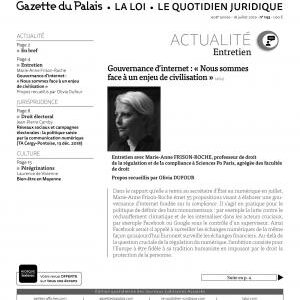
► Full Reference: M.-A. Frison-Roche, L'apport du Droit de la Compliance dans la Gouvernance d'Internet  (The contribution of Compliance Law to the Internet Governance), Report asked by the French Government, published the 15th of July 2019, 139 p. - ► Report Summary. Governing the Internet? Compliance Law can help. Compliance Law is for the Policy Maker to aim for global goals that they require to be achieved by companies in a position to do so. In the digital space built on the sole principle of Liberty, the Politics must insert a second principle: the Person. The respect of this One, in balance with the Freedom, can be required by the Policy Maker via Compliance Law, which internalises this specific pretention in the digital companies. Liberalism and Humanism become the two pillars of Internet Governance. The humanism of European Compliance Law then enriches US Compliance law. The crucial digital operators thus forced, like Facebook, YouTube, Google, etc., must then exercise powers only to better achieve these goals to protect persons (against hatred, inadequate exploitation of data, terrorism, violation of intellectual property, etc.). They must guarantee the rights of individuals, including intellectual property rights. To do this, they must be recognized as "second level regulators", supervised by Public Authorities. This governance of the Internet by Compliance Law is ongoing. By the European Banking Union. By green finance. By the GDPR. We must force the line and give unity and simplicity that are still lacking, by infusing a political dimension to Compliance: the Person. The European Court of Justice has always done it. The European Commission through its DG Connect is ready.   ► 📓 Read the reporte (in French) 📝 Read the Report Summary in 3 pages (in English) 📝 Read the Report Summary in 6 pages (in English) -   ►  Plan of the Report (4 chapters): an ascertainment of the digitization of the world (1), the challenge of civilization that this constitutes (2), the relations of Compliance mechanisms as it should be conceived between Europe and the United States, not to mention that the world is not limited to them, with the concrete solutions that result from this (3) and concrete practical solutions to better organize an effective digital governance, inspired by what is particularly in the banking sector, and continuing what has already been done in Europe in the digital field, which has already made it exemplary and what it must continue, France can be force of proposal by the example (4). -   📝  Read the written presentation of the Report done by Minister Cédric O (in French). 🏛 Listen to the oral  presentation of the Report by Minister Cédric O durant the parliamentary discussion of the law against hate contente on the Internet (in French). -   💬 Read the interview published the 18 July 2019 : "Gouvernance d'Internet : un enjeu de civilisation" ( "Governing Internet: an Issue of Civilization"), given in French,  📻 Listen the Radio broadcast of July 21, 2019 during which its consequences are applied to the cryptocurrency "Libra" (given in French) 🏛 Presentation of the Report to the Conseil Supérieur de l'Audiovisuel- CSA (French Council of Audiovisual) on Septembre 5, by a discussion with its members presentation (in French) 💬 Read the  Interview published the 20 December 2019 : "Le droit de la compliance pour réguler l'Internet" ("Compliance Law for regulate Internet"), given in French -     read below the 54 propositions of the Report ⤵️ - 🌐 follow Marie-Anne Frison-Roche on LinkedIn 🌐follow Marie-Anne Frison-Roche on Instagram 🌐subscribe to the Newsletter MAFR Regulation, Compliance, Law 

Working papers

🚧 Competition Law & Compliance Law

► Full Reference: Frison-Roche, M.-A., Competition Law & Compliance Law , Working Paper, October 2018. -   ► this Working Paper has served as basis for an Article published later in French in the Review Concurrences  ; read the presentation in English of this Article.  -   ► Summary and introduction : Compliance Law is a new branch of Law, still under construction. One can have a "narrow definition" of seeing it as the obligation of businesses to show that they are constantly and actively complying with the law. One can have a richer definition, of a substantive nature, defining it as the obligation or the own will of certain companies to achieve "monumental goals" that go beyond economic and financial performance.The Competition Law partly integrates its two conceptions of Compliance: Precursor, the Competition Law concretizes dynamically the first conception of the Compliance Law (I) It is with more difficulties but also much more future that the Competition Law can express in dialectic the second conception of the Compliance Law as internationalization of these "monumental goals", especially in the digital space (II).

Working papers

🚧 To protect human beings, the ethical imperative of the legal concept of person

►   This working document was intended to serve as a support for a conference pronounced in French in the conference Droit et Ethique ( Law & Ethics) of May 31, 2018 in a symposium organized by the Court of Cassation and the Association Française de Philosophie du Droit.  French Association of Philosophy of Law on the general theme Law & Ethics. See a general presentation of this conference.  Rather, it has served as a support for the article to be published in the Archives de Philosophie du Droit (APD). This article is written in French.    ►   Summary: It is through the Law that the human being has acquired a unity in the West (I). What religion could have done, the Law also did by posing on each human being the indetachable notion of him of "person" (I.A). But this is what is challenged today, not the personality and the power that the human being has to express his freedom but the unity that implies in the disposition that we have of ourselves in repelling the desire that others have always had to dispose of us. Current law tends to "pulverize" human beings into data and transform into neutral legal services what was considered before as the devouring of others. The legal concept of "consent", ceasing to be proof of a free will but becoming an autonomous concept, would suffice (I.B.). To prevent the reigning of the "law of desires", which merely reflects the adjustment of forces, we must demand here and now the ethical sovereignty of Law, because Law can not be just just be just the interests adjustment (II). We can form this request if we do not want to live in an a-moral universe (II.A), if we see that the unity of the person is the legal invention that protects the weak human being (II.B.). If we admit this imperative, then we must finally ask who in the legal system will express and impose it, especially the legislator or the judge, because we seem to have lost the ability to recall this principle of the Person on which the West was so centered. But the principles that are no longer said disappear. There would then remain only the case-by-case adjustment of interests between human beings in the world field of particular forces. At this yardstick, Law would be more than a technique of securisation of particular adjustments. Law would be reduced at that and would have lost its link with Ethics. (II.C). .   

Articles

Cambridge Analytica: Probationary Perspective, Accountability Perspective

It is about a particular case that one can rephrase the general questions. If the case is hot, it is even more important to return to the general questions, which are always colder (more boring, too). Thus, Cambridge Analytica is a case of which everyone speaks a lot … It is at the same time particular and very burning. So we talk about it a lot, and with vehemence, and in a way often definitive, as well in attack as in defense. For the prosecution, there are many advocacies, gathered for example in the Guardian's files. For the defense, we find less. But one can read for example the article that has been published in early April 2018: Why (almost) everything reported about the Cambridge Analytica Facebook 'hacking' controversy is wrong. The number of comments, and their more or less inflamed nature, in any case always definitive, does not mean anything in itself. The regulators took the floor a little later, both in a more concrete way, the "group of 29" (bringing together all the European Regulators personal data) establishing the 11 April 2018 a working group on this subject and publishing April 10, 2018 new guidelines on the place that must be made to "consent". But for the moment, if we loof at the media, it looks like a trial, because everyone claims to be entirely right and pretends that the other is entirely wrong. Trial to break the truth and virtue, say the accusers. Trial in witchcraft, says Facebook. And it's always up to us. Because all this is probably due to the fact that we are no longer spectators: we are placed in the judge's position. The financial market was the first judge. It has already condemned. Without really trying to find out. This is because the public good of the financial markets is Trust, it is enough that one can even suspect the wife of Caesar, and so it is not really matter of truth of the facts and goof application of Rule of Law. For the public opinion that we are, this is something else, because we could wait to know more. And we should, since we seek to remain a little attached to the "truth " of the facts and respect for the Rule of Law. However, this case is complex and is above all a matter of judicial analysis which will come and which we cannot lead ourselves, both in terms of the facts-which are complex-as well as the rules of law to be applied which are equally so. What turns us into a court, an ordinary sociological phenomenon, is a new legal mechanism: the "whistleblower". By nature, it gives the bonus to the Attack This logic of the legal mechanism of the whistleblower, a movement of fact to throw facts as one throws a buoy outside but one could also say stones on the firm that the insider denounces, logic today encouraged and protected by the Law, allows a person who knows something, most often because he participated, to let everyone know, without a filter. To denounce it. For the public good.. The successive texts on the whistleblower are nrms of a Compliance Law1Frison-Roche, M.-A., Compliance Law, 2016. which seek, in particular in French Law, to ensure a balance between this "monumental goal"2On this notion, Frison-Roche, M.-A., From Regulation Law to Compliance Law, 2017. which is the respect of the truth, the fight against corruption, the protection of human beings, etc., and the risks to be endured by the company thus denounced. The case is exemplary of this, since Facebook is  "denounced" only in second place, behind Cambridge Analytica, but the notoriety and power of the first makes that it is hit first. French law in the so-called "Sapin 2 Act " of 2016 has ensured to protect the company denounced, but British and American Law are more violent, probably because they encourage more the private enforcement. Temporality is therefore favorable to the attack. The time of the defense is always slower. It is usually the people in situations of weakness who suffer it: slowness of justice, justice outside courthouses, etc. With Compliance mechanisms, it is probably the very powerful who will live this. It is not a matter of rejoicing: the misfortune of some (here the difficulty of a company hasty  "judged") does not console in any way the misfortune of others (the difficulty of ordinary beings accused or having only the right to protect themselves to reach concretely a judge and really get a judgment executed, even as they are in their right). But if we go to general questions, since on the facts of this case we don't have the means to appreciate them, nor on the rules which apply to them, we cannot apply them in an adequate way until a court will have exercised its office? However, the general perspectives highlighted by this singular case are two orders: Probationary order (I) and Accountability order (II).     Read below.          
Articles

Jesus legally replaces Caesar. The image of currencies and the idea of security

Cryptocurrencies seem to be admitted, delivered from the State. And many rejoiced. Let's take the question on the side of Law. In France, we remember an article written in 1968 by the great lawyer Carbonnier : L'imagerie des monnaies  (Imagery of Coins), seeing in Caesar's face engraved on the coin the image of the State itself, guarantor of the entire monetary and exchange system. In Europe, we remember the discussions on the image of the euro, how each state in the zone could express its existence while the guarantee was common and concentrated in the same central bank, preferring a public building to a character. Today the currencies to be virtual do not have less an "image". One could even say that they have only that, since it is no longer the State which, by the face of Caesar is inserted there. But other faces can be imbued. Could the law find fault with it, because some figures would be "reprochable" because only Caesar would be beyond reproach? Could the Law draw any consequences from it, because some figures would be "engaging", less than that of Caesar but still a little? Certainly, not faces that the Criminal Law rejects, not that of Jack the Ripper, not that of Hitler. But other historical figures less clearly banned, in this period where it is easily argued that everything would be "questionable" and therefore admissible and that besides everything would be "to discuss", the currency thus expressing this flow of discussion , speech that goes from hand to hand, from post to post on virtual networks? Still, figures are block around them. This is particularly true in communities that can thus elect them to trust each other: just like their "Caesar", and knowing each other well, lend themselves more easily with confidence, to pay each other, while they would not lend to others, they would not buy from others. Why no. Since we accept the principle of this currency, based on the only technical security (double encryption) and trust between people (intersubjectivity of a circle that has been chosen), without mentioning the issue of the debtor as a last resort, in order to challenge Caesar and public finances. But let us take the hypothesis that the figure embedded in the virtual currency is that of Jesus. And the hypothesis is not fancy. Indeed, the "religious currencies" are multiplying. And the platforms that offer them insist on the fact that these tokens that are exchanged between people who believe in Jesus place great trust in the "son of God" and are therefore particularly trusting each other, for example in their respective capacity to keep their commitment. Outside the Law. On their respective ability to help each other. Outside the Law. Is it necessary to forget the affirmation that it was necessary "to render to Caesar what was Caesar's"? Let's ask some questions in Law. – Reflections on what could or should be the "regulation" of non-state currencies, whether we call them virtual or not (in what does this change the nature of the currency?), That we secure them by encryption technology and / or by the decentralization of information, should they also relate to images? – Are non-state currencies so much that the religious image, as long as it is not contrary to public order, is permissible, notably in legal systems where the constitutional principle of secularism has as its object and effect not only to neutralize the religious significance of religious objects but also to protect religious freedom? – Can "religious currencies" be protected and have specific economic and financial significance, as the United States Supreme Court admitted in the Hobby Lobby judgment of June 30, 2014? Europe is not the United States. – If the image of Jesus is encrusted on the currency, can we consider that the corpus is also inserted so that the platform that attracts a particularly interesting clientele (solvent, "responsible", holding its commitments, etc.) ? This insertion of the religious corpus, as the state was through the face of Caesar would operate not de jure but de facto, so that the company holding the platform should respond to third parties by the factual belief that this may have generated in third parties. – Moreover, do not these "religious currencies" produce a specific systemic risk? Not that such and such a religion could collapse, or this or that religious effigy to undergo a haircut with a domino effect on all the saints, waves of doubt provoking a mistrust of all the faithful ones because the various religions are doing well, but precisely because the mark of these religious communities to which these platforms specifically appeal is to make "their own law" prevailing over the law of the Dtate, considered inferior since it comes only from men and not from God. And now the churches are starting to coin money… At the very least, it will be necessary in Ex Post that the faithful do not come to seek the state by guaranteeing if there is bankruptcy, because Caesar does not meddle in the affairs of Jesus. To each his currency and each to reread Carbonnier, one of the finest readers of the Bible -