Court

Organisation of events

🧱⚙️scientifi organisation and moderation of 🧮Le Droit processuel de la Vigilance (Vigilance General Procedural Law), in cycle de conférences-débats “Contentieux Systémique Émergent”

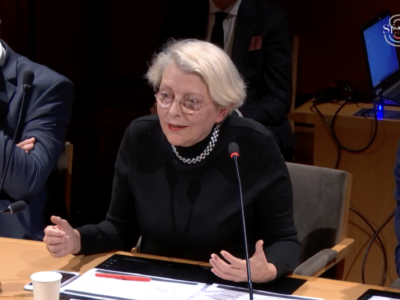
► Full Reference: Le Droit processuel de la Vigilance (Vigilance General Procedural Law), in cycle of conference-debates "Contentieux Systémique Émergent" ("Emerging Systemic Litigation"), organised on the initiative of the Cour d'appel de Paris (Paris Cour of Appeal), with the Cour de cassation (French Court of cassation), the Cour d'appel de Versailles (Versailles Court of Appeal), the École nationale de la magistrature – ENM (French National School for the Judiciary) and the École de formation des barreaux du ressort de la Cour d'appel de Paris – EFB (Paris Bar School), under the scientific direction of Marie-Anne Frison-Roche, November 18, 2024, 11h-12h30, Cour d'appel de Paris, Cassin courtroom - ► Presentation of the conférence:  - 🧮Programme of this event:  Seventh conference-debate LE DROIT PROCESSUEL DE LA VIGILANCE (VIGILANCE GENERAL PROCEDURAL LAW) Paris Court of Appeal, Cassin courtroom Presentation and moderation par Marie-Anne Frison-Roche, Professor of Regulatory and Compliance Law, Director ot the Journal of Regulation & Compliance (JoRC) 🕰️11h-11h20. 🎤, by 🕴️Marie-Anne Frison-Roche, Professor of Regulatory and Compliance Law, Director ot the Journal of Regulation & Compliance (JoRC) 🕰️11h20-11h40. 🎤, by 🕴️Natalie Fricero, Emeritus Professor of Law at Côte d'Azur University 🕰️11h40-12h30. Debate - 🔴Registrations and information requests can be sent to: inscriptionscse@gmail.com 🔴For the attorneys, registrations have to be sent to the following address: https://evenium.events/cycle-de-conferences-contentieux-systemique-emergent/  ⚠️The conference-debates are held in person only, in the Cour d’appel de Paris (Paris Court of Appeal). -

Articles in a legal collective publication

💬”Les droits de la défense sont au bénéfice de tout le monde, y compris de l’entreprise elle-même” (The rights of defence benefit everyone, including the company itself)

► Full Reference: M.-A. Frison-Roche, "Les droits de la défense sont au bénéfice de tout le monde, y compris de l’entreprise elle-même" (The rights of defence benefit everyone, including the company itself), interview by Chloé Lassel, in Guide Compliance Fraudes Investigations, edition 2024, ed. Décideurs, Oct. 2024, pp. - 💬read the interview (in French) 🌐its  présentation on LinkedIn (in French) - ► Presentation of this interview by Décideurs juridiques : "Directrice du Journal of Regulation & Compliance (JoRC) et fondatrice de l’École européenne de droit de la régulation et de la compliance, Marie-Anne Frison-Roche revient sur la révolution du droit de la compliance, son articulation avec les enquêtes internes et les droits de la défense, la place que vont y prendre les contrats et l’arbitrage international." ("Marie-Anne Frison-Roche, Director of the Journal of Regulation & Compliance (JoRC) and founder of the European School of Regulatory and Compliance Law, looks back at the revolution in Compliance Law, its relationship with internal investigations and the rights of the defence, and the role that contracts and international arbitration will play in it. - ► Questions asked, Answers given:  Décideurs. Question : La compliance est au cœur des préoccupations des entreprises depuis plusieurs années. Pouvez-vous expliquer ce que c’est exactement ? (Compliance has been a key concern for companies for several years. Can you explain what it is exactly?) Marie-Anne Frison-Roche. English summary Answer: 'Compliance' should not be confused with 'Compliance', which I defined in 2016. Compliance Law is an extension of Regulatory Law, by freeing the latter from the existence of a sector as a prerequisite and a regulatory authority as an indicator. Internalised in the company, it manifests itself, for example, in Vigilance mechanisms, which are its cutting edge. Through Compliance, the political authority asks companies to help it achieve "Monumental Goals", as I have suggested, standards in which this new branch of Law is anchored (anti-money laundering, anti-corruption, sustainability, etc.).   D. Q. : Les entreprises doivent désormais être enquêtrices et juges de ce qu’il leur arrive. Voire transmettre aux autorités, lorsqu’il le faut, des informations pouvant les incriminer. Comment concilier ces obligations avec les droits de la défense ? (Companies must now be investigators and judges of what happens to them. When necessary, they can even pass on incriminating information to the authorities. How do you reconcile these obligations with the rights of the defence?) MaFR. English summary A.: In 2023, I proposed this expression of companies as "prosecutors and judges of themselves", and the place that this should give to the rights of the defence, and in 2024 I will work out the right balance between internal investigations and the rights of the defence. For the moment, this balance has not been achieved.   D. Q. : Dans l’un de vos ouvrages, François Ancel, conseiller à la première chambre civile de la Cour de cassation, écrit que la compliance renouvelle l’office du juge. Comment concilier cette idée avec l’office habituel du juge qui est celui de se prononcer sur des faits avérés et non pas futurs ? (In one of your books, François Ancel, judge in the First Civil Chamber of the French Court of Cassation, writes that Compliance is renewing the role of the judge. How do you reconcile this idea with the judge's usual role, which is to rule on proven facts rather than future ones?) MaFR. English summary A.: Indeed, In this book La juridictionnalisation de la compliance (Compliance Jurisdictionalisation), he stresses that the role of the civil and commercial courts is being profoundly renewed, in particular because they must deal with what I described in 2021 as "Systemic Litigation" and must rule on the future. From then on, the ordinary courts will take centre stage.   D. Q. : Le recours aux clauses de compliance est-il une solution pour être à la hauteur des ambitions de la compliance et de ses exigences ? (Is the use of compliance clauses a solution for living up to the ambitions and requirements of compliance?) MaFR. English summary A.: Indeed, in 2022, I developed the concepts of 'Compliance Contract' and 'Compliance clauses', by which companies implement their legal compliance obligations. This gives rise to Regulatory Contracts, particularly in business chains. This gives a great deal of leeway and power, but also Responsibility, to the companies that invent them.   D. Q. : Le recours aux arbitrages doit-il être privilégié ? (D. Q. Should recourse to arbitration be preferred?) MaFR. English summary A.: It has to be. Because there is a contract. Even though Compliance is closely bound up with the legal obligations and public order, and possibly international public order. Even if this is not yet apparent, Compliance and International Arbitration are natural allies. - 🌐follow Marie-Anne Frison-Roche on LinkedIn 🌐follow Marie-Anne Frison-Roche on Instagram 🌐subscribe to the Newsletter MAFR. Regulation, Compliance, Law 🌐subscribe to the Newsletter Surplomb, par MAFR

Articles in a legal collective publication

Article in a collective legal publication

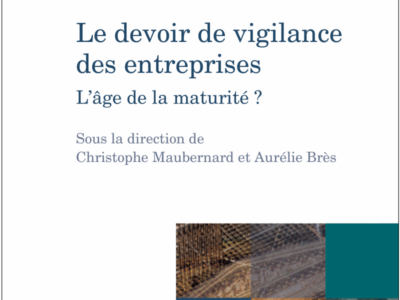
📝Devoir de vigilance : progresser (“Duty of Vigilance: the Way Forward), in 🕴️Ch. Maubernard & 🕴️A. Brès (eds.), 📗Le devoir de vigilance des entreprises. L’âge de la maturité ?

► Full Reference: M.-A. Frison-Roche, "Devoir de vigilance : progresser" ("Duty of Vigilance: the Way Forward"), in Ch. Maubernard & A. Brès (eds.), Le devoir de vigilance des entreprises. L'âge de la maturité ? (The duty of vigilance. The age of maturity?), Bruylant, "Droit & Economie" Serie, 2024, pp. 221-251 - 📝read the article (in French)  - 🚧 read the bilingual Working Paper which is the basis of this article, with additional developments, technical references and hyperlinks - ► English Summary of the article: In 2017 in France the so-called Vigilance law expressed great ambition. So did the draft directive. But in 2024 the European institutions moderated this ambition by refusing to increase either the type of companies subject and the constraints to which the duty of vigilance is associated. The directive has essentially halted what was for some the "march of progress". Does the ambition no longer exist? Does the future lie in an extension of the philosophy of the duty of vigilance, i.e. companies that should always be more concerned about others? This would undoubtedly be reaching the "age of maturity", where others see the age of madness, because it would be a contradiction in terms to ask a company to be concerned about anything other than its own development. It is therefore appropriate to consider this very hypothesis of an "age of maturity" as being an ambition maintained despite a European directive which, in its adopted version, is weakened and while the oppositions are intact (I). First of all, it must be admitted that the notion of "maturity" most often conceals a value judgment when applied to a legal concept (I.A.) and that this is blatantly obvious with regard to the duty of vigilance, which is considered by some and by nature by some as a good and by others as an evil (I.B). In order not to remain in what appears to be trench warfare, we must not get too bogged down in the reference French legislation of 2017 and what appears to be a European stutter in 2024, arguing so loudly that we can hear them reasoning in print, by paying attention to less visible and now more promising avenues of progress (II). In fact, the duty of vigilance can progress simply by the passage of time (II.A), by a better definition of the vocabulary (II.B), by the consolidation of the principles of Responsibility and Dialogue (II.C), by the uniqueness of the jurisdictional route (II.D). This last perspective of the progress that will be made possible in France by the uniqueness of the judicial route leads to a final avenue of progress. By their very nature, laws are jolts, all the more violent for being disputed. At the moment, if we want to make progress, these two other sources – the contract and the judge – must be favoured (III). The European directive is rightly concerned with access to the courts and takes a measured view of the effectiveness of contracts as a means of making the duty of vigilance effective, with the courts having to ensure that the contract does not destroy the spirit of the system. This is what the law already organises about the relationship between the contract, the judge and the duty of compliance (III.A). What is new in Europe in 2024 is the introduction of a Supervisor (III.B). Here again, vigilance is the "cutting edge" of Compliance Law, as it is an extension of Regulatory Law.  The result is that, through interpretation and the handling of principles, and to formulate a more general conclusion, it is the judge who holds and will hold the balance of the duty of vigilance. - 🌐follow Marie-Anne Frison-Roche on LinkedIn 🌐follow Marie-Anne Frison-Roche on Instagram 🌐subscribe to the Newsletter MAFR. Regulation, Compliance, Law 🌐s'abonner à la Newsletter Surplomb, par MAFR

Books

Conseil d'État🏛️ & Cour de cassation🏛️

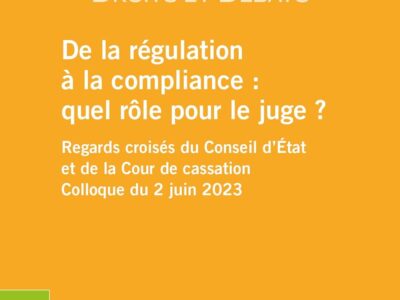
📗De la régulation à la compliance : quel rôle pour le Juge ?. Regards croisés du Conseil d’État et de la Cour de cassation (From Regulatory Law to Compliance Law: what role for the Judge?. Viewpoints of the Conseil d’État (French Administrative Supreme Court) and Cour de Cassation (French Judiciairy Supreme Court)

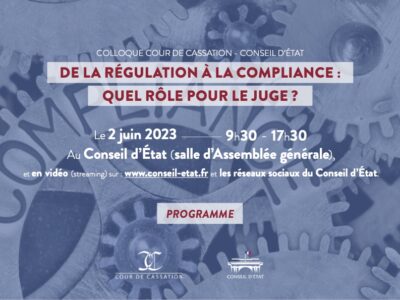
► Full Reference: Conseil d'État (French Administrative Supreme Court) & Cour de cassation (French Judiciary Supreme Court), De la régulation à la compliance : quel rôle pour le juge ? Regards croisés du Conseil d'État et de la Cour de cassation, ("From Regulatory Law to Compliance Law: what role for the Judge?"), La Documentation française, coll. "Droits et Débats", 2024, 241 p. - 📗read the  coverback (in French) - 📗read the table of content (in French) - ► Summary of this book : "Compliance, sometimes translated in French by the word "conformité" ("conformity"), is an extension of Regulatory Law and represents from it a new and decisive step forward. Compliance brings together all the mechanisms implemented within an organisation to achieve general interest goals (security, sustainability), thereby countering systemic risks. By relying on the rules, legal and ethical standards that embody these values, which are imposed on them and internalised by them, enterprises can both prevent the risk of sanctions and participate in this alliance between public authorities, economic operators and stakeholders to detect and prevent future systemic disasters.  Organisé par le Conseil d’État et la Cour de cassation, le colloque du 2 juin 2023 analyse ce changement de paradigme créé par cette nouvelle branche du droit.".  Organised by the Conseil d'État (French Administrative Supreme Court) and the Cour de cassation (French Judiciary Supreme Court), the conference on 2 June 2023, basis of this book, has analysed this paradigm shift created by this new branch of law: Compliance Law.  - 📝read the presentation in English of the concluding contribution of  Marie-Anne Frison-Roche : "Le rôle du juge dans le déploiement du droit de la régulation par le droit de la compliance" - 📝read the presentation in English of the contribution of François Ancel : "Quel rôle pour le juge aujourd’hui dans la compliance ? Quel office processuel du juge dans la compliance ?" -

Articles in a legal collective publication

📝Le rôle du juge dans le déploiement du droit de la régulation par le droit de la compliance (The role of the Judge in the deployment of Regulatory Law through Compliance Law), synthesis in 🏛️Conseil d’État and 🏛️Cour de cassation, 📗De la régulation à la compliance : quel rôle pour le juge ?

► Full Reference: M.-A. Frison-Roche, "Le rôle du juge dans le déploiement du droit de la régulation par le droit de la compliance" ("Synthesis: The role of the Judge in the deployment of Regulatory Law through Compliance Law"), Synthesis in Conseil d'État (French Council of State) and Cour de cassation (French Court of cassation), De la régulation à la compliance : quel rôle pour le juge ? Regards croisés du Conseil d'État et de la Cour de cassation – Colloque du 2 juin 2023, La Documentation française, "Droits et Débats" Serie, 2024, pp. 173-182 - 🎥this article follows the closing speech of the biannual symposium organised by the Council of State and the Court of cassation, which in 2023 was entitled De la régulation à la compliance : quel rôle pour le juge ? (From Regulation to Compliance, what role for the judge ?) - 🚧read the bilingual Working Paper which is the basis of this article, with additional developments, technical references and hyperlinks - ► Presentation of this concluding article: It is remarkable to note the unity of conception and practice between professionals who tend to work in administrative jurisdictions and professionals who tend to work in judicial jurisdictions: they all note, in similar terms, an essential movement: what Regulatory Law is, how it has been transformed into Compliance Law, and how in one and even more so in the other the Judge is at the centre of it. Judges, as well as Regulators and European officials, explain this and use different examples to illustrate the far-reaching changes it brings to the Law and to the companies responsible for increasing the systemic effectiveness of the rules through the practice and dissemination of a Culture of Compliance. The role of the judge participating in this Ex Ante transformation is renewed, whether he/she is a judge of Public Law or a judge of Private Law, in a greater unity of the legal system. - ► English Summary of this article: The tug-of-war between 'Compliance' and 'conformity', which is exhausting us, obscures what is essential, i.e. the great novelty of a branch of law that assumes a humanist vision expressing the ambition to shape the future so that it is not catastrophic (preventing systems from collapsing), or even better (protecting human beings in these systems). The article begins by describing the emergence of Compliance Law, as an extension of Regulatory Law and going beyond it. This new branch of law takes account of our new world, brings its benefits and seeks to counter these systemic dangers so that human beings could be their beneficiaries and are not crushed by them. This branch of Ex Ante Law is therefore political, often supported by public Authorities, such as Regulatory Authorities, but today it goes beyond sectors, as shown by its cutting edge, the Obligation of Vigilance. The "Monumental Goals" in which Compliance Law is normatively anchored imply a teleological interpretation, leading to an "empowerment" of the crucial operators, not only States but also companies, responsible for the effectiveness of the many new Compliance Tools. The article goes on to show that Judges are increasingly central to Compliance Law. Lawsuits are designed to make companies more accountable. In this transformation, the role of the judge is also to remain the guardian of the Rule of Law, both in the protection of the rights of the defence and in the protection of secrets. Efficiency is not what defines Compliance, which should not be reduced to a pure and simple method of efficiency, which would lead to being an instrument of dictatorship. This is why the principle of Proportionality is essential in the judge's review of the requirements arising from this so powerful branch of Law.  The courts are thus faced with a new type of dispute, of a systemic nature, in their own area, which must not be distorted: the Area of Justice. - 📝read article (in French) - 🌐follow Marie-Anne Frison-Roche on LinkedIn 🌐follow Marie-Anne Frison-Roche on Instagram 🌐subscribe to the Newsletter MAFR Regulation, Compliance, Law

Conferences

🎤Les voies d’innovations juridiques face aux nouveaux “défis climatiques” (“Innovative legal solutions to the new “climate challenges””), in 🧮Nouveaux défis – Regards croisés : Droit, Économie et Finance. Quel Droit face au Changement Climatique ? (“New challenges – Crossed perspectives : Law, Economics and Finance. What Law in the Face of Climate Change?”)

► Full Reference: M.-A. Frison-Roche, "Les voies d'innovations juridiques face aux nouveaux "défis climatiques" ("Innovative legal solutions to the new "climate challenges""), in C. Arnaud, O. de Bandt et B. Deffains (dir.), Nouveaux défis – Regards croisés : Droit, Économie et Finance. Quel Droit face au Changement Climatique ? (("New challenges – Crossed perspectives : Law, Economics and Finance. What Law in the Face of Climate Change?"), Banque de France (French Central Bank) and CRED/Paris Panthéon-Assas University, Paris, Centre de Conférence de la Banque de France, April 2, 2024 - 🧮See the full programme of this event - 🔲see the slides, basis of this conference (in French) - ► Summary of this conference: In response to the question of how the Law can produce 'innovations' to meet the 'climate challenges', the process is based on the three traditional sources of Law, which are, firstly, laws and regulations, secondly, the commitments of individuals, mainly contracts, and thirdly, court rulings. At first sight, the Law in its traditional conception and practice is weak in the face of climate change. This weakness is inherent in the nature of climate change, which is at once future, global and systemic, in the face of these three sources of Law, which do not address all three dimensions at once. The scale of the legal innovation required to ensure that one or more articulated sources can grasp the future, the global and the systemic is therefore clear. And yet this is what is happening. As far as laws and regulations are concerned, they do not seem very appropriate because they are, by their very nature, a territorial limit, and international treaties are very difficult to negotiate. The interweaving of European regulations, for example the CSRD and the CS3D, which mirror each other, may be more effective. As far as 'commitments' are concerned, a concept which in Law is not very precise outside of contracts and liability cases📎1🕴️M.-A. Frison-Roche, 📝What a commitment is, in 🕴️M.-A. Frison-Roche (ed.), 📘Compliance Obligation, 2024., contracts are above all a means for companies to fulfill their legal obligations, and a contract always implies a judge. At first sight, however, the judge is the least well placed to respond to 'climate challenges', particularly in France where he is said or wished to be powerless, where he rules on the past and where, especially the civil judge, he settles a one-off dispute between two singular parties. But a major change has occurred with the emergence of a new branch of law: the Compliance Law, a teleological branch of Law whose legal normativity is lodged in the Monumental Goals📎2🕴️M.-A. Frison-Roche, 📝Compliance Monumental Goals, beating heart of Compliance Law, in 🕴️M.-A. Frison-Roche (ed.), 📘Compliance Monumental Goals, 2023. that it pursues, namely the preservation of systems, for example the climate system. In France, the so-called "Sapin 2" law in 2016, followed by the so-called "Vigilance" law in 2017, illustrate this. And the Judge is at the centre of it all. In this global, systemic, extraterritorial perspective, the object of which is the future – Compliance Law is, moreover, rejected by many legal experts – the legislative innovation is major. Indeed, the law of 23 March 2017, known as "Vigilance" designated large companies, because they are "powerful", because they are "in a position to act" to "detect and prevent" breaches of the environment and human rights. The 2017 law copied the "compliance tools"📎3🕴️M.-A. Frison-Roche (ed.), 📘Compliance Tools, 2021. put in place by the Sapin 2 anti-corruption law: risk mapping, plans, alerts, audits, internal investigations, and so on.  Only large companies are subject to the Compliance Law, notably the Vigilance Law, since they are the only ones in a position to act, in this case "parent companies or principals", and borders are no longer limits since the obligation, creating personal liability for the company📎4🏛️Conseil constitutionnel (French Constitutional Council), March 23, 2017, decision No. 2017-750 DC, Loi relative au devoir de vigilance des sociétés mères et des entreprises donneuses d’ordre., extends throughout the "value chain". The notion and fact of "systemic dispute" is emerging before the courts. In France, the Paris Court of First Instance has exclusive jurisdiction. European legislation is proving more difficult to draw up, because although it is compulsory to provide information on these "extra-financial" subjects (CSRD), the directive on the duty of vigilance, which has just been adopted, does not go any further than the French law of 2017. On the second point, that of commitments, we are only at the beginning. Judges do not transform ethical statements into "unilateral legal commitments", and vigilance does not transform company law into co-management. But contracts do form a global network through which companies adjust their various legal obligations. This is why arbitrators, the only "global judges", will soon be involved in this systemic litigation📎5🕴️M.-A. Frison-Roche (ed.), 📘Compliance Obligation, 2024, of which a chapter is dedicated to "International Arbitration in support of the Compliance Obligation"., and more general case law is to come on "compliance contracts and clauses"📎6🕴️M.-A. Frison-Roche, 🚧Compliance contract, compliance clauses, 2022 ; 🕴️M.-A. Frison-Roche (ed.), 📘Contrat and Contract, 2024.. But the most innovative aspect undoubtedly comes from the courts. Perhaps and notably in France because it is from where we least expect it, the civil courts, that the imagination comes, but also the guarding of the great principles of the Rule of Law, because for the moment the case law is reasonable. This innovation has not come about proprio motu: the judges are not taking action, it is the NGOs that are conducting a kind of litigation policy, systematically giving formal notice to the major energy companies, but also to the major banks and insurers on climate issues, alleging non-compliance with their vigilance plans. The interim relief judge at the Paris Court of First Instance must then provide answers in systemic disputes, of which the so-called "Total Uganda"📎7🏛️Tribunal judiciaire de Paris (Paris First Instance Civil Court), summary rulings, February 28, 2023, No. RG 22/53943 and 22/53942, Total Ouganda. case is an example. The courts are demonstrating a great deal of innovation. The Court of First Instance's interim relief judge has appointed amici curiae📎8🕴️N. Cayrol, 📝L'amicus curiae, mesure d'instruction ordinaire, 2022., the Paris Court of Appeal has set up a specialised chamber📎9On the creation on the new 5-12 Chamber, Contentieux émergent – Devoir de vigilance et responsabilité écologique see 🕴️J. Boulard, 💬Contentieux systémique : "Il est important, pour les magistrats, de rester au plus près des réalités" (Systemic litigation: "It is important for judges to remain as close as possible to reality"), March 28, 2024., and training conferences have been set up on this "Emerging Systemic Litigation"📎10🕴️M.-A. Frison-Roche, 💬"Nous voyons émerger aujourd’hui le contentieux systémique" ("We are now seeing the emergence of the Systemic Litigation"), March 28, 2024 ; 🕴️M.-A. Frison-Roche, Coordination and animation of cycle of conference-debates 🧮Contentieux Systémique Émergent (Emerging Systemic Litigation). . In conclusion, Law is in the process of being rebuilt through a new branch of Law, Compliance Law, whose the very purpose, as an extension of and going beyond Regulatory Law📎11🏛️Conseil d'État (French Council of State) and 🏛️Cour de cassation (French Court of cassation), 📗De la régulation à la compliance : quel rôle pour le juge ? (From Regulation to Compliance: what role for the Judge?), 2024; 🕴️M.-A. Frison-Roche, 🚧The deployment of Regulatory Law through Compliance Law in the European project, 2023 ; 🚧Compliance Law loses the ties of Regulation Law but retains its principles : consequences for companies, 2018 ; 🚧From Regulation Law to Compliance Law, 2017., is to preserve systems, in particular the climate system, in a profoundly renewed role for judges📎12🕴️M.-A. Frison-Roche, 📝Le rôle du juge dans le déploiement du droit de la régulation par le droit de la compliance et ;🕴️Fr. Ancel, 📝Quel rôle pour le juge aujourd’hui dans la compliance ? Quel office processuel du juge dans la compliance ?, in 🏛️Conseil d'État et 🏛️Cour de cassation, 📗De la régulation à la compliance : quel rôle pour le juge ?, 2024 ; 🕴️Fr. Ancel, 📝Le principe processuel de compliance, un nouveau principe directeur du procès ?, in M.-A. Frison-Roche (dir.), 📕La juridictionnalisation de la Compliance, 2023 ; 🕴️M.-A. Frison-Roche, 📝Le Juge requis pour une Obligation de Compliance effective, in 🕴️M.-A. Frison-Roche (dir.), 📕L'Obligation de Compliance, 2024.. - 🌐follow Marie-Anne Frison-Roche on LinkedIn 🌐follow Marie-Anne Frison-Roche on Instagram 🌐subscribe to the Newsletter MAFR Regulation, Compliance, Law
Organisation of events

1st conference-debate of the cycle "Contentieux Systémique Émergent" ("Emerging Systemic Licigation")

🧮Importance et spécificité du Contentieux Systémique Émergent (Importance and specificity of the Emerging Systemic Litigation), in cycle of conferences-debates “Contentieux Systémique Émergent” (“Emerging Systemic Litigation”)

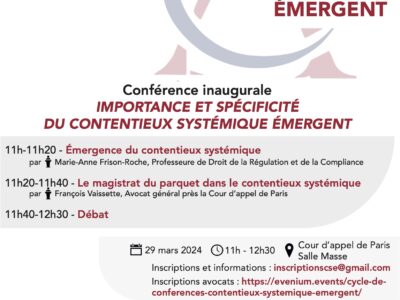
► Full Reference: Importance et spécificité du Contentieux Systémique Émergent (Importance and specificity of the Emerging Systemic Litigation), in cycle of conference-debates "Contentieux Systémique Émergent" ("Emerging Systemic Litigation"), organised on the initiative of the Cour d'appel de Paris (Paris Cour of Appeal), with the Cour de cassation (French Court of cassation), the Cour d'appel de Versailles (Versailles Court of Appeal), the École nationale de la magistrature – ENM (French National School for the Judiciary) and the École de formation des barreaux du ressort de la Cour d'appel de Paris – EFB (Paris Bar School), under the scientific direction of Marie-Anne Frison-Roche, March 29, 2024, 11h-12h30, Cour d'appel de Paris, Masse room - ► Presentation of the conference-debate: The "Systemic Litigation" is emerging. Through and beyond the dispute, a system is involved: the banking, financial, digital, health and climate systems. How can such litigation be recognised? How do you make room for a system in a court of law? What can be done when several systems are in conflict? Who represents these systems and their interests? How can the temporality of systems and litigation be reconciled? In practical terms, the magistrate has a new role. Whether they are prosecutors or judges, they deal with systemic litigation in criminal, civil, commercial and other areas.   - 🎤see the detailed presentation of the first speech of 🕴️Marie-Anne Frison-Roche : L'émergence du Contentieux Systémique (The Emergence of Systemic Litigation) - 🧮Programme of this event:  Inaugural Conference IMPORTANCE ET SPÉCIFICITÉ DU CONTENTIEUX SYSTÉMIQUE ÉMERGENT (IMPORTANCE AND SPECIFICITY OF THE EMERGING SYSTEMIC LITIGATION)   Cour d’appel de Paris (Paris Court of Appeal), Masse room 🕰️11h-11h20. 🎤L’émergence du contentieux systémique (The Emergence of the Systemic Litigation), by 🕴️Marie-Anne Frison-Roche, Professor of Regulatory and Compliance Law, Director if the Journal of Regulation & Compliance (JoRC)   🕰️11h20-11h40. 🎤L’office du magistrat du parquet dans le contentieux systémique (The role of the Public Prosecutor in Systemic Litigation), by 🕴️François Vaissette, Avocat général près la Cour d’appel de Paris (Advocate General at the Paris Court of Appeal)   🕰️11h40-12h30. Debate - 🔴Registrations and information requests can be sent to: inscriptionscse@gmail.com 🔴For the attorneys, registrations have to be sent to the following address: https://evenium.events/cycle-de-conferences-contentieux-systemique-emergent/  ⚠️The conference-debates are held in person only, in the Cour d’appel de Paris (Paris Court of Appeal). - 🧮Read below a detailed presentation of this event⤵️ -

Lessons

Teaching for the École nationale de la magistrature - ENM (French National School for the Judiciary)

⚖️Droit de la compliance (Compliance Law)

► Full Reference: F. Ancel &  M.-A. Frison-Roche, Droit de la compliance (Compliance Law), École nationale de la magistrature – ENM (French National School for the Judiciary), in collaboration with the École de Formation professionnelle des Barreaux du ressort de la cour d'appel de Paris – EFB (Paris Bar School), Paris, February 1 and 2, 2024 This teaching is given in French. - 🌐consult on LinkedIn a general présentation of this event, which links to a presentation and a report of each speech - ► Presentation of the Teaching: The aim of this two-day conference is to enable judges and lawyers to grasp the issues, objectives and methods that define Compliance Law as it is practised in companies. The speakers will illustrate the growing trend towards litigation, which is difficult to reconcile with the supranational dimension, or even indifference to territories, for example when disputes concern systemic climate or digital issues: the result is a renewal of the role of the judge and the role of lawyers. This must be set against the renewal of the role and operation of companies themselves. This is analysed from the perspective of Civil Law, in particular Contract Law and Liability Law. Company Law and Criminal Law are also addressed, as well as the way in which the legal system now integrates governance, regulation, climate and digital issues and the smooth operation of financial markets through Compliance techniques. - ► Organisation of the Teaching: This conference is divided into two parts. The first day is designed as a presentation of the major themes through which Compliance Law crosses the branches of traditional Law. The speakers will be professors of Law who will successively summarise the branches of Law and put into perspective the way in which Compliance imperatives give rise to new situations, new difficulties and new solutions. This enables the second day to focus on practical and topical issues and to debate controversial questions between people of different sensibilities. The participants tend to be judges, members of regulatory authorities, lawyers, members of associations and so on. - ► Enrolment procedure: The course is open to all judicial and consular magistrates, as well as lawyers. Registrations can be made directly with the ENM or with the EFB. - ► Speakers :   🎤François Ancel, Judge at the Première Chambre civile de la Cour de cassation (First Civil Chamber of the French Court of cassation)  🎤Thomas Baudesson, Attorney at the Paris Bar, Partner at Clifford Chance 🎤Guillaume Beaussonie, Full Professor at Toulouse 1 Capitole University 🎤Jacques Boulard, Premier Président de la Cour d’appel de Paris (First President of the Paris Court of Appeal) 🎤Marie Caffin-Moi, Full Professor at Paris Panthéon-Assas University 🎤Malik Chapuis, Judge at the Tribunal judiciaire de Paris (Paris First Instance Civil Court) 🎤Lucie Chatelain, Advocacy and Litigation Manager – Civil Liability of Parent Companies, Sherpa 🎤Jean-Benoît Devauges, Directeur Juridique, Ethique et Gouvernance des entreprises (Legal, Ethics and enterprises governance Director), MEDEF 🎤Marie-Anne Frison-Roche, Professor of Regulatory and Compliance Law, Director of the Journal of Regulation & Compliance (JoRC) 🎤Arnaud Gossement, Attorney at the Paris Bar, Partner at Gossement Avocats 🎤Thibault Goujon-Bethan, Full Professor at Jean Moulin Lyon 3 University 🎤Christophe Ingrain, Attorney at the Paris Bar, Partner at Darrois Villey Maillot Brochier 🎤Isabelle Jegouzo, Director of the Agence française anticorruption – AFA (French Anti-Corruption Agency)  🎤Anne-Valérie Le Fur, Full Professor at Versailles Saint-Quentin-en-Yvelines University 🎤Charlotte Michon, Attorney at the Paris Bar, partner at Charlotte Michon Avocat 🎤Jean-Baptiste Racine, Full Professor at Paris Panthéon-Assas University 🎤 Jean-Christophe Roda, Full Professor at Jean-Moulin Lyon 3 University 🎤Jérôme Simon, 1er Vice-Procureur Financier (First Financial Vice-Prosecutor) - 🧮read below the programme put together and organised by François Ancel and Marie-Anne Frison-Roche, as well as the reports of each presentation⤵️ - 🌐follow Marie-Anne Frison-Roche on LinkedIn 🌐follow Marie-Anne Frison-Roche on Instagram 🌐subscribe to the Newsletter MAFR Regulation, Compliance, Law
Working papers

Working Paper for an article

🚧Compliance, Vigilance and Civil Liability: put in order and keep the sense of Reason

► Full Reference : M.-A. Frison-Roche, Compliance, Vigilance and Civil Liability: put in order and keep the sense of Reason, Working Paper, June 2024 - 📝 In its French version, this Working Paper is the basis of the contribution "Compliance, Vigilance et Responsabilité civile : mettre en l'ordre et raison garder", in 📕L'Obligation de Compliance - ► Summary of this Working Paper:  The descriptions of the Liability incurred by large companies as a result of their compliance obligations are very diverse, even contradictory, going beyond the wishes that may be expressed as to what this liability should be. The first part of this study therefore sets out the various liabilities incurred by companies, which differ in the conditions under which they are implemented and in their scope, so as not to confuse them. Indeed, as the various laws establish specific legal compliance obligations, they give rise to liabilities of varying conditions and scope, and it is not possible to avail of the regime of one in a situation that falls within the scope of another. It is therefore necessary to review the various bodies of compliance legislation, the GDPR, the ALM-FT regulations, the French so-called Sapin 2 law, the French so-called Vigilance law , the European IA Act , the European European DGA Act, etc., to recall the inflexion that each of these bodies of legislation has made to the liability rules applied to the companies subject to them. Nevertheless, the unicity of the Compliance Obligation, overcoming this necessary diversity of situations, regulations and liability regimes,  can provide grouping lines to indicate beyond this diversity the extent of the liability incurred by companies. Once this classification has been made, the second part of the study develops the observation that none of this can create any principle of general liability on large companies in terms of compliance, and in particular not in terms of vigilance. It is not possible to deduce a general principle of specific obligations of liability or specific obligations to reparation, for example in the area of vigilance, as the texts creating specific vigilance obligation refer to the conditions of commun Tort Law (proof damage and causality), and International Public Law does not have the force to generate a general principle binding companies in this respect. The third part stresses that it is nevertheless always possible to invoke Tort Law, and companies cannot claim to escape this. This may involve contractual liability, a situation  becoming increasingly frequent as companies contractualise their legal compliance obligations, reproducing them but also modifying them, and as Vigilance duty is an obligation that goes beyond the specific situations covered by the regulations.  But it is essential, and this is the subject of the fourth part, not to make companies pure and simple guarantors of the state of the world, present and future. Indeed, if we were to transform sectoral compliances into illustrations of what would then be a new general principle, but one that applied only to them, they would consequently exercise the other side of this coin, namely power over others. - 🔓read the Working Paper below⤵️ - 🌐follow Marie-Anne Frison-Roche sur LinkedIn 🌐follow Marie-Anne Frison-Roche on Instagram 🌐subscribe to the Newsletter MAFR Regulation, Compliance, Law 🌐subscribe to the Video Newsletter MAFR Surplomb

Breaking news

💬Compliance : les cours suprêmes s’emparent de la question de ses enjeux juridictionnels (Compliance : the Supreme Courts take up the issue of its jurisdictional implications)

🌐follow Marie-Anne Frison-Roche on LinkedIn 🌐subscribe to the Newsletter MAFR Regulation, Compliance, Law  - ► Full Reference:  M.-A. Frison-Roche et A. Seban, "Compliance : les cours suprêmes s’emparent de la question de ses enjeux juridictionnels" ("Compliance : the Supreme Courts take up the issue of its jurisdictional implications"), interview with Olivia Dufour, Actu-Juridique, 5 July 2023. - 💬read the interview (in French) - ► Presentation of the interview by the journal (in French): "Le 2 juin dernier s’est tenu au Conseil d’État un colloque fondateur sur le rôle du juge dans la compliance. Le professeur Marie-Anne Frison-Roche et le conseiller d’État Alain Seban, qui ont tout deux contribué aux débats, ont accepté de commenter les principaux enseignements des travaux de cette journée." - ► Questions asked (in French):  Le colloque « De la régulation à la compliance, quel rôle pour les juges » qui s’est tenu au Conseil d’État le 2 juin dernier a rassemblé juges civils et administratifs. En quoi le juge administratif est-il concerné par la compliance qui semble plutôt une affaire d’entreprises et donc de justice civile et commerciale ?  ​Vincent Vigneau, président de la chambre commerciale de la Cour de cassation rappelle que la compliance a plutôt vocation à éviter le juge en se situant ex ante, pourtant on découvre que le juge lui-même accepte de plus en plus de se prononcer en ex ante… qu’en est-il ?  Quel peut donc être le rôle du juge dans la compliance ? Peut-il contribuer à faire émerger un droit de la compliance et à l’harmoniser ?  ​ ​François Ancel semble considérer que le rôle juge va devoir adapter son office à la compliance, il évoque trois concepts : téléologique, soutenabilité et efficacité… Le juge dispose-t-il en l’état de tous les outils nécessaires ? Si tel n’est pas le cas, que faut-il créer ? En quoi le dialogue des juges, civil/administratif, national/européen, national/international, est-il important ? Que veut dire F. Ancel quand il déclare que le juge doit évoluer du constat à la trajectoire ? Existe-t-il des domaines où la compliance entre en conflit avec des principes processuels, par exemple le principe de légalité des peines ? En quoi la notion de « buts monumentaux », que vous avez créée en 2016, a-t-elle trouvé sa place dans le droit ? -

Conferences

🎥Le rôle du Juge dans le déploiement du Droit de la Régulation en Droit de la Compliance (The role of the Judge in the deployment of Regulatory Law in Compliance Law), in 🧮De la Régulation à la Compliance : le rôle du juge ?

► Full Reference: M.-A. Frison-Roche, Le rôle du Juge dans le déploiement du Droit de la Régulation en Droit de la Compliance (The role of the Judge in the deployment of Regulatory Law in Compliance Law), in Conseil d'État (French Administrative Supreme Court) and Cour de cassation (French Judiciaire Supreme Court of cassation), De la Régulation à la Compliance : quel rôle pour le Juge ? ("From Regulatory to Compliance : what role for the judge?"), speech constituting the "closing session" of the bi-annual joint symposium of the two High Courts, held at the Conseil d'État, Salle d'Assemblée générale, 2 June 2023. The event was held in French. - 🧮See the full programme of this event (in French) - 🎥watch the interview given about the conclusion, done after the speech (in French) - 🧮read the general programme of the manifestation (in French) - 📚read the bibliographical dossier du participant. (participant's file made in French) - 🎥watch the general introductory speechs of Didier-Roland Tabuteau, Vice-Président du Conseil d'État, de Christophe Soulard, Premier Président de la Cour de cassation, and of François Molins, Procureur général près la Cour de cassation ;  and the interventions in the first session devoted to the path from the Regulatory to the Compliance with Marie-Anne Barbat-Layani, présidente de l'AMF, Jean-Yves Ollier, conseiller d'Etat, Daniel Calleja-Crespo, directeur général du service juridique de la Commission européenne andChristine Guegen, , première avocate générale de la chambre commerciale de la Cour de cassation - 🎥watch the speechs in the second session devoted to the office of the judge with  Vincent Vigneau, président de la chambre commerciale de la Cour de cassation, François Ancel, conseiller à la première chambre civile de la Cour de cassatin, Astrid Mignon-Colombet, avocate à la Cour, Lucien Rapp, professeur à Toulouse-Capitol and Alain Seban, conseiller d'Etat ; the speechs of the third session dedicated to the Compliance new frontiers, with Christophe Chantepy, président de la section du contentieux du Conseil d'État, Roch-Olivier Maistre, président de l'Arcom, Paul Nihoul, juge au Tribunal de l'Union européenne, Jean-François Bohnert, procureur de la République financier, Joëlle Tolédano, professeure émérite à Dauphine ; the final session with Marie-Anne Frison-Roche - 🎥watch this final speech by Marie-Anne Frison-Roche, which formed the closing session of the event - 🚧read the bilingual Working Paper used as basis for the article to be published later - 💬read the interview given by Marie-Anne Frison-Roche and Alain Seban after the colloquia and entitled "Compliance : les cours suprêmes s’emparent de la question de ses enjeux juridictionnels" ("Compliance : the Supreme Courts take up the issue of its jurisdictional implications") - ► English presentation of this general conclusion: Having a definition of Compliance Law in mind, a definition around which there still seems to be so much dispute, is not required to understand that this Law is what will enable us to enter and deal with a new world and if this subject is so fascinating to young people who want to become lawyers, prosecutors, regulators or judges, even though they are not taught this subject, it is because they have understood that with Compliance Law they will be able to actively participate in this new world and build it. This is the way we want it to take it, with force and courage in a sort of collective adventure. In this way, the Judges have a monumental role to play, which is at the very heart of Compliance Law. They will necessarily be so because demands and claims will converge on them from all sides, from Internet users, consumers, investors, associations and companies, and the Judge will have to respond. This has already started and is only just beginning. Judges must be prepared. Four expectations are emerging as to what their role should be. Firstly, judges must persist in their role as guardians of the Rule of Law, in a Compliance Law impregnated with technologies (algorithms) that could be described as insensitive. Secondly, beyond this vital role as guardian of the Rule of Law, the Judge has a new role in the extraordinary deployment of Compliance Law, which is measured in terms of the novelty of the normative control it exercises, the commitments it supports, the remedies it finds and the sustainability it reinforces. Thirdly, in the natural space of justice, the judge responds to parties who make claims of compliance, both as plaintiff and defendant, because the causes of compliance are systemic causes that deserve a new jurisdictional treatment. Fourthly, given the novelty and scope of this innovative approach, all judges must converge in terms of content, qualifications, and methods if they are both to continue their traditional role as guardians of the Rule of Law and to be able to endure their new role, a dialogue in which they have so much to contribute to each other. - 🌐follow Marie-Anne Frison-Roche on LinkedIn 🌐follow Marie-Anne Frison-Roche on Instagram 🌐subscribe to the Newsletter MAFR Regulation, Compliance, Law 
Working papers

Working Paper

🚧The role of the Judge in the deployment of Regulatory Law through Compliance Law

► Full Reference: M.-A. Frison-Roche, The role of the Judge in the deployment of Regulatory Law through Compliance Law, Working Paper, April  2023. - 🎤 This working paper was drawn up to serve as the basis for the concluding summary session of the colloquium organised by the Conseil d'État (French Administrative Supreme Court) and the Cour de cassation (French Judicial Supreme Court), De la régulation à la compliance: quel rôle pour le juge? ("From Regulation to Compliance: what role for the Judge?") held on 2 June 2023 at the Conseil d'État.  - 📝 This working paper also served as the basis for the article that concludes the book De la régulation à la compliance : quel rôle pour le juge, published by the La Documentation Française, 2024. - ► Working Paper Summary: It is remarkable to note the unity of conception and practice between professionals who tend to work in administrative jurisdictions and professionals who tend to work in judicial jurisdictions: they all note, in similar terms, an essential movement: what Regulatory Law is, how it has been transformed into Compliance Law, and how in one and even more so in the other the Judge is at the centre of it. Judges, as well as regulators and European officials, explain this and use different examples to illustrate the profound transformation this has brought about for the law and for the companies responsible for increasing the systemic effectiveness of the rules through the practice and dissemination of a culture of compliance. The role of the judge participating in this Ex Ante transformation is renewed, whether he is a public law judge or a private law judge, in a greater unity of the legal system.   - 🔓read the Working Paper below⤵️ - 🌐follow Marie-Anne Frison-Roche on LinkedIn 🌐follow Marie-Anne Frison-Roche on Instagram 🌐subscribe to the Newsletter MAFR Regulation, Compliance, Law

Articles

📧Dans les causes systémiques : “délibérer” plutôt que “se disputer”

🌐 follow Marie-Anne Frison-Roche on LinkedIn 🌐 subscribe to the Newsletter MAFR Regulation, Compliance, Law - ► Full Reference: M.-A. Frison-Roche, "Dans les causes systémiques : "délibérer" plutôt que "se disputer"" ("In systemic causes: 'deliberate' rather than 'argue'"), Newsletter MAFR – Law, Compliance, Regulation, 17 April 2023. - 📧Read by freely subscribing other news of the Newsletter MAFR – Law, Compliance, Regulation - 🔴To deal with "systemic causes", including systemic cases of compliance, move from "argument" to "deliberation" from the start Compliance Law involves systems, for example banking, financial, digital, health, etc. When a dispute is brought before a judge, this dimension remains, whether before a judge of the Law or a judge of the merits, whether before a civil, criminal, commercial, administrative or European judge, etc. The judge's office must be adapted accordingly. And this is in the process of being done. - 📧read the article ⤵️ 
Working papers

🚧Laws, Compliance, Contracts, and Judges: places and alliances

🌐 follow Marie-Anne Frison-Roche on LinkedIn 🌐 subscribe to the Newsletter MAFR Regulation, Compliance, Law  - ► Full Reference: M.-A. Frison-Roche, Laws, Compliance, Contracts, and Judges: places and alliances, Working Paper, March 2023. - . 📝this working paper is the basis for an article published in French (click HERE) in the 📚chronique of Compliance Law held in the Recueil Dalloz. - 📚Read the other articles published by this Compliance Law Chronicle. open since 2018. - ►Summary of this Working Paper: To understand the functioning of compliance systems in the articulation of the legal actors and the legal instruments used, whatever the technical sector considered, it is necessary to put the "law", the "contract" and the "judge" back into the perspective of legitimacy and efficiency regarding what Compliance is.  At the very least, it is a 'conformity' mechanism. In this process of simple obedience, legislators, economic operators, and judges find themselves in the position of having to obey the law in a hierarchical conception. In a more dynamic and ambitious conception, when Compliance Law is not reduced to a more astute method of obedience but draws substantial normativity from the Monumental Goals pursued, legislators and operators enter an alliance. The contract becomes a major instrument, and the Judge becomes a major actor, no longer to punish the non-obedient but to facilitate the links to help a sustainable system.  Faced with issues such as digital, climatic, and technological challenges, where we are each so weak and isolated, we must not limit our conception and practices to the instrument of conformity but choose the substantial Compliance Law, i.e. the alliance of forces, which puts forward the contract and renews the office of the judge, with the Public Authorities remaining legitimate in setting the Monumental Goals since they commit the future of the social group. -   🔓read bellow the developments⤵️