Court

Articles in a legal collective publication

📝La part du gracieux dans le traitement juridictionnel de la compliance (The role of Discretionary Jurisdictio in the judicial treatment of Compliance cases), in📗Liber Amicorum, Mélanges en l’honneur de Dominique d’Ambra

► Full Reference: M.-A. Frison-Roche, "La part du gracieux dans le traitement juridictionnel de la compliance (The role of Discretionary Jurisdictio in the judicial treatment of Compliance cases)", in Mélanges Dominique d'Ambra, Liber Amicorum, Lefebvre-Dalloz, 2026, pp. 175-196. - 📝read this article (in French)  - 🚧read the bilingual Working Paper, base of this article - ► English summary of this article: Based on the definition of Judicial Office, the procedural principles that derive from it and the consequent powers that judges exercise, the objet of this study is to measure the degree of discretion that exists in the judicial treatment of compliance, without direct consideration for the dispute between litigants. This part is very ignored, when it should be given top priority. Indeed, because Systems are involved in compliance cases brought before civil or commercial judges, we are seeing a development of this discretionary element in judicial fonction. Discretionary matters differ from unilateral discretionary procedures, and this discretionary element relates to what the judge examines, possibly in the context of a dispute. The first part of this contribution therefore aims to describe the natural development of the discretionary power of the judge to deal with compliance cases brought before them. This role stems from the fact that, even when triggered by a dispute, what is submitted to the judge is a situation composed of a system, which cannot defend its interests before the civil or commercial judge in this Systemic Litigation arising from the very nature of Compliance Law and the Compliance Obligations it engenders on systemic entites. Moreover, it is the Future whose interests must be considered and protected, which the judge must do directly. This leads to the second part of the contribution, calling for a rethinking of the procedure and the role of the Compliance Judge, so that ex gratia matters can be dealt with. The judge must therefore verify that there are no conflicts of interest between the litigants, including hidden ones, and must learn about the systems involved. The inquisitorial principle must therefore be strengthened. But at the same time, since the primary aim is not to settle a dispute but to resolve a systemic problematic situation, the judge must facilitate the movements of the parties, and the adversarial principle must also be strengthened. Must be encouraged this activation of a powerful and discretionary approach, not as an exception but as a principle fully articulated with a contentious principle, with the dispute being only a means used by the necessary parties to enable systemic compliance situations to be resolved. - 🌐 follow Marie-Anne Frison-Roche on LinkedIn 🌐follow Marie-Anne Frison-Roche on Instagram 🌐subscribe to the Newsletter MAFR Regulation, Compliance, Law 🌐subscribe to the Video Newsletter MAFR Surplomb 🌐subscribe to the Newsletter MaFR Droit & Art

Articles in a legal collective publication

contribution in a collective legal publication

📝L’invention du “droit à l’enfant”. Les conséquences de la pratique contractuelle comme source d’engendrement de l’enfant (The invention of the “right to a child”. The consequences of the contractual practice as a source of childbearing), in 📗Nouvelles filiations (New Filiations)

► Full Reference: M.-A. Frison-Roche,  « L'invention du "droit à l'enfant". Les conséquences de la pratique contractuelle comme source d'engendrement de l'enfant (The invention of the "right to a child". The consequences of the contractual practice as a source of childbearing)", in Special Issue Nouvelles filiations (New Filiations), AJ Famille, Lefebvre Dalloz, Nov. 2025, pp. 568-571.    - 📗read the table of content of the special issue in which this article is published (in French) - 📝read this article (in French) - 🚧Read the underlying bilingual working document, which includes additional technical developments, technical references and hyperlinks. - ► English summary of this article: Every legal system is built on concepts that form its pillars. Filiation is one such concept. A cas-law solution, presented as pragmatic and casuistic, can overturn this concept. Whether one agrees with it or not, it must first be acknowledged and assessed. Through a series of rulings on surrogacy, notably a ruling by its First Civil Chamber granting exequatur to a judgment recognising the filiation established by surrogacy between a child and persons with no biological link to the child and without recourse to adoption, the French Cour de Cassation has introduced the possibility of creating parentage by contract. This not only changes the concept of filiation but also changes the very structure of the French legal system, which is based on the distinction between persons and things. One may agree or disagree with this, but it must be said. Since the judge gives force to such a contract establishing filiation, with the foreign judge simply recognising it and the French judge ensuring only that the contract is balanced, the prospect opens up of a society in which individuals will be able to contractually create institutions at their disposal, within the private normative space of the contract, with the State's only function being to give effect to their right to legal recognition of their unique "project". Parentage is only a first example. Thus constructed on what was "inconceivable", i.e. a "right to a child", thanks to the contractual power to which the State should lend its force a posteriori, the judge makes parentage resulting .the judge technically declares a parentage arising from a contract to be "admissible". Is opening a society in institutions were contractually governed.  - 🌐follow Marie-Anne Frison-Roche on LinkedIn 🌐follow Marie-Anne Frison-Roche on Instagram 🌐subscribe to the Newsletter MAFR Regulation, Compliance, Law 🌐subscribe to the Video Newsletter MAFR Surplomb 🌐subscribe to theNewsletter MaFR Droit & Art

MAFR Chronicles Compliance Law

article forming part of a thematic column

📝Droit de la compliance et Contentieux systémique (Compliance Law and Systemic Litigation)

►Full Reference: M.-A. Frison-Roche, "Droit de la compliance et Contentieux systémique" (Compliance Law and Systemic Litigation), in Chroniques Droit de la Compliance (Compliance Law Chronicles), Recueil Dalloz, 30 October 2025, No. 38, p. 1849 - 🚧read the bilingual Working Paper on which this article is based, with additional developments, technical references and hyperlinks -   ►read the English presentation of the previous chronicles: "Compliance and conformity: Distinguish them in order to articulate them", 2024 "Regulations, Compliance, Contracts, and Judges: places and alliances", 2023 "Contract of compliance, stipulations fo compliance", 2022 "The Adventure of the Compliance", 2020 "Compliance and Legal Personality", 2019 "TLegal Theory of Risk Mapping", 2019 ►read the English presentation of the whole chroniques - ►English summary of this article: Legal systems have changed, and Compliance Law, in its uniqueness, reflects this change and plays a powerful role in it. Through new sets of compliance rules, particularly at European level, in areas such as data protection (GDPR), anti-money laundering (AMLA), climate balance protection (CS3D) and banking and financial system sustainability (Banking Union), techniques (always the same) have been developed and imposed on large companies, which must implement them: alerts, mapping, assessment, sanctions, etc. These new regulatory frameworks only make sense in relation to their ‘Monumental Goals’: to detect systemic risks Ex Ante and prevent crises so that the systems in question do not collapse, but ‘sustain". All the legal instruments in the corpus are normatively rooted in these Monumental Goals, which are the core that unifies Compliance Law (I). Judges are the guardians (II) of this new and highly ambiguous normative framework, which relies on the practical ability of companies to do just that. They ensure that the technical provisions are applied teleologically in each of these compliance blocks, and that the regulatory frameworks are mutually supportive, for it is always the same systemic goal that all compliance regulations serve: to ensure that systems (banking, financial, climate, digital, energy, etc.) do not collapse, that they are sustainable, and that present and future human beings are not crushed by them but, on the contrary, benefit from them. This unity is still little perceived, as regulations pulverize this profound unity of compliance law in the myriad of changing provisions. Entrusting the "regulatory mass" to algorithms increases this pulverization, making the whole increasingly incomprehensible and therefore impossible to handle.  Acknowledging the judge's rightful place, i.e. at the heart of the matter, will enable us to master this new branch of law. But it's not the judge's job alone to restore clarity to a whole covered in the dust of his own technicality. The systemic object of Compliance Law is transferred to Litigation. Indeed, the Litigation that emerges from the new Compliance Law is also fundamentally new, by transitivity. Indeed, the aim of Compliance Law is to make systems sustainable (or sustainable, or resilient, the vocabulary varies). The result is litigation which is itself "systemic litigation" (III), most often initiated by an organization against a systemic operator. The place and role of each are transformed (IV).   -

Articles in a legal collective publication

contribution in a Round Table

📝De l’obligation de compliance à l’obligation de vigilance : le rôle du juge

► Full reference : M.-A. Frison-Roche, "De l'obligation de compliance à l'obligation de vigilance : le rôle du juge (From the obligation of compliance to the obligation of vigilance: the role of the judge)", in Round table De la compliance au devoir de vigilance. Une nouvelle responsabilité des entreprises (From Compliance to the Vigilance duty. A new responsibility for businesses," Lettre des juristes d'affaires, Oct. 2025. - 📝read the article reproducing the entire discussion (in French) - ► Summary of my contribution:  In this debate, the terms of which have been reproduced in the journal, I was asked to explain how the legal system had evolved, first by establishing Compliance Law, built on systemic ambitions to prevent sectoral disasters (banking, finance, energy), ambitions that constitute "Monumental Negative Goals", and then evolving on the one hand "Monumental Positive Goals", namely the protection of human beings involved willingly or unwillingly in these systems, on the other hand, outside even sectors with clearly defined boundaries, such as environmental or digital ambitions. The duty of vigilance extends this regulatory law and gives concrete form to the "compliance obligation" to which companies are subject. It is important to maintain a sense of proportion in the conception of the responsibility attached to it so as not to lose everything. Companies are bound by the goals but must remain free in their choice of means, and in particular be encouraged to use contractual techniques. This measure is entrusted to the judge because, due to the Compliance Jurisdictionalisation, it is at the heart of this new branch of Law, which is developing independently of fluctuations in the regulations. During the discussion, I was asked for my opinion on the ruling handed down by the Paris Court of Appeal on 17 June 2025, known as La Poste case. I pointed out that the comments had often focused only on the developments regarding risk mapping, whereas this ruling first establishes the principle that the vigilance plan is the work of the company's decision-making bodies and is not co-constructed, as consultation is a process of discussion and taking in consideration, which is not the same thing, with the judge himself pointing out that they must not interfere in management. In the discussion, I emphasised that if we were to highlight the essence of what would be a "new responsibility", it would primarily concern a new probative dimension that the company must implement in Ex Ante. The implementation of the CSRD, even if it has been excessively standardised, is in line with this, and this probative culture must be developed. - ⛏️Further reading on the subject : 🕴️M.-A. Frison-Roche (ed.), 📘Compliance Obligation, 2026 🕴️M.-A. Frison-Roche, 📝Vigilance, the front line and integral part of the compliance obligation, 2025 🕴️M.-A. Frison-Roche, 📝Compliance, Vigilance and Civil Liability: put in Order and keep the sense of Reason, 2025 🕴️M.-A. Frison-Roche (ed.), 📘Compliance Jurisdictionalisation, 2024 -   -   - ► Article summary : The  - 🌐Follow Marie-Anne Frison-Roche on LinkedIn 🌐follow Marie-Anne Frison-Roche on Instagram 🌐Subscribe to the Newsletter MAFR Regulation, Compliance, Law 🌐Subscribe to the video newsletter MAFR Overhang 🌐Subscribe to the Newsletter MaFR Law & Art

Articles in The Journal of Regulation & Compliance « JoRC »

Article in the Journal of Regulation & Compliance (JoRC)

📝Le juge adéquat pour l’effectivité de l’Obligation de Compliance (The Adequate Judge for the Effectiveness of the Compliance Obligation), in 🕴️M.-A. Frison-Roche (ed.), 📕L’Obligation de Compliance

► Full Reference: M.-A. Frison-Roche, "Le juge adéquat pour l'effectivité de l'Obligation de Compliance" ("The Adequate Judge for the Effectiveness of the Compliance Obligation"), in M.-A. Frison-Roche (ed.), L'Obligation de Compliance, Journal of Regulation & Compliance (JoRC) and Dalloz, coll. "Régulations & Compliance" 2025, pp. 741-775. - 📝read the article (in French) - 🚧read the bilingual Working Paper on the basis this contribution has been built, with  more developments, technical references and hyperlinks.  - 📕read the general presentation of the book, L'Obligation de Compliance, in which this article is published 📚see the general presentation of the series "Régulations & Compliance" in which this book is published - ► English summary of this contribution : The Judge is a character who seems weak in a Compliance Law that seems so powerful in a world where Technology is developing even a more impressive power. But present and future cases show, on the contrary, that he or she has a central role to play and that his/her role must be to use his/her own strength to remain what he/she is: the guardian of the Rule of Law, which is not so obvious because many Compliance tools, which are technological in nature, are in a way 'insensitive' to what we hold dear, the protection of human beings, which is based on the diligence of companies (I).  The second role that we can expect of the Judge is that not only does he/she help to ensure the permanence of this Rule of Law, which relies to a large extent on him:Her in the face of a future world that is unknown to us, mainly in its digital and climatic dimensions, perspectives that Compliance Law seeks to grasp, by renewing Regulation Law, by acting in relation to companies whose role is active, which leads the Judge to control them and to be aware of the claims that can be made against them, without taking the place of their management powers (II). This presupposes a new method (III), and all the judges, however diverse, will converge in an active dialogue between the judges, which will enable, firstly, the traditional role of the judge, linked to the Rule of Law, to endure in a rapidly changing world and, secondly, each judge to take on this new role implied by Compliance Law (IV). The perfect triangle will then be established, the strength and simplicity of which allows the use of the singular and the retention of capital letters for each of these three terms: Regulation Compliance Judge. - 🌐follow Marie-Anne Frison-Roche on LinkedIn 🌐follow Marie-Anne Frison-Roche on Instagram 🌐subscribe to the Newsletter MAFR Regulation, Compliance, Law 🌐subscribe to the Video Newsletter MAFR Surplomb

Articles in The Journal of Regulation & Compliance « JoRC »

📝Les enjeux présents et à venir de l’articulation des principes de procédure civile et commerciale avec la logique de compliance (Current and future challenges for articulating civil and commercial procedural principles with Compliance Logic), in 🕴️M.-A. Frison-Roche (dir.), 📕L’Obligation de Compliance

► Full reference : Th. Goujon-Bethan, "Les enjeux présents à venir de l’articulation des principes de procédure civile et commerciale avec la logique de compliance (Current and future challenges for articulating civil and commercial procedural principles with Compliance Logic)", in  M.-A. Frison-Roche (ed.), L'Obligation de Compliance, Journal of Regulation & Compliance (JoRC) and Dalloz, coll. "Régulations & Compliance", 2025, pp. 693-719. - 📕Read a general presentation of the book, L'Obligation de Compliance, in which this article is published. - ► Summary of this article (by the Journal of Regulation & Compliance – JoRC): The author shows that the French Code of Civil Procedure, because it is exceptionally well designed and managed, can respond to the scale of transformation brought about by Compliance Law. Compliance Law is normatively anchored in its Monumental Goals: these are brought as such before the judge in 'Systemic Cases'. However, the French Code of Civil Procedure distinguishes between litigation and conflict, as demonstrated by the work of the academic authors of the Code, who were very famous legal scholars. Indeed, in a "Systemic Case" such as Compliance Law, which necessarily takes precedence (climate, protection of internet users, effective equality of human beings, sustainability of banking systems, etc.), it is the parties who are in dispute, while the conflict encompasses the systems themselves and other entities. The procedure must incorporate not only the dispute but also the conflict. This means, in particular, that we must deal not only with the dispute, but also with the conflict, which does not necessarily end with the dispute and does not find the same solutions as those sought by the dispute. It is particularly in this latter perspective, essentially in a "Systemic Compliance Case" procedure, that the techniques of mediation, amicus curiae, with a judge who takes an ex ante position, etc., are required. They are available through legal dispositions of this French Code of Civil Procedure: judges who understand what "Systemic Compliance Cases" are need only apply them. - 🦉this  article is available in full text for people who follow the professor Marie-Anne Frison-Roche's teaching  -

Articles in The Journal of Regulation & Compliance « JoRC »

Article in a book copublished by the Journal of Regulation & Compliance

📝Le droit processuel, prototype de l’Obligation de Compliance (General Procedural Law, prototype of Compliance Obligation), in 🕴️M.-A. Frison-Roche (dir.), 📕L’obligation de Compliance

► Full Reference: M.-A. Frison-Roche, "Le droit processuel, prototype de l'Obligation de Compliance " ("General Procedural Law, prototype of Compliance Obligation"), in M.-A. Frison-Roche (ed.), L'Obligation de Compliance, Journal of Regulation & Compliance (JoRC) and Dalloz, coll. "Régulations & Compliance" 2025, pp. 209-233. - 📝read the article (in French) - 🚧read the bilingual Working Paper on the basis this contribution has been built, with  more developments, technical references and hyperlinks.  - 📕read a general presentation of the book, L'Obligation de Compliance, in which this article is published  - ► English summary of this contribution : At first glance, General Procedural Law seems to be the area the least concerned by the Compliance Obligation, because if the person is obliged by it, mainly large companies, it is precisely, thanks to this Ex Ante, in order to never to have to deal with proceedings, these path that leads to the Judge, that Ex Post figure that in return for the weight of the compliance obligation they have been promised they will never see: any prospect of proceedings would be seeming to signify the very failure of the Compliance Obligation (I). But not only are the legal rules attached to the Procedure necessary because the Judge is involved, and increasingly so, in compliance mechanisms, but they are also rules of General Procedural Law and not a juxtaposition of civil procedure, criminal procedure, administrative procedure, etc., because the Compliance Obligation itself is not confined either to civil procedure or to criminal procedure, to administrative procedure, etc., which in practice gives primacy to what brings them all together: General Procedural Law (II). In addition to what might be called the "negative" presence of General Procedural Law, there is also a positive reason, because General Procedural Law is the prototype for "Systemic Compliance Litigation", and in particular for the most advanced aspect of this, namely the duty of vigilance (III). In particular, it governs the actions that can be brought before the Courts (IV), and the principles around which proceedings are conducted, with an increased opposition between the adversarial principle, which marries the Compliance Obligation, since both reflect the principle of Information, and the rights of the defence, which do not necessarily serve them, a clash that will pose a procedural difficulty in principle (V). Finally, and this "prototype" status is even more justified, because Compliance Law has given companies jurisdiction over the way in which they implement their legal Compliance Obligations, it is by respecting and relying on the principles of General Procedural Law that this must be done, in particular through not only sanctions but also internal investigations (VI). - 🌐follow Marie-Anne Frison-Roche on LinkedIn 🌐follow Marie-Anne Frison-Roche on Instagram 🌐subscribe to the Newsletter MAFR Regulation, Compliance, Law 🌐subscribe to the Video Newsletter MAFR Surplomb

Books

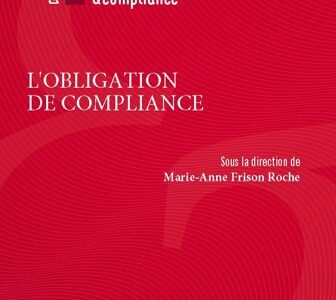
📕L’Obligation de Compliance (dir.)

► Full Reference: M.-A. Frison-Roche (dir.), L'Obligation de Compliance, coll."Régulations & Compliance", Journal of Regulation & Compliance (JoRC) and Dalloz, 2025, 816 p. - 📘 At the same time, a book in English, Compliance Obligation, is published in the collection copublished by the Journal of Regulation & Compliance (JoRC) and the Éditions Bruylant. - 📚This volume is one of a series of books devoted to Compliance in the series edited by Marie-Anne Frison-Roche. - ► General presentation of this book: Compliance is sometimes presented as something that cannot be avoided, which is tantamount to seeing it as the legal obligation par excellence, Criminal Law being its most appropriate mode of expression. It is sometimes presented as something that the company does out of ethical concern, self-regulation which is the opposite of legal obligation. For the moment, therefore, there is no single vision of the Compliance Obligation. This is all the less the case because of the multitude of texts, themselves constantly evolving and changing, which inject such a wide range of compliance obligations that we give up trying to establish any unity, thinking that, on a case-by-case basis, we will define a regime and a legal constraint of greater or lesser strength, aimed at one subject or debtor or another, for the benefit of one or other. This lack of unity, due to the absence of a definition of the Compliance Obligation, makes the application of the texts difficult to foresee and therefore makes the Judge fearful, even though he/she is going to take on more and more importance. This book asks the practical questions: What is Compliance obliging? Who is obliged to comply? and How far are we obliged to comply? and provides answers, Compliance practices, constraints and innovations will be better mastered and anticipated by all those they affect: companies, stakeholders, technicians, lawyers, consultants, institutions and courts. - 🏗️general construction of this Book: The book opens with a double Introduction.  The first, which is freely accessible, consists of a summary of the book, while the second, which is substantial, deals with the unified conception that we can, and indeed should, have, of the "Compliance Obligation", without losing the concrete and active character that characterises this branch of law. The first Part of the book aims to define the Compliance Obligation. To this end, Chapter I deals with the Nature of this obligation. Chapter II deals with the Spaces of the Compliance Obligation. The Part II aims to articulate the Compliance Obligation with other branches of Law.  The Part III of the book looks at the way in which the possibility of obliging and the means of obliging are provided.  To this end, Chapter I deals with the Convergence of the Sources of the Compliance Obligation. Chapter II considers International Arbitration as a reinforcement of the Compliance Obligation. To this end, Chapter I deals with the Convergence of the Sources of the Compliance Obligation. Chapter II considers International Arbitration as a reinforcement of the Compliance Obligation.  The last Part of the book is devoted to Vigilance, the leading edge of the Compliance Obligation. Chapter I is devoted to a study of the various sectors, and analyses the Intensities of the Vigilance Obligation. Chapter II deals with the Variations in Tension generated by the Vigilance Obligation. Finally, Chapter III deals with the New Modalities of the Compliance Obligation, highlighted by the Vigilance Imperative. - TABLE OF CONTENTS    ANCRER LES OBLIGATIONS DE COMPLIANCE SI DIVERSES    DANS LEUR NATURE, LEURS REGIMES ET LEUR FORCE  POUR DEGAGER  L'UNITE DE L'OBLIGATION DE COMPLIANCE LA RENDANT COMPREHENSIBLE ET PRATIQUABLE  (ANCHOR COMPLIANCE OBLIGATIONS, SO DIVERSE  IN THEIR NATURE, THEIR REGIMES AND THEIR FORCE, TO BRING OUT THE UNITY OF THE COMPLIANCE OBLIGATION MAKING IT COMPREHENSIBLE AND PRACTICABLE) ♦️ Obligation de Compliance : construire une structure de compliance produisant des effets crédibles au regard des Buts Monumentaux visés par le Législateur (Compliance Obligation: building a compliance structure that produces credible results with regard to the Monumental Goals targeted by the Legislator), by 🕴️Marie-Anne Frison-Roche   TITRE I. CERNER L’OBLIGATION DE COMPLIANCE  (IDENTIFYING THE COMPLIANCE OBLIGATION)   CHAPITRE I : LA NATURE DE L’OBLIGATION DE COMPLIANCE (THE NATURE OF THE COMPLIANCE OBLIGATION) Section 1 ♦️ La volonté, le cœur et le calcul, les trois traits cernant l'Obligation de Compliance  (Will, Heart and Calculation, the three traits encercling the Compliance Obligation), by 🕴️Marie-Anne Frison-Roche Section 2 ♦️ De la dette à l’obligation de compliance (From the Debt to the Compliance Obligation), by 🕴️Bruno Deffains Section 3 ♦️ Obligation de Compliance et droits humains (Compliance Obligation and Human Rights), by 🕴️Jean-Baptiste Racine Section 4 ♦️ L'Obligation de Compliance et les mutations de la souveraineté et de la citoyenneté (Compliance Obligation and changes in Sovereignty and Citizenship), by 🕴️René Sève Section 5 ♦️ La définition de l''obligation de compliance confrontée au droit de la cybersécurité (The definition of the Compliance Obligation in Cybersecurity Law) by🕴️Michel Séjean   CHAPITRE II : LES ESPACES DE L’OBLIGATION DE COMPLIANCE (SPACES OF THE COMPLIANCE OBLIGATION) Section 1 ♦️ Entités industrielles et Obligation de compliance (Industrial entities and Compliance Obligation), by 🕴️Etienne Maclouf Section 2 ♦️ L'Obligation de Compliance dans les chaînes de valeur (The Compliance Obligation in Value Chains), by 🕴️Lucien Rapp Section 3 ♦️ Compliance et conflits de lois. Le droit international de la vigilance-conformité à partir de quelques applications récentes sur le continent européen (Compliance and conflict of laws. International Law of Vigilance-Conformity, based on recent applications in Europe), by 🕴️Louis d'Avout    TITRE II. ARTICULER L’OBLIGATION DE COMPLIANCE AVEC DES BRANCHES DU DROIT (ARTICULATING THE COMPLIANCE OBLIGATION WITH BRANCHES OF LAW)   Section 2 ♦️ Droit fiscal et obligation de compliance (Tax Law and Compliance Obligation), by 🕴️Daniel Gutmann Section 3 ♦️ Le droit processuel, prototype de l'Obligation de Compliance (General Procedural Law, prototype of the Compliance Obligation), by 🕴️Marie-Anne Frison-Roche Section 4 ♦️ Le droit des sociétés et des marchés financiers face à l'Obligation de Compliance (Corporate and Financial Markets Law facing the Compliance Obligation), by 🕴️Anne-Valérie Le Fur Section 5 ♦️ Le rapport entre le Droit de la responsabilité civile et l'Obligation de Compliance (The link between Tort Law and Compliance Obligation), by 🕴️Jean-Sébastien Borghetti Section 6 ♦️ Dimensions environnementales et climatiques de l'Obligation de Compliance (Environmental and Climatic Dimensions of the Compliance Obligation), by 🕴️Marta Torre-Schaub Section 7 ♦️ Droit de la concurrence et Droit de la Compliance (Competition Law and Compliance Law), by 🕴️Jean-Christophe Roda Section 8 ♦️ L'Obligation de Compliance en Droit global (The Compliance Obligation in Global Law), by 🕴️Benoît Frydman & 🕴️Alice Briegleb Section 9 ♦️ Les juges du droit des entreprises en difficulté et les obligations de compliance (Judges of Insolvency Law and Compliance Obligations), by 🕴️Jean-Baptiste Barbièri   TITRE III. COMPLIANCE : DONNER ET SE DONNER LES MOYENS D’OBLIGER (COMPLIANCE : GIVE AND TAKE THE MEANS TO OBLIGE)   CHAPITRE I : LA CONVERGENCE DES SOURCES (CONVERGENCE OF SOURCES) Section 1 ♦️ Obligation sur obligation vaut (Compliance Obligation on Obligation works), by 🕴️Marie-Anne Frison-Roche Section 2 ♦️ Les technologies disponibles, prescrites ou proscrites pour satisfaire Compliance et Vigilance (Technologies available, prescribed or prohibited to meet Compliance and Vigilance requirements), by 🕴️Emmanuel Netter Section 3 ♦️ Contrainte légale et stratégie des entreprises en matière de Compliance (Legal Constraint and Company Strategies in Compliance matters), by 🕴️Jean-Philippe Denis & Nathalie Fabbe-Costes Section 4 ♦️ La loi, source de l’Obligation de Compliance (The Law, source of the Compliance Obligation), by 🕴️Jean-Baptiste Blanc Section 5 ♦️ Opposition et convergence des systèmes juridiques américains et européens dans les règles et cultures de compliance (Opposition and Convergence of American and European Legal Systems in Compliance Rules and Cultures), by 🕴️Raphaël Gauvain & 🕴️Blanche Balian Section 6 ♦️ Ce à quoi les engagements engagent qu'est un engagement (What a ), by 🕴️Marie-Anne Frison-Roche   CHAPITRE II : L’ARBITRAGE INTERNATIONAL EN RENFORT DE L’OBLIGATION DE COMPLIANCE (INTERNATIONAL ARBITRATION IN SUPPORT OF THE COMPLIANCE OBLIGATION) Section 1 ♦️ Comment l'arbitrage international peut être un renfort de l'Obligation de Compliance (How International Arbitration can reinforce the Compliance Obligation), by 🕴️Laurent Aynès Section 2 ♦️ La considération par l'Arbitrage de l'Obligation de Compliance pour une place d'arbitrage durable (Arbitration' consideration of Compliance Obligation for a Sustainable Arbitration Place),  by 🕴️Marie-Anne Frison-Roche  Section 3 ♦️ L’usage de l’arbitrage international pour renforcer l’obligation de Compliance : l’exemple du secteur de la construction (The use of International Arbitration to reinforce the Compliance Obligation: the example of the construction sector), by 🕴️Christophe Lapp Section 4 ♦️ L’arbitre, juge, superviseur, accompagnateur  ? (The Arbitrator, Judge, Supervisor, Support) , by 🕴️Jean-Baptiste Racine   TITRE IV. LA VIGILANCE, POINTE AVANCÉE DE L’OBLIGATION DE COMPLIANCE (VIGILANCE, SPEARHEAD OF THE COMPLIANCE OBLIGATION) Section 1 ♦️ La Vigilance, pointe avancée et part totale de l'Obligation de Compliance (….), by 🕴️Marie-Anne Frison-Roche CHAPITRE I : LES INTENSITÉS DE L’OBLIGATION DE VIGILANCE, POINTE AVANCÉE DU SYSTÈME DE COMPLIANCE (INTENSITIES OF THE VIGILANCE OBLIGATION, SPEARHEAD OF THE COMPLIANCE SYSTEM) Section 2 ♦️ L’intensité de l’Obligation de Vigilance selon les secteurs : le cas des opérateurs financiers (Intensity of the Vigilance Obligation by Sectors: the case of Financial Operators), by 🕴️Anne-Claire Rouaud Section 3 ♦️ L’intensité de l’Obligation de Vigilance selon les secteurs : le cas des opérateurs bancaires et d’assurance (Intensity of the Vigilance Obligation by Sectors: the case of Banking and Insurance Operators), by 🕴️Mathieu Françon Section 4 ♦️ L’intensité de l’obligation de vigilance selon les secteurs : le cas des opérateurs numériques (Intensity of the Vigilance Obligation by Sectors: the case of Digital Operators), by 🕴️Grégoire Loiseau Section 5 ♦️ L’Obligation de vigilance des opérateurs énergétiques (The Vigilance obligation of Energy Operators), by 🕴️Marie Lamoureux Section 2 ♦️ Transformation de la gouvernance et obligation de Vigilance (Transformation of Governance and Vigilance Obligation), by 🕴️Véronique Magniermag   CHAPITRE II : LES DISPUTES AUTOUR DE L'OBLIGATION DE VIGILANCE, POINTE AVANCÉE DU SYSTÈME DE COMPLIANCE, DANS SON RAPPORT AVEC LA RESPONSABILITÉ Section 1 ♦️ Le rapport entre le droit de la responsabilité civile et l'obligation de compliance, by 🕴️Jean-Sébastien Borghetti Section 2 ♦️ Repenser le concept de responsabilité civile à l’aune du devoir de vigilance, pointe avancée de la compliance (Rethinking the Concept of Civil Liability in the light of the Duty of Vigilance, Spearhead of Compliance), by 🕴️Mustapha Mekki Section 3 ♦️ Tensions et contradictions entre les instruments relatifs à la vigilance raisonnable des entreprises, by 🕴️Laurence Dubin Section 4 ♦️ Compliance, Vigilance et Responsabilité civile : mettre en ordre et raison garde (Compliance, Vigilance  and Civil Liability: put in order and keep the Reason), by 🕴️Marie-Anne Frison-Roche   CHAPITRE III : LES MODALITÉS NOUVELLES DE L'OBLIGATION DE COMPLIANCE, MISES EN LUMIÈRE PAR L'IMPÉRATIF DE VIGILANCE (NEW MODALITIES OF THE COMPLIANCE OBLIGATION, HIGHLIGHTED BY THE VIGILANCE IMPERATIVE) Section 1 ♦️ Clauses et contrats, modalités de l’obligation de vigilance (Clauses and Contracts, terms and conditions of implementation of the Vigilance Obligation), by 🕴️Gilles J. Martin Section 2 ♦️ La preuve de la bonne exécution de la Vigilance au regard du système probatoire de Compliance (Proof that Vigilance has been properly carried out with regard to the Compliance Evidence System), by 🕴️Jean-Christophe Roda   TITRE V. LE JUGE ET L'OBLIGATION DE COMPLIANCE (THE JUDGE AND THE COMPLIANCE OBLIGATION) Section 1 Section 1 ♦️ Devoir de vigilance et litiges commerciaux : une compétence à partager ?, par 🕴️François Ancel Section 2 ♦️ Les enjeux présents à venir de l’articulation des principes de procédure civile et commerciale avec la logique de compliance (Present and Future Challenges of Articulating Principles of Civil and Commercial Procedure with the Logic of Compliance), by 🕴️Thibault Goujon-Bethan Section 3 ♦️ Le juge de l’amiable et la compliance (The amicable settlement judge and compliance), by 🕴️Malik Chapuis Section 4 ♦️ Le Juge requis pour une Obligation de Compliance effective (The Judge required for an Effective Compliance Obligation), by 🕴️Marie-Anne Frison-Roche     L’OBLIGATION DE COMPLIANCE : VISION D’ENSEMBLE (COMPLIANCE OBLIGATION : OVERVIEW) ♦️ L'obligation de compliance, charge portée par les entreprises systémiques donnant vie au Droit de la Compliance. – lignes de force de l'ouvrage (The Compliance Obligation, a burden borne by Systemic Companies giving life to Compliance Law –  key points of the book (free access) by 🕴️Marie-Anne Frison-Roche - 🌐follow Marie-Anne Frison-Roche on LinkedIn 🌐follow Marie-Anne Frison-Roche on Instagram 🌐subscribe to the Newsletter MAFR Regulation, Compliance, Law 🌐subscribe to the VideoNews  MAFR Surplomb 🌐subscribe to the Newsletter MaFR Law & Art

Working papers

Working Paper for 📺Overhang

🚧Dans le silence des textes, vers qui se tourner en cas de manquement à une disposition du Droit de la Compliance ?

► Full Reference: M.-A. Frison-Roche, Who is responsible for making the Compliance provision effective? Is it the company or the public authority? Example of data: CE, 27 January 2025, B. c/ CNIL, Working Paper, February 2025.   - 🎤 This Working Paper was developed as a basis for the Overhang👁 video  on 8 February 2025 : click HERE (in French) - 🎬🎬🎬In the collection of the Overhangs👁 It falls into the News category. ►Watch the complete collection of the Overhangs👁 : click HERE - ► Summary of this Working Paper: In its decision of 27 January 2025, B. v CNIL, the French Administrative Supreme Court (Conseil d'État ) had to provide a solution to a case that the Compliance rules applicable to data had not expressly provided for. Can a person who believes that another person has failed to fulfill their obligations under the GDPR refer the matter to the French Data Protection Regulator (CNIL) and not the data controller? The Conseil d'État considers that the question is clear and that there is no point in referring a preliminary question to the ECJ. Indeed, the texts require the person alleging that his or her right has been infringed to first contact the data controller to have the information deleted before subsequently referring the matter to the CNIL. Furthermore, this case involved personal information inserted by doctors in an expert report submitted to a court. The Conseil d'État agreed with the CNIL that it was not required to review and assess the evidence, which is the role of the court. This shows that, while the right to alert can be used to refer cases directly to the administrative authorities, here the specific takes precedence over the general, with the spirit of the Law entrusting the direct preservation of rights to the data controller, with the CNIL's supervisory and sanctioning role coming only at a later stage. This illustrates the more general nature of Compliance Law, which relies primarily on the operators themselves. Furthermore, as a melting pot of various subjective rights, in this case the right to erasure but also the right to contribute to the debates, the Conseil d'État stresses that it is the role of the judicial judge to ensure the fairness of the debates. - 🔓read the developments below⤵️ - 🌐follow Marie-Anne Frison-Roche sur LinkedIn 🌐follow Marie-Anne Frison-Roche on Instagram 🌐subscribe to the Newsletter MAFR Regulation, Compliance, Law  🌐subscribe to the Video Newsletter MAFR Surplomb

Articles

Interview in a newspaper

« La compliance est avant tout une affaire humaine » (Compliance is first and foremost a human issue)

► Full Reference: M.-A. Frison-Roche,  « La compliance est avant tout une affaire humaine» (Compliance is first and foremost a human issue), interview conducted by Olivia Dufour for Actu-juridique, Lextenso, 23 January 2025.   - ► read the interview: 💬in French) - 🏛️🏛️🏛️🏛️this interview was organised following a number of official opening hearings of Parisian courts, in particular that of the Paris Judicial Court on 21 January 2025, at which the presidents of these courts explained the role now played by systemic litigation and compliance and/or vigilance law, in particular in the internal organisation of their courts. - ► presentation of this interview:  Q. (translated): At the start of the new session of the official opening hearings of Paris Court of First Instance on 21 January, President Stéphane Noël spoke at length about the creation of a 34th chamber dedicated to handling cases relating to companies' obligation of vigilance. What are the advantages of this new specialisation? MAFR Answer Summary: It corresponds to the jurisdiction given to the Paris Court of First Instance by the French 2020 so-called Confidence Act, which extends the French 2017 so-called Vigilance Act. It reflects the importance of Compliance Law, of which Vigilance is the leading edge.   Q. (translated): The court president points out that this new litigation raises questions about the role of the courts, which is to "concilier le respect des buts fondamentaux pour la protection de l’humanité avec la possibilité pour les entreprises d’apprécier la maitrise des risques et leur éventuelle responsabilité" ("reconcile respect for the monumental goals of protecting humanity with the ability of companies to assess the control of risks and their potential liability"). What do you think?   MAFR Answer Summary: the role of the judge has been renewed, as they take charge of the future of the systems and participates in the achievement of the Monumental Goals of Compliance Law. Companies are subject by law to a new compliance obligation and must demonstrate their diligence. They may be held liable under the general ordinary legal regime, as set out in the French 2017 Act on Vigilance duty, if the claimant demonstrates the existence of fault or negligence, damage and a causal link between the 2.   Q. (translated): All this comes under the heading of compliance, a concept you've been working on for 10 years and which is still not fully understood and is too often confused with conformity….   MAFR Answer Summary: The 2 aforementioned concepts ("conformity" and "compliance") were identified in the article I published in 2016 entitled Le droit de la compliance"Compliance law". This notion has taken a long time to mature because, on the one hand, it is a radically new branch of law that has an impact on the other branches. On the other hand, indeed,  there is confusion between 'compliance' and 'conformity'. Conformity is the obedience to applicable regulations; compliance is the active participation in the achievement of monumental goals to preserve or save systems in which humans are involved. Conformity is, and is only, a tool of Compliance Law.   Q. (translated):  The Nanterre Court has just created a chamber for Emerging Systemic and Regulatory Litigation. Does this confirm the interest of the courts in this fundamental development?   MAFR Answer Summary: This statement by the President of the Nanterre Court of Appeal at his hearing on 20 January 2025 illustrates the Regulation – Compliance – Vigilance continuum. He involves training for judges and dialogue between judges. Training and dialogue are being put in place.   Q. (translated):  Y a-t-il d’autres initiatives en ce sens ? MAFR Answer Summary:Le président du Tribunal de commerce Paris à son audience du 15 janvier 2025 a annoncé la création d'une chambre des contentieux complexe. Les contentieux systémiques émergents, que le Droit de la Compliance peut engendrer, ont vocation à y être présentés. Là  aussi, formation et dialogue se mettent en place.   Q. (translated):  Que manque-t-il encore ? MAFR Answer Summary: puisque le Droit de la compliance se contractualise de plus en plus, notamment dans les chaines de valeur concernées par les techniques de vigilance, l'arbitrage international est concerné. Des arbitres internationaux intégrant le droit de la compliance, et pas seulement attaché à telle et telle réglementation sectorielle, sont un enjeu d'attractivité de la Place de Paris. Cela va émerger, notamment par le dynamisme de la Cour internationale d'arbitrage, dont le siège est à Paris. - 🌐suivre Marie-Anne Frison-Roche sur LinkedIn 🌐suivre Marie-Anne Frison-Roche sur Instagram 🌐s'abonner à la Newsletter MAFR Regulation, Compliance, Law 🌐s'abonner à la Newsletter en vidéo MAFR Surplomb

Conferences

Conference

🎤Identifier et anticiper la pratique du Contentieux Systémique Émergent ; Présentation de 🧮L’expérience des juridictions dans le Contentieux Systémique Émergent

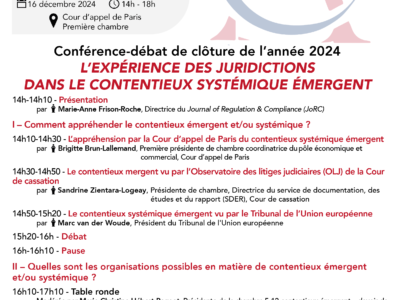
► Full Reference: M.-A. Frison-Roche, Identifier et anticiper la pratique du Contentieux Systémique Émergent (Identifying and anticipating the practice of Emerging Systemic Litigation) ; Presentation of L’expérience des juridictions dans le Contentieux Systémique Émergent (Courts Experience in Emerging Systemic Litigation), in cycle of conference-debates "Contentieux Systémique Émergent" ("Emerging Systemic Litigation"), organised on the initiative of the Cour d'appel de Paris (Paris Cour of Appeal), with the Cour de cassation (French Court of cassation), the Cour d'appel de Versailles (Versailles Court of Appeal), the École nationale de la magistrature – ENM (French National School for the Judiciary) and the École de formation des barreaux du ressort de la Cour d'appel de Paris – EFB (Paris Bar School), under the scientific direction of Marie-Anne Frison-Roche, 16 December 2024, 2pm.-6pm., Cour d'appel de Paris, Première Chambre (First Chamber). - 🧮see the full programme of this event - ⚙️This event has been conceived as a part of the cycle of conference-debates "Contentieux Systémique Émergent" ("Emerging Systemic Litigation"), organised on the initiative of the Cour d'appel de Paris (Paris Cour of Appeal), with the Cour de cassation (French Court of cassation), the Cour d'appel de Versailles (Versailles Court of Appeal), the École nationale de la magistrature – ENM (French National School for the Judiciary) and the École de formation des barreaux du ressort de la Cour d'appel de Paris – EFB (Paris Bar School), under the scientific direction of Marie-Anne Frison-Roche - ► English Summary of the conference:  - 🌐follow Marie-Anne Frison-Roche on LinkedIn 🌐follow Marie-Anne Frison-Roche on Instagram 🌐subscribe to the Newsletter MAFR Regulation, Compliance, Law 🌐subscribe to the Newsletter Surplomb, par MAFR

Organisation of events

🧱⚙️scientific organisation of 🧮L’expérience des juridictions dans le Contentieux Systémique Émergent (Courts Experience in Emerging Systemic Litigation), in cycle of conference-debates “Contentieux Systémique Émergent” (“Emerging Systemic Litigation”)

► Full Reference: L’expérience des juridictions dans le Contentieux Systémique Émergent (Courts Experience in Emerging Systemic Litigation), in cycle of conference-debates "Contentieux Systémique Émergent" ("Emerging Systemic Litigation"), organised on the initiative of the Cour d'appel de Paris (Paris Cour of Appeal), with the Cour de cassation (French Court of cassation), the Cour d'appel de Versailles (Versailles Court of Appeal), the École nationale de la magistrature – ENM (French National School for the Judiciary) and the École de formation des barreaux du ressort de la Cour d'appel de Paris – EFB (Paris Bar School), under the scientific direction of Marie-Anne Frison-Roche, 16 December 2024, 2pm.-6pm., Cour d'appel de Paris, Première Chambre (First Chamber) - ► Presentation of the conference:  - 🧮Programme of this event:  Closing conference-debate of 2024 L'EXPÉRIENCE DES JURIDICTIONS DANS LE CONTENTIEUX SYSTÉMIQUE ÉMERGENT  (COURTS EXPERIENCE IN EMERGING SYSTEMIC LITIGATION) Paris Court of Appeal, First Chamber   🕰️2pm.-2.10pm. Présentation (Introduction), by 🕴️Marie-Anne Frison-Roche, Professor of Regulatory Law and  Compliance Law, Director of the Journal of Regulation & Compliance (JoRC), Scientific Director of the Cycle of conferences-debates on the Emerging Systemic Litigation – ESL)   I – Comment appréhender le contentieux émergent et/ou systémique ?  (I – How to deal with Emerging and/or Systemic Litigation?) 🕰️2.10pm.-2.30pm. 🎤L’appréhension par la Cour d’appel de Paris du Contentieux Systémique Émergent (The Paris Court of Appeal's approach to Emerging Systemic Litigation), by 🕴️Brigitte Brun-Lallemand, Première présidente de chambre coordinatrice du pôle économique et commercial, Cour d’appel de Paris (First President of Chamber, Coordinator of the Economic and Commercial Division, Paris Court of Appeal) 🕰️2.30pm.-2.50pm. 🎤Le contentieux émergent vu par l’Observatoire des litiges judiciaires (OLJ) de la Cour de cassation, par 🕴️Sandrine Zientara-Logeay, Présidente de chambre, Directrice du service de documentation, des études et du rapport – SDER, Cour de cassation (President of Chamber, Director of the Department of Documentation, Studies and Reports – SDER, French Court of cassation)  🕰️2.50pm.-3.20pm. 🎤Le contentieux systémique Eémergent vu par le Tribunal de l’Union européenne (Emerging Systemic Litigation as seen by the General Court of the European Union), par 🕴️Marc van der Woude, President of the General Court of the European Union  🕰️3.20pm.-4pm. Debate 🕰️4pm.-4.20pm. Break   II – Quelles sont les organisations possibles en matière de contentieux émergent et/ou systémique ?  (II – How to organise with Emerging and/or Systemic Litigation?) 🕰️4.10pm.-5.10pm. 🎤Table ronde (Round Table) Moderated by 🕴️Marie-Christine Hébert-Pageot, Présidente de la chambre 5-12 contentieux émergent – devoir de vigilance et responsabilité écologique, Cour d‘appel de Paris (President of the 5-12 Chamber emerging litigation – duty of vigilance and ecological liability, Paris Court of Appeal) Speakers: 🕴️Stéphane Noël, Président du Tribunal judiciaire de Paris (President of the Paris First Instance Civil Court) 🕴️Patrick Sayer, Président du Tribunal de commerce de Paris (President of the Paris First Instance Commercial Court) 🕴️Jean-François Beynel, Premier président de la Cour d’appel de Versailles (First President of the Versailles Court of Appeal) and 🕴️Benjamin Deparis, Président du Tribunal judiciaire de Nanterre (President of the Nanterre First Instance Civil Court) 🕰️5.10pm.-5.40pm. Debate   🕰️5.40pm.-6pm. 🎤Conclusion. Le Contentieux Systémique Émergent : dialogues (Conclusion. Emerging Systemic Litigation: Dialogues), by 🕴️Jacques Boulard, Premier Président de la Cour d’appel de Paris (First President of the Paris Court of Appeal) - 🔴Registrations and information requests can be sent to: inscriptionscse@gmail.com 🔴For the attorneys, registrations have to be sent to the following address: https://evenium.events/cycle-de-conferences-contentieux-systemique-emergent/  ⚠️The conference-debates are held in person only, in the Cour d’appel de Paris (Paris Court of Appeal). -

Articles

📝Antitrust, natural field of Systemic Litigation

► Full Reference: M.-A. Frison-Roche, "Antitrust, natural field of Systemic Litigation", Concurrences, November 2024, No. 4, Art. No. 120776. - 📝read the article (in English) - 🚧read the bilingual Working Paper which is the basis of this article, with additional developments, technical references and hyperlinks - ► English Summary of this article: Systemic Litigation is a specific category of Litigation in which beyond the dispute between the parties the interest of a System is involved, in particular its future. Competition Law is a natural and long-standing field for this category, which is now emerging strongly for information, climate and energy systems.  It should be remembered that a market is not self-regulating and cannot continue to function in the long term unless it has the benefit of a judge, a figure who is specific in that he/she is both external to it and yet apprehends its specific interest. In order to satisfy this double requirement, liberal legal organisations often entrust the competition authority with jurisdiction over this Systemic Litigation. Ordinary courts will also hear such cases, either on appeal or in other proceedings, and it cannot be claimed that courts are excluded, the systemic dimension of the dispute being expressed by the presence of the competition authority in the proceedings. This explains the procedural rules that are hard to justify otherwise. The Authority, the European Commission for example, must be able to develop and express the specific interests of the competition system. This special role of the competition authority in this type of litigation, because it is systemic, has been in place for decades and should serve as a model for Systemic Litigation, which is being developed for other systems whose sustainability is now referred to the courts. - 🌐follow Marie-Anne Frison-Roche on LinkedIn 🌐follow Marie-Anne Frison-Roche on Instagram 🌐subscribe to the Newsletter MAFR Regulation, Compliance, Law 🌐subscribe to the Newsletter Surplomb, par MAFR

Conferences

conference

🎥Synthèse (Synthesis), in 🧮Les pratiques juridictionnelles au service d’un espace juridique pour le futur (In the Space of Justice, Jurisdictional Practices at the Service of the Future)

► Full Reference: M.-A. Frison-Roche, "Synthèse" ("Synthesis"), in M.-A. Frison-Roche (dir.), Dans l’espace de justice, les pratiques juridictionnelles au service du futur (In the Space of Justice, Jurisdictional Practices at the Service of the Future), in Cour de cassation, cycle of conferences "Penser les pratiques juridictionnelles au service d’un espace de justice" ("Thinking about jurisdictional practices in the service of an area of justice"), 21 November 2024, 4pm.-6pm. - 🧮see the program of this manifestation (in French) - ► English summary of this conference:  The topic covered takes account of the fact that this scientific event comes almost last in this cycle of conferences Penser les pratiques juridictionnelles au service d’un espace de justice ("Thinking about jurisdictional practices in the service of an area of justice"). Indeed, 'jurisdictional practices' have previously been addressed insofar as they are 'at the service of a European area of justice' (February 2023), enlightened (March 2023), attractive (June 2023), interactive (September 2023), peacemaking (December 2023). The approach here is different and complementary. The conference's starting point is the observation that, today, many new claims are made before Judges that relate directly to the Future. Admittedly, in their traditional role, Judges deal with the Future of disputed situations, but today it is the Future of Systems in their entirety that is sometimes submitted to them through a dispute or a claim. Moreover, they may be asked to find a systemic solution. The possible presence of future generations is just one sign of this change. The courtroom may seem unsuitable for trials of such gigantic proportions, both in terms of their subject matter and their impact. No doubt a distinction must be drawn between judges, some of whom may appear more familiar than others with the systemic issues that the Future brings with itself. Perhaps the judge's prudence should guide him/her in the use they make of their powers when they relate to the future, for example in the handling of sanctions, because the future by its very nature contains an element of the unknown, a fundamental prudence that the principle of the legality of offences and penalties expresses. But the future is not a blank page and Judges, without inventing it, can, indeed must, monitor the coherence of those who write the legal rules, if they are constitutional judges, and of those who write contracts and commitments, if they are civil and commercial judges. In order to fulfill their role, particularly with regard to the demands of stakeholders, judges need to think about and deal with this new systemic object before them: the future. To understand it, Judges draw on available jurisdictional practices, adjust others and combine them, using new methods. - 🧮see below the complete programme of this manifestation⤵️ - 🌐follow Marie-Anne Frison-Roche on LinkedIn 🌐follow Marie-Anne Frison-Roche on Instagram 🌐subscribe to the Newsletter MAFR Regulation, Compliance, Law

Organisation of events

🧱⚙️Coordination of the conference 🧮Dans l’espace de justice, les pratiques juridictionnelles au service du futur (In the Space of Justice, Jurisdictional Practices at the Service of the Future)

► Full Reference: M.-A. Frison-Roche, coordination of the conference Dans l’espace de justice, les pratiques juridictionnelles au service du futur (In the Space of Justice, Jurisdictional Practices at the Service of the Future), in Cour de cassation, cycle of conferences "Penser les pratiques juridictionnelles au service d’un espace de justice" ("Thinking jurisdictional practices in the service of a Space of Justice"), 21 November 2023, 4pm.-6.30pm. - ► General presentation of the conference: The conception of the conference takes account of the fact that the event comes almost last in the cycle. Previous themes have been ‘jurisdictional practices’ insofar as they are ‘at the service of a European area of justice’ (February 2023), ‘enlightened’ (March 2023), ‘attractive’ (June 2023), ‘interactive’ (September 2023) and ‘peacemaking’ (December 2023). The conference's problematic stems from an observation: today, judges are facing claims that relate directly to the future. Of course, in their traditional office judges deal with the future of disputed situations, but today it is the future of systems in their entirety that is sometimes submitted to them through a dispute or a request, and a solution is sought. The possible presence of future generations is just one sign of this. The space of justice may seem unsuitable for such gigantic trials, both in terms of their subject matter and their impact. No doubt a distinction must be made between judges, and some judges may seem more familiar than others with the systemic issues that the future brings with it. Perhaps the judge's prudence should lead him not to use his power over the future, for example in the handling of sanctions, forgetting that the future by its very nature contains an element of the unknown, a fundamental prudence which the principle of the legality of offences and penalties expresses. But the future is not a blank page either and the judge, without inventing it, can check the coherence of those who write the law, if he is a constitutional judge, those who write contracts and commitments, if he is a civil or commercial judge. In order to fulfil their office, which the stakeholders are demanding, judges need to think about and deal with this new systemic object before them: the future. To understand it, judges draw on available jurisdictional practices, adjust others, and link them together using new methods. - 🧮read the programme of the cycle of conférences in 2023 (in French) -