Corruption

Breaking news

📧Regarding Compliance: Observations on the first steps of the European Public Prosecutor and her conception of the EPPO’s Action: on Health, Infrastructures and Agriculture

► It is in its "Risk and Compliance" section that the Wall Street Journal, by its article of June 18, 2021 (➡️📝Europe's Chief Prosecutor Has 300 Cases on Her Plate Already), presents the first steps of the European Public Prosecutor’s Office, since June 1, 2021. This inclusion presupposes that it is through a Compliance Law perspective that this new body must be understood, in order to understand and anticipate its action. ►In this perspective : ➡️📧Frison-Roche, M.-A., European Public Prosecutor's Office comes on stage: the company having itself become a private prosecutor, are we going towards an alliance of all prosecutors?, June 2, 2021 ➡️ 💬Frison-Roche, « Le parquet européen est un apport considérable au Droit de la Compliance » (“The European Public Prosecutor's Office is a remarkable contribution to Compliance Law"), June 14, 2021   I. AN ACTION THAT WILL FOCUS ON FIGHTING THE MEANS USED TO DAMAGE THE FINANCIAL INTERESTS OF THE EUROPEAN UNION The article of the Wall Street Journal takes the form of an interview with the European Prosecutor. Her responses also confirm the consubstantial link between European Public Prosecutor's Office and Compliance Law. It is remarkable that she immediately says that she hopes the treatment of many cases, especially on healthcare and infrastructure sectors: "Our expectation is to have more cases, especially in the healthcare system, in public procurement, infrastructure, and also in agriculture ". However, the 2017 European Regulation which established the European Public Prosecutor’s Office said that its "mandate" is to prosecute offenses affecting the "financial interests of the European Union", without being hampered by the cumbersome procedures for cooperation between States while these offenses are most often cross-border. But one could think that, knowingly taking the means (corruption, money laundering) for the goal, the European Public Prosecutor's Office would immediately pursue not only the defense of the financial interests of the Union (admittedly financial interests damaged by corruption or money laundering) but these facts themselves: thus the European Public Prosecutor's Office works with the European Supervisory Authorities, in particular banking and financial authorities, which fight in Ex Ante against these offenses and prevent them.   II. AN ACTION THAT FOCUSES ON SECTORS NOT LEGALLY REGULATED IN EX ANTE BY SECTORAL REGULATORY AUTHORITIES Moreover, it will be noted that the European Prosecutor is targeting three economic sectors which are not "regulated sectors" in the legal sense of the qualification, that is to say not monitored by a sectoral Regulatory and/or Supervision Authority: Health, Infrastructure and Agriculture. Thus, the power of Regulatory Law, which relies in its Ex Ante, and its weakness, which derives from the pre-required existence of a sectoral Authority, is compensated: the action of the Public Prosecutor's Office is not limited to legally regulated sectors. While Competition Authorities are mandated (➡️📅La concurrence dans tous ses états, June 25 and 26, 2021) to protect the competitive functioning of the markets, a Public Prosecutor's Office can deal with any infringement without having to determine a market. For instance, Infrastructures don't constitute pertinent markets but can constitute fields for criminal activities, such as corruption or money laundering, justifying Compliance Law mechanisms.  What the new European Prosecutor is aiming for, namely Health, Infrastructures and Agriculture, have undoubtedly been damaged both by the sole primacy of the Competition perspective and by a Criminal Law constrained by the difficult inter-State cooperation, even though they are not subject to a supranational Ex Ante Regulation. The European Public Prosecutor's Office aims to directly improve this, through Entreprises acting in Health, Infrastructures and Agriculture.  -   ► subscribe to the French Newsletter MaFR ComplianceTech®

Jurisprudence

Autorité de Contrôle Prudentiel et de Résolution (French Banking Regulator), Commission des sanctions (Commission of sanctions)

Decision of 24th of February 2021 2021, ING France

Full reference: Autorité de Contrôle Prudentiel et de Résolution (French Banking Regulator), Commission des sanctions (Commission of sanctions), 24th of February 2021, ING Bank France, procedure n°2020-02   Read the decision (in French)   In this decision, the ACPR Sanctions Commission condemns IGN Bank France to a reprimand and a financial penalty of 3 million euros because of the inadequacy of its measures to fight corruption, money laundering and financing of terrorism.   Extract from the decision summarizing ING France's breaches of its Compliance obligations to fight against corruption, money laundering and financing of terrorism: "At the time of the on-site check, ING France's risk classification was incomplete and ineffective (grievance 1) and its system for monitoring its business relations (complaint 2) and their operations (grievance 4) presented serious deficiencies, as well as its organization and procedures for fund transfers (grievance 3). The updating of customer knowledge was insufficient (grievance 5), as were the detection of PEPs and the implementation of measures due diligence for this category of clientele (grievance 6). For the implementation of its due diligence obligations, numerous shortcomings were noted, whether these were breaches of the obligation to carry out a reinforced examination (grievance 7) or breaches of the obligation to send Tracfin a DS, initial (grievance 8) or additional (grievance 9). Finally, the detection of persons subject to an asset freezing measure was not fully effective (grievance 10) " (our translation of the decision which is only available in French).

Reports

Agence française anticorruption - AFA (French Anti-corruption Agency)

📜The French Anti-Corruption Agency Guidelines. Notice on the French Anti-corruption Agency Guidelines to help public and private sector entities to prevent and detect bribery, influence peddling, extorsion by public officials, illegal taking of interest, misappropriation of public funds and favoritism

► Full Reference: Agence française anticorruption – AFA (French Anti-corruption Agency), The French Anti-Corruption Agency Guidelines. Notice on the French Anti-corruption Agency Guidelines to help public and private sector entities to prevent and detect bribery, influence peddling, extorsion by public officials, illegal taking of interest, misappropriation of public funds and favoritism, January 12, 2021 - 📜Read the guidelines -

Analyses

Comparaison des versions 2017 et 2020 des recommendations de l’Agence Française Anti-corruption sur la cartographie des risques de corruption (Mechanical Comparison of 2017 and 2020 versions of French Anti-Corruption Authority recommendations about Corruption Risk Mapping)

Full reference: Coeurquetin, R., Comparaison mécanique des versions 2017 et 2020 des recommendations de l'Agence Française Anti-corruption sur la cartographie des risques de corruption, October 2020, 9 p.  Read the mechanical comparison (in French) To go further on the question of risk mapping, read Marie-Anne Frison-Roche's working papers: Drawing up Risk Maps a an Obligation and the Paradoxe of "Compliance Risks" and Anchor Points of the Risk Mapping in the Legal System

Articles

Interregulation: way of “cooperation protocol”​ between Regulatory Bodies.Example between French Financial Markets Authority and Anticorruption Agency

Full reference: Frison-Roche, M.-A., Interregulation: way of "cooperation protocol"​ between Regulatory Bodies. Example between French Financial Markets Authority and Anticorruption Agency, Newsletter MAFR – Law, Compliance, Regulation, 22nd of September 2020 Read by freely subscribing other news of the Newsletter MAFR – Law, Compliance, Regulation   Summary of the news:  Although Regulation Law was born from the notion "sector", constant interferences between sectors and frequent interactions between some sectors and more general questions common to different sectors, make interregulation necessary. Compliance Law being the extension of Regulation Law, this interregulation mechanism is also necessary in Compliance Law.  This interregulation can take many legal paths like letters exchanges between regulators, the creation of a network of regulators and supervisors at the world level or about some specific question or the adoption of a "cooperation protocol" as the AMF (French Financial Market Regulator) and the AFA (French Anticorruption Agency) did on 16th of September 2020 to reinforce their respective fight against corruption, against market abuses and for the protection of investors.  This cooperation protocol between the AFA and the AMF has the following subjects: A more efficient methodology concerning the research and the analysis of corruption and market abuses. A more efficient prevention of corruption and market abuses. A better capacity to give recommendations of new regulations to the Legislator. A more rigorous monitoring of international works on the topic.  A more coherent information for the public. Are regulators the new teachers? 

Reports

Agence Française Anticorruption (French anticorruption agency) - Département de l'appui aux acteurs économiques (Support to economic actors department)

La politique cadeaux et invitations dans les entreprises, les EPIC, les associations et les fondations (Gifts and invitations policy for firms, public firms, associations and fondations)

Full reference: Agence Française Anticorruption (French anticorruption agency), Département de l'appui aux acteurs économiques (Support to economic actors department), La politique cadeaux et invitations dans les entreprises, les EPIC, les associations et les fondations (Gifts and invitations policy for firms, public firms, associations and fondations), Guide pratique 2020 (Practical Guide 2020), 11th of September 2020, 14 p. Read the practical guide in French

Articles

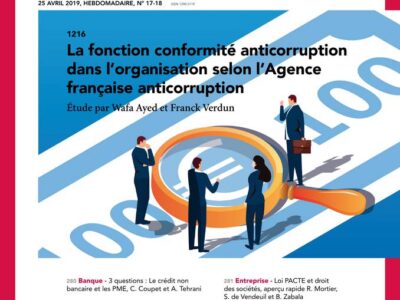
La fonction conformité anticorruption dans l’organisation selon l’Agence française anticorruption

Full reference : Ayed,W., Verdun,F., La fonction conformité anticorruption dans l’organisation selon l’Agence française anticorruption, in La semaine juridique, Entreprises et Affaires, JCP, E, LexisNexis, n°17-18/1206, 25 avril 2019, pp. 38-44.     Sciences Po students can read the article via the drive, folder  "MAFR – Régulation – Compliance"

Texts

United-Kingdom Parliament

UK Bribery Act

Full reference: United-Kingdom Parliament, UK Bribery Act, 2010 Read the text