Compliance Law

Videos

🎥Compliance and management: mediation rather than punishment, Interview with 🕴️Marie-Anne Frison-Roche by 🕴️Jean-Philippe Denis,🎬 Series of talks on Compliance Law, in 📺 Open windows on management

► Full reference:  M.-A. Frison-Roche, "Compliance et management : la médiation plutôt que la sanction ?" ("Compliance and management: mediation rather than punishment?"), interview conducted by Jean-Philippe Denis as part of a series of interviews on Compliance Law, in Fenêtres ouvertes sur la gestion (Open windows on management), broadcast by J.-Ph. Denis, Xerfi Canal, recorded December 12, 2023, released on May 22, 2024 - 🌐consult the December 2023 presentation of the interview on LinkedIn - 🌐read the MAFR. Law, Compliance, Regulation of April 2024 based on this interview  - 🧱consult the general presentation of this series of interviews on Compliance Law - 🎥view the full interview on Xerfi Canal - ► Starting point: Since 2016, Marie-Anne Frison-Roche has been building Compliance Law, notably through a collection co-published in French with Editions Dalloz and co-published in English with Editions Bruylant:  🧱lire la présentation de la collection en langue française, Régulations & Compliance ➡️click HERE  🧱read the presentation of the series in English, Compliance & Regulation ➡️click HERE - ► Summary of interview: Jean-Philippe Denis. Question: To put it bluntly, isn't Compliance Law expressed by the BNP Paribas fine? Marie-Anne Frison-Roche.  Answer: It is still through this fine that Compliance is often perceived. How regrettable… - Jean-Philippe Denis. Q.: At least, that's how the Politician realised there was a subject…. Marie-Anne Frison-Roche.  A. : This is true, and not just for politicians and firms since this case has had an impact on European public opinion. This matter has therefore become known for the violence of the sanctions, and the intervention of heads of State to reduce their consequences. But we're talking about sanctions. Meanwhile, others talk about compliance through soft law, soft co-regulation, charters and soft commitments, the contours of which are sometimes uncertain. Today, adjustments are made regarding the Monumental Goals of preserving the systems on which this Compliance Law is based, and tools are used on this basis, tools with which lawyers are very familiar: contracts. Through contracts, enterprises structure their compliance obligations. - Jean-Philippe Denis. Q.: You point out that Compliance Law is becoming more civilised and that more people are resorting to mediation. Marie-Anne Frison-Roche.  A.: Yes, Compliance Law is becoming more civilised, and civil law is becoming increasingly important, particularly through Contract Law, with stipulations being inserted to prevent human rights or environmental infringements. As Compliance Law operates on an ex-ante basis, the enterprise will organise dialogue with stakeholders, in particular when vigilance plans are drawn up, Vigilance mechanism being the spear head of Compliance Law. If the situation becomes litigious and the matter is referred to the courts, the civil courts, whose role is growing, will themselves organise mediation. Mediation, which is now part is an instrument for bringing the parties together and finding solutions. -

Articles

📧Ne pas confondre process de conformité et Droit de la Compliance: les conséquences pratiques (Don’t confuse compliance processes with compliance law: practical consequences)

► Full Reference: M.-A. Frison-Roche, "Ne pas confondre process de conformité et Droit de la Compliance: les conséquences pratiques (Don't confuse compliance processes with compliance law: practical consequences)", Newsletter MAFR Law, Compliance, Regulation, May 5, 2024 - 📧Read by freely subscribing other news of the Newsletter MAFR – Law, Compliance, Regulation - ► News summary : Reducing Compliance to conformity processes can be fatal for companies. Reading Norbert Alter's book on management in a two-pronged movement which, according to the author, has consisted on the one hand in draining companies of all process and control, and on the other hand in injecting learning about ethics, benevolence and concern for others, has been detrimental in that the first movement has systemically destroyed meaning, meaning which is then so difficult to inculcate. This is very instructive if we look at it from a legal perspective: in effect, it corresponds to what is happening between Compliance Law and Compliance Processes. In the latter case, we might even consider that it is “liability” in the legal sense that is at stake: the company would incur liability at the slightest failure of the non-compliance process, whereas Compliance Law, a branch teleologically built on the Monumental Goals that constitute its legal standards (preservation of systems, e.g. banking, financial, health, energy, digital, climate systems, etc.), implies only an obligation of means. Compliance law does not require companies to follow processes blindly and to the letter, but to demonstrate the effects that have already been achieved and that it is reasonably plausible that they will achieve in the future. In this respect, compliance is essentially a probationary obligation. - 📧read the article published on 5 May 2024 on this topic in the Newsletter MAFR – Law, Compliance, Regulation ⤵️ - 🌐follow Marie-Anne Frison-Roche on LinkedIn 🌐follow Marie-Anne Frison-Roche on Instagram 🌐subscribe to the Newsletter MAFR Regulation, Compliance, Law

Videos

🕴️MaFR interviews 🕴️Eduardo Silva-Romero

🎥Compliance Law: International Arbitration and geopolitics, Interview with 🕴️Eduardo Silva Romero by🕴️Marie-Anne Frison-Roche, 🎬 Series of talks on Compliance Law, in 📺 Open windows on management

► Full reference: E. Silva-Romero, "Droit de la Compliance : Arbitrage International et géopolitique" ("Compliance Law: International Arbitration and Geopolitics"), interview conducted by M.-A. Frison-Roche as part of a series of interviews on Compliance Law, in Fenêtres ouvertes sur la gestion (Open windows on management), broadcast by J.-Ph. Denis, Xerfi Canal, recorded December 12, 2023, recorded April 27, 2024 - 🌐consult the presentation of Eduardo Silva-Romero's interview on LinkedIn - 🎥view the full interview on Xerfi Canal -   ► Starting point: In 2023, Eduardo Silva-Romero wrote a contribution:📝What place is there for compliance in investment arbitration?, in the book 📘Compliance Jurisdictionalisation 🧱read the presentation of this contribution ➡️click HERE - ► Summary of interview: Marie-Anne Frison-Roche. Question: What is the place of Compliance in international investment arbitration and, first of all, what is its specificity?   Edouardo Silva-Romero. Answer: International investment arbitration is based on a treaty, generally signed between two States, which agree to protect the investments that companies make in the host State. The resulting disputes may give rise to this specific type of arbitration.   Compliance has a special place here, because if the investment is tainted by corruption or fails to respect human rights, it will not be protected by the arbitrators, as the host state is no longer bound. - MaFR. Q.: So, through Compliance, states can assert their sovereignty?   E.S-R. A.: Yes, through the social dimension of Compliance, States can assert their social conception and impose it in investment arbitration. - MaFR. Q.: Is the attractiveness of the Paris marketplace enhanced?   E.S-R. A.: The International Court of Arbitration is headquartered in Paris, and it's clear that this presence, combined with Compliance's humanistic approach to investment arbitration, is an essential element of attractiveness. Because of the technicalities involved, it is essential for international arbitrators to master compliance law in order to participate in this new element of attractiveness, as it takes the form of rules of public order, and this is also how the Paris Court of Appeal exercises its control over awards. -

Articles in a legal collective publication

📝L’usage des puissances privées par le droit de la compliance pour servir les droits de l’homme (Use of private companies by Compliance Law to serve Human Rights), in 🕴️J. Andriantsimbazovina (dir.), 📗Puissances privées et droits de l’Homme. Essai d’analyse juridique

► Full reference: M.-A. Frison-Roche, "L’usage des puissances privées par le droit de la compliance pour servir les droits de l’homme" (Use of private companies by Compliance Law to serve Human Rights) , in J. Andriantsimbazovina (dir.), Puissances privées et droits de l'Homme. Essai d'analyse juridique, Mare & Martin,  coll. "Horizons européens", 2024, pp. 279-295 - 🚧read the  Bilingual Working Paper on which this article is based, with more technical developments, references and hypertext links - ► English Summary of this article: Following the legal tradition, Law creates a link between power with a legitimate source, the State, public power being its prerogative, while private companies exercise their power only in the shadow of this public power exercised ex ante.  The triviality of Economic Law, of which Competition Law is at the heart, consisting of the activity of companies that use their power on markets, relegates the action of the State to the rank of an exception, admissible if the State, which claims to exercise this contrary power, justifies it.  The distribution of roles is thus reversed, in that the places are exchanged, but the model of opposition is shared. This model of opposition exhausts the forces of the organisations, which are relegated to being the exception. However, if we want to achieve great ambitions, for example to give concrete reality to human rights beyond the legal system within which the public authorities exercise their normative powers, we must rely on a new branch of Law, remarkable for its pragmatism and the scope of the ambitions, including humanist ambitions, that it embodies: Compliance Law. Compliance Law is thus the branch of Law which makes the concern for others, concretised by human rights, borne by the entities in a position to satisfy it, that is to say the systemic entities, of which the large companies are the direct subjects of law (I). The result is a new division between Public Authorities, legitimate to formulate the Monumental Goal of protecting human beings, and private organisations, which adjust to this according to the type of human rights and the means put in place to preserve them. Corporations are sought after because they are powerful, in that they are in a position to make human rights a reality, in their indifference to territory, in the centralisation of Information, technologies and economic, human, and financial means. This alliance is essential to ensure that the system does not lead to a transfer of political choices from Public Authorities to private companies; this alliance leads to systemic efficiency. The result is a new definition of sovereignty as we see it taking shape in the digital space, which is not a particular sector since it is the world that has been digitalised, the climate issue justifying the same new distribution of roles (II).  - 📝read the article (in French) - 🌐follow Marie-Anne Frison-Roche on LinkedIn 🌐follow Marie-Anne Frison-Roche on Instagram 🌐subscribe to the Newsletter MAFR Regulation, Compliance, Law 🌐subscribe to the Video Newsletter MAFR Surplomb

Videos

🏛️Audition by a commission or public body

🏛️Audition by the French National Assembly’s Law Commission on the confidentiality of legal advice (the “Legal Privilege à la française”)

► Full reference: M.-A. Frison-Roche, Audition by the French National Assembly's Law Commission on the confidentiality of legal advice  (the "Legal Privilege à la française"), 8 April 2024. - I had expressed my opinion on the need for French legal system to better ensure the confidentiality of legal opinions drawn up by internal lawyers in companies, in an article published in 2023 in the French academic journal Recueil Dalloz: "La compliance, socle de la confidentialité nécessaire des avis juridiques élaborés en entreprise (Compliance Law, the cornerstone of the necessary confidentiality of legal opinions drawn up by companies". Compliance, the cornerstone of the necessary confidentiality of legal opinions drawn up by companies).  Following on from this article, and as a specialist in Regulatory and Compliance Law, I was invited by the French National Assembly's Law Commission to give my opinion on the proposed law n°2022 on the confidentiality of consultations by in-house lawyers ( Proposition de loi n°2022 relative à la confidentialité des consultations des juristes d'entreprises), often named in French Legal privilege à la française. -     ► Summary of this presentation: I have shown that we must start not from the person (external lawyer / in-house lawyer, for instance) and not even centrally from the information in question (branch of Law by branch of Law), but from the Goals pursued, i.e. from Compliance Law. In this respect, we must not be misled. We could do so by confusing mechanical "conformity" with this new branch of Law: Compliance Law. Conformity is merely a tool of Compliance Law. Out of concern for the correct use of the French language, as "Compliance" appears to many to be an American term, the proposed law uses the term "conformité" but refers to Compliance Law. Conformity" is merely the mechanical obligation to obey the applicable rules, which is the fate of any subject of law, subject to the mandatory rules, a passive position common to everyone in a State governed by the Rule of Law. Compliance Law is quite different, with conformity being just one of its tools. On the one hand, Compliance Law imposes an active obligation, and on the other, it targets only certain legal subjects: companies.  For them, it is a matter of ensuring that certain goals set by the legislator are actually achieved, which becomes effectively and efficiently possible thanks to the power of companies (financial power, organizational power, management power, information power, location power, information power). These "Monumental Goals" are either negative (preventing systems from collapsing) or positive (ensuring that systems improve). For companies to play this role – a role that is not required of other "ordinary" people, as they are not "in a position" to take on such a burden, particularly in terms of finance and organization – those in charge of organizing themselves and taking action, i.e. companies, must "detect and prevent" system failures (as required by laws such as US FCPA, French so-called Sapin 2 and Vigilance laws, European CSRD and CS3D, etc.). To "detect and prevent", which is an order from the Legislator, companies need to know the weaknesses of their organization and of the people they answer to, in order to remedy them: "remediation" is a "remedy" to ensure the "sustainability" of "systems". This set of key concepts lies at the heart of Compliance Law, the branch of law That focuses on the future. It is the legal opinions, for example, and in particular the report resulting from internal investigations, that enable those who decide and control this organization (the managers) to fulfill the role entrusted to them by the State. If these opinions are not confidential, the result is not the remediation and preservation of global systems (competitive, climatic, digital, energy, banking, financial systems, etc.): the effective managerial solution in Ex-Ante then consists not in seeking information but, conversely, in not seeking this information, since obtaining it will lead to the weakening of the company through the sanction that the information produces, for lack of confidentiality. The interests of the system, the State and the company are disjointed, because Compliance Law implies their alliance, which is what the confidentiality of legal opinions produces. This is why Compliance Law must, by its very nature, ensure the confidentiality of legal advice. -   When asked about the actual text of the proposal, I felt that the explanatory memorandum was particularly relevant, since the link between Compliance Law (admittedly called "conformité" in the proposed bill by a rather too mechanical respect for the French legal language, from which the French legislator has so far been unable to dispense….) is clear, that this confidentiality is attached to the document, that the company can waive it, and that it is clearly distinct from professional secrecy, all three of which should be approved. For my part, I've suggested a change to the procedure, which must be open to the confidentiality process. Indeed, public authorities, such as Competition and Regulatory Authorities, are rather hostile to this confidentiality. Having contributed a great deal to the development of Regulatory Law, and continuing to do so, I believe that Competition and Regulatory Authorities have a logic that needs to be understood. It is as follows: Regulatory Authorities are Ex-Ante (this was less true for the Competition Authorities, but it too is increasingly so) and are in a situation of information asymmetry. Their first concern is to combat this asymmetry. If we translate this into legal terms, it means that in order to carry out their mission of general interest, they must seek out all available information. However, legal opinions, and in particular the internal investigation report, are what I have described as "evidence treasure". In their logic, the Competition and Regulatory Authorities want to seize it. There is therefore a conflict between two general interest logics: the general interest of the Monumental Goals of Compliance Law actively served by companies, at the behest of the Legislation, which requires the confidentiality of legal opinions, and the general interest of the action of Regulators who fight against information asymmetry and seek to seize the evidential treasures of legal opinions. For the reasons given above, I believe that the Monumental Goals of Compliance must prevail. All the more so as the rights of the defence converge to this end. Ultimately, however, it is up to the Judge, in the event of open conflict, to balance these two claims, which are based on the service of the general interest.  However, reading the proposition, it seems to me that the rather complicated procedure entrusts this to a multiplicity of judges… But since it is indeed Compliance Law which is the best basis for "legal privilege à la française", Compliance Law, which is the extension of Regulatory Law and whose advanced point is the Vigilance duty, it would be more appropriate and logical to entrust this litigation to the exclusive jurisdiction of the Paris Judicial Court. This court has already the exclusive competence for litigation about Vigilance. This would have another fortunate effect: on appeal, the dispute would be brought before the Paris Court of Appeal, which has exclusive jurisdiction (barring exceptions) over disputes concerning decisions on French Competition and Regulatory Authorities. The judges of the "Pôle 5" (12 chambers specializing in economic law) of the very specific court are seasoned and would be well-suited to strike the necessary balance between the two general interests involved. I think a procedural amendment to the proposed text along these lines would be welcome. -   ► See in my work those that may be of interest with regard to this hearing (all with English summary, many with bilingual working paper) ⤵️   🕴️M.-A. Frison-Roche, 📝Le rôle du juge dans le déploiement du Droit de la Régulation par le Droit de la Compliance, in 📗Conseil d'État et Cour de cassation, De la Régulation à la Compliance : quel rôle pour le Juge ?, 2024.   🕴️M.-A. Frison-Roche, 📝Compliance et conformité : les distinguer pour mieux les articuler, 2024. 🕴️M.-A. Frison-Roche (dir.),📕L'obligation de compliance, 2024. 🕴️M.-A. Frison-Roche et M. Boissavy (dir.), 📕Compliance et droits de la défense, 2024. 🕴️M.-A. Frison-Roche (dir.), 📕Compliance et droits de la défense, Les Buts Monumentaux de la compliance,  2022. 🕴️M.-A. Frison-Roche, 📝Contrat de compliance, clauses de compliance, 2022. 🕴️M.-A. Frison-Roche, 📝Le Droit de la compliance, 2016. - 🌐 follow Marie-Anne Frison-Roche on LinkedIn 🌐follow Marie-Anne Frison-Roche on Instagram 🌐subscribe to the Newsletter MAFR Regulation, Compliance, Law 🌐subscribe to the Video Newsletter MAFR Surplomb

Articles in a legal collective publication

📝Le rôle du juge dans le déploiement du droit de la régulation par le droit de la compliance (The role of the Judge in the deployment of Regulatory Law through Compliance Law), synthesis in 🏛️Conseil d’État and 🏛️Cour de cassation, 📗De la régulation à la compliance : quel rôle pour le juge ?

► Full Reference: M.-A. Frison-Roche, "Le rôle du juge dans le déploiement du droit de la régulation par le droit de la compliance" ("Synthesis: The role of the Judge in the deployment of Regulatory Law through Compliance Law"), Synthesis in Conseil d'État (French Council of State) and Cour de cassation (French Court of cassation), De la régulation à la compliance : quel rôle pour le juge ? Regards croisés du Conseil d'État et de la Cour de cassation – Colloque du 2 juin 2023, La Documentation française, "Droits et Débats" Serie, 2024, pp. 173-182 - 🎥this article follows the closing speech of the biannual symposium organised by the Council of State and the Court of cassation, which in 2023 was entitled De la régulation à la compliance : quel rôle pour le juge ? (From Regulation to Compliance, what role for the judge ?) - 🚧read the bilingual Working Paper which is the basis of this article, with additional developments, technical references and hyperlinks - ► Presentation of this concluding article: It is remarkable to note the unity of conception and practice between professionals who tend to work in administrative jurisdictions and professionals who tend to work in judicial jurisdictions: they all note, in similar terms, an essential movement: what Regulatory Law is, how it has been transformed into Compliance Law, and how in one and even more so in the other the Judge is at the centre of it. Judges, as well as Regulators and European officials, explain this and use different examples to illustrate the far-reaching changes it brings to the Law and to the companies responsible for increasing the systemic effectiveness of the rules through the practice and dissemination of a Culture of Compliance. The role of the judge participating in this Ex Ante transformation is renewed, whether he/she is a judge of Public Law or a judge of Private Law, in a greater unity of the legal system. - ► English Summary of this article: The tug-of-war between 'Compliance' and 'conformity', which is exhausting us, obscures what is essential, i.e. the great novelty of a branch of law that assumes a humanist vision expressing the ambition to shape the future so that it is not catastrophic (preventing systems from collapsing), or even better (protecting human beings in these systems). The article begins by describing the emergence of Compliance Law, as an extension of Regulatory Law and going beyond it. This new branch of law takes account of our new world, brings its benefits and seeks to counter these systemic dangers so that human beings could be their beneficiaries and are not crushed by them. This branch of Ex Ante Law is therefore political, often supported by public Authorities, such as Regulatory Authorities, but today it goes beyond sectors, as shown by its cutting edge, the Obligation of Vigilance. The "Monumental Goals" in which Compliance Law is normatively anchored imply a teleological interpretation, leading to an "empowerment" of the crucial operators, not only States but also companies, responsible for the effectiveness of the many new Compliance Tools. The article goes on to show that Judges are increasingly central to Compliance Law. Lawsuits are designed to make companies more accountable. In this transformation, the role of the judge is also to remain the guardian of the Rule of Law, both in the protection of the rights of the defence and in the protection of secrets. Efficiency is not what defines Compliance, which should not be reduced to a pure and simple method of efficiency, which would lead to being an instrument of dictatorship. This is why the principle of Proportionality is essential in the judge's review of the requirements arising from this so powerful branch of Law.  The courts are thus faced with a new type of dispute, of a systemic nature, in their own area, which must not be distorted: the Area of Justice. - 📝read article (in French) - 🌐follow Marie-Anne Frison-Roche on LinkedIn 🌐follow Marie-Anne Frison-Roche on Instagram 🌐subscribe to the Newsletter MAFR Regulation, Compliance, Law

Books

Conseil d'État🏛️ & Cour de cassation🏛️

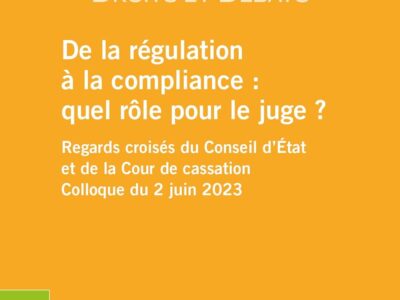
📗De la régulation à la compliance : quel rôle pour le Juge ?. Regards croisés du Conseil d’État et de la Cour de cassation (From Regulatory Law to Compliance Law: what role for the Judge?. Viewpoints of the Conseil d’État (French Administrative Supreme Court) and Cour de Cassation (French Judiciairy Supreme Court)

► Full Reference: Conseil d'État (French Administrative Supreme Court) & Cour de cassation (French Judiciary Supreme Court), De la régulation à la compliance : quel rôle pour le juge ? Regards croisés du Conseil d'État et de la Cour de cassation, ("From Regulatory Law to Compliance Law: what role for the Judge?"), La Documentation française, coll. "Droits et Débats", 2024, 241 p. - 📗read the  coverback (in French) - 📗read the table of content (in French) - ► Summary of this book : "Compliance, sometimes translated in French by the word "conformité" ("conformity"), is an extension of Regulatory Law and represents from it a new and decisive step forward. Compliance brings together all the mechanisms implemented within an organisation to achieve general interest goals (security, sustainability), thereby countering systemic risks. By relying on the rules, legal and ethical standards that embody these values, which are imposed on them and internalised by them, enterprises can both prevent the risk of sanctions and participate in this alliance between public authorities, economic operators and stakeholders to detect and prevent future systemic disasters.  Organisé par le Conseil d’État et la Cour de cassation, le colloque du 2 juin 2023 analyse ce changement de paradigme créé par cette nouvelle branche du droit.".  Organised by the Conseil d'État (French Administrative Supreme Court) and the Cour de cassation (French Judiciary Supreme Court), the conference on 2 June 2023, basis of this book, has analysed this paradigm shift created by this new branch of law: Compliance Law.  - 📝read the presentation in English of the concluding contribution of  Marie-Anne Frison-Roche : "Le rôle du juge dans le déploiement du droit de la régulation par le droit de la compliance" - 📝read the presentation in English of the contribution of François Ancel : "Quel rôle pour le juge aujourd’hui dans la compliance ? Quel office processuel du juge dans la compliance ?" -

Conferences

🎤L’émergence du contentieux systémique (Emergence of the Systemic Litigation), in 🧮Importance et spécificité du Contentieux Systémique Émergent, cycle of conference-debates “Contentieux Systémique Émergent”

► Full Reference: M.-A. Frison-Roche, "L’émergence du Contentieux Systémique" ("Emergence of the Systemic Litigation"), in Importance et spécificité du Contentieux Systémique Émergent (Importance and specificity of the Emerging Systemic Litigation), in cycle of conferences-debates "Contentieux Systémique Émergent" ("Emerging Systemic Litigation"), organised on the initiative of the Cour d'appel de Paris (Paris Cour of Appeal), with the Cour de cassation (French Court of cassation), the Cour d'appel de Versailles (Versailles Court of Appeal), the École nationale de la magistrature – ENM (French National School for the Judiciary) and the École de formation des barreaux du ressort de la Cour d'appel de Paris – EFB (Paris Bar School), under the scientific direction of Marie-Anne Frison-Roche, March 29, 2024, 11h-12h30, Cour d'appel de Paris, salle Masse - 🧮see the full programme of this event - 🧮see the programme of the entire cycle Contentieux Systémique Émergent - 🌐consult on LinkedIn the report of this speech (in French) - 🌐consult on LinkedIn a general présentation of this event, which links to a presentation and a report of each speech (in French) - 🧱consult the scientific coordination sheet of this event, which gives an account of the various speeches made - 🔲see the slides used to support this intervention (in French) - 🚧read the bilingual Working Paper which is the basis of this speech - ► English Summary of the conference: We are seeing the emergence of what should be referred to as a category of its own: the "Systemic Litigation". This concept, proposed in 2021📎1🕴️M.-A. Frison-Roche, 🚧The hypothesis of Systemic Cases brought before the Judge, 2021., refers to the hypothesis in which a system is 'involved' in a particular 'case' submitted to the judge. The presence of a system should not be confused with a systemic analysis of a phenomenon. The term 'cause' must be understood in the procedural sense, as used in article 5 of the Code civil (French Civil Code). Specifically, the prohibition contained in article 5 of the French Civil Code does not apply because a system thus involved calls for factual responses and solutions and not necessarily general and abstract solutions: the solution of a systemic nature and scope, that the presence of a system in a cause calls for, may be a factual solution, even if it radiates out from the system as a whole. But precisely because the presence of a system in the case often gives rise to a question that is itself systemic, the judge, if he wishes to comply with article 4 of the French Civil Code, must respond not only a minima by not evading the question, for example of systemic risks, but also fully by providing systemic solutions, for example remedies to preserve in the future the solidity and durability of the systems involved in the case.    These systems may be of different kinds: banking, financial, transport, health, energy, digital, algorithmic or climatic. Their presence in cases brought to the attention of judges, the variety and difficulties of which will be seen in later contributions, leads to basic questions relating to the emergence of Systemic Litigation: firstly, how can Systemic Litigation be defined? Secondly, what makes this category of litigation emerge? The answers to these two questions have essential practical consequences.  The new solutions must be based on a classic distinction, used in particular in criminal and administrative proceedings, which are more objective, but also in civil proceedings, notably by Hébraud, namely the distinction between the "party to the dispute/litigation" and the "party to the proceedings". Depending on whether it is accepted that the system should be considered as a "party to the litigation", which would allow it, through an entity that is legitimate in expressing it, to allege claims and formulate demands against an adversary, or as a "party to the proceedings", a much broader category, which would allow the judge to hear the interests of the systems involved without individuals being able, on behalf of a system, to formulate claims against or for the benefit of a party to the litigation.     This makes it possible to innovate while preserving the measure of which the judge is the guardian.   - 🌐follow Marie-Anne Frison-Roche on LinkedIn 🌐follow Marie-Anne Frison-Roche on Instagram 🌐subscribe to the Newsletter MAFR Regulation, Compliance, Law

Organisation of events

1st conference-debate of the cycle "Contentieux Systémique Émergent" ("Emerging Systemic Licigation")

🧮Importance et spécificité du Contentieux Systémique Émergent (Importance and specificity of the Emerging Systemic Litigation), in cycle of conferences-debates “Contentieux Systémique Émergent” (“Emerging Systemic Litigation”)

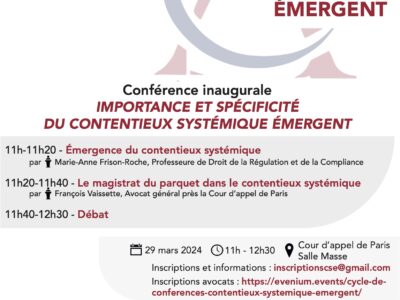
► Full Reference: Importance et spécificité du Contentieux Systémique Émergent (Importance and specificity of the Emerging Systemic Litigation), in cycle of conference-debates "Contentieux Systémique Émergent" ("Emerging Systemic Litigation"), organised on the initiative of the Cour d'appel de Paris (Paris Cour of Appeal), with the Cour de cassation (French Court of cassation), the Cour d'appel de Versailles (Versailles Court of Appeal), the École nationale de la magistrature – ENM (French National School for the Judiciary) and the École de formation des barreaux du ressort de la Cour d'appel de Paris – EFB (Paris Bar School), under the scientific direction of Marie-Anne Frison-Roche, March 29, 2024, 11h-12h30, Cour d'appel de Paris, Masse room - ► Presentation of the conference-debate: The "Systemic Litigation" is emerging. Through and beyond the dispute, a system is involved: the banking, financial, digital, health and climate systems. How can such litigation be recognised? How do you make room for a system in a court of law? What can be done when several systems are in conflict? Who represents these systems and their interests? How can the temporality of systems and litigation be reconciled? In practical terms, the magistrate has a new role. Whether they are prosecutors or judges, they deal with systemic litigation in criminal, civil, commercial and other areas.   - 🎤see the detailed presentation of the first speech of 🕴️Marie-Anne Frison-Roche : L'émergence du Contentieux Systémique (The Emergence of Systemic Litigation) - 🧮Programme of this event:  Inaugural Conference IMPORTANCE ET SPÉCIFICITÉ DU CONTENTIEUX SYSTÉMIQUE ÉMERGENT (IMPORTANCE AND SPECIFICITY OF THE EMERGING SYSTEMIC LITIGATION)   Cour d’appel de Paris (Paris Court of Appeal), Masse room 🕰️11h-11h20. 🎤L’émergence du contentieux systémique (The Emergence of the Systemic Litigation), by 🕴️Marie-Anne Frison-Roche, Professor of Regulatory and Compliance Law, Director if the Journal of Regulation & Compliance (JoRC)   🕰️11h20-11h40. 🎤L’office du magistrat du parquet dans le contentieux systémique (The role of the Public Prosecutor in Systemic Litigation), by 🕴️François Vaissette, Avocat général près la Cour d’appel de Paris (Advocate General at the Paris Court of Appeal)   🕰️11h40-12h30. Debate - 🔴Registrations and information requests can be sent to: inscriptionscse@gmail.com 🔴For the attorneys, registrations have to be sent to the following address: https://evenium.events/cycle-de-conferences-contentieux-systemique-emergent/  ⚠️The conference-debates are held in person only, in the Cour d’appel de Paris (Paris Court of Appeal). - 🧮Read below a detailed presentation of this event⤵️ -

MAFR Chronicles Compliance Law

🔄Chronique MAFR Compliance Law

📝Compliance et conformité : les distinguer pour les articuler (Compliance and conformity: distinguish them in order to articulate them)

► Full Reference: M.-A. Frison-Roche, "Compliance et conformité : les distinguer pour les articuler" ("Compliance and conformity: distinguish them in order to articulate them"), D. 2024, chron., pp. 497-499 - 📝read the article (in French) - 🚧read the bilingual Working Paper which is the basis of this article, with additional developments, technical references and hyperlinks - ► English Summary of the article: "Compliance" and "conformité" ("conformity") are sometimes presented as synonyms, with "conformité" simply being the translation of "compliance". On the contrary, they are two opposing concepts. "Conformity" refers to the obligation to obey all applicable regulations, regardless of their content. A godsend for the regulator… Compliance Law is quite different! Political and public authorities set systemic 'Monumental Goals' to ensure that systems do not collapse tomorrow, or even improve, and then entrust large companies with the task of activating the means to achieve these goals. Conformity then resumes its place in Compliance Law: being one of its tools. - 📚read the other articles published in this chronique of Compliance Law published in the Recueil Dalloz   - 🌐follow Marie-Anne Frison-Roche on LinkedIn 🌐follow Marie-Anne Frison-Roche on Instagram 🌐subscribe to the Newsletter MAFR Regulation, Compliance, Law

Working papers

Working Paper, basis for an article

🚧Compliance Obligation: build a compliance structure producing credible effects in the perspective of the Monumental Goals targeted by the Legislator

► Full Reference: M.-A. Frison-Roche, Compliance Obligation: build a compliance structure producing credible effects in the perspective of the Monumental Goals targeted by the Legislator, Working Paper, March 2024. - 📝 This Working Paper is the basis of the article "Compliance Obligation: build a compliance structure producing credible effects in the perspective of the Monumental Goals targeted by the Legislator", in📘 Compliance 'Obligation de Compliance,   - ► Summary of this Working Paper: This article explains what companies' Compliance Obligation" is. Delving into the mass of compliance obligations, it uses the method of classification of those that are subject to an obligation of result and those that are subject to an obligation of means. It justifies the choice of this essential criterion, which changes the objects and the burden of proof of companies that are subject to an obligation of result when it comes to setting up "compliance structures" and are subject to an obligation of means when it comes to the effects produced by these compliance structures. Indeed, this article goes on to analyse each body of regulations ("Sapins 2", "Vigilance", CSRD, CS3D, DSA, NIS2, DMA, DORA, AML-FT, ….) and the technical compliance obligations they impose, dividing them into obligations of result or obligations of means, depending on the text. This table of positive law thus drawn up, with reference to all the articles of the texts, shows that in positive law the Compliance Obligation has above all an evidential dimension, which is developed in the third part of the article: the company must show that it has put in place the compliance structures (obligations of result) required by the texts and it is up to third parties who criticise it for the unsatisfactory effects that these structures would have produced, according to them, to show that there is a fault or negligence on the part of the company (obligation of means). Indeed, rather than getting bogged down in definitional disputes, given that Compliance Law is itself a nascent branch of Law, the idea of this contribution is to take as a starting point the different legal regimes of so many different compliance obligations to which laws and regulations subject large companies: sometimes they have to apply them to the letter and sometimes they are only sanctioned in the event of fault or negligence. This brings us back to the distinction between obligations of result and obligations of means. Although it would be risky to transpose the expression and regime of contractual obligations to legal obligations put by legislation, starting from this observation in the evidentiary system of compliance of a plurality of obligations of means and of result, depending on whether it is a question of this or that technical compliance obligation, we must first classify them. It would then appear that this plurality will not constitute a definitive obstacle to the constitution of a single definition of the Compliance Obligation. On the contrary, it makes it possible to clarify the situation, to trace the paths through what is so often described as a legal jumble, an unmanageable "mass of regulations". Indeed, insofar as the company obliged under Compliance Law participates in the achievement of the Monumental Goals on which this is normatively based, a legal obligation which may be relayed by contract or even by ethics, it can only be an obligation of means, by virtue of this very teleological nature and the scale of the goals targeted, for example the happy outcome of the climate crisis which is beginning or the desired effective equality between human beings. This established principle leaves room for the fact that the behaviour required is marked out by processes put in place by structured tools, most often legally described, for example the establishment of a vigilance plan or regularly organised training courses (effectiveness), are obligations of result, while the positive effects produced by this plan or these training courses (effaciety) are obligations of means. This is even more the case when the Goal is to transform the system as a whole, i.e. to ensure that the system is solidly based, that there is a culture of equality, and that everyone respects everyone else, all of which come under the heading of efficiency. The Compliance Obligation thus appears unified because, gradually, and whatever the various compliance obligations in question, their intensity or their sector, its structural process prerequisites are first and foremost structures to be established which the Law, through the Judge in particular, will require to be put in place but will not require anything more, whereas striving towards the achievement of the aforementioned Monumental Goals will be an obligation of means, which may seem lighter, but corresponds to an immeasurable ambition, commensurate with these Goals. In addition, because these structures (alert mechanisms, training, audits, contracts and clauses, etc.)  have real meaning if they are to produce effects and behaviours that lead to changes converging towards the Monumental Goals, it is the obligations of means that are most important and not the obligations of result. The judge must also take this into account. Finally, the Compliance Obligation, which therefore consists of this interweaving of multiple compliance obligations of result and means of using the entreprise's position, ultimately Goals at system efficiency, in Europe at system civilisation, for which companies must show not so much that they have followed the processes correctly (result) but that this has produced effects that converge with the Goals sought by the legislator (effects produced according to a credible trajectory). This is how a crucial company, responsible Ex Ante, should organise itself and behave. - 🔓read the developments below⤵️ - 🌐follow Marie-Anne Frison-Roche on LinkedIn 🌐follow Marie-Anne Frison-Roche on Instagram 🌐subscribe to the Newsletter MAFR Regulation, Compliance, Law 🌐subscribe to the video Newsletter MAFR Surplomb
Articles

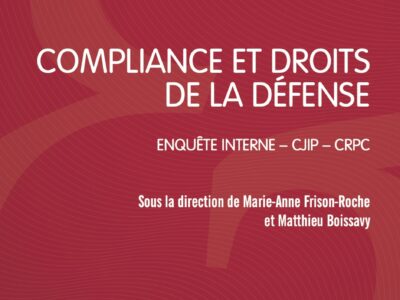
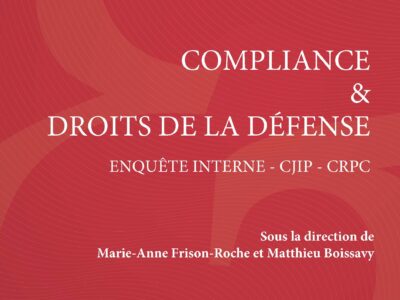
📧📕Compliance et droits de la défense. Enquête interne – CJIP – CRPC : les lignes de force de l’ouvrage (Compliance and rights of the defence. Internal investigation – French Judicial Public Interest Agreement – French guilty plea procedure : the main themes of the book)

► Full Reference: M.-A. Frison-Roche, Compliance et droits de la défense. Enquête interne – CJIP – CRPC : les lignes de force de l'ouvrage (Compliance and rights of the defence. Internal investigation – French Judicial Public Interest Agreement – French guilty plea procedure : the main themes of the book), Newsletter MAFR Law, Compliance, Regulation, March 5, 2024 - 📧Read by freely subscribing other news of the Newsletter MAFR – Law, Compliance, Regulation - 🧱Compliance and rights of defense: a book to design them together to improve practices   The book Compliance et droits de la défense (Compliance and rights of the defence), co-published by the Journal of Regulation & Compliance (JoRC ) and Dalloz, takes as its starting point practices ranging from internal investigations to convention judiciaire d’intérêt public – CJIP (Judicial Public Interest Agreement) and comparution sur reconnaissance préalable de culpabilité – CRPC (French guilty plea procedure), to measure the way in which Compliance makes room, or not, for the rights of the defense.   📧read the general presentation of the book and, in a very detailed presentation of the book's main points, the presentation of each of the contributions, published on March 5, 2024 in the Newsletter MAFR – Law, Compliance, Regulation - 🌐follow Marie-Anne Frison-Roche on LinkedIn 🌐follow Marie-Anne Frison-Roche on Instagram 🌐subscribe to the Newsletter MAFR Regulation, Compliance, Law

Articles in The Journal of Regulation & Compliance « JoRC »

FIORINI, Benjamin🕴️

📝Approche doctrinale de l’enquête interne et de l’enquête pénale privée, in 🕴️M.-A. Frison-Roche & 🕴️M. Boissavy (eds.), 📕Compliance et droits de la défense. Enquête interne – CJIP – CRPC

► Full Reference: B. Fiorini, "Approche doctrinale de l’enquête interne et de l’enquête pénale privée" ("Doctrinal approach to internal investigations and private criminal investigations"), in M.-A. Frison-Roche & M. Boissavy (eds.), Compliance et droits de la défense. Enquête interne – CJIP – CRPC, Journal of Regulation & Compliance (JoRC) and Dalloz, coll. "Régulations & Compliance", 2024, pp. 63-68 - 📕read a general presentation of the book, Compliance et droits de la défense. Enquête interne – CJIP – CRPC, in which this article is published - ► English Summary of the article (done by the Journal of Regulation & Compliance – JoRC): The author sets out the two profoundly distinct, even opposing, cultures of inquisitorial and adversarial repressive procedural systems. The former gives confidence and power to public officials to find the truth, while the latter gives confidence and power to the opposing parties in the dispute. Private investigations naturally develop in the second system and not in the first. This second system of thought is rooted in the United States, which naturally welcomes internal investigations carried out by companies and associates procedural principles such as the rights of the defence, adversarial proceedings and the right to a lawyer. The first system, characteristic of Continental Law systems, is resistant to the very idea of a private criminal investigation. This is why, when the internal investigation mechanism develops within a company, the procedural mechanisms mentioned above are less naturally associated with it. - 🦉This article is available in full text to those registered for Professor Marie-Anne Frison-Roche's courses -

Articles in The Journal of Regulation & Compliance « JoRC »

BOISSAVY, Matthieu🕴️

📝Compliance et droits de la défense : toujours pour le respect des droits humains, in 🕴️M.-A. Frison-Roche & 🕴️M. Boissavy (eds.), 📕Compliance et droits de la défense. Enquête interne – CJIP – CRPC

► Full Reference: M. Boissavy, "Compliance et droits de la défense : toujours pour le respect des droits humains" ("Compliance and the rights of the defence: always in favour of respect for human rights"), in M.-A. Frison-Roche & M. Boissavy (eds.), Compliance et droits de la défense. Enquête interne – CJIP – CRPC, Journal of Regulation & Compliance (JoRC) and Dalloz, coll. "Régulations & Compliance", 2024, pp. 27-32. - 📕read a general presentation of the book, Compliance et droits de la défense. Enquête interne – CJIP – CRPC, in which this article is published - ► English Summary of the article (done by the Journal of Regulation & Compliance – JoRC): The author begins by describing Compliance, whereby the company's freedom is curtailed so that its power serves the goals set by the public authorities and prevents risks from occurring. These "Monumental Goals" are set by the public authorities either to prevent the occurrence of systemic risks, or to achieve beneficial objectives for society, human beings and the environment. In order to do this, companies will have to investigate themselves and denounce themselves, with this self-denunciation reducing the criminal penalties incurred as a result of infringements they have uncovered themselves. These surveillance tools facilitate the convention judiciaire d'intérêt public – CJIP (French Judicial Public Interest Agreement) mechanism. They work "for the better" if the aforementioned Monumental Goals are achieved. They work "for the worse", if this is at the cost of sacrificing the rights of the defence. The second part of the paper recalls the importance of the rights of the defence, their roots in history, and even in Natural Law, their position at the very top of the hierarchy of norms and, according to the author, the integration of the adversarial principle within them, as well as the fact that they apply even outside trials, as has been imposed by case-law in matters of dismissal.  This is why, thirdly, the paper argues that the rights of the defence must always be applied in all compliance mechanisms, even if this does not involve a trial or a sanction in the strict sense of the term, particularly in internal investigations, procedures without a trial which are above all evidentiary mechanisms for the next stage, which is usually judicial. In addition, the author questions the effectiveness of the consents expressed during the CJIP and comparution sur comparution sur reconnaissance préalable de culpabilité – CRPC (French French guilty plea procedure). - 🦉This article is available in full text to those registered for Professor Marie-Anne Frison-Roche's courses -