Compliance Law

Conferences

🎤Concevoir une raison d’être et l’expliciter (Conceiving a raison d’être and explaining it), in🪑🪑🪑Dire sa raison d’être (Expressing your Raison d’être)

► Full reference : M.-A. Frison-Roche, "Concevoir une Raison d'être et l'explicitre (Conceiving a Raison d'être and explaining it)", speech at the round table discussion "Dire sa Raison d'être (Expressing your Raison d'être)", National Conference of the Géomètres Expert (French Chartered Surveyors), 6 November 2025, Paris. - ► Presentation of the Round Table : This round table opens two days of work bringing together all the leaders, members of the Council of the Order of Chartered Surveyors and Regional Councils of Chartered Surveyors, in the presence of the relevant Ministry, in specific sessions during which the two Raison d'être that have been developed over several years of work and adopted, the Raison d'être of the profession and the Raison d'être of the Order, are presented. 🪑🪑🪑Other participants in the round table discussion, moderated by Hervé Grélard, General Deputy of the French Order of Chartered Surveyors: 🕴🏻Thomas Bonnel, chartered surveyor 🕴🏻Luc Lanoy, chartered surveyor, 🕴🏻Séverine Vernet, Chairwoman of the French Order of Chartered Surveyors - ► Summary of my presentation : Firstly, I spoke to remind everyone what a "raison d'être" is, in itself, and why it is particularly important when the entity that embodies it also constitutes a "profession", the raison d'être expressing this hybrid nature that is destined to endure in today's societies. It moves those who uphold the raison d'être – the professional, the profession, the umbrella organisation that is the Order – from the past to the future. To effectively carry this raison d'être, its bearer cannot remain isolated. Unlike the agent who operates in a market and whose strategy is solitary dynamism against others, the bearer of the raison d'être must find allies who share similar or compatible ideas and develop points of contact to carry out a collective project (the "Monumental Goals"). This is why it is just as important to communicate, explain and share the raison d'être with the outside world. Secondly, as the discussion surrounding the statement of purpose of the French Order of Surveyors and the profession progressed, I was led to point out that the raison d'être is not, or not only, ethical in nature, but also legal in nature, constituting at the very least a legal fact that can become enforceable against those who recognise themselves in it and claim it. This kind of reward, which is the "ex ante responsibility" expressed by the raison d'être and relayed by Compliance Law, anchored in its monumental goals of sustainability and responsibility, justifies that the profession that embraces its raison d'être is not simply an efficient profession in a supply and demand market, but establishes the Order as a regulator. This places both in the long term. - ⛏️Further reading on the subject: (with English Summaries) 🕴🏻M.-A. Frison-Roche, 💬"Géomètres-experts : une profession qui assume concrètement sa responsabilité territoriale", 2025 🕴🏻M.-A. Frison-Roche, 📝A quoi engagent les engagements, 2025 🕴🏻M.-A. Frison-Roche et 🕴🏻S. Vernet, 📝La profession investit le Droit de la compliance et détermine sa Raison d'être, 2023 🕴🏻M.-A. Frison-Roche, 📧Quels sont les points de contact entre la Raison d'être des entreprises et le Droit de la Compliance ?, 2022   - 🌐Follow Marie-Anne Frison-Roche on LinkedIn 🌐follow Marie-Anne Frison-Roche on Instagram 🌐Subscribe to the Newsletter MAFR Regulation, Compliance, Law 🌐Subscribe to the video newsletter MAFR Overhang 🌐Subscribe to the Newsletter MaFR Law & Art

MAFR Chronicles Compliance Law

article forming part of a thematic column

📝Droit de la compliance et Contentieux systémique (Compliance Law and Systemic Litigation)

►Full Reference: M.-A. Frison-Roche, "Droit de la compliance et Contentieux systémique" (Compliance Law and Systemic Litigation), in Chroniques Droit de la Compliance (Compliance Law Chronicles), Recueil Dalloz, 30 October 2025, No. 38, p. 1849 - 🚧read the bilingual Working Paper on which this article is based, with additional developments, technical references and hyperlinks -   ►read the English presentation of the previous chronicles: "Compliance and conformity: Distinguish them in order to articulate them", 2024 "Regulations, Compliance, Contracts, and Judges: places and alliances", 2023 "Contract of compliance, stipulations fo compliance", 2022 "The Adventure of the Compliance", 2020 "Compliance and Legal Personality", 2019 "TLegal Theory of Risk Mapping", 2019 ►read the English presentation of the whole chroniques - ►English summary of this article: Legal systems have changed, and Compliance Law, in its uniqueness, reflects this change and plays a powerful role in it. Through new sets of compliance rules, particularly at European level, in areas such as data protection (GDPR), anti-money laundering (AMLA), climate balance protection (CS3D) and banking and financial system sustainability (Banking Union), techniques (always the same) have been developed and imposed on large companies, which must implement them: alerts, mapping, assessment, sanctions, etc. These new regulatory frameworks only make sense in relation to their ‘Monumental Goals’: to detect systemic risks Ex Ante and prevent crises so that the systems in question do not collapse, but ‘sustain". All the legal instruments in the corpus are normatively rooted in these Monumental Goals, which are the core that unifies Compliance Law (I). Judges are the guardians (II) of this new and highly ambiguous normative framework, which relies on the practical ability of companies to do just that. They ensure that the technical provisions are applied teleologically in each of these compliance blocks, and that the regulatory frameworks are mutually supportive, for it is always the same systemic goal that all compliance regulations serve: to ensure that systems (banking, financial, climate, digital, energy, etc.) do not collapse, that they are sustainable, and that present and future human beings are not crushed by them but, on the contrary, benefit from them. This unity is still little perceived, as regulations pulverize this profound unity of compliance law in the myriad of changing provisions. Entrusting the "regulatory mass" to algorithms increases this pulverization, making the whole increasingly incomprehensible and therefore impossible to handle.  Acknowledging the judge's rightful place, i.e. at the heart of the matter, will enable us to master this new branch of law. But it's not the judge's job alone to restore clarity to a whole covered in the dust of his own technicality. The systemic object of Compliance Law is transferred to Litigation. Indeed, the Litigation that emerges from the new Compliance Law is also fundamentally new, by transitivity. Indeed, the aim of Compliance Law is to make systems sustainable (or sustainable, or resilient, the vocabulary varies). The result is litigation which is itself "systemic litigation" (III), most often initiated by an organization against a systemic operator. The place and role of each are transformed (IV).   -

Organisation of events

🧱⚙️Scientific coordination and co-hosting of the colloquia series 🧮Compliance and Contract

► Full reference : M.-A. Frison-Roche, Scientific coprdination and co-hosting of the colloquia series Compliance and Contract, organised on the initiative of the Journal of Regulation & Compliance (JoRC) and its academic partners - - ► The Symposium Series in a nutshell : As a direct continuation of the previous symposium series co-organised by the Journal of Regulation & Compliance and its partner universities on "Compliance Obligation", which served as the basis for the publication of the book 📘Compliance Obligation,  The series, some elements of which began in 2024 and others are already present in this book, explored in depth the specific theme of the links between compliance law and contracts. Indeed, compliance law is often analysed as the construction of laws and regulations to achieve "📘 Monumental Goals " of a political nature desired by States and public authorities, to the achievement of which systemic economic operations contribute through 📘Compliance Tools that are now well documented. Contracts are still relatively little studied, or even developed, in compliance systems that are often perceived through the orders issued, the technologies put in place and the 📘sanctions to be avoided or endured. On the contrary, the future of compliance law, particularly in its European conception, which places human beings at the centre of concerns for the sustainability of systems and the use of contracts, is the new conception that we must adopt. Contracts then appear to be both the means by which the subject company fulfils its legal obligations, forges relationships with other actors and deploys the necessary innovations. Contract law is both used and renewed as a result. The series of symposiums will examine various aspects of this general issue. It will result in the publication of a 📘book Compliance and Contrat. - ► Presentation of symposiums in development :  29 May 2026🧮THE JUDGE CONFRONTED WITH CONTRACTS OF COMPLIANCE AND COMPLIANCE CLAUSES: read the presentation   12 June 2026🧮THE "CONTRACT OF COMPLIANCE" : read the presentation   25  Septembre 2026🧮COMPLIANCE: CLAUSE BY CLAUSE: read the presentation   2 October 2026🧮COMPLIANCE AND COMMON CONTRACT LAW : read the presentation   September 2026🧮COMPLIANCE, VALUE CHAINS AND CONTRACT: read the presentation   2 November 2026 🧮COMPLIANCE AND THE STRATEGIC CONTRACTUAL ORGANISATION OF CHAINS VALUE BY ENTERPRISES: read the presentation  -

Articles in a legal collective publication

contribution in a Round Table

📝De l’obligation de compliance à l’obligation de vigilance : le rôle du juge

► Full reference : M.-A. Frison-Roche, "De l'obligation de compliance à l'obligation de vigilance : le rôle du juge (From the obligation of compliance to the obligation of vigilance: the role of the judge)", in Round table De la compliance au devoir de vigilance. Une nouvelle responsabilité des entreprises (From Compliance to the Vigilance duty. A new responsibility for businesses," Lettre des juristes d'affaires, Oct. 2025. - 📝read the article reproducing the entire discussion (in French) - ► Summary of my contribution:  In this debate, the terms of which have been reproduced in the journal, I was asked to explain how the legal system had evolved, first by establishing Compliance Law, built on systemic ambitions to prevent sectoral disasters (banking, finance, energy), ambitions that constitute "Monumental Negative Goals", and then evolving on the one hand "Monumental Positive Goals", namely the protection of human beings involved willingly or unwillingly in these systems, on the other hand, outside even sectors with clearly defined boundaries, such as environmental or digital ambitions. The duty of vigilance extends this regulatory law and gives concrete form to the "compliance obligation" to which companies are subject. It is important to maintain a sense of proportion in the conception of the responsibility attached to it so as not to lose everything. Companies are bound by the goals but must remain free in their choice of means, and in particular be encouraged to use contractual techniques. This measure is entrusted to the judge because, due to the Compliance Jurisdictionalisation, it is at the heart of this new branch of Law, which is developing independently of fluctuations in the regulations. During the discussion, I was asked for my opinion on the ruling handed down by the Paris Court of Appeal on 17 June 2025, known as La Poste case. I pointed out that the comments had often focused only on the developments regarding risk mapping, whereas this ruling first establishes the principle that the vigilance plan is the work of the company's decision-making bodies and is not co-constructed, as consultation is a process of discussion and taking in consideration, which is not the same thing, with the judge himself pointing out that they must not interfere in management. In the discussion, I emphasised that if we were to highlight the essence of what would be a "new responsibility", it would primarily concern a new probative dimension that the company must implement in Ex Ante. The implementation of the CSRD, even if it has been excessively standardised, is in line with this, and this probative culture must be developed. - ⛏️Further reading on the subject : 🕴️M.-A. Frison-Roche (ed.), 📘Compliance Obligation, 2026 🕴️M.-A. Frison-Roche, 📝Vigilance, the front line and integral part of the compliance obligation, 2025 🕴️M.-A. Frison-Roche, 📝Compliance, Vigilance and Civil Liability: put in Order and keep the sense of Reason, 2025 🕴️M.-A. Frison-Roche (ed.), 📘Compliance Jurisdictionalisation, 2024 -   -   - ► Article summary : The  - 🌐Follow Marie-Anne Frison-Roche on LinkedIn 🌐follow Marie-Anne Frison-Roche on Instagram 🌐Subscribe to the Newsletter MAFR Regulation, Compliance, Law 🌐Subscribe to the video newsletter MAFR Overhang 🌐Subscribe to the Newsletter MaFR Law & Art

Books

Can the Public Be Trusted?: On the Promise and Perils of Voluntary Compliance

► Full Reference: Y. Feldman,Can the Public Be Trusted?: On the Promise and Perils of Voluntary Compliance, Cambridge University Press, 2025.  - ► Presentation of the book (done by the Author) : "When do citizens voluntarily comply with regulations rather than act out of fear of sanctions? Can the Public Be Trusted? challenges prevailing regulatory paradigms by examining when democratic states can rely on voluntary compliance. Drawing on behavioral science, law, and public policy research, Yuval Feldman explores why voluntary compliance, despite often yielding superior and more sustainable outcomes, remains underutilized by policymakers. Through empirical analysis of policy implementation in COVID-19 response, tax compliance, and environmental regulation, Feldman examines trust-based governance’s potential and limitations. The book presents a comprehensive framework for understanding how cultural diversity, technological change, and institutional  shape voluntary cooperation.". -   📗Read the book

Conferences

participation in a Round-Table

🎥Adéquation et inadéquation de la sanction comme outil de régulation financière et sa transformation par la Compliance (Adequacy and inadequacy of sanctions as a tool of Financial Regulation and its transformation through Compliance), in🧮Quel rôle pour la sanction dans la Régulation ? (what role for the Sanction in the Financial Regulatory System?)

► Full reference: M.-A. Frison-Roche, "Adéquation et inadéquation de la sanction comme outil de régulation financière et sa transformation par la Compliance" (Adequacy and inadequacy of sanctions as a tool of Financial Regulation and its transformation through Compliance)", contribution to the round-table discussion on"Quel rôle pour la sanction dans la Régulation ? (What role for sanctions in Regulatory System)", Annual conference of the Commission des sanctions (Enforcement Committee) of the Autorité des marchés financiers – AMF (French Financial Markets Authority), Paris,  14 October 2025. - ► see the general programme of this manifestation (in French) The event comprises two round tables. The theme of the first round table is: La preuve des abus de marché entre l’AMF et le juge pénal : vers une convergence ? (Proof of market abuse between the AMF and the criminal courts: towards convergence?) 🪑🪑🪑AutresOther participants in this 2nd round table, moderated by Sophie Schiller, member of the Enforcement Committe on the topic: Quel rôle pour la sanction dans la Régulation ? (What role for sanctions in Regulatory System?) 🕴🏻Sébastien Raspiller, Secretary General of the AMF 🕴🏻Martine Samuelian, Partner, Jeantet Law Firm 🕴🏻Vincent Villette, Secretary General of the CNIL (French Personal Data Regulatory Body) - ► Summary of this intervention : In the round-table discussion on the role of sanctions, a number of contributions will be made, depending on the nature of the discussion itself. They will be brief in nature and will be aimed at an audience with a good knowledge of financial regulation. It is the occasion for me to insist on 2 things, the first naturely and probably for ever attached to the role of sanctions in all Regulatory Systems, the secund very new. The first is the indissociability between Criminal Law and Sanction, even if sanctions is defined as a regulatory tools. The secund is the conception and the use of sanctions through Compliance Law. Therefore, in the first idea, my first intervention, aimed more at establishing the subject and describing the Intangible, is on the very idea that sanctions have a role to play in financial regulation. By its very nature. But this does not make it any less difficult. It is not obvious, because if penalties are seen as a 'regulatory tool', then it is the regulatory perspective that predominates and 'colours' the tool that is the penalty. Regulation, of which the texts on the basis which sanctions are issued are only one tool and which is not the set of applicable rules, Regulation which is an apparatus of institutions, rules and decisions aimed at establishing the equilibrium of a sector and maintaining this equilibrium, which is by nature unstable, over time, which the sector could not do by its own efforts alone (Regulatory Law, which is Ex Ante Law, thus distinguishing itself from Competition Law, which is Ex Post Law). From the perspective of Financial Regulatory System, as in other sectoral regulatory systems, and in the general Regulatory Law, sanctions are a tool (and a tool like any other, simply more powerful than the others. This is the pragmatic perspective adopted by the State and the Regulatory body itself, which will use it in conjunction with other tools, such as an Information, Education and Incentive mechanism. Moreover, it shall use sanction as informative tool, as educational tool, as incentive tool. However, the principle of the autonomy of Criminal Law, and the European concept of "Criminal Matters" mean that the sanction can be seen in terms of the autonomous criteria of the seriousness of the act imputed and the sanction imposed on the legal person. In this respect, the penalty is inseparable from the way in which it is imposed (Criminal Law is constitutionally inseparable from Criminal Procedure). In this respect, the sanction is not a tool coloured by the overall objective served by the Financial Markets Regulatory Body: the sustainability of the financial system. The Enforcement Committee is not the AMF's "armed wing"; it is a "court", as the Oury ruling reminded us. Therefore, the question is and I would like to ask it directly to the Enforcement Committed: Can you be both?   As they say, could you be both carp and rabbit? Depending on whether you are viewed from one angle or another, you will be seen as the body that makes financial markets effective (a tool among the tools) or as the body that punishes misconduct (a court among the courts). It is possible, and in practice it is often true. But if we are honest, we will admit that regulation feeds on information and that the procedure before a criminal court is built on secrecy and the weapons of those who, innocent or guilty, are at risk because they are, or will be, prosecuted. We've never got out of this difficulty. We always try to strike a balance between the fact that it is in itself a repressive sanction for a person who will suffer and the fact that it is also a systemic tool: there is a 'balance' between the search for systemic benefit (which reduces the protection of individuals for the benefit of the system) and the concern for the people involved (which reduces the present and future protection of the system). The balance goes more or less in one direction. It is often public opinion, the place, the legislator and, even above all,  the civil appeal judge (vertical dialogue) and those in dialogue, between the regulator and the criminal judge (horizontal dialogue) which cause the scales of diverse technical solutions. It is also the way in which the Enforcement Committee, in defining itself as the armed wing of the AMF (carp) or as a repressive court (rabbit), chooses in its procedural behaviour the role of sanctions in Financial Regulatory System, more or less instrumentalised (carp) or jurisdictionalised (rabbit). - The second point, if there is to be one, concerns the development of the role of sanctions in Financial Regulatory System . On the basis of these fundamentals, an evolution in the role of sanctions in financial regulatory system (an evolution that can be observed in all sectoral regulatory systems) consists of internalising sanctions (in their conception by the texts, their elaboration by the Sanctions Committees, their application) in the economic operators sanctioned, in the economic sectors concerned, in the opinion concerned (the figure of Peelmanian circles of the audiences applying). This internalisation transforms Regulatory mission of the administrative body (which deals with market structures) into Rupervision (which deals directly with market operators) since the sanction penetrates the operator, the operator adopting commitments. This concept corresponds to the new branch of Law known as Compliance Law.  Compliance Law uses sanctions as an "incentive like any other", and (we must be careful on this point), because it is systemic in nature, the concern for the system being internalised in the operator, it is relatively insensitive to procedural rights. With the emphasis on information, it is the principle of adversarial debate (which provides information) rather than the rights of the defence that is valued. The cooperation of the person being prosecuted is highly valued, and non-cooperation becomes incomprehensible. The internalisation of sanctions by operators has led to two major changes. Firstly, these economic operators themselves must sanction, detect and prevent market abuse. The number of special obligations of vigilance is increasing. The obligation of vigilance of operators themselves is becoming a pillar of Regulation, transformed in Supervision.  The other development is the liberalisation of regulatory system in relation to territory, thank to Compliance Law. As operators are less dependent on borders than are regulators and authors of legal texts (but soft law is spreading, including repression), market abuses can be apprehended in several jurisdictions at the same time, notably through global compliance programmes. - 🌐follow Marie-Anne Frison-Roche on LinkedIn 🌐follow Marie-Anne Frison-Roche on Instagram 🌐subscribe to the Newsletter MAFR Regulation, Compliance, Law 🌐subscribe to the VideoNews  MAFR Surplomb 🌐subscribe to the Newsletter MaFR Law & Art

Publication director

🏗️ copublishing and direction of the collection: 📚Régulations & Compliance

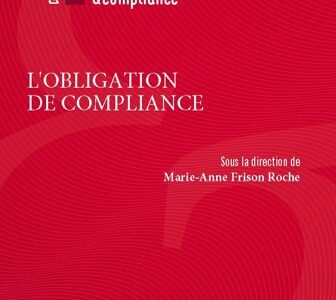
📚Publication of🕴️M.-A. Frison-Roche (ed.), 📕L’Obligation de Compliance

  - ► Full Reference: M.-A. Frison-Roche (dir.), L’Obligation de Compliance, coll.”Régulations & Compliance“, Journal of Regulation & Compliance (JoRC) and Dalloz, 2025. - 📘 At the same time, a book in English, Compliance Obligation, is published in the collection copublished by the Journal of Regulation & Compliance (JoRC) and the Éditions Bruylant. - 🧮the book follows the cycle of colloquia organised by the Journal of Regulation & Compliance (JoRC) and its Universities partners in 2023 and 2024. - 📚this volume is one of a series of books devoted to Compliance in this collection. ► Read the presentations of the other books in the series: the following books: 🕴️M.-A. Frison-Roche (ed.), 📕Compliance et Contrat, forthcoming 🕴️L. Laref (ed.), 📕Compliance et vigilance bancaire, forthcoming 🕴️M.-A. Frison-Roche, 📕Le système juridique de l’adressage de l’Internet. Une structure multi-acteurs, gage de durabilité (The Legal System of Internet Addressing. A Multi-Stakeholder Structure, the Pledge of its Sustainability), forthcoming 🕴️M.-A. Frison-Roche (ed.), 📕Le système probatoire de la Compliance, forthcoming   the previous books: 🕴️M.-A. Frison-Roche and M. Boissavy (eds.), 📕Compliance et droits de la défense. Enquête interne – CJIP – CRPC, 2024 🕴️M.-A. Frison-Roche (ed.), 📕La juridictionnalisation de la Compliance, 2023 🕴️M.-A. Frison-Roche (ed.), 📕Les Buts Monumentaux de la Compliance, 2022 🕴️M.-A. Frison-Roche (ed.), 📕Les outils de la Compliance, 2021 🕴️M.-A. Frison-Roche (ed.), 📕Pour une Europe de la Compliance, 2019 🕴️N. Borga, J.-Cl. Marin and J.-Ch. Roda (eds.), 📕Compliance : l’entreprise, le régulateur et le juge, 2018 🕴️M.-A. Frison-Roche (ed.), 📕Régulation, Supervision, Compliance, 2017 🕴️M.-A. Frison-Roche (ed.), 📕Internet, espace d’interrégulation, 2016 📚see the global presentation of all the books of the collection. - ► General presentation of this book: Compliance is sometimes presented as something that cannot be avoided, which is tantamount to seeing it as the legal obligation par excellence, Criminal Law being its most appropriate mode of expression. It is sometimes presented as something that the company does out of ethical concern, self-regulation which is the opposite of legal obligation. For the moment, therefore, there is no single vision of the Compliance Obligation. This is all the less the case because of the multitude of texts, themselves constantly evolving and changing, which inject such a wide range of compliance obligations that we give up trying to establish any unity, thinking that, on a case-by-case basis, we will define a regime and a legal constraint of greater or lesser strength, aimed at one subject or debtor or another, for the benefit of one or other. This lack of unity, due to the absence of a definition of the Compliance Obligation, makes the application of the texts difficult to foresee and therefore makes the Judge fearful, even though he/she is going to take on more and more importance. This book asks the practical questions: What is Compliance obliging? Who is obliged to comply? and How far are we obliged to comply? and provides answers, Compliance practices, constraints and innovations will be better mastered and anticipated by all those they affect: companies, stakeholders, technicians, lawyers, consultants, institutions and courts. - 🏗️general construction of this Book: The book opens with a double Introduction.  The first, which is freely accessible, consists of a summary of the book, while the second, which is substantial, deals with the unified conception that we can, and indeed should, have, of the “Compliance Obligation”, without losing the concrete and active character that characterises this branch of law. The first Part of the book aims to define the Compliance Obligation. To this end, Chapter I deals with the Nature of this obligation. Chapter II deals with the Spaces of the Compliance Obligation. The Part II aims to articulate the Compliance Obligation with other branches of Law.  The Part III of the book looks at the way in which the possibility of obliging and the means of obliging are provided.  To this end, Chapter I deals with the Convergence of the Sources of the Compliance Obligation. Chapter II considers International Arbitration as a reinforcement of the Compliance Obligation. To this end, Chapter I deals with the Convergence of the Sources of the Compliance Obligation. Chapter II considers International Arbitration as a reinforcement of the Compliance Obligation.  The last Part of the book is devoted to Vigilance, the leading edge of the Compliance Obligation. Chapter I is devoted to a study of the various sectors, and analyses the Intensities of the Vigilance Obligation. Chapter II deals with the Variations in Tension generated by the Vigilance Obligation. Finally, Chapter III deals with the New Modalities of the Compliance Obligation, highlighted by the Vigilance Imperative. - TABLE OF CONTENTS    ANCRER LES OBLIGATIONS DE COMPLIANCE SI DIVERSES    DANS LEUR NATURE, LEURS REGIMES ET LEUR FORCE  POUR DEGAGER  L’UNITE DE L’OBLIGATION DE COMPLIANCE LA RENDANT COMPREHENSIBLE ET PRATIQUABLE  (ANCHOR COMPLIANCE OBLIGATIONS, SO DIVERSE  IN THEIR NATURE, THEIR REGIMES AND THEIR FORCE, TO BRING OUT THE UNITY OF THE COMPLIANCE OBLIGATION MAKING IT COMPREHENSIBLE AND PRACTICABLE) ♦️ Obligation de Compliance : construire une structure de compliance produisant des effets crédibles au regard des Buts Monumentaux visés par le Législateur (Compliance Obligation: building a compliance structure that produces credible results with regard to the Monumental Goals targeted by the Legislator), by 🕴️Marie-Anne Frison-Roche   TITRE I. CERNER L’OBLIGATION DE COMPLIANCE  (IDENTIFYING THE COMPLIANCE OBLIGATION)   CHAPITRE I : LA NATURE DE L’OBLIGATION DE COMPLIANCE (THE NATURE OF THE COMPLIANCE OBLIGATION) Section 1 ♦️ La volonté, le cœur et le calcul, les trois traits cernant l’Obligation de Compliance  (Will, Heart and Calculation, the three traits encercling the Compliance Obligation), by 🕴️Marie-Anne Frison-Roche Section 2 ♦️ De la dette à l’obligation de compliance (From the Debt to the Compliance Obligation), by 🕴️Bruno Deffains Section 3 ♦️ Obligation de Compliance et droits humains (Compliance Obligation and Human Rights), by 🕴️Jean-Baptiste Racine Section 4 ♦️ L’Obligation de Compliance et les mutations de la souveraineté et de la citoyenneté (Compliance Obligation and changes in Sovereignty and Citizenship), by 🕴️René Sève Section 5 ♦️ La définition de l”obligation de compliance confrontée au droit de la cybersécurité (The definition of the Compliance Obligation in Cybersecurity Law) by🕴️Michel Séjean   CHAPITRE II : LES ESPACES DE L’OBLIGATION DE COMPLIANCE (SPACES OF THE COMPLIANCE OBLIGATION) Section 1 ♦️ Entités industrielles et Obligation de compliance (Industrial entities and Compliance Obligation), by 🕴️Etienne Maclouf Section 2 ♦️ L’Obligation de Compliance dans les chaînes de valeur (The Compliance Obligation in Value Chains), by 🕴️Lucien Rapp Section 3 ♦️ Compliance et conflits de lois. Le droit international de la vigilance-conformité à partir de quelques applications récentes sur le continent européen (Compliance and conflict of laws. International Law of Vigilance-Conformity, based on recent applications in Europe), by 🕴️Louis d’Avout    TITRE II. ARTICULER L’OBLIGATION DE COMPLIANCE AVEC DES BRANCHES DU DROIT (ARTICULATING THE COMPLIANCE OBLIGATION WITH BRANCHES OF LAW)   Section 2 ♦️ Droit fiscal et obligation de compliance (Tax Law and Compliance Obligation), by 🕴️Daniel Gutmann Section 3 ♦️ Le droit processuel, prototype de l’Obligation de Compliance (General Procedural Law, prototype of the Compliance Obligation), by 🕴️Marie-Anne Frison-Roche Section 4 ♦️ Le droit des sociétés et des marchés financiers face à l’Obligation de Compliance (Corporate and Financial Markets Law facing the Compliance Obligation), by 🕴️Anne-Valérie Le Fur Section 4 ♦️ Transformation de la gouvernance et obligation de vigilance, by 🕴️Véronique Magnier Section 5 ♦️ Le rapport entre le Droit de la responsabilité civile et l’Obligation de Compliance (The link between Tort Law and Compliance Obligation), by 🕴️Jean-Sébastien Borghetti Section 6 ♦️ Dimensions environnementales et climatiques de l’Obligation de Compliance (Environmental and Climatic Dimensions of the Compliance Obligation), by 🕴️Marta Torre-Schaub Section 7 ♦️ Droit de la concurrence et Droit de la Compliance (Competition Law and Compliance Law), by 🕴️Jean-Christophe Roda Section 8 ♦️ L’Obligation de Compliance en Droit global (The Compliance Obligation in Global Law), by 🕴️Benoît Frydman & 🕴️Alice Briegleb Section 9 ♦️ Les juges du droit des entreprises en difficulté et les obligations de compliance (Judges of Insolvency Law and Compliance Obligations), by 🕴️Jean-Baptiste Barbièri   TITRE III. COMPLIANCE : DONNER ET SE DONNER LES MOYENS D’OBLIGER (COMPLIANCE : GIVE AND TAKE THE MEANS TO OBLIGE)   CHAPITRE I : LA CONVERGENCE DES SOURCES (CONVERGENCE OF SOURCES) Section 1 ♦️ Obligation sur obligation vaut (Compliance Obligation on Obligation works), by 🕴️Marie-Anne Frison-Roche Section 2 ♦️ Les technologies disponibles, prescrites ou proscrites pour satisfaire Compliance et Vigilance (Technologies available, prescribed or prohibited to meet Compliance and Vigilance requirements), by 🕴️Emmanuel Netter Section 3 ♦️ Contrainte légale et stratégie des entreprises en matière de Compliance (Legal Constraint and Company Strategies in Compliance matters), by 🕴️Jean-Philippe Denis & Nathalie Fabbe-Costes Section 4 ♦️ La loi, source de l’Obligation de Compliance (The Law, source of the Compliance Obligation), by 🕴️Jean-Baptiste Blanc Section 5 ♦️ Opposition et convergence des systèmes juridiques américains et européens dans les règles et cultures de compliance (Opposition and Convergence of American and European Legal Systems in Compliance Rules and Cultures), by 🕴️Raphaël Gauvain & 🕴️Blanche Balian Section 6 ♦️ Ce à quoi les engagements engagent qu’est un engagement (What a ), by 🕴️Marie-Anne Frison-Roche   CHAPITRE II : L’ARBITRAGE INTERNATIONAL EN RENFORT DE L’OBLIGATION DE COMPLIANCE (INTERNATIONAL ARBITRATION IN SUPPORT OF THE COMPLIANCE OBLIGATION) Section 1 ♦️ Comment l’arbitrage international peut être un renfort de l’Obligation de Compliance (How International Arbitration can reinforce the Compliance Obligation), by 🕴️Laurent Aynès Section 2 ♦️ La considération par l’Arbitrage de l’Obligation de Compliance pour une place d’arbitrage durable (Arbitration’ consideration of Compliance Obligation for a Sustainable Arbitration Place),  by 🕴️Marie-Anne Frison-Roche  Section 3 ♦️ L’usage de l’arbitrage international pour renforcer l’obligation de Compliance : l’exemple du secteur de la construction (The use of International Arbitration to reinforce the Compliance Obligation: the example of the construction sector), by 🕴️Christophe Lapp Section 4 ♦️ L’arbitre, juge, superviseur, accompagnateur  ? (The Arbitrator, Judge, Supervisor, Support) , by 🕴️Jean-Baptiste Racine   TITRE IV. LA VIGILANCE, POINTE AVANCÉE DE L’OBLIGATION DE COMPLIANCE (VIGILANCE, SPEARHEAD OF THE COMPLIANCE OBLIGATION) Section 1 ♦️ La Vigilance, pointe avancée et part totale de l’Obligation de Compliance (….), by 🕴️Marie-Anne Frison-Roche CHAPITRE I : LES INTENSITÉS DE L’OBLIGATION DE VIGILANCE, POINTE AVANCÉE DU SYSTÈME DE COMPLIANCE (INTENSITIES OF THE VIGILANCE OBLIGATION, SPEARHEAD OF THE COMPLIANCE SYSTEM) Section 2 ♦️ L’intensité de l’Obligation de Vigilance selon les secteurs : le cas des opérateurs financiers (Intensity of the Vigilance Obligation by Sectors: the case of Financial Operators), by 🕴️Anne-Claire Rouaud Section 3 ♦️ L’intensité de l’Obligation de Vigilance selon les secteurs : le cas des opérateurs bancaires et d’assurance (Intensity of the Vigilance Obligation by Sectors: the case of Banking and Insurance Operators), by 🕴️Mathieu Françon Section 4 ♦️ L’intensité de l’obligation de vigilance selon les secteurs : le cas des opérateurs numériques (Intensity of the Vigilance Obligation by Sectors: the case of Digital Operators), by 🕴️Grégoire Loiseau Section 5 ♦️ L’Obligation de vigilance des opérateurs énergétiques (The Vigilance obligation of Energy Operators), by 🕴️Marie Lamoureux   CHAPITRE II : LES DISPUTES AUTOUR DE L’OBLIGATION DE VIGILANCE, POINTE AVANCÉE DU SYSTÈME DE COMPLIANCE, DANS SON RAPPORT AVEC LA RESPONSABILITÉ Section 1 ♦️ Le rapport entre le droit de la responsabilité civile et l’obligation de compliance, by 🕴️Jean-Sébastien Borghetti Section 2 ♦️ Repenser le concept de responsabilité civile à l’aune du devoir de vigilance, pointe avancée de la compliance (Rethinking the Concept of Civil Liability in the light of the Duty of Vigilance, Spearhead of Compliance), by 🕴️Mustapha Mekki Section 3 ♦️ Tensions et contradictions entre les instruments relatifs à la vigilance raisonnable des entreprises, by 🕴️Laurence Dubin Section 4 ♦️ Compliance, Vigilance et Responsabilité civile : mettre en ordre et raison garde (Compliance, Vigilance  and Civil Liability: put in order and keep the Reason), by 🕴️Marie-Anne Frison-Roche   CHAPITRE III : LES MODALITÉS NOUVELLES DE L’OBLIGATION DE COMPLIANCE, MISES EN LUMIÈRE PAR L’IMPÉRATIF DE VIGILANCE (NEW MODALITIES OF THE COMPLIANCE OBLIGATION, HIGHLIGHTED BY THE VIGILANCE IMPERATIVE) Section 1 ♦️ Clauses et contrats, modalités de l’obligation de vigilance (Clauses and Contracts, terms and conditions of implementation of the Vigilance Obligation), by 🕴️Gilles J. Martin Section 2 ♦️ La preuve de la bonne exécution de la Vigilance au regard du système probatoire de Compliance (Proof that Vigilance has been properly carried out with regard to the Compliance Evidence System), by 🕴️Jean-Christophe Roda   TITRE V. LE JUGE ET L’OBLIGATION DE COMPLIANCE (THE JUDGE AND THE COMPLIANCE OBLIGATION) Section 1 Section 1 ♦️ Devoir de vigilance et litiges commerciaux : une compétence à partager ?, par 🕴️François Ancel Section 2 ♦️ Les enjeux présents à venir de l’articulation des principes de procédure civile et commerciale avec la logique de compliance (Present and Future Challenges of Articulating Principles of Civil and Commercial Procedure with the Logic of Compliance), by 🕴️Thibault Goujon-Bethan Section 3 ♦️ Le juge de l’amiable et la compliance (The amicable settlement judge and compliance), by 🕴️Malik Chapuis Section 4 ♦️ Le juge adéquat pour l'effectivité de l'Obligation de Compliance (The Adequate Judge for the Effectiveness of the Compliance Obligation), by 🕴️Marie-Anne Frison-Roche     L’OBLIGATION DE COMPLIANCE : VISION D’ENSEMBLE (COMPLIANCE OBLIGATION : OVERVIEW) ♦️ L’obligation de compliance, charge portée par les entreprises systémiques donnant vie au Droit de la Compliance. – lignes de force de l’ouvrage (The Compliance Obligation, a burden borne by Systemic Companies giving life to Compliance Law –  key points of the book (free access) by 🕴️Marie-Anne Frison-Roche - 🌐follow Marie-Anne Frison-Roche on LinkedIn 🌐follow Marie-Anne Frison-Roche on Instagram 🌐subscribe to the Newsletter MAFR Regulation, Compliance, Law 🌐subscribe to the VideoNews  MAFR Surplomb 🌐subscribe to the Newsletter MaFR Law & Art

Articles in The Journal of Regulation & Compliance « JoRC »

GUTMANN, Daniel🕴️

📝Droit fiscal et obligation de compliance (“Tax Law and Compliance Obligation”), in 🕴️M.-A. Frison-Roche (dir.), 📕L’obligation de Compliance (“Compliance Obligation”)

► Full Reference: D. Gutmann, "Droit fiscal et obligation de compliance" (Tax Law and Compliance Obligation), in M.-A. Frison-Roche (dir.), L'Obligation de Compliance, Journal of Regulation & Compliance (JoRC) and Dalloz, coll. "Régulations & Compliance", 2025, pp. 199-207. - ► English summary of this contribution (done by the Journal of Regulation & Compliance): The author takes up the hypothesis of a Compliance Law defined by its Monumental Goals, the realisation of which is entrusted to "crucial operators" and confronts it with Tax Law. The link is particularly effective since these operators possess what governments need in this area: relevant Information. Going further, Compliance Law can give rise to two types of obligations on the part of these operators, either towards others operators who need to be monitored, corrected or denounced, or towards themselves, when they need to make amends. In the first part of this contribution, the author shows that Compliance Obligation reproduces the mechanism of a Tax Law which, for large companies, is embroiled in a process of increasing Globalisation. It enables Governments to aspire to the "Monumental Goals" of combating tax optimisation and impoverishing governments, victims of the erosion of the tax base, in the face of the strategies of companies that are more powerful than they are themselves, by using this very power of firms to turn it against them. Companies become the willing or de facto allies of governments, particularly when it comes to recovering tax debts, or assist them in their stated ambition to achieve social justice.  In this way, the State "manages" Tax Law by cooperating with companies. In the second part, the author outlines the contours of this business Compliance Obligation, which is no longer simply a matter of paying tax. Beyond this financial obligation, it is more a question of mastering Information, particularly when multinational companies are subject to specific tax reporting obligations and are required to reveal their tax strategy, presumed to be transparent and coherent within the group : this legal presumption gives rise to obligations to seek information and ensure coherence, since a single tax strategy is not self-evident in a group. The author emphasises that companies have accepted the principles governing these new compliance obligations and are tending to transform these obligations, particularly Transparency, into a communication strategy, in line with the ESG criteria that have been developed and a desire for fruitful relations with stakeholders. Therefore the tax relations developed by major companies are being extended not only to the tax authorities, but also to NGOs, by incorporating a strong ethical dimension. This is leading to new strategies, particularly in the area of Vigilance. The author concludes: "A n’en pas douter, l’obligation de compliance existe bel et bien en matière fiscale." ("There is no doubt that the Compliance Obligation does exist in tax matters"). - 📕read the general presentation of the book, L'obligation de Compliance, in which this contribution is published -

Articles in The Journal of Regulation & Compliance « JoRC »

📝Le rapport entre le Droit de la responsabilité civile et l’Obligation de Compliance (The Relation between Tort Law and Compliance Obligation), in 🕴️M.-A. Frison-Roche (dir.), 📕L’obligation de Compliance

► Full Reference: J.-S. Borghetti, "Le rapport entre le Droit de la responsabilité civile et l'Obligation de Compliance" (The Relation between Tort Law and Compliance Obligation), in M.-A. Frison-Roche (dir.), L'obligation de Compliance, Journal of Regulation & Compliance (JoRC) and Dalloz, coll. "Régulations & Compliance", 2025, pp. 589-598. - 📕read the general presentation of the book, L'obligation de Compliance, in which this article is published - ► English Summary of this Article (done by the Journal of Regulation & Compliance – JoRC) : The Author points out that in order to establish civil liability, it is first necessary to find fault, i.e. a deviation from an obligation, which will trigger a secondary obligation, that of reparation. But it can also be argued that it is from liability that this primary obligation arises, civil liability then revealing an obligation which existed only implicitly. That establishes a two-way relationship between liability and obligation. The Compliance Obligation illustrates this, in particular through the Obligation of Vigilance conceived by the French law of 2017. The author therefore devotes the first part of his contribution to civil liability as a result of an Compliance Obligation, especially the Obligation of Vigilance. issued of the French law of 2017. After discussing whether the constraints generated by compliance should be classified as 'obligations', since there is no creditor, which therefore opens the way to liability in tort, he examines the conditions for incurring such liability, which are difficult, particularly with regard to the burden of proof and the demonstration of the causal link. The requirement concerning the latter may evolve in French law towards the admission of proportional causality, as is now accepted in certain cases in German case law. In the second part of his contribution, the author deals with the hypothesis of civil liability as an indicator of a Compliance Obligation. He points out that the claims made, particularly in the cases of TotalOuganda  (France) and Milieudefensie v. Shell (Netherlands) seek to obtain from the judge a such "revelation". The author considers that it is not possible to draw from the  French 2017 law which refers to article 1240 of the French Civil Code on the liability because this article is referred to only in order to organise the consequences of a breach of article L.225-102-4 of the French Commercial Code organising the Obligation of Vigilance (article 1240 being therefore under the secondary obligation described above) and not to feed what this article L.225-102-4 requires under the primary obligation (defined above).  -

Articles in The Journal of Regulation & Compliance « JoRC »

RACINE, Jean-Baptiste🕴️

📝Obligation de Compliance et droits humains (Compliance Obligation and Human Rights​), in 🕴️M.-A. Frison-Roche (dir.), 📕L’obligation de Compliance

► Full Reference: J.-B. Racine, "Obligation de Compliance et droits humains" ("Compliance Obligation and Human Rights"), in M.-A. Frison-Roche (dir.), L'Obligation de Compliance, Journal of Regulation & Compliance (JoRC) and Dalloz, "Régulations & Compliance" Serie, 2025, pp. 83-95. - 📕read a general presentation of the book, L'Obligation de Compliance, in which this article is published - ► English Summary of the article (done by the Journal of Regulation & Compliance – JoRC) : The author asks whether human rights can, over and above the many compliance obligations, form the basis of the Compliance Obligation. The consideration of human rights corresponds to the fundamentalisation of Law, crossing both Private and Public Law, and are considered by some as the matrix of many legal mechanisms, including international ones. They prescribe values that can thus be disseminated. Human rights come into direct contact with Compliance Law as soon as Compliance Law is defined as "the internalisation in certain operators of the obligation to structure themselves in order to achieve goals which are not natural to them, goals which are set by public authorities responsible for the future of social groups, goals which these companies must willingly or by force aim to achieve, simply because they are in a position to achieve them". These "Monumental Goals" converge on human beings, and therefore the protection of their rights by companies.  In a globalised context, the State can either act through mandatory regulations, or do nothing, or force companies to act through Compliance Law. For this to be effective, tools are needed to enable 'crucial' operators to take responsibility ex ante, as illustrated in particular by the French law on the Vigilance Obligation of 2017. This obligation takes the form of both a "legal obligation", expression which is quite  imprecise, found for example in the duty of vigilance of the French 2017 law, and in a more technical sense through an obligation that the company establishes, in particular through contracts. Legal obligations are justified by the fact that the protection of human rights is primarily the responsibility of States, particularly in the international arena. Even if it is only a question of Soft Law, non-binding Law, this tendency can be found in the Ruggie principles, which go beyond the obligation of States not to violate human rights, to a positive obligation to protect them effectively. The question of whether this could apply not only to States but also to companies is hotly debated. If we look at the ICSID Urbaser v. Argentina award of 2016, the arbitrators accepted that a company had an obligation not to violate human rights, but rejected an obligation to protect them effectively. In European Law, the GDPR, DSA and AIA, and in France the so-called Vigilance law, use Compliance Lools, often Compliance by Design, to protect human rights ex ante. Contracts, particularly through the inclusion of multiple clauses in often international contracts, express the "privatisation" of human rights. Care should be taken to ensure that appropriate sanctions are associated with them and that they do not give rise to situations of contractual imbalance. The relationship of obligation in tort makes it necessary to articulate the Ex Ante logic and the Ex Post logic and to conceive what the judge can order. The author concludes that "la compliance oblige à remodeler les catégories classiques du droit dans l’optique de les adosser à l’objectif même de la compliance : non pas uniquement un droit tourné vers le passé, mais un droit ancré dans les enjeux du futur ; non pas un droit émanant exclusivement de la contrainte publique, mais un droit s’appuyant sur de la normativité privée ; non pas un droit strictement territorialisé, mais un droit appréhendant l’espace transnational" ("Compliance requires us to reshape the classic categories of Law with a view to bringing them into line with the very objective of Compliance: not just a Law turned towards the past, but a Law anchored in the challenges of the future; not a Law emanating exclusively from public constraint, but a Law based on private normativity; not a strictly territorialised Law, but a law apprehending the transnational space". - 🦉Cet article est accessible en texte intégral pour les personnes inscrites aux enseignements de la Professeure Marie-Anne Frison-Roche

Articles in The Journal of Regulation & Compliance « JoRC »

TORRE-SCHAUB, Marta🕴️

📝La compliance environnementale et climatique (Environmental and Climate Compliance), in 🕴️M.-A. Frison-Roche (dir.), 📕L’Obligation de Compliance

► Full Reference: M. Torre-Schaub, "La compliance environnementale et climatique" ("Environmental and Climate Compliance"), in M.-A. Frison-Roche (dir.), L'Obligation de Compliance, Journal of Regulation & Compliance (JoRC) and Dalloz, coll. "Régulations & Compliance", 2025, pp. 271-286. - 📕lire une présentation générale de l'ouvrage, L'Obligation de Compliance, dans lequel cet article est publié - ► Summary of this contribution  (done by the Journal of Regulation & Compliance) : The author starts from the fact that Compliance Law, in that it is not limited to conformity process, and Environmental Law are complementary, both based above all on the prevention of risks and harmful behaviour, environmental crises and the right to a healthy environment involving the strengthening of Environmental Vigilance. It is all the more important to do this because definitions remain imprecise, not least those of Environment and Climate, which are diffuse concepts. Firstly, the contribution sets out the purpose of Environmental Compliance, which is to ensure that companies are vigilant with regard to all kinds of risks: they put in place and follow a series of processes to obtain "progress" in accordance with a standard of "reasonable vigilance". This requires them to go beyond mere conformity and encourages them to develop their own soft law tools within a framework of information and transparency, so that the climate system itself benefits in accordance with its own objectives. Then the author stresses the preventive nature of Environmental Vigilance mechanisms, which go beyond providing Information to managing risks upstream, in particular through the vigilance plan, which may be unified or drawn up risk by risk, and which must be adapted to the company, particularly in the risk mapping drawn up, with assessment being carried out on a case-by-case basis. Lastly, in the light of recent French case law, the author describes the implementation of the system, which may bring the parties before the Tribunal judiciaire de Paris (Paris Court of First Instance) and then the specialised chamber of the Paris Court of Appeal. The author believes that judges must clarify the obligation of Environmental Vigilance so that companies can adjust to it, and these 2 courts are in the process of doing so. - 🦉This article is available in full text to those registered for Professor Marie-Anne Frison-Roche's courses -

Articles in The Journal of Regulation & Compliance « JoRC »

RODA, Jean-Christophe🕴️

📝Obligations de compliance et concurrence : les liaisons dangereuses ? (Compliance obligations and Competition: dangerous liaisons?), in 🕴️M.-A. Frison-Roche (dir.), 📕L’obligation de Compliance

► Full Reference: J.-Ch. Roda "Obligations de compliance et concurrence : les liaisons dangereuses ? (Compliance obligations and Competition: dangerous liaisons?)", in M.-A. Frison-Roche (ed.), L'Obligation de Compliance, Journal of Regulation & Compliance (JoRC) and Éditions Lefebvre – Dalloz, coll. "Régulations & Compliance", 2025, pp. 287-297. - 📕read a general presentation of the book, L'Obligation de Compliance, in which this contribution is published  - ► English summary of this contribution (done by the Journal of Regulation & Compliance – JoRC): The author stresses that if Compliance Law and Competition Law may seem far apart today, it is because many people today have a restricted and inaccurate view of Competition Law. Indeed, if Competition Law is reduced to being no more than that which enables offer and demand rule to function fully, then 'compliance obligations' need to be injected into this sort of 'natural law' of the market backed up by the legal system, compliance obligations giving humanity to the whole. But if Competition Law is given back its rightful dimension, which it has in its more classical conception, the links between the obligations arising from the 2 branches of Law find harmonious relationships. They are all the more necessary because, particularly through the Duty of Vigilance, Civil Competition Law is going to interfere because of the contractualisation of this legal obligation and the possible significant imbalance that could be identified, the article stressing that the application of Compliance stipulations on a partner could end up being analysed as a power, justifying merger control or at the very least a dominant position legal qualification, the abuse of which will be sanctioned. It is for this reason that the 2024 CS3D reminds us that it must be implemented in respect with competition legal rules. However, the author emphasises that it is towards a kind of 'Ethical Competition' that compliance obligations are leading, leading to new practices. The results, described in the second part of the article, are increasing the influence of the Compliance Obligation, which embodies the ambition of a "just transition" and a "social Europe". These ambitions are rejected by the advocates of the so-called "neo-liberal" conception of what Competition Law should be, but the conception of "Competition-Means" was indeed that of the American designers of the corpus of appropriate rules in the nineteenth century, when it was necessary in particular to fight against the large infrastructure monopolies, and it was also that of the jurists who founded the European Union. Only the minimal view of what falls within the scope of competition leads to opposition to the Compliance Obligation. The author therefore stresses that "il semble aujourd’hui évident que la compliance doit être la boussole du droit de la concurrence (it seems obvious today that Compliance must be the compass of Competition Law)". It is in this spirit that companies must draft the compliance clauses that will multiply to structure the value chains they have set up, providing in particular for the resolution of tensions, or even conflicts, with partners. The author concludes that it is in this way that crucial companies will demonstrate their "particular responsibility" both and in the same way with regard to Competition Law and Compliance Law. - 🦉This article is available for people who follow Professor Marie-Anne Frison-Roche teaching 

Articles in The Journal of Regulation & Compliance « JoRC »

📝Transformation de la gouvernance et obligation de vigilance (The transformation of governance and due diligence), in 🕴️M.-A. Frison-Roche (dir.), 📕L’obligation de Compliance

► Full Reference: V. Magnier, "Transformation de la gouvernance et obligation de vigilance" (The transformation of governance and due diligence), in M.-A. Frison-Roche (dir.), L'Obligation de Compliance, Journal of Regulation & Compliance (JoRC) and Dalloz, coll. "Régulations & Compliance", 2025, pp. 259-269. - 📕read the general presentation of the book, L'Obligation de Compliance, in which this contribution is published - ► English summary of this contribution (done by the Journal of Regulation & Compliance – JoRC) : The author develops the tensions caused by Compliance Law and the Duty of Vigilance on corporate governance. The French "Sapin 2" law targets corruption, while the French "Vigilance" law has a broader scope in terms of risks and the entire value chain. It is logical that this should create tensions in terms of governance, given the monumental goals involved. Companies need to take ownership of the powers delegated to them, which means rethinking their governance and the way in which they exercise their corporate mandates, with the corporate interest, the judge's compass, having to be combined with the adoption of new standards of behaviour formalised voluntarily by ethical charters in line with international standards. On this voluntary and supervised basis, the company must adapt its structure and then contractualise these norms. This ethical approach has an impact on the role of corporate organs, not only in terms of transparency and risk prioritisation, but also proactively in terms of the adoption of commitments whose sincerity will be verified, as reflected, for example, in corporate governance codes (cf.in France the AFEP-MEDEF Code), the setting up of ad hoc committees and the presence of stakeholders, who will be consulted when the vigilance plan is drawn up. She stresses that this creates tensions, that dialogue is difficult, that business secrecy must be preserved, but that stakeholders must become Vigilance watchdogs, a role that should not be left to the public authorities alone. - 🦉this article is available in full text pour the persons following the Professor Marie-Anne Frison-Roche teaching -

Articles in The Journal of Regulation & Compliance « JoRC »

article in a legal collective book

📝La volonté, le cœur et le calcul, les trois traits cernant l’Obligation de Compliance (Will, Heart and Calculation, the three marks surrounding the Compliance Obligation), in 🕴️M.-A. Frison-Roche (ed.), 📕L’Obligation de Compliance

► Full Reference: M.-A. Frison-Roche, "La volonté, le cœur et le calcul, les trois traits cernant l'Obligation de Compliance" ("Will, Heart and Calculation, the three marks surrounding the Compliance Obligation"), in M.-A. Frison-Roche (ed.), L'Obligation de Compliance, Journal of Regulation & Compliance (JoRC) and Dalloz, coll. "Régulations & Compliance" 2025, pp. 49-65. - 📝read the article (in French) - 🚧read the bilingual Working Paper on the basis this contribution has been built, with  more developments, technical references and hyperlinks.  - 📕read the general presentation of the book, L'Obligation de Compliance, in which this article is published 📚see the general presentation of the series "Régulations & Compliance" in which this book is published - ► English summary of this contribution : There is often a dispute over the pertinent definition of Compliance Law, but the scale and force of the resulting obligation for the companies subject to it is clear.  It remains difficult to define. First, we must not to be overwhelmed by the many obligations through which the Compliance Obligation takes shape, such as the obligation to map, to investigate, to be vigilant, to sanction, to educate, to collaborate, and so on. Not only this obligations list is very long, it is also open-ended, with companies themselves and judges adding to it as and when companies, sectors and cases require.  Nor should we be led astray by the distance that can be drawn between the contours of this Compliance Obligation, which can be as much a matter of will, a generous feeling for a close or distant other in space or time, or the result of a calculation. This plurality does not pose a problem if we do not concentrate all our efforts on distinguishing these secondary obligations from one another but on measuring what they are the implementation of, this Compliance Obligation which ensures that entities, companies, stakeholders and public authorities, contribute to achieving the Goals targeted by Compliance Law, Monumental Goals which give unity to the Compliance Obligation.  Thus unified by the same spirit, the implementation of all these secondary obligations, which seem at once disparate, innumerable and often mechanical, find unity in their regime and the way in which Regulators and Judges must control, sanction and extend them, since the Compliance Obligation breathes a common spirit into them.  In the same way that the multiplicity of compliance techniques must not mask the uniqueness of the Compliance Obligation, the multiplicity of sources must not produce a similar screen. Indeed, the Legislator has often issued a prescription, an order with which companies must comply, Compliance then often being perceived as required obedience. But the company itself expresses a will that is autonomous from that of the Legislator, the vocabulary of self-regulation and/or ethics being used in this perspective, because it affirms that it devotes forces to taking into consideration the situation of others when it would not be compelled to do so, but that it does so nonetheless because it cares about them. However, the management of reputational risks and the value of bonds of trust, or a suspicious reading of managerial choices, lead us to say that all this is merely a calculation. Thus, the contribution sets out to identify the Compliance Obligation by recognising the role of all these different sources. It emphasises that, in monitoring the proper performance of technical compliance obligations by Managers, Regulators and Judges, insofar as they implement the Compliance Obligation, it is pointless to limit oneself to a single source or to rank them abruptly in order of importance. The Compliance Obligation is part of the very definition of Compliance Law, built on the political ambition to achieve these Monumental Goals of preserving systems – banking, financial, energy, digital, etc. – in the future, so that human beings who cannot but depend on them are not crushed by them, or even benefit from them. This is the teleological yardstick by which the Compliance Obligation is measured, and with it all the secondary obligations that give it concrete form, whatever their source and whatever the reason why the initial standard was adopted. In order to define Compliance's Obligation, the study endeavours to recognise the contribution of all these three sources: Will, Heart and Calculation.   - 🌐follow Marie-Anne Frison-Roche on LinkedIn 🌐follow Marie-Anne Frison-Roche on Instagram 🌐subscribe to the Newsletter MAFR Regulation, Compliance, Law 🌐subscribe to the Video Newsletter MAFR Surplomb 🌐subscribe to the Newsletter MaFR Droit & Art

Articles in The Journal of Regulation & Compliance « JoRC »

Article in a book copublished by the Journal of Regulation & Compliance

📝Le droit processuel, prototype de l’Obligation de Compliance (General Procedural Law, prototype of Compliance Obligation), in 🕴️M.-A. Frison-Roche (dir.), 📕L’obligation de Compliance

► Full Reference: M.-A. Frison-Roche, "Le droit processuel, prototype de l'Obligation de Compliance " ("General Procedural Law, prototype of Compliance Obligation"), in M.-A. Frison-Roche (ed.), L'Obligation de Compliance, Journal of Regulation & Compliance (JoRC) and Dalloz, coll. "Régulations & Compliance" 2025, pp. 209-233. - 📝read the article (in French) - 🚧read the bilingual Working Paper on the basis this contribution has been built, with  more developments, technical references and hyperlinks.  - 📕read a general presentation of the book, L'Obligation de Compliance, in which this article is published  - ► English summary of this contribution : At first glance, General Procedural Law seems to be the area the least concerned by the Compliance Obligation, because if the person is obliged by it, mainly large companies, it is precisely, thanks to this Ex Ante, in order to never to have to deal with proceedings, these path that leads to the Judge, that Ex Post figure that in return for the weight of the compliance obligation they have been promised they will never see: any prospect of proceedings would be seeming to signify the very failure of the Compliance Obligation (I). But not only are the legal rules attached to the Procedure necessary because the Judge is involved, and increasingly so, in compliance mechanisms, but they are also rules of General Procedural Law and not a juxtaposition of civil procedure, criminal procedure, administrative procedure, etc., because the Compliance Obligation itself is not confined either to civil procedure or to criminal procedure, to administrative procedure, etc., which in practice gives primacy to what brings them all together: General Procedural Law (II). In addition to what might be called the "negative" presence of General Procedural Law, there is also a positive reason, because General Procedural Law is the prototype for "Systemic Compliance Litigation", and in particular for the most advanced aspect of this, namely the duty of vigilance (III). In particular, it governs the actions that can be brought before the Courts (IV), and the principles around which proceedings are conducted, with an increased opposition between the adversarial principle, which marries the Compliance Obligation, since both reflect the principle of Information, and the rights of the defence, which do not necessarily serve them, a clash that will pose a procedural difficulty in principle (V). Finally, and this "prototype" status is even more justified, because Compliance Law has given companies jurisdiction over the way in which they implement their legal Compliance Obligations, it is by respecting and relying on the principles of General Procedural Law that this must be done, in particular through not only sanctions but also internal investigations (VI). - 🌐follow Marie-Anne Frison-Roche on LinkedIn 🌐follow Marie-Anne Frison-Roche on Instagram 🌐subscribe to the Newsletter MAFR Regulation, Compliance, Law 🌐subscribe to the Video Newsletter MAFR Surplomb

Articles in The Journal of Regulation & Compliance « JoRC »

📝La Vigilance, pointe avancée et part totale de l’Obligation de Compliance (Vigilance, the cutting edge and a full part of the Compliance Obligation​), in 🕴️M.-A. Frison-Roche (dir.), 📕L’obligation de Compliance

► Full Reference: M.-A. Frison-Roche, "La Vigilance, pointe avancée et part totale de l’Obligation de Compliance" (Vigilance, the cutting edge and a full part of the Compliance Obligation), in M.-A. Frison-Roche (ed.), L'Obligation de Compliance, Journal of Regulation & Compliance (JoRC) and Dalloz, coll. "Régulations & Compliance" 2025, pp. 511-536. - 📝read the article (in French) - 🚧read the bilingual Working Paper on the basis this contribution has been built, with  more developments, technical references and hyperlinks.  - 📕read a general presentation of the book, L'Obligation de Compliance, in which this article is published  - ► English summary of this contribution : The "duty of vigilance" unleashes all the more radical and passionate positions, sometimes among Law professors, because it has not been precisely defined. One word is used for another, either inadvertently or deliberately, deliberately if it can attract this or that element from one legal corpus and import it into another.  The very exercise of definition is therefore required in practice. There are specific obligations of vigilance that come under such and such a body of regulations and are imposed on such and such a category of operators to fulfill such and such a function. These are precise circles which are not confused and must not be confused. This is superimposed on what the French 2017 law so-called "Vigilance law", which is much more encompassing since it applies to all large companies in the operation of the value chains they have set up. The European 2024 directive is in the same way. But there is no general duty or obligation of Vigilance. Such a claim would be based on confusing or shifting each of these 3 levels, which must be avoided because no positive law does support this (I). If the duty of vigilance is attracting so much attention, whether or not the European CS3D is fully effective, it is because Vigilance is the "cutting edge" of Compliance Obligation (II). Vigilance requires companies, by consideration of their power and without reproaching them for it or demanding that it be reduced, to detect risks of damage to the environment and climate, but also to human rights, because they are in a position to do so in order to prevent them from turning into disasters. In this respect, the  Vigilance duty makes clearer the exact legal nature of the Compliance Obligation. Moreover, Vigilance appears as the Total Part of the Compliance Obligation (III). Indeed, although it is restricted to one area, the value chain, and to two types of risk, deterioration of the environment and deterioration of human rights, it expresses the totality of the Compliance Obligation by means of tools that the 2017 French "Vigilance law" had itself duplicated from the 2016 so-called "Sapin 2 law": to preserve systems today, but above all tomorrow, in order they do not collapse (Negative Monumental Goals), or even consolidate them (Positive Monumental Goals), so that the human beings who are willingly or unwillingly involved in them are not crushed by them but benefit from them. This is why large companies are subject to the Obligation of Compliance and Vigilance, particularly in the humanist conception that Europe is developing. The result is a new type of Litigation, of a systemic nature, for which the Courts have spontaneously become specialised, and for which the procedures will have to be adapted and the office  of the Judge shall have to evolve. - 🌐follow Marie-Anne Frison-Roche on LinkedIn 🌐follow Marie-Anne Frison-Roche on Instagram 🌐subscribe to the Newsletter MAFR Regulation, Compliance, Law 🌐subscribe to the Video Newsletter MAFR Surplomb

Articles in The Journal of Regulation & Compliance « JoRC »

📝À quoi engagent les engagements (In Compliance Law, the legal consequences for Entreprises of their commitments and undertakings), in 🕴️M.-A. Frison-Roche (dir.), 📕L’Obligation de Compliance

► Full Reference: M.-A. Frison-Roche, "À quoi engagent les engagements" (In Compliance Law, the legal consequences for Entreprises of their commitments and undertakings), in M.-A. Frison-Roche (dir.), L'Obligation de Compliance, Journal of Regulation & Compliance (JoRC) and Lefebvre-Dalloz, coll. "Régulations & Compliance", 2025, pp. 419-447. - 📝read the article (in French) - 🚧read the bilingual Working Paper on which this article is based, with additional developments, technical references and hyperlinks - 📕read the general presentation of the book, L'Obligation de Compliance, in which this article is published 📚see the general presentation of the series "Régulations & Compliance" in which this book is published - ► English summary of this article: The innocents might believe, taking the Law and its words literally, that "commitments" are binding on those who make them. Shouldn't they be afraid of falling into the trap of the 'false friend', which is what the Law wants to protect them from (as stated in the prolegomena)? Indeed, the innocent persons think that those who make commitments ask what they must do and say what they will do. Yet, strangely enough, the 'commitments' that are so frequent and common in compliance behaviours are often considered by those who adopt them to have no binding value! Doubtless because they come under disciplines other than Law, such as the art of Management or Ethics. It is both very important and sometimes difficult to distinguish between these different Orders – Management, Moral Norms and Law – because they are intertwined, but because their respective standards do not have the same scope, it is important to untangle this tangle. This potentially creates a great deal of insecurity for companies (I). The legal certainty comes back when commitments take the form of contracts (II), which is becoming more common as companies contractualise their legal Compliance Obligations, thereby changing the nature of the resulting liability, with the contract retaining the imprint of the legal order or not having the same scope if this prerequisite is not present. But the contours and distinctions are not so uncontested. In fact, the qualification of unilateral undertaking of will is proposed to apprehend the various documents issued by the companies, with the consequences which are attached to that, in particular the transformation of the company into a 'debtor', which would change the position of the stakeholders with regard to it (III). It remains that the undertakings expressed by companies on so many important subjects cannot be ignored: they are facts (IV). It is as such that they must be legally considered. In this case, Civil Liability will have to deal with them if the company, in implementing what it says, what it writes and in the way it behaves, commits a fault or negligence that causes damage, not only the sole existence of an undertaking.  - 🌐follow Marie-Anne Frison-Roche on LinkedIn 🌐follow Marie-Anne Frison-Roche on Instagram 🌐subscribe to the Newsletter MAFR Regulation, Compliance, Law 🌐subscribe to the Video Newsletter MAFR Surplomb 🌐subscribe to the Newsletter MaFR Droit & Art

Articles in The Journal of Regulation & Compliance « JoRC »

📝Les enjeux présents et à venir de l’articulation des principes de procédure civile et commerciale avec la logique de compliance (Current and future challenges for articulating civil and commercial procedural principles with Compliance Logic), in 🕴️M.-A. Frison-Roche (dir.), 📕L’Obligation de Compliance

► Full reference : Th. Goujon-Bethan, "Les enjeux présents à venir de l’articulation des principes de procédure civile et commerciale avec la logique de compliance (Current and future challenges for articulating civil and commercial procedural principles with Compliance Logic)", in  M.-A. Frison-Roche (ed.), L'Obligation de Compliance, Journal of Regulation & Compliance (JoRC) and Dalloz, coll. "Régulations & Compliance", 2025, pp. 693-719. - 📕Read a general presentation of the book, L'Obligation de Compliance, in which this article is published. - ► Summary of this article (by the Journal of Regulation & Compliance – JoRC): The author shows that the French Code of Civil Procedure, because it is exceptionally well designed and managed, can respond to the scale of transformation brought about by Compliance Law. Compliance Law is normatively anchored in its Monumental Goals: these are brought as such before the judge in 'Systemic Cases'. However, the French Code of Civil Procedure distinguishes between litigation and conflict, as demonstrated by the work of the academic authors of the Code, who were very famous legal scholars. Indeed, in a "Systemic Case" such as Compliance Law, which necessarily takes precedence (climate, protection of internet users, effective equality of human beings, sustainability of banking systems, etc.), it is the parties who are in dispute, while the conflict encompasses the systems themselves and other entities. The procedure must incorporate not only the dispute but also the conflict. This means, in particular, that we must deal not only with the dispute, but also with the conflict, which does not necessarily end with the dispute and does not find the same solutions as those sought by the dispute. It is particularly in this latter perspective, essentially in a "Systemic Compliance Case" procedure, that the techniques of mediation, amicus curiae, with a judge who takes an ex ante position, etc., are required. They are available through legal dispositions of this French Code of Civil Procedure: judges who understand what "Systemic Compliance Cases" are need only apply them. - 🦉this  article is available in full text for people who follow the professor Marie-Anne Frison-Roche's teaching  -

Articles in The Journal of Regulation & Compliance « JoRC »

contribution dans a collective legal publication

📝Compliance et Responsabilité civile : comprendre et raison garder (Compliance, Vigilance and Civil Liability: put in Order and keep the sense of Reason), in 🕴️M.-A. Frison-Roche (dir.), 📕L’Obligation de Compliance

► Full Reference: M.-A. Frison-Roche, "Compliance, Vigilance et Responsabilité civile : mettre en ordre et raison garder" (Compliance, Vigilance and Civil Liability: put in Order and keep the sense of Reason), in M.-A. Frison-Roche (dir.), L'Obligation de Compliance, Journal of Regulation & Compliance (JoRC) and Lefebvre-Dalloz, coll. "Régulations & Compliance", 2025, pp. 635-659. - 📝read the article (in French) - 🚧read the bilingual Working Paper on which this article is based, with additional developments, technical references and hyperlinks - 📕read the general presentation of the book, L'Obligation de Compliance, in which this article is published 📚see the general presentation of the series "Régulations & Compliance" in which this book is published - ► English summary of this article: The descriptions of the Liability incurred by large companies as a result of their compliance obligations are very diverse, even contradictory, going beyond the wishes that may be expressed as to what this liability should be. The first part of this study therefore sets out the various liabilities incurred by companies, which differ in the conditions under which they are implemented and in their scope, so as not to confuse them. Indeed, as the various laws establish specific legal compliance obligations, they give rise to liabilities of varying conditions and scope, and it is not possible to avail of the regime of one in a situation that falls within the scope of another. It is therefore necessary to review the various bodies of compliance legislation, the GDPR, the ALM-FT regulations, the French so-called Sapin 2 law, the French so-called Vigilance law , the European IA Act , the European European DGA Act, etc., to recall the inflexion that each of these bodies of legislation has made to the liability rules applied to the companies subject to them. Nevertheless, the unicity of the Compliance Obligation, overcoming this necessary diversity of situations, regulations and liability regimes,  can provide grouping lines to indicate beyond this diversity the extent of the liability incurred by companies. Once this classification has been made, the second part of the study develops the observation that none of this can create any principle of general liability on large companies in terms of compliance, and in particular not in terms of vigilance. It is not possible to deduce a general principle of specific obligations of liability or specific obligations to reparation, for example in the area of vigilance, as the texts creating specific vigilance obligation refer to the conditions of commun Tort Law (proof damage and causality), and International Public Law does not have the force to generate a general principle binding companies in this respect. The third part stresses that it is nevertheless always possible to invoke Tort Law, and companies cannot claim to escape this. This may involve contractual liability, a situation  becoming increasingly frequent as companies contractualise their legal compliance obligations, reproducing them but also modifying them, and as Vigilance duty is an obligation that goes beyond the specific situations covered by the regulations.  But it is essential, and this is the subject of the fourth part, not to make companies pure and simple guarantors of the state of the world, present and future. Indeed, if we were to transform sectoral compliances into illustrations of what would then be a new general principle, but one that applied only to them, they would consequently exercise the other side of this coin, namely power over others. - 🌐follow Marie-Anne Frison-Roche on LinkedIn 🌐follow Marie-Anne Frison-Roche on Instagram 🌐subscribe to the Newsletter MAFR Regulation, Compliance, Law 🌐subscribe to the Video Newsletter MAFR Surplomb 🌐subscribe to the Newsletter MaFR Droit & Art