Compliance Law

Conferences

conference

🎤Conclusions, in 🧮le devoir de vigilance des entreprises : l’âge de la maturité ?

flollow Marie-Anne Frison-Roche on LinkedIn subscribe to the Newsletter MAFR Regulation, Compliance, Law  - ► Full Reference: M.-A. Frison-Roche, "Conclusions", in Ch. Maubernard et A. Brès (dir.), Institut de droit européen des droits de l'homme et Centre de droit de l'entreprise, Université de Montpellier, Le devoir de vigilance des entreprises : l'âge de la maturité?("The Entreprises duty of vigilance: the maturity age?") , Montpellier, May 25, 2023. The conference is held in French. - 🧮see the manifestation programme (in French) - read the report done on LinkedIn (in French) - ► English summary of this final speech of the manifestation: It is rather difficult to draw a conclusion after listening so many contributions. For three reasons: firstly, because of their richness and extreme diversity; secondly, because of the fact that we do not know whether the duty of vigilance is under the French law of 2017 (known as the Vigilance Law) or in other national, European and international texts or beyond or below the legal rules; thirdly, because we do not know what is meant by the "maturity" of a legal concept. But in the end, since the question posed by the title itself of the colloquium is Duty of Vigilance: the age of maturity? the answer is clearly: no. But this is regrettable. It is therefore essential to explore the ways in which the duty of vigilance can mature.  If we find merit in this duty which has now entered the legal system, there are eight intersecting avenues, which must be exploited. The first path is progression through the passage of time, rediscovering what in the past was already vigilance and what in the future will be its deployment. The second way is to progress by fixing the vocabulary, because we are witnessing a great battle of words, overtly or covertly, in French or English. The third path is progression through the emergence of principles, or even a principle, rediscovered or invented. The fourth path is progression through coherence brought to the legal system(s), which at present suffer from gaps and inconsistencies, which could be remedied by methods such as centralising litigation or, more radically, ignoring borders. The fifth path is progression through the fact that it works, because vigilance techniques are those of Compliance, of which vigilance is the leading edge, and the challenge is to find solutions. The sixth path is progression through using power of the legal system not only to create new areas of relevance – starting with the notion of vigilance, but also that of the value chain – but also to impose new indifferences, namely indifference to the figure of the market (to which laws prefer the company and the value chain) and indifference to borders. The seventh path is progression through bringing perspectives closer together, in order to find solutions even when interests are opposed. This is where the two techniques of contract and mediation are very welcome. The eighth path is progression through culture, because the culture of vigilance, like the culture of compliance, must be developed within companies and supply chains, and must become common to them and their stakeholders. - 🚧read the Working Paper written just after this oral conclusion in preparation for the article to be published. -  

MAFR Chronicles Compliance Law

📚chronique MAFR Compliance Law

📝La loi, la compliance, le contrat et le juge : places et alliances (Regulations, Compliance, Contracts, and Judges: places and alliances”)

🌐 follow Marie-Anne Frison-Roche on LinkedIn 🌐 subscribe to the Newsletter MAFR Regulation, Compliance, Law - ► Full Reference: M.-A. Frison-Roche, "La loi, la compliance, le contrat et le juge : places et alliances" ("Regulations, Compliance, Contracts, and Judges: places and alliances"), Chronique of Compliance Law, D. 2023, pp. 906-908. - 📝read the article (in French) - ► English summary of this article: Compliance Law brings together the forces of regulations, contracts, and judges' decisions to achieve monumental goals so that in the future human beings will not be crushed by systems but will instead benefit from them. In this teleological and systemic branch of Law, legislators, regulators, companies, stakeholders, and judges must find their place. This can lead to bonds of obedience, a vision of 'conformity'. But conformity is only a tool of compliance, whose vigilance is the advanced point of this new branch of Law in which the alliance makes it possible to find solutions, the contract being then a usual mode of elaborating means under the control of the judge. - 🚧read the bilingual Working Paper which is the basis of this article, with additional developments, technical references and hyperlinks - 📚read the other articles published in this chronique of Compliance Law published in the Recueil Dalloz -

Working papers

Working Paper

🚧Use of private companies by Compliance Law to serve Human Rights

► Full reference: M.-A. Frison-Roche, Use of private companies by Compliance Law to serve Human Rights, Working Paper, May 2023. - This Working Paper is the basis of: 🎤a conference done in French in Toulouse on June 16, 2023 📝an article previously written before and for this conference, and subsequently published in the book Puissances privées et droits de l'homme ("Private Powers and Human Rights") - ►Summary of this Working Paper: Following the legal tradition, Law creates a link between power with a legitimate source, the State, public power being its prerogative, while private companies exercise their power only in the shadow of this public power exercised ex ante.  The triviality of Economic Law, of which Competition Law is at the heart, consisting of the activity of companies that use their power on markets, relegates the action of the State to the rank of an exception, admissible if the State, which claims to exercise this contrary power, justifies it.  The distribution of roles is thus reversed, in that the places are exchanged, but the model of opposition is shared. This model of opposition exhausts the forces of the organisations, which are relegated to being the exception. However, if we want to achieve great ambitions, for example to give concrete reality to human rights beyond the legal system within which the public authorities exercise their normative powers, we must rely on a new branch of Law, remarkable for its pragmatism and the scope of the ambitions, including humanist ambitions, that it embodies: Compliance Law. Compliance Law is thus the branch of Law which makes the concern for others, concretised by human rights, borne by the entities in a position to satisfy it, that is to say the systemic entities, of which the large companies are the direct subjects of law (I). The result is a new division between Public Authorities, legitimate to formulate the Monumental Goal of protecting human beings, and private organisations, which adjust to this according to the type of human rights and the means put in place to preserve them. Corporations are sought after because they are powerful, in that they are in a position to make human rights a reality, in their indifference to territory, in the centralisation of Information, technologies and economic, human, and financial means. This alliance is essential to ensure that the system does not lead to a transfer of political choices from Public Authorities to private companies; this alliance leads to systemic efficiency. The result is a new definition of sovereignty as we see it taking shape in the digital space, which is not a particular sector since it is the world that has been digitalised, the climate issue justifying the same new distribution of roles (II).  -   🔓read the full developments below⤵️ - 🌐 follow Marie-Anne Frison-Roche on LinkedIn 🌐follow Marie-Anne Frison-Roche on Instagram 🌐 subscribe to the Newsletter MAFR Regulation, Compliance, Law 

Working papers

Working Paper

🚧The role of the Judge in the deployment of Regulatory Law through Compliance Law

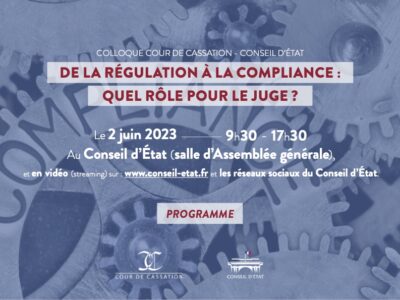
► Full Reference: M.-A. Frison-Roche, The role of the Judge in the deployment of Regulatory Law through Compliance Law, Working Paper, April  2023. - 🎤 This working paper was drawn up to serve as the basis for the concluding summary session of the colloquium organised by the Conseil d'État (French Administrative Supreme Court) and the Cour de cassation (French Judicial Supreme Court), De la régulation à la compliance: quel rôle pour le juge? ("From Regulation to Compliance: what role for the Judge?") held on 2 June 2023 at the Conseil d'État.  - 📝 This working paper also served as the basis for the article that concludes the book De la régulation à la compliance : quel rôle pour le juge, published by the La Documentation Française, 2024. - ► Working Paper Summary: It is remarkable to note the unity of conception and practice between professionals who tend to work in administrative jurisdictions and professionals who tend to work in judicial jurisdictions: they all note, in similar terms, an essential movement: what Regulatory Law is, how it has been transformed into Compliance Law, and how in one and even more so in the other the Judge is at the centre of it. Judges, as well as regulators and European officials, explain this and use different examples to illustrate the profound transformation this has brought about for the law and for the companies responsible for increasing the systemic effectiveness of the rules through the practice and dissemination of a culture of compliance. The role of the judge participating in this Ex Ante transformation is renewed, whether he is a public law judge or a private law judge, in a greater unity of the legal system.   - 🔓read the Working Paper below⤵️ - 🌐follow Marie-Anne Frison-Roche on LinkedIn 🌐follow Marie-Anne Frison-Roche on Instagram 🌐subscribe to the Newsletter MAFR Regulation, Compliance, Law

Articles

📧Face aux clauses de Compliance : le Juge (colloque du 7 avril 2023)

🌐 follow Marie-Anne Frison-Roche on LinkedIn 🌐 subscribe to the Newsletter MAFR Regulation, Compliance, Law  - ► Full Reference: M.-A. Frison-Roche, "Face aux clauses de Compliance : le Juge (colloque du 7 avril 2023)" ("Facing Compliance clauses: the Judge (symposium of 7 April 2023)"), Newsletter MAFR – Law, Compliance, Regulation, 4 April 2023. - 📧Read by freely subscribing other news of the Newsletter MAFR – Law, Compliance, Regulation - Compliance Law is starting to be known; mainly through two blocks: Firstly the spectacular sanctions by which it made as its entry in Europe by the "BNPP sanction" of 2014. 🔴M.-A. Frison-Roche, 📝Le Droit de la Compliance, 2016 Secondly, the accumulation of tools, legal and non-legal, with which companies have equipped themselves: plans to detect and prevent breaches, internal investigations, mapping, ad hoc training, etc. 🔴M.-A. Frison-Roche (dir), 📘Compliance Tools, 2021   But what is the "compliance obligation" in the name of which these fearful and heavy sanctions are pronounced and these new and multiple tools are put in place? We do not have a very clear idea. That is why the Journal of Regulation & Compliance (JoRC) and its partner universities have chosen to focus on the topic of the Compliance Obligation in a series of symposiums held in 2023. 🔴JoRC, 🏗️L'obligation de compliance, 2023   It could be said that the company is "obliged" by Compliance because it is obliged by the Law, as Compliance would only mean obeying "regulations" (a term used to describe everything that is obligatory, from the Constitution to ethical charters, etc.). The English vocabulary "comply with" suggests this, as does the Chinese practice of Compliance. The difference would then only be the fact that the company shows its "stakeholders" that it does in fact respect all these texts that commit it.   But the practice and the jurist remember that what is sometimes considered as the heart of the Law, since Roman Law, is Obligations Law, having as its object Contract Law and Tort Law.   Yet, in practice, companies have put contracts concerning compliance everywhere, and they are relatively little studied. 🔴M.-A. Frison-Roche, 📝Contrat de compliance, clauses de compliance, 2023 These may be entire contracts whose very purpose is to entrust another with the task of fulfilling all or part of the compliance obligation incumbent on the company, with regard to personal data. These may be clauses inserted in contracts with another purpose, for instance sales contracts in a value chain, where the company stipulates that the other company will also ensure compliance obligations for itself or for the other company, e.g. detect and prevent corruption, be vigilant, etc. Contract Law has already taken on compliance in practice, especially in long-term economic transactions with an international dimension. The judge has always been present in Obligation Law.   How is the triangle articulated: Judge – Compliance – Obligation?   The Judge has been present from the outset in the development of the Compliance Obligation through criminal liability, administrative liability and the obligation for the company to become a judge of itself, particularly through internal investigations. 🔴M.-A. Frison-Roche (dir.), 📘Compliance Jurisdictionalisation, 2023   The Judge is also present through Obligation Law stricto sensu, first of all through liability, which is transformed under the effect of the compliance system, which operates more in the logic of "accountability" and generates legal mechanisms of "ex ante liability". 🔴M.-A. Frison-Roche, 📝La responsabilité Ex Ante, pilier du Droit de la Compliance, 2022   In contractual matters, the Judge will intervene, in particular with regard to the stipulations which, in the contracts which form the architecture of the value chains, ensure the efficacy (and no longer only the effectiveness) of the duty of vigilance. The Judge will then intervene under the French law of 2017, known as the "Vigilance Law", 🔴M.-A. Frison-Roche, 🚧Vigilance, Buts Monumentaux de la Compliance et "Société vigilante", 2023 but also, because the Judge is the "judge of the contract", he will intervene as such.   To identify the Obligation of Compliance,  🔴M.-A. Frison-Roche (dir.), 📘Compliance Obligation, 2024 it is therefore necessary to analyse the way in which the Judge apprehends or should in the future apprehend contracts and compliance clauses.   That's why, in the above-mentioned cycle of symposiums, a symposium is being held on 7 April 2023. It is co-organised by the Journal of Regulation & Compliance (JoRC) and the Law Faculty of Perpignan, and has been designed under the scientific direction of Walid Chaiehloudj and Marie-Anne Frison-Roche. 🧮Le juge face aux clauses et aux contrats de compliance (The Judge facing clauses and contrats of compliance) -

Breaking news

💬Colloque : « Avocat et droits de la défense dans les enquêtes internes et la justice négociée »

🌐follow Marie-Anne Frison-Roche on LinkedIn 🌐subscribe to the Newsletter MAFR Regulation, Compliance, Law  - ► Full Reference: M.-A. Frison-Roche & M. Boissavy, "Colloque : « Avocat et droits de la défense dans les enquêtes internes et la justice négociée »" ("Symposium: "Lawyers and rights of the defence in internal investigations""), interview with Olivia Dufour, Actu-Juridique, 3rd April 2023. - 💬read the interview (in French) - ► Presentation of the interview by the journal (in French): "Le Conseil national des barreaux (CNB) organise les 20 et 21 avril prochains un colloque intitulé « Avocat et droits de la défense dans les enquêtes internes et la justice négociée ». Matthieu Boissavy, avocat aux barreaux de Paris et de New York, médiateur et vice-président de la commission Libertés et droits de l’Homme du Conseil national des barreaux et Marie-Anne Frison-Roche, professeure de droit, directrice du Journal of Regulation and Compliance nous expliquent les enjeux de ces nouvelles pratiques judiciaires qui bousculent le rôle traditionnel des acteurs de la justice, qu’il s’agisse des avocats ou des magistrats." - ► Questions asked (in French):  Le CNB organise les 20 et 21 avril prochains un colloque sur le thème : Avocats et droits de la défense dans les enquêtes internes et la justice négociée. Pourquoi ce choix ?​ La compliance n’est-elle pas en train de bouleverser le métier d’avocat ? ​​​ Comment cela se traduit-il en pratique ?​ Quelles sont les implications déontologiques, ne faut-il pas inventer de nouvelles règles ? Qu’est-ce que la CJIP a changé dans le métier d’avocat ? Quels sont les nouveaux risques pour l’avocat ? Cela modifie-t-il les relations entre avocats, parquet et juges du siège ? -

Conferences

🖥️Propos introductifs : Les buts monumentaux de la vigilance, in🧮La société vigilante

🌐 follow Marie-Anne Frison-Roche on LinkedIn 🌐subscribe Newsletter MAFR Regulation, Compliance, Law  - ► Full Reference: M.-A. Frison-Roche, "Propos introductifs : Les buts monumentaux de la vigilance" (Introductory remarks: The Monumental Goals of Vigilance), in La société vigilante ("The Vigilant Company"), Aix-Marseille University, Institut de Droit des Affaires, March 24, 2023. - This conference is done in French; read its English Summary below⤵️ 🧮see the complete program of the manifestation (in French) - ► English Summary of the conference: "Vigilance" is intriguing because, although it occurs in many branches of Law and is familiar in "banking compliance", in a form that is moreover reinforced since it is an obligation of vigilance on the part of the banker about a client whom he/she should "know", it is the "duty of vigilance" that made this notion famous. One could almost say scandalously famous because of a French law of 2017 that now bears its name, called the "Vigilance Law", whereas other laws bear the name of the minister who thought of it, which due diligence (vocabulary used for the European directive) does not erase.   The current challenge is to take the right measure of what "vigilance" is. Vigilance goes beyond the French Loi Vigilance, which is not enough to express what it is in its few dispositions. To say what it is in the legal system, to use it in practice, to propose the intellectuel legal exercice of qualification, Vigilance must be thought of in Compliance Law, of which it is both a "Tool" and the most advanced point, as shown by the European Directive, whose discussions during its elaboration show these design issues. Thus, like the whole of Compliance Law, Vigilance is understood, deployed, analysed and exercised through what underpins and gives meaning to all these constantly changing regulations, powers, and obligations, through Compliance Monumental Goals which give it stability and simplicity. This is the least that can be done in a mechanism that has the ambition to organise the "sustainability" of economic relations. But while Vigilance expresses and concretizes Compliance Monumental Goals, it must not go beyond measure. In fact, to set up structures, use tools and behave in such a way that human rights and nature are effectively and extraterritorially protected, both negatively and positively, these obligations of the company, which is the natural subject of the "duty", more generally the natural subject of Compliance Law, see its legal powers increased, these means being required for the company to fulfil its new obligations, first legal, then contractual, soon to be unilaterally formulated. Perhaps we should conceive of a "vigilant company" and not just a company that, beyond and through its economic activity, cares for others and the world, but a company that "watches over" everything and on everything would be to go beyond the measure, to make companies the "regents" of the world and the people who live in it. Faced with this perspective to be excluded, the construction of a Europe of Compliance, which does not be reduced to corruption fighting or environment protection, and draws on its humanist tradition, distinguishing itself in this respect from the American and Chinese compliance systems, is the major challenge.  Companies are not the alpha and omega, but they are one of the elements of an Alliance between the political Authorities and the population, its link, the one that allows us to escape from the limit of the territory, in what we call by this inadequate term of "extraterritoriality". It is rather a question of going beyond territories, required by the Compliance Monumental Goals of Compliance, of which Vigilance is the advanced point. - 🚧read the English Working Paper, basis of this conference: "Vigilance, Compliance Monumental Goals, and "Vigilant Company"" - 📈see the slides created for this conference (in French) - 📝read the article published after this conference -

Working papers

Working Paper

🚧Thinking and using Vigilance through its Compliance Monumental Goals

🌐 follow Marie-Anne Frison-Roche on LinkedIn 🌐 subscribe to the Newsletter MAFR Regulation, Compliance, Law  - ► Full reference: M.-A. Frison-Roche, Thinking and using Vigilance through its Compliance Monumental Goals, Working Paper, March 2023. - 🎤 This Working Paper has been done as basis for the  introduction of the colloquia La société vigilante ("Vigilant Company") at the Aix-Marseille University on March 24, 2023 (conference given in French)  - 📝It is also the basis of the article that introduces a special issue on La société vigilante - ► Summary of the Working Paper: The concept of "Vigilance" is difficult to define. Probably because even as it is becoming a standard, it has just entered the legal systems. And what a splash it is! To understand it, it must not be isolated. Neither in the only French law attracting all the attention, all the fears, all the hopes, the so-called Loi Vigilance ("Vigilance Law"), nor in the only technical mechanisms that make Vigilance a reality. Vigilance is itself only a part of a deeper movement, of which it is the advanced point, allowing us to anticipate the evolution of the whole: Compliance Law. In this light and for not getting lost in it, because the stakes are so high that one quickly loses the measure of things, with each party lashing out at the others, so Vigilance, the key element of Compliance, requires above all alliances,  that we can first examine the entry of Vigilance into the legal system and then understand it through the Monumental Goals which give the measure of it, i.e. both the scope and the limit, each one having to act within the margins that are theirs, States, companies, stakeholders, and judges. A Will for tomorrow can then emerge today, carried by Europe. - 🔓read the Working Paper⤵️

Working papers

🚧Laws, Compliance, Contracts, and Judges: places and alliances

🌐 follow Marie-Anne Frison-Roche on LinkedIn 🌐 subscribe to the Newsletter MAFR Regulation, Compliance, Law  - ► Full Reference: M.-A. Frison-Roche, Laws, Compliance, Contracts, and Judges: places and alliances, Working Paper, March 2023. - . 📝this working paper is the basis for an article published in French (click HERE) in the 📚chronique of Compliance Law held in the Recueil Dalloz. - 📚Read the other articles published by this Compliance Law Chronicle. open since 2018. - ►Summary of this Working Paper: To understand the functioning of compliance systems in the articulation of the legal actors and the legal instruments used, whatever the technical sector considered, it is necessary to put the "law", the "contract" and the "judge" back into the perspective of legitimacy and efficiency regarding what Compliance is.  At the very least, it is a 'conformity' mechanism. In this process of simple obedience, legislators, economic operators, and judges find themselves in the position of having to obey the law in a hierarchical conception. In a more dynamic and ambitious conception, when Compliance Law is not reduced to a more astute method of obedience but draws substantial normativity from the Monumental Goals pursued, legislators and operators enter an alliance. The contract becomes a major instrument, and the Judge becomes a major actor, no longer to punish the non-obedient but to facilitate the links to help a sustainable system.  Faced with issues such as digital, climatic, and technological challenges, where we are each so weak and isolated, we must not limit our conception and practices to the instrument of conformity but choose the substantial Compliance Law, i.e. the alliance of forces, which puts forward the contract and renews the office of the judge, with the Public Authorities remaining legitimate in setting the Monumental Goals since they commit the future of the social group. -   🔓read bellow the developments⤵️
Couverture – Compliance Monumental Goals

Publication director

🏗️ copublishing and direction of the collection: 📚Compliance & Regulation

Publication of :🕴️ M.-A. Frison-Roche (ed.),📘 Compliance Monumental Goals

🌐 follow Marie-Anne Frison-Roche on LinkedIn 🌐subscribe to the Newsletter MAFR Regulation, Compliance, Law  - ► Full Reference: M.-A. Frison-Roche (ed.), Compliance Monumental Goals, coll. "Compliance & Regulation", Journal of Regulation & Compliance (JoRC) and Bruylant, 2023, 528 p. - ► This book in a few words: Seize Compliance by its mind: its Monumental Goals. The notion of "monumental goals" of Compliance was proposed in 2016 by Marie-Anne Frison-Roche1🕴️M.A. Frison-Roche, 📝Compliance Law, 2016.. It has become explicit in the texts and the resolution of cases, for example to fight against climate change, make human beings effectively equal, force to be extraterritorially vigilant about suppliers.  Compliance Monumental Goals are targeted ex ante by regulations, contracts, CSR, and international treaties. Creating an alliance between business and political authorities, aiming for a new form of sovereignty. The presence in litigation of these Monumental Goals of global dimension renews the responsibilities and the Judge office. Describing and conceiving these Monumental Goals makes it possible to anticipate Compliance Law, which is more powerful every day. - 📕 In parallel, a book in French Les Buts Monumentaux de la Compliance, is published in the collection "Régulations & Compliance" co-published by the Journal of Regulation & Compliance (JoRC) and Dalloz.  - 📅 This book follows a cycle of colloquia 2021 organized by the Journal of Regulation & Compliance (JoRC) and its universities partners.  - 📚   This book is inserted in this series created by Marie-Anne Frison-Roche for developing Compliance Law. 📚   read the presentations of the other books of this Compliance Series:  📘M.-A. Frison-Roche (ed), Compliance Juridictionnalisation, 2022 📘M.-A. Frison-Roche (ed.), Compliance Tools, 2020 - ► go to the general presentation of this 📚Series ​Compliance & Regulation, conceived, founded et managed by Marie-Anne Frison-Roche, co-published par the Journal of Regulation & Compliance (JoRC) and Bruylant.  - ► General construction of the book:  The book opens with an Introduction, ​which proposes the Monumental Goals as definition of Compliance Law putting them at its "beating heart", giving this new branch of law its originality and specificity, explaining what, in the History of the United States and Europe, gave birth to this singular corpus and justifies a substantial definition of Compliance Law. The concept of Monumental Goals is explained, justifying both systemic and political nature of Compliance Law, the practical consequences of which legal specific rules are thus better identified and limited, since Compliance Law does not lead to all-obedience. We can then determine what we can expect from this Law of the Future that is Compliance Law. From there, the book unfolds in 5 chapters. A first chapter is devoted to the "radioscopy" of this notion, in itself and branch of Law by branch of Law. A second chapter aims to measure how the Monumental Goals are questioned by a crisis situation, for example in a health situation, but not in that example, if they aggravate it and must be discarded, or if, on the contrary, they are exactly conceived for this hypothesis. of crisis, risks, catastrophes and that it is advisable to exploit them, in particular in order, in this "test", to benefit from the alliance between the political authorities, public powers and crucial operators. Once made explicit and tested, the Monumental Goals must find a sure way to be taken into account. This is why a third chapter aims to measure in principle and in practice how the Proportionality method can help the integration of Compliance, thus giving a new dimension to the Law without dragging it into insecurity and illegitimate grabbing of powers. But because Compliance Monumental Goals express a very great ambition, the question of a bearable, even beneficial relationship with the international competitiveness of companies, standards and systems must be opened. This is the object of the fourth chapter.   Finally, because the Monumental Goals express by nature a new ambition of the Law in a world which must not give up in what could be the prospect of its abyss, the fifth chapter has for object the relationship between the Monumental Goals of Compliance and Sovereignty. - ► Table of Content : INTRODUCTION 🕴️M.-A. Frison-Roche, 📝Main Aspects of the Book. The Monumental Goals of Compliance Law 🕴️M.-A. Frison-Roche, 📝Compliance Monumental Goals, Beating Heart of Compliance Law   CHAPTER I. THE VERY IDEA OF MONUMENTAL GOALS, THE BEATING HEART OF COMPLIANCE LAW 🕴️R.-O. Maistre, 📝What are the Monumental Goals for the Regulator in a Rapidly Changing Audiovisual and Digital Landscape? 🕴️A.-V. Le Fur, 📝Interest and “raison d’être” of the Company: How Does It Fit Together with the Compliance Monumental Goals? 🕴️A. Le Goff, 📝Monumental Goals Perceived by the Firm: Serene Business or Business under Pressure? 🕴️J.-F. Vaquieri, 📝The “Monumental Goals of Compliance” from the Company’s Perspective – the Case of Enedis 🕴️M. Malaurie-Vignal, 📝Monumental Goals of Market Law – Reflection on the Method 🕴️C. Peicuti et 🕴️J. Beyssade,📝Feminisation of Positions of Responsibility in the Workplace as a Goal of Compliance. Example of the Banking Sector 🕴️I. Gavanon, 📝Data Protection Law in the Digital Economy Confronted to Monumental Goals 🕴️B. Petit, 📝The Monumental Goals of (European) Labour Law: a Changing System with Balances to be Consolidated 🕴️G. Beaussonie, 📝Do Criminal Law and Compliance Form a System? 🕴️Ch. Huglo,📝Under what Conditions could Climate Law Constitute a Priority Monumental Goal?   CHAPTER II. IMPLEMENTATION OF COMPLIANCE MONUMENTAL GOALS IN ARTICULATION WITH THE MAJOR PRINCIPLE OF PROPORTIONALITY 🕴️L. Rapp, 📝Compliance, Proportionality and Normativity 🕴️B. Bär-Bouyssière, 📝Proportionality and Compliance 🕴️A. Mendoza-Caminade, 📝Proportionality and Evaluation. The Example of Intellectual Property Law 🕴️L. Meziani, 📝Proportionality in Compliance, the Guarantee of Public Order in Companies 🕴️M. Segonds, 📝Compliance, Proportionality and Sanction. A French Perspective 🕴️M.-A. Frison-Roche, 📝Definition of Proportionality and Definition of Compliance Law   CHAPTER III. COMPLIANCE MONUMENTAL GOALS TESTED BY CRISIS SITUATIONS 🕴️A. Oumedjkane, A. Tehrani et P. Idoux, 📝Public Norms and Compliance in Crisis Periods: Testing Monumental Goals. A Few Thoughts 🕴️J. Bonnet, 📝The Crisis, an Opportunity to Seize Compliance as a Mode of Communication for Public Authorities 🕴️M.-A. Frison-Roche, 📝Place and Role of Companies in the Creation and Effectiveness of Compliance Law in Crisis   CHAPTER IV. EFFECTIVENESS OF COMPLIANCE MONUMENTAL GOALS AND INTERNATIONAL COMPETITIVENESS 🕴️B. Deffains, 📝Compliance and International Competitiveness 🕴️J.-Ch. Roda, 📝Compliance, Internal Investigations and International Competitiveness: What are Risks for the French Companies (in the Light of Antitrust Law)? 🕴️F. Marty, 📝The Case for Compliance Programs in International Competitiveness: A Competition Law and Economics Perspective 🕴️S. Lochmann, 📝ESG Rating Agencies and Compliance as an Effective Way of Increasing International Competitiveness 🕴️M.-A. Frison-Roche, 📝Assessment of Whistleblowing and Vigilance Obligation with regard to International Competitiveness   CHAPTER V. COMPLIANCE SUPPORTED BY MONUMENTAL GOALS, A NEW WAY FOR SOVEREIGNTY 🕴️R. Bismuth, 📝The Ambiguous Relations between Corporate Compliance and Sovereignty 🕴️L. Benzoni, 📝International Trade, Competitivity and Sovereignty: Towards a Political Economy of Compliance 🕴️S. Pottier, 📝In Favour of European Compliance, a Vehicle of Economic and Political Assertion 🕴️Ch. André, 📝State Sovereingty, Sovereingty of the People: What Social Contract for Compliance? 🕴️M.-A. Frison-Roche, 📝The Principle of Active Systemic Proximity: Corollary of the Renewal of the Principle of Sovereignty by Compliance Law -
Couverture – Compliance Monumental Goals

Articles in a JoRC book

📝Place and Role of Companies in the Creation and Effectiveness of Compliance Law in Crisis, in 🕴️M.-A. Frison-Roche (ed.), 📘Compliance Monumental Goals

► Full Reference: M.-A. Frison-Roche, "Place and Role of Companies in the Creation and Effectiveness of Compliance Law in situation of crisis", in M.-A. Frison-Roche (ed.), Compliance Monumental Goals, series "Compliance & Regulation", Journal of Regulation & Compliance (JoRC) and Bruylant, 2023, pp. 325-340. - ► Article Summary:  This article has a very topic: the place of private Companies, regarding the chapter's issue: "the ordeal of a crisis". The crisis constitutes a "test", that is to say, it brings evidence. Let us take it as such. Indeed, during the health crisis, Companies have helped the Public Authorities to resist the shock, to endure and to get out of the Crisis. They did so by force, but they also took initiatives in this direction. From this too, we must learn lessons for the next crisis that will come. It is possible that this has already started in the form of another global and systemic crisis: the environmental crisis. In view of what we have been able to observe and the evolution of the Law, of the standards adopted by the Authorities but also by the new case law, what can we expect from Companies in the face of this next Crisis, willingly and strength? -   🚧Read the bilingual Working Paper, with more developments, technical references, and hypertext links. - 📘go to the general presentation of the book, Compliance Monumental Goals, in which this article is published - ► read the presentations of the other Marie-Anne Frison-Roche's contributions in this book:  📝Compliance Monumental Goals, beating heart of Compliance Law,  📝Definition of Principe of Proportionality and Definition of Compliance Law, 📝 Assessment of Whistleblowing and the duty of Vigilance - .  
Couverture – Compliance Monumental Goals

Articles in a JoRC book

📝Definition of Proportionality and Definition of Compliance Law, in 🕴️M.-A. Frison-Roche (ed.), 📘Compliance Monumental Goals

► Full Reference: M.-A. Frison-Roche, " Definition of Proportionality and Definition of Compliance Law", in M.-A. Frison-Roche (ed.), Compliance Monumental Goals, series "Compliance & Regulation", Journal of Regulation & Compliance (JoRC) and Bruylant, 2023, pp. 259-288. - ► Article Summary: The use of Proportionality t always limit powers is only justified when it is about sanctions, but sanctions are only one tool among others in Compliance Law, intended moreover to have little place in this Ex Ante branch of Law. And returning to the very nature of Compliance Law, which relies on operators, private or public, because they are powerful, then using proportionality to limite powers is detrimental to Compliance Law.  However, nothing requires that. Compliance Law is not an exception that should be limited. On the contrary, it is a branch of Law which carries the greatest principles, aimed at protecting human beings and whose Normativity lies in its "Monumental Goals": detecting and preventing future major systemic crisis (financial, health and climate ones). However, literally the principle of Proportionality is: "no more powers than necessary, as many powers as necessary". The second part of the sentence is independent of the first: this must be used. Politics having fixed these Monumental Goals, the entity, in particular the company, must have, even tacitly, "all the necessary powers" to achieve them. For example, the power of vigilance, the power of audit, the power over third parties. Because they are necessary to fulfill the obligations that these "crucial operators" must perform as they are "in a position" to do so. So instead of limiting the powers, the Principe of Proportionality comes to support the powers, to legitimize them and to increase them, so that we have a chance that our future is not catastrophic, perhaps better. In this respect, Compliance Law, in its rich Definition, will itself have enriched the Principle of Proportionality. -   🚧read the Working Paper, with technical developments, references, and hypertext links. - 📘go to the general presentation of the book in which this article is published - ► read the presentations of the other Marie-Anne Frison-Roche's contributions in this book:  📝Compliance Monumental Goals, beating heart of Compliance Law,  📝 Role and Place of Companies in the Creation and Effectiveness of Compliance Law in Crisis,  📝 Assessment of Whistleblowing and the duty of Vigilance -
Couverture – Compliance Monumental Goals

Articles in a legal collective publication

PEICUTI, Cristina🕴️ and BEYSSADE, Jacques🕴️

📝Feminisation of Positions of Responsibility in the Workplace as a Goal of Compliance. Example of the Banking Sector, in 🕴️M.-A. Frison-Roche (ed.), 📘Compliance Monumental Goals

► Full Reference: Peicuti, C. et Beyssade, J., Feminisation of Positions of Responsibility in the Workplace as a Goal of Compliance. Example of the Banking Sector, in Frison-Roche, M.-A. (ed.), Compliance Monumental Goals, series "Compliance & Regulation", Journal of Regulation & Compliance (JoRC) and Bruylant, 2023,pp. 117-135. - ► Article Summary:  If the Compliance techniques are conceived as taking their meaning by their Goal, the latter being in particular the protection and the effective promotion of human beings, to be reinforced in the future thanks to Compliance Law tools, the example of the effective promotion of efficient equality between women and men in the banking sector to exercise responsible functions is clear. strongly feminized, the image of banking sector remains masculine and in fact too few women exercise positions of responsibility, although no text is opposed to it and all rights have been allocated for this. To move from this situation to a future where equality will be effective, it is therefore in terms of regulatory mechanisms that we should think of the necessary transformation and even more of "transition" so that one day a de facto equality will be established. and appears natural to all. The bank must then structurally integrate this Goal, which corresponds to the definition of Compliance. To do this, the banking company is part of a long-term voluntary Compliance process, relying in particular on human resources and on the public authorities of the European Banking Union which, by further implementing the concept of sustainable economy, facilitated this long-term action. In this transition, each action and result must be considered in relation to this sought-after goal of effective equality: each progress must be valued not so much in relation to the past but in relation to the future. This Ex Ante perspective justifies these self-binding Compliance techniques, such as plans, commitments, quotas, stakeholder implications, and more flexible techniques such as examples given by managers, internal training and joint affirmations with the public authorities, are all used by the company to achieve this Monumental Goal of effective equality between human beings. The banking sector is all the more exemplary for this because the banking authorities themselves deploy incentives in this direction, the definition of Compliance Law as an alliance between the Authorities and the Companies therefore corresponding to such an action clearly in progress, structurally in the BPCE group. -     📝 see the general presentation of the book 📘Compliance Monumental Goals in which this article is published -
Couverture – Compliance Monumental Goals

Articles in a legal collective publication

BEAUSSONIE, Guillaume👤

📝Do Criminal Law and Compliance Form a System?, in 🕴️M.-A. Frison-Roche (ed.), 📘Compliance Monumental Goals

► Full Reference complète : Beaussonie, G., Do Criminal Law and Compliance Form a System?, in Frison-Roche, M.-A. (ed.),Compliance Monumental Goals, series "Compliance & Regulation", Journal of Regulation & Compliance (JoRC) and Bruylant, 2023, pp. 169-180. - ► Article Summary:  By nature, Criminal Law is a system that is not intended to develop, principles which limit it being internal to it. Nevertheless if Proportionality is respected, its extension may be legitimate to preserve “fundamental social values” because Criminal Law is the branch of Law concerning what is grave, grave in consequences as in causes. Not always being concerned by Efficiency, the temptation is important to supplement Criminal Law with other repressive mechanisms , not only Administrative Repression but today Compliance which pursues concordant objectives and aims by the "Goals Monumental ”to what would be most important and therefore for which Efficiency would be required, in particular because victory (for example against corruption) should be global. Efficiency is obtained by the internalisation in powerful companies, but this efficiency comes at a price and Criminal Law should not impose too many obligations to do maintaining only a potential link with the commission of a "real offense ”. Its association with Compliance can therefore also only be exceptional and must not lead to forget  that Freedom must always remain the principle. -     📝 Read the  general presentation of the book in which this article is published.   -
Couverture – Compliance Monumental Goals

Articles in a legal collective publication

MAISTRE, Roch-Olivier🕴️

📝What are the Monumental Goals for the Regulator in a Rapidly Changing Audiovisual and Digital Landscape?, in 🕴️M.-A. Frison-Roche (ed.), 📘Compliance Monumental Goals

► Full Reference: R.-O. Maistre,  "What are the Monumental Goals for the Regulator in a Rapidly Changing Audiovisual and Digital Landscape?", ​in M.-A Frison-Roche (ed.), Compliance Monumental Goals, series "Compliance & Regulation", Journal of Regulation & Compliance (JoRC) and Bruylant, 2023, pp. 61-68. - ► Article Summary (done by the JoRC editor):  In France, since the law of 1982 which put an end to the State monopoly on the audio-visual area, the landscape has profoundly evolved and diversified. In view of the multitude of players who are now established there, the Conseil supérieur de l'audiovisuel – CSA (French High Audiovisual Council) must ensure the economic balance of the sector and the respect for pluralism, in the interest of all audiences. The growing societal responsibilities of audiovisual media and new digital players have multiplied the "monumental goals" on which the Arcom is watching. Its competences have gradually been extended to the digital space and the successive laws concerning its missions aim at new objectives, in particular in terms of protection of minors, fight against online hate or against disinformation. The emergence of a new European model of Regulation makes it possible to give substance to these additional goals, the Regulator adopting a systemic perspective and calling on soft law tools to fulfill its new missions. -   📘see the general presentation of the book, Compliance Monumental Goals, in which this article is published -