Commitments

Articles in The Journal of Regulation & Compliance « JoRC »

article in a legal collective book

📝In Compliance Law, the legal consequences for Entreprises of their commitments and undertakings, in 🕴️M.-A. Frison-Roche (dir.), 📘Compliance Obligation,

► Full Reference: M.-A. Frison-Roche, "In Compliance Law, the legal consequences for Entreprises of their commitments and undertakingsn", in M.-A. Frison-Roche (ed.), Compliance Obligation, Journal of Regulation & Compliance (JoRC) and Bruylant, "Compliance & Regulation" Serie, 2026, forthcoming. - 📝read the article - 🚧read the bilingual Working Paper on the basis this article has been written, with more developments, technical references and hyperlinks - 📘read a general presentation of the book, Compliance Obligation, in which this article is published - ► Summary of this article: The innocents might believe, taking the Law and its words literally, that "commitments" are binding on those who make them. Shouldn't they be afraid of falling into the trap of the 'false friend', which is what the Law wants to protect them from (as stated in the prolegomena)? Indeed, the innocent persons think that those who make commitments ask what they must do and say what they will do. Yet, strangely enough, the 'commitments' that are so frequent and common in compliance behaviours are often considered by those who adopt them to have no binding value! Doubtless because they come under disciplines other than Law, such as the art of Management or Ethics. It is both very important and sometimes difficult to distinguish between these different Orders – Management, Moral Norms and Law – because they are intertwined, but because their respective standards do not have the same scope, it is important to untangle this tangle. This potentially creates a great deal of insecurity for companies (I). The legal certainty comes back when commitments take the form of contracts (II), which is becoming more common as companies contractualise their legal Compliance Obligations, thereby changing the nature of the resulting liability, with the contract retaining the imprint of the legal order or not having the same scope if this prerequisite is not present. But the contours and distinctions are not so uncontested. In fact, the qualification of unilateral undertaking of will is proposed to apprehend the various documents issued by the companies, with the consequences which are attached to that, in particular the transformation of the company into a 'debtor', which would change the position of the stakeholders with regard to it (III). It remains that the undertakings expressed by companies on so many important subjects cannot be ignored: they are facts (IV). It is as such that they must be legally considered. In this case, Civil Liability will have to deal with them if the company, in implementing what it says, what it writes and in the way it behaves, commits a fault or negligence that causes damage, not only the sole existence of an undertaking.  -   - 🌐Follow Marie-Anne Frison-Roche on LinkedIn 🌐follow Marie-Anne Frison-Roche on Instagram 🌐Subscribe to the Newsletter MAFR Regulation, Compliance, Law 🌐Subscribe to the video newsletter MAFR Overhang 🌐Subscribe to the Newsletter MaFR Law & Art

Articles in The Journal of Regulation & Compliance « JoRC »

📝L’arbitre, juge, superviseur, accompagnateur ? (The arbitrator, judge, supervisor, coach?),, in 🕴️M.-A. Frison-Roche (dir.), 📕L’obligation de Compliance

► Full Reference: J.-B. Racine, "L’arbitre, juge, superviseur, accompagnateur ?" (The arbitrator, judge, supervisor, coach?), in M.-A. Frison-Roche (dir.), L'Obligation de Compliance, Journal of Regulation & Compliance (JoRC) and Dalloz, coll. "Régulations & Compliance", 2025, pp. 489-502. - 📕read the general presentation of the book, L'Obligation de Compliance, in which this article is published - ► English Summary of this article (done by the Journal of Regulation & Compliance – JoRC) : From the outset, the author sets out what is at stake in these terms:  "Quel rôle peut ou pourrait jouer l’arbitre dans les dispositifs de compliance ? Selon le rôle qu’il est amené à jouer, il peut ou pourrait venir en renfort de l’obligation de compliance. Poser cette question, c’est poser la question des pouvoirs de l’arbitre et de son office. C’est aussi, d’une certaine manière, renvoyer à la notion même d’arbitrage." (What role can or could the arbitrator play in compliance systems? Depending on the role he/she is called upon to play, he/she can or could reinforce the compliance obligation. Asking this question raises the question of the powers of the arbitrator and his/her office. In a way, it also goes back to the very notion of arbitration).  In practice, arbitrators deal with compliance issues in their office as judges. This is illustrated by disputes involving allegations of corruption, where the arbitrators' ruling obviously cannot give effect to a corrupt practice unless they violate themselves international public order. But in this, the arbitrator is only applying a legal standard, the main issue being then the question of evidence, with compliance tools often serving as indicators of the corruption itself. Leaving behind the strict legal source and coming to the standards issued by the ICC about the fight against corruption, we really enter into the "compliance obligation", in the strict sense, when a contract appears. International business practices standards are emerging, not only in the area of probity but also in the protection of human rights, for which arbitrators can now act as guarantors. Arbitrators can do this, in particular, through the emerging litigation relating to vigilance obligation, either directly when vigilance plans are at issue,, even if a legal rule gives a specific competence to a State court (as the French 2017 law does) or if we imagine that a plan itself includes a system for recourse to arbitration, which would imply a change in culture, or if we consider that soft law is in the process of emerging from the practices of international trade laying down a duty of vigilance that arbitrators could take up. In the second part of his contribution, the author takes a second, bolder approach, namely that of an arbitrator who understands Compliance Law in that he/she would be more than a Judge, i.e. he/she would do more than settle a dispute by applying the law. This would be conceivable given the tendency to consider that the arbitrator could modify contracts and if example is taken from the technique of arbitration practised for concentration disputes in merger law. To give arbitration the required regulatory dimension, this third party would have to be able to exercise a supervisory function, which the notion of "dispute" hardly lends itself to, especially as an arbitrator is only set up to be a judge, and if he/she ceases to be one it is difficult for him/her to remain an arbitrator…. However, it is conceivable that in Ex Post the arbitrator could perform the monitoring function often required in Compliance Law. The technique of disputes boards is inspiring in this respect. The two fields, Arbitration and Compliance, are thus destined to move closer together, as the two traditional limits, arbitrability and litigation, are in the process of evolving so that they no longer stand in the way of such rapprochements. The author can therefore conclude: "C’est aux différents acteurs de la compliance de penser à l’arbitrage, et à la souplesse, la plasticité et la liberté qu’il offre, pour éventuellement le configurer spécialement au service des buts de la compliance." (It is up to the various players in Compliance to think about Arbitration, and the flexibility, plasticity and freedom it offers, in order to configure it specifically to serve the goals of Compliance Law). -

Articles in The Journal of Regulation & Compliance « JoRC »

📝À quoi engagent les engagements (In Compliance Law, the legal consequences for Entreprises of their commitments and undertakings), in 🕴️M.-A. Frison-Roche (dir.), 📕L’Obligation de Compliance

► Full Reference: M.-A. Frison-Roche, "À quoi engagent les engagements" (In Compliance Law, the legal consequences for Entreprises of their commitments and undertakings), in M.-A. Frison-Roche (dir.), L'Obligation de Compliance, Journal of Regulation & Compliance (JoRC) and Lefebvre-Dalloz, coll. "Régulations & Compliance", 2025, pp. 419-447. - 📝read the article (in French) - 🚧read the bilingual Working Paper on which this article is based, with additional developments, technical references and hyperlinks - 📕read the general presentation of the book, L'Obligation de Compliance, in which this article is published 📚see the general presentation of the series "Régulations & Compliance" in which this book is published - ► English summary of this article: The innocents might believe, taking the Law and its words literally, that "commitments" are binding on those who make them. Shouldn't they be afraid of falling into the trap of the 'false friend', which is what the Law wants to protect them from (as stated in the prolegomena)? Indeed, the innocent persons think that those who make commitments ask what they must do and say what they will do. Yet, strangely enough, the 'commitments' that are so frequent and common in compliance behaviours are often considered by those who adopt them to have no binding value! Doubtless because they come under disciplines other than Law, such as the art of Management or Ethics. It is both very important and sometimes difficult to distinguish between these different Orders – Management, Moral Norms and Law – because they are intertwined, but because their respective standards do not have the same scope, it is important to untangle this tangle. This potentially creates a great deal of insecurity for companies (I). The legal certainty comes back when commitments take the form of contracts (II), which is becoming more common as companies contractualise their legal Compliance Obligations, thereby changing the nature of the resulting liability, with the contract retaining the imprint of the legal order or not having the same scope if this prerequisite is not present. But the contours and distinctions are not so uncontested. In fact, the qualification of unilateral undertaking of will is proposed to apprehend the various documents issued by the companies, with the consequences which are attached to that, in particular the transformation of the company into a 'debtor', which would change the position of the stakeholders with regard to it (III). It remains that the undertakings expressed by companies on so many important subjects cannot be ignored: they are facts (IV). It is as such that they must be legally considered. In this case, Civil Liability will have to deal with them if the company, in implementing what it says, what it writes and in the way it behaves, commits a fault or negligence that causes damage, not only the sole existence of an undertaking.  - 🌐follow Marie-Anne Frison-Roche on LinkedIn 🌐follow Marie-Anne Frison-Roche on Instagram 🌐subscribe to the Newsletter MAFR Regulation, Compliance, Law 🌐subscribe to the Video Newsletter MAFR Surplomb 🌐subscribe to the Newsletter MaFR Droit & Art
Articles in The Journal of Regulation & Compliance « JoRC »

📝Transformation de la gouvernance et obligation de vigilance (The transformation of governance and due diligence), in 🕴️M.-A. Frison-Roche (dir.), 📕L’obligation de Compliance

► Full Reference: V. Magnier, "Transformation de la gouvernance et obligation de vigilance" (The transformation of governance and due diligence), in M.-A. Frison-Roche (dir.), L'Obligation de Compliance, Journal of Regulation & Compliance (JoRC) and Dalloz, coll. "Régulations & Compliance", 2025, pp. 259-269. - 📕read the general presentation of the book, L'Obligation de Compliance, in which this contribution is published - ► English summary of this contribution (done by the Journal of Regulation & Compliance – JoRC) : The author develops the tensions caused by Compliance Law and the Duty of Vigilance on corporate governance. The French "Sapin 2" law targets corruption, while the French "Vigilance" law has a broader scope in terms of risks and the entire value chain. It is logical that this should create tensions in terms of governance, given the monumental goals involved. Companies need to take ownership of the powers delegated to them, which means rethinking their governance and the way in which they exercise their corporate mandates, with the corporate interest, the judge's compass, having to be combined with the adoption of new standards of behaviour formalised voluntarily by ethical charters in line with international standards. On this voluntary and supervised basis, the company must adapt its structure and then contractualise these norms. This ethical approach has an impact on the role of corporate organs, not only in terms of transparency and risk prioritisation, but also proactively in terms of the adoption of commitments whose sincerity will be verified, as reflected, for example, in corporate governance codes (cf.in France the AFEP-MEDEF Code), the setting up of ad hoc committees and the presence of stakeholders, who will be consulted when the vigilance plan is drawn up. She stresses that this creates tensions, that dialogue is difficult, that business secrecy must be preserved, but that stakeholders must become Vigilance watchdogs, a role that should not be left to the public authorities alone. - 🦉this article is available in full text pour the persons following the Professor Marie-Anne Frison-Roche teaching -

Working papers

Working Paper for 📺Overlook

🚧Status and Role of the ‘trajectory’ in Regulatory and Compliance Law

► Full Reference: M.-A. Frison-Roche, Status and Role of the 'trajectory' in Regulatory and Compliance Law​, Working Paper, January 2025.   - 🎤 This Working Paper was developed as a basis for the Overhang👁 video  on 18 January 2024 : click HERE (in French) - 🎬🎬🎬In the collection of the Overhangs👁 It falls into the Notions category. ►Watch the complete collection of the Overhangs👁 : click HERE - ► Summary of this Working Paper: The notion of Trajectory is a key concept in Compliance Law. This is shown in 4 steps. – 1. the decisive use of the trajectory in the 3 Grande-Synthe decisions of the French Conseil d'État, – 2. defining the trajectory, – 3. the application of the trajectory in various sectoral Compliances and Compliance tools, – 4. the probationary dimension of the trajectory and the consequences for subjected entities          - 🔓read the developments below⤵️ - 🌐follow Marie-Anne Frison-Roche sur LinkedIn 🌐follow Marie-Anne Frison-Roche on Instagram 🌐subscribe to the Newsletter MAFR Regulation, Compliance, Law  🌐subscribe to the Video Newsletter MAFR Surplomb
Conferences

🎤Les voies d’innovations juridiques face aux nouveaux “défis climatiques” (“Innovative legal solutions to the new “climate challenges””), in 🧮Nouveaux défis – Regards croisés : Droit, Économie et Finance. Quel Droit face au Changement Climatique ? (“New challenges – Crossed perspectives : Law, Economics and Finance. What Law in the Face of Climate Change?”)

► Full Reference: M.-A. Frison-Roche, "Les voies d'innovations juridiques face aux nouveaux "défis climatiques" ("Innovative legal solutions to the new "climate challenges""), in C. Arnaud, O. de Bandt et B. Deffains (dir.), Nouveaux défis – Regards croisés : Droit, Économie et Finance. Quel Droit face au Changement Climatique ? (("New challenges – Crossed perspectives : Law, Economics and Finance. What Law in the Face of Climate Change?"), Banque de France (French Central Bank) and CRED/Paris Panthéon-Assas University, Paris, Centre de Conférence de la Banque de France, April 2, 2024 - 🧮See the full programme of this event - 🔲see the slides, basis of this conference (in French) - ► Summary of this conference: In response to the question of how the Law can produce 'innovations' to meet the 'climate challenges', the process is based on the three traditional sources of Law, which are, firstly, laws and regulations, secondly, the commitments of individuals, mainly contracts, and thirdly, court rulings. At first sight, the Law in its traditional conception and practice is weak in the face of climate change. This weakness is inherent in the nature of climate change, which is at once future, global and systemic, in the face of these three sources of Law, which do not address all three dimensions at once. The scale of the legal innovation required to ensure that one or more articulated sources can grasp the future, the global and the systemic is therefore clear. And yet this is what is happening. As far as laws and regulations are concerned, they do not seem very appropriate because they are, by their very nature, a territorial limit, and international treaties are very difficult to negotiate. The interweaving of European regulations, for example the CSRD and the CS3D, which mirror each other, may be more effective. As far as 'commitments' are concerned, a concept which in Law is not very precise outside of contracts and liability cases📎1🕴️M.-A. Frison-Roche, 📝What a commitment is, in 🕴️M.-A. Frison-Roche (ed.), 📘Compliance Obligation, 2024., contracts are above all a means for companies to fulfill their legal obligations, and a contract always implies a judge. At first sight, however, the judge is the least well placed to respond to 'climate challenges', particularly in France where he is said or wished to be powerless, where he rules on the past and where, especially the civil judge, he settles a one-off dispute between two singular parties. But a major change has occurred with the emergence of a new branch of law: the Compliance Law, a teleological branch of Law whose legal normativity is lodged in the Monumental Goals📎2🕴️M.-A. Frison-Roche, 📝Compliance Monumental Goals, beating heart of Compliance Law, in 🕴️M.-A. Frison-Roche (ed.), 📘Compliance Monumental Goals, 2023. that it pursues, namely the preservation of systems, for example the climate system. In France, the so-called "Sapin 2" law in 2016, followed by the so-called "Vigilance" law in 2017, illustrate this. And the Judge is at the centre of it all. In this global, systemic, extraterritorial perspective, the object of which is the future – Compliance Law is, moreover, rejected by many legal experts – the legislative innovation is major. Indeed, the law of 23 March 2017, known as "Vigilance" designated large companies, because they are "powerful", because they are "in a position to act" to "detect and prevent" breaches of the environment and human rights. The 2017 law copied the "compliance tools"📎3🕴️M.-A. Frison-Roche (ed.), 📘Compliance Tools, 2021. put in place by the Sapin 2 anti-corruption law: risk mapping, plans, alerts, audits, internal investigations, and so on.  Only large companies are subject to the Compliance Law, notably the Vigilance Law, since they are the only ones in a position to act, in this case "parent companies or principals", and borders are no longer limits since the obligation, creating personal liability for the company📎4🏛️Conseil constitutionnel (French Constitutional Council), March 23, 2017, decision No. 2017-750 DC, Loi relative au devoir de vigilance des sociétés mères et des entreprises donneuses d’ordre., extends throughout the "value chain". The notion and fact of "systemic dispute" is emerging before the courts. In France, the Paris Court of First Instance has exclusive jurisdiction. European legislation is proving more difficult to draw up, because although it is compulsory to provide information on these "extra-financial" subjects (CSRD), the directive on the duty of vigilance, which has just been adopted, does not go any further than the French law of 2017. On the second point, that of commitments, we are only at the beginning. Judges do not transform ethical statements into "unilateral legal commitments", and vigilance does not transform company law into co-management. But contracts do form a global network through which companies adjust their various legal obligations. This is why arbitrators, the only "global judges", will soon be involved in this systemic litigation📎5🕴️M.-A. Frison-Roche (ed.), 📘Compliance Obligation, 2024, of which a chapter is dedicated to "International Arbitration in support of the Compliance Obligation"., and more general case law is to come on "compliance contracts and clauses"📎6🕴️M.-A. Frison-Roche, 🚧Compliance contract, compliance clauses, 2022 ; 🕴️M.-A. Frison-Roche (ed.), 📘Contrat and Contract, 2024.. But the most innovative aspect undoubtedly comes from the courts. Perhaps and notably in France because it is from where we least expect it, the civil courts, that the imagination comes, but also the guarding of the great principles of the Rule of Law, because for the moment the case law is reasonable. This innovation has not come about proprio motu: the judges are not taking action, it is the NGOs that are conducting a kind of litigation policy, systematically giving formal notice to the major energy companies, but also to the major banks and insurers on climate issues, alleging non-compliance with their vigilance plans. The interim relief judge at the Paris Court of First Instance must then provide answers in systemic disputes, of which the so-called "Total Uganda"📎7🏛️Tribunal judiciaire de Paris (Paris First Instance Civil Court), summary rulings, February 28, 2023, No. RG 22/53943 and 22/53942, Total Ouganda. case is an example. The courts are demonstrating a great deal of innovation. The Court of First Instance's interim relief judge has appointed amici curiae📎8🕴️N. Cayrol, 📝L'amicus curiae, mesure d'instruction ordinaire, 2022., the Paris Court of Appeal has set up a specialised chamber📎9On the creation on the new 5-12 Chamber, Contentieux émergent – Devoir de vigilance et responsabilité écologique see 🕴️J. Boulard, 💬Contentieux systémique : "Il est important, pour les magistrats, de rester au plus près des réalités" (Systemic litigation: "It is important for judges to remain as close as possible to reality"), March 28, 2024., and training conferences have been set up on this "Emerging Systemic Litigation"📎10🕴️M.-A. Frison-Roche, 💬"Nous voyons émerger aujourd’hui le contentieux systémique" ("We are now seeing the emergence of the Systemic Litigation"), March 28, 2024 ; 🕴️M.-A. Frison-Roche, Coordination and animation of cycle of conference-debates 🧮Contentieux Systémique Émergent (Emerging Systemic Litigation). . In conclusion, Law is in the process of being rebuilt through a new branch of Law, Compliance Law, whose the very purpose, as an extension of and going beyond Regulatory Law📎11🏛️Conseil d'État (French Council of State) and 🏛️Cour de cassation (French Court of cassation), 📗De la régulation à la compliance : quel rôle pour le juge ? (From Regulation to Compliance: what role for the Judge?), 2024; 🕴️M.-A. Frison-Roche, 🚧The deployment of Regulatory Law through Compliance Law in the European project, 2023 ; 🚧Compliance Law loses the ties of Regulation Law but retains its principles : consequences for companies, 2018 ; 🚧From Regulation Law to Compliance Law, 2017., is to preserve systems, in particular the climate system, in a profoundly renewed role for judges📎12🕴️M.-A. Frison-Roche, 📝Le rôle du juge dans le déploiement du droit de la régulation par le droit de la compliance et ;🕴️Fr. Ancel, 📝Quel rôle pour le juge aujourd’hui dans la compliance ? Quel office processuel du juge dans la compliance ?, in 🏛️Conseil d'État et 🏛️Cour de cassation, 📗De la régulation à la compliance : quel rôle pour le juge ?, 2024 ; 🕴️Fr. Ancel, 📝Le principe processuel de compliance, un nouveau principe directeur du procès ?, in M.-A. Frison-Roche (dir.), 📕La juridictionnalisation de la Compliance, 2023 ; 🕴️M.-A. Frison-Roche, 📝Le Juge requis pour une Obligation de Compliance effective, in 🕴️M.-A. Frison-Roche (dir.), 📕L'Obligation de Compliance, 2024.. - 🌐follow Marie-Anne Frison-Roche on LinkedIn 🌐follow Marie-Anne Frison-Roche on Instagram 🌐subscribe to the Newsletter MAFR Regulation, Compliance, Law

Conferences

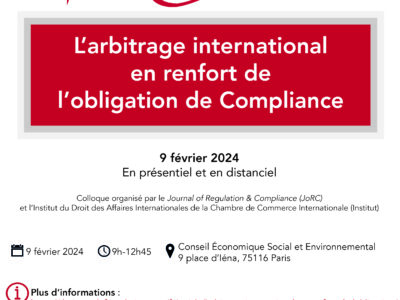
🎤Le renforcement des engagements de compliance par le renvoi Ex Ante à l’arbitrage international (Reinforcing Compliance commitments by referring Ex Ante to International Arbitration), in 🧮L’arbitrage international en renfort de l’obligation de Compliance

► Full Reference: M.-A. Frison-Roche, "Le renforcement des engagements de Compliance par le renvoi Ex Ante à l'arbitrage international" ("Reinforcing Compliance commitments by referring Ex Ante to International Arbitration"), in L. Aynès, M.-A. Frison-Roche, J.-B. Racine and E. Silva-Romero (dir.), L'arbitrage international en renfort de l'obligation de Compliance (International Arbitration in support of the Compliance Obligation), Journal of Regulation & Compliance (JoRC) and Institute of World Business Law of the ICC (Institute), Conseil Économique Social et Environnemental (CESE), Paris, February 9, 2024 - 🧮see the full programme of this event - 🌐consult on LinkedIn a general presentation of this event, which links to a presentation of each speech (in French) - 🧱consult the scientific direction sheet of this event, which gives an account of the various speeches made - 🔲see the slides used to support the presentation (in French) - 📝This conference and the Working Paper on which it is based are to be linked with the article to be published in the book📘Compliance Obligation  - 🎤see a presentation of the conference "Préalable : ce qu'est l'Obligation de Compliance" ("Prerequisite: what is the Compliance Obligation"), given at the same symposium - 🎤see a presentation of the conference "Préalable : ce qu'est un engagement" ("Prerequisite: the Commitment"), given at the same symposium - ► Presentation of the conference: It was initially planned that I would speak on the subject Le renforcement des engagements de Compliance par le renvoi Ex Ante à l'arbitrage international (Reinforcing Compliance commitments through the Ex Ante referral to International Arbitration), but it was agreed with the other organisers of the symposium that after defining the concept of the Compliance Obligation📎1🕴️M.-A. Frison-Roche, 🎤Préalable : ce qu'est l'obligation de Compliance (Prerequisite: the Compliance Obligation), in 🧮L'arbitrage international en renfort de l'obligation de Compliance (International Arbitration in support of the Compliance Obligation), 2024. I would refocus my second speech, mentioned above, on what a Commitment is📎2M.-A. Frison-Roche, Préalable : ce qu'est un engagement 🕴️M.-A. Frison-Roche, 🎤Préalable : ce qu'est un engagement (Prerequisite: the Commitment), in 🧮L'arbitrage international en renfort de l'obligation de Compliance (International Arbitration in support of the Compliance Obligation), 2024., an essential prerequisite for dealing with the subject of International Arbitration in support of the Compliance Obligation. Developments on Reinforcing Compliance commitments through the Ex Ante referral to International Arbitration will appear in the forthcoming books: L'obligation de Compliance (in French), Compliance Obligation (in English). Nevertheless, if I had dealt with this subject, I would have raised the following points: The inclusion of an offer of arbitration in the field of Compliance implies considering it in a contract as well as in a non-contractual commitment, and studying which category of Compliance Obligation the offer may apply to. This insertion benefits from taking the form of a "graduated offer", in a crescendo organised by the company ex ante and offered to the stakeholders: conciliation, mediation and arbitration, in "circles of trust"📎3🕴️M.-A. Frison-Roche, 🚧Compliance and Trust, 2017.. This is supported by the current French amicable settlement policy. The result was that I had to prepare a long "preliminary" discussion of what a "commitment" is, without which it seemed difficult to talk in concrete terms about the effective insertion of an offer of arbitration if we did not know whether such links or words had a constraining effect on the person issuing them in relation to the person benefiting from them. After discussions with the other speakers, it became clear that it would be more effective to give a talk devoted solely to the question of the legal definition of commitment. We therefore decided to allocate this second speaking slot to the notion of commitment. Since the written words do not have the same constraints, it will take up the initial construction, insisting on the different supports, either compliance contracts, or associations with compliance clauses, relating to different Compliance obligations, in particular on information or audit or Vigilance📎4🕴️M.-A. Frison-Roche, 🚧Compliance contract, compliance clauses, 2022., because the company must have the legal power corresponding to the mission that the State entrusts to it through Compliance📎5🕴️M.-A. Frison-Roche, 🚧Conceiving Power, 2021.. The offer must be carefully drafted to explain its purpose, and its organisation must prove the reality of this purpose: to give access to a judge to people affected by the company's activity, and not to block it. This will therefore be available in detail in the forthcoming books: M.-A. Frison-Roche (ed.), 📕L'obligation de Compliance M.-A. Frison-Roche (ed.), 📘Compliance Obligation - 🌐follow Marie-Anne Frison-Roche on LinkedIn 🌐follow Marie-Anne Frison-Roche on Instagram 🌐subscribe to the Newsletter MAFR Regulation, Compliance, Law

Organisation of events

🧱Co-organisation of the Symposium 🧮L’arbitrage international en renfort de l’Obligation de Compliance (International Arbitration in support of the Compliance Obligation)

► Full Reference: L. Aynès, M.-A. Frison-Roche, J.-B. Racine and E. Silva-Romero (dir.), L'arbitrage international en renfort de l'obligation de Compliance (International Arbitration in support of the Compliance Obligation), Journal of Regulation & Compliance (JoRC) and Institute of World Business Law of the ICC (Institute), Conseil Économique Social et Environnemental (CESE), Paris, February 9, 2024 - 🌐consult on LinkedIn a general présentation of this event, which links to a presentation and a report of each speech  - 🏗️This symposium takes place in the cycle of symposiums organised by the Journal of Regulation & Compliance (JoRC) and its partners Universities, focusing in 2023-2024 on the general theme of the Compliance Obligation - 📚The works will then be inserted in the books:  📕L'obligation de Compliance, to be published in the 📚Régulations & Compliance Serie, co-published by the Journal of Regulation & Compliance (JoRC) and Dalloz, published in French. 📘Compliance Obligation, to be published on the 📚Compliance & Regulation Serie, co-published by the Journal of Regulation & Compliance (JoRC) and Dalloz, published in English. - ► General presentation of the symposium: "Compliance Obligation" appears to be far from International Arbitration if Compliance Law is only understood in terms of binding regulations or even Criminal Law. Arbitration would only have contact with Compliance Obligation in a repulsive way, when a person claims to have enforced a contract before an arbitration court that disregards a compliance prohibition, e.g. corruption or money laundering. It is therefore from a negative angle that the cross-over has taken place. The fact that Arbitration Law respects the requisite of Criminal Law is nothing new.  Moreover, the power of Compliance in its detection and prevention tools, particularly in terms of evidence, no doubt increases the global efficiency. But Compliance Obligation is based on Monumental Goals, notably linked to global human rights and active ambitions about environment and climate which, particularly in the value chain economy, take the legal form of compliance clauses, or even compliance contracts, or various commitments and plans, which the parties can ask the international arbitrator to enforce. They will do so even more as arbitrators are often the only international, or even global, judges available. The use they will do of Contract Law, Quasi-Contract Law, Enforcement Law, Tort Law, reinforces Compliance Law in a global dimension. - - ► Interviennent :  🎤 Laurent Aynès, emeritus Professor at Paris 1 Panthéon-Sorbonne University, Attorney, Darrois Villey Maillot Brochier (Paris) 🎤 Marie-Anne Frison-Roche, Professor of Regulatory and Compliance Law, Director of the Journal of Regulation & Compliance (JoRC) 🎤 Jean-François Guillemin, former General Secretary of the Bouygues Group 🎤 Christophe Lapp, Attorney, Advant Altana (Paris) 🎤 Jean-Baptiste Racine, Full Professor at Paris Panthéon-Assas University (Paris 2) 🎤 Eduardo Silva-Romero, President of the Institute of World Business Law of the ICC (Institute), Attorney, Wordstone (Paris) - 🧮Read a detailed presentation of the event below⤵️ - 🌐follow Marie-Anne Frison-Roche on LinkedIn 🌐follow Marie-Anne Frison-Roche on Instagram 🌐subscribe to the Newsletter MAFR Regulation, Compliance, Law
Conferences

🎤Préalable : ce qu’est un engagement (Prerequisite: the Commitment), in 🧮L’arbitrage international en renfort de l’obligation de Compliance

► Full Reference: M.-A. Frison-Roche, "Préalable : ce qu'est un engagement" ("Prerequisite: the Commitment"), in L. Aynès, M.-A. Frison-Roche, J.-B. Racine and E. Silva-Romero (dir.), L'arbitrage international en renfort de l'obligation de Compliance (International Arbitration in support of the Compliance Obligation), Journal of Regulation & Compliance (JoRC) and Institute of World Business Law of the ICC (Institute), Conseil Économique Social et Environnemental (CESE), Paris, February 9, 2024 - 🧮see the full programme of this event - 🌐consult on LinkedIn a general presentation of this event, which links to a presentation of each speech (in French) - 🧱consult the scientific direction sheet of this event, which gives an account of the various speeches made - 🔲see the slides used to support the presentation (in French) - 🎤see a presentation of the conference "Préalable : ce qu'est l'Obligation de Compliance" ("Prerequisite: what is the Compliance Obligation"), given at the same symposium - 🎤see a presentation of the conference "Le renforcement des engagements de Compliance par le renvoi Ex Ante à l'arbitrage international" ("Reinforcing Compliance commitments by referring Ex Ante to International Arbitration") which was finally not pronounced but will be the subject of an 📝article in the forthcoming book 📘Compliance Obligation  - ► Presentation of the conference: Having defined the Compliance Obligation in "Préalable : ce qu'est l'Obligation de Compliance" ("Prerequisite: what is the Compliance Obligation"), I set out to define what a commitment is. No one doubts that commitments, as words, constitute facts that can engage the liability of companies if there are inconsistencies or lies. The question today is whether a commitment can constitute a legal act, binding in ex ante. Companies make commitments either to fulfil their legal Compliance obligations, which is simply obeying the law, or to express their own wishes, either for themselves or for others. The cases are often confused, even though the scope is not the same. If the commitment takes the form of a contract, Compliance is concerned if the contract is used as an Ex Ante Compliance Tool📎1🕴️M.-A. Frison-Roche (ed.), 📘Compliance Tools, 2021., either if the entire contract has this purpose, or if a compliance clause is inserted, and an arbitration clause may be linked to it. The commitment, a concept that comes more from the Economics of Regulation, was conceived between a Regulatory Authority and a Company: it is the unilateral decision of the Authority that gives legal force to the commitment. Case law confirms this (Conseil d'État (French Council of State)📎2🏛️Conseil d'État (French Council of State), 21 April 2023, No. 464349, Sté Orange v. Arcep. and Conseil constitutionnel (French Constitutional Council)📎3🏛️Conseil constitutionnel (French Constitutional Council), 19 March 2021, decision No. 2021-891 QPC, Association Générations futures et autres.) and this is particularly clear in Competition Law, but it is also true of the convention judiciaire d'intérêt public – CJIP (French Judicial Public Interest Agreement). If commitment is central to Compliance, particularly Vigilance, it is because Compliance Law is an extension of Regulatory Law📎4🕴️M.-A. Frison-Roche, 🚧From Regulation Law to Compliance Law ; 🚧Compliance Law loses the ties of Regulation Law but retains its principles: consequences for companies, 2018 ; 🚧The deployment of Regulatory Law through Compliance Law in the European project, 2023.. The company is forcibly instituted by the Compliance regulator, particularly in value chains, or on digital spaces (DSA). In drawing up a plan, the company is fulfilling its legal obligation. But if we were to consider that it is a commitment, then we would also have to consider that the plan is the result of its will, that it must consult the stakeholders in its preparation, but that the source of the plan is its will: the provisions are not stipulations, are not applications of the law, but unilateral voluntary provisions. In this respect, and because its source is the will of the company (which does not prevent its co-construction), a plan could contain a "graduated offer" of arbitration. This offer could be included in commitments that are less regulated by law, such as those made in the context of CSR. - 🌐follow Marie-Anne Frison-Roche on LinkedIn 🌐follow Marie-Anne Frison-Roche on Instagram 🌐subscribe to the Newsletter MAFR Regulation, Compliance, Law

Working papers

🚧In Compliance Law, the legal consequences for Entreprises of their commitments and undertakings

► Full Reference: M.-A. Frison-Roche, In Compliance Law, the legal consequences for Entreprises of their commitments and undertakings, June 2024. - 📝 This Working Paper is the basis for the contribution "In Compliance Law, the legal consequences for Entreprises of their commitments and undertakings", in📘Compliance Obligation. - ► Summary of this Working Paper: The innocents might believe, taking the Law and its words literally, that "commitments" are binding on those who make them. Shouldn't they be afraid of falling into the trap of the 'false friend', which is what the Law wants to protect them from (as stated in the prolegomena)? Indeed, the innocent persons think that those who make commitments ask what they must do and say what they will do. Yet, strangely enough, the 'commitments' that are so frequent and common in compliance behaviours are often considered by those who adopt them to have no binding value! Doubtless because they come under disciplines other than Law, such as the art of Management or Ethics. It is both very important and sometimes difficult to distinguish between these different Orders – Management, Moral Norms and Law – because they are intertwined, but because their respective standards do not have the same scope, it is important to untangle this tangle. This potentially creates a great deal of insecurity for companies (I). The legal certainty comes back when commitments take the form of contracts (II), which is becoming more common as companies contractualise their legal Compliance Obligations, thereby changing the nature of the resulting liability, with the contract retaining the imprint of the legal order or not having the same scope if this prerequisite is not present. But the contours and distinctions are not so uncontested. In fact, the qualification of unilateral undertaking of will is proposed to apprehend the various documents issued by the companies, with the consequences which are attached to that, in particular the transformation of the company into a 'debtor', which would change the position of the stakeholders with regard to it (III). It remains that the undertakings expressed by companies on so many important subjects cannot be ignored: they are facts (IV). It is as such that they must be legally considered. In this case, Civil Liability will have to deal with them if the company, in implementing what it says, what it writes and in the way it behaves, commits a fault or negligence that causes damage, not only the sole existence of an undertaking.  - 🔓read the developments below ⤵️ - 🌐follow Marie-Anne Frison-Roche on LinkedIn 🌐follow Marie-Anne Frison-Roche on Instagram 🌐subscribe to the Newsletter MAFR Regulation, Compliance, Law  🌐subscribe to the Video Newsletter MAFR Surplomb
Jurisprudence

🏛️Décision n° 22-DCC-186 du 30 septembre 2022 relative à la prise de contrôle exclusif de la société McKesson Europe par le groupe Phoenix

► Full Reference: Autorité de la concurrence (French Competition Authority), Décision relative à la prise de contrôle exclusif de la société McKesson Europe par le groupe Phoenix (Decision on the acquisition of sole control of McKesson Europe by the Phoenix Group), 30 September 2022, n° 22-DCC-186. - 🏛️read the decision (in French) -

Breaking news

📧 THE FRENCH COMPETITION AUTHORITY ALSO MAKE KIND OF PUBLIC INTEREST JUDICIAL AGREEMENT: EXAMPLE OF THE FRENCH COMPETITION AUTHORITY’S STATEMENT OF JUNE 3, 2021 ON FACEBOOK

► Compliance Law and Competition: for building, is it necessary to legislate ? Example of quasi-public interest judicial agreement: the French Competition Authority's Statement of June 3, 2021 on Facebook   The French law so-called "Sapin 2" of 2016, organized the "convention judiciaire d’intérêt public – CJIP" (Public Interest Judicial Agreement) which allows the prosecutor to undertake not to prosecute a company in returns for this company's commitments for the future. Is this mechanism reserved for this law, which only concerns corruption and bribery? The answer is often positive. Is it so obvious? Since the entity having the power to prosecute therefore always has the power not to prosecute. As the company always has the freedom to make commitments for the future. And everything stops. News in Competition Law illustrate this. On June 9, 2021, as part of a transaction, the Autorité de la concurrence (French Competition Authority) sanctions Google (➡️📝 Communiqué of the Autorité de la Concurrence , translated in English by the French Competition Authority) , which has not contested the facts, for abuse of dominant position for having privileged its services in the online advertising services. Similar facts were alleged against Facebook. But on June 3, 2021, the Autorité de la concurrence (French Competition Authority) published a "communiqué de presse" (➡️📝statement translated in English by the French Competition Authority) saying that Facebook has, during the investigation, proposed commitments regarding its future behavior. It is remarkable that this statement on Facebook is published as an “acte de régulation” (regulatory act). Yes, it is indeed an regulatory act about the future and structuring the online advertising area, internalized in this company which engages itself in its future behavior. With its statement, the Competition Authority invites the “acteurs du secteur” (actors of this sector) to make observations, for the development of what will be a sort of compliance program. In these negotiations which are akin to a game table, where everyone calculates without knowing if they enter into a negotiation or a confrontation, the first game assuming that one shows more cards than in the second, it is indeed towards a kind of Public Interest Judicial Agreement that they are going with a Competition Authority which is both Judge and Prosecutor, concludes the agreement and, through a later decision, gives it force. Under the various legal qualifications, it is indeed the same general mechanism of Compliance Law, well beyond the specific French law known as Sapin 2. Managed in this way, Compliance Law being an Ex Ante corpus, transforms the Competition Authority, an Ex Post Authority, into an Ex Ante Authority, openly taking "acte de régulation" (Regulatory Act), and allows it to rely on the power of companies, thus “committed”, to structure markets, which are however not regulated. Like advertising or retailing areas (➡️📝see Frison-Roche, M.-A., From Competition Law to Compliance Law: Example of French Competition Authority's decision on central purchasing body in mass distribution, 2020). Thus Compliance Law has achieved the autonomy of Regulatory Law with regards to the notion, which nevertheless seemed intimate to it, of "sector".   ► register to the French Newsletter MaFR ComplianceTech®

Books

Le droit des contrats