Climate

Videos

concluding lecture

🖥️L’avenir de la compliance (The future of Compliance), in 🧮La compliance (Compliance)

► Full reference : M.-A. Frison-Roche, "The Future of Compliance", series Compliance, Centre Perelman, Brussels, 23 February 2026. - 🧮view the full programme for the series Compliance (in French) - ► English presentation of this concluding conference in the series Compliance : The future of Compliance: who knows what it holds? Anyone who practises and studies the texts, litigation, structures and behaviours will have to admit that they do not know what will become of what has emerged as a new branch of law. It is not easily recognised, probably for three reasons. Firstly, because the birth of a new branch of law is an unusual phenomenon, whose disruptive and regenerative waves are felt in all branches of law and other regulatory systems, accompanying and reflecting the new world we have already entered, whether we like it or not. Secondly, because it is unpleasant (especially if you are a professor…) to begin and conclude with the fact that you do not know. Thirdly, because it is not very marketable, and in today's large and growing "compliance market", it is not very smart, if you want to sell compliance products (whether they be algorithms, new services to be linked to the highest level of companies, specialities in law firms, new chairs in various schools), to say that you don't know. So the experts say they know. For my part, I meet many people who are "experts" and who are "knowledgeable". What is surprising is the diversity of their discourse, which casts doubt on the solidity of the projection, particularly on the meaning of words: for example, not only words that could be described as "new" (which we then try to anchor in old words) such as "compliance/conformity" and "governance", but also words that we are undoubtedly more familiar with, such as "commitment" and "responsibility" or "sanction", i.e. the very pillars of the matter. Why is this a cause for concern, apart from the fact that it is always better to know what we are talking about, rather than everyone talking in their own corner, for their own compliance corpus, for their like-minded friends, with the subject matter becoming increasingly siloed? Because the object of Compliance Law is the future. So, the future of this branch of law which its object is the future is by nature very uncertain.   It will therefore be assumed in advance that not knowing the future is a major difficulty when it comes to Compliance Law, in that this branch of law is unified in that it is ex ante and its object is the future. The difficulty is neither of the same nature nor of the same magnitude when it comes to the legislator, the "regulator", the regulated company (calculating or political), or the judge faced with systemic compliance litigation. That said, in a first part, one can imagine the future possibilities for Compliance (because that is what it boils down to, given the number of candidates eager to seize the instruments of power that are the " Compliance tools"). It is not a foregone conclusion that this future will be governed by Law. The consequences could take care of that. Or the order given by the leader (Trump, for instance), and that would go down all the better as he states that he certainly does not care about human beings but that he wields the power of Compliance to restore the climate balance (through Chinese regulations): except to say that there is no unified Compliance Law. That there would be one for the climate and another for human rights. So what about the future consistency of European Law, which links the two in the CSRD and the CS3D? Particularly in value chains. The question then is: what will be the uniqueness of Compliance Law in the future? -   In a second part, since we do not know how things will turn out, from omnibus to omnibus, from a government hostile to the Law to a government appealing to the Due Process, from case law to case law, from special law to common law, we must weigh up the advantages and disadvantages of the various perspectives. There is never one perspective where everything is good and another where everything is bad, because in that case there would be no choice and no policy: it would be enough to have information, to be "rational" and to go for the right solution rather than the wrong one. Beyond general statements that a combination of compliance and ethics is welcome, which is not in doubt in the superb statements made in this regard, it is necessary to look at the advantages and disadvantages of the direction we may take. Firstly, there is the disappearance of Compliance Law, with the advantage of reducing the regulatory burden on those subject to it and the disadvantage of abandoning altruistic and global ambitions (these two Monumental Goals may overlap). Secundly, it could involve the creation of a global empire, with the advantage of a simplified American empire, whether extraterritorialised by the state or by companies and their governance or technology, with the advantage of a Western model and the disadvantage of the crushing of "mondialisation" by globalisation and the disappearance of the specific ambitions of States. Thirdly, it may be a contribution to a war between powers, particularly through the European DSA and the data war, with the advantage of European maturity in Compliance Law as an extension of Regulatory Law and the disadvantage that we could move from a war in the metaphorical sense (never use metaphors in Law) to a war. Quaterly, it could be a new rule of Law in which systemic companies participate in an alliance to achieve Monumental political Goals decided by States and political authorities, preserving systems for the future ("sustainability") so that human beings are not crushed by them but benefit from them. The disadvantage is that we have to relearn the Law, because although it has nothing to do with conformity, which is only an instrument, Compliance Law changes all branches of Law and requires the integration of other techniques, particularly political and technological ones. -   In third part, in practice, we must strive in advance to reduce the disadvantages associated with the shortcomings of possible future developments in Compliance Law, just as we must strive in advance to increase the advantages associated with the qualities of possible future developments in Compliance Law. The disadvantage lies in the very nature of Compliance Law, namely its great power, because unlike Competition Law, it calls for and increases power. We must therefore counteract the prospect of compliance techniques, particularly those related to Information, being monopolised by those who only want to use them to consolidate or extend their power, laughing at Ethics and Monumental Goals. This means that supervision techniques on the one hand and a renewed role for judges on the other must be considered. The quality attached to possible futures stems from the fact that we could uphold a "Global Law" (reference to the work of Benoît Frydman, among others) and that, faced with the possible disappearance of Public International Law and the imperative preservation of value chains, particularly in the context of possible war, the alliance between supervised systemic companies and the political authorities in charge of the future of the social group that legitimises them may appear to be a legitimate, effective, efficiate and efficient system. -   ⛏️Go further  : 🕴🏻M.-A. Frison-Roche, 📝Compliance Law, 2016 🕴🏻M.-A. Frison-Roche, 📝Conceiving Power, 2021 🕴🏻M.-A. Frison-Roche, 📕Compliance Monumental Goals, 2022  🕴🏻M.-A. Frison-Roche, 📝The Birth of a New Branch of Law: Compliance Law, 2024 🕴🏻M.-A. Frison-Roche, 📝Compliance Law and conformity: distinguishing between them to better articulate them, 2024 🕴🏻M.-A. Frison-Roche, 📕Complianceo Obligation, 2025 🕴🏻M.-A. Frison-Roche, 📝Compliance Law and Systemic Litigation, 2025 - 🌐Follow Marie-Anne Frison-Roche on LinkedIn 🌐follow Marie-Anne Frison-Roche on Instagram 🌐Subscribe to the Newsletter MAFR Regulation, Compliance, Law 🌐Subscribe to the video newsletter MAFR Overhang 🌐Subscribe to the Newsletter MaFR Law & Art
MAFR Chronicles Compliance Law

article forming part of a thematic column

📝Droit de la compliance et Contentieux systémique (Compliance Law and Systemic Litigation)

►Full Reference: M.-A. Frison-Roche, "Droit de la compliance et Contentieux systémique" (Compliance Law and Systemic Litigation), in Chroniques Droit de la Compliance (Compliance Law Chronicles), Recueil Dalloz, 30 October 2025, No. 38, p. 1849 - 🚧read the bilingual Working Paper on which this article is based, with additional developments, technical references and hyperlinks -   ►read the English presentation of the previous chronicles: "Compliance and conformity: Distinguish them in order to articulate them", 2024 "Regulations, Compliance, Contracts, and Judges: places and alliances", 2023 "Contract of compliance, stipulations fo compliance", 2022 "The Adventure of the Compliance", 2020 "Compliance and Legal Personality", 2019 "TLegal Theory of Risk Mapping", 2019 ►read the English presentation of the whole chroniques - ►English summary of this article: Legal systems have changed, and Compliance Law, in its uniqueness, reflects this change and plays a powerful role in it. Through new sets of compliance rules, particularly at European level, in areas such as data protection (GDPR), anti-money laundering (AMLA), climate balance protection (CS3D) and banking and financial system sustainability (Banking Union), techniques (always the same) have been developed and imposed on large companies, which must implement them: alerts, mapping, assessment, sanctions, etc. These new regulatory frameworks only make sense in relation to their ‘Monumental Goals’: to detect systemic risks Ex Ante and prevent crises so that the systems in question do not collapse, but ‘sustain". All the legal instruments in the corpus are normatively rooted in these Monumental Goals, which are the core that unifies Compliance Law (I). Judges are the guardians (II) of this new and highly ambiguous normative framework, which relies on the practical ability of companies to do just that. They ensure that the technical provisions are applied teleologically in each of these compliance blocks, and that the regulatory frameworks are mutually supportive, for it is always the same systemic goal that all compliance regulations serve: to ensure that systems (banking, financial, climate, digital, energy, etc.) do not collapse, that they are sustainable, and that present and future human beings are not crushed by them but, on the contrary, benefit from them. This unity is still little perceived, as regulations pulverize this profound unity of compliance law in the myriad of changing provisions. Entrusting the "regulatory mass" to algorithms increases this pulverization, making the whole increasingly incomprehensible and therefore impossible to handle.  Acknowledging the judge's rightful place, i.e. at the heart of the matter, will enable us to master this new branch of law. But it's not the judge's job alone to restore clarity to a whole covered in the dust of his own technicality. The systemic object of Compliance Law is transferred to Litigation. Indeed, the Litigation that emerges from the new Compliance Law is also fundamentally new, by transitivity. Indeed, the aim of Compliance Law is to make systems sustainable (or sustainable, or resilient, the vocabulary varies). The result is litigation which is itself "systemic litigation" (III), most often initiated by an organization against a systemic operator. The place and role of each are transformed (IV).   -

Articles in The Journal of Regulation & Compliance « JoRC »

TORRE-SCHAUB, Marta🕴️

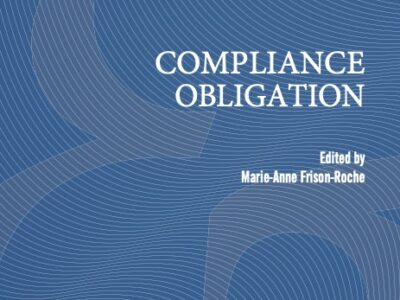
📝Environmental and Climate Compliance, in 🕴️M.-A. Frison-Roche (ed.), 📘Compliance Obligation

► Full Reference: M. Torre-Schaub, "Environmental and Climate Compliance", in M.-A. Frison-Roche (ed.), Compliance Obligation, Journal of Regulation & Compliance (JoRC) and Bruylant, "Compliance & Regulation" Serie, to be published - 📘read a general presentation of the book, Compliance Obligation, in which this article is published - ► Summary of the article (done by the Journal of Regulation & Compliance – JoRC):  The author starts from the fact that Compliance Law, in that it is not limited to conformity process, and Environmental Law are complementary, both based above all on the prevention of risks and harmful behaviour, environmental crises and the right to a healthy environment involving the strengthening of Environmental Vigilance. It is all the more important to do this because definitions remain imprecise, not least those of Environment and Climate, which are diffuse concepts. Firstly, the contribution sets out the purpose of Environmental Compliance, which is to ensure that companies are vigilant with regard to all kinds of risks: they put in place and follow a series of processes to obtain "progress" in accordance with a standard of "reasonable vigilance". This requires them to go beyond mere conformity and encourages them to develop their own soft law tools within a framework of information and transparency, so that the climate system itself benefits in accordance with its own objectives. Then the author stresses the preventive nature of Environmental Vigilance mechanisms, which go beyond providing Information to managing risks upstream, in particular through the vigilance plan, which may be unified or drawn up risk by risk, and which must be adapted to the company, particularly in the risk mapping drawn up, with assessment being carried out on a case-by-case basis. Lastly, in the light of recent French case law, the author describes the implementation of the system, which may bring the parties before the Tribunal judiciaire de Paris (Paris Court of First Instance) and then the specialised chamber of the Paris Court of Appeal. The author believes that judges must clarify the obligation of Environmental Vigilance so that companies can adjust to it, and these 2 courts are in the process of doing so. - 🦉This article is available in full text to those registered for Professor Marie-Anne Frison-Roche's courses -

Texts

🏛️Directive (EU) of 13 June 2024 on corporate sustainability due diligence (CS3D)

► Full Reference: Directive (EU) 2024/1760 of the European Parliament and of the Council of 13 June 2024 on corporate sustainability due diligence and amending Directive (EU) 2019/1937 and Regulation (EU) 2023/2859 (CS3D) - ► read the text of the directive - 📧see on LinkedIn the article published by Marie-Anne Frison-Roche in the Newsletter MAFR. Regulation, Compliance, Law, on the occasion of the publication of this directive in the Official Journal of the European Union -

Articles in a legal collective publication

📝L’usage des puissances privées par le droit de la compliance pour servir les droits de l’homme (Use of private companies by Compliance Law to serve Human Rights), in 🕴️J. Andriantsimbazovina (dir.), 📗Puissances privées et droits de l’Homme. Essai d’analyse juridique

► Full reference: M.-A. Frison-Roche, "L’usage des puissances privées par le droit de la compliance pour servir les droits de l’homme" (Use of private companies by Compliance Law to serve Human Rights) , in J. Andriantsimbazovina (dir.), Puissances privées et droits de l'Homme. Essai d'analyse juridique, Mare & Martin,  coll. "Horizons européens", 2024, pp. 279-295 - 🚧read the  Bilingual Working Paper on which this article is based, with more technical developments, references and hypertext links - ► English Summary of this article: Following the legal tradition, Law creates a link between power with a legitimate source, the State, public power being its prerogative, while private companies exercise their power only in the shadow of this public power exercised ex ante.  The triviality of Economic Law, of which Competition Law is at the heart, consisting of the activity of companies that use their power on markets, relegates the action of the State to the rank of an exception, admissible if the State, which claims to exercise this contrary power, justifies it.  The distribution of roles is thus reversed, in that the places are exchanged, but the model of opposition is shared. This model of opposition exhausts the forces of the organisations, which are relegated to being the exception. However, if we want to achieve great ambitions, for example to give concrete reality to human rights beyond the legal system within which the public authorities exercise their normative powers, we must rely on a new branch of Law, remarkable for its pragmatism and the scope of the ambitions, including humanist ambitions, that it embodies: Compliance Law. Compliance Law is thus the branch of Law which makes the concern for others, concretised by human rights, borne by the entities in a position to satisfy it, that is to say the systemic entities, of which the large companies are the direct subjects of law (I). The result is a new division between Public Authorities, legitimate to formulate the Monumental Goal of protecting human beings, and private organisations, which adjust to this according to the type of human rights and the means put in place to preserve them. Corporations are sought after because they are powerful, in that they are in a position to make human rights a reality, in their indifference to territory, in the centralisation of Information, technologies and economic, human, and financial means. This alliance is essential to ensure that the system does not lead to a transfer of political choices from Public Authorities to private companies; this alliance leads to systemic efficiency. The result is a new definition of sovereignty as we see it taking shape in the digital space, which is not a particular sector since it is the world that has been digitalised, the climate issue justifying the same new distribution of roles (II).  - 📝read the article (in French) - 🌐follow Marie-Anne Frison-Roche on LinkedIn 🌐follow Marie-Anne Frison-Roche on Instagram 🌐subscribe to the Newsletter MAFR Regulation, Compliance, Law 🌐subscribe to the Video Newsletter MAFR Surplomb

Conferences

🎤Les voies d’innovations juridiques face aux nouveaux “défis climatiques” (“Innovative legal solutions to the new “climate challenges””), in 🧮Nouveaux défis – Regards croisés : Droit, Économie et Finance. Quel Droit face au Changement Climatique ? (“New challenges – Crossed perspectives : Law, Economics and Finance. What Law in the Face of Climate Change?”)

► Full Reference: M.-A. Frison-Roche, "Les voies d'innovations juridiques face aux nouveaux "défis climatiques" ("Innovative legal solutions to the new "climate challenges""), in C. Arnaud, O. de Bandt et B. Deffains (dir.), Nouveaux défis – Regards croisés : Droit, Économie et Finance. Quel Droit face au Changement Climatique ? (("New challenges – Crossed perspectives : Law, Economics and Finance. What Law in the Face of Climate Change?"), Banque de France (French Central Bank) and CRED/Paris Panthéon-Assas University, Paris, Centre de Conférence de la Banque de France, April 2, 2024 - 🧮See the full programme of this event - 🔲see the slides, basis of this conference (in French) - ► Summary of this conference: In response to the question of how the Law can produce 'innovations' to meet the 'climate challenges', the process is based on the three traditional sources of Law, which are, firstly, laws and regulations, secondly, the commitments of individuals, mainly contracts, and thirdly, court rulings. At first sight, the Law in its traditional conception and practice is weak in the face of climate change. This weakness is inherent in the nature of climate change, which is at once future, global and systemic, in the face of these three sources of Law, which do not address all three dimensions at once. The scale of the legal innovation required to ensure that one or more articulated sources can grasp the future, the global and the systemic is therefore clear. And yet this is what is happening. As far as laws and regulations are concerned, they do not seem very appropriate because they are, by their very nature, a territorial limit, and international treaties are very difficult to negotiate. The interweaving of European regulations, for example the CSRD and the CS3D, which mirror each other, may be more effective. As far as 'commitments' are concerned, a concept which in Law is not very precise outside of contracts and liability cases📎1🕴️M.-A. Frison-Roche, 📝What a commitment is, in 🕴️M.-A. Frison-Roche (ed.), 📘Compliance Obligation, 2024., contracts are above all a means for companies to fulfill their legal obligations, and a contract always implies a judge. At first sight, however, the judge is the least well placed to respond to 'climate challenges', particularly in France where he is said or wished to be powerless, where he rules on the past and where, especially the civil judge, he settles a one-off dispute between two singular parties. But a major change has occurred with the emergence of a new branch of law: the Compliance Law, a teleological branch of Law whose legal normativity is lodged in the Monumental Goals📎2🕴️M.-A. Frison-Roche, 📝Compliance Monumental Goals, beating heart of Compliance Law, in 🕴️M.-A. Frison-Roche (ed.), 📘Compliance Monumental Goals, 2023. that it pursues, namely the preservation of systems, for example the climate system. In France, the so-called "Sapin 2" law in 2016, followed by the so-called "Vigilance" law in 2017, illustrate this. And the Judge is at the centre of it all. In this global, systemic, extraterritorial perspective, the object of which is the future – Compliance Law is, moreover, rejected by many legal experts – the legislative innovation is major. Indeed, the law of 23 March 2017, known as "Vigilance" designated large companies, because they are "powerful", because they are "in a position to act" to "detect and prevent" breaches of the environment and human rights. The 2017 law copied the "compliance tools"📎3🕴️M.-A. Frison-Roche (ed.), 📘Compliance Tools, 2021. put in place by the Sapin 2 anti-corruption law: risk mapping, plans, alerts, audits, internal investigations, and so on.  Only large companies are subject to the Compliance Law, notably the Vigilance Law, since they are the only ones in a position to act, in this case "parent companies or principals", and borders are no longer limits since the obligation, creating personal liability for the company📎4🏛️Conseil constitutionnel (French Constitutional Council), March 23, 2017, decision No. 2017-750 DC, Loi relative au devoir de vigilance des sociétés mères et des entreprises donneuses d’ordre., extends throughout the "value chain". The notion and fact of "systemic dispute" is emerging before the courts. In France, the Paris Court of First Instance has exclusive jurisdiction. European legislation is proving more difficult to draw up, because although it is compulsory to provide information on these "extra-financial" subjects (CSRD), the directive on the duty of vigilance, which has just been adopted, does not go any further than the French law of 2017. On the second point, that of commitments, we are only at the beginning. Judges do not transform ethical statements into "unilateral legal commitments", and vigilance does not transform company law into co-management. But contracts do form a global network through which companies adjust their various legal obligations. This is why arbitrators, the only "global judges", will soon be involved in this systemic litigation📎5🕴️M.-A. Frison-Roche (ed.), 📘Compliance Obligation, 2024, of which a chapter is dedicated to "International Arbitration in support of the Compliance Obligation"., and more general case law is to come on "compliance contracts and clauses"📎6🕴️M.-A. Frison-Roche, 🚧Compliance contract, compliance clauses, 2022 ; 🕴️M.-A. Frison-Roche (ed.), 📘Contrat and Contract, 2024.. But the most innovative aspect undoubtedly comes from the courts. Perhaps and notably in France because it is from where we least expect it, the civil courts, that the imagination comes, but also the guarding of the great principles of the Rule of Law, because for the moment the case law is reasonable. This innovation has not come about proprio motu: the judges are not taking action, it is the NGOs that are conducting a kind of litigation policy, systematically giving formal notice to the major energy companies, but also to the major banks and insurers on climate issues, alleging non-compliance with their vigilance plans. The interim relief judge at the Paris Court of First Instance must then provide answers in systemic disputes, of which the so-called "Total Uganda"📎7🏛️Tribunal judiciaire de Paris (Paris First Instance Civil Court), summary rulings, February 28, 2023, No. RG 22/53943 and 22/53942, Total Ouganda. case is an example. The courts are demonstrating a great deal of innovation. The Court of First Instance's interim relief judge has appointed amici curiae📎8🕴️N. Cayrol, 📝L'amicus curiae, mesure d'instruction ordinaire, 2022., the Paris Court of Appeal has set up a specialised chamber📎9On the creation on the new 5-12 Chamber, Contentieux émergent – Devoir de vigilance et responsabilité écologique see 🕴️J. Boulard, 💬Contentieux systémique : "Il est important, pour les magistrats, de rester au plus près des réalités" (Systemic litigation: "It is important for judges to remain as close as possible to reality"), March 28, 2024., and training conferences have been set up on this "Emerging Systemic Litigation"📎10🕴️M.-A. Frison-Roche, 💬"Nous voyons émerger aujourd’hui le contentieux systémique" ("We are now seeing the emergence of the Systemic Litigation"), March 28, 2024 ; 🕴️M.-A. Frison-Roche, Coordination and animation of cycle of conference-debates 🧮Contentieux Systémique Émergent (Emerging Systemic Litigation). . In conclusion, Law is in the process of being rebuilt through a new branch of Law, Compliance Law, whose the very purpose, as an extension of and going beyond Regulatory Law📎11🏛️Conseil d'État (French Council of State) and 🏛️Cour de cassation (French Court of cassation), 📗De la régulation à la compliance : quel rôle pour le juge ? (From Regulation to Compliance: what role for the Judge?), 2024; 🕴️M.-A. Frison-Roche, 🚧The deployment of Regulatory Law through Compliance Law in the European project, 2023 ; 🚧Compliance Law loses the ties of Regulation Law but retains its principles : consequences for companies, 2018 ; 🚧From Regulation Law to Compliance Law, 2017., is to preserve systems, in particular the climate system, in a profoundly renewed role for judges📎12🕴️M.-A. Frison-Roche, 📝Le rôle du juge dans le déploiement du droit de la régulation par le droit de la compliance et ;🕴️Fr. Ancel, 📝Quel rôle pour le juge aujourd’hui dans la compliance ? Quel office processuel du juge dans la compliance ?, in 🏛️Conseil d'État et 🏛️Cour de cassation, 📗De la régulation à la compliance : quel rôle pour le juge ?, 2024 ; 🕴️Fr. Ancel, 📝Le principe processuel de compliance, un nouveau principe directeur du procès ?, in M.-A. Frison-Roche (dir.), 📕La juridictionnalisation de la Compliance, 2023 ; 🕴️M.-A. Frison-Roche, 📝Le Juge requis pour une Obligation de Compliance effective, in 🕴️M.-A. Frison-Roche (dir.), 📕L'Obligation de Compliance, 2024.. - 🌐follow Marie-Anne Frison-Roche on LinkedIn 🌐follow Marie-Anne Frison-Roche on Instagram 🌐subscribe to the Newsletter MAFR Regulation, Compliance, Law

Articles in a legal collective publication

📝Droit de la compliance et climat. Pour prévenir le risque et construire l’équilibre climatiques, in 🕴️M. Torre Schaub, 🕴️A. Stevignon et 🕴️B. Lormeteau (ed.), 📗Les risques climatiques à l’épreuve du droit

► Full Reference: M.-A. Frison-Roche, "Droit de la compliance et climat. Pour prévenir le risque et construire l'équilibre climatiques" ("Compliance Law and climate. Prevent the climate risk and build the climate balance"), in M. Torre Schaub, A. Stevignon and B. Lormeteau (ed.), Les risques climatiques à l'épreuve du droit, Mare & Martin, coll. "Collection de l'Institut des sciences juridique et philosophique de la Sorbonne", 2023, pp. 73-83 - 📝read the article (in French) - 🚧read the bilingual Working Paper which is the basis of this article, with additional developments, technical references and hyperlinks - ► Summary of the article: Compliance Law is beginning to emerge in climate topic, through the expression  "Climate Compliance Law", but the climate issue itself is the most perfect example of why General Compliance Law is made for.  It is indeed a new branch of Law, a global Law claiming to provide Ex Ante solutions here and now for global issues, so that in the future systemic catastrophies will not occur, will not happen: it is these "Monumental Goals" that give meaning, coherence, and simplicity to Compliance Law. Compliance Law, linked to the Rule of Law principle, makes it possible to go beyond the choice often presented between the effectiveness of the protection of the planet and the renunciation of freedoms, in particular the freedom to do business and the freedom of individuals, especially the protection of their data. Climate is thus exemplary of the object of Monumental Goals of Compliance Law (I). The systemic risk that it now constitutes is analogous to Banking or Digital Systemic Risks and therefore calls for the application of identical legal Compliance Tools, formerly put in place for Banking Regulatory and Compliance Law, recently invented for Digital. Compliance Law, extending Regulation Law, itself from the precondition of the Sector and the Territory, is therefore the branch which makes it possible to put in place new legal solutions, either by force (judicial agreements, compliance programs, etc.), or by will (commitments, global charters, etc.). Therefore, an alliance can exist between political and public authorities, and crucial economic operators (II), that the rise in power of the "raison d'être" is the sight and whose technical challenge is the collection of information that must be put in correlation. Scientists pooling Information, this public good, provided by public and private entities. The courts are at the center of this articulation between Compliance Law and Climate, which object is the Future. - 🌐follow Marie-Anne Frison-Roche on LinkedIn 🌐follow Marie-Anne Frison-Roche on Instagram 🌐subscribe to the Newsletter MAFR Regulation, Compliance, Law

Books

📗Les risques climatiques à l’épreuve du droit

► Full Reference:  M. Torre Schaub, A. Stevignon and B. Lormeteau (ed.), Les risques climatiques à l'épreuve du droit, Mare & Martin, coll. "Collection de l'Institut des sciences juridique et philosophique de la Sorbonne", 2023, 362 p. - ► read the table of content (in French) - ► read the backcover (in French) - ► Summary of the book (done by the publisher, in French): "Le présent ouvrage explore l’appréhension juridique d’un nouveau concept : le « risque de transition », concept découlant du changement climatique. En effet, le phénomène du changement climatique crée et amplifie des aléas qui sont à l’origine de plusieurs périls encore peu considérés par le droit (risques contentieux, financiers et réglementaires). Pour assurer la pérennité de nos sociétés, toutes les dimensions de ces dangers doivent être identifiées et traitées. Les contributions proposées ont pour objectif de dresser une typologie des risques climatiques et de présenter des pistes juridiques pour y faire face. À l’échelon global, national et territorial, se pose la question de la reformulation de la responsabilité des États, mais également des acteurs privés (entreprises, banques, sociétés d’investissement), face aux aléas non maîtrisés. De nouvelles législations et réglementations internationales, européennes et nationales émergent, tendant à aborder ces risques. Cet ouvrage en fait état, ainsi que des développements contentieux climatiques inédits que s’y rattachent.". - 📝read the article of Marie-Anne Frison-Roche : "Droit de la compliance et climat. Pour prévenir le risque et construire l'équilibre climatiques" ("Compliance Law and climate. Prevent the climate risk and build the climate balance") -

Texts

RÈGLEMENT (UE) 2023/1115, du 31 mai 2023, relatif à la mise à disposition sur le marché de l’Union et à l’exportation à partir de l’Union de certains produits de base et produits associés à la déforestation et à la dégradation des forêts, et abrogeant le règlement (UE) n° 995/2010

► Full Reference: Regulation (EU) 2023/1115 of the European Parliament and of the Council of 31 May 2023 on the making available on the Union market and the export from the Union of certain commodities and products associated with deforestation and forest degradation and repealing Regulation (EU) N° 995/2010. - ► read the text -