Business

Articles in The Journal of Regulation & Compliance « JoRC »

article in a legal collective book

📝Conceiving the Compliance Obligation: Using its Position to take part in achieving the Compliance Monumental Goals, in 🕴️M.-A. Frison-Roche (ed.), 📘Compliance Obligation

► Full Reference: M.-A. Frison-Roche, "Conceiving the Compliance Obligation: Using its Position to take part in achieving the Compliance Monumental Goals", in M.-A. Frison-Roche (ed.), Compliance Obligation, Journal of Regulation & Compliance (JoRC) and Bruylant, "Compliance & Regulation" Serie, 2026, forthcoming. - 📝read the article - 🚧read the bilingual Working Paper on the basis this article has been written, with more developments, technical references and hyperlinks - 📘read a general presentation of the book, Compliance Obligation, in which this article is published - ► Summary of this article: This article explains what companies' Compliance Obligation" is. Delving into the mass of compliance obligations, it uses the method of classification of those that are subject to an obligation of result and those that are subject to an obligation of means. It justifies the choice of this essential criterion, which changes the objects and the burden of proof of companies that are subject to an obligation of result when it comes to setting up "compliance structures" and are subject to an obligation of means when it comes to the effects produced by these compliance structures. Indeed, rather than getting bogged down in definitional disputes, given that Compliance Law is itself a nascent branch of Law, the idea of this contribution is to take as a starting point the different legal regimes of so many different compliance obligations to which laws and regulations subject large companies: sometimes they have to apply them to the letter and sometimes they are only sanctioned in the event of fault or negligence. This brings us back to the distinction between obligations of result and obligations of means. Although it would be risky to transpose the expression and regime of contractual obligations to legal obligations put by legislation, starting from this observation in the evidentiary system of compliance of a plurality of obligations of means and of result, depending on whether it is a question of this or that technical compliance obligation, we must first classify them. It would then appear that this plurality will not constitute a definitive obstacle to the constitution of a single definition of the Compliance Obligation. On the contrary, it makes it possible to clarify the situation, to trace the paths through what is so often described as a legal jumble, an unmanageable "mass of regulations". Indeed, insofar as the company obliged under Compliance Law participates in the achievement of the Monumental Goals on which this is normatively based, a legal obligation which may be relayed by contract or even by Ethics, it can only be an obligation of means, by virtue of this very teleological nature and the scale of the goals targeted, for example the happy outcome of the climate crisis which is beginning or the desired effective equality between human beings. This established principle leaves room for the fact that the behaviour required is marked out by processes put in place by structured tools, most often legally described, for example the establishment of a vigilance plan or regularly organised training courses (effectiveness), are obligations of result, while the positive effects produced by this plan or these training courses (effaciety) are obligations of means. This is even more the case when the Goal is to transform the system as a whole, i.e. to ensure that the system is solidly based, that there is a culture of equality, and that everyone respects everyone else, all of which come under the heading of efficiency. The Compliance Obligation thus appears unified because, gradually, and whatever the various compliance obligations in question, their intensity or their sector, its structural process prerequisites are first and foremost structures to be established which the Law, through the Judge in particular, will require to be put in place but will not require anything more, whereas striving towards the achievement of the aforementioned Monumental Goals will be an obligation of means, which may seem lighter, but corresponds to an immeasurable ambition, commensurate with these Goals. In addition, because these structures (alert mechanisms, training, audits, contracts and clauses, etc.)  have real meaning if they are to produce effects and behaviours that lead to changes converging towards the Monumental Goals, it is the obligations of means that are most important and not the obligations of result. The judge must also take this into account. Finally, the Compliance Obligation, which therefore consists of this interweaving of multiple compliance obligations of result and means of using the entreprise's position, ultimately Goals at system efficiency, in Europe at system civilisation, for which companies must show not so much that they have followed the processes correctly (result) but that this has produced effects that converge with the Goals sought by the legislator (effects produced according to a credible trajectory). This is how a crucial company, responsible Ex Ante, should organise itself and behave. - 🌐Follow Marie-Anne Frison-Roche on LinkedIn 🌐follow Marie-Anne Frison-Roche on Instagram 🌐Subscribe to the Newsletter MAFR Regulation, Compliance, Law 🌐Subscribe to the video newsletter MAFR Overhang 🌐Subscribe to the Newsletter MaFR Law & Art

Articles

Article in a Newsletter MAFR

📝Asset freezing in the legal saga between American power and Venezuelan wealt

► Full reference: M.-A. Frison-Roche, "Asset freezing in the legal saga between American power and Venezuelan wealth", MAFR Law, Compliance, Regulation Newsletter, 23 January 2026 - 🌐read this article published on LinkedIn the 23 January 2026  - 📧Read other articles from the MAFR Newsletter – Law, Compliance, Regulation for free with a subscription. - ► Summary of this article  : It is often emphasised that the  law is merely a masquerade in the series of events we are witnessing. This is not entirely true. For three reasons. 1. Much will depend on the judge who will rule on the Madura couple's case. The energy sector has always similarly mixed regulation, public policies of states and businesses, both articulated by States and companies, both articulated by  international contracts, always organising international arbitration 3. If ExxonMobil now refuses to make the investments desired by Trump, it is also because this enterprise remembers that many years ago the freeze  of assets granted by the arbitrators was not very successful, and now the company manager believes that investment in  Venezuala's infrastructure is therefore "impossible". And given the current state of the law in the US, there is little Trump can do about it.. - 📝⤵Read the complete article below⤵ - 🌐Follow Marie-Anne Frison-Roche on LinkedIn 🌐follow Marie-Anne Frison-Roche on Instagram 🌐Subscribe to the Newsletter MAFR Regulation, Compliance, Law 🌐Subscribe to the video newsletter MAFR Overhang 🌐Subscribe to the Newsletter MaFR Law & Art
Articles in The Journal of Regulation & Compliance « JoRC »

MACLOUF, Étienne🕴️

📝Entités industrielles et Obligation de compliance (Industrial Entities and Compliance Obligation), in 🕴️M.-A. Frison-Roche (ed.), 📕L’Obligation de Compliance

► Full Reference: E. Maclouf, "Entités industrielles et Obligation de compliance" ("Industrial Entities and Compliance Obligation"), in M.-A. Frison-Roche (ed.), L'Obligation de Compliance, Journal of Regulation & Compliance (JoRC) and Dalloz, "Régulations & Compliance" Serie, 2025, to be published - 📕read a general presentation of the book, L'Obligation de Compliance, in which this article is published - ► Summary of this article (done by the Journal of Regulation & Compliance – JoRC) : This article looks at the topic Industrial Entities and Compliance Obligation from the perspective of Management Science and sets out to resolve the paradox of industrial organisations expressing the ambition of progress for the benefit of people, a humanist ambition that is contradicted by the effects produced by this industrialisation itself, which are harmful to that same humanity. The Compliance Obligation, insofar as it is based on the Monumental Goals and is anchored in Industrial Organisations, aims to resolve this paradox. The science of human organisations aims to allocate nature's scarce resources as efficiently as possible by getting individuals to cooperate, this engineering producing natural, industrial and social disasters, which are themselves more or less anticipated. The Compliance Obligation holds out the hope of better preventing them (Negative Monumental Goal) and managing them, or even improving people's lives (Positive Monumental Goal) by going beyond traditional disciplines and developing Ex Ante. However, Industrial Organisations may also reject the weight of the constraints that this creates for them, calling for deregulation instead. The debate is currently open. Furthermore, by moving from the mechanical logic of conformity to the dynamic logic of the Compliance Obligation, companies find themselves in a situation of systemic uncertainty and must decide on the strategy to be implemented, resulting in a managerialisation of the Law  and implying many new decisions to be taken. The notion of "project" is therefore back at the heart of Industrial Organisations, and more specifically that of "Humanist Project", as embodied by the Compliance Obligation, in a new Organisation where everyone plays their part in the Value Chain. The author draws on the work of Raymond Aron and the Rueff-Armand report to show that the dynamism and strength of Industrial Organisation can support a Humanist Project that is politically developed and fits in with the Economic Rationality of Industrial Organisations. This is all the more necessary as this Regulatory Framework cannot come from the sum of individual actions alone (employees, consumers, investors), as the interests of the company, of the sector, of society, of nature cannot be served by this addition alone, and the claim that the whole is self-regulated by the expression of a single one of these players (who are themselves both inside and outside the industrial organisation) is unsustainable. The Author shows that new entities are therefore being created to regulate Industrial Entities in the public interest through the Compliance Obligation, which inserts an Obligation into the Industrial Organisation modifying its project: the French so-called "Sapin 2" law is a perfect example of this, encouraging appropriate strategic responses from Industrial Organisations, which have modified their managerial procedures to integrate new strategic projects and involve stakeholders. Finally, because the Compliance Obligation is anchored in Monumental Goals, it can be the basis of the Company's Project and the Players' Project of the players, which leads us to return to the basis of the Organisations Theory, which entrusts to the corporate bodies the power and the mission of defining such a project through corporate deliberations which will then be, in the aforementioned approach of Industrial Rationality, broken down into Objectives and Plans. This is a reminder that Profit is not a Company's Goal: it is the sine qua non of its survival, which is different. A Rational Organisation determines its Project and for ensuring it,  to achieve it, it must not run the risk of going bankrupt. The Compliance Obligation is developing  between this difference and the link between the Project and this necessity to have some profit which is just a Condition. Furthermore, in order to establish this project, the organisation must resolve oppositions (conflictuality) through the complex interplay of players (Jean-Pierre Dupuy). Industrial organisations must respond to the Compliance Obligation. In particular, they do this by developing norms, or by contributing to the development of public norms, and by themselves expressly aiming Goals such as the fight against suffering in the workplace or equality between men and women as falling within the scope of the Compliance Obligation. This framing work is an essential part of the organisation's strategy, and environmental concerns can thus be integrated to a greater or lesser extent into this or that perspective. All this goes beyond the mere logic of conformity. The Compliance Obligation thus enables the production of what the Author calls "adaptive responses by individuals in the face of Systemic Crises and their causes", countering the Anomie which is also a monumental problem in today's society, which has lost its bearings and is suffering from Uncertainty. This Compliance Obligation enables Industrial Entities to integrate into Society, if necessary by coercion, by becoming the vectors of human rights and social and environmental expectations. But the success of this Compliance Obligation presupposes a certain appropriation of the Goals by the scales companies, which taints the Compliance Obligation itself with Uncertainty. -   🦉This article is available in full text to those registered for Professor Marie-Anne Frison-Roche's courses -

Books

Can the Public Be Trusted?: On the Promise and Perils of Voluntary Compliance

► Full Reference: Y. Feldman,Can the Public Be Trusted?: On the Promise and Perils of Voluntary Compliance, Cambridge University Press, 2025.  - ► Presentation of the book (done by the Author) : "When do citizens voluntarily comply with regulations rather than act out of fear of sanctions? Can the Public Be Trusted? challenges prevailing regulatory paradigms by examining when democratic states can rely on voluntary compliance. Drawing on behavioral science, law, and public policy research, Yuval Feldman explores why voluntary compliance, despite often yielding superior and more sustainable outcomes, remains underutilized by policymakers. Through empirical analysis of policy implementation in COVID-19 response, tax compliance, and environmental regulation, Feldman examines trust-based governance’s potential and limitations. The book presents a comprehensive framework for understanding how cultural diversity, technological change, and institutional  shape voluntary cooperation.". -   📗Read the book

Articles in The Journal of Regulation & Compliance « JoRC »

SÈVE, René🕴️

📝Les mutations de la souveraineté et l’Obligation de Compliance (Compliance Obligation and changes in Sovereignty and Citizenship), in 🕴️M.-A. Frison-Roche (dir.), 📕L’obligation de Compliance

► Full Reference: R. Sève, "L'Obligation de Compliance et les mutations de la souveraineté et de la citoyenneté" ("Compliance Obligation and changes in Sovereignty and Citizenship"), in M.-A. Frison-Roche (ed.), L'obligation de Compliance, Journal of Regulation & Compliance (JoRC) and Dalloz, coll. "Régulations & Compliance", 2025, pp. 97-107.   - 📕read the general presentation of the book, L'obligation de Compliance, in which this article is published. - ► English Summary of this article (done by the Journal of Regulation & Compliance – JoRC) : The contribution describes "les changements de philosophie du droit que la notion de compliance peut impliquer par rapport à la représentation moderne de l’Etat assurant l’effectivité des lois issues de la volonté générale, dans le respect des libertés fondamentales qui constituent l’essence du sujet de droit." ("the changes in legal philosophy that the notion of Compliance may imply in relation to the modern representation of the State ensuring the effectiveness of laws resulting from the general will, while respecting the fundamental freedoms that constitute the essence of the subject of law"). The contributor believes that the definition of Compliance is due to authors who « jouer un rôle d’éclairage et de structuration d’un vaste ensemble d’idées et de phénomènes précédemment envisagés de manière disjointe.  Pour ce qui nous occupe, c’est sûrement le cas de la théorie de la compliance, développée en France par Marie-Anne Frison-Roche dans la lignée de grands économistes (Jean-Jacques Laffont, Jean Tirole) et dont la première forme résidait dans les travaux bien connus de la Professeure sur le droit de la régulation. » ( "play a role in illuminating and structuring a vast set of ideas and phenomena previously considered in a disjointed manner.  For our purposes, this is certainly the case with the theory of Compliance, developed in France by Marie-Anne Frison-Roche in the tradition of great economists (Jean-Jacques Laffont, Jean Tirole) and whose first form was in her well-known work on Regulatory Law"). Drawing on the Principles of the Law of the American Law Institute, which considers compliance to be a "set of rules, principles, controls, authorities, offices and practices designed to ensure that an organisation conforms to external and internal norms", he stresses that Compliance thus appears to be a neutral mechanism aimed at efficiency through a move towards Ex Ante. But he stresses that the novelty lies in the fact that it is aimed 'only' at future events, by 'refounding' and 'monumentalising' the matter through the notion of 'monumental goals' conceived by Marie-Anne Frison-Roche, giving rise to a new jus comune. Thus, "la compliance c’est l’idée permanente du droit appliquée à de nouveaux contextes et défis." ("Compliance is the permanent idea of Law applied to new contexts and challenges").  So it's not a question of making budget savings, but rather of continuing to apply the philosophy of the Social Contract to complex issues, particularly environmental issues.  This renews the place occupied by the Citizen, who appears not only as an individual, as in the classical Greek concept and that of Rousseau, but also through entities such as NGOs, while large companies, because they alone have the means to pursue the Compliance Monumental Goals, would be like "super-citizens", something that the digital space is beginning to experience, at the risk of the individuals themselves disappearing as a result of "surveillance capitalism". But in the same way that thinking about the Social Contract is linked to thinking about capitalism, Compliance is part of a logical historical extension, without any fundamental break: "C’est le développement et la complexité du capitalisme qui forcent à introduire dans les entités privées des mécanismes procéduraux d’essence bureaucratique, pour discipliner les salariés, contenir les critiques internes et externes, soutenir les managers en place" ("It is the development and complexity of capitalism that forces us to introduce procedural mechanisms of a bureaucratic nature into private entities, in order to discipline employees, contain internal and external criticism, and support the managers in place") by forcing them to justify remuneration, benefits, and so on. Furthermore, in the words of the author, "Avec les buts monumentaux, – la prise en compte des effets lointains, diffus, agrégés par delà les frontières, de l’intérêt des générations futures, de tous les êtres vivants – ,  on passe, pour ainsi dire, à une dimension industrielle de l’éthique, que seuls de vastes systèmes de traitement de l’information permettent d’envisager effectivement." ("With the Monumental Goals – taking into account the distant, diffuse effects, aggregated across borders, the interests of future generations, of all living beings – we move, so to speak, to an industrial dimension of ethics, which only vast information processing systems can effectively envisage"). This is how we can find a division between artificial intelligence and human beings in organisations, particularly companies, or in decision-making processes. In the same way, individual freedom does not disappear with Compliance, because it is precisely one of its monumental goals to enable individuals to make choices in a complex environment, particularly in the digital space where the democratic system is now at stake, while technical mechanisms such as early warning will revive the right to civil disobedience, invalidating the complaint of "surveillance capitalism". The author concludes that the stakes are so high that Compliance, which has already overcome the distinctions between Private and Public Law and between national and international law, must also overcome the distinction between Information and secrecy, particularly in view of cyber-risks, which requires the State to develop and implement non-public Compliance strategies to safeguard the future. - 🦉Cet article est accessible en texte intégral pour les personnes inscrites aux enseignements de la Professeure Marie-Anne Frison-Roche

Articles in The Journal of Regulation & Compliance « JoRC »

GUTMANN, Daniel🕴️

📝Droit fiscal et obligation de compliance (“Tax Law and Compliance Obligation”), in 🕴️M.-A. Frison-Roche (dir.), 📕L’obligation de Compliance (“Compliance Obligation”)

► Full Reference: D. Gutmann, "Droit fiscal et obligation de compliance" (Tax Law and Compliance Obligation), in M.-A. Frison-Roche (dir.), L'Obligation de Compliance, Journal of Regulation & Compliance (JoRC) and Dalloz, coll. "Régulations & Compliance", 2025, pp. 199-207. - ► English summary of this contribution (done by the Journal of Regulation & Compliance): The author takes up the hypothesis of a Compliance Law defined by its Monumental Goals, the realisation of which is entrusted to "crucial operators" and confronts it with Tax Law. The link is particularly effective since these operators possess what governments need in this area: relevant Information. Going further, Compliance Law can give rise to two types of obligations on the part of these operators, either towards others operators who need to be monitored, corrected or denounced, or towards themselves, when they need to make amends. In the first part of this contribution, the author shows that Compliance Obligation reproduces the mechanism of a Tax Law which, for large companies, is embroiled in a process of increasing Globalisation. It enables Governments to aspire to the "Monumental Goals" of combating tax optimisation and impoverishing governments, victims of the erosion of the tax base, in the face of the strategies of companies that are more powerful than they are themselves, by using this very power of firms to turn it against them. Companies become the willing or de facto allies of governments, particularly when it comes to recovering tax debts, or assist them in their stated ambition to achieve social justice.  In this way, the State "manages" Tax Law by cooperating with companies. In the second part, the author outlines the contours of this business Compliance Obligation, which is no longer simply a matter of paying tax. Beyond this financial obligation, it is more a question of mastering Information, particularly when multinational companies are subject to specific tax reporting obligations and are required to reveal their tax strategy, presumed to be transparent and coherent within the group : this legal presumption gives rise to obligations to seek information and ensure coherence, since a single tax strategy is not self-evident in a group. The author emphasises that companies have accepted the principles governing these new compliance obligations and are tending to transform these obligations, particularly Transparency, into a communication strategy, in line with the ESG criteria that have been developed and a desire for fruitful relations with stakeholders. Therefore the tax relations developed by major companies are being extended not only to the tax authorities, but also to NGOs, by incorporating a strong ethical dimension. This is leading to new strategies, particularly in the area of Vigilance. The author concludes: "A n’en pas douter, l’obligation de compliance existe bel et bien en matière fiscale." ("There is no doubt that the Compliance Obligation does exist in tax matters"). - 📕read the general presentation of the book, L'obligation de Compliance, in which this contribution is published -

Articles in The Journal of Regulation & Compliance « JoRC »

RAPP, Lucien🕴️

📝L’obligation de Compliance dans les chaînes de valeur, in 🕴️M.-A. Frison-Roche (dir.), 📕L’obligation de Compliance

► Full Reference: L. Rapp, "Compliance, Chaines de valeur et Économie servicielle",  ", in M.-A. Frison-Roche (dir.), L'obligation de Compliance, Journal of Regulation & Compliance (JoRC) and Dalloz, coll. "Régulations & Compliance", 2025, pp. 153-172. - 📕read the general contribution of the book, L'Obligation de Compliance, in which this contribution is published - ► English summary of this contribution  (done par its author) :  Based on an analysis of the value chains of companies in the space sector and their recent evolution, this contribution examine the role, place and current transformations of compliance policies and strategies in the context of an industrial transformation that has become essential: the transition from an industrial economy to a service economy. - 🦉This article is available in full text to those registered for Professor Marie-Anne Frison-Roche's courses -

Books

📕L’Obligation de Compliance (dir.)

► Full Reference: M.-A. Frison-Roche (dir.), L'Obligation de Compliance, coll."Régulations & Compliance", Journal of Regulation & Compliance (JoRC) and Dalloz, 2025, 816 p. - 📘 At the same time, a book in English, Compliance Obligation, is published in the collection copublished by the Journal of Regulation & Compliance (JoRC) and the Éditions Bruylant. - 📚This volume is one of a series of books devoted to Compliance in the series edited by Marie-Anne Frison-Roche. - ► General presentation of this book: Compliance is sometimes presented as something that cannot be avoided, which is tantamount to seeing it as the legal obligation par excellence, Criminal Law being its most appropriate mode of expression. It is sometimes presented as something that the company does out of ethical concern, self-regulation which is the opposite of legal obligation. For the moment, therefore, there is no single vision of the Compliance Obligation. This is all the less the case because of the multitude of texts, themselves constantly evolving and changing, which inject such a wide range of compliance obligations that we give up trying to establish any unity, thinking that, on a case-by-case basis, we will define a regime and a legal constraint of greater or lesser strength, aimed at one subject or debtor or another, for the benefit of one or other. This lack of unity, due to the absence of a definition of the Compliance Obligation, makes the application of the texts difficult to foresee and therefore makes the Judge fearful, even though he/she is going to take on more and more importance. This book asks the practical questions: What is Compliance obliging? Who is obliged to comply? and How far are we obliged to comply? and provides answers, Compliance practices, constraints and innovations will be better mastered and anticipated by all those they affect: companies, stakeholders, technicians, lawyers, consultants, institutions and courts. - 🏗️general construction of this Book: The book opens with a double Introduction.  The first, which is freely accessible, consists of a summary of the book, while the second, which is substantial, deals with the unified conception that we can, and indeed should, have, of the "Compliance Obligation", without losing the concrete and active character that characterises this branch of law. The first Part of the book aims to define the Compliance Obligation. To this end, Chapter I deals with the Nature of this obligation. Chapter II deals with the Spaces of the Compliance Obligation. The Part II aims to articulate the Compliance Obligation with other branches of Law.  The Part III of the book looks at the way in which the possibility of obliging and the means of obliging are provided.  To this end, Chapter I deals with the Convergence of the Sources of the Compliance Obligation. Chapter II considers International Arbitration as a reinforcement of the Compliance Obligation. To this end, Chapter I deals with the Convergence of the Sources of the Compliance Obligation. Chapter II considers International Arbitration as a reinforcement of the Compliance Obligation.  The last Part of the book is devoted to Vigilance, the leading edge of the Compliance Obligation. Chapter I is devoted to a study of the various sectors, and analyses the Intensities of the Vigilance Obligation. Chapter II deals with the Variations in Tension generated by the Vigilance Obligation. Finally, Chapter III deals with the New Modalities of the Compliance Obligation, highlighted by the Vigilance Imperative. - TABLE OF CONTENTS    ANCRER LES OBLIGATIONS DE COMPLIANCE SI DIVERSES    DANS LEUR NATURE, LEURS REGIMES ET LEUR FORCE  POUR DEGAGER  L'UNITE DE L'OBLIGATION DE COMPLIANCE LA RENDANT COMPREHENSIBLE ET PRATIQUABLE  (ANCHOR COMPLIANCE OBLIGATIONS, SO DIVERSE  IN THEIR NATURE, THEIR REGIMES AND THEIR FORCE, TO BRING OUT THE UNITY OF THE COMPLIANCE OBLIGATION MAKING IT COMPREHENSIBLE AND PRACTICABLE) ♦️ Obligation de Compliance : construire une structure de compliance produisant des effets crédibles au regard des Buts Monumentaux visés par le Législateur (Compliance Obligation: building a compliance structure that produces credible results with regard to the Monumental Goals targeted by the Legislator), by 🕴️Marie-Anne Frison-Roche   TITRE I. CERNER L’OBLIGATION DE COMPLIANCE  (IDENTIFYING THE COMPLIANCE OBLIGATION)   CHAPITRE I : LA NATURE DE L’OBLIGATION DE COMPLIANCE (THE NATURE OF THE COMPLIANCE OBLIGATION) Section 1 ♦️ La volonté, le cœur et le calcul, les trois traits cernant l'Obligation de Compliance  (Will, Heart and Calculation, the three traits encercling the Compliance Obligation), by 🕴️Marie-Anne Frison-Roche Section 2 ♦️ De la dette à l’obligation de compliance (From the Debt to the Compliance Obligation), by 🕴️Bruno Deffains Section 3 ♦️ Obligation de Compliance et droits humains (Compliance Obligation and Human Rights), by 🕴️Jean-Baptiste Racine Section 4 ♦️ L'Obligation de Compliance et les mutations de la souveraineté et de la citoyenneté (Compliance Obligation and changes in Sovereignty and Citizenship), by 🕴️René Sève Section 5 ♦️ La définition de l''obligation de compliance confrontée au droit de la cybersécurité (The definition of the Compliance Obligation in Cybersecurity Law) by🕴️Michel Séjean   CHAPITRE II : LES ESPACES DE L’OBLIGATION DE COMPLIANCE (SPACES OF THE COMPLIANCE OBLIGATION) Section 1 ♦️ Entités industrielles et Obligation de compliance (Industrial entities and Compliance Obligation), by 🕴️Etienne Maclouf Section 2 ♦️ L'Obligation de Compliance dans les chaînes de valeur (The Compliance Obligation in Value Chains), by 🕴️Lucien Rapp Section 3 ♦️ Compliance et conflits de lois. Le droit international de la vigilance-conformité à partir de quelques applications récentes sur le continent européen (Compliance and conflict of laws. International Law of Vigilance-Conformity, based on recent applications in Europe), by 🕴️Louis d'Avout    TITRE II. ARTICULER L’OBLIGATION DE COMPLIANCE AVEC DES BRANCHES DU DROIT (ARTICULATING THE COMPLIANCE OBLIGATION WITH BRANCHES OF LAW)   Section 2 ♦️ Droit fiscal et obligation de compliance (Tax Law and Compliance Obligation), by 🕴️Daniel Gutmann Section 3 ♦️ Le droit processuel, prototype de l'Obligation de Compliance (General Procedural Law, prototype of the Compliance Obligation), by 🕴️Marie-Anne Frison-Roche Section 4 ♦️ Le droit des sociétés et des marchés financiers face à l'Obligation de Compliance (Corporate and Financial Markets Law facing the Compliance Obligation), by 🕴️Anne-Valérie Le Fur Section 5 ♦️ Le rapport entre le Droit de la responsabilité civile et l'Obligation de Compliance (The link between Tort Law and Compliance Obligation), by 🕴️Jean-Sébastien Borghetti Section 6 ♦️ Dimensions environnementales et climatiques de l'Obligation de Compliance (Environmental and Climatic Dimensions of the Compliance Obligation), by 🕴️Marta Torre-Schaub Section 7 ♦️ Droit de la concurrence et Droit de la Compliance (Competition Law and Compliance Law), by 🕴️Jean-Christophe Roda Section 8 ♦️ L'Obligation de Compliance en Droit global (The Compliance Obligation in Global Law), by 🕴️Benoît Frydman & 🕴️Alice Briegleb Section 9 ♦️ Les juges du droit des entreprises en difficulté et les obligations de compliance (Judges of Insolvency Law and Compliance Obligations), by 🕴️Jean-Baptiste Barbièri   TITRE III. COMPLIANCE : DONNER ET SE DONNER LES MOYENS D’OBLIGER (COMPLIANCE : GIVE AND TAKE THE MEANS TO OBLIGE)   CHAPITRE I : LA CONVERGENCE DES SOURCES (CONVERGENCE OF SOURCES) Section 1 ♦️ Obligation sur obligation vaut (Compliance Obligation on Obligation works), by 🕴️Marie-Anne Frison-Roche Section 2 ♦️ Les technologies disponibles, prescrites ou proscrites pour satisfaire Compliance et Vigilance (Technologies available, prescribed or prohibited to meet Compliance and Vigilance requirements), by 🕴️Emmanuel Netter Section 3 ♦️ Contrainte légale et stratégie des entreprises en matière de Compliance (Legal Constraint and Company Strategies in Compliance matters), by 🕴️Jean-Philippe Denis & Nathalie Fabbe-Costes Section 4 ♦️ La loi, source de l’Obligation de Compliance (The Law, source of the Compliance Obligation), by 🕴️Jean-Baptiste Blanc Section 5 ♦️ Opposition et convergence des systèmes juridiques américains et européens dans les règles et cultures de compliance (Opposition and Convergence of American and European Legal Systems in Compliance Rules and Cultures), by 🕴️Raphaël Gauvain & 🕴️Blanche Balian Section 6 ♦️ Ce à quoi les engagements engagent qu'est un engagement (What a ), by 🕴️Marie-Anne Frison-Roche   CHAPITRE II : L’ARBITRAGE INTERNATIONAL EN RENFORT DE L’OBLIGATION DE COMPLIANCE (INTERNATIONAL ARBITRATION IN SUPPORT OF THE COMPLIANCE OBLIGATION) Section 1 ♦️ Comment l'arbitrage international peut être un renfort de l'Obligation de Compliance (How International Arbitration can reinforce the Compliance Obligation), by 🕴️Laurent Aynès Section 2 ♦️ La considération par l'Arbitrage de l'Obligation de Compliance pour une place d'arbitrage durable (Arbitration' consideration of Compliance Obligation for a Sustainable Arbitration Place),  by 🕴️Marie-Anne Frison-Roche  Section 3 ♦️ L’usage de l’arbitrage international pour renforcer l’obligation de Compliance : l’exemple du secteur de la construction (The use of International Arbitration to reinforce the Compliance Obligation: the example of the construction sector), by 🕴️Christophe Lapp Section 4 ♦️ L’arbitre, juge, superviseur, accompagnateur  ? (The Arbitrator, Judge, Supervisor, Support) , by 🕴️Jean-Baptiste Racine   TITRE IV. LA VIGILANCE, POINTE AVANCÉE DE L’OBLIGATION DE COMPLIANCE (VIGILANCE, SPEARHEAD OF THE COMPLIANCE OBLIGATION) Section 1 ♦️ La Vigilance, pointe avancée et part totale de l'Obligation de Compliance (….), by 🕴️Marie-Anne Frison-Roche CHAPITRE I : LES INTENSITÉS DE L’OBLIGATION DE VIGILANCE, POINTE AVANCÉE DU SYSTÈME DE COMPLIANCE (INTENSITIES OF THE VIGILANCE OBLIGATION, SPEARHEAD OF THE COMPLIANCE SYSTEM) Section 2 ♦️ L’intensité de l’Obligation de Vigilance selon les secteurs : le cas des opérateurs financiers (Intensity of the Vigilance Obligation by Sectors: the case of Financial Operators), by 🕴️Anne-Claire Rouaud Section 3 ♦️ L’intensité de l’Obligation de Vigilance selon les secteurs : le cas des opérateurs bancaires et d’assurance (Intensity of the Vigilance Obligation by Sectors: the case of Banking and Insurance Operators), by 🕴️Mathieu Françon Section 4 ♦️ L’intensité de l’obligation de vigilance selon les secteurs : le cas des opérateurs numériques (Intensity of the Vigilance Obligation by Sectors: the case of Digital Operators), by 🕴️Grégoire Loiseau Section 5 ♦️ L’Obligation de vigilance des opérateurs énergétiques (The Vigilance obligation of Energy Operators), by 🕴️Marie Lamoureux Section 2 ♦️ Transformation de la gouvernance et obligation de Vigilance (Transformation of Governance and Vigilance Obligation), by 🕴️Véronique Magniermag   CHAPITRE II : LES DISPUTES AUTOUR DE L'OBLIGATION DE VIGILANCE, POINTE AVANCÉE DU SYSTÈME DE COMPLIANCE, DANS SON RAPPORT AVEC LA RESPONSABILITÉ Section 1 ♦️ Le rapport entre le droit de la responsabilité civile et l'obligation de compliance, by 🕴️Jean-Sébastien Borghetti Section 2 ♦️ Repenser le concept de responsabilité civile à l’aune du devoir de vigilance, pointe avancée de la compliance (Rethinking the Concept of Civil Liability in the light of the Duty of Vigilance, Spearhead of Compliance), by 🕴️Mustapha Mekki Section 3 ♦️ Tensions et contradictions entre les instruments relatifs à la vigilance raisonnable des entreprises, by 🕴️Laurence Dubin Section 4 ♦️ Compliance, Vigilance et Responsabilité civile : mettre en ordre et raison garde (Compliance, Vigilance  and Civil Liability: put in order and keep the Reason), by 🕴️Marie-Anne Frison-Roche   CHAPITRE III : LES MODALITÉS NOUVELLES DE L'OBLIGATION DE COMPLIANCE, MISES EN LUMIÈRE PAR L'IMPÉRATIF DE VIGILANCE (NEW MODALITIES OF THE COMPLIANCE OBLIGATION, HIGHLIGHTED BY THE VIGILANCE IMPERATIVE) Section 1 ♦️ Clauses et contrats, modalités de l’obligation de vigilance (Clauses and Contracts, terms and conditions of implementation of the Vigilance Obligation), by 🕴️Gilles J. Martin Section 2 ♦️ La preuve de la bonne exécution de la Vigilance au regard du système probatoire de Compliance (Proof that Vigilance has been properly carried out with regard to the Compliance Evidence System), by 🕴️Jean-Christophe Roda   TITRE V. LE JUGE ET L'OBLIGATION DE COMPLIANCE (THE JUDGE AND THE COMPLIANCE OBLIGATION) Section 1 Section 1 ♦️ Devoir de vigilance et litiges commerciaux : une compétence à partager ?, par 🕴️François Ancel Section 2 ♦️ Les enjeux présents à venir de l’articulation des principes de procédure civile et commerciale avec la logique de compliance (Present and Future Challenges of Articulating Principles of Civil and Commercial Procedure with the Logic of Compliance), by 🕴️Thibault Goujon-Bethan Section 3 ♦️ Le juge de l’amiable et la compliance (The amicable settlement judge and compliance), by 🕴️Malik Chapuis Section 4 ♦️ Le Juge requis pour une Obligation de Compliance effective (The Judge required for an Effective Compliance Obligation), by 🕴️Marie-Anne Frison-Roche     L’OBLIGATION DE COMPLIANCE : VISION D’ENSEMBLE (COMPLIANCE OBLIGATION : OVERVIEW) ♦️ L'obligation de compliance, charge portée par les entreprises systémiques donnant vie au Droit de la Compliance. – lignes de force de l'ouvrage (The Compliance Obligation, a burden borne by Systemic Companies giving life to Compliance Law –  key points of the book (free access) by 🕴️Marie-Anne Frison-Roche - 🌐follow Marie-Anne Frison-Roche on LinkedIn 🌐follow Marie-Anne Frison-Roche on Instagram 🌐subscribe to the Newsletter MAFR Regulation, Compliance, Law 🌐subscribe to the VideoNews  MAFR Surplomb 🌐subscribe to the Newsletter MaFR Law & Art

Articles in a legal collective publication

article in a collective legal publication

📝100 fois remettre la Compliance sur le métier de la Stratégie (“100 times put Compliance back on the Strategy agenda”)

► Full Reference: M.-A. Frison-Roche, "100 fois remettre la Compliance sur le métier de la Stratégie" (100 times put Compliance back on the Strategy agenda), in Lettre d'information Compliance. Groupe SNCF, 100ième issue, 28 may 2025. - 📝read the article (in French) - ► English presentation of this article: This anniversary article sets out what Compliance is and should be in a large group. It expresses it in 4 points: 1. Actively master regulations by understanding their spirit 2. Improving risk detection without taking away the entrepreneurial spirit 3. Promoting convergence and managing conflict 4. Strengthen the company's identity by focusing on its strategic ambitions     - 🌐follow Marie-Anne Frison-Roche on LinkedIn 🌐follow Marie-Anne Frison-Roche on Instagram 🌐subscribe to the Newsletter MAFR Regulation, Compliance, Law 🌐subscribe to the Video Newsletter MAFR Surplomb

Conferences

conference

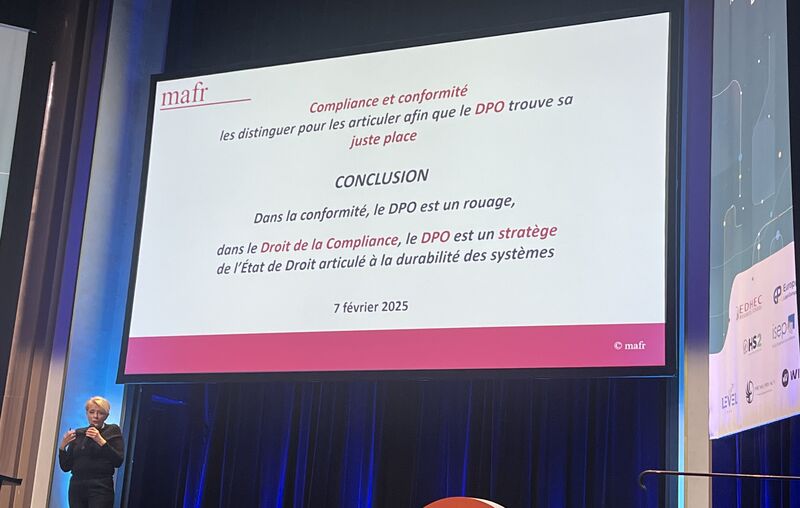
🎥”Compliance” et “conformité” : les distinguer/mieux les articuler afin que le DPO trouve sa juste place (Compliance Law” and “conformity” : distinguish between them/better articulate them so that the DPO finds their rightful place), in 🧮19ème Université AFCDP des DPO, in 🧮19ème Université AFCDP des DPO, in 🧮19ème Université AFCDP des DPO

► Full Reference: M.-A. Frison-Roche, "Compliance" et "conformité" : les distinguer/mieux les articuler afin que le DPO trouve sa juste place" ("Compliance Law" and "conformity" : distinguish between them/better articulate them so that the DPO finds their rightful place"), , in  Association française des correspondants à la protection des données à caractère personnel (AFCDP),  19ème Université AFCDP des DPO – La gouvernance des données ("Data Governance"), Maison de la Chimie, Paris, 7 February 2025 , 10h-10h45. - 🧮 see this manifestation full program (in French) - ⬜ see les slides on which this conference is done (in French)  - ► English Presentation of this conference: 'Compliance' and 'conformité' are often considered to be synonymous, notably in French in which the term "Compliance" is so often used to express only the "conformity" (conformité). This is a misunderstanding and a reduction, particularly of the role of professionals, notably DPOs. In fact, 'conformity' consists solely of ensuring that regulations are respected. Of course, an"active" conformity and "proven" conformity with these regulations, in particular the European GDPR. That and only that. If that's the case, then on the one hand this task impossible, because no one can comply with all the regulations, and it's the obsession with avoiding or reducing penalties that actually replaces the desire to do the right thing. On the other hand, algorithms are going to replace the DPO, a human being, because algorithms will identify 'non-conformity', then conformity, then write it down by "smart" contracts. But Compliance Law is more than conformity, which is only one of its tools. Compliance Law aim is to protect the human beings involved in the systems. Data protection is one of the best examples of this, and it underpins all the other areas of Compliance Law. Companies are asked to do less (obligation of means) and more: to help protect, by distinguishing between what must be revealed and what must be kept secret, sometimes to resolve conflicts between the 2 prescriptions, to educate, to make alliances. To built a real "governance". In this human and humanist mission that anchors Europe, the algorithm is flat. We are waiting for the DPO. In this human and humanist mission that anchors Europe, the algorithm is flat. We are waiting for the DPO. There is the role of guardian of the spirit of the texts, of strategic aid for the data controller, of adjuster of complementary or contradictory subjective rights, of adjustment of the texts in the European puzzle of a Regulatory Europe, which is being put in place in the humanist tradition which is its own to preserve the durability of the systems to protect the people who are forcibly or voluntarily involved in them. - 🌐suivre Marie-Anne Frison-Roche sur LinkedIn 🌐suivre Marie-Anne Frison-Roche sur Instagram 🌐s'abonner à la Newsletter MAFR Regulation, Compliance, Law 🌐s'abonner à la Newsletter en vidéo MAFR Surplomb/Overhang

Surplomb - Notion

Serie of videos on Regulation, Compliance and Vigilance 📺Surplomb/Overhang

🎬Monumental Goals, normative anchoring of Compliance Law

► Full Reference: M.-A. Frison-Roche, "Monumental Goals, normative anchoring of Compliance Law", in Series of videos Overhang / Surplomb, 1st February 2025 - 🌐watch on LinkedIn this video of the Series Surplomb/Overhang - 🌐watch on LinkedIn this video of the Serie Surplomb/Overhang, published in the Newsletter Surplomb/Overhang, by MAFR - 🎬watch below this video of the Serie Surplomb/Overhang⤵️ - Surplomb/Overhang, by mafr the Serie of videos dedicated to Regulation, Compliance and Vigilance - 🌐follow Marie-Anne Frison-Roche on LinkedIn 🌐follow Marie-Anne Frison-Roche on Instagram 🌐subscribe to the Newsletter MAFR. Regulation, Compliance, Law 🌐subscribe to the Video Newsletter MAFR. Overhang / Surplomb

Surplomb - Notion

🎬Regulation and Compliance

Articles in a legal collective publication

💬”Les droits de la défense sont au bénéfice de tout le monde, y compris de l’entreprise elle-même” (The rights of defence benefit everyone, including the company itself)

► Full Reference: M.-A. Frison-Roche, "Les droits de la défense sont au bénéfice de tout le monde, y compris de l’entreprise elle-même" (The rights of defence benefit everyone, including the company itself), interview by Chloé Lassel, in Guide Compliance Fraudes Investigations, edition 2024, ed. Décideurs, Oct. 2024, pp. - 💬read the interview (in French) 🌐its  présentation on LinkedIn (in French) - ► Presentation of this interview by Décideurs juridiques : "Directrice du Journal of Regulation & Compliance (JoRC) et fondatrice de l’École européenne de droit de la régulation et de la compliance, Marie-Anne Frison-Roche revient sur la révolution du droit de la compliance, son articulation avec les enquêtes internes et les droits de la défense, la place que vont y prendre les contrats et l’arbitrage international." ("Marie-Anne Frison-Roche, Director of the Journal of Regulation & Compliance (JoRC) and founder of the European School of Regulatory and Compliance Law, looks back at the revolution in Compliance Law, its relationship with internal investigations and the rights of the defence, and the role that contracts and international arbitration will play in it. - ► Questions asked, Answers given:  Décideurs. Question : La compliance est au cœur des préoccupations des entreprises depuis plusieurs années. Pouvez-vous expliquer ce que c’est exactement ? (Compliance has been a key concern for companies for several years. Can you explain what it is exactly?) Marie-Anne Frison-Roche. English summary Answer: 'Compliance' should not be confused with 'Compliance', which I defined in 2016. Compliance Law is an extension of Regulatory Law, by freeing the latter from the existence of a sector as a prerequisite and a regulatory authority as an indicator. Internalised in the company, it manifests itself, for example, in Vigilance mechanisms, which are its cutting edge. Through Compliance, the political authority asks companies to help it achieve "Monumental Goals", as I have suggested, standards in which this new branch of Law is anchored (anti-money laundering, anti-corruption, sustainability, etc.).   D. Q. : Les entreprises doivent désormais être enquêtrices et juges de ce qu’il leur arrive. Voire transmettre aux autorités, lorsqu’il le faut, des informations pouvant les incriminer. Comment concilier ces obligations avec les droits de la défense ? (Companies must now be investigators and judges of what happens to them. When necessary, they can even pass on incriminating information to the authorities. How do you reconcile these obligations with the rights of the defence?) MaFR. English summary A.: In 2023, I proposed this expression of companies as "prosecutors and judges of themselves", and the place that this should give to the rights of the defence, and in 2024 I will work out the right balance between internal investigations and the rights of the defence. For the moment, this balance has not been achieved.   D. Q. : Dans l’un de vos ouvrages, François Ancel, conseiller à la première chambre civile de la Cour de cassation, écrit que la compliance renouvelle l’office du juge. Comment concilier cette idée avec l’office habituel du juge qui est celui de se prononcer sur des faits avérés et non pas futurs ? (In one of your books, François Ancel, judge in the First Civil Chamber of the French Court of Cassation, writes that Compliance is renewing the role of the judge. How do you reconcile this idea with the judge's usual role, which is to rule on proven facts rather than future ones?) MaFR. English summary A.: Indeed, In this book La juridictionnalisation de la compliance (Compliance Jurisdictionalisation), he stresses that the role of the civil and commercial courts is being profoundly renewed, in particular because they must deal with what I described in 2021 as "Systemic Litigation" and must rule on the future. From then on, the ordinary courts will take centre stage.   D. Q. : Le recours aux clauses de compliance est-il une solution pour être à la hauteur des ambitions de la compliance et de ses exigences ? (Is the use of compliance clauses a solution for living up to the ambitions and requirements of compliance?) MaFR. English summary A.: Indeed, in 2022, I developed the concepts of 'Compliance Contract' and 'Compliance clauses', by which companies implement their legal compliance obligations. This gives rise to Regulatory Contracts, particularly in business chains. This gives a great deal of leeway and power, but also Responsibility, to the companies that invent them.   D. Q. : Le recours aux arbitrages doit-il être privilégié ? (D. Q. Should recourse to arbitration be preferred?) MaFR. English summary A.: It has to be. Because there is a contract. Even though Compliance is closely bound up with the legal obligations and public order, and possibly international public order. Even if this is not yet apparent, Compliance and International Arbitration are natural allies. - 🌐follow Marie-Anne Frison-Roche on LinkedIn 🌐follow Marie-Anne Frison-Roche on Instagram 🌐subscribe to the Newsletter MAFR. Regulation, Compliance, Law 🌐subscribe to the Newsletter Surplomb, par MAFR

Working papers

Working Paper for 📺Overhang

🚧Monumental Goals, normative anchoring of Compliance

► Full Reference: M.-A. Frison-Roche, Monumental Goals, normative anchoring of Compliance, Working Paper, February 2025.   - 🎬This working document has been drawn up to serve as basis to the video Overhang👁 of  the 1st February 2025: click HERE - 🎬🎬🎬In the collection of the Overhangs👁 It falls into the Notions category. ►Watch the complete collection of the Overhangs👁 : click HERE - ► Summary of this  Working Paper: Compliance, of which conformity is only one instrument (the 2 should not be confused), must be understood through the ‘Monumental Goals’ : political ambitions pursued by the public authorities and internalised in the entities in a position to achieve them, i.e. large companies. These Goals are Monumental in that they concern systems: ensuring that these systems do not collapse in the future = ‘Negative Monumental Goals’ (e.g. fight against corruption, against climate change); more ambitious still, they may aim to improve systems = ‘Positive Monumental Goals’ (e.g. effective equality between women and men). Their systemic nature gives rise to Systemic Litigation. - 🔓read the developments below⤵️ - 🌐follow Marie-Anne Frison-Roche sur LinkedIn 🌐follow Marie-Anne Frison-Roche on Instagram 🌐subscribe to the Newsletter MAFR Regulation, Compliance, Law  🌐subscribe to the Video Newsletter MAFR Overhang/Surplomb

Conferences

conference

🎤Pourquoi les textes et la pratiques sur le rapport de durabilité vont engendrer un Contentieux Systémique (Why the texts and practices on sustainability reporting will give rise to Systemic Litigation), in 🧮Le rapport de durabilité : obligation et Contentieux Systémiques Émergents (The Sustainability Report: Emerging Systemic Obligation and Litigation), in cycle of conference-debates “Contentieux Systémique Émergent” (“Emerging Systemic Litigation”)

► Full Reference: M.-A. Frison-Roche, "Pourquoi les textes et la pratiques sur le rapport de durabilité vont engendrer un Contentieux Systémique" ("Why the texts and practices on sustainability reporting will give rise to Systemic Litigation"), in Le rapport de durabilité : obligation et Contentieux Systémiques Émergents (The Sustainability Report: Emerging Systemic Obligation and Litigation), in cycle of conference-debates "Contentieux Systémique Émergent" ("Emerging Systemic Litigation"), organised on the initiative of the Cour d'appel de Paris (Paris Cour of Appeal), with the Cour de cassation (French Court of cassation), the Cour d'appel de Versailles (Versailles Court of Appeal), the École nationale de la magistrature – ENM (French National School for the Judiciary) and the École de formation des barreaux du ressort de la Cour d'appel de Paris – EFB (Paris Bar School), under the scientific direction of Marie-Anne Frison-Roche, September 19, 2024, 11h-12h30, Cour d'appel de Paris, Cassin courtroom - 🧮see the full programme of this event - ► English summary of the conference: Systemic Litigation refers to a specific category whose proposed category in 2021 refers to "cases" brought before the courts, sometimes specialised, sometimes under ordinary law courts: these are cases in which not only are the parties involved in their dispute but also a system is itself involved, with the procedure and the judge having to allow the interests of the system to be taken into consideration. However, what is also the subject of new terminology, namely the "Sustainability Report", reflects the same legal revolution: the company must be able to assess not only its economic and financial performance, which is the subject of accounting, but also its development in terms of what it does externally in terms of ESG and what the outside world does about it. In this perspective, the whole Information System is being transformed, and in different ways depending on the standards adopted, in the United States, Europe or elsewhere, either it is sufficient to obtain Information, no more, so that third parties can adjust their behaviour, mainly investments, or, as in Europe, Law includes a more substantial perspective, so that the company itself adjusts its own behaviour, its Governance, its position in the world, in a renewed relationship with its stakeholders. In Europe, saying and doing are intertwined, CSRD being twinned with CS3D. Moreover, we can therefore consider that non-financial information, through the sustainability report, its assurance of credibility and the regulation of the audit carried out on it, is itself a system. The sustainability report, inside the sustainability system, is then interwoven with other systems, which are themselves the subject of Emerging Systemic Litigation: firstly Vigilance, which has been studied as a field of systemic litigation, and then artificial intelligence field, which has been studied in the same way. The Sustainability Report, insofar as it intersects with the sustainability obligation implied by the duty of Vigilance, may be attracted to the Systemic Litigation to which Vigilance gives rise. In the same way, algorithms can be a tool for data accumulating and matching ESG criteria, which could have the same attraction effect. If this happens, this dimension will have to be present and understood, for example through amici curiae mechanism, in conjunction with the Regulators and the professions concerned. In addition, as in any emerging mechanism, and as we have seen for example in relation to rating agencies, Tort Law may interfere if the liability of either the company or the person who carried out the audit were to be appreciated, the systemic perspective then having to be integrated into the handling of the case, even before the non-specialised judge.   - 🌐follow Marie-Anne Frison-Roche on LinkedIn 🌐follow Marie-Anne Frison-Roche on Instagram 🌐subscribe to the Newsletter MAFR Regulation, Compliance, Law