Bank

Publication director

🏗️ copublishing and direction of the collection: 📚Régulations & Compliance

📚Forthcoming: 🕴️L. Laref (ed.), 📕Compliance et vigilance bancaire (“Compliance and Banking Vigilance”)

► Full reference: L. Laref (ed.), Compliance et vigilance bancaire. Contribution des acteurs bancaires et financiers à la LCB-FT (Compliance and Banking Vigilance. The Contribution of Banking and Financial Actors to AML/CFT), preface by N. Vasse, “Régulations & Compliance” series, Journal of Regulation & Compliance (JoRC) and Lefebvre-Dalloz, forthcoming. - 🧮This book follows the colloquium Compliance et vigilance bancaire : la participation des acteurs du secteur bancaire et financier à la LCB/FT, at which Marie-Anne Frison-Roche spoke: 🎤“Obligation de compliance et gouvernance bancaire” (Compliance Obligation and Banking Governance). - 📝Contribution by 🕴️Marie-Anne Frison-Roche: « La contribution des banques à la lutte contre le blanchiment de capitaux et le financement du terrorisme, illustration de l’Obligation systémique de Compliance » (The Contribution of Banks to the Fight against Money Laundering and Terrorist Financing, an Illustration of the Systemic Compliance Obligation). - ► Read the presentations of the other books in the series: the following books: 🕴️M.-A. Frison-Roche, 📕Le système juridique de l’adressage de l’Internet. Une structure multi-acteurs, gage de durabilité (The Legal System of Internet Addressing. A Multi-Stakeholder Structure, the Pledge of its Sustainability), forthcoming 🕴️M.-A. Frison-Roche (ed.), 📕Le système probatoire de la Compliance, forthcoming   the previous books: 🕴️M.-A. Frison-Roche (ed.), 📕Compliance et Contrat, forthcoming 🕴️M.-A. Frison-Roche (ed.), 📕L’Obligation de Compliance, 2025 🕴️M.-A. Frison-Roche and M. Boissavy (eds.), 📕Compliance et droits de la défense. Enquête interne – CJIP – CRPC, 2024 🕴️M.-A. Frison-Roche (ed.), 📕La juridictionnalisation de la Compliance, 2023 🕴️M.-A. Frison-Roche (ed.), 📕Les Buts Monumentaux de la Compliance, 2022 🕴️M.-A. Frison-Roche (ed.), 📕Les outils de la Compliance, 2021 🕴️M.-A. Frison-Roche (ed.), 📕Pour une Europe de la Compliance, 2019 🕴️N. Borga, J.-Cl. Marin and J.-Ch. Roda (eds.), 📕Compliance : l’entreprise, le régulateur et le juge, 2018 🕴️M.-A. Frison-Roche (ed.), 📕Régulation, Supervision, Compliance, 2017 🕴️M.-A. Frison-Roche (ed.), 📕Internet, espace d’interrégulation, 2016 📚See all the books of the series. - ► Provisional table of contents: PROVISIONAL TABLE OF CONTENTS (in French) Preface by 🕴️Nicolas Vasse, Executive Director of the Anti-Money Laundering Authority (AMLA) PROPOS INTRODUCTIFS (Introductory Remarks) PERSPECTIVE GÉNÉRALE (General Perspective) ♦️ La contribution des banques à la lutte contre le blanchiment de capitaux et le financement du terrorisme, illustration de l’Obligation systémique de Compliance, by 🕴️Marie-Anne Frison-Roche PREMIÈRE PARTIE (PART ONE) LA DIFFUSION DE LA COMPLIANCE DANS LE SECTEUR BANCAIRE ET FINANCIER (THE DIFFUSION OF COMPLIANCE IN THE BANKING AND FINANCIAL SECTOR) ♦️ Quelques rappels terminologiques utiles…, by 🕴️Jérôme Lasserre Capdeville DEUXIÈME PARTIE (PART TWO) LA RÉCEPTION DE L’OBLIGATION DE COMPLIANCE PAR LES PROFESSIONNELS DU SECTEUR BANCAIRE ET FINANCIER (THE RECEPTION OF THE COMPLIANCE OBLIGATION BY BANKING AND FINANCIAL SECTOR PROFESSIONALS) ♦️ La réception de la compliance LCB-FT par le secteur bancaire et financier. Modalités d’appropriation, dysfonctionnements structurels et éthique comme condition d’effectivité, by 🕴️Jennifer Marchand ♦️ L’obligation de compliance LCB-FT, moteur de transformation des pratiques en matière de crédits et de garanties, by 🕴️Patricia Le Besnerais TROISIÈME PARTIE (PART THREE) LA MODULATION DES OBLIGATIONS DES PROFESSIONNELS DU SECTEUR BANCAIRE ET FINANCIER EN MATIÈRE DE LCB-FT (THE MODULATION OF THE AML/CFT OBLIGATIONS OF BANKING AND FINANCIAL SECTOR PROFESSIONALS) ♦️ Le banquier face au défi de la vigilance : entre exigences contradictoires et responsabilités croissantes, by 🕴️Paula Seixas et 🕴️Romain Ducatez ♦️ L’harmonisation européenne face à la modulation de l’obligation de vigilance : les enseignements de l’AMLR, by 🕴️Cassandre Degrande QUATRIÈME PARTIE (PART FOUR) COMPLIANCE ET PERFORMATIVITÉ : LES ENJEUX AUTOUR DE LA REGTECH DANS LE SECTEUR BANCAIRE ET FINANCIER APPLIQUÉE À LA LCB-FT (COMPLIANCE AND PERFORMATIVITY: THE STAKES OF REGTECH IN THE BANKING AND FINANCIAL SECTOR APPLIED TO AML/CFT) ♦️ Compliance, performativité et RegTech : la reconfiguration des dispositifs de vigilance bancaire en matière de LCB-FT, by 🕴️Gurvan Branellec ♦️ Les observations de l’ACPR sur l’usage de l’IA par les banques et néobanques — entre avancées et nouveaux défis (titre provisoire), by 🕴️Jean-Christophe Cabotte PROPOS CONCLUSIFS (Concluding Remarks) - 🌐follow Marie-Anne Frison-Roche on LinkedIn 🌐follow Marie-Anne Frison-Roche on Instagram 🌐subscribe to the Newsletter MAFR Regulation, Compliance, Law 🌐subscribe to the Video Newsletter MAFR Surplomb 🌐subscribe to the Newsletter MaFR Droit & Art

Articles in a legal collective publication

📝Considérer la géographie juridique africaine pour y réussir l’obligation de vigilance (Taking into account the legal landscape in Africa to fulfil the Vigilance Obligation), in📗Devoir de vigilance, quelles perspectives africaines (The Vigilance Duty: what African perspectives?)?

► Full reference: M.-A. Frison-Roche, “Considérer la géographie juridique africaine pour y réussir l'obligation de vigilance" (Taking into account the legal landscape in Africa to fulfil the Vigilance Obligation), in E. Da Allada (ed.), Devoir de vigilance, quelles perspectives africaines ? (The Vigilance Duty: what African perspectives?), Lefebvre-Dalloz, “Thèmes et Commentaires” series, 2026, pp. 235-235. - 📝Read the article (in French) - 🚧read the bilingual working document on which this article is based - 🎤read the presentation of the conference  which summarised this topic - ► Summary of the article: The French ‘Vigilance’ Act of 2017 incorporated the technical provisions and the spirit of the ‘Sapin 2’ Act of 2016. They share a common ambition. They have been, and remain, a source of both controversy and fervour. At their heart lies the establishment of a “compliance obligation”, for which vigilance techniques form the “vanguard” in serving a grand ambition: to protect systems from present and future risks in order to safeguard the people involved in them. The passion that continues to surround the Vigilance Act – which gave rise to the CS3D Directive – is not a good thing, because the law and passion are never allies. Some are passionately committed to the triumph of vigilance by forcing companies to perform miracles, whilst others are passionately committed to the destruction of all the legislation that has established the very concept of this compliance law, built upon these monumental humanist goals. But let us recognise that in these debates on the Duty of Care, which is being legally implemented across value chains,  Africa is often cited as an example in a general discussion. It is not often considered as a distinct case in its own right. No account is taken of its strengths or its own legal mechanisms, even though value chains – particularly industrial ones – so often lead to it, both now and in the future. Through analyses of the duty of care, Africa is perceived as a place of retribution or of a new form of paternalism, and when its future is considered, prospects seem to be lacking, even though the very purpose of compliance – and therefore of due diligence – is the future.  If we take a less confrontational view and focus more on the ‘legal geography’ of African countries and their social and inter-state structures  social and inter-state structures, we can see that concern for others – both present and future – which ultimately constitutes the Monumental Aim of Compliance Law and thus of the Duty of Vigilance – is more prevalent in Africa than it is in Europe, which is now built upon legal individualism. This concern for others is reflected in legal mechanisms akin to mediation and various legal structures that our own institutions would do well to take on board – our legislators before adopting legislation, and our judges, who could listen to them as amici curiae before always reaching a decision. If we turn our attention to the African continent, where a segment of the value chains operates, and to the way work is organised, it becomes clear that here too, legislation and sanctions are not the whole story. Compliance techniques that make use of soft law and the contractual arrangements underpinning the chains themselves can remove the element of abstraction that is, by its very nature, inherent in general legislation. Making progress through contracts, under the scrutiny and with the support of the courts, is an approach that could prove more fruitful than well-intentioned legislation – which served as a catalyst – given the prominent role of Contract Law within OHADA. This serves to enhance the judge’s importance. The judicialisation of compliance is also linked to the growing connection between compliance and contracts. However, it appears that not only can European judges specialising in due diligence thus rule on matters concerning Africa – a continent they can only know from a distance (though it is the lot of every judge to be an outsider) – but African and inter-state courts, notably through OHADA, can address the duty of care because value chains are constituted by contracts. By developing it not as a foreign concept to be assimilated, but as something that expresses the very heart of the law in Africa: concern for others, solidarity, and the search for compromises and solutions to ensure that the social and environmental – that is to say, human – system continues to thrive tomorrow. - 🌐Follow Marie-Anne Frison-Roche on LinkedIn 🌐follow Marie-Anne Frison-Roche on Instagram 🌐subscribe to the Newsletter MAFR Regulation, Compliance, Law 🌐Subscribe to the Video Newsletter MAFR Surplomb 🌐Subscribe to the MaFR Law & Art Newsletter

Articles in a legal collective publication

📝La part du gracieux dans le traitement juridictionnel de la compliance (The role of Discretionary Jurisdictio in the judicial treatment of Compliance cases), in📗Liber Amicorum, Mélanges en l’honneur de Dominique d’Ambra

► Full Reference: M.-A. Frison-Roche, "La part du gracieux dans le traitement juridictionnel de la compliance (The role of Discretionary Jurisdictio in the judicial treatment of Compliance cases)", in Mélanges Dominique d'Ambra, Liber Amicorum, Lefebvre-Dalloz, 2026, pp. 175-196. - 📝read this article (in French)  - 🚧read the bilingual Working Paper, base of this article - ► English summary of this article: Based on the definition of Judicial Office, the procedural principles that derive from it and the consequent powers that judges exercise, the objet of this study is to measure the degree of discretion that exists in the judicial treatment of compliance, without direct consideration for the dispute between litigants. This part is very ignored, when it should be given top priority. Indeed, because Systems are involved in compliance cases brought before civil or commercial judges, we are seeing a development of this discretionary element in judicial fonction. Discretionary matters differ from unilateral discretionary procedures, and this discretionary element relates to what the judge examines, possibly in the context of a dispute. The first part of this contribution therefore aims to describe the natural development of the discretionary power of the judge to deal with compliance cases brought before them. This role stems from the fact that, even when triggered by a dispute, what is submitted to the judge is a situation composed of a system, which cannot defend its interests before the civil or commercial judge in this Systemic Litigation arising from the very nature of Compliance Law and the Compliance Obligations it engenders on systemic entites. Moreover, it is the Future whose interests must be considered and protected, which the judge must do directly. This leads to the second part of the contribution, calling for a rethinking of the procedure and the role of the Compliance Judge, so that ex gratia matters can be dealt with. The judge must therefore verify that there are no conflicts of interest between the litigants, including hidden ones, and must learn about the systems involved. The inquisitorial principle must therefore be strengthened. But at the same time, since the primary aim is not to settle a dispute but to resolve a systemic problematic situation, the judge must facilitate the movements of the parties, and the adversarial principle must also be strengthened. Must be encouraged this activation of a powerful and discretionary approach, not as an exception but as a principle fully articulated with a contentious principle, with the dispute being only a means used by the necessary parties to enable systemic compliance situations to be resolved. - 🌐 follow Marie-Anne Frison-Roche on LinkedIn 🌐follow Marie-Anne Frison-Roche on Instagram 🌐subscribe to the Newsletter MAFR Regulation, Compliance, Law 🌐subscribe to the Video Newsletter MAFR Surplomb 🌐subscribe to the Newsletter MaFR Droit & Art

Conferences

keynote address at a conference

🎥Obligation de compliance et gouvernance bancaire (Compliance obligations and banking governance), in 🧮Compliance et vigilance bancaire : la participation des acteurs du secteur bancaire et financier à la LCB/FT (Compliance and Banking Vigilance: the Participation of Banking and Financial Sector Players in AML/CFT)

► Full reference : M.-A. Frison-Roche, "Obligation de compliance et gouvernance bancaire (Compliance obligations and banking governance)", in Chair in Business Ethics: Compliance, ESG and Sustainability Reporting & National Association of Bank Lawyers (ANJB), Compliance et vigilance bancaire : la participation des acteurs du secteur bancaire et financier à la LCB/FT (Compliance and Banking Vigilance: the Participation of Banking and Financial Sector Players in AML/CFT) , Faculty of Law, Catholic University of Lille, Lille, 12 March 2026. - 🧮view the full programme for the event (in French) - 📶view the slides (in French) - 🌐read the summary of this conference and the colloquium on LinkedIn - 📝This lecture will form the basis of a contribution to a forthcoming book in the 📚Régulations & Compliance series, co-published by the Journal of Regulation & Compliance (JoRC) and Lefebvre-Dalloz.   - ► English presentation of this introductory lecture of the symposium : Based on a specific method, three perspectives will be taken. In method, to shed light on the round tables making up the day's meetings without addressing the subject in their place or pretending to answer in advance the questions they will raise, or seeking to conclude in advance without having listened to anything, which is sometimes the flaw of introductions, which are so often a kind of disguised closing statement, with just a few question marks to give the impression of change, I have adopted the old, old method of the "triple funnel" introduction. This involves starting from a point other than the subject of the conference itself, Compliance and banking vigilance: the participation of banking and financial sector players in AML/CFT, in order to approach the subject from an external perspective and in a preliminary manner, nbsp;then moving on to a second external point, and doing so a third time, so that after this three-part presentation, the subject has been explored in sufficient depth to allow the following speakers to focus on the specific topic at hand. This is all the easier given that the chosen theme itself focuses on three points: a specific ambition (the "fight against money laundering and terrorist financing"), a specific sector (the "banking sector") and a specific activity carried out by individuals; three specific terms: one ambition (the "fighting agains AML/CFT""activity"). – one sectors (the "banking sector") and one active department (the "participation of stakeholders"). - My first starting point is to define what Compliance Law is in order to link Compliance Law to the subject it covers: the banking sector. Because if it were simply a matter of "being conform with applicable regulations", it is difficult to understand why the banking sector is so concerned, so constrained, so exposed to "compliance", which is simply the British way of saying "conformity". There must be more to it than simply obeying every rule and standards for preventing breaches for it, to be obliged to be so structuring and for the banking sector to be at the forefront. It therefore appears that Compliance Law is not simply mechanical obedience to a body of regulations, but rather the contribution made by systemic operators to the realisation of political ambitions that are essential for the future (the "Monumental Goals", both negative and positive). It is in this capacity that the banking sector, because it is composed of "crucial operators", is the natural subject of Compliance Law. Its power should not be criticised; it is indispensable. In an emerging branch of law that is systemic, that is Ex Ante, that is above all a Law of action whose object is the future. Techniques of conformity is only one tool. ⛏️Go further  : 🕴🏻M.-A. Frison-Roche, 📝Compliance Law, 2016 🕴🏻M.-A. Frison-Roche, 📝 Monumental goals, the beating heart of compliance law, in  🕴🏻M.-A. Frison-Roche, 📕The monumental goals of compliance, 2022 🕴🏻M.-A. Frison-Roche, 📝The Birth of a New Branch of Law: Compliance Law, 2024 🕴🏻M.-A. Frison-Roche, 📝Compliance and conformity: distinguishing between them in order to articulate them, 2024 - My second starting point is to start with the "Monumental Goals", this normative foundation of Compliance Law, and link it to this present specific case, privileged ambition of combating money laundering and terrorist financing. Certain things are surprising. Indeed, if we refuse at the introductory stage to delve into the technicalities of the texts and the litigation surrounding them, we may wonder why these two subjects (money laundering and terrorist financing) are linked in this way. We can see the correlation between banking activitird and money laundering. Notaries, auctioneers, and, in short, anyone who handles money are also involved in the fight against it. Moreover, if we see the ratio legis, the idea remains that the one who is merely the conduit (to use the familiar basis distinction in the regulatory rule of essential network infrastructure) could also be the one who organises the content: the image remains of the money laundering banker. Even if the ex ante compliance diligence whitewashes in advance, this suspicion that remains of an ex post sanction. We pay dearly for this representation, which permeates the repressive, even Criminal, Law of banking supervision, particularly in matters of secrecy, transparency, information and risk-taking. But why extend it to terrorist financing? Because the suspicion of terrorist bankers no longer exists. The case becomes clear-cut again. It is a matter of internalising within banks the sovereign responsibility to intervene before it is too late, before people are killed. Financing is the weak and visible point of systemic evil. This is understandable. It has moved from ex post (financial processing after the crime) to ex ante (financial processing before the crime). It is of a different nature. But if this is of a different nature, there is no reason to stop this Ex Ante surveillance, because money movements provide so much information about collective and individual projects. For example, in the digital space. We must be careful about this, in light of the principle of freedom, of which the principle of non-interference is only one aspect. ⛏️Go further  : 🕴🏻M.-A. Frison-Roche, 📝The Ex Ante – Ex Post Couple, Justification of a Specific Regulatory Law, in 🕴🏻M. -A. Frison-Roche, 📕Les engagements dans les systèmes de régulation, 2006 🕴🏻M.-A. Frison-Roche, 📝Ex Ante Responsability, a pillar of Compliance Law, 2022 🕴🏻M.-A. Frison-Roche, 📝Compliance, Vigilance and Civil Liability: Understanding and Keeping a Level Head, in  🕴🏻M.-A. Frison-Roche, 📕The obligation of compliance, 2025 - My third starting point is "Governance", a rather mysterious term, as it relates more to the political art of mobilising human beings than to Law. Why is it necessary for "actors" to participate, when legal norms are binding and, in most cases, take the form of Criminal Law? The combination of the most violent norms, the application of financial penalties, and even deprivation of liberty, being often claimed as a victory for financial and banking regulatory and supervisatory bodies , even as procedural principles are being rolled back, could be a source of incomprehension. Moreover, in a legal system that would be challenged by this "Governance", it is up to the State to dictate and the banks to obey. But if banks take charge of everything, it becomes difficult to maintain this system, and it is undoubtedly no longer tenable if the Monumental Goal expands to dimensions that exceed those of the State but correspond to those of the banks. The risk then is to move from one governing body to another, which is a growing social and political risk. In practical terms, banking operators can achieve this reversal in two ways. Firstly, by effectively involving the human beings who make up their organisations, both internally and externally, their partners and stakeholders. This can be called "Governance" in an alliance based on explicitcommon  goals, with contributions that are not taken at face value but are provided by "compliance structures", "credible behaviour" and "plausible trajectories". In this respect, mutual banks are in a better position than others. Training mechanisms, which are central to Compliance Law, play an essential role here. Secondly, alliances with public authorities and regional roots, with concrete assessments, are decisive. The contract then becomes not only the mandatory means by which the regulated bank fulfils its regulatory obligation, but also the most traditional legal tool by which it exercises its freedom to contribute, in its own way, to the achievement of Monumental Goals for the future of the social group, which is currently under threat. We are far beyond "conformity": this is called Compliance Law. ⛏️Find out more  : 🕴🏻M.-A. Frison-Roche, 📝A substantive Compliance Law, based on the European humanist tradition,in 🕴🏻M. -A. Frison-Roche, 📕Towards a Europe of Compliance, 2019 🕴🏻M.-A. Frison-Roche, 📝Training: content and context of Compliance Law, in 🕴🏻M. -A. Frison-Roche, 📕Compliance tools, 2020 🕴🏻M.-A. Frison-Roche, 📝Compliance Contract, compliance clauses, 2022 🕴🏻M.-A. Frison-Roche, ⚙️Compliance and Contracts, 2026 🕴🏻M.-A. Frison-Roche, 🏛️Official Mission given by the French Minister of Justice, Compliance Law, Work in progress, 2025 – 2026. - 🌐Follow Marie-Anne Frison-Roche on LinkedIn 🌐follow Marie-Anne Frison-Roche on Instagram 🌐Subscribe to the Newsletter MAFR Regulation, Compliance, Law 🌐Subscribe to the video newsletter MAFR Overhang 🌐Subscribe to the Newsletter MaFR Law & Art

Working papers

Working Paper for 📺Overhang (News)

🚧The Contract, a Compliance tool: the Obligation for a platform to control content (French Supreme Judicial Court, 15 January 2025) :

► Full Reference: M.-A. Frison-Roche, The Contract, a Compliance tool: the Obligation for a platform to control content CE, 27 January 2025, B. c/ CNIL, Working Paper, March 2025. - 🎤 This Working Paper was developed as a basis for the Overhang👁 video  on 29 March 2025 : click HERE (in French) - 🎬🎬🎬In the collection of the Overhangs👁 It falls into the News category. ►Watch the complete collection of the Overhangs👁 : click HERE - ► Summary of this Working Paper: The ruling handed down on 15 January 2025 by the Commercial, Economic and Financial Chamber of the French Judicial Supreme Court (Cour de cassation) provides a solution to the issue of content control in the digital environment. It resolves what appears to be the aporia so often emphasised, and even claimed, namely the impossibility of developing an effective controlling technology. To do this, the Court disregarded the applicable laws and referred to the electronic payment contract between the bank and the platform, which contained a clause on Vigilance against unlawful content, linked to a termination clause. It held that this clause was fully effective. This solution, so simple and so strong, can make a major contribution to regulating the digital space, if the banks so wish, because what platform can do without reliable electronic payment services?   - 🔓read the developments below⤵️ - 🌐follow Marie-Anne Frison-Roche sur LinkedIn 🌐follow Marie-Anne Frison-Roche on Instagram 🌐subscribe to the Newsletter MAFR Regulation, Compliance, Law  🌐subscribe to the Video Newsletter MAFR Surplomb

Videos

Conference

💻Comment s’adapter au Contentieux Émergent de la Compliance (How to adapt to Emerging Compliance Litigation)

► Full Reference: M.-A. Frison-Roche, "Comment s’adapter au Contentieux Émergent de la Compliance" ("How to adapt to Emerging Compliance Litigation"), in , Association nationale des juristes de banque (ANJB), September 19, 2024, Paris, - This conference is being held with another speaker, Maître Jean-Pierre Picca. It is followed by a discussion with the audience. - 🧮see the full programme of this manifestation - ► English Summary of this conference: Compliance Law is a new branch of Law, teleological in nature, whose legal normativity is rooted in its goals.These are systemic goals of preserving systems by detecting the risks that weaken them and preventing the failures that can destroy them. It is therefore an Ex Ante branch of Law, the implementation of which will weigh on the "entities" in a position to detect risks and prevent failures so that these systemic goals are achieved.  As such, they are "Monumental Goals" in that they are political goals aimed at complete systems. It is therefore essential to distinguish between "conformity Law", which simply consists of "complying" with the applicable regulations, and Compliance Law, which consists of contributing to the achievement of these "Monumental Goals", either by force (legal obligation) or by choice (raison d'être, company with mission, contractual obligation, CSR). In this respect, Compliance Law is both much more limited in its aims and much more ambitious, since it is about building the future rather than mechanically complying with regulations. The banking sector, which can be considered an exception to the principle of Competition, which is based on extreme mobility and the absence of rents, the destruction of the weakest, risk-taking, the lack of solidity of the operator posing no problem, appears to be the paragon of the principle of Compliance, which is based on the sustainability of systems ensured by the solidity of the operators themselves, their solidarity, the exchange of information, and integrated supervisors. For example, the duty of vigilance and the information about others, and the Regulation through Supervision were born in this sector, which has internalised this sectoral concern in the banks, itself the bearer of a general concern, particularly in the European conception of continental banking. the European Banking Union  increasing this concern. As a result, banks will internalise concerns about the future that go beyond safeguarding the banking sector, such as preventing systemic climate risk or educating the population or safeguarding people in vulnerable situations. - The litigation that shall ensue is itself highly specific. The topic of this conference is to provide the keys to understanding how banks must play their part. Emerging Compliance Litigation is systemic in nature. It is a reflection of the Ex Ante organisation whereby entities are asked to make a contribution to the achievement of Monumental Goals. In a dispute between two opposing parties, an individual or an NGO or a trade union or a municipality or a State and a bank, a conflict arises between what might be called the party claiming to represent the present and future interests of a system, for example the climate system or the social relations system, and the bank which has a legally imposed "compliance obligation" to help protect this system. The author who described this perfectly was Chaïm Perelman, particularly in his 1978 book, Logique juridique, which describes audience circles. We need to understand the systemic construction of the judicial instance. The bank must not let to be confined itself solely to its role as litigant, while the other party, for example an NGO, in its role as guardian of "civil society" or the "climate system" or the "effective equality between human beings", going beyond this first circle between the litigants and brings the system itself into the proceedings.  This is where the adaptation has to take place.  - This adaptation is procedural, evidentiary and substantive. The procedural adaptation must take place even before any litigation, since there is a continuum between Ex Ante and Ex Post, with the Judicial System itself being just one accountability method (rendering of accounts) among others. This accountability takes place in relation to a ‘mission’ that is entrusted to the banks in relation to the goals: prevention, detection and the fight against corruption, money laundering, climate change, etc., by building alliances, making good use of information (knowing how to take it, knowing how not to pass it on, knowing how to pass it on). The procedure, i.e. the way in which something is done, must reflect a substantial element, in that it engenders a ‘sense of responsibility’: the purpose of Compliance Law is to ‘make powers accountable’ and to build on positions of power. The proper procedure is to make ‘good use of one's power’ for the benefit of others. Techniques for ‘taking others into consideration’ are an essential element. Consideration by the person who agrees to exercise power (the power to finance, the power to gather information, the power to organise together, the power to contract). Evidentiary’ adaptation: indifference of evidentiary obligations and rights to the procedural position of the parties. The firm has a ‘Compliance Obligation’ even if it is the defendant in the proceedings. The object of proof is given to it by the Monumental Goals that the Law or its own will require it to help achieve. Its burden is to show that it is helping to achieve these goals, by acting for the future (for example, by knowing its customers, or by taking into account the interests of its stakeholders, etc.). - ► Structure of the speech:  I. The current situation: suffering the harmful consequences of reducing Compliance Law to the mechanics of "conformity". II. The opportunity for banks to adapt by understanding Compliance Law and going beyond the mechanics of conformity: the European puzzle, its apparent complexity, its architectural clarity (CSRD/CS3D/DSA). III. The opportunity for banks not to allow themselves to be trapped in proceedings that are merely sanctions, transferred from Ex Post to Ex Ante: the emergence of Systemic Compliance Litigations before the Ordinary Law Courts (French Law of 2017 on Vigilance; Paris Court of appeal decisions of 18 June 2024). IV. What is expected of banks in Systemic Compliance and Vigilance Litigations before the Ordinary Courts, reflecting the dialogue and action required by Compliance Law (article to be published).  V. The opportunity for banks to adapt to the new evidentiary dimension of emerging Compliance and Vigilance Litigation (article to be published). VI. The opportunity for banks to adapt to the new Ex Ante dimension of Systemic Compliance and Vigilance Litigation, Litigation which deals with the future (article to be published). - ► A few bibliographical references:    🕴️M.-A. Frison-Roche, 📝Compliance Law, 2016 🕴️M.-A. Frison-Roche, 📝Compliance and conformity: distinguish them in order to articulate them, 2024 🕴️M.-A. Frison-Roche, 📝Duty of Vigilance: the way forward, 2024 🕴️M.-A. Frison-Roche, 📝Systemic Litigation, 2024 - 🌐follow Marie-Anne Frison-Roche on LinkedIn 🌐follow Marie-Anne Frison-Roche on Instagram 🌐subscribe to the Newsletter MAFR Regulation, Compliance, Law

Conferences

🕴️MaFR interviews 🕴️Jacques Beyssade

🎥Compliance and governance (example of a banking group), interview with 🕴️Jacques Beyssade by Marie-Anne Frison-Roche, 🎬 Series of talks on Compliance Law, in 📺 Open windows on management

► Full reference: J. Beyssade, "Compliance et gouvernance (exemple d'un groupe bancaire)" (Compliance and governance (example of a banking group)), interview conducted by M.-A. Frison-Roche on the occasion of a series of interviews on Compliance Law, in Fenêtres ouvertes sur la gestion (Open windows on management), broadcast by J.-Ph. Denis, Xerfi Canal, recorded December 12, 2023, recorded February 24, 2024 - 🌐consult the presentation of Jacques Beyssade's interview on LinkedIn - 🎥view the full interview on Xerfi Canal - ► Starting point: In 2022, Jacques Beyssade wrote a contribution on 📝Feminisation of positions of responsibility in the workplace as a goal of Compliance, in 📘Compliance Monumental Goals 🧱read the presentation of this contribution ➡️click HERE - ► Summary of interview:  Marie-Anne Frison-Roche. Question: Compliance and governance are often linked. Can you explain how, in the strategy of a banking group like BPCE, this link between compliance and governance is articulated? Jacques Beyssade. Answer. Compliance is not just a matter of obeying the rules, but also, and perhaps even more so, of respecting customers, suppliers, stakeholders and members. For a mutualist structure, customers and member-policyholders are closer, they are the same social body, and so it's a matter of governance. - MaFR. Q.: Let's take a concrete example, where Compliance and governance serve a specific purpose: effective equality between men and women, for example. How does this work in your Group? J.B. R.: This objective is in the genes of BPCE, and in particular of the savings banks. The Copé-Zimmermann law requires it. We go beyond this constraint, at the level of governance. The management board, or executive committee, is egalitarian, and this also works as an example. Compliance takes up the baton, for example, by identifying talent, particularly female talent, and correcting any anomalies.  - MaFR. Q.: In the future, can we hope that this alliance between new governance and the power of Compliance, with the same Monumental Goals, will transform our societies? J.B. R.: Changes in society come from the behavior of individuals and companies, as demonstrated by the opening of savings accounts to women in the 19th century. Both can do a great deal, within the framework of regulations, by going beyond them. Through governance, for example in a mutual bank like BPCE, it's the members who set the rules, reflecting social movements because they themselves are representative of society as a whole. In this way, through the alliance of governance and compliance, they can act to give concrete expression to the fundamental social movements they themselves represent, through the broad representation of the social body that the member-policyholders constitute. -

Articles in The Journal of Regulation & Compliance « JoRC »

BRUNEAU, Alain🕴️

📝The company judges itself: the Compliance function in the bank, in 🕴️M-A Frison-Roche (ed.), 📘Compliance Jurisdictionalisation

► Full Reference: A. Bruneau, "The company judges itself: the Compliance function in the bank", in M.-A. Frison-Roche, (ed.), Compliance Jurisdictionalisation, Journal of Regulation & Compliance (JoRC) and Bruylant, coll. "Compliance & Regulation", 2024, pp. 127-145 - 📘read a general presentation of the book, Compliance Jurisdictionalisation, in which this article is published - ► Summary of the article: First, it should be remembered that the compliance function was born within finance, and that by being structured, it has evolved to support the transition from regulatory law to compliance law. Through these changes, compliance has gone from an ex-post controlling function to an ex-ante binding function. The LIBOR crisis imperfectly illustrates the primacy of this transition. The evolution of this role is illustrated by concrete examples. Firstly, the management of reputational risk is a fundamental part of the company as prosecutor and judge of itself. Reputational risk is a significant element for a financial institution, because it can have negative consequences on its capitalization, or even culminate in a systemic crisis. Avoiding a large-scale financial crisis is also part of the monumental goals of compliance. In order to avoid complex and inopportune scenarios, compliance law intervenes as early as possible and identifies issues that may impact reputation. The regulations require the implementation of certain ex ante mechanisms. The French law known as "Sapin 2" requires the implementation of tools that concern all companies (and not just banks). Indeed, beyond the risk of reputation, it is essential to consider the risk of corruption. Consideration of reputational risk may justify refusing to execute certain transactions. From this perspective, compliance must assess the potential consequences of entering into a relationship with a new client upstream, sometimes to decline the provision of services. The compliance function therefore unilaterally judges the relationship with a view to managing the company reputational risk. Secondly, the internal sanction mechanism established by compliance law is also discussed in this article, in particular the internal sanctions adopted by compliance in a financial institution. Compliance can act as a prosecutor via management committees set up within the business lines. In addition, compliance can determine and apply sanctions against employees. In this way, there is a dual role of prosecutor and judge for the compliance function within the framework of an extraordinary mechanism of ordinary law. Finally, the analysis deals with the case of the "judge-judged": following a decision by the bank, the regulator may take an even stricter position by believing that the bank is applying its guidelines incorrectly. Thus, the compliance law, which takes hold within the banking enterprise, finds itself under the judgment of its own regulator. The company finds itself judged and comes to be a prosecutor and judge of itself, but also of its clients. - 🦉This article is available in full text to those registered for Professor Marie-Anne Frison-Roche's courses -

Articles in a legal collective publication

PEICUTI, Cristina🕴️ and BEYSSADE, Jacques🕴️

📝 Feminisation of positions of responsibility in the workplace as a goal of Compliance, in Frison-Roche, M.-A. (ed.), 📘Compliance Monumental Goals

► Full Reference: Peicuti, C. et Beyssade, J., Feminisation of positions of responsibility in the workplace as a goal of Compliance, in Frison-Roche, M.-A. (ed.), Compliance Monumental Goals, series "Compliance & Regulation", Journal of Regulation & Compliance (JoRC) and Bruylant, 2023,pp. 117-135. - ► Article Summary:  If the Compliance techniques are conceived as taking their meaning by their Goal, the latter being in particular the protection and the effective promotion of human beings, to be reinforced in the future thanks to Compliance Law tools, the example of the effective promotion of efficient equality between women and men in the banking sector to exercise responsible functions is clear. strongly feminized, the image of banking sector remains masculine and in fact too few women exercise positions of responsibility, although no text is opposed to it and all rights have been allocated for this. To move from this situation to a future where equality will be effective, it is therefore in terms of regulatory mechanisms that we should think of the necessary transformation and even more of "transition" so that one day a de facto equality will be established. and appears natural to all. The bank must then structurally integrate this Goal, which corresponds to the definition of Compliance. To do this, the banking company is part of a long-term voluntary Compliance process, relying in particular on human resources and on the public authorities of the European Banking Union which, by further implementing the concept of sustainable economy, facilitated this long-term action. In this transition, each action and result must be considered in relation to this sought-after goal of effective equality: each progress must be valued not so much in relation to the past but in relation to the future. This Ex Ante perspective justifies these self-binding Compliance techniques, such as plans, commitments, quotas, stakeholder implications, and more flexible techniques such as examples given by managers, internal training and joint affirmations with the public authorities, are all used by the company to achieve this Monumental Goal of effective equality between human beings. The banking sector is all the more exemplary for this because the banking authorities themselves deploy incentives in this direction, the definition of Compliance Law as an alliance between the Authorities and the Companies therefore corresponding to such an action clearly in progress, structurally in the BPCE group. -     📝 see the general presentation of the book 📘Compliance Monumental Goals in which this article is published -

Articles in The Journal of Regulation & Compliance « JoRC »

LE GOFF, Anne🕴️

📝Monumental Goals Perceived by the Firm: Serene Business or Business under Pressure?, in 🕴️M.-A. Frison-Roche (ed.), 📘Compliance Monumental Goals

► Full Reference: A. Le Goff, "Monumental Goals Perceived by the Firm: Serene Business or Business under Pressure?", in M.-A. Frison-Roche (ed.), Compliance Monumental Goals, coll. "Compliance & Regulation", Journal of Regulation & Compliance (JoRC) and Bruylant, 2023, pp. 83-90. - 📘read a general presentation of the book, Compliance Monumental Goals, in which this article is published. - ► Summary of the article:  -

Articles in The Journal of Regulation & Compliance « JoRC »

BRUNEAU, Alain🕴️

📝L’entreprise juge d’elle-même: la fonction compliance dans la banque, in 🕴️M.-A. Frison-Roche (ed.), 📕La juridictionnalisation de la Compliance

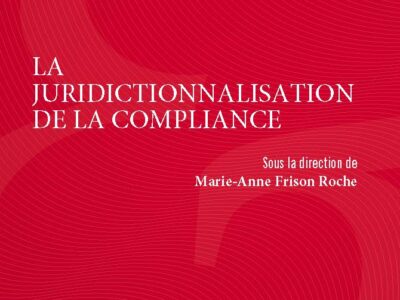
► Full Reference: A. Bruneau, "L'entreprise juge d'elle-même : la fonction compliance dans la banque" ("The company judge of itself: the compliance function inside the bank"), in M.-A. Frison-Roche (ed.), La juridictionnalisation de la Compliance, coll. "Régulations & Compliance", Journal of Regulation & Compliance (JoRC) and Dalloz, 2023, pp. 115-131.  - 📕read a general presentation of the book, La juridictionnalisation de la Compliance, in which this article is published     - ► Summary of the article (done by the author): First of all, it should be remembered that the compliance function was born within finance, and that by being structured, it has evolved to support the transition from regulatory law to compliance law. Through these changes, compliance has gone from an ex-post controlling function to an ex-ante binding function. The LIBOR crisis imperfectly illustrates the primacy of this transition. The evolution of this role is illustrated by concrete examples Firstly, the management of reputational risk is a fundamental part of the company as prosecutor and judge of itself. Reputational risk is a significant element for a financial institution, because it can have negative consequences on its capitalization, or even culminate in a systemic crisis. Avoiding a large-scale financial crisis is also part of the monumental goals of compliance. In order to avoid complex and inopportune scenarios, compliance law intervenes as early as possible and identifies issues that may impact reputation. The regulations require the implementation of certain ex ante mechanisms. The French law known as "Sapin 2" requires the implementation of tools that concern all companies (and not just banks). Indeed, beyond the risk of reputation, it is essential to consider the risk of corruption. Consideration of reputational risk may justify refusing to execute certain transactions. From this perspective, compliance must assess the potential consequences of entering into a relationship with a new client upstream, sometimes to decline the provision of services. The compliance function therefore unilaterally judges the relationship with a view to managing the company reputational risk. Secondly, the internal sanction mechanism established by compliance law is also discussed in this article, in particular the internal sanctions adopted by compliance in a financial institution. Compliance can act as a prosecutor via management committees set up within the business lines. In addition, compliance can determine and apply sanctions against employees. In this way, there is a dual role of prosecutor and judge for the compliance function within the framework of an extraordinary mechanism of ordinary law. Finally, the analysis deals with the case of the "judge-judged": following a decision by the bank, the regulator may take an even stricter position by believing that the bank is applying its guidelines incorrectly. Thus, the compliance law, which takes hold within the banking enterprise, finds itself under the judgment of its own regulator. The company finds itself judged and comes to be a prosecutor and judge of itself, but also of its clients. -

Articles in The Journal of Regulation & Compliance « JoRC »

LE GOFF, Anne🕴️

📝La part des banques dans la concrétisation des Buts monumentaux de la Compliance, in🕴️M.-A. Frison-Roche (ed.), 📕Les Buts Monumentaux de la Compliance

► Full Reference: A. Le Goff, "La part des banques dans la concrétisation des buts monumentaux de la compliance" ("The banks' part in achieving the Compliance Monumental Goals"), in M.-A. Frison-Roche (ed.), Les Buts Monumentaux de la Compliance, coll. "Régulations & Compliance", Journal of Regulation & Compliance (JoRC) and Dalloz, 2022, pp. 69-75. - 📕read a general presentation of the book, Les Buts Monumentaux de la Compliance, in which this article is published - ► Summary of the article (done by the Journal of Regulation & Compliance): As the head of a banking group, the question is whether compliance requirements and techniques put companies "under pressure" or whether these obligations represent an opportunity for them, the former not excluding the latter. The author shows that the entire banking sector is under pressure from regulations that express the aim of Monumental Goals, the complexity coming from the fact that these evolve over time, sometimes making it difficult to comply with them. Within this general framework, the author shows that a mutual bank such as Crédit Mutuel Arkéa has great opportunities, since these Monumental Goals resonate not only with its social responsibility, particularly in a context of crisis, but also with what is, for Arkéa, its "raison d'être". Regulation thus supports the Group's operations and it's identity. -

Articles in The Journal of Regulation & Compliance « JoRC »

PEICUTI, Cristina🕴️ et BEYSSADE, Jacques🕴️

📝La féminisation des postes à responsabilité dans les entreprises comme But de la Compliance. Exemple du secteur bancaire, in 🕴️M.-A. Frison-Roche (ed.), 📕Les Buts Monumentaux de la Compliance

► Full Reference: C. Peicuti et J. Beyssade, "La féminisation des postes à responsabilité dans les entreprises comme but de la compliance. Exemple du secteur bancaire" ("The feminization of responsibility positions in companies as a Compliance Goal. Example of the banking sector"), in M.-A. Frison-Roche (ed.), Les Buts Monumentaux de la Compliance, coll. "Régulations & Compliance", Journal of Regulation & Compliance (JoRC) and Dalloz, 2022, 109-124. - 📕read a general presentation of the book, Les Buts Monumentaux de la Compliance, in which this article is published - ► Summary of the article (done by the Journal of Regulation & Compliance): If the Compliance techniques are conceived as taking their meaning by their Goal, the latter being in particular the protection and the effective promotion of human beings, to be reinforced in the future thanks to Compliance Law tools, the example of the effective promotion of efficient equality between women and men in the banking sector to exercise responsible functions is clear. strongly feminized, the image of banking sector remains masculine and in fact too few women exercise positions of responsibility, although no text is opposed to it and all rights have been allocated for this. To move from this situation to a future where equality will be effective, it is therefore in terms of regulatory mechanisms that we should think of the necessary transformation and even more of "transition" so that one day a de facto equality will be established. and appears natural to all. The bank must then structurally integrate this Goal, which corresponds to the definition of Compliance. To do this, the banking company is part of a long-term voluntary Compliance process, relying in particular on human resources and on the public authorities of the European Banking Union which, by further implementing the concept of sustainable economy, facilitated this long-term action. In this transition, each action and result must be considered in relation to this sought-after goal of effective equality: each progress must be valued not so much in relation to the past but in relation to the future. This Ex Ante perspective justifies these self-binding Compliance techniques, such as plans, commitments, quotas, stakeholder implications, and more flexible techniques such as examples given by managers, internal training and joint affirmations with the public authorities, are all used by the company to achieve this Monumental Goal of effective equality between human beings. The banking sector is all the more exemplary for this because the banking authorities themselves deploy incentives in this direction, the definition of Compliance Law as an alliance between the Authorities and the Companies therefore corresponding to such an action clearly in progress, structurally in the BPCE group. -

Publication director

🏗️ direction of the collection: 📚Cours Dalloz – Série Droit privé

📚Publication of : 🕴️Stéphane PIÉDELIÈVRE, 📕Instruments de crédit et de paiement (Credit and Payment Instruments), 12th ed.

► Full Reference : S. Piédelièvre, Instruments de crédit et de paiement (Credit and Payment Instruments), 12th ed., 2022, Dalloz, “Cours Dalloz-Série Droit privé” Series, 453 p. - ► General presentation of the book (written in French) : The book first sets out the theory of accounts. Then the credit instruments, namely commercial paper and the new credit instruments. In the second part of the book, payment instruments are explained, namely the cheque and the new means of payment. This textbook thus makes it possible to understand the legal instruments through which companies obtain credit and pay the claims that third parties hold against them: the bill of exchange, the promissory note or the cheque, the whole most often operating through a bank account. In this tradition, which remains rooted in civil law whose guiding principles continue to govern the subject, the modernity of certain instruments renews it, such as the Dailly assignment or electronic money, which is upsetting the law of payment. This clear and above all pedagogical textbook explains this dialectic between classic law and the modernity of techniques. - 📚See the entire collection in which the book is published. -

Jurisprudence

Autorité de Contrôle Prudentiel et de Résolution (French Banking Regulator), Commission des sanctions (Commission of sanctions)

Decision of 24th of February 2021 2021, ING France

Full reference: Autorité de Contrôle Prudentiel et de Résolution (French Banking Regulator), Commission des sanctions (Commission of sanctions), 24th of February 2021, ING Bank France, procedure n°2020-02   Read the decision (in French)   In this decision, the ACPR Sanctions Commission condemns IGN Bank France to a reprimand and a financial penalty of 3 million euros because of the inadequacy of its measures to fight corruption, money laundering and financing of terrorism.   Extract from the decision summarizing ING France's breaches of its Compliance obligations to fight against corruption, money laundering and financing of terrorism: "At the time of the on-site check, ING France's risk classification was incomplete and ineffective (grievance 1) and its system for monitoring its business relations (complaint 2) and their operations (grievance 4) presented serious deficiencies, as well as its organization and procedures for fund transfers (grievance 3). The updating of customer knowledge was insufficient (grievance 5), as were the detection of PEPs and the implementation of measures due diligence for this category of clientele (grievance 6). For the implementation of its due diligence obligations, numerous shortcomings were noted, whether these were breaches of the obligation to carry out a reinforced examination (grievance 7) or breaches of the obligation to send Tracfin a DS, initial (grievance 8) or additional (grievance 9). Finally, the detection of persons subject to an asset freezing measure was not fully effective (grievance 10) " (our translation of the decision which is only available in French).