Publications

Filter by type

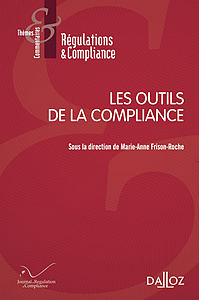
Couverture – Les outils de la Compliance

Books

Collection Régulations & Compliance Les outils de la Compliance (ed.)

General reference : Frison-Roche, M.-A. (ed.), Les outils  de la Compliance, series "Régulations & Compliance", Journal of Regulation & Compliance (JoRC) & Dalloz, 2021. In parallel, the book is published in an English version Compliance Tools, co-edited by the Journal of Regulation & Compliance (JoRC) and Bruylant.  This book follows a cycle of conferences organized by the Journal of Regulation & Compliance and by its partner universities.  -   See the collection Regulation & Compliance in which the book has been published.    - General presentation of the book : The political dimension of Compliance Law resides in the monumental goals that it aims for and which define it. These goals are internalized in "crucial operators", who willingly or by force must structure themselves and act to achieve "monumental goals", as set by public authorities and which may coincide with the interests of the enterprise. This one designs and controls the Ex Ante reorganization that this implies, under the public authorities supervision. Enterprises, even if their activities are not regulated, thus become transparent and must show the Compliance Tools effectively deployed to effectively achieve these goals. It is a major transformation of economic life in all countries because the Compliance Tools are adopted everywhere and have a global effect. These appear to be very diverse but their unity is profound and bringing it out has the practical benefit of producing a legal regime that is as unified as possible, while allowing their adaptation country by country, sector by sector, enterprise by enterprise.  This book aims to understand these Compliance Tools to better anticipate the assessment that will be made by Regulators, Supervisors and Courts, as well as the new conceptions of the authors of legal texts which impose new ones every day, while companies must also imagine the most appropriate Compliance Tools. This collective work specifically apprehends those on which we have few studies when we handle them on a daily basis, such as risk mapping or training or rights, letting more familiar tools shine through more transversal contributions, such as compliance programs, sanctions, whistleblowing or many sorts of settlements, agreements of public interest. A first chapter takes a legal and economic approach. A second chapter emphasizes the role of risk mapping. A third chapter draws the game of incentives. A fourth chapter identifies the expertise required. A fifth chapter insists on geographic significance. A sixth chapter details the measurement of effectiveness. A seventh chapter explores training. The eighth chapter examines technological tools. The concluding article leads to rights. -   Read the general presentation of the book, including the table of contents and the introduction (in French).   Read the presentations of the articles of the book :   Amico, Th., La Compliance ou le passage de l'ex post à l'ex ante: une révision copernicienne pour l'avocat pénaliste ?   Banck, A., La maturité de l’usager de l’outil de la Compliance, premier critère du choix de l’outil adéquat   Benzoni, L., and Deffains, B., Approche économique des outils de la Compliance: finalités, effectivité et mesure de la Compliance "subie" et "choisie"   Burlingame, R., Coppens, KK, Power, N. & Lee, D.H., Compliance : lutte internationale contre la corruption et gestion du risque   Calandri, L., Incitation(s) et autorégulation(s): quelle place pour le Droit de la Compliance dans le secteur audiovisuel?   Causse, H., La formation en Compliance, par et au-delà de la formation classique   Frison-Roche, M.-A., Décrire, concevoir et corréler les outils de la Compliance, pour en faire un usage adéquat   Frison-Roche, Construire juridiquement l'unité des outils de la Compliance à partir de la définition du droit de la Compliance par ses "buts monumentaux" ​ Frison-Roche, M.-A., Compliance et incitations, un couple à propulser   Frison-Roche, M.-A., Résoudre la contradiction entre incitations et sanctions sous le feu du Droit de la Compliance   Frison-Roche, M.-A., Dresser des cartographie des risques comme obligation et le paradoxe des "risques de conformité"   Frison-Roche, M.-A., Compliance : contenu et contenant du Droit de la Compliance    Frison-Roche, M.-A., Les droits subjectifs, outils premiers et naturels du Droit de la Compliance ​ Galland, M., Le contrôle par le Régulation de l'effectivité des instruments de compliance ​ ​Granier, C., L'originalité normative de la Compliance by design   Guillaume, N., Cartographie des risques de compliance : premiers aperçus des enjeux,des limites et des bonnes pratiques   Gutierriez-Crespin, A., L’audit du dispositif de compliance : un outil clé pour en vérifier la robustesse   Koenigsberg, S. et Barrière, Fr, La construction de l'expertise de l'avocat en matière de compliance   Larouer, M., Les manifestations des mécanismes incitatifs dans le Droit français de la Compliance   Merabet, S., La morale by design   Pailler, L., Les outils technologiques, la Compliance by Design et le RGPD: la protection des données personnelles dès la conception   Racine, J.-B., La prégnance géographique dans le choix et l'usage des outils de la Compliance   Rapp, L., Théorie des incitations et gouvernance des activités spatiales   ​Roda, J.-C., Compliance by Design en antitrust: entre innovation et illusion   Salah, M., Conception et application de la Compliance en Afrique   Tardieu, H., Souveraineté des données et Compliance   Thouret, T., Formation et Compliance, deux outils corrélés de transmission d'information   -
Couverture – Les outils de la Compliance

Articles in a legal collective publication

📝Approche juridique des outils de la Compliance. Construire juridiquement l’unité des outils de la Compliance à partir de la définition du Droit de la Compliance par ses “buts monumentaux”, in 🕴️M.-A. Frison-Roche (ed.), 📕Les outils de la Compliance

► Full Reference: M.-A. Frison-Roche, "Approche juridique des outils de la Compliance. Construire juridiquement  l'unité des outils de la Compliance à partir de la définition du Droit de la Compliance par ses "buts monumentaux"" ("Legal approach to Compliance Tools. Building by Law the Unicity of Compliance Tools from the definition of Compliance Law by its "Monumental Goals""), in  M.-A. Frison-Roche, (ed.), Les outils de la Compliance, coll. "Régulations & Compliance", Journal of Regulation & Compliance (JoRC) and Dalloz, 2021, pp. 27-38. - 📝read the article (in French)  - 🚧read the bilingual Working Paper which is the basis of this article, with more developments, technical references and hypertext links - 📕read a general presentation of the book, Les outils de la Compliance, in which this article is published - ► Summary of the article (done by the Journal of Regulation and Compliance): The "tools of Compliance" do not stack on top of each other. They form a system, thanks to a unity drawn from the goals that all these multiple and different tools serve: the "Monumental Goals" by which Compliance Law is defined. All these tools are configured by these goals and for mastering all these techniques, it is essential to put them all in perspective of what Compliance Law is, which is designed teleologically with regard to its goals. Extension of Regulatory Law and like it, Compliance Law is built on a balance between the principle of competition and other concerns that public authorities claim to take care of. Compliance Law has moreover more "pretensions" in this respect, for example in environmental matters. All the means are then good, the violence of the tools marrying without difficulty with the voluntary commitments since it is the goals which govern this branch of Law. As legal solutions adopted show, a common method of interpretation and common levels of constraint for all Compliance Tools result from this definition. Starting from the goals (in which legal normativity is housed), the interpretation of the different tools is thus unified. Moreover, the different degrees of constraint do not operate according to the consideration of sources (traditional legal criterion) but by the goals, according to the legal distinction between obligations of means and obligations of results which result from the articulation between tools, of which the establishment is an obligation of result, and the goal, of which the achievement is only an obligation of means. -