Publications

Filter by type

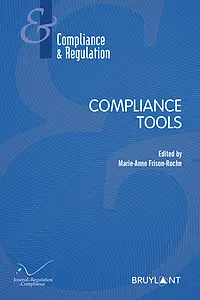
Couverture – Compliance Tools

Articles in a legal collective publication

Describing, conceiving and correlating compliance tools, in order to use them adequately, in Frison-Roche, M.-A. (ed.), “Compliance Tools”

Full reference: Frison-Roche, M.-A., Describing, conceiving and correlating compliance tools, in order to use them adequately, in Frison-Roche, M.-A. (ed.), Compliance Tools, series Regulation & Compliance, Journal of Regulation & Compliance (JoRC) and Bruylant, 2021, pp. 9-32.   -   Summary of the article: The article is the general introduction to the book on Compliance tools. In its first part it develops the overall problematic. In its second part, it presents each of the contributions, placed in the overall construction of the work.   -   Read a general presentation of the book in which this article has been published.    
Couverture – Compliance Tools

Articles in a legal collective publication

Training: content and container of Compliance Law, in Frison-Roche, M.-A. (ed.) “Compliance Tools”

Full Reference: Frison-Roche, M.-A., Training: content and container of Compliance Law, in Frison-Roche, M.-A. (ed.), Compliance tools, series "Régulations & Compliance", Journal of Regulation & Compliance (JoRC) and Bruylant, 2021, pp. 245-264   -   Summary of the article Firstly, as Training is a specific Compliance tool, it is supervised by Regulators. It becomes mandatory when it is contained in Compliance programs or sanction decisions. Since effectiveness and efficiency are legal requirements, what is the margin of companies to design them and how to measure the result? Secondly, as long as each Compliance tool includes, more and more, an educational dimension, we can take each of them to identify this perspective. So even condemnations and prescriptions are so many lessons, lessons given, lessons to be followed. The question is then to know who, in this so pedagogical Compliance Law, are the "teachers"?   -   This article is based on a bilingual Working Paper, including additional technical developments, pop-up notes and hypertext links.   Consult an overview of the volume in which the article was published.     -

Breaking news

📧 European Public Prosecutor’s Office comes on stage: the company having itself become a private prosecutor, are we going towards an alliance of all prosecutors ?

► The European Public Prosecutor's Office (EPPO), a major weapon for the Compliance Law.   The European Union's prosecutor comes out of its cradle : the "European Public Prosecutor's Office" starts its activities. Long to set up, this European judicial body is linked to delegated prosecutors in the Member States. It is not a simple emanation of national bodies networked; of autonomous competence, it is the organ in the name of which the action is carried out. In addition to this institutional revolution, there is a substantial revolution: this European Public Prosecutor's Office can prosecute any attack to the "financial interests of the European Union". These "attacks on financial interests" are conceived broadly, including in particular acts of corruption or embezzlement. First of all, Didier Reynders emphasizes that this puts the rule of Law at the center. It is no longer Europe supporting actions to be coordinated between States, the national prosecution having technical difficulties to cooperate effectively with each other, but the European Public Prosecutor's Office which will allow unified and effective European action between delegated prosecutors. Secondly, it continues the string of effectiveness between Compliance, located in Ex Ante, Compliance Law consisting in "preventing" and "detecting" such behavior, and the Ex Post, because a judge is sometimes necessary so that the disregard of these Ex Ante obligations is sometimes sanctioned (➡️📝Frison-Roche, M.-A., Compliance and International Public Order: the French conception preserved by the Paris Cour of Appeal, 2021) but also a prosecution: the prosecutor is a major figure in Compliance Law. Indeed, being able to prosecute, the prosecutor can also not prosecute and change its decision to close the file in returns for commitments (Ex Ante) from the company: the "public interest judicial agreements" – CJIP. In fact, through the opportunity to prosecute, will such powerful flexibility be found at European level? Thirdly, the prospect of prosecution by the European Public Prosecutor's Office will incent in Ex Ante companies to prevent, or to prosecute themselves (➡️🎤Frison-Roche, M.-A. et Roda, J.-C. (dir.), The firm instituted prosecutor and judge of itself by Compliance Law, Lyon, June 23, 2021) the perpetrators of fraud in the interests of the Union European. At a time when the Union is engaging in direct loans to lend still more, this role of the company, sometimes qualified as "private prosecutor", linked to a prosecutor, now European, is necessary. Are we moving towards the alliance of all prosecutors?

Working papers

🚧 Place and Role of Companies in the Creation and Effectiveness of Compliance Law in Crisis

Full Reference: Frison-Roche, M.-A. Place and Role of Companies in the Creation and Effectiveness of Compliance Law in Crisis, Working Paper, May 2021.  -   This Working Paper has been elaborated as basis for a conference in the colloquium of Mai 17, 2021 (done in French: Normes publiques et Compliance en temps de crise : les buts monumentaux à l'épreuve. This video is made with English substitutes.  It is also the basis for an article in the book Compliance Monumental Goals, the English version of which is co-published by the Journal of Regulation & Compliance (JoRC) and Bruylant. Summary: This article has a very topic: the place of private Companies, with regard to the chapter's issue: "the ordeal of a crisis". The crisis constitutes a "test", that is to say, it brings evidence. Let us take it as such. Indeed, during the health crisis, it appears that Companies have helped the Public Authorities to resist the shock, to endure and to get out of the Crisis. They did so by force, but they also took initiatives in this direction. From this too, we must learn lessons for the next crisis that will come. It is possible that this has already started in the form of another global and systemic crisis: the environmental crisis. In view of what we have been able to observe and the evolution of the Law, of the standards adopted by the Authorities but also by the new case law, what can we expect from Companies in the face of this next Crisis, willingly and strength    Lire ci-dessous les développements.