Articles in a legal collective publication

Articles in a legal collective publication

The attorney, vector of conviction in the new Compliance system (L’avocat, porteur de conviction dans le nouveau système de Compliance)

Référence générale : Frison-Roche, M.-A., L'avocat, porteur de conviction dans le nouveau système de Compliance, Dalloz Avocat, mars 2020. This editorial opens a thematic collective publication about Compliance. A synthetic article on all the contributions, published in May 2020, mirrors it: "Attorney and Compliance – The future of the character and his tool: Law, Humanism and Defense" - English Summary of the article (written in French) :  If we perceive Compliance Law as an aggression of the private company and a binding set of mechanisms that have no meaning and added value for it, then the attorney has a utility: to defend the business. It can do so not only during the sanctions phase, but also to prevent it. But this function is not central. He and she becomes so if we understand Compliance Law as being a body of substantial rules, pursuing a "monumental goal": the protection of the person, goal injected by political bodies and taken up by the operator. From this, the company must convince everyone to take it back, inside the company and outside. In a general and contradictory debate, the attorney carries this conviction, because he and shed is always convincing those who in the end judge (market, public opinion, etc.) that is their raison d'être.   Read the article   -     Read the Working Paper underlying this article, with the technical references and all the articles serving as the basis for all the assertions in this article          

Articles in a legal collective publication

The use of Intellectual Property as Regulatory and Compliance Tool (Le maniement de la propriété intellectuelle comme outil de régulation et de compliance), in “Major cases in Intellectual Property” (“Les Grands Arrêts de la propriété intellectuelle”

Référence complète : Frison-Roche, M.-A., Le maniement de la propriété intellectuelle comme outil de régulation et de compliance, in Vivant, M. (dir.), Les Grands Arrêts de la propriété intellectuelle, 3ième éd., 2019, 9-11, pp. 43-53. This contribution is written in French. Summary:  Intellectual Property, which comes from the State and is incorporated into public policy, can be designed not to reward the creator a posteriori, but to encourage others to innovate. It is then an Ex Ante regulatory tool, an alternative to the subsidy. If private copying is an exception, it is not in relation to the principle of Competition but in an insertion into a system of incentives, starting from the costs borne by the creator of the first innovation: the rights holder is then protected , not only according to a balance of interests involved but in order not to discourage innovative potentials and the sector itself. (1st decision) ; The sectoral policy then permeates Intellectual Property, used to regulate a sector, for example that of the drug. While it is true that a laboratory wishing to market a generic drug did not wait for the expiration of the patent for the original drug to do so, it is however not relevant to sanction this anticipation by a few days because the investments made by the holder of the Intellectual Property right have been made profitable by this one and because the public authorities favor the generics in a concern of public health (2nd decision). Systemic interest prevails and therefore Internet service providers have to bear the costs of blocking access while they are irresponsible because of the texts. This obligation to pay is internalized by Compliance Law because they are in the digital system best able to put an end to the violation of Intellectual Property rights which the ecosystem requires to be effective. (3rd decision).   Read the contribution (in French).   Read the Working Paper written in English having served as a basis for this contribution and endowed with additional developments, technical references and hypertext links.  -

Articles in a legal collective publication

📝Dessiner les cercles du Droit de la Compliance, in Études en l’honneur de Philippe Neau-Leduc, 📗Le juriste dans la cité

► Full Reference:  Frison-Roche, M.-A., Dessiner les cercles du Droit de la Compliance, in Études en l'honneur de Philippe Neau-Leduc, Le juriste dans la cité, coll. « Les mélanges », Lextenso – LGDJ,  2018, pp. 483-496. -   🚧this article  is based on a Working Paper, with footnotes, technical references and hypertext links.  This Working Paper is freely available : in French: Tracer les cercles du Droit de la Compliance. in English:  Drawing the circles of Compliance Law.  - ► English Summary of this article: Compliance Law has the same teleological functioning as the Economic Law to which it belongs, which consists in placing the normativity of rules, decisions and reasoning in the aims pursued. Once we know what the goals of compliance techniques are, then we know who should be responsible for them, who must be subject to them, who must activate the rules: compliance rules must be activated by those who are in the best position to achieve the outcome in order to achieve the goal sought by the authority which designed the compliance mechanism. The "circles" are thus plotted in a rational and pragmatic way. That, all of it ("useful effect"), but not beyond that. The notion of efficiency does not always imply balancing: on the contrary, it can involve drawing circles which designate those who are "placed" to carry the burden of the rules because they are capable of producing them the desired effects. Within these circles, the rules must apply without restriction and without compromise, but they must not apply beyond these circles. Drawing such circles requires defining the Law of Compliance itself, since on the one hand the choice of those who must implement the Compliance depends on the aims of the Compliance and on the other hand the definition of the Law of Compliance is itself teleological in nature. This is why, contrary to the assertion that the exercise of definition would be useless in these matters, which would be above all on a case-by-case basis, this effort to define and determine the purposes is, on the contrary, necessary in practice to show which enterprise must bear the obligations of compliance and which must not. But it is enough to have posed this to reveal the major difficulty of the Compliance, that explains resistances, and even gives the impression that one is confronted with an aporia. If, as a matter of principle, what is expected of the "users" of the Compliance mechanisms must be articulated to the aim that is affected by the authors of the compliance mechanisms to them, we must have a minimum correspondence between the aims of these authors (Legislators and Regulators) and the aims pursued by those who are responsible for implementing them: companies. However, this correspondence does not exist at first sight, because the compliance mechanisms are found to be uniquely based on "monumental goals" which the public authorities have a legitimate concern, whereas companies have for their own interest . The two circles do not match. The internationalization of concern for these aims in companies would therefore be only a mechanism of violence of which enterprises are the object, violence felt as such. (I). To resolve this violence, it is better to stop confusing the State and enterprises, whose goals are not the same, and draw the circle of subjects of law "eligible" for Compliance. It is highly legitimate to target certain entities, in particular this category of companies, which are the "crucial operators", in a binding way, as it is legitimate to govern companies that have expressed a desire to surpass their own interests. These circles of a different nature can overlap on a concrete operator: for example, if a bank – always a crucial operator that is structural because it is systemic – is also international – a crucial operator because of its activity – decides to worry about others by commitments verified by the authorities to overcome their own interest (social responsibility), but these different circles are not confused. In any case, companies may belong to only one circle, or even belong to none. In the latter case, they must therefore remain beyond the reach of the pressure and cost of Compliance Law, in particular because they are not objectively required to realize the "monumental goals" aimed at effectiveness and do not want it: in a liberal system, it is for the public authorities to aim at the general interest, the ordinary people indirectly participating in it by paying the tax. (II). It is by making these "Compliance Circles" of eligible subjects of this specific Law to implement the heavy but justified and controlled burden of Compliance with regard to the monumental goals that this new system  aims, that then opens a royal way in order to find a uniqueness and to increase the "monumental function" of the Compliance Law by a relation of Trust towards the global general interest, rather than the mechanical application of rules whose meaning is not understood and whose perception is no longer perceived than violence. -   📝read the article. -    

Articles in a legal collective publication

Le juge, le régulateur et le Droit

Articles in a legal collective publication

Compliance et confiance

Articles in a legal collective publication

article dans une publication juridique collective

📝La mondialisation du point de vue du Droit (“Globalisation from a legal perspective”), in📗La mondialisation (“The Globalisation”)

► Full Reference: M.-A. Frison-Roche, "La mondialisation du point de vue du Droit" (Globalisation from a legal perspective), in Association Henri Capitant,  La mondialisation, t. LXVI/2016, Berlin, Bruylant, coll. "Travaux de l'Association Henri Capitant",   2017, pp. 11-30 - 📝read the  article (in French)  - 📗read the general presentation of the book, La mondialisation, in which this contribution for the book's synthesis and conclusion is published - 🚧lire le document de travail bilingue sur la base duquel cet article a été élaboré, doté de développements supplémentaires, de références techniques et de liens hypertextes - ► English summary of this article: Globalisation is a confusing phenomenon for lawyers. The first thing to do is to take the measure of it. Once this has been done, it is essential to allow oneself to think something about it, or even to force oneself to think something about it. For example, on the novelty or otherwise of the phenomenon, which then enables us to assess what is being put in place. If Law can and must "pretend" to defend every human being, a universal ambition that is intended to confront the global field of forces, then the next – but secondary – question is: quid facere? Nothing? Less than nothing? Or regulate? Or do we still affirm that the Law fulfills its primary function, which is to protect the weak, even in the power struggle that is Globalisation? - 📝read the summary and conclusive report of the symposium organised by the Association Henri Capitant, as part of the Journées internationales Allemande about La Mondialisation in Berlin, the 27 May 2016. - 🌐follow Marie-Anne Frison-Roche on LinkedIn 🌐follow Marie-Anne Frison-Roche on Instagram 🌐subscribe to the Newsletter MAFR Regulation, Compliance, Law

Articles in a legal collective publication

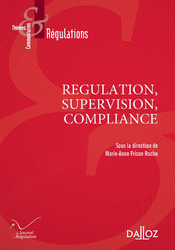
📝From Regulation Law to Compliance Law, in 📕Regulation, Supervision, Compliance

Complete reference: Frison-Roche, M.-A., Du Droit de la régulation au Droit de la compliance, in Frison-Roche, M.-A. (dir.), Régulation, Supervision, Compliance, Série Régulations, Dalloz, 2017, pp. 1-14. This article was published in the book Régulation, Supervision, Compliance, published in the Régulations.  Series. (Dalloz-Journal of Regulation and Compliance -JoRC) It is based on a working paper, available in French and English. Read the article. Summary: It is a question of showing the movement which starts from Regulation Law, today constituted, to Compliance Law, today in the process of being born. To explain this movement, making it possible to anticipate the near future, in what it should not be and in what it should be, it is necessary to restore how the Compliance Law was born from a Law of Regulation which has thus found the sources of a Law of public services whose roots it had first cut (I). In fact, the Law of Regulation has happily renewed the Law but has also narrowed its perspective. Today, the phenomenon of globalization calls for a need for public authority 1 that States cannot be satisfied by traditional legal methods, even when it is necessary to set up a sort of "global public service". This then takes place through Compliance Law which revolutionizes all legal systems, both Common Law and Civil Law (II). In fact, the Compliance Law internalizes in certain companies, the "crucial operators", the duty to make effective the "monumental goals" that the regulatory authorities have formulated and which these companies must make effective worldwide. In this respect, Compliance Law is an extension of Regulation Law, which is taking on a new dimension both in its aims and in its space. It is the whole of the Law which is transformed. The near future will say whether it results in confrontations, between companies and regulators, between Europe and the United States, or on the contrary by a pact of confidence between crucial operators and Regulators. If this is achieved, the Compliance Law, expressing the political dimension of the Law of regulation, expressing the share of companies ceasing to be neutralized by the mechanics of the markets, will be an advance in Law. It is in this perspective that European Compliance Law must be constructed.    

Articles in a legal collective publication

Au coeur du droit, du cinéma et de la famille : la vie (“At the heart of Law, Cinema and Family: Life”), preface of the book “La famille au cinéma. Regards juridiques et esthétiques” (“Family in Cinema. Legal and Aesthetic Perspectives”)

Full reference : Frison-Roche, M.-A., Au cœur du Droit, du cinéma et de la famille : la vie ("At the heart of Law, Cinema and Family: Life"), preface of La famille au cinéma. Regards juridiques et esthétiques ("Family in Cinema. Legal and Aesthetic Perspectives"), Florès-Longou, M. and Épinoux E. (ed.), coll. "Droit & cinéma",  Mare & Martin, 2016, pp. 21-27. Read a general presentation of the book Read the working paper from which the article was written, containing some notes and a hundred links, especially towards film extracts.  Read the article (in French) This introductive article, which constitutes the preface of the book, relies on approximatively one hundred movies to show that cinema does not stop to show legal situations and protagonists, even if "Family Law" seems to be less the darling child than the actors of the trial. We find the child, the mother and the father, the spouses and the engaged people. Often with the shape of drama, breaks and machinations and even murders, because it is like that that family appears on the screen. It is difficult to not fall asleep facing the peaceful happiness of happy families.   But why such a confluence between Cinema and Family Law?  Because both have a purpose: life.  Do not being anxious about family life, it is not understanding Family Law. And because Cinema take life itself as purpose, so when we want to learn Family Law, it is the path towards Cinema that we should take.