Economic Law, Regulation and Compliance

Articles in a non-legal collective publication

Article in a non-legal collective publication

📝Réguler le numérique, ou Sisyphe heureux (Regulating Digital, or a happy Sisyphus), in 📚Enjeux numérique, 📗Compliance et nouvelles régulations (Compliance and New Regulations)

► Full Reference: P. Bonis & M.-A. Frison-Roche, "Réguler le numérique, ou Sisyphe heureux" (Regulating Digital, or a happy Sisyphus), in P. Bonis & L. Castex (dir.), Compliance et Nouvelles Régulations, Les Annales des Mines, series "Enjeux numériques, June 2025, pp. 5-7. - 📝read the article (in French) - 📗read the table of content of this special issue of Enjeux numérique, Régulation et Compliance (in French), in which this introductory article is published. - ► English Summary of this article: This introduction to the collective publication on Regulation and Compliance, which aims to bring order to the Digital space, takes up the idea expressed by Camus when he referred to 'happy' Sisyphus, and expresses the idea that Regulation and Compliance are applied to this area with difficulty, relentlessness and failure, with texts constantly being adopted, modified and amplified on all sides, while the Digital Space is constantly changing, and the slope is constantly being climbed again. But this should not be seen as a failure, not even a flaw, because it is in the nature of digital regulation to always place the regulatory apparatus on our shoulders. This weight is shared by all, by the Authorities of all countries, because there is something common to all and also because there is something specific for each, because the techniques differ and because the visions of the world that the Politicians print in the texts and project in the Digital will always differ. This weight is also shared by companies, which internalise the rules through Compliance mechanisms, making them necessary agents for the efficiency and sustainability of the digital system, but also players in it, in articulation with Internet users in a permanent and unstable articulation with the local to the finest and this global that the Internet has invented. This presentation opens the series of contributions to the collective publication Régulation et Compliance, which makes up this special issue of Enjeux numériques in Annales des Mines. - 🌐read also the English presentation of:🕴️Marie-Anne Frison-Roche, 📝Le Droit de la compliance, voie royale pour réguler l'espace numérique (Compliance Law as a Royal Road for regulating the Digital Space) - 🌐follow Marie-Anne Frison-Roche on LinkedIn 🌐follow Marie-Anne Frison-Roche on Instagram 🌐subscribe to the Newsletter MAFR Regulation, Compliance, Law 🌐subscribe to the Video Newsletter MAFR Surplomb 🌐subscribe to the Newsletter MaFR Droit & Art

Articles in a non-legal collective publication

article in a non-legal collective publication

📝Le Droit de la compliance, voie royale pour réguler l’espace numérique (Compliance Law as a Royal Road for regulating the Digital Space​), in📚Enjeux numérique,📗Régulation et Compliance

► Full Reference: M.-A. Frison-Roche, "Le Droit de la compliance, voie royale pour réguler l'espace numérique" (Compliance Law as a Royal Road for regulating the Digital Space), in P. Bonis et L. Castex (dir.), Compliance et nouvelles régulation, Annales des Mines, coll. "Enjeux numériques", juin 2025, pp. 69-77. - 📝 read the article (in French)  - 🚧This article is underpinned by a English Working Paper in English, with additional technical developments and hypertext links. : Compliance Law as a Royal Road for regulating the Digital Space - ► English Summary of this article:  In order to describe the role of Compliance Law in regulating the digital space and to conclude that this new branch of Law is the 'royal road' to this end, this study proceeds in 6 stages.  Firstly, at first sight and conceptually, there is a gap between the political idea of Regulating and the ideas (freedom and technology as 'law') on which the digital space has been built and is unfolding.  Secondly, in practice, there is such a huge gap between the ordinary methods of Regulatory Law, which are backed by a State, and the organisation of the Digital Space by these economic operators, that are both American and global.  Thirdly, the political claim to civilise the Digital Space remains and is growing, relying on the very strength of the entities capable of realising this ambition, these entities being the crucial digital operators themselves, seized as Ex Ante.  Fourthly, it corresponds to the conception and practice of a new branch of Law, Compliance Law, which should not be confused with "conformity" and which is normatively anchored in its "Monumental Goals".  Fifthly, Compliance Law internalises Monumental Goals in the digital operators which disseminate them through structures and behaviours in the digital space.  Sixthly, through the interweaving of legislation, court rulings and corporate behaviour, the Monumental Goals are given concrete expression, willingly or by force, in ways that can civilise the digital space without undermining the primacy of freedom. - 🌐follow Marie-Anne Frison-Roche on LinkedIn 🌐follow Marie-Anne Frison-Roche on Instagram 🌐subscribe to the Newsletter MAFR Regulation, Compliance, Law 🌐subscribe to the Video Newsletter MAFR Surplomb 🌐subscribe to the Newsletter MaFR Droit & Art

Working papers

Working Paper for a Newsletter

🚧Pour maîtriser la masse réglementaire de la Compliance, la penser comme un puzzle

► Full Reference : M.-A. Frison-Roche, To master the regulatory mass of Compliance, think of it as a jigsaw puzzle,  Working Paper , May 2025 - 📝 This Working Paper underpins the Newsletter MAFR Law -Compliance – Regulation  of 2 June 2025 :  - ► Summary of this Working Paper:  People are rightly complaining that Europe's regulatory and compliance regulations are too numerous, too complicated and too changeable. As a result, they are said to be unmanageable. Three solutions are proposed: specialise lawyers, regulatory corpus by regulatory corpus; deregulate; entrust everything to algorithms. These are inadequate solutions, because regulations cannot be understood unless they are put into perspective with the rest of the legal rules .; we have entered a new world, and these new regulations reflect the need for a new Law (unless we want to destroy the Law itself, which is what some people are dreaming of doing); algorithms reproduce past solutions and do not produce the new legal conception required. For an appropriate solution, we need to move away from a word-by-word understanding of the regulatory and compliance regulations and understand them as a whole, not only in relation to the purpose that gives them meaning, but also in relation to each other. In the positive sense of the term, they form a European 'jigsaw puzzle'. We need to look at the overall picture in which each regulation fits and makes sense. It finds its simplicity in relation to its purpose. It is always a question of working towards the sustainability of systems by asking companies to contribute so that the systems do not crush human beings but benefit them. Thus, in practice, the Monumental Goals of Compliance Law give clarity to the body of regulations which, when seen as a whole, are manageable and practical. Judges interpret them in this way. - 🔓read the Working Paper below⤵️ - 🌐follow Marie-Anne Frison-Roche on LinkedIn 🌐follow Marie-Anne Frison-Roche on Instagram 🌐subscribe to the Newsletter MAFR Regulation, Compliance, Law 🌐subscribe to the Video Newsletter MAFR Surplomb 🌐subscribe to the Newsletter MaFR Droit & Art

Articles in a legal collective publication

article in a collective legal publication

📝100 fois remettre la Compliance sur le métier de la Stratégie (“100 times put Compliance back on the Strategy agenda”)

► Full Reference: M.-A. Frison-Roche, "100 fois remettre la Compliance sur le métier de la Stratégie" (100 times put Compliance back on the Strategy agenda), in Lettre d'information Compliance. Groupe SNCF, 100ième issue, 28 may 2025. - 📝read the article (in French) - ► English presentation of this article: This anniversary article sets out what Compliance is and should be in a large group. It expresses it in 4 points: 1. Actively master regulations by understanding their spirit 2. Improving risk detection without taking away the entrepreneurial spirit 3. Promoting convergence and managing conflict 4. Strengthen the company's identity by focusing on its strategic ambitions     - 🌐follow Marie-Anne Frison-Roche on LinkedIn 🌐follow Marie-Anne Frison-Roche on Instagram 🌐subscribe to the Newsletter MAFR Regulation, Compliance, Law 🌐subscribe to the Video Newsletter MAFR Surplomb

Publication director

🏗️ direction of the collection: 📚Cours Dalloz – Série Droit privé

📚Publication of : 🕴️Alain PIETRANCOSTA, 📕Droit des marchés financiers (Financial Markets Law), 1st ed.

► Full Reference : A. Pietrancosta, Droit des marchés financiers (Financial Markets Law), 1st ed., 2025, Dalloz, “Cours Dalloz-Série Droit privé” Series, 500 p. - ► Table of contents of the book (written in French) : Introduction Preliminary chapter: Presentation of the subject matter Part 1: General features of financial markets law Title 1: The spirit of financial markets law Chapter 1: The pair deregulation – regulation Chapter 2: The objectives assigned to financial markets law Section 1: The proper technical functioning of markets Section 2: Transparency Section 3: Investor protection Title 2: The sources of financial markets law Chapter 1: General approach Chapter 2: Description of the positive normative framework Section 1: International sources Section 2: European sources Section 3: French sources Part 2: Technical aspects of financial markets law Title 1: Infrastructural components Chapter 1: Legal approach to financial securities markets Section 1: Definition and typologies of financial securities Section 2: Organisation of financial securities markets Chapter 2: The public regulator: the Autorité des marchés financiers Section 1: Legal nature of the AMF Section 2: General missions of the AMF Section 3: Organisation of the AMF Section 4: Powers Title 2: Market transparency Chapter 1: Periodic information Section 1: Accounting information Section 2: Financial information Section 3: Governance information Section 4: Social and environmental information Chapter 2: Occasional information: the prospectus Chapter 3: Permanent or continuous information Section 1: Disclosure by listed issuers of inside information concerning them Section 2: Declarations by investors of threshold crossings and shareholder agreements Title 3: Substantive investor protection Chapter 1: Governance of listed companies Section 1: Rules specifically applicable to listed companies Section 2: Rules with plural sources Chapter 2: Takeover bids and buy-out offers Section 1: Takeover bids Section 2: Public buy-out offers and squeeze-outs Chapter 3: The prohibition of market abuse Section 1: Common European rules Section 2: The prohibition of insider dealing Section 3: The prohibition of market manipulation - 📚See the entire collection in which the book is published. -

Monographs

monograph in a legal publication

📝Le “Grand Arrêt” de la Cour d’Appel de Paris du 7 mai 2025, Dalloz et al. c/ Forseti

► Full Reference : M.-A. Frison-Roche, Le "Grand Arrêt" de la Cour d'appel de Paris du 7 mai 2025, Dalloz et al. c/Forseti, D. 2025, p. - 📝reread the article (in French) - ► Ench presentation of this article: The first part of the article describes the Paris Court of Appeal's ruling against the company that created a Legaltech platform under the trade name 'Doctrine', which offers a large number of court rulings, particularly from lower courts. Sued for unfair competition by a group of publishers offering a similar service, they were not convicted at first instance, but were convicted by the Court of Appeal because it appeared that they had fraudulently obtained thousands of judgments, which, under Civil Law, constitutes unfair competition to the detriment of the plaintiffs. The second part of the article draws 6 lessons from this. The power of general law. On the benefits that the perpetrator has derived from the slowness of justice.  On the importance of Open Data. On the fact that the law is not mastered by accumulating data but by putting it into perspective through the thinking of authors and publishers. On the indifference for this of the financiers who built and resold the "Doctrine" website. On the very nature of a 'Grand Arrêt', such as this one.   -    

Working papers

Working Paper basis for an article in a collective publication

🚧Compliance Law as the Royal Road for regulatinf the Digital Space

► Full Reference: M.-A. Frison-Roche, Compliance law as a Royal Road for regulating the Digital Space, Working Paper, May 2025 - 📝 This Working Paper is the English basis for an article written in French "Le Droit de la compliance, voie royale pour réguler l'espace numérique", in 📕 - ► Summary of this Working Paper: In order to describe the role of Compliance Law in regulating the digital space and to conclude that this new branch of Law is the 'royal road' to this end, this study proceeds in 6 stages. Firstly, at first sight and conceptually, there is a gap between the political idea of Regulating and the ideas (freedom and technology as 'law') on which the digital space has been built and is unfolding. Secondly, in practice, there is such a huge gap between the ordinary methods of Regulatory Law, which are backed by a State, and the organisation of the Digital Space by these economic operators, that are both American and global. Thirdly, the political claim to civilise the Digital Space remains and is growing, relying on the very strength of the entities capable of realising this ambition, these entities being the crucial digital operators themselves, seized as Ex Ante. Fourthly, it corresponds to the conception and practice of a new branch of Law, Compliance Law, which should not be confused with "conformity" and which is normatively anchored in its "Monumental Goals". Fifthly, Compliance Law internalises Monumental Goals in the digital operators which disseminate them through structures and behaviours in the digital space. Sixthly, through the interweaving of legislation, court rulings and corporate behaviour, the Monumental Goals are given concrete expression, willingly or by force, in ways that can civilise the digital space without undermining the primacy of freedom. - 🔓read the Working Paper below⤵️ - 🌐follow Marie-Anne Frison-Roche on LinkedIn 🌐follow Marie-Anne Frison-Roche on Instagram 🌐subscribe to the Newsletter MAFR Regulation, Compliance, Law 🌐subscribe to the Video Newsletter MAFR Overhang 🌐subscribe to the Newsletter MaFR Droit & Art

Conferences

🖥️Traduire dans l’institution judiciaire l’articulation entre l’international et le systémique, in🧮Le contentieux systémique émergent, un contentieux international justifiant la création de juridictions spécialisées ?

  - ► Référence complète : M.-A. Frison-Roche, "Traduire dans l'institution judiciaire l'articulation entre l'international et le systémique" in CREDIP, Faculté de Droit de l'Université Jean Moulin – Lyon 3, Le contentieux systémique émergent, un contentieux international justifiant la création de juridictions spécialisées, cycle de conférences sur Le contentieux international et la spécialisation des juges, Lyon , 18 avril 2025, 10h-12h. - 🪑🪑🪑Participent aussi à cette manifestation : 🪑Jacques Boulard, Premier président de la Cour d'appel de Paris 🪑Brigitte Brun-Lallemand, Première présidente de chambre de la Cour d'appel de Paris (Pôle économique) 🪑Jérémy Heymann, professeur de droit à l'Université Jean Moulin – Lyon 3 🪑Sabine Abravanel-Jolly, Professeure de droit au sein de l'Equipe Louis Josserand 🪑Marylou Françoise, maîtresse de conférences à l'Université Jean Moulin – Lyon 3 - 🧮consulter le programme complet de cette manifestation - ► Résumé de l'intervention : cette intervention ayant eu lieu après les présentations du Premier Président Jacques Boulard et Madame la Première Présidente Brigitte Brun-Lallemand, elle s'articule sur ces deux interventions.   I. Contentieux systémique et Contentieux international. On peut ainsi se demander si la nature d'un "contentieux systémique" se prête à ce qu'est un "contentieux international" ? A première vue, non. L'on pourrait poser que, d'une part, si le "contentieux systémique émergent" était "nécessairement international", alors l'on ne comprendrait pas pourquoi la Chambre spéciale internationale de la Cour d'appel de Paris ne suffisait pas et d'autre part, l'on ne comprendrait pas comment deux jugements ont été rendus sur le Devoir de Vigilance, dont on ne conteste pas qu'il appartient au Contentieux Systémique Emergent, alors qu'ils ne portent pas sur une chaine internationale de valeur : jugement TJ Paris 5 décembre 2023 dit La Poste, cas systémique actuellement devant la chambre spécialisée de la Cour d'appel de Paris ; TJ Paris 13 février 2025, dit SNCF, cas systémique, n'ayant pas fait l'objet d'appel.   II. Deux chambres spécialisées en miroir Dès lors, l'on pourrait dire que le contentieux systémique est de fait international mais pas par nature. Parce que cela n'est pas une subdivision du contentieux international, cela explique certes que la chambre 5-12 soit autonome par rapport à la chambre 5-16 (chambre internationale), mais parce que la perspective est de fait souvent transnationale, ces 2 chambres ont vocation à fonctionner en miroir. Car le système est un fait global. Et c'est plus en terme de fait global qu'il convient de le traiter, ce qui est plus facile dans des systèmes qui ne sont pas construit sur cette summa divisio du fait et du droit, qui convient mal au contentieux systémique.   III. Par nature, un contentieux dans lequel un système est "impliqué". Cela nous amène donc vers la définition du "Contentieux Systémique Emergent". Elle est simple : c'est un Cause dans laquelle un système est impliqué, dans lequel les intérêts de celui-ci sont en jeu, le premier de ses intérêts étant sa survie. C'est pourquoi la durabilité est une notion-clé, que l'on retrouve quelque soit le système impliqué. C'est pourquoi l'avenir est présent dans le contentieux systémique. C'est pourquoi l'office du juge est renouvelé car il s'agit d'un office Ex Ante, renouvellement à la fois procédural et substantiel qui conduit en pratique à un Droit processuel. Le fait systémique mène donc de droit à une dialogue des juges qui se spécialisent sur des faits globaux et les obligent, sauf à méconnaître ceux-ci, à se prendre en considération. Cela donne un nouveau statut au "droit comparé".   IV. Un contentieux émergent par le fait de systèmes nouveaux, globaux, saisis par des opérateurs locaux qui en fixent la stratégie.  Les systèmes ont déjà donné lieu à des contentieux : c'est la juridictionnalisation du Droit de la Régulation. Mais la Régulation a quitté ce prérequis des systèmes pour entrer à l'intérieur des opérateurs économiques dont le pouvoir de stratégie est situé localement. Le Droit de la Compliance internalise les besoins systémiques. Le Droit de la Compliance dont on affirma, parce qu'Ex Ante, qu'il allait dispenser du Juge, s'est lui-même juridictionnalisé. L'obligation de vigilance étant elle-même la pointe avancée de la Compliance, ne pouvait que donner une large place au Juge. Tandis que le système est l'enjeu du procès et de sa bonne solution, la partie au litige est l'opérateur cruciale : non seulement les entreprises régulées (comme les banques) mais encore les entreprises maîtresses des chaines de valeur (ce qui fait sortir le Droit de la Régulation des secteurs régulés). Or, les chaines de valeur sont un espace global contractuellement structuré transnational rattachées à un juge local qui est confronté à un office renouvelé avec le DIP.    V. Une culture juridictionnelle propre à des zones distinctes. Le Droit de la Vigilance, de la Compliance et de la Régulation tel qu'on le voit manier par les juges dépasse nos distinctions entre droit public et droit privé, entre les systèmes juridique, mais les décisions que l'on lit expriment trois cultures, procédurales et substantielles, différentes : l'Asie, les Etats-Unis et l'Europe. Cette culture de place porteuse d'une identité européenne de Vigilance, de Compliance et de Régulation repose notamment sur une culture juridictionnelle propre à cette zone-là. - 🌐suivre Marie-Anne Frison-Roche sur LinkedIn 🌐suivre Marie-Anne Frison-Roche sur Instagram 🌐s'abonner à la Newsletter MAFR Regulation, Compliance, Law 🌐s'abonner à la Newsletter en vidéo MAFR Surplomb 🌐s'abonner à la Newsletter MaFR Droit & Art


Working papers

Working Paper for📺MAFR - OverHang (Notion)

🚧Arbitration, a highly appropriate technique for deploying Compliance Law, in particular to satisfy the Vigilance Obligation

► Full Reference: M.-A. Frison-Roche, Arbitration, a highly appropriate technique for deploying Compliance Law, in particular to satisfy the Vigilance Obligation, Working Paper, March 2025. - 🎤 This Working Paper was developed as a basis for the Overhang👁 video  on …  April 2025 : click HERE  - 🎬🎬🎬In the collection of the Overhangs👁 It falls into the Notion category. ►Watch the complete collection of the Overhangs👁 : click HERE - ► Summary of this Working Paper: If Arbitration has so far not developed much in Compliance Law, it is because this new branch of Law is not well known. Indeed, if it were simply a matter of 'conformity' with mandatory regulations, then Arbitration involving rights that are freely available to the parties and Compliance would be 2 worlds that must ignore each other. But Compliance Law is defined quite differently. Its normativity lies in the Monumental Goals set by the political authorities, which oblige large companies, because these compagnies are in a position to do so, to contribute to achieving these Goals, namely the future preservation of the Systems (banking, digital, climate, energy, etc.) and human beings involved. While the Goal is constrained, the company is free to choose the means, as long as these means  are credible. Arbitration is one of them. From the arbitration clause to the appropriate award. One example is the Duty of Vigilance, the cutting edge of Compliance. In order to effectively find solutions in the value chain that the company governs, Arbitration is a suitable means of achieving the Monumental Goals of environmental protection and human rights, under the control of the Judge.       - 🔓read the developments below⤵️ - 🌐follow Marie-Anne Frison-Roche sur LinkedIn 🌐follow Marie-Anne Frison-Roche on Instagram 🌐subscribe to the Newsletter MAFR Regulation, Compliance, Law  🌐subscribe to the Video Newsletter MAFR Surplomb

Working papers

Working Paper for 📺Overhang (News)

🚧The Contract, a Compliance tool: the Obligation for a platform to control content (French Supreme Judicial Court, 15 January 2025) :

► Full Reference: M.-A. Frison-Roche, The Contract, a Compliance tool: the Obligation for a platform to control content CE, 27 January 2025, B. c/ CNIL, Working Paper, March 2025. - 🎤 This Working Paper was developed as a basis for the Overhang👁 video  on 29 March 2025 : click HERE (in French) - 🎬🎬🎬In the collection of the Overhangs👁 It falls into the News category. ►Watch the complete collection of the Overhangs👁 : click HERE - ► Summary of this Working Paper: The ruling handed down on 15 January 2025 by the Commercial, Economic and Financial Chamber of the French Judicial Supreme Court (Cour de cassation) provides a solution to the issue of content control in the digital environment. It resolves what appears to be the aporia so often emphasised, and even claimed, namely the impossibility of developing an effective controlling technology. To do this, the Court disregarded the applicable laws and referred to the electronic payment contract between the bank and the platform, which contained a clause on Vigilance against unlawful content, linked to a termination clause. It held that this clause was fully effective. This solution, so simple and so strong, can make a major contribution to regulating the digital space, if the banks so wish, because what platform can do without reliable electronic payment services?   - 🔓read the developments below⤵️ - 🌐follow Marie-Anne Frison-Roche sur LinkedIn 🌐follow Marie-Anne Frison-Roche on Instagram 🌐subscribe to the Newsletter MAFR Regulation, Compliance, Law  🌐subscribe to the Video Newsletter MAFR Surplomb

Organisation of events

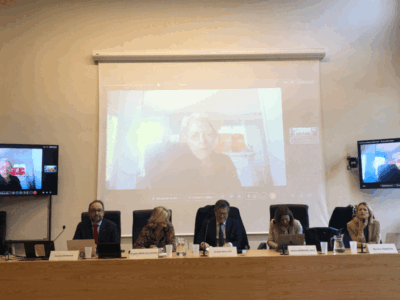
⚙️Co-organisation of the symposium 🧮Durabilité de l’Internet : le rôle des opérateurs du système des noms de domaine. Compliance et Régulation de l’espace numérique (Sustainability of the Internet: the role of the operators of the domain name system. Compliance and regulation of the digital space)

  - ► Full Reference: M.-A. Frison-Roche & G. Loiseau (dir.), Durabilité de l'Internet : le rôle des opérateurs du système des noms de domaine. Compliance et régulation de l'espace numérique (Sustainability of the Internet: the role of the operators of the domain name system. Compliance and regulation of the digital space), Journal of Regulation & Compliance (JoRC) and Institut de Recherche Juridique de la Sorbonne (André Tunc – IRJS), Paris 1 Panthéon-Sorbonne University, 21 Fabruary 2025 - ► General presentation of this symposium: The digital space has been built on and as a system. Its primary interest is of a negative nature: it consists of to be preserved against the prospect of systemic failure, of not collapsing. Like all other systems, this 'Monumental Goal' specific to the digital system justifies resources that incorporate this concern for the future. As with all systems, it integrates and relies on the specific technical nature of this system. The digital space is largely based on the invention, technology and architecture of domain names. Domain names, as an addressing system, enable users to enter the digital space and find other Internet users. The uniqueness and solidity of the domain name system, entrusted to a single root and decentralisation, makes this community possible for those who use the digital space and ensures the technical durability required, without which the digital space would be compromised. The architecture, operation, operators and what they do under the control of legislators, regulators, judges and legal subjects are therefore examined from a dual technical and legal perspective, in the light of the imperative of sustainability. This allows to progress in 4 stages. Firstly, to examine the permanence in time and space of the domain name system, insofar as it is the foundation of the Internet and the digital system. This technical construction gives rise to legal qualifications, not only for the present but also for the future, since the Web3 offers new technical solutions. Secondly, this technical sustainability is an imperative that is built into the operators of the domain names themselves, which are inter-linked not only at national level but also at global level, this cross-linking being necessary for the security of the system. The State is present through public law techniques that enable surveillance, control and possible recovery. Thirdly, it imposes constraints on the operators subject to them in order to serve this monumental goal of technical sustainability, and these constraints themselves generate as many powers as they need to usefully achieve this mission. This proportionality must be at the heart of the method and the requirements. The relationship between constraints and powers also stems from it. Fourthly, this imperative of technical sustainability, which is global in nature, gives way to imperatives of societal sustainability, more localised in space and time, when domain name operators are called upon by the legitimate authors of binding standards, legislators in the first instance, to express concerns such as the protection of people involved in the digital space and whose rights are compromised or who are in danger. This second type of sustainability, which is more localised and less inherent in the architecture of the Internet, is justified by the available power of the operators concerned and their adherence to social imperatives. The resulting constraints and powers are therefore not the same. The 2 sustainabilities must then be articulated in a conception that is both teleological and pragmatic. - - ► Speakers (they will speak in French, but the book to be published will be in English):  🎤Pierre Bonis, Chief Executive Officer of the Association française pour le nommage Internet en coopération (Afnic) 🎤Lucien Castex, Adviser of the Afnic Chief Executive Officer for Research internet and society and Internet governance 🎤Marie-Anne Frison-Roche, Full Professor of Regulatory and Compliance Law, Director of the Journal of Regulation & Compliance (JoRC) 🎤Claire Leveneur, Senior Lecturer at Paris-Est Créteil University 🎤Grégoire Loiseau, Full Professor at Paris 1 Panthéon-Sorbonne University 🎤Samir Merabet, Full Professor at the University of West Indies 🎤Antoine Oumedjkane, Senior Lecturer at Lille University 🎤Frédéric Sardain, attorney at law, Jeantet law firm - read below a detailed presentation of this event⤵️ - 🌐follow Marie-Anne Frison-Roche on LinkedIn 🌐follow Marie-Anne Frison-Roche on Instagram 🌐subscribe to the Newsletter MAFR. Regulation, Compliance, Law 🌐subscribe to the Newsletter Surplomb, par MAFR

Conferences

conference

🎥La qualification juridique du système de noms de domaine comme infrastructure et ses conséquences juridiques (“The legal status of the domain name system as an infrastructure and its legal consequence”), in 🧮Durabilité de l’Internet : le rôle des opérateurs du système des noms de domaine. Compliance et régulation de l’espace numérique (Sustainability of the Internet: the role of the operators of the domain name system. Compliance and regulation of the digital space)

► Full Reference: M.-A. Frison-Roche, La qualification juridique du système de noms de domaine comme infrastructure et ses conséquences juridiques ("The legal status of the domain name system as an infrastructure and its legal consequence"), in M.-A. Frison-Roche et G. Loiseau (dir.), Durabilité de l'Internet : le rôle des opérateurs du système des noms de domaine (Sustainability of the Internet: the role of the operators of the domain name system. Compliance and regulation of the digital space). Compliance et régulation de l'espace numérique, 21 février 2025, organisé par le Journal of Regulation & Compliance et l'Institut de la Recherche en Droit de la Sorbonne (André Tunc – IRDJS), 12 place du Panthéon, Paris. - 🧮see the full programme of this colloquium (in French) - ► Summary of this conference:  "Domain names" are a technical reality. This technical reality has come to the fore, seeming to have been both little "thought out" and little "conceived" in Law and, perhaps because it is little coveted, Competition Law, which neutralises the concreteness of things and services in order to focus on exchange, hardly qualifies them. It is rather from the 'Competition Policy' perspective that 'domain names' are apprehended. However, Competition Policy expresses wishes and perspectives, while Competition aw must make way for the perspective of Regulatory Law inside the liberal economic system. Looking at the technicalities of the domain name system, we can proceed in 3 stages. Firstly, if a domain name is taken in isolation, it may appear as property and/or a projection of a person, and has rightly been described as such by the courts. But domain names only exist in relation to each other, the addressing system on which the Internet itself and the digital space that enables everyone to spread, reach and be reached were built. In this way, they constitute an Infrastructure in their plurality, in a uniqueness (I). The legal system must take account of this technological reality through the concept of Essential Infrastructure, which is well known in Regulatory legal perspective(I). Secondly, the legal consequences of this legal qualification of Infrastructure must be detailed (II). Regulatory Law does not necessarily imply institutions, a regulatory authority being an indication rather than a criterion. Rather, it requires specific charges, powers and controls to ensure that the Infrastructure is established and operates to fulfill, now and in the future, the function that is crucially expected of it. Because the digital space was born of the Internet, an a-sectional and a-territorial space, Compliance Law, which is an extension of Regulatory Law, outside the sectors and internalised in the crucial operators, is essential as it is appropriate without diminishing the public dimension of the organisation. Thirdly, the evidential dimension should be emphasised (III). Indeed, because we need to ensure that the Domain Names Infrastructure is always solid and reliable, so as not to risk a systemic failure of the Internet, and therefore of the digital space, we must not remain with the traditional system of burden of proof that rests on the person making the complaint. Because there is a Compliance Obligation, it is up to the crucial operators to credibly show their ability to ensure the technical sustainability of this infrastructure on which the digital space in which we live is based. It shall be different if the issue is one of non-technical Sustainability, for example that which is linked to a particular societal project, in which the operators of the domain name system are not at the origin and are required on an ad hoc basis because they are in a good position to help the Authorities or because they wish to do so. - 🌐suivre Marie-Anne Frison-Roche sur LinkedIn 🌐suivre Marie-Anne Frison-Roche sur Instagram 🌐s'abonner à la Newsletter MAFR Regulation, Compliance, Law 🌐s'abonner à la Newsletter en vidéo MAFR Surplomb

Conferences

conference

🎥La clé de la proportionnalité pour établir l’équilibre des obligations, pouvoirs et droits – Exemple de l’inclusion technique assurée par les opérateurs des noms de domaine, , in 🧮Durabilité de l’Internet : le rôle des opérateurs du système des noms de domaine. Compliance et régulation de l’espace numérique (Sustainability of the Internet: the role of the operators of the domain name system. Compliance and regulation of the digital space)

► Full Reference: M.-A. Frison-Roche, "La clé de la proportionnalité pour établir l’équilibre des obligations, pouvoirs et droits –  Exemple de l’inclusion technique  assurée par les  opérateurs des noms  de domaine" (The key to proportionality in balancing obligations, powers and rights – Example of technical inclusion by domain name operators), in M.-A. Frison-Roche et G. Loiseau (dir.), Durabilité de l'Internet : le rôle des opérateurs du système des noms de domaine (Sustainability of the Internet: the role of the operators of the domain name system. Compliance and regulation of the digital space). Compliance et régulation de l'espace numérique, 21 février 2025, organisé par le Journal of Regulation & Compliance et l'Institut de la Recherche en Droit de la Sorbonne (André Tunc – IRDJS), 12 place du Panthéon, Paris.   - 🧮see the full programme of this colloquium (in French) - ► Summary of this conference:  The domain name operators operate in a liberal system and have internalised the tasks being technically inherent in the very architecture of the Internet, while the Public Authorities, because they recognise this nature, ensure in Ex Ante that there are no global failures. This translates into a system of obligations. All the more so since domain name operators not only bear multiple obligations but also, by order of the laws and regulations, impose them on others, for example on their co-contractors and users. It is from this perspective that  the Principle of Proportionality, which is central here, must be considered. It is another expression of the legal Principle of Necessity, which must be conceived in terms of goals: what is proportionate is what is necessary to achieve the objective with regard to which the duties and prerogatives are entrusted and/or exercised. This is why it is first necessary to recall and explain what the Principle of Proportionality is with regard to the operators obligations covered by Compliance Law, which goes beyond jurisdictional powers such as sanctions or dispute resolution, to explain the teleological control of obligations and powers (I).  From this practical framework, the most relevant example is the technical obligation of inclusion (II) In the technical sense, Inclusion means that anyone who wants to enter the digital space must be able to do so and must be able to reach those who are there and be reached by others. This gives everyone the right to reach and be reached. Is it possible to go  further and ask for comfort for everyone and equality in this comfort and advantages to rebalance this accessibility? For instance, to know everything about everyone beyond this simple digital adresse? To ask domains names operators to help everyone to develop his/her personality in the digital space, compensating his/her lack of initial chance?  This is social and political inclusion. It is not the same thing. It does not have the same sources. It does not follow the same paths. Not the same forces. The Sustainability that is then projected can be cumulative. A distinction has to be made on the one hand, and a link made on the other. Moreover, in the name of mistreated social inclusion, can we mistreat technical inclusion, i.e. exclude a person from the digital space?  (III). - 🌐suivre Marie-Anne Frison-Roche sur LinkedIn 🌐suivre Marie-Anne Frison-Roche sur Instagram 🌐s'abonner à la Newsletter MAFR Regulation, Compliance, Law 🌐s'abonner à la Newsletter en vidéo MAFR Surplomb

Conferences

🏛️Hearing before a public body

🏛️ hearing before the French Working Group on the modernisation of French Arbitration Law, about the issue Arbitrage et Droit de la Compliance : est-il besoin d’un texte ? (“Arbitration and Compliance Law: is a text required?”)

► Full Reference: M.-A. Frison-Roche, hearing before the French working group on the modernisation of French Arbitration Law, about the issue Arbitrage et Droit de la Compliance : est-il besoin d'un texte ? ("Arbitration and Compliance Law: is a text required?"), Directorate of Civil Affairs' French Ministry of Justice, 13 February 2025. - ► Result of this presentation and the ensuing discussion, recorded in the working group's report published in March 2025 (published in French, translated her: "This report on the guiding principles would not be complete without mentioning the discussions in the working group on the introduction of a guiding principle requiring the arbitral tribunal to take into account "human, environmental and compliance issues, as well as respect for the fundamental rights and freedoms of the parties".This proposal gave rise to particularly heated discussions. Some saw it as a scarecrow likely to make French Arbitration Law less attractive and to weaken Arbitration awards, opening up cases of recourse on the pretext of bad faith, even though these values would already be taken into account in the review of domestic or international public policy.  Others, on the other hand, felt that such a text would have the advantage of enshrining an Arbitration Law connected to values that are not exclusively economically oriented, pointing out, moreover, that such a principle would not be redundant with the control of public policy, which intervenes ex post, whereas this text imposes Ex Ante responsability, and that this principle would allow a noteworthy introduction of Compliance Law in rbitration.  They added that the promotion of such values could make it possible to demonstrate a commitment to virtuous arbitration practice. In the light of these differences, after much hesitation, the decision was made not to include it in the draft Code, considering that the final choice was more a question of political dimension that the working group felt it could not decide on its own. ". (p. 36).   - ► English Summary of the presentation: My presentation deals with the relationship between Compliance Law and Arbitration, particularly International Arbitration. It is built around 12 successive points. The work I have carried out on these various points is associated with it. It precedes the answers I shall give to the questions put by the members of the working group and the ensuing discussion.   1. stagnation in the relationship between Arbitration and Compliance Law, due to continuing misunderstandings about Compliance 2. progress towards a better understanding of Compliance and the appropriateness of the arbitrator's role within Compliance Law 3. prospects for the growing relationship between Compliance Law and Arbitration, particularly with regard to the value chains built up by international companies 4. educational issues 5. time required to build a "culture of place" in this matter 6. "Doctrinal" difficulties 7. benefit from the production of a "doctrine of place" on this subject 8. going beyond the continental summa divisio of Public Law and Private Law 9. practical assimilation of Regulatory Contracts in sustainable sectors and chains 10. opening up the Arbitration World to this articulation with Compliance Law 11.  Can an official legal text contribute to this? 12.  example of the guiding principles of the French Code of Civil Procedure. -   🔓read the presentation developments below⤵️ - 🌐follow Marie-Anne Frison-Roche on LinkedIn 🌐follow Marie-Anne Frison-Roche on Instagram 🌐subscribe to the Newsletter MAFR Regulation, Compliance, Law 🌐 subscribe to the Video Newsletter MAFR Overhang/Surplomb

Conferences

conference

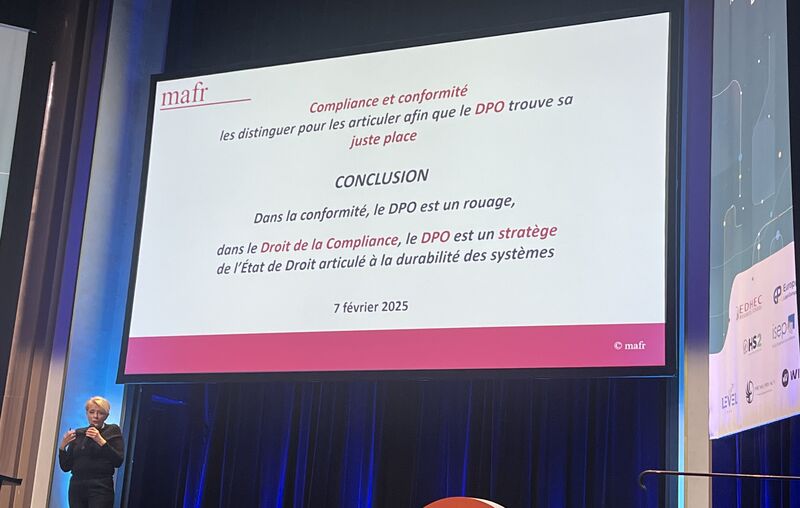
🎥”Compliance” et “conformité” : les distinguer/mieux les articuler afin que le DPO trouve sa juste place (Compliance Law” and “conformity” : distinguish between them/better articulate them so that the DPO finds their rightful place), in 🧮19ème Université AFCDP des DPO, in 🧮19ème Université AFCDP des DPO, in 🧮19ème Université AFCDP des DPO

► Full Reference: M.-A. Frison-Roche, "Compliance" et "conformité" : les distinguer/mieux les articuler afin que le DPO trouve sa juste place" ("Compliance Law" and "conformity" : distinguish between them/better articulate them so that the DPO finds their rightful place"), , in  Association française des correspondants à la protection des données à caractère personnel (AFCDP),  19ème Université AFCDP des DPO – La gouvernance des données ("Data Governance"), Maison de la Chimie, Paris, 7 February 2025 , 10h-10h45. - 🧮 see this manifestation full program (in French) - ⬜ see les slides on which this conference is done (in French)  - ► English Presentation of this conference: 'Compliance' and 'conformité' are often considered to be synonymous, notably in French in which the term "Compliance" is so often used to express only the "conformity" (conformité). This is a misunderstanding and a reduction, particularly of the role of professionals, notably DPOs. In fact, 'conformity' consists solely of ensuring that regulations are respected. Of course, an"active" conformity and "proven" conformity with these regulations, in particular the European GDPR. That and only that. If that's the case, then on the one hand this task impossible, because no one can comply with all the regulations, and it's the obsession with avoiding or reducing penalties that actually replaces the desire to do the right thing. On the other hand, algorithms are going to replace the DPO, a human being, because algorithms will identify 'non-conformity', then conformity, then write it down by "smart" contracts. But Compliance Law is more than conformity, which is only one of its tools. Compliance Law aim is to protect the human beings involved in the systems. Data protection is one of the best examples of this, and it underpins all the other areas of Compliance Law. Companies are asked to do less (obligation of means) and more: to help protect, by distinguishing between what must be revealed and what must be kept secret, sometimes to resolve conflicts between the 2 prescriptions, to educate, to make alliances. To built a real "governance". In this human and humanist mission that anchors Europe, the algorithm is flat. We are waiting for the DPO. In this human and humanist mission that anchors Europe, the algorithm is flat. We are waiting for the DPO. There is the role of guardian of the spirit of the texts, of strategic aid for the data controller, of adjuster of complementary or contradictory subjective rights, of adjustment of the texts in the European puzzle of a Regulatory Europe, which is being put in place in the humanist tradition which is its own to preserve the durability of the systems to protect the people who are forcibly or voluntarily involved in them. - 🌐suivre Marie-Anne Frison-Roche sur LinkedIn 🌐suivre Marie-Anne Frison-Roche sur Instagram 🌐s'abonner à la Newsletter MAFR Regulation, Compliance, Law 🌐s'abonner à la Newsletter en vidéo MAFR Surplomb/Overhang

Working papers

Working Paper for 📺Overhang

🚧Dans le silence des textes, vers qui se tourner en cas de manquement à une disposition du Droit de la Compliance ?

► Full Reference: M.-A. Frison-Roche, Who is responsible for making the Compliance provision effective? Is it the company or the public authority? Example of data: CE, 27 January 2025, B. c/ CNIL, Working Paper, February 2025.   - 🎤 This Working Paper was developed as a basis for the Overhang👁 video  on 8 February 2025 : click HERE (in French) - 🎬🎬🎬In the collection of the Overhangs👁 It falls into the News category. ►Watch the complete collection of the Overhangs👁 : click HERE - ► Summary of this Working Paper: In its decision of 27 January 2025, B. v CNIL, the French Administrative Supreme Court (Conseil d'État ) had to provide a solution to a case that the Compliance rules applicable to data had not expressly provided for. Can a person who believes that another person has failed to fulfill their obligations under the GDPR refer the matter to the French Data Protection Regulator (CNIL) and not the data controller? The Conseil d'État considers that the question is clear and that there is no point in referring a preliminary question to the ECJ. Indeed, the texts require the person alleging that his or her right has been infringed to first contact the data controller to have the information deleted before subsequently referring the matter to the CNIL. Furthermore, this case involved personal information inserted by doctors in an expert report submitted to a court. The Conseil d'État agreed with the CNIL that it was not required to review and assess the evidence, which is the role of the court. This shows that, while the right to alert can be used to refer cases directly to the administrative authorities, here the specific takes precedence over the general, with the spirit of the Law entrusting the direct preservation of rights to the data controller, with the CNIL's supervisory and sanctioning role coming only at a later stage. This illustrates the more general nature of Compliance Law, which relies primarily on the operators themselves. Furthermore, as a melting pot of various subjective rights, in this case the right to erasure but also the right to contribute to the debates, the Conseil d'État stresses that it is the role of the judicial judge to ensure the fairness of the debates. - 🔓read the developments below⤵️ - 🌐follow Marie-Anne Frison-Roche sur LinkedIn 🌐follow Marie-Anne Frison-Roche on Instagram 🌐subscribe to the Newsletter MAFR Regulation, Compliance, Law  🌐subscribe to the Video Newsletter MAFR Surplomb