Economic Law, Regulation and Compliance

Conferences

🕴️MaFR interviews 🕴️Jacques Beyssade

🎥Compliance and governance (example of a banking group), interview with 🕴️Jacques Beyssade by Marie-Anne Frison-Roche, 🎬 Series of talks on Compliance Law, in 📺 Open windows on management

► Full reference: J. Beyssade, "Compliance et gouvernance (exemple d'un groupe bancaire)" (Compliance and governance (example of a banking group)), interview conducted by M.-A. Frison-Roche on the occasion of a series of interviews on Compliance Law, in Fenêtres ouvertes sur la gestion (Open windows on management), broadcast by J.-Ph. Denis, Xerfi Canal, recorded December 12, 2023, recorded February 24, 2024 - 🌐consult the presentation of Jacques Beyssade's interview on LinkedIn - 🎥view the full interview on Xerfi Canal - ► Starting point: In 2022, Jacques Beyssade wrote a contribution on 📝Feminisation of positions of responsibility in the workplace as a goal of Compliance, in 📘Compliance Monumental Goals 🧱read the presentation of this contribution ➡️click HERE - ► Summary of interview:  Marie-Anne Frison-Roche. Question: Compliance and governance are often linked. Can you explain how, in the strategy of a banking group like BPCE, this link between compliance and governance is articulated? Jacques Beyssade. Answer. Compliance is not just a matter of obeying the rules, but also, and perhaps even more so, of respecting customers, suppliers, stakeholders and members. For a mutualist structure, customers and member-policyholders are closer, they are the same social body, and so it's a matter of governance. - MaFR. Q.: Let's take a concrete example, where Compliance and governance serve a specific purpose: effective equality between men and women, for example. How does this work in your Group? J.B. R.: This objective is in the genes of BPCE, and in particular of the savings banks. The Copé-Zimmermann law requires it. We go beyond this constraint, at the level of governance. The management board, or executive committee, is egalitarian, and this also works as an example. Compliance takes up the baton, for example, by identifying talent, particularly female talent, and correcting any anomalies.  - MaFR. Q.: In the future, can we hope that this alliance between new governance and the power of Compliance, with the same Monumental Goals, will transform our societies? J.B. R.: Changes in society come from the behavior of individuals and companies, as demonstrated by the opening of savings accounts to women in the 19th century. Both can do a great deal, within the framework of regulations, by going beyond them. Through governance, for example in a mutual bank like BPCE, it's the members who set the rules, reflecting social movements because they themselves are representative of society as a whole. In this way, through the alliance of governance and compliance, they can act to give concrete expression to the fundamental social movements they themselves represent, through the broad representation of the social body that the member-policyholders constitute. -

Conferences

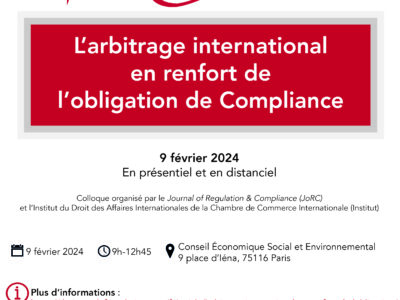
🎤Préalable : ce qu’est l’obligation de Compliance (Prerequisite: the Compliance Obligation), in 🧮L’arbitrage international en renfort de l’obligation de Compliance

► Full Reference: M.-A. Frison-Roche, "Préalable : ce qu'est l'obligation de Compliance" ("Prerequisite: the Compliance Obligation"), in L. Aynès, M.-A. Frison-Roche, J.-B. Racine and E. Silva-Romero (dir.), L'arbitrage international en renfort de l'obligation de Compliance (International Arbitration in support of the Compliance Obligation), Journal of Regulation & Compliance (JoRC) and Institute of World Business Law of the ICC (Institute), Conseil Économique Social et Environnemental (CESE), Paris, February 9, 2024 - 🧮see the full programme of this event - 🌐consult on LinkedIn a general presentation of this event, which links to a presentation of each speech (in French) - 🧱consult the scientific direction sheet of this event, which gives an account of the various speeches made - 🔲see the slides used to support the presentation (in French) - 🎤see a presentation of the conference "Préalable : ce qu'est un engagement" ("Prerequisite: the Commitment"), given at the same symposium - 🎤see a presentation of the conference "Le renforcement des engagements de Compliance par le renvoi Ex Ante à l'arbitrage international" ("Reinforcing Compliance commitments by referring Ex Ante to International Arbitration") which was finally not pronounced but will be the subject of an 📝article in the forthcoming book 📘Compliance Obligation  - ► Presentation of the conference: I have first dealt with the very definition of the Compliance Obligation. After showing that the relationship between Compliance Law and International Arbitration will naturally develop, because the companies subject to it are international, because they contractualise their legal Compliance obligations and because Compliance is being jurisdictionalised📎1🕴️M.-A. Frison-Roche (ed.), 📘Compliance Jurisdictionalisation, 2024., the arbitrator being the natural judge since he is a global judge and the judge of the contract, I pointed out that Compliance Law does not simply entrust arbitration with the task of preventing evils, such as corruption pacts, but that it creates positive obligations for companies: to detect and prevent behaviour whose systemic effect is deleterious. This culture of compliance is achieved either through compliance contracts📎2🕴️M.-A. Frison-Roche, 🚧Compliance contract, compliance clauses, 2022. (which outsource the handling of audits, alerts, the drawing up of plans, etc.), or through compliance clauses📎2🕴️M.-A. Frison-Roche, 🚧Compliance contract, compliance clauses, 2022., which are inserted into distribution or supply contracts, etc.; arbitration clauses are linked to these. Thus, the alliance between Compliance and Contract is an indirect mode of alliance between Arbitration and Compliance Obligation. The obligation of Compliance which then takes concrete form consists for the company not in making effective Ex Ante all the regulations which apply to it (conception of conformity which is at once unreasonable, blind and impossible), but in making its best efforts, which it must make visible (see Compliance Evidence System📎3🕴️M.-A. Frison-Roche, 📝The Judge, the Compliance Obligation and the Company. The Compliance Evidence System, in 🕴️M.-A. Frison-Roche (ed.), 📘Compliance Jurisdictionalisation, 2024.) to achieve Monumental Goals. These Monumental Goals are systemic. The aim is to protect systems from collapse (Negative Monumental Goals) or to make them better (Positive Monumental Goals)📎4🕴️M.-A. Frison-Roche, 📝Compliance Monumental Goals, Beating Heart of Compliance Law, in🕴️M.-A. Frison-Roche (ed.), 📘Compliance Monumental Goals, 2023.. By making companies accountable, via this Ex Ante Law whose object is the future, the systemic evils of corruption, money laundering, discrimination, climate change and hatred are combated, thus finding substantial unity. The Positive Monumental Goals aim to engender sustainability, security, respect for human beings, etc. in systems, be they banking, financial, digital, climatic, etc. The role of the Judge, and therefore also that of the Arbitrator, is renewed. - 🌐follow Marie-Anne Frison-Roche on LinkedIn 🌐follow Marie-Anne Frison-Roche on Instagram 🌐subscribe to the Newsletter MAFR Regulation, Compliance, Law

Conferences

🎤Le renforcement des engagements de compliance par le renvoi Ex Ante à l’arbitrage international (Reinforcing Compliance commitments by referring Ex Ante to International Arbitration), in 🧮L’arbitrage international en renfort de l’obligation de Compliance

► Full Reference: M.-A. Frison-Roche, "Le renforcement des engagements de Compliance par le renvoi Ex Ante à l'arbitrage international" ("Reinforcing Compliance commitments by referring Ex Ante to International Arbitration"), in L. Aynès, M.-A. Frison-Roche, J.-B. Racine and E. Silva-Romero (dir.), L'arbitrage international en renfort de l'obligation de Compliance (International Arbitration in support of the Compliance Obligation), Journal of Regulation & Compliance (JoRC) and Institute of World Business Law of the ICC (Institute), Conseil Économique Social et Environnemental (CESE), Paris, February 9, 2024 - 🧮see the full programme of this event - 🌐consult on LinkedIn a general presentation of this event, which links to a presentation of each speech (in French) - 🧱consult the scientific direction sheet of this event, which gives an account of the various speeches made - 🔲see the slides used to support the presentation (in French) - 📝This conference and the Working Paper on which it is based are to be linked with the article to be published in the book📘Compliance Obligation  - 🎤see a presentation of the conference "Préalable : ce qu'est l'Obligation de Compliance" ("Prerequisite: what is the Compliance Obligation"), given at the same symposium - 🎤see a presentation of the conference "Préalable : ce qu'est un engagement" ("Prerequisite: the Commitment"), given at the same symposium - ► Presentation of the conference: It was initially planned that I would speak on the subject Le renforcement des engagements de Compliance par le renvoi Ex Ante à l'arbitrage international (Reinforcing Compliance commitments through the Ex Ante referral to International Arbitration), but it was agreed with the other organisers of the symposium that after defining the concept of the Compliance Obligation📎1🕴️M.-A. Frison-Roche, 🎤Préalable : ce qu'est l'obligation de Compliance (Prerequisite: the Compliance Obligation), in 🧮L'arbitrage international en renfort de l'obligation de Compliance (International Arbitration in support of the Compliance Obligation), 2024. I would refocus my second speech, mentioned above, on what a Commitment is📎2M.-A. Frison-Roche, Préalable : ce qu'est un engagement 🕴️M.-A. Frison-Roche, 🎤Préalable : ce qu'est un engagement (Prerequisite: the Commitment), in 🧮L'arbitrage international en renfort de l'obligation de Compliance (International Arbitration in support of the Compliance Obligation), 2024., an essential prerequisite for dealing with the subject of International Arbitration in support of the Compliance Obligation. Developments on Reinforcing Compliance commitments through the Ex Ante referral to International Arbitration will appear in the forthcoming books: L'obligation de Compliance (in French), Compliance Obligation (in English). Nevertheless, if I had dealt with this subject, I would have raised the following points: The inclusion of an offer of arbitration in the field of Compliance implies considering it in a contract as well as in a non-contractual commitment, and studying which category of Compliance Obligation the offer may apply to. This insertion benefits from taking the form of a "graduated offer", in a crescendo organised by the company ex ante and offered to the stakeholders: conciliation, mediation and arbitration, in "circles of trust"📎3🕴️M.-A. Frison-Roche, 🚧Compliance and Trust, 2017.. This is supported by the current French amicable settlement policy. The result was that I had to prepare a long "preliminary" discussion of what a "commitment" is, without which it seemed difficult to talk in concrete terms about the effective insertion of an offer of arbitration if we did not know whether such links or words had a constraining effect on the person issuing them in relation to the person benefiting from them. After discussions with the other speakers, it became clear that it would be more effective to give a talk devoted solely to the question of the legal definition of commitment. We therefore decided to allocate this second speaking slot to the notion of commitment. Since the written words do not have the same constraints, it will take up the initial construction, insisting on the different supports, either compliance contracts, or associations with compliance clauses, relating to different Compliance obligations, in particular on information or audit or Vigilance📎4🕴️M.-A. Frison-Roche, 🚧Compliance contract, compliance clauses, 2022., because the company must have the legal power corresponding to the mission that the State entrusts to it through Compliance📎5🕴️M.-A. Frison-Roche, 🚧Conceiving Power, 2021.. The offer must be carefully drafted to explain its purpose, and its organisation must prove the reality of this purpose: to give access to a judge to people affected by the company's activity, and not to block it. This will therefore be available in detail in the forthcoming books: M.-A. Frison-Roche (ed.), 📕L'obligation de Compliance M.-A. Frison-Roche (ed.), 📘Compliance Obligation - 🌐follow Marie-Anne Frison-Roche on LinkedIn 🌐follow Marie-Anne Frison-Roche on Instagram 🌐subscribe to the Newsletter MAFR Regulation, Compliance, Law

Conferences

🎤Préalable : ce qu’est un engagement (Prerequisite: the Commitment), in 🧮L’arbitrage international en renfort de l’obligation de Compliance

► Full Reference: M.-A. Frison-Roche, "Préalable : ce qu'est un engagement" ("Prerequisite: the Commitment"), in L. Aynès, M.-A. Frison-Roche, J.-B. Racine and E. Silva-Romero (dir.), L'arbitrage international en renfort de l'obligation de Compliance (International Arbitration in support of the Compliance Obligation), Journal of Regulation & Compliance (JoRC) and Institute of World Business Law of the ICC (Institute), Conseil Économique Social et Environnemental (CESE), Paris, February 9, 2024 - 🧮see the full programme of this event - 🌐consult on LinkedIn a general presentation of this event, which links to a presentation of each speech (in French) - 🧱consult the scientific direction sheet of this event, which gives an account of the various speeches made - 🔲see the slides used to support the presentation (in French) - 🎤see a presentation of the conference "Préalable : ce qu'est l'Obligation de Compliance" ("Prerequisite: what is the Compliance Obligation"), given at the same symposium - 🎤see a presentation of the conference "Le renforcement des engagements de Compliance par le renvoi Ex Ante à l'arbitrage international" ("Reinforcing Compliance commitments by referring Ex Ante to International Arbitration") which was finally not pronounced but will be the subject of an 📝article in the forthcoming book 📘Compliance Obligation  - ► Presentation of the conference: Having defined the Compliance Obligation in "Préalable : ce qu'est l'Obligation de Compliance" ("Prerequisite: what is the Compliance Obligation"), I set out to define what a commitment is. No one doubts that commitments, as words, constitute facts that can engage the liability of companies if there are inconsistencies or lies. The question today is whether a commitment can constitute a legal act, binding in ex ante. Companies make commitments either to fulfil their legal Compliance obligations, which is simply obeying the law, or to express their own wishes, either for themselves or for others. The cases are often confused, even though the scope is not the same. If the commitment takes the form of a contract, Compliance is concerned if the contract is used as an Ex Ante Compliance Tool📎1🕴️M.-A. Frison-Roche (ed.), 📘Compliance Tools, 2021., either if the entire contract has this purpose, or if a compliance clause is inserted, and an arbitration clause may be linked to it. The commitment, a concept that comes more from the Economics of Regulation, was conceived between a Regulatory Authority and a Company: it is the unilateral decision of the Authority that gives legal force to the commitment. Case law confirms this (Conseil d'État (French Council of State)📎2🏛️Conseil d'État (French Council of State), 21 April 2023, No. 464349, Sté Orange v. Arcep. and Conseil constitutionnel (French Constitutional Council)📎3🏛️Conseil constitutionnel (French Constitutional Council), 19 March 2021, decision No. 2021-891 QPC, Association Générations futures et autres.) and this is particularly clear in Competition Law, but it is also true of the convention judiciaire d'intérêt public – CJIP (French Judicial Public Interest Agreement). If commitment is central to Compliance, particularly Vigilance, it is because Compliance Law is an extension of Regulatory Law📎4🕴️M.-A. Frison-Roche, 🚧From Regulation Law to Compliance Law ; 🚧Compliance Law loses the ties of Regulation Law but retains its principles: consequences for companies, 2018 ; 🚧The deployment of Regulatory Law through Compliance Law in the European project, 2023.. The company is forcibly instituted by the Compliance regulator, particularly in value chains, or on digital spaces (DSA). In drawing up a plan, the company is fulfilling its legal obligation. But if we were to consider that it is a commitment, then we would also have to consider that the plan is the result of its will, that it must consult the stakeholders in its preparation, but that the source of the plan is its will: the provisions are not stipulations, are not applications of the law, but unilateral voluntary provisions. In this respect, and because its source is the will of the company (which does not prevent its co-construction), a plan could contain a "graduated offer" of arbitration. This offer could be included in commitments that are less regulated by law, such as those made in the context of CSR. - 🌐follow Marie-Anne Frison-Roche on LinkedIn 🌐follow Marie-Anne Frison-Roche on Instagram 🌐subscribe to the Newsletter MAFR Regulation, Compliance, Law

Conferences

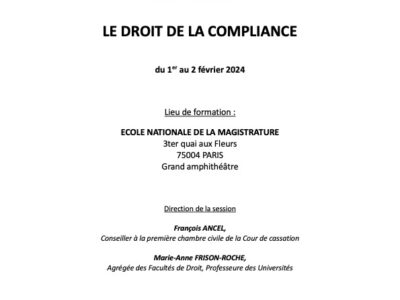
🎤Droit de la compliance : tour d’horizon (Compliance Law: Overview), in 🧮Droit de la compliance (Compliance Law)

► Full Reference: M.-A. Frison-Roche, "Droit de la compliance : tour d'horizon" ("Compliance Law: Overview"), in Droit de la compliance (Compliance Law), École nationale de la magistrature – ENM (French National School for the Judiciary) in collaboration with the École de Formation professionnelle des Barreaux du ressort de la cour d'appel de Paris – EFB (Paris Bar School), Paris, February 1, 2024. - ► This conference is given in French - 🧮see the full programme of this event (in French) - 🌐consult on LinkedIn a general presentation of this event, which links to a presentation of each speech (in French) - 🧱consult the scientific direction sheet of this event, which gives an account of the various speeches made - 🔲see the slides used to support the presentation (in French) - 🎤see a presentation of the other speech about "Compliance et Responsabilité civile : comprendre et raison garder" ("Compliance and Civil Liability: understanding and keeping our heads"), given at the same symposium - ► Presentation of the conference: Compliance Law is mysterious in itself, because it is still in creation1🕴️M.-A. Frison-Roche, 📝Naissance d'une branche du Droit : le Droit de la Compliance (Birth of a branch of Law : Compliance Law), to be published., because its presence and power are felt, but it is difficult to grasp it. It is necessary, however, because it deals with the most important, even the most dramatic, facts and carries with it the greatest ambitions. Magistrates must also "make the effort" to participate in the "adventure of Compliance Law", because it affects, and even overturns, all subjects, and because the Prosecutor and the Judge play an increasing role in it2🕴️M.-A. Frison-Roche (ed.), 📘Compliance Jurisdictionalisation, 2023.. Because the purpose of this conference is to introduce the two days of a training course designed for magistrates and open to lawyers, it only provides an "overview" of, so that we do not get lost in the sprawling regulations, the global mechanisms and the political ambitions that permeate them. Therefore, without going into any of the subjects, it is about opening up four ways of entering what is a branch of Law that is being born before our eyes: 1. Understanding Compliance Law through "regulations" 2. Understanding Compliance Law through "tools"3🕴️M.-A. Frison-Roche (ed.), 📘Compliance Tools, 2020. 3. Understanding Compliance Law through "methods" 4. Understanding Compliance Law through "goals"4🕴️M.-A. Frison-Roche (ed.), 📘Compliance Monumental Goals, 2023. The four approches are legitimate because the four dimensions are articulated in the legal system, notably case law. But the more positive Law is consolidated, the more its normativity through the goals that give normativity, or even a simplicity without which the whole is not humanly controllable. These Goals are Monumental and Europe bears them more and better than other areas of the world5🕴️M.-A. Frison-Roche (ed.), 📕Pour une Europe de la Compliance (For the Europe of the Compliance), 2019.. - 🌐follow Marie-Anne Frison-Roche on LinkedIn 🌐follow Marie-Anne Frison-Roche on Instagram 🌐subscribe to the Newsletter MAFR Regulation, Compliance, Law

Conferences

🎤Compliance et responsabilité civile : comprendre et raison garder (Compliance and Civil Liability: understanding and keeping our heads), in 🧮Droit de la compliance

► Full Reference: M.-A. Frison-Roche, "Compliance et Responsabilité civile : comprendre et raison garder" ("Compliance and Civil Liability: understanding and keeping our heads"), in Droit de la compliance (Compliance Law), École nationale de la magistrature – ENM (French National School for the Judiciary) in collaboration with the École de Formation professionnelle des Barreaux du ressort de la cour d'appel de Paris – EFB (Paris Bar School), Paris, February 1, 2024. - ► This conference is given in French. - 🧮see the full programme of this event (in French) - 🌐consult on LinkedIn a general presentation of this event, which links to a presentation of each speech (in French) - 🧱consult the scientific direction sheet of this event, which gives an account of the various speeches made - 🔲see the slides used to support the presentation (in French) - 📝This conference and the Working Paper on which it is based are to be linked with the article to be published in the book📘Compliance Obligation  - 🎤see a presentation of the conference "Droit de la Compliance : tour d'horizon" ("Compliance Law: overview"), given at the same symposium - ► Presentation of the conference : It is difficult, even artificial, to separate the presentation of the relationship between Compliance Law and Civil Liability from the consideration given in Compliance to Criminal Liability, sanctions and the whole contractual organisation. But, if only for reasons of time, this will be done. The chosen method consists of using decisions handed down either under Compliance Law, an emerging branch of Law of which an overview has been given before📎1🕴️M.-A. Frison-Roche, 🎤Droit de la Compliance : tour d'horizon (Compliance Law: overview), 2024., or under Special Liability Laws, such as Company Law (but here too the field of analysis is huge), or under Ordinary Civil Liability Law. The latter is often the preferred approach. It always seems that civil liability and Compliance Law are both intimate and have a difficult relationship. To understand them, before embarking on crusades in one direction or another, it is technically necessary to look at the liabilities attached to the application of "compliance regulations" imposed on economic operators, who contractualise the resulting legal obligations and whose third parties may also rely on breaches on the grounds of civil liability. This is the first stage of the analysis. Much is made of the Vigilance technique. Even if this is the advances point of Compliance, we also need to look at the GDPR, the French co-called "Sapin 2" law, Anti-Corruption, etc. However, civil liability is not the same depending on whether the obligation, legal and/or contractual, in relation to which it arises as a cause of action, gives rise, depending on the case, the text and the person, to an obligation of means or an obligation of result. If there is one principle to bear in mind, particularly in the mind of the judge, it is that, unless a text or clause provides otherwise, an obligation is an obligation of means. This essential question raises the need to better define the "Compliance Obligation", which consists of prevention and detection, with the economic operator making his "best efforts" with regard to the monumental goals to which the various regulations (thus finding their unity) are normatively anchored. The Ex Ante evidential dimension thus comes to the fore. In the second part of the analysis, which continues to be based on court decisions, we need to measure the "points of contact" between these "special compliance responsibilities" and the Ordinary Law of Civil Liability. Indeed, because this is a profound movement that runs through the entire legal system, expressing a social demand that distinguishes Western law from the rest of the world, Ordinary Liability Law has long had a preventive dimension and targets operators in a different way, not only because of their power, but also because of their "mission". This is expressly stated in the case law, and these points of contact do not justify opposing the two branches. It would only be if Compliance Law were confused with its instrument, "conformity", and if new principles were invented in an Ordinary Law, that clashes could arise. In the third stage of the analysis, which can be applied to the principles at stake today, it should be remembered that while there is no general Compliance Obligation under Ordinary Law, which implies detecting and preventing for oneself and for others any breach of any applicable regulation likely to harm others, there is a principle of freedom, as the Conseil constitutionnel (French Constitutional Council) regularly reminds us. Unless we change the legal system so that people become nothing more than subjects who obey all regulations and let it be seen that they do so, with the judge's role being limited to punishing them for not doing so. Indeed, the principle of freedom remains the foundation both of the Ordinary Civil Liability Law (and not of repression, as in Chinese Law) and of the Special Law of Compliance (and not of conformity, as in Chinese law). In conclusion, it appears that the evolution of Civil Liability, in particular due to the spirit of a Compliance Law that is articulated with it, is leading to a twofold movement: from Ex Post liability to Ex Ante responsibility📎2🕴️M.-A. Frison-Roche, 🚧Ex Ante Responsibility, 2022 ; 🕴️M.-A. Frison-Roche, 📝La responsabilité ex ante, pilier du droit de la compliance (Ex Ante Responsibility, pillar of Compliance Law), 2022, and from Liability to Accountability. To accompany this movement, alliances are being forged and must be fostered, which brings Compliance Law face to face with Competition Law, alliances often forged by contract and for which the role of the judge is being renewed, particularly through mediation techniques. - 🌐follow Marie-Anne Frison-Roche on LinkedIn 🌐follow Marie-Anne Frison-Roche on Instagram 🌐subscribe to the Newsletter MAFR Regulation, Compliance, Law

Conferences

🎤Conclusion. Compliance et contrats publics : une alliance naturelle (Conclusion. Compliance and Public Contracts: a natural alliance), in 🧮Compliance et contrats publics

► Full Reference : M.-A. Frison-Roche, "Conclusion. Compliance et contrats publics : une alliance naturelle" ("Conclusion. Compliance and Public Contracts: a natural alliance"), in M.-A. Frison-Roche, C. Gilles & A. Oumedjkane (dir.), Compliance et contrats publics (Compliance and public contracts), Journal of Regulation & Compliance (JoRC), Centre de recherches et d’études administratives de Montpellier (CREAM) and Centre d’Études et de Recherches Comparatives Constitutionnelles et Politiques (CERCOP) of the Montpellier University, Faculté de droit et de science politique de Montpellier, 39 rue de l’Université, Amphiteatre C Paul Valéry, January 12, 2024 - 🧮see the full programme of this event - ✏️read the notes taken on the spot to draw up the symposium conclusion - 🌐consult on LinkedIn a general presentation of this event, which links to a presentation of each speech (in French) - 🧱consult the co-organisation sheet of this event, giving an account of the various speakers - ► English Summary of the conference: Firstly, it would appear that, as with all the contracts studied in the area of Compliance, public contracts are, for the public authorities or public companies, an instrument through which they implement the Compliance Obligation imposed on them by the laws and regulations. Public bodies involved in public contracts are particularly concerned because of the points of contact, even intimacy, between Compliance Law and the general interest. But the contract, whether public or private, remains in its classic conception what results from the expression of two wills which exchange their consents📎1🕴️M.-A. Frison-Roche, 🚧Compliance contract, Compliance clauses, 2022..   Secondly, in terms of free will, public contracts can be the means by which public bodies and their co-contractors express their conception of what needs to be done to preserve the future, for example in environmental and social matters. On the contrary, the seemingly technical issue of exclusions from public contracts, whether they be automatic exclusions or optional exclusions, expresses the extent to which economically powerful players (public authorities, municipalities, public companies) take care of each other. In this respect, Compliance Law runs counter to Competition Law📎2🕴️M.-A. Frison-Roche, 🚧Competition Law and Compliance Law, 2018. and profoundly affects Public Procurement Law.   But thirdly, the public contract, in that it expresses the general interest by its very nature, its ex ante nature reinforces regulatory action and the nature of Compliance as an extension of Regulation📎3🕴️M.-A. Frison-Roche (ed.), 📕Régulation, Supervision, Compliance (Regulation, Supervision, Compliance), 2017.. It appears to be the most appropriate instrument for this new branch of Law, without the need for it to be transformed. This underlines the extent to which Compliance Law must draw on classical Law, in this case Administrative Law.   Moreover, fourthly, the public contract appears to be the model for the Compliance Contract. The public contract is a model first of all because of the central place of the general interest. The "Monumental Goals" in which the substantive definition of  Compliance Law is anchored📎4🕴️M.-A. Frison-Roche, 📝Compliance Monumental Goals, beating heart of Compliance Law, in 🕴️M.-A. Frison-Roche (ed.), 📘Compliance Monumental Goals, 2022. are a development of this. Admittedly, this concern for the general interest drives the public entity, but the "raison d'être" of companies more generally also incorporates it through "governance", profoundly renewed by Compliance. The public contract is also a model because the contract is handled by a powerful party, in this case the public entity. The subject of Compliance Law is the powerful company, and only that company, chosen because it is powerful and because it uses that power to achieve the Monumental Goals. In this respect, the "exorbitant powers" that characterise the public contractor are reconstituted either by Compliance laws or by stipulations, which confer on all obliged or voluntary companies – by virtue of CSR, which has many points of contact with Compliance Law as long as it is not confused with obeying the applicable regulations (which is what "conformity" is)📎5🕴️M.-A. Frison-Roche, 📝Reinforce the Judge and the Lawyer to impose Compliance Law as a characteristic of the Rule of Law, in 🕴️M.-A. Frison-Roche (ed.), 📘Compliance Jurisdictionalisation, 2023. – a power over the co-contractor, or even over third parties, equivalent to that of the public entity📎6🕴️M.-A. Frison-Roche, 🚧Use of private companies by Compliance Law to serve Human Rights, 2023..  The judge is the one who, through contractual litigation, both public and private, will bring to life these Monumental Goals desired by the State, carried by powerful entities (administration, companies), pledge of the Rule of Law📎7🕴️M.-A. Frison-Roche, 📝Reinforce the Judge and the Lawyer to impose Compliance Law as a characteristic of the Rule of Law, in 🕴️M.-A. Frison-Roche (ed.), 📘Compliance Jurisdictionalisation, 2023.. These include contractual mechanisms for information, audit, disclosure, control, collaboration, supervision, etc., through which the company, whether private or public, takes charge of the structure it has created, for example the value chain it masters📎8🕴️M.-A. Frison-Roche, 📝Assessment of whistleblowing and the obligation of vigilance regarding International Competitiveness, in 🕴️M.-A. Frison-Roche (ed.), 📘Compliance Monumental Goals, 2022..   It can therefore be concluded that this logic of a public contract as an instrument of administrative action to achieve goals of general interest, now fully taken up in Compliance Law, must be acculturated into the Ordinary Contract Law and must be preserved in Public Contract Law, which presupposes a new balance with Competition Law, which for a long time carried within Public Law a contract model without concern for sustainability or the collective interest. To achieve this, dialogue between judges is essential. The Conseil d'État (French Council of State) and the Cour de cassation (French Court of cassation) set the example📎9Conseil d'État (French Council of State) and Cour de cassation (French Court of cassation), 📗Du droit de la régulation au droit de la compliance : quel rôle pour le juge ?, La Documentation Française, 2024 (to be published).. - 📝This conference will be followed by an article, "The public contract, model of the Compliance Contract", which will be published in the book 📘Compliance and contract. - 🌐follow Marie-Anne Frison-Roche on LinkedIn 🌐follow Marie-Anne Frison-Roche on Instagram 🌐subscribe to the Newsletter MAFR Regulation, Compliance, Law

Conferences

final speech of a scientific manifestation

🎥 5 leçons en conclusions ouvertes (5 Lessons in Open Conclusions), in 🧮Compliance, vigilance et médiation

► Full Reference: M.-A. Frison-Roche, "Conclusion", in M. Boissavy, H. Dehghani-Azar, and M.-A. Frison-Roche (dir.), Journal of Regulation & Compliance (JoRC) and Conseil national des Barreaux (CNB), Compliance, vigilance et médiation (Compliance, Vigilance and Mediation), Amphitheatre of the Conseil national des Barreaux, November 30, 2023. - 🧮see the full programme of this event - 🌐follow Marie-Anne Frison-Roche on LinkedIn 🌐follow Marie-Anne Frison-Roche on Instagram 🌐subscribe to the Newsletter MAFR Regulation, Compliance, Law

Conferences

conference

🎤Participation in the🏛️Law Day🧮Normes de Responsabilité Sociale des Entreprises /RSE & Devoir de Vigilance (Corporate Social Responsibility Standards /CSR & Duty of Vigilance)

🌐follow Marie-Anne Frison-Roche on LinkedIn 🌐subscribe to the Newsletter MAFR Regulation, Compliance, Law - ► Full Reference: M.-A. Frison-Roche, Participation à la Table ronde "Normes de Responsabilité Sociale des Entreprises (RSE & Devoir de Vigilance)" (Participation in the Round Table "Corporate Social Responsibility Standards (CSR & Duty of Vigilance)"), in Fribourg University, Journée du Droit, Fribourg University, Pérolles site, room C230, October 2, 2023. - 🧮see the full programme of this event 🎥​watch the video of this event (in French) - 🌐read the report written in French with photos, tags and links on LinkedIn and also with links to each the speech - ► General presentation of the event : This conference, build around 4 presentations and a debate between the speakers and then with the audience, aimed at explaining and understanding this fundamental movement and the new texts that express it in Switzerland, even if it is French law, such as the so-called 'Vigilance' law of 2017 and the draft European CS3D directive, because on the one hand it is a movement that begins with legal technique and on the other hand the texts in question are extraterritorial in scope, if only because of the notion of 'value chain'. In the first part of this round table, and to set the scene, I will outline the origin and content of the French 'Vigilance' law, the way in which the draft directive draws heavily on it, its relationship with Compliance Law, of which it constitutes the 'advanced point', and the decisive role it gives to the courts, in the general movement of the jurisdictionalisation of compliance. The purpose of this is to allow the discussion to get underway. 🕴️Idris Abdelkhalek, PhD candidate and lawyer, introduced the speakers and led the debate between them and the audience. He took questions from the audience on the intensity of the obligation weighing on companies, in particular between civil liability and criminal liability, between the obligation of means and the obligation of result, and on the way in which the duty of vigilance is applied to specific sectors such as defence. - ► Presentation of my speech : the subject of which was Presentation of French Vigilance law, European perspective and European Compliance System. My presentation was divided into four points. Firstly, I outlined the state of Law in France, in the novelty represented by the 2017 law known as the "Vigilance" law, whose principles are simple and strong, principles that are situated in the aims pursued, and the way in which this law inspires what is currently being negotiated: the CS3D Directive. Secondly, I stressed the need for companies to master these often technically complicated corpus, especially if we take into account the link between Vigilance and the CSRD directive on sustainability reporting and extra-financial information.  Thirdly, I have shown that an overall understanding can nevertheless be achieved, and that the technical nature of the 'tools' is better mastered if we place the duty of vigilance within Compliance Law, of which it constitutes the 'advanced point'. All of this anchors its legal normativity in the 'Monumental Goals' it serves, which in Europe are humanistic, since the aim is to protect, now but above all in the future because it is a branch of ex ante Law, the human beings involved in the systems (banking, finance, energy, digital, climate, etc.). Fourthly, I emphasised that this understanding enables everyone to play their part: political and public authorities, businesses and stakeholders. Even more, and at the heart of the matter, the judge plays an essential role, even in countries with so-called 'continental' Law. I have used current cases as examples. This is just the beginning, and judges need to train, specialise and work in dialogue to achieve this. - ► Presentation of the other speakers contributions : 🕴️Marion Paradas, Ambassador of France to Switzerland and Liechtenstein, opened the conference and gave a general presentation of the theme. Ambassador Marion Paradas presented the international challenge represented by Law, illustrated here by the duty of vigilance. She emphasised that this is a major issue, both now and in the future, for Swiss companies and French companies based in Switzerland, particularly as this duty extends throughout the "value chain" and in view of the CS3D directive, which will also have consequences for both. 🕴️Isabelle Chabloz Waidacher, Professor at the Faculty of Law in Fribourg and holder of the Chair of Economic Law at the University of Fribourg, gave a Presentation of Swiss Law. In particular, she emphasised the state of Swiss Law, which could have gone further than the 2017 French law known as the "Vigilance" law if the popular initiative reference had led to the adoption of a law, and which currently focuses more on information and transparency obligations, with CSR taking over from there. But she stresses that the reality of value chains will force Swiss companies to take into account the requirements of the European directive currently being adopted. 🕴️Renaud Roussel, Managing Director of Colas Switzerland, presented an entrepreneurial view of the subject. He began by outlining the concrete steps taken by his industrial group in Switzerland and around the world to implement its commitments to protect the environment, for example by ensuring the proper use of materials used in road construction. He also stressed the importance of human rights, particularly in labour relations, in the context of CSR and vigilance. He went on to point out that it was not always easy for a large company to meet its own requirements, or the requirements imposed on it by the law, because in the construction and public works sector in particular it is often small companies that are competing, competitors who do not bear the costs of such obligations. -


Conferences

🎤Conclusion, in 🧮L’eau : entre protection de la ressource et conflits d’usage

🌐follow Marie-Anne Frison-Roche on LinkedIn 🌐subscribe to the Newsletter MAFR Regulation, Compliance, Law - ► Full Reference: M.-A. Frison-Roche, "Conclusion", in Club des avocats environnementalistes, L’eau : entre protection de la ressource et conflits d’usage, Maison des Avocats, Auditorium, September 28, 2023. - 🧮see the full programme of this event -

Conferences

🎤Participation in the panel “Vigilance (due diligence)”, in 🧮150th Anniversary Symposium of the ILA/ADI

🌐 follow Marie-Anne Frison-Roche sur LinkedIn 🌐subscribe to the Newsletter MAFR Regulation, Compliance, Law  - ► Full Reference: M.-A. Frison-Roche, participation in the panel "Vigilance (due diligence)", in International Law Association (ILA), 150th Anniversary Symposium of the ILA/ADI, Paris, 19 June 2023. - 🧮See the full programme of this event -

Conferences

🖥️L’usage des puissances privées par le droit de la compliance pour servir les droits de l’homme, in 🧮Puissances privées et droits de l’homme

🌐 follow Marie-Anne Frison-Roche on LinkedIn 🌐 subscribe to the Newsletter MAFR Regulation, Compliance, Law - ► Full Reference: M.-A. Frison-Roche, "L'usage des puissances privées par le droit de la compliance pour servir les droits de l’homme" ("The use of private forces by Compliance Law to serve human rights"), in Joel Andriantsimbazovina (dir.), Puissances privées et droits de l'homme, University of Toulouse, 16 June 2023. - 🧮Read the full programme of this event -

Conferences

🎥L’esprit des Lois en matière de vigilance (“Spirit of Law in Vigilance (Due Diligences) matters”), in 🧮Réalités et défis de la CSRD – Perspectives du devoir de vigilance

► Full Reference: M.-A. Frison-Roche, "L'esprit des Lois en matière de vigilance" ("Spirit of Law in Vigilance (Due Diligences) matters"), in Haut Conseil du Commissariat aux Comptes (H3C), Réalités et défis de la CSRD – Perspectives du devoir de vigilance, Paris, 14 June 2023. - 🎥watch the video of a part of the speech (in French) - 🧱read the description of the speeches of other speakers of this panel (in French) -   The speech took place during the third-round table devoted to the Perspectives du devoir de vigilance (Perspectives of the duty of vigilance), the first round table having been devoted to the lessons that the DPEF can provide for the CSRD, and the second to the transposition work of the CSRD. 🧮See the full programme of this annual event (in French) - ► English summary of the speech: In consideration of and in addition to what has been said, explained and even affirmed by other speakers, I have emphasised that 'vigilance" laws is not a 'regulation' like any other, but the leading edge of a very vast movement, Compliance Law, in which the 2017 French law is the driving force. For its application, the Judge, who is at the centre because of the will of the Legislator, is already taking into consideration the CS3D, the twin text of the CSRD. The texts must not be seen in isolation. If we isolate them from each other, they become almost incomprehensible, their meaning appearing uncertain, even threatening: we need to understand the spirit of these texts, which are indeed new, because they aim to provide answers to the new world we have entered. We must all rejoice in this political ambition, which is taking a legal form, and work to make it efficient: Legislators, companies, auditors, Regulators and Judges. If we do not stop at the letter, which would be to reduce Compliance to conformity, whereas Compliance Law, particularly Vigilance, is the extension of Regulation, finds its meaning in the Goals, we see that the French law of 2017, known as the "Vigilance law", which copies all the techniques of the French law known as "Sapin 2", gives goals simple to understand to the companies subject to the Legislator's will: detect and prevent environmental and human rights abuses in the value chains. The logic is therefore Ex-Ante. This Ex-Ante logic is retained by the CS3D directive. The Judge is central to it. But the responsibility which the NGOs will ask him to trigger is itself an "Ex Ante responsibility", the Compliance trials being like "accountability" trials, to ensure that companies act in accordance with the Goals set by the Legislator. This is transforming the role of the Judge, who must find effective solutions for the future. The discussion and the adversarial principle will become more important. Mediation will be encouraged. Stakeholders and the company will have to work together, and this method, which was intended by the Legislator for drawing up the vigilance plan, will be continued in the supporting legal proceedings. This will also transform the company, and the role played by those who accredit the information on the company's actions and long-term strategies: auditors therefore have a central role to play. - 🌐follow Marie-Anne Frison-Roche on LinkedIn 🌐follow Marie-Anne Frison-Roche on Instagram 🌐subscribe to the Newsletter MAFR Regulation, Compliance, Law