Economic Law, Regulation and Compliance

Conferences

conference

🎥La clé de la proportionnalité pour établir l’équilibre des obligations, pouvoirs et droits – Exemple de l’inclusion technique assurée par les opérateurs des noms de domaine, , in 🧮Durabilité de l’Internet : le rôle des opérateurs du système des noms de domaine. Compliance et régulation de l’espace numérique (Sustainability of the Internet: the role of the operators of the domain name system. Compliance and regulation of the digital space)

► Full Reference: M.-A. Frison-Roche, "La clé de la proportionnalité pour établir l’équilibre des obligations, pouvoirs et droits –  Exemple de l’inclusion technique  assurée par les  opérateurs des noms  de domaine" (The key to proportionality in balancing obligations, powers and rights – Example of technical inclusion by domain name operators), in M.-A. Frison-Roche et G. Loiseau (dir.), Durabilité de l'Internet : le rôle des opérateurs du système des noms de domaine (Sustainability of the Internet: the role of the operators of the domain name system. Compliance and regulation of the digital space). Compliance et régulation de l'espace numérique, 21 février 2025, organisé par le Journal of Regulation & Compliance et l'Institut de la Recherche en Droit de la Sorbonne (André Tunc – IRDJS), 12 place du Panthéon, Paris.   - 🧮see the full programme of this colloquium (in French) - ► Summary of this conference:  The domain name operators operate in a liberal system and have internalised the tasks being technically inherent in the very architecture of the Internet, while the Public Authorities, because they recognise this nature, ensure in Ex Ante that there are no global failures. This translates into a system of obligations. All the more so since domain name operators not only bear multiple obligations but also, by order of the laws and regulations, impose them on others, for example on their co-contractors and users. It is from this perspective that  the Principle of Proportionality, which is central here, must be considered. It is another expression of the legal Principle of Necessity, which must be conceived in terms of goals: what is proportionate is what is necessary to achieve the objective with regard to which the duties and prerogatives are entrusted and/or exercised. This is why it is first necessary to recall and explain what the Principle of Proportionality is with regard to the operators obligations covered by Compliance Law, which goes beyond jurisdictional powers such as sanctions or dispute resolution, to explain the teleological control of obligations and powers (I).  From this practical framework, the most relevant example is the technical obligation of inclusion (II) In the technical sense, Inclusion means that anyone who wants to enter the digital space must be able to do so and must be able to reach those who are there and be reached by others. This gives everyone the right to reach and be reached. Is it possible to go  further and ask for comfort for everyone and equality in this comfort and advantages to rebalance this accessibility? For instance, to know everything about everyone beyond this simple digital adresse? To ask domains names operators to help everyone to develop his/her personality in the digital space, compensating his/her lack of initial chance?  This is social and political inclusion. It is not the same thing. It does not have the same sources. It does not follow the same paths. Not the same forces. The Sustainability that is then projected can be cumulative. A distinction has to be made on the one hand, and a link made on the other. Moreover, in the name of mistreated social inclusion, can we mistreat technical inclusion, i.e. exclude a person from the digital space?  (III). - 🌐suivre Marie-Anne Frison-Roche sur LinkedIn 🌐suivre Marie-Anne Frison-Roche sur Instagram 🌐s'abonner à la Newsletter MAFR Regulation, Compliance, Law 🌐s'abonner à la Newsletter en vidéo MAFR Surplomb

Conferences

🏛️Hearing before a public body

🏛️ hearing before the French Working Group on the modernisation of French Arbitration Law, about the issue Arbitrage et Droit de la Compliance : est-il besoin d’un texte ? (“Arbitration and Compliance Law: is a text required?”)

► Full Reference: M.-A. Frison-Roche, hearing before the French working group on the modernisation of French Arbitration Law, about the issue Arbitrage et Droit de la Compliance : est-il besoin d'un texte ? ("Arbitration and Compliance Law: is a text required?"), Directorate of Civil Affairs' French Ministry of Justice, 13 February 2025. - ► Result of this presentation and the ensuing discussion, recorded in the working group's report published in March 2025 (published in French, translated her: "This report on the guiding principles would not be complete without mentioning the discussions in the working group on the introduction of a guiding principle requiring the arbitral tribunal to take into account "human, environmental and compliance issues, as well as respect for the fundamental rights and freedoms of the parties".This proposal gave rise to particularly heated discussions. Some saw it as a scarecrow likely to make French Arbitration Law less attractive and to weaken Arbitration awards, opening up cases of recourse on the pretext of bad faith, even though these values would already be taken into account in the review of domestic or international public policy.  Others, on the other hand, felt that such a text would have the advantage of enshrining an Arbitration Law connected to values that are not exclusively economically oriented, pointing out, moreover, that such a principle would not be redundant with the control of public policy, which intervenes ex post, whereas this text imposes Ex Ante responsability, and that this principle would allow a noteworthy introduction of Compliance Law in rbitration.  They added that the promotion of such values could make it possible to demonstrate a commitment to virtuous arbitration practice. In the light of these differences, after much hesitation, the decision was made not to include it in the draft Code, considering that the final choice was more a question of political dimension that the working group felt it could not decide on its own. ". (p. 36).   - ► English Summary of the presentation: My presentation deals with the relationship between Compliance Law and Arbitration, particularly International Arbitration. It is built around 12 successive points. The work I have carried out on these various points is associated with it. It precedes the answers I shall give to the questions put by the members of the working group and the ensuing discussion.   1. stagnation in the relationship between Arbitration and Compliance Law, due to continuing misunderstandings about Compliance 2. progress towards a better understanding of Compliance and the appropriateness of the arbitrator's role within Compliance Law 3. prospects for the growing relationship between Compliance Law and Arbitration, particularly with regard to the value chains built up by international companies 4. educational issues 5. time required to build a "culture of place" in this matter 6. "Doctrinal" difficulties 7. benefit from the production of a "doctrine of place" on this subject 8. going beyond the continental summa divisio of Public Law and Private Law 9. practical assimilation of Regulatory Contracts in sustainable sectors and chains 10. opening up the Arbitration World to this articulation with Compliance Law 11.  Can an official legal text contribute to this? 12.  example of the guiding principles of the French Code of Civil Procedure. -   🔓read the presentation developments below⤵️ - 🌐follow Marie-Anne Frison-Roche on LinkedIn 🌐follow Marie-Anne Frison-Roche on Instagram 🌐subscribe to the Newsletter MAFR Regulation, Compliance, Law 🌐 subscribe to the Video Newsletter MAFR Overhang/Surplomb

Conferences

conference

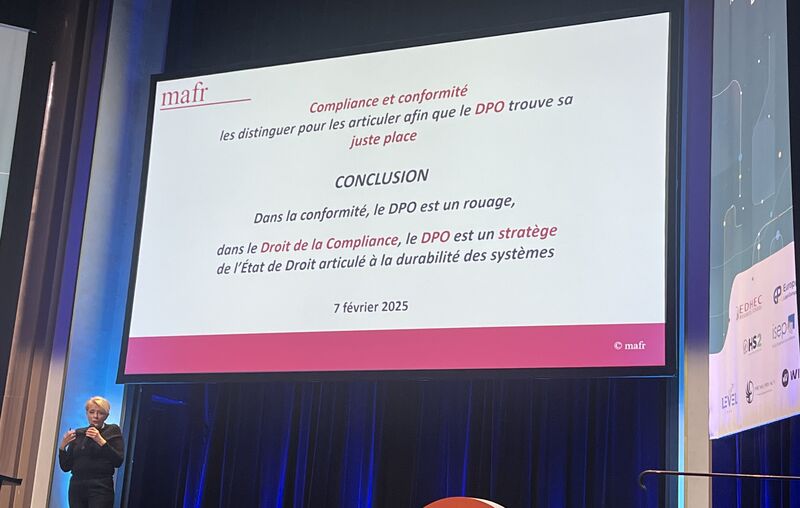
🎥”Compliance” et “conformité” : les distinguer/mieux les articuler afin que le DPO trouve sa juste place (Compliance Law” and “conformity” : distinguish between them/better articulate them so that the DPO finds their rightful place), in 🧮19ème Université AFCDP des DPO, in 🧮19ème Université AFCDP des DPO, in 🧮19ème Université AFCDP des DPO

► Full Reference: M.-A. Frison-Roche, "Compliance" et "conformité" : les distinguer/mieux les articuler afin que le DPO trouve sa juste place" ("Compliance Law" and "conformity" : distinguish between them/better articulate them so that the DPO finds their rightful place"), , in  Association française des correspondants à la protection des données à caractère personnel (AFCDP),  19ème Université AFCDP des DPO – La gouvernance des données ("Data Governance"), Maison de la Chimie, Paris, 7 February 2025 , 10h-10h45. - 🧮 see this manifestation full program (in French) - ⬜ see les slides on which this conference is done (in French)  - ► English Presentation of this conference: 'Compliance' and 'conformité' are often considered to be synonymous, notably in French in which the term "Compliance" is so often used to express only the "conformity" (conformité). This is a misunderstanding and a reduction, particularly of the role of professionals, notably DPOs. In fact, 'conformity' consists solely of ensuring that regulations are respected. Of course, an"active" conformity and "proven" conformity with these regulations, in particular the European GDPR. That and only that. If that's the case, then on the one hand this task impossible, because no one can comply with all the regulations, and it's the obsession with avoiding or reducing penalties that actually replaces the desire to do the right thing. On the other hand, algorithms are going to replace the DPO, a human being, because algorithms will identify 'non-conformity', then conformity, then write it down by "smart" contracts. But Compliance Law is more than conformity, which is only one of its tools. Compliance Law aim is to protect the human beings involved in the systems. Data protection is one of the best examples of this, and it underpins all the other areas of Compliance Law. Companies are asked to do less (obligation of means) and more: to help protect, by distinguishing between what must be revealed and what must be kept secret, sometimes to resolve conflicts between the 2 prescriptions, to educate, to make alliances. To built a real "governance". In this human and humanist mission that anchors Europe, the algorithm is flat. We are waiting for the DPO. In this human and humanist mission that anchors Europe, the algorithm is flat. We are waiting for the DPO. There is the role of guardian of the spirit of the texts, of strategic aid for the data controller, of adjuster of complementary or contradictory subjective rights, of adjustment of the texts in the European puzzle of a Regulatory Europe, which is being put in place in the humanist tradition which is its own to preserve the durability of the systems to protect the people who are forcibly or voluntarily involved in them. - 🌐suivre Marie-Anne Frison-Roche sur LinkedIn 🌐suivre Marie-Anne Frison-Roche sur Instagram 🌐s'abonner à la Newsletter MAFR Regulation, Compliance, Law 🌐s'abonner à la Newsletter en vidéo MAFR Surplomb/Overhang

Conferences

Conference

🎤Identifier et anticiper la pratique du Contentieux Systémique Émergent ; Présentation de 🧮L’expérience des juridictions dans le Contentieux Systémique Émergent

► Full Reference: M.-A. Frison-Roche, Identifier et anticiper la pratique du Contentieux Systémique Émergent (Identifying and anticipating the practice of Emerging Systemic Litigation) ; Presentation of L’expérience des juridictions dans le Contentieux Systémique Émergent (Courts Experience in Emerging Systemic Litigation), in cycle of conference-debates "Contentieux Systémique Émergent" ("Emerging Systemic Litigation"), organised on the initiative of the Cour d'appel de Paris (Paris Cour of Appeal), with the Cour de cassation (French Court of cassation), the Cour d'appel de Versailles (Versailles Court of Appeal), the École nationale de la magistrature – ENM (French National School for the Judiciary) and the École de formation des barreaux du ressort de la Cour d'appel de Paris – EFB (Paris Bar School), under the scientific direction of Marie-Anne Frison-Roche, 16 December 2024, 2pm.-6pm., Cour d'appel de Paris, Première Chambre (First Chamber). - 🧮see the full programme of this event - ⚙️This event has been conceived as a part of the cycle of conference-debates "Contentieux Systémique Émergent" ("Emerging Systemic Litigation"), organised on the initiative of the Cour d'appel de Paris (Paris Cour of Appeal), with the Cour de cassation (French Court of cassation), the Cour d'appel de Versailles (Versailles Court of Appeal), the École nationale de la magistrature – ENM (French National School for the Judiciary) and the École de formation des barreaux du ressort de la Cour d'appel de Paris – EFB (Paris Bar School), under the scientific direction of Marie-Anne Frison-Roche - ► English Summary of the conference:  - 🌐follow Marie-Anne Frison-Roche on LinkedIn 🌐follow Marie-Anne Frison-Roche on Instagram 🌐subscribe to the Newsletter MAFR Regulation, Compliance, Law 🌐subscribe to the Newsletter Surplomb, par MAFR

Conferences

conference

🎥Synthèse (Synthesis), in 🧮Les pratiques juridictionnelles au service d’un espace juridique pour le futur (In the Space of Justice, Jurisdictional Practices at the Service of the Future)

► Full Reference: M.-A. Frison-Roche, "Synthèse" ("Synthesis"), in M.-A. Frison-Roche (dir.), Dans l’espace de justice, les pratiques juridictionnelles au service du futur (In the Space of Justice, Jurisdictional Practices at the Service of the Future), in Cour de cassation, cycle of conferences "Penser les pratiques juridictionnelles au service d’un espace de justice" ("Thinking about jurisdictional practices in the service of an area of justice"), 21 November 2024, 4pm.-6pm. - 🧮see the program of this manifestation (in French) - ► English summary of this conference:  The topic covered takes account of the fact that this scientific event comes almost last in this cycle of conferences Penser les pratiques juridictionnelles au service d’un espace de justice ("Thinking about jurisdictional practices in the service of an area of justice"). Indeed, 'jurisdictional practices' have previously been addressed insofar as they are 'at the service of a European area of justice' (February 2023), enlightened (March 2023), attractive (June 2023), interactive (September 2023), peacemaking (December 2023). The approach here is different and complementary. The conference's starting point is the observation that, today, many new claims are made before Judges that relate directly to the Future. Admittedly, in their traditional role, Judges deal with the Future of disputed situations, but today it is the Future of Systems in their entirety that is sometimes submitted to them through a dispute or a claim. Moreover, they may be asked to find a systemic solution. The possible presence of future generations is just one sign of this change. The courtroom may seem unsuitable for trials of such gigantic proportions, both in terms of their subject matter and their impact. No doubt a distinction must be drawn between judges, some of whom may appear more familiar than others with the systemic issues that the Future brings with itself. Perhaps the judge's prudence should guide him/her in the use they make of their powers when they relate to the future, for example in the handling of sanctions, because the future by its very nature contains an element of the unknown, a fundamental prudence that the principle of the legality of offences and penalties expresses. But the future is not a blank page and Judges, without inventing it, can, indeed must, monitor the coherence of those who write the legal rules, if they are constitutional judges, and of those who write contracts and commitments, if they are civil and commercial judges. In order to fulfill their role, particularly with regard to the demands of stakeholders, judges need to think about and deal with this new systemic object before them: the future. To understand it, Judges draw on available jurisdictional practices, adjust others and combine them, using new methods. - 🧮see below the complete programme of this manifestation⤵️ - 🌐follow Marie-Anne Frison-Roche on LinkedIn 🌐follow Marie-Anne Frison-Roche on Instagram 🌐subscribe to the Newsletter MAFR Regulation, Compliance, Law

Conferences

Conference

🎤Choix et embranchements de compétences lorsqu’un enjeu de vigilance est allégué (Choice and Branching of Jurisdiction when a Vigilance issue is Alleged), in 🧮Le Droit processuel de la Vigilance (Vigilance General Procedural Law)

► Full Reference: M.-A. Frison-Roche, "Choix et embranchements de compétences lorsqu'un enjeu de vigilance est allégué" ("Choice and Branching of Jurisdiction when a Vigilance issue is Alleged"), in Le Droit processuel de la Vigilance (Vigilance General Procedural Law), in cycle of conference-debates "Contentieux Systémique Émergent" ("Emerging Systemic Litigation"), organised on the initiative of the Cour d'appel de Paris (Paris Cour of Appeal), with the Cour de cassation (French Court of cassation), the Cour d'appel de Versailles (Versailles Court of Appeal), the École nationale de la magistrature – ENM (French National School for the Judiciary) and the École de formation des barreaux du ressort de la Cour d'appel de Paris – EFB (Paris Bar School), under the scientific direction of Marie-Anne Frison-Roche, November 18, 2024, 11h-12h30, Cour d'appel de Paris, Cassin courtroom - 🕴️An other speaker to this conference is Natalie Fricero, Emeritus Professor at Côte d'Azur University 🧮see the full programme of this event - ⚙️This event was conceived as part of the "Emerging Systemic Litigation" cycle of conference-debates, organized by the Paris Court of appeal, in conjunction with the French Court of cassation, the Versailles Court of appeal, the French National School for the Judiciary and the Paris Bar School, under the scientific direction of Marie-Anne Frison-Roche. - ► English Summary of the conference: This speech opens the conference. It therefore logically focuses on the question of "jurisdictional competence". It is divided into successive points which are progressively linked to each other. The first point consists to insist on this rule : the organisation of the courts and their jurisdiction can never be detached from the substance of the matter in dispute. This explains why the issue of jurisdiction is such a source of passion for as long as the very definition of Vigilance remains so contentious, and why the 2021 legislature's belief that it could put out the fire has only served to exacerbate it. The second point relates to the first proposed solution, i.e. maintaining the exclusivity of the Paris First Judicial Court, which is acceptable in principle because by specialising judges acquire a "technical competence" but which presents a very damaging "Bibendum risk". The third point relates to the second solution proposed, namely the reference to the Motulskian notion of the 'basis of demand', which provokes a fork in the road, with the risk of interminable conflicts and divergent interpretations. The fourth point is the need to find the best solution, i.e. the least bad solution, consisting above all of forming practical alliances, without requiring new texts, for this particular type of litigation which does not come under any branch of Law and which justifies a dialogue between the heads of the courts.           - 🔓read the key points of this speech below ⤵️ - 🌐follow Marie-Anne Frison-Roche on LinkedIn 🌐follow Marie-Anne Frison-Roche on Instagram 🌐subscribe to the Newsletter MAFR Regulation, Compliance, Law 🌐subscribe to the Newsletter Surplomb, par MAFR

Conferences

Conference

🎤Les spécificités à concevoir dans l’audience publique des contentieux systémiques de vigilance (The Specific Features of Public Hearings to conceive on Vigilance Systemic Litigation), in 🧮Le Droit processuel de la Vigilance (Vigilance General Procedural Law)

► Full Reference: M.-A. Frison-Roche, "Les spécificités à concevoir dans l'audience publique des contentieux systémiques de vigilance" ("The Specific Features of Public Hearings to conceive on Vigilance Systemic Litigation"), in Le Droit processuel de la Vigilance (Vigilance General Procedural Law), in cycle of conference-debates "Contentieux Systémique Émergent" ("Emerging Systemic Litigation"), organised on the initiative of the Cour d'appel de Paris (Paris Cour of Appeal), with the Cour de cassation (French Court of cassation), the Cour d'appel de Versailles (Versailles Court of Appeal), the École nationale de la magistrature – ENM (French National School for the Judiciary) and the École de formation des barreaux du ressort de la Cour d'appel de Paris – EFB (Paris Bar School), under the scientific direction of Marie-Anne Frison-Roche, November 18, 2024, 11h-12h30, Cour d'appel de Paris, Cassin courtroom - 🕴️An other speaker to this conference is Natalie Fricero, Emeritus Professor at Côte d'Azur University 🧮see the full programme of this event - ⚙️This event was conceived as part of the "Emerging Systemic Litigation" cycle of conference-debates, organized by the Paris Court of appeal, in conjunction with the French Court of cassation, the Versailles Court of appeal, the French National School for the Judiciary and the Paris Bar School, under the scientific direction of Marie-Anne Frison-Roche. - ► English Summary of the conference:  - 🌐follow Marie-Anne Frison-Roche on LinkedIn 🌐follow Marie-Anne Frison-Roche on Instagram 🌐subscribe to the Newsletter MAFR Regulation, Compliance, Law 🌐subscribe to the Newsletter Surplomb, par MAFR
Conferences

Conference

🎤Considérer la géographie pour réussir le Devoir de Vigilance (Taking Geography into account for a successful Vigilance Duty), in 🧮Devoir de vigilance, quelles perspectives africaines ? Regards croisés en droit international, droit comparé et droit OHADA

► Full Reference: M.-A. Frison-Roche, "Considérer la géographie pour réussir le Devoir de Vigilance" ("Taking Geography into account for a successful Vigilance Duty"), concluding speech in Devoir de vigilance, quelles perspectives africaines ? Regards croisés en droit international, droit comparé et droit OHADA (Vigilance Duty : what African perspectives? Cross-analysis of International Law, Comparative Law and OHADA Law), Institut de Recherche en Droit des Affaires et du Patrimoine (IRDAP), Bordeaux, 15 November 2024. - 🧮see the full programme of this manifestation (in French) - ► English summary of this concluding speech: This concluding speech was made "on the bench", i.e. directly after listening to all the day's speakers. It is not, therefore, based on an a priori conception of the subject, but on the impression that emerged from the whole, as one speaker followed another. The general impression is that these compliance instruments, of which the vigilance tool is the spurred head, are only appropriate if they fulfill the purpose for which they were devised and imposed, which presupposes that they are appropriate to the concrete situations to which they apply: to the country, to the legislation that shapes and expresses this country, to its economy, to its population. There is certainly room for improvement. But Vigilance legal instruments, like Compliance Law, are new mechanisms that are in the process of taking shape: we must seek to improve them and find solutions: 🧱🕴🏻mafr, 🚧Duty of Vigilance: the way forward, 2024   This is not easy, especially if we get lost in the jigsaw puzzle of texts and decisions in which the vigilance technique fits, particularly at French, European and international level: 🧱🕴🏻mafr, 🚧Vigilance, a piece of the European puzzle, 2023   Listening to all the many and varied speakers, it is clear that progress needs to be made to ensure that the Vigilance instrument takes greater account of the concrete situations reflected in the various legal systems of African countries, and in particular the unified OHADA legal system. It can be done, as long as everyone is willing to bear it in mind. 🧱🕴🏻J.-B. Racine, 📝Geographical dominance in the choice and the use of compliance tools. Introductory remarks, in 🧱🕴🏻mafr (ed.), 📘Compliance Tools, 2021   The speakers demonstrated that the good feelings of Paris or Brussels can pave the way for African hell, for example when about the children labour. The same is true of the fight against corruption, as Mohamed Salah showed. 🧱🕴🏻M.M. Salah ,📝Conception and Application of Compliance in Africa, in 🧱🕴🏻mafr (ed.), 📘Compliance Tools, 2021 - Meanwhile, listening to each other, it appears that often, despite using the same words, the speakers were not talking about the same thing, particularly not in terms of what the very term "Vigilance" refers to, the difference between the French and English being a challenge because "due diligences" are not the same than Vigilance duty . This is a sign that what we call a duty, or an obligation, or a spontaneous commitment, or a legal order criminally sanctioned, which are not at all the same thing, shows the immaturity of this notion of "Vigilance". What's more, we sometimes talk about the climate, or human rights, or the need to fight corruption or money laundering. These latter concerns are undoubtedly covered by texts classified under Compliance Law, some of which assert that Vigilance is the cutting edge, while others claim that Compliance is alien to or merely a component of Vigilance, because Vigilance embraces ethics, while Compliance is merely obedience to the norm ('conformity'). It is clear that the absence of an agreement on definitions is a handicap in practice, as we do not know which legal regime will apply. This uncertainty is problematic in practice because the regulations don't  lay down definitions which alone make it possible to deduce the outline of the obligations of each party, particularly not those of the companies, which ask for instructions for use. Companies receive contradictory interpretations for the same situation, depending on who you are dealing with (a regulator or an NGO for example) or depending on the text (a text specific to the industrial activity, a text specific to the country, or a text from the country of the ordering company on the duty of vigilance, or a text from ordinary contract law or a text that will come from a soft law that remains rather mysterious).   This uncertainty feeds the passion that surrounds the issue of vigilance, with everyone speaking out, the specialists who want to talk about it being suspected of being a technocrat or captured, and those who don't speak out being the local population for whom others speak out. As a result, two phenomena are set to persist, which we had hardly anticipated but which are set to increase: the contractualisation of all vigilance mechanisms and the jurisdictionalisation of all vigilance organisation. - The first phenomenon is the contracting of Vigilance. This contractualisation is the means by which companies have been carrying out their legal compliance obligations for years, using a contractual art that is becoming increasingly sophisticated. We have very little information on these contracts, which are nonetheless what allow companies to obey the regulations and also to add to them, a combination of obedience and contractual freedom, the effects of which in practice have not yet been fully measured. 🧱🕴🏻mafr, 🚧Will, Heart and Calculation, the Three Traits Encercling the Compliance Obligation, 2024 🧱🕴🏻mafr (ed.), 📘Compliance and Contract, 2025   But they do raise essential questions. Firstly, they will bring back the jurisdiction of general courts , for example the commercial courts (tribunaux de commerce) in France, and the courts of the countries where the industrial operations take place: moreover, they are the natural route to international arbitration. They are a new type of contract, since they structure "value chains" (a managerial concept). 🧱🕴🏻mafr, 🚧Compliance Contract, Compliance Clauses, 2022   There are two key issues concerning these contracts: they directly concern African countries, their economic activity and their populations, as described throughout all the speeches. The first is to know who governs the structural apparatus constituted by these 'regulatory contracts' through which chains of activity are built as durable structures. Who is strong and who is weak, between companies and states? The second is to find out how much of the reality of the country and of local economic activity is taken into account by the subsidiary, and how much consideration is given to the local people involved: are the people who are actually involved really "taken into consideration" when we speak for them? Who is best placed to speak on their behalf, to defend them, to get to know them? If we want to contextualise, refine and get to know the situation as closely as possible, in other words if we want to have definitions so that we know what we are talking about, but at the same time start from geographical and human realities, then it is the Judge who appears because the court starts from the facts. - This is the second phenomenon that has emerged and is set to increase: the jurisdictionalisation of Vigilance. 🧱🕴🏻mafr (ed.), 📘Compliance Jurisdictionalisation, 2023 This is understandable, since the judge is able to take cognisance of the facts, the situation in Uganda or Tanzania, and what is often referred to as the "extraterritoriality" of the Compliance mechanisms being thus compensated for. However, the exclusive jurisdiction of the Paris Court of First Instance (decided in France by a 2021 law) may become more difficult, as it is even further away from Africa than the ordering company is. But it is precisely the contract judges who can be called upon to rule on the basis of Contract Law. This central role of the judge raises a number of procedural difficulties that have either not yet been resolved, moreover are not still being perceive 🧱🕴🏻mafr (dir.), 🧮Le Droit processuel de la Vigilance (Vigilance Genreral Procedural Law), 2024   At the interface between procedure and substance, evidentiary issues require the development of a new evidentiary system. When the relevant facts are in Africa but the company accountable for them is in France under legislation adopted in Europe, this must be taken into account. 🧱🕴🏻mafr, 📝The Judge, the Compliance Obligation and the Company. The Compliance Evidence System, in 🧱🕴🏻mafr (ed.), 📘Compliance Jurisdictionalisation, 2023   What's more, since the Monumental Goal is to prevent, manage and detect risks, it is the future that is the main object of proof. A difficult subject by its very nature of the future, which calls for caution. Caution is to be expected from Judges, who may prefer the solution of an agreement: the contract and the commitment come back, for example through mediation, among the methods of conflict resolution. But as close as possible to where it happens, OHADA's courts can then be called upon to hear States and populations.   What is more, in contractualisation (at which point the two major phenomena, contractualisation and jurisdictionalisation, enter into a dialectic), the clauses work together to activate the natural judge of the international contract, including vigilance clauses: the international arbitrator. 🧱🕴🏻L. Aynès, 📝How international arbitration can reinforce the Compliance Obligation, in 🧱🕴🏻mafr (ed.), 📘Compliance Obligation, 2025   OHADA has institutional arbitration mechanisms. Now is the time to guide them so that they open up Africa to Vigilance and open up Vigilance to Africa. In concrete terms. - 🌐follow Marie-Anne Frison-Roche on LinkedIn 🌐follow Marie-Anne Frison-Roche on Instagram 🌐subscribe to the Newsletter MAFR Regulation, Compliance, Law 🌐subscribe to the Newsletter Surplomb, par MAFR
Conferences

conference

🎤Entreprises assujetties au Droit de la Compliance : la charge de prouver la crédibilité de la trajectoire des actions entreprises à partir des structures mises en place (Companies subject to Compliance Law: the burden of proving the credibility of the course of action taken on the basis of the structures put in place), in 🧮Les techniques probatoires adéquates dans le Contentieux Systémique Émergent (Appropriate Evidentiary Techniques in Emerging Systemic Litigation), in cycle of conference-debates “Contentieux Systémique Émergent” (“Emerging Systemic Litigation”)

  🌐subscribe to the Video Newsletter MAFR Surplomb - ► Full Reference: M.-A. Frison-Roche, "Entreprises assujetties au Droit de la Compliance : la charge de prouver la crédibilité de la trajectoire des actions entreprises à partir des structures mises en place" ("Companies subject to Compliance Law: the burden of proving the credibility of the course of action taken on the basis of the structures put in place"), in Les techniques probatoires adéquates dans le Contentieux Systémique Émergent (Appropriate Evidentiary Techniques in Emerging Systemic Litigation), in cycle of conference-debates "Contentieux Systémique Émergent" ("Emerging Systemic Litigation"), organised on the initiative of the Cour d'appel de Paris (Paris Cour of Appeal), with the Cour de cassation (French Court of cassation), the Cour d'appel de Versailles (Versailles Court of Appeal), the École nationale de la magistrature – ENM (French National School for the Judiciary) and the École de formation des barreaux du ressort de la Cour d'appel de Paris – EFB (Paris Bar School), under the scientific direction of Marie-Anne Frison-Roche, October 14, 2024, 11am.-12.30pm., Paris Court of Appeal, Cassin courtroom - 🧮see the full programme of this event - ► English Summary of the conference : As developed below, the presentation shows that Systemic Litigation highlights what is incumbent on systemic companies: first and foremost, a permanent Evidential Obligation that they must satisfy with regard to stakeholders, in particular investors, partners, consumers and public opinion, whether or not there is a lawsuit. But it is essential to determine the purpose of this proof, the burden of which is permanent. It is a question of showing the efforts made on an ongoing basis by the crucial company to ensure that the system in which it operates does not collapse ("Negative Monumental Goal"), or even that it improves ("Positive Monumental Goal"). As these are inherently future factual goals, which is akin to impossible proof, it is a question of demonstrating "Credibility", i.e. showing that the structures put in place by the company and the behaviour already obtained by it, both internally and externally, generate a "trajectory" which can reasonably be expected to produce the effects expected by the Legislator which places obligations on companies. This is relevant whatever the systems involved, be they banking, financial, energy, climate, digital, etc., and whatever the monumental systemic goal targeted, be it the fight against corruption, money laundering, harmful climate change, the establishment of effective equality between human beings, respect for others, etc. It is in this new conception that the traditional notions of the object of proof, the burden of proof, presumption, means of proof, exemption from proof, and above all the judge's evidentiary role, must be adjusted to the Systemic Litigation that is emerging. - 🌐follow Marie-Anne Frison-Roche on LinkedIn 🌐follow Marie-Anne Frison-Roche on Instagram 🌐subscribe to the Newsletter MAFR Regulation, Compliance, Law

Conferences

Conference

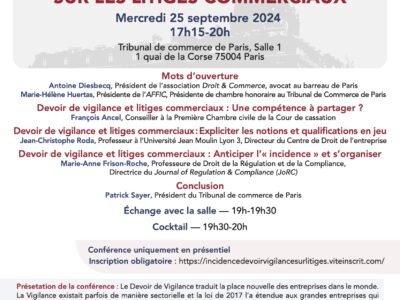
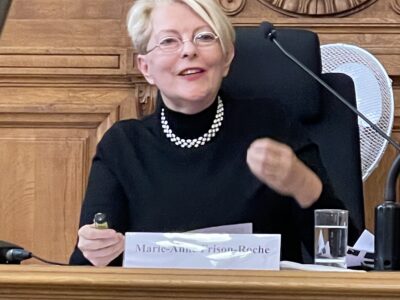
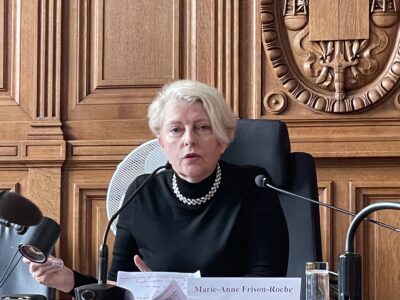
🎤Devoir de vigilance et litiges commerciaux : Anticiper l'”incidence” et s’organiser (Duty of vigilance and Commercial Litigation: Anticipating the “impact” and getting organised), in 🧮L’incidence du devoir de vigilance sur les litiges commerciaux (The Impact of the Duty of Vigilance on Commercial Litigation)

► Full Reference: M.-A. Frison-Roche, "Devoir de vigilance et litiges commerciaux : Anticiper l'"incidence" et s’organiser" ("Duty of vigilance and Commercial Litigation: Anticipating the "impact" and getting organised"), in L'incidence du devoir de vigilance sur les litiges commerciaux (The Impact of the Duty of Vigilance on Commercial Litigation), Tribunal de commerce de Paris (Paris Commercial Court), Droit & Commerce and Association Française en Faveur de l'Institution Consulaire (AFFIC), Tribunal de commerce de Paris, September 25, 2024, 17.15pm to 20pm - 🌐read the report of this speech on LinkedIn (in French) - 🧮see the full programme of this event (in French) - 🧱consult the scientific coordination sheet of this event - 🌐consult on LinkedIn a general presentation of this event (in French) - ► English Summary of the conference: After listening to the enlightening speeches of François Ancel and Jean-Christophe Roda, I had the great opportunity to emphasise, as they did, that the duty of vigilance, in the respect of French laws of 2017 and 2021, with a view to the transposition of the CS3D, does not imply, so brutally as has been said, a lack of knowledge by judges other than those of the Tribunal judiciaire de Paris (Paris First Instance Civil Court) of this new Law, which is the extension of Compliance Law, as François Ancel reminded us. Because Commercial Court judges deal with Contract Law on a daily basis, and because companies build their value chains through contracts that should be described as "regulatory contracts", the duty of vigilance has an "impact" on these disputes. These disputes may be of a "systemic" nature. This can only result not in jurisdictional trenches, but in "shared jurisdiction", along the lines drawn by François Ancel. This sharing must be built through a dialogue between judges, a necessary method on which Patrick Sayer concluded this elaborate conference on an essential and forward-looking subject. - 🌐follow Marie-Anne Frison-Roche on LinkedIn 🌐follow Marie-Anne Frison-Roche on Instagram 🌐subscribe to the Newsletter MAFR Regulation, Compliance, Law 🌐subscribe to the Video Newsletter MAFR Surplomb

Conferences

conference

🎤Pourquoi les textes et la pratiques sur le rapport de durabilité vont engendrer un Contentieux Systémique (Why the texts and practices on sustainability reporting will give rise to Systemic Litigation), in 🧮Le rapport de durabilité : obligation et Contentieux Systémiques Émergents (The Sustainability Report: Emerging Systemic Obligation and Litigation), in cycle of conference-debates “Contentieux Systémique Émergent” (“Emerging Systemic Litigation”)

► Full Reference: M.-A. Frison-Roche, "Pourquoi les textes et la pratiques sur le rapport de durabilité vont engendrer un Contentieux Systémique" ("Why the texts and practices on sustainability reporting will give rise to Systemic Litigation"), in Le rapport de durabilité : obligation et Contentieux Systémiques Émergents (The Sustainability Report: Emerging Systemic Obligation and Litigation), in cycle of conference-debates "Contentieux Systémique Émergent" ("Emerging Systemic Litigation"), organised on the initiative of the Cour d'appel de Paris (Paris Cour of Appeal), with the Cour de cassation (French Court of cassation), the Cour d'appel de Versailles (Versailles Court of Appeal), the École nationale de la magistrature – ENM (French National School for the Judiciary) and the École de formation des barreaux du ressort de la Cour d'appel de Paris – EFB (Paris Bar School), under the scientific direction of Marie-Anne Frison-Roche, September 19, 2024, 11h-12h30, Cour d'appel de Paris, Cassin courtroom - 🧮see the full programme of this event - ► English summary of the conference: Systemic Litigation refers to a specific category whose proposed category in 2021 refers to "cases" brought before the courts, sometimes specialised, sometimes under ordinary law courts: these are cases in which not only are the parties involved in their dispute but also a system is itself involved, with the procedure and the judge having to allow the interests of the system to be taken into consideration. However, what is also the subject of new terminology, namely the "Sustainability Report", reflects the same legal revolution: the company must be able to assess not only its economic and financial performance, which is the subject of accounting, but also its development in terms of what it does externally in terms of ESG and what the outside world does about it. In this perspective, the whole Information System is being transformed, and in different ways depending on the standards adopted, in the United States, Europe or elsewhere, either it is sufficient to obtain Information, no more, so that third parties can adjust their behaviour, mainly investments, or, as in Europe, Law includes a more substantial perspective, so that the company itself adjusts its own behaviour, its Governance, its position in the world, in a renewed relationship with its stakeholders. In Europe, saying and doing are intertwined, CSRD being twinned with CS3D. Moreover, we can therefore consider that non-financial information, through the sustainability report, its assurance of credibility and the regulation of the audit carried out on it, is itself a system. The sustainability report, inside the sustainability system, is then interwoven with other systems, which are themselves the subject of Emerging Systemic Litigation: firstly Vigilance, which has been studied as a field of systemic litigation, and then artificial intelligence field, which has been studied in the same way. The Sustainability Report, insofar as it intersects with the sustainability obligation implied by the duty of Vigilance, may be attracted to the Systemic Litigation to which Vigilance gives rise. In the same way, algorithms can be a tool for data accumulating and matching ESG criteria, which could have the same attraction effect. If this happens, this dimension will have to be present and understood, for example through amici curiae mechanism, in conjunction with the Regulators and the professions concerned. In addition, as in any emerging mechanism, and as we have seen for example in relation to rating agencies, Tort Law may interfere if the liability of either the company or the person who carried out the audit were to be appreciated, the systemic perspective then having to be integrated into the handling of the case, even before the non-specialised judge.   - 🌐follow Marie-Anne Frison-Roche on LinkedIn 🌐follow Marie-Anne Frison-Roche on Instagram 🌐subscribe to the Newsletter MAFR Regulation, Compliance, Law

Conferences

🎤Les deux rencontres entre l’intelligence artificielle et le Contentieux Systémique (The two meetings between Artificial Intelligence and Systemic Litigation), in 🧮L’intelligence artificielle, nouveau champ de contentieux systémique (“Artificial intelligence, new field of systemic litigation”), in cycle de conférences-débats “Contentieux Systémique Émergent” (“Emerging Systemic Litigation”)

► Full Reference: M.-A. Frison-Roche, "Les deux rencontres entre l'intelligence artificielle et le Contentieux Systémique" ("The two meetings between Artificial Intelligence and Systemic Litigation"), in L’intelligence artificielle, nouveau champ de Contentieux Systémique (Artificial intelligence, new field of Systemic Litigation), in cycle of conferences-debates "Contentieux Systémique Émergent" ("Emerging Systemic Litigation"), organised on the initiative of the Cour d'appel de Paris (Paris Cour of Appeal), with the Cour de cassation (French Court of cassation), the Cour d'appel de Versailles (Versailles Court of Appeal), the École nationale de la magistrature – ENM (French National School for the Judiciary) and the École de formation des barreaux du ressort de la Cour d'appel de Paris – EFB (Paris Bar School), under the scientific direction of Marie-Anne Frison-Roche, June 24, 2024, 11am-12.30pm, Cour d'appel de Paris, Cassin courtroom. - 🧮see the full programme of this event - ► English Summary of the conference: In the general presentation on the theme itself, I underlined "The two meetings between Artificial Intelligence and Systemic Litigation". The focus of this conference is not the state of what is usually called Artificial Intelligence, but rather how to correlate AI and "Emerging Systemic Litigation" (ESL). This involves recalling what "Systemic Litigation" is (1), then looking at the contribution of Artificial Intelligence to dealing with this type of litigation (2), before considering that the algorithmic system itself can be a subject of Systemic Litigation (3).   1. What is the Systemic Litigation that we see Emerging? On the very notion of "Emerging Systemic Litigation" (ESL), proposed in 2021, read : M.-A. Frison-Roche, 🚧The Hypothesis of the category of Systemic Cases brought before the Judge, 2021 Emerging Systemic Litigation concerns situations that are brought before the Judge and in which a System is involved. This may involve the banking system, the financial system, the energy system, the digital system, the climate system or the algorithmic system. In this type of litigation, the interests and future of the system itself are at stake, "in the case". The judge must therefore "take them into consideration"📎1🕴️Fr. Ancel, 📝Compliance Law, a new guiding principle for the Trial?, in 🕴️M.-A. Frison-Roche (ed.), 📘Compliance Jurisdictionalisation, 2024.. In this respect, "Emerging Systemic Litigation" must be distinguished from "Mass Litigation". "Mass litigation" refers to a large number of similar disputes. The fact that they are often of "low importance" is not necessarily decisive, as these disputes are important for the people involved and the use of A.I. must not overpower the specificity of each one. The fact remains, however, that the criterion for Systemic Litigation is the presence of a system. It may happen that a mass litigation calls into question the very interest of a system (for example, value date litigation), but more often than not the Systemic Litigation we see emerging is, unlike mass litigation, a very specific case in which one party, for example, formulates a very specific claim (e.g., asking for considerable work to be stopped) against a multinational company, and will thus "call into question" an entire value chain and the obligations incumbent on the powerful company to safeguard the climate system, which is therefore present in the proceedings (which does not, however, entitle it to make claims, but which must be taken into consideration).   2. The contribution of Algorithmic Power in the conduct of a Systemic Litigation In this respect, AI can be a useful, if not indispensable, tool for mastering such Systemic Litigation, the emergence of which corresponds to a novelty, and the knowledge of which is brought before the Ordinary Law Judge. Indeed, this type of litigation is particularly complex and time-consuming, with evidentiary issues at the heart of the case, and with expert appraisal following on from expert appraisal. Expert appraisals are difficult to carry out. AI can therefore be a means for the judge to control the expert dimension of Systemic Litigation, in order to curb the increased risk of experts capturing the judge's decision-making power. The choice of AI techniques presents the same difficulties as those that have always applied to experts. It is likely that certification mechanisms, analogous to registration on expert lists, will be put in place, if we move away from construction by the courts themselves (or by the government, which may pose a problem for the independence of the judiciary), or if we want control over tools provided by the parties themselves, with regard to the principle of equality of arms due to the cost of these tools.   3. When it is the Algorithmic System itself that is the subject of a Systemic Litigation: its place is then rather in defense Moreover, the algorithmic system itself gives rise to Systemic Litigation, in that individuals may bring a case before the courts claiming to have suffered damage as a result of the algorithmic system's operation, or seeking enforcement of a contract drawn up by the system. It is in the realm of the Ordinary Contract and Tort Law that the system may find itself involved in the jurisdictional proceedings. It is noteworthy that, compared with the hypotheses hitherto favored in previous conference-debates, notably those of April 26, 2024 on Emerging Systemic Litigation linked to the Duty of Vigilance📎2🧮La vigilance, nouveau champ de contentieux systémique (Vigilance, new field of Systemic Litigation), in cycle of conference-debates "Contentieux Systémique Émergent" ("Emerging Systemic Litigation"), organised on the initiative of the Cour d'appel de Paris (Paris Cour of Appeal), with the Cour de cassation (French Court of cassation), the Cour d'appel de Versailles (Versailles Court of Appeal), the École nationale de la magistrature - ENM (French National School for the Judiciary) and the École de formation des barreaux du ressort de la Cour d'appel de Paris - EFB (Paris Bar School), under the scientific direction of Marie-Anne Frison-Roche, June 24, 2024., the systems involved have been taken into consideration more behind the claims articulated by the plaintiffs, since they allege that a system has been attacked. It would then be "civil society" acting against the company. In the case of the algorithmic system, the initial litigation is made up of allegations that accuse the system of infringing rights (e.g. copyright, right to privacy, etc.). However, the instance changes if the system is no longer presented as the potential "victim" but rather as the potential "culprit". In particular, it is much less clear what type of intervener in the proceedings, who is not necessarily a party to the dispute, should speak to explain the system's interest, particularly with regard to the sustainability and future of the AI system. This is an area for further consideration by heads of courts. -

Conferences

conference

🎤Participation au panel “Une Gouvernance responsable : vers un mieux vivre ensemble ?” (“Responsible corporate governance: towards a better way of living together”), in 🧮Grenelle du Droit 5

► Full Reference: M.-A. Frison-Roche, Participation in the panel "Une Gouvernance responsable : vers un mieux vivre ensemble ?" ("Responsible governance: towards a better way of living together"), in Grenelle du Droit 5. L'avenir de la filière juridique, Association française des juristes d'entreprise ("The future of the legal profession"), AFJE), Cercle Montesquieu and Paris Panthéon-Sorbonne University, Campus Port-Royal Université Paris 1 Panthéon-Sorbonne, 1 rue de la Glacière, 75013 Paris, June 12, 2024 - 🧮See the full programme of this event (in French) - 🎥watch the interview made just after this round-table discussion (in French) - 🪑🪑🪑🪑🪑 will also be taking part in this round-table discussion: 🕴️Yves Garagnon, Chairman of Dilitrust, 🕴️Pierrick Le Goff, lawyer, partner at De Gaulle Fleurance, 🕴️Sabine Lochmann, Chairman of Ascend, 🕴️Vincent Vigneau, President of the Commercial, Economic and Financial Chamber of the Cour de cassation (French Judicial Supreme Court) - ► English presentation of my intervention in this event's opening plenary  round-table: In this plenary round table which opens the event, devoted to the theme of 'responsible corporate governance', for my interventions based on my work I will have the opportunity to address more particularly these different perspectives: How the new Compliance Law, which gives concrete expression to the responsibility of enterprises in a new relationship with States and with civil society, constitutes a 'legal revolution 💡for the record, mafr,📝Compliance Law, 2016 ; (ed.) 📘Compliance Monumental Goals, 2022   how the judgment handed down by the Tribunal judiciaire de Paris (Paris First Instance Civil Court) on 28 February 2023 (Total Ouganda case) is remarkable and already constitutes a turning point in case law 💡for the record, mafr, 🎤audition as amica curiae, hearing of 26 October 2022 before the first instance Paris Court; (ed)📘Compliance Jurisdictionalisation, 2024   how the relationship between States and enterprises is being renewed by this profound legal movement expressed by Compliance Law 💡for the record, mafr et M. Boissavy (ed.), 📕Compliance et droits de la défense – Enquêtes internes, CJIP, CRPC, mafr (dir.), 📘 Compliance Obligation, 2025   how internal lawyers have a decisive and central role to play in this movement, particularly in the mechanism of vigilance / corporate sustainability due diligence, the "cutting edge" of Compliance Law, 💡for the record, mafr, 📝Contract of Compliance, Compliance stipulations, 2023 ; (ed.), 📘Compliance and Contract, 2025   what is meant by the "Ex Ante responsibility" of enterprises, which does not necessarily entail their Ex Post liability, a distinction which lawyers are the guardians of 💡for the record, mafr, 📝La responsabilité Ex Ante, pilier du Droit de la Compliance ("Ex-Ante Responsability, Compliance Law Pillar"), 2021   how European Compliance Law is profoundly humanist, an identity that distinguishes European Compliance from American Compliance and, above all, from Chinese Compliance. 💡for the record, mafr (ed.), 📕Pour une Europe de la Compliance ("For the Europe of the Compliance"), 2017 - read the  article about this round table written by Delphine Bauer in Actu-Juridique (in French) - 🌐follow Marie-Anne Frison-Roche on LinkedIn 🌐follow Marie-Anne Frison-Roche on Instagram 🌐subscribe to the Newsletter MAFR Regulation, Compliance, Law

Conferences

🎤Le Contentieux Systémique Emergent du fait du système numérique (“emerging systemic litigation arising from the digital system”), in 🧮Importance et spécificité du Contentieux Systémique Émergent, cycle de conférences-débats “Contentieux Systémique Émergent”

► Full Reference: M.-A. Frison-Roche, "Le Contentieux Systémique Emergent du fait du système numérique ("emerging systemic litigation arising from the digital system"), in Les contrôles techniques des risques présents sur les plateformes et les contentieux engendrés (Technical controls on the risks present on platforms and the disputes that arise), in cycle of conferences-debates "Contentieux Systémique Émergent" ("Emerging Systemic Litigation"), organised on the initiative of the Cour d'appel de Paris (Paris Cour of Appeal), with the Cour de cassation (French Court of cassation), the Cour d'appel de Versailles (Versailles Court of Appeal), the École nationale de la magistrature – ENM (French National School for the Judiciary) and the École de formation des barreaux du ressort de la Cour d'appel de Paris – EFB (Paris Bar School), under the scientific direction of Marie-Anne Frison-Roche, May 27,2024, 9h-10h30, Cour d'appel de Paris, Cassin room - 🧮see the full programme of this event - 🧮see the full programme of the entire cycle Contentieux Systémique Émergent (Emerging Systemic Litigation) - 🔲see the slides (in French), basis of this conference - 🌐read on  LinkedIn the summary of this conference les slides - 🎤read  the presentation of the second conference in this manifestation: "Un contentieux systémique in vivo : le cas dit des sites pornographiques" ("a Systemic Litigation in vivo: the case of pornographic prestations platforms") - 🧱read the general presentation of this scientific coordination of this manifestation and its various speechs - 🌐read on LinkedIn the summary of this manifestation in the Newsletter MAFR Regulation, Compliance, Law - ► Summary of this conference: This speech is a prelude to the three more specific speeches and aims to show how the digital system, by its very nature, produces and will produce "Systemic Litigation".  Systemic Litigation" is defined by "cases" (a procedural notion) brought before judges, who may be judges of first instance, or possibly emergency judges, in which the interests, or even the future, of a system are involved beyond the dispute between the parties.  This Systemic Case may be brought before a specialised judge, including the juridictional body of a Regulatory or Supervisory Authority, but also before a judge of ordinary Law, on the basis of a special text but possibly on the basis of a text of ordinary Law. This can lead to a fragmentation of litigation, even though the unity of the system remains, or even is at stake, in the present and in the future. The "digital system" is an example of the "natural" production of Systemic Litigation which arise as a result of the Digital System alone, in particular because of the systemic risks inherent in this system, and the fact that their prevention and management are internalised in the operators who have built and manage the system (Compliance Law). The issue is therefore one of Interregulation. Platforms in particular give rise to Systemic Litigation because of the specific nature of certain risks, for example disinformation, terrorism, destruction of rights (copyright being just one example), the risk of minors having access to content that is destructive for them, and so on. Digital Systemic Litigation has only just begun. It is essential that judges are prepared for this and that they face up to it together through dialogue.             - 🌐follow Marie-Anne Frison-Roche on LinkedIn 🌐follow Marie-Anne Frison-Roche on Instagram 🌐subscribe to the Newsletter MAFR Regulation, Compliance, Law

Conferences

🎤Synthèse, in 🧮Concurrence : les enjeux de la Compliance

► Full Reference: M.-A. Frison-Roche, "Synthèse" ("Synthesis"), in Concurrence : les enjeux de la Compliance​, May 24, 2024, Paris, Collège européen de Paris, Paris Panthéon-Assas University, 28 rue Saint-Guillaume - 🧮see the full programme of this event (in French):  🌐read the  la newsletter MAFR Law, Compliance, Regulation on 26 Mai 2024 about this colloquium and this synthesis (in English) - ► Summary of this concluding conference:The conference was based on the 'framework document' on conformity programmes published by the French Competition Authority, the Autorité de la concurrence, on 24 May 2022 and focused on one of the tools used, namely risk mapping. The care taken to bring together academics whose job it is to give an account of reality by classifying and naming it, which makes it easier to handle, and people who every day in enterprises find solutions to anticipate difficulties so that they can be resolved, or even prevented from arising, has borne fruit. - From all the presentations and discussions, 4 perspectives emerge, each showing what has been achieved, what may still emerge in interaction with all the other mechanisms in Compliance Law that incorporate risk mapping (for instance ,the French 2016 so-called "Sapin 2" law, the French 2017 so-called "Vigilance" law, the CS3D European directive, etc.) and the other mechanisms that are correlated with risk mapping (audit, internal investigations, evidence likely to be raised before a judge by the enterprise and/or by a stakeholder and what remains uncertain in this 2022 framework document.   - The first perspective is the basis of these recommendations, encouragement, methods, advice, etc. The second perspective is the means developed to establish and implement these compliance programmes. The third perspective is the scope of this framework document, which also depends to a large extent on the scope of the compliance programmes adopted by the firms themselves. The fourth perspective is that of the subjects of law who are obliged, or who benefit from the adoption of such  compliance programmes in Competition Law.   - During this conclusion, based solely on what each speaker had to say, I continued my reflections in each of these 4 directions. This reminded me of some of my work made in English on this subject:  M.-A. Frison-Roche (ed.), 📘Compliance Tools, ,2022   M.-A. Frison-Roche, 🚧 Support from Compliance Law for day-to-day management of Competition Law, 2021   M.-A. Frison-Roche, 🚧 Competition Law and Compliance Law, 2018   - 🌐follow Marie-Anne Frison-Roche on LinkedIn 🌐follow Marie-Anne Frison-Roche on Instagram 🌐subscribe to the Newsletter MAFR Regulation, Compliance, Law

Conferences

🎤Les voies d’innovations juridiques face aux nouveaux “défis climatiques” (“Innovative legal solutions to the new “climate challenges””), in 🧮Nouveaux défis – Regards croisés : Droit, Économie et Finance. Quel Droit face au Changement Climatique ? (“New challenges – Crossed perspectives : Law, Economics and Finance. What Law in the Face of Climate Change?”)

► Full Reference: M.-A. Frison-Roche, "Les voies d'innovations juridiques face aux nouveaux "défis climatiques" ("Innovative legal solutions to the new "climate challenges""), in C. Arnaud, O. de Bandt et B. Deffains (dir.), Nouveaux défis – Regards croisés : Droit, Économie et Finance. Quel Droit face au Changement Climatique ? (("New challenges – Crossed perspectives : Law, Economics and Finance. What Law in the Face of Climate Change?"), Banque de France (French Central Bank) and CRED/Paris Panthéon-Assas University, Paris, Centre de Conférence de la Banque de France, April 2, 2024 - 🧮See the full programme of this event - 🔲see the slides, basis of this conference (in French) - ► Summary of this conference: In response to the question of how the Law can produce 'innovations' to meet the 'climate challenges', the process is based on the three traditional sources of Law, which are, firstly, laws and regulations, secondly, the commitments of individuals, mainly contracts, and thirdly, court rulings. At first sight, the Law in its traditional conception and practice is weak in the face of climate change. This weakness is inherent in the nature of climate change, which is at once future, global and systemic, in the face of these three sources of Law, which do not address all three dimensions at once. The scale of the legal innovation required to ensure that one or more articulated sources can grasp the future, the global and the systemic is therefore clear. And yet this is what is happening. As far as laws and regulations are concerned, they do not seem very appropriate because they are, by their very nature, a territorial limit, and international treaties are very difficult to negotiate. The interweaving of European regulations, for example the CSRD and the CS3D, which mirror each other, may be more effective. As far as 'commitments' are concerned, a concept which in Law is not very precise outside of contracts and liability cases📎1🕴️M.-A. Frison-Roche, 📝What a commitment is, in 🕴️M.-A. Frison-Roche (ed.), 📘Compliance Obligation, 2024., contracts are above all a means for companies to fulfill their legal obligations, and a contract always implies a judge. At first sight, however, the judge is the least well placed to respond to 'climate challenges', particularly in France where he is said or wished to be powerless, where he rules on the past and where, especially the civil judge, he settles a one-off dispute between two singular parties. But a major change has occurred with the emergence of a new branch of law: the Compliance Law, a teleological branch of Law whose legal normativity is lodged in the Monumental Goals📎2🕴️M.-A. Frison-Roche, 📝Compliance Monumental Goals, beating heart of Compliance Law, in 🕴️M.-A. Frison-Roche (ed.), 📘Compliance Monumental Goals, 2023. that it pursues, namely the preservation of systems, for example the climate system. In France, the so-called "Sapin 2" law in 2016, followed by the so-called "Vigilance" law in 2017, illustrate this. And the Judge is at the centre of it all. In this global, systemic, extraterritorial perspective, the object of which is the future – Compliance Law is, moreover, rejected by many legal experts – the legislative innovation is major. Indeed, the law of 23 March 2017, known as "Vigilance" designated large companies, because they are "powerful", because they are "in a position to act" to "detect and prevent" breaches of the environment and human rights. The 2017 law copied the "compliance tools"📎3🕴️M.-A. Frison-Roche (ed.), 📘Compliance Tools, 2021. put in place by the Sapin 2 anti-corruption law: risk mapping, plans, alerts, audits, internal investigations, and so on.  Only large companies are subject to the Compliance Law, notably the Vigilance Law, since they are the only ones in a position to act, in this case "parent companies or principals", and borders are no longer limits since the obligation, creating personal liability for the company📎4🏛️Conseil constitutionnel (French Constitutional Council), March 23, 2017, decision No. 2017-750 DC, Loi relative au devoir de vigilance des sociétés mères et des entreprises donneuses d’ordre., extends throughout the "value chain". The notion and fact of "systemic dispute" is emerging before the courts. In France, the Paris Court of First Instance has exclusive jurisdiction. European legislation is proving more difficult to draw up, because although it is compulsory to provide information on these "extra-financial" subjects (CSRD), the directive on the duty of vigilance, which has just been adopted, does not go any further than the French law of 2017. On the second point, that of commitments, we are only at the beginning. Judges do not transform ethical statements into "unilateral legal commitments", and vigilance does not transform company law into co-management. But contracts do form a global network through which companies adjust their various legal obligations. This is why arbitrators, the only "global judges", will soon be involved in this systemic litigation📎5🕴️M.-A. Frison-Roche (ed.), 📘Compliance Obligation, 2024, of which a chapter is dedicated to "International Arbitration in support of the Compliance Obligation"., and more general case law is to come on "compliance contracts and clauses"📎6🕴️M.-A. Frison-Roche, 🚧Compliance contract, compliance clauses, 2022 ; 🕴️M.-A. Frison-Roche (ed.), 📘Contrat and Contract, 2024.. But the most innovative aspect undoubtedly comes from the courts. Perhaps and notably in France because it is from where we least expect it, the civil courts, that the imagination comes, but also the guarding of the great principles of the Rule of Law, because for the moment the case law is reasonable. This innovation has not come about proprio motu: the judges are not taking action, it is the NGOs that are conducting a kind of litigation policy, systematically giving formal notice to the major energy companies, but also to the major banks and insurers on climate issues, alleging non-compliance with their vigilance plans. The interim relief judge at the Paris Court of First Instance must then provide answers in systemic disputes, of which the so-called "Total Uganda"📎7🏛️Tribunal judiciaire de Paris (Paris First Instance Civil Court), summary rulings, February 28, 2023, No. RG 22/53943 and 22/53942, Total Ouganda. case is an example. The courts are demonstrating a great deal of innovation. The Court of First Instance's interim relief judge has appointed amici curiae📎8🕴️N. Cayrol, 📝L'amicus curiae, mesure d'instruction ordinaire, 2022., the Paris Court of Appeal has set up a specialised chamber📎9On the creation on the new 5-12 Chamber, Contentieux émergent – Devoir de vigilance et responsabilité écologique see 🕴️J. Boulard, 💬Contentieux systémique : "Il est important, pour les magistrats, de rester au plus près des réalités" (Systemic litigation: "It is important for judges to remain as close as possible to reality"), March 28, 2024., and training conferences have been set up on this "Emerging Systemic Litigation"📎10🕴️M.-A. Frison-Roche, 💬"Nous voyons émerger aujourd’hui le contentieux systémique" ("We are now seeing the emergence of the Systemic Litigation"), March 28, 2024 ; 🕴️M.-A. Frison-Roche, Coordination and animation of cycle of conference-debates 🧮Contentieux Systémique Émergent (Emerging Systemic Litigation). . In conclusion, Law is in the process of being rebuilt through a new branch of Law, Compliance Law, whose the very purpose, as an extension of and going beyond Regulatory Law📎11🏛️Conseil d'État (French Council of State) and 🏛️Cour de cassation (French Court of cassation), 📗De la régulation à la compliance : quel rôle pour le juge ? (From Regulation to Compliance: what role for the Judge?), 2024; 🕴️M.-A. Frison-Roche, 🚧The deployment of Regulatory Law through Compliance Law in the European project, 2023 ; 🚧Compliance Law loses the ties of Regulation Law but retains its principles : consequences for companies, 2018 ; 🚧From Regulation Law to Compliance Law, 2017., is to preserve systems, in particular the climate system, in a profoundly renewed role for judges📎12🕴️M.-A. Frison-Roche, 📝Le rôle du juge dans le déploiement du droit de la régulation par le droit de la compliance et ;🕴️Fr. Ancel, 📝Quel rôle pour le juge aujourd’hui dans la compliance ? Quel office processuel du juge dans la compliance ?, in 🏛️Conseil d'État et 🏛️Cour de cassation, 📗De la régulation à la compliance : quel rôle pour le juge ?, 2024 ; 🕴️Fr. Ancel, 📝Le principe processuel de compliance, un nouveau principe directeur du procès ?, in M.-A. Frison-Roche (dir.), 📕La juridictionnalisation de la Compliance, 2023 ; 🕴️M.-A. Frison-Roche, 📝Le Juge requis pour une Obligation de Compliance effective, in 🕴️M.-A. Frison-Roche (dir.), 📕L'Obligation de Compliance, 2024.. - 🌐follow Marie-Anne Frison-Roche on LinkedIn 🌐follow Marie-Anne Frison-Roche on Instagram 🌐subscribe to the Newsletter MAFR Regulation, Compliance, Law

Conferences

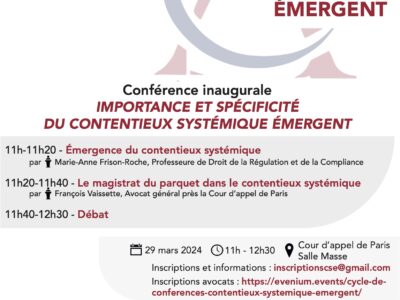
🎤L’émergence du contentieux systémique (Emergence of the Systemic Litigation), in 🧮Importance et spécificité du Contentieux Systémique Émergent, cycle of conference-debates “Contentieux Systémique Émergent”

► Full Reference: M.-A. Frison-Roche, "L’émergence du Contentieux Systémique" ("Emergence of the Systemic Litigation"), in Importance et spécificité du Contentieux Systémique Émergent (Importance and specificity of the Emerging Systemic Litigation), in cycle of conferences-debates "Contentieux Systémique Émergent" ("Emerging Systemic Litigation"), organised on the initiative of the Cour d'appel de Paris (Paris Cour of Appeal), with the Cour de cassation (French Court of cassation), the Cour d'appel de Versailles (Versailles Court of Appeal), the École nationale de la magistrature – ENM (French National School for the Judiciary) and the École de formation des barreaux du ressort de la Cour d'appel de Paris – EFB (Paris Bar School), under the scientific direction of Marie-Anne Frison-Roche, March 29, 2024, 11h-12h30, Cour d'appel de Paris, salle Masse - 🧮see the full programme of this event - 🧮see the programme of the entire cycle Contentieux Systémique Émergent - 🌐consult on LinkedIn the report of this speech (in French) - 🌐consult on LinkedIn a general présentation of this event, which links to a presentation and a report of each speech (in French) - 🧱consult the scientific coordination sheet of this event, which gives an account of the various speeches made - 🔲see the slides used to support this intervention (in French) - 🚧read the bilingual Working Paper which is the basis of this speech - ► English Summary of the conference: We are seeing the emergence of what should be referred to as a category of its own: the "Systemic Litigation". This concept, proposed in 2021📎1🕴️M.-A. Frison-Roche, 🚧The hypothesis of Systemic Cases brought before the Judge, 2021., refers to the hypothesis in which a system is 'involved' in a particular 'case' submitted to the judge. The presence of a system should not be confused with a systemic analysis of a phenomenon. The term 'cause' must be understood in the procedural sense, as used in article 5 of the Code civil (French Civil Code). Specifically, the prohibition contained in article 5 of the French Civil Code does not apply because a system thus involved calls for factual responses and solutions and not necessarily general and abstract solutions: the solution of a systemic nature and scope, that the presence of a system in a cause calls for, may be a factual solution, even if it radiates out from the system as a whole. But precisely because the presence of a system in the case often gives rise to a question that is itself systemic, the judge, if he wishes to comply with article 4 of the French Civil Code, must respond not only a minima by not evading the question, for example of systemic risks, but also fully by providing systemic solutions, for example remedies to preserve in the future the solidity and durability of the systems involved in the case.    These systems may be of different kinds: banking, financial, transport, health, energy, digital, algorithmic or climatic. Their presence in cases brought to the attention of judges, the variety and difficulties of which will be seen in later contributions, leads to basic questions relating to the emergence of Systemic Litigation: firstly, how can Systemic Litigation be defined? Secondly, what makes this category of litigation emerge? The answers to these two questions have essential practical consequences.  The new solutions must be based on a classic distinction, used in particular in criminal and administrative proceedings, which are more objective, but also in civil proceedings, notably by Hébraud, namely the distinction between the "party to the dispute/litigation" and the "party to the proceedings". Depending on whether it is accepted that the system should be considered as a "party to the litigation", which would allow it, through an entity that is legitimate in expressing it, to allege claims and formulate demands against an adversary, or as a "party to the proceedings", a much broader category, which would allow the judge to hear the interests of the systems involved without individuals being able, on behalf of a system, to formulate claims against or for the benefit of a party to the litigation.     This makes it possible to innovate while preserving the measure of which the judge is the guardian.   - 🌐follow Marie-Anne Frison-Roche on LinkedIn 🌐follow Marie-Anne Frison-Roche on Instagram 🌐subscribe to the Newsletter MAFR Regulation, Compliance, Law

Conferences

📝L’enjeu de la confidentialité des avis juridiques internes au regard des « Buts Monumentaux » de la Compliance

► Full Reference: M.-A. Frison-Roche, "L’enjeu de la confidentialité des avis juridiques internes au regard des « Buts Monumentaux » de la Compliance" ("The issue of confidentiality of in-house legal opinions with regard to the "Monumental Goals" of Compliance"), in L’instauration d’un Legal Privilege à la française. Le temps de l’action au service de la souveraineté et de la compétitivité de nos entreprises, Association française des juristes d'entreprise (AFJE), Association nationale des juristes de banque (ANJB) et Cercle Montesquieu, March 7, 2024, Maison de la Chimie, 28 rue Saint Dominique Paris - 📝On the same topic, read the article of Marie-Anne Frison-Roche "La compliance, socle de la confidentialité nécessaire des avis juridiques élaborés en entreprise" ("Compliance, the cornerstone of the confidentiality required for in-house legal opinions") - 🌐follow Marie-Anne Frison-Roche on LinkedIn 🌐follow Marie-Anne Frison-Roche on Instagram 🌐subscribe to the Newsletter MAFR Regulation, Compliance, Law