Other Videos

Videos

🎥 Compliance law: a strategic tool for a sovereign Europe (” Le droit de la compliance : un outil stratégique pour une Europe souveraine”)

► Full Reference: Frison-Roche, M.-A., Le droit de la Compliance : un outil stratégique pour une Europe souveraine (Compliance law: a strategic tool for a sovereign Europe), interview with Jean-Philippe Denis, recorded on July 3, 2021 and broadcast on September 17, 2021 -   🎥 Watch the interview, as broadcast on Xerfi Canal channels.    🎥Watch the interview enhanced with French subtitles - ►Summary: Compliance Law powerfully and clearly helps to build a sovereign Europe.  Compliance Law is not the annex of Competition Law; it is another branch of Law, which aims instead to rely on the de facto power of companies, when they are in a position to achieve the "Monumental Goals" that the Political Authorities have decided to achieve, which requires an alliance between them and those companies in a position to achieve these "Monumental Goals". Companies can do this because they are in a position to do so, in that they are well located to act, have the information, the technology and the adequate financial means.) Compliance is a construction tool, and not, as it is still sometimes presented, a means to limit the ability of those who are concretely able to build, i.e. the companies. The architect remains and must remain the Politics. But the company remains the master of the means to achieve these goals, and free to duplicate them in its own care, via CSR, "raison d'être" and ethics.  

Videos

French Financial Markets Authority decision of 11 December 2019 sanctioning the Bloomberg press organ for disseminating false information on the financial market: here, the ethical obligation converges with Financial Law

Watch the video commenting on the decision of the Commission des sanctions of the Autorité des marchés financiers – AMF (French Financial Market Authority Sanctions Commission). Read the decision. -   In 2015, a document supposedly emanating from the Vinci company reached the Bloomberg media announcing unexpected catastrophic results. The two journalists who received it immediately published it without checking anything, the Vinci listed shares losing more than 18%. It was a rude forgery, which a basic check would have established, a check which the journalists had not done. 4 years later, the Bloomerg company is punished for the breach to "disseminate false information" on the financial market, by a decision of the Sanctions Commission of the Autorité des Marchés Financiers (French Financial Markets Authority) of December 11, 2019. The company being sued argued that it was up to journalists to be accountable and not to itself, because on the contrary the firm had implemented both detection software and a code of conduct, even though there was no legal rule constraining it. In consequence, it would not possible to pursue it. But the AMF Sanctions Commission stresses that, independently of this, it is a general rule of ethics for journalists that obliges them to verify the authenticity of the documents they publish, which they did not, whereas an elementary check would have allowed them to measure that it is a rude forgery. In addition, the Sanctions Commission refers to the European Regulation on market abuses which in its article 21 targets the special status to be reserved for press freedom and the special status of journalists, but associates this ethical obligation to verify documents . However, the Sanctions Commission notes that this obligation, which was targeted by both the journalists' ethics and the reference text of Financial Law, was completely ignored by the two journalists. It is therefore up to the press agency to be accountable and to be punished. However, the media entreprise maintained that the balance between the principle of freedom of the press and the principle of freedom of opinion on the one hand and the principle of the protection of the financial market and of investors against false information disseminated requires an interpretation of the European Union Law, which must oblige the Sanctions Commission to ask a preliminary question to the Court of Justice of the European Union. The Sanctions Commission dismisses this request because it considers that the European texts are "clear", which allows the Sanctions Commission to interpret them itself. And precisely the European Regulation on market abuse in its article 21 provides for the exception in favor of the press and journalists but compels them to respect their ethics, in particular the verification of the authenticity of documents. In this case, they did nothing. They are clearly the authors of a breach attributable to the company. - In a less clear case, one could consider that this balance between two principles, both of public interest, is delicate and that an interpretation by the Court of Justice would always be useful. Indeed and more fundamentally, does Financial Law remain an autonomous Law, putting first the objective of the preservation of the integration of the financial market and the protection of investors or is it the advanced point of an Information Law protecting everyone against the action of any "influencer" (category to which Bloomberg belongs) consisting in disseminating inaccurate information (notion of "misinformation")? And that is not so "clear" ….   -

Videos

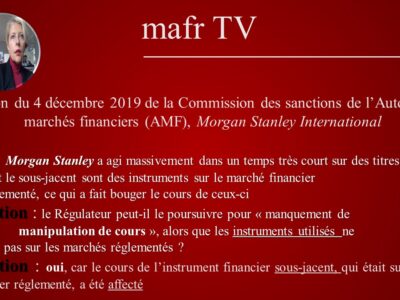
By its decision “Morgan Stanley International” of December 4, 2019, the French Financial Markets Authority Sanctions Committee specifies the interpretation of both restrictive but tacit texts and the system of evidence of breaches of breach of breach through that of price manipulation

Watch the video that presents, analyzes and measures the scope of the Commission des sanctions de l'Autorité des marchés financiers – AMF (French Financial Markets Authority Sanctions Committee) of December 4, 2019, Morgan Stanley International. - The bank, through its British subsidiary, had to answer before the Sanctions Committee of the Authority of the financial markets where it contested a notification of price manipulation grievances on financial instruments based on specific securities (OAT) issued by the Public Treasury French and put on  the regulated market, these first various financial instruments being themselves built elsewhere and offered on various national financial markets, for example for France FOAT, which are futures on these OAT not traded on a regulated market. The sentencing decision of 4 December 2019 is instructive. On the very principle of the competence of the administrative sanctioning authority (I) and on the evidentiary mechanism of the facts (II). This corresponded to the "3 elements of the infringement", which should in principle be found in the repressive administrative law, which is a "criminal matter." But as expressly stated in the decision, the intentional element is not required for market abuse. There remains therefore the legal element, which requires that the behavior be precisely targeted by a text, and the material element.   Let's see their fate.   I. LE PRINCIPE DE LEGALITE DES DELITS ET DES PEINES N'ENTRAVE PAS L'EFFET NATUREL DE LA DEFINITION "NATURELLE" DU COURS DU TITRE SOUS-JACENT AFFECTE PAR LA MANIPULATION En premier lieu la Banque contestait la compétence même du Régulateur à en connaître car ce n'est que postérieurement aux faits reprochés que les textes applicables ont dit qu'étaient sanctionnables les agissement sur des instruments financiers "liés" aux instruments financiers émis sur un marché réglementé. Au nom du principe d'analyse restrictive et de la non-rétroactivité des textes d'incrimination qui gouvernent la matière pénale, la Banque soutenait n'être pas apte à être poursuivie. La Commission des sanction écarte le moyen en affirmant qu'elle respecte ces principes inhérents à la matière pénale, mais qu'il faut regarder la finalité des textes. Or la manipulation de cours, manquement ici en cause, est un manquement parce que l'agissement a pour objet ou pour effet de perturber le cours du titre qui est sur le marché réglementé. En agissant sur un instrument financier, même situé sur un marché non-réglementé, dont le sous-jacent est sur un marché réglement, le cours de celui-ci est perturbé, alors la manipulation du premier ayant pour effet de perturbé le cours du second justifie la pourrsuite et la sanction. Sans qu'il y ait rétroactivité des textes.    II. LES PRESOMPTIONS SIMPLES D'AGISSEMENTS LEGITIMES OU ILLEGITIMES SUR LES TITRES ET LE "FAIT JUSTIFICATIF DE COMPLIANCE" En second lieu, la Banque soutient que son action sur les différents instruments financiers sur les différents marchés a été justifiée par son intérêt légitime démontré en raison de l'absence de liquidité du titre et pour dénouer une position déficitaire appelant une intervention massive dans un temps très court de sa part sur plusieurs marchés en même temps et que si le cours en a été modifié, il n'en est pas devenu pour autant "anormal", ce qui est un élément matériel du manquement.  La Commission des sanctions pose tout d'abord que l'opérateur peut à la fois avoir des motifs légitimes démontrés d'agir sur un titre et néanmoins opérer sur celui-ci une manipulation de cours.  Revenant sur la définition de la manipulation de cours, la Commission ne reprend pas la notion d'"anormalité" dans le sens où il faudrait que le cours ne soit pas conforme aux attentes, il faut mais il suffit qu'il soit inattendu : le "normal" est donc dans le sens de l'inhabituel. Si la Banque parvient à justifier son action, comme elle arrive à le faire pour un titre (le FGBL et FGBX), alors il n'y a pas de sanction (n°90 de la décision) mais dans les autres cas la Commission estime que les agissements ont eu pour effet de faire varier le cours des sous-jacents émis par le Trésor public français (OAT), ne s'expliquent pas autrement, les autres opérateurs agissant comme si la hause de la valeur des OAT avait une autre origine. Or, la Banque avant cet effet a revendu immédiatement les OAT. L'ensemble des agissements ayant duré moins d'un quart d'heure, la Commission considère que l'élément matériel de la manipulation de cours est constitué.  Pourtant la Banque se prévalait d'une sorte de fait justificatif : elle avait agi en "conformité" avec "une pratique de marché" (article 631-1 Réglement général de l'AMF).  La Commission récuse cela, car elle considère que ce texte ne vise que trois hypothèses : contrats de liquidité obligatoires, contrats de liquidité sur actions et acquisitions d'actions…. pour les opérations de croissance externe". C'est donc tout à fait une conception très restrictive que la Commission adopte pour ce qui vient en restriction des textes répressifs…. Quand à "l'intention manipulatoire", les choses sont encore plus claire. Pour sanctionner un manquement, il n'est besoin d'aucune démonstration d'une intention puisque les textes sur les abus de marché "ne font référence pas à un quelconque élément intentionnel"… Pour se protéger, la Commission estime que l'intention découle de toutes les façons du manquement…   QU'EN PENSER ? Il est probable que cette décision fera l'objet d'un recours.  L'on comprend bien le raisonnement du Régulateur. Il fait prévaloir l'efficacité, la sanction n'étant qu'un moyen de préservation l'intégrité du système financier dans son coeur même à savoir le caractère adéquat des prix des instruments qui y sont offerts. En cela la sanction n'est qu'un instrument au service du marché, n'est qu'un instrument de Compliance.  Il est assez savoureux, et amer, de lire comment la "conformité à une pratique de marché" est balayée d'un revers de main, le caractère général, de principe et téléologique n'étant tout à coup plus un raisonnement recevable…. Il est vrai que le Conseil d'État conçoit la sanction de la même façon. A propos du mécanisme de gel des avoirs, autre instrument du Droit de la Compliance, la sanction infligée à une banque par l'ACPR est maniée de la même façon. Mais que reste-t-il du Droit pénal, qui devait innerver dans son esprit et ses principes fondamentaux, repris dans la "matière pénale" le Droit administratif répressif ? Comment ne pas être inquiet quand il est désormais affirmé que d'élément intentionnel, il n'en est plus besoin ? L'on peut effectivement penser que le Droit retient la sanction, et l'accroît, mais met de côté la matière pénale : de la répression sans droit pénal… N'est-ce pas un oxymore ? Ne faut-il pas chercher au moins à le résoudre ?  -

Videos

The French Council of State (Conseil d’État) confirms the wide and therefore severe application of the sanctions mechanism in the Compliance Law concerning the freezing of assets, by its decision of November 15, 2019, La Banque Postale v. ACPR

Watch the video explaining the content, meaning and scope of the decision made by the Conseil d'État (French Council of State) on November 15, 2019, La Banque Postale v. Autorité de contrôle prudentiel et de résolution (ACPR). The Autorité de contrôle prudentiel et de résolution – ACPR (French Authority of prudential control and resolution) pronounced a very high sanction, representing 7% of La Banque Postale's net annual result. The breach is constituted by the fact of not having prevented the use of the banking technique of the "money order" which was used to escape the freezing of the assets. The Conseil d'État recalls that by nature if the assets are frozen, it is not possible that anyone is able to dispose of these assets. However, by the use of "money orders", persons targeted by asset freezing decisions, tools used in connection with the fight against money laundering and the fight against terrorism, had been able to circulate money to from accounts managed by La Banque Postale, of which they were not customers. This case was not foreseen at the time when the Bank Postale was sanctioned by the ACPR for not having prevented such a use, the texts forcing it under its obligations of "conformity" to prevent this behavior of violation background gels on the part of his customers, but only that. This case of a use of a means by a person who is not a customer of the bank was not foreseen at the time when the alleged facts took place and the Bank claims not to be able to be punished since in the repressive matter it is necessary to respect the principle of non-retroactivity of the texts, – in this case texts later supplemented to aim at such an assumption -, the non-retroactivity being a major principle itself related to the principle of the legality of the offenses and the penalties. We are therefore in the hypothesis of a silence of the texts. What to decide? Can the Bank be condemned and so heavily or not by the ACPR? The Bank does not think so.  It acted against this sanction decision firstly because those who used these money orders were not its clients. It has strong reasons to avail itself of this fact, since subsequently the texts needed to be modified to aim not only the use of this technique of money order by those who have a count in the bank and also by those who act with cash through the bank without a count, that is to say without an account holder to look at. Because we are in criminal matters, the restrictive interpretation and non-retroactivity of the text should lead to follow the reasoning of the Bank. But the Conseil d'État does not because it considers that implicitly but necessarily even with this subsequent modification of the text, it had aimed that use before. By this way, the Conseil d'Étatuncil develops a very broad concept of the obligations of banks in their role in the fight against money laundering, and therefore a very repressive point of view, which permeates their "obligation of Compliance". Thus, when the bank also argues that it can not be sanctioned since for it this activity of money order is  deficit and that it did not cause harm to its customers even by assuming badly its obligations, theConseil d'État stresses that this is not a pertinent perspective since the Compliance obligations falls within the "overriding general interest of protection of public order and public security, to which the freezing of assets legislation responds". -   Read the  judgment of the Conseil d'État ( in French).