Conferences and Talks

Videos

🎥 The Economic Attractiveness of Impartiality (“L’attractivité économique de l’impartialité”), in “”Economic Attractiveness, Judge Office and Impartiality. Thinking the judge Office” (“L’attractivité économique, l’office du juge et l’impartialité. Penser l’office du juge”)

►  Full Reference : Frison-Roche, M.-A., The Economic Attractiveness of Impartiality ("L'attractivité économique de l'impartialité"), in ""Economic Attractiveness, Judge Office and Impartiality. Thinking the judge Office" ("L'attractivité économique, l'office du juge et l'impartialité. Penser l'office du juge"),  -   🎥 watch the conference (in French with English subtitles) -   📝 read the colloquium program ( in French) 📝 see the general program of the cycle on the Judge Office. -   📝 read François Ancel's article of 14th of January 2021 in the Receuil Dalloz and which report this colloquium (in French)      📝 read the Working Paper, basis of this conference. This Working Paper is significantly different from the conference because it was conceived befor the colloquia cycle beginning. In addition, since this manifestation was a Round Table, the conference has taken more into account previous conferences and what said the other two speakers.   📊 see the slides, basis of the conference (in French) The slides could not be shown during the conference. Orally, it was appropriate to more develop the introductory remarks for emphasizing the human and unique dimension of the Judge Office, expected in economic matters. As a result, the second part of the conference was not given orally, so slides therefore remain the only media available. - ►  Summary of the conference : To fit into the ambition of this general colloquia cycle, which is to "Think the Judge Office" and in this round table which apprehends the imperative of economic attractiveness of this office, firstly emerges the seemingly contradictory relationship between this imperative and the distance that the judge must maintain. Thus it is often asserted that the judge should be internalized at this point in the "places", – an economic concept of great scope (to which the first part of the introduction is devoted, defining the "place" at the same time as a closed and porous space and as a "systemic litigant" -, that he/she should ipso facto lose his/her distance, that is to say his/her impartiality. As places are in competition, even if weighing on one hand the effectiveness of the place, and on the other hand the impartiality of a judge who is external to this place – Judge referring to the Law , Impartiality would necessarily emerge weakened. It would then be necessary on a case-by-case basis to get the judge to give the desired concessions… The conference aim is to take the opposite position and to state that the Place – in particular because they must be strongly distinguished from the Markets, of which they were the ancestors – require a Judge, who is at the same time "singular", that is to say with a personality, a face, opinions, and in distance so that his/her imagination does not surprise Place. Indeed, these require a human Justice, and a not mechanical one and singular judges, of whom the juge des référés or the arbitrator are the epigone, meets this need. But for reducing their "margins of discretion", how Economy qualifies the Impartiality of a person who can never be neutral, the singular Judge's Office must be inserted into mechanisms reducing these margins. In this way, the Place may reach a Judge who is always more impartial, and in doing so the Place becomes always more attractive. To achieve this in practice, the place expresses two legitimate expectations, as a "systemic litigant", whose satisfaction increases and the singular Judge's Impartiality and increases the Attractiveness of the Place as a space. This clearly shows that the Place's Attractiveness and the Judge's Impartiality, because judges are inserted into procedures, into institutions and into a "jurisdictional family", are not only not contradictory, but are on the contrary convergent, one fueling the other. Concretely, and judicial practice shows it, it is necessary to consolidate the particular Judge's Impartiality by inserting him/her into collective processes. As it is necessary to promote a radiance of Impartiality by strengthening the "jurisdictional family". To consolidate the singular Judge's Impartiality  by inserting him/her into collective processes, it is necessary to admit without hesitation the subjectivity of the judge, to seek it even. The reduction of the margins of discretion, definition of impartiality, being obtained by the inclusion of the judge in a procedure of which he /her alone is the master but in which he/her is not alone. This has the technical consequence that he/her is himself/herself in an adversarial debate, not only during the proceedings, but also before (in the media), inside the judgment (and the decision of the Criminal Chamber of 25 November 2020 is a model of that) and after the judgment. By that, the Judge shows that by his/her office he/she is in the future, as climate justice will show. In addition, to limit his/her margins of discretion, the singular judge must fit into a rational principle of coherence, vertical and horizontal. Vertical coherence, because he/she integrates what it is said and the technique of the "determining opinion" is to be encouraged, the singular judge having to avoid it only if he/she has "strong reasons" to do it. This is to follow  this general rule Comply or Explain (which is the very opposite of blind obedience). Horizontal coherence, because the singular judge either sticks to what he/she said, estoppel also being a rule of logic. But above all, the institution must extract as much as possible from " institutional doctrines", by all means, of which the annual reports are an example. To consolidate the singular Judge's Impartiality by strengthening the notion and reality of the "Jurisdictional Family", it is necessary to have of it a broader conception, which could lead to "guidelines" common to various jurisdictions, and a stronger one, by integrating those surrounding the judge to lead to judgment. In this, the procedure before the Court of Justice of the European Union, working on a common file, is a model. If this community were even stronger, the Judge Office would be even more useful than it is already in the digital space. Thus, Judges who are always human, always diverse, always singular, who listen, consider and adjust to the situation, who within a Jurisdictional Family fit into an Institutional Doctrine which transcends and supports them but which they transform if there is a strong reason to do so, a reason always expressed said: this is the embodied Impartiality that makes an economic and financial Place attractive.   -      
Articles

💬Facebook: Quand le Droit de la Compliance démontre sa capacité à protéger les personnes (Facebook: When Compliance Law proves its ability to protect people)

Full reference: Frison-Roche, M.-A., Facebook: Quand le Droit de la Compliance démontre sa capacité à protéger les personnes (Facebook: When Compliance Law proves its ability to protect people), interview with Olivia Dufour, Actu-juridiques Lextenso, 23rd of November 2020 Read the interview (in French) Read the news of the Newsletter MAFR – Law, Compliance, Regulation about this question

Videos

🎥Compliance Law, an adequate legal framework for GAIA-X, in 🧮GaiaX Summit2020, The World with GAIA-X

► Full Reference: M.-A. Frison-Roche, "Compliance Law, an adequate legal framework for GAIA-X", in Pan-European GAIA – X Summit, The World with GAIA-X, November18, 2020. - 🧮See the general presentation of the Summit - 📈​See the slides, basis of this intervention. - ► Summary of the intervention: Europe may offer an adequate legal framework for the GAIA-X project through Compliance Law. Compliance Law is a new form for Regulatory Law, driven by "Monumental Goals", negative Monumental Goals, for instance prevention of systemic failures, and positive Monumental Goals, for instance innovation or stability. This very new branch of Law works on these Monumental Goals, which must be explicit and internalized in Crucial Enterprises. These Crucial Enterprises concretize these Goals, supervised by public Authorities.  European Compliance Law already works, for instance about Personal Data protection (case law and GDPR) or prevention banking systemic failures (Banking Union), Compliance Tools being in balance with Competition principle. European Union Law is moving from the Ex-Post Competition Law to the Ex-Ante Compliance Law, internalizing Monumental Goals in Crucial Enterprises.  There is a perfect adequacy between European Compliance Law and GAIA-X. This project built by Crucial Enterprises must be supervised by public authority, maybe a specific or the European Commission. The governance of GAIA-X must be transparent and accountable. This private organization must use it powers in respect of the proportionality principle, controlled by the public supervisory body. The legal framework is required but it is sufficient.  - 📈see the slides, basis of this intervention. - 🎥watch the video of this intervention.  -    

Articles

FRISON-ROCHE, Marie-Anne

💬 “Health Data Hub est un coup de maître du Conseil d’État” (“Health Data Hub is a stroke of genius of the Conseil d’État”)

Full reference: Frison-Roche, M.-A., "Health Data Hub est un coup de maître du Conseil d'État", interview realized by Olivia Dufour for Actu-juridiques, Lextenso, 22nd of October 2020 Read the news of 19th of October 2020 of the Newsletter MAFR – Law, Compliance, Regulation on which relies this interview: Conditions for the legality of a platform managed by an American company hosting European health data​: French Conseil d'État decision  To go further, on the question of Compliance Law concerning Health Data Protection, read the news of 25th of August 2020: The always in expansion "Right to be Forgotten"​: a legitimate Oxymore in Compliance Law built on Information. Example of​ Cancer Survivors Protection 

Articles

💬Et si le secret de l’avocat était l’allié de la lutte contre le blanchiment ? (Why would the attorney not be an ally in the fight against money laundering?)

Full reference: Frison-Roche, M.-A., Et si le secret de l’avocat était l’allié de la lutte contre le blanchiment ?, interview realized by Olivia Dufour for Actu-juridiques, Lextenso, 15th of October 2020 Read the interview (in French) To go deeper on the place of the attorney in Compliance Law, read Marie-Anne Frison-Roche's working paper: The Attorney, Vector of Conviction in the New Compliance System

Conferences

Le “Droit européen de la Compliance” : un rempart contre la crise ? (“European Compliance Law”: a bulwark against the crisis?), in “Les Défis Conformité / Compliance”

Full reference : Frison-Roche, M.-A., Le "Droit européen de la Compliance" : un rempart contre la crise ? ("European Compliance Law": a bulwark against the crisis?") in Option Finances, Les Défis Conformité / Compliance (Conformity/Compliance Challenges), 15th of September 2020, Paris. Read the program (in French) Read the slides of the intervention (in French)   It was possible to attend to the manifestation in live A bilingual video will be aviaible soon.   Summary of the intervention: This intervention as keynote speaker was at the articulation between the first two sessions, one on "strategy in times of crisis" and the other on "good governance", and the third session on technology. Because the question is: "?Does Europe has the pretension to prevent crisis, thank to Compliance Law ?" The answer must be: Yes or No. If Europe has this pretension to allow answering Yes, and it must have it, it must have, through its public institutions and the crucial European companies – expressing their raison d'être – a clear, simple and coherent vision of the "monumental goals" that it pursues. Compliance Law is adequate for such an "enterprise" (an "enterprise" always being an "adventure") since it is defined through its monumental goals, including crisis prevention, for which Europe must and is able to develop an exemplary model. When this is done, and it is in the process of being done, it is necessary but sufficient to carry out the technical work of adjusting the legal technical tools with these monumental goals. -

Conferences

THE TOOLS OF COMPLIANCE AND THE THEORY OF CLIMATES, IN “GEOGRAPHICAL PREGNANCE IN COMPLIANCE TOOLS “

Complete reference : Frison-Roche, M.-A., The tools of Compliance and the Theorie of Climates, in "Geographical pregance in Compliance Tools" (Les outils de la Compliance et la Théorie des climats, in La prégnance géographique dans les outils de la Compliance), February 4, 2020, Nice.    Conference Summary: Starting from Montesquieu's "climate theory", affirming that human beings would be of a different nature in different places of the world, which therefore requires different rules of government according to these places, a theory which echoes the geographical confinement that Pascal operated on the Laws, we can think that, as with any rule, Compliance legal rules, which ensure compliance of the behavior of human beings to the rules, this will vary depending on whether we are below or beyond the Pyrenees. But on this geographical dimension so natural one can on the contrary and at first doubt. Indeed, by presenting it as a simple process, which artificial intelligence based on algorithms could fully take care of, by its absence of substance this dimension loses all relevance. Except falling into the other excess consisting in posing that everything is only a question of "pure compliance culture" or that this is only the dressing of a pure balance of power, between geographical areas, for example the United States and Europe, and in this Law of palisade geo-politics is to such an extent that it would have devoured Law. It is necessary to keep the measure of things and on the contrary organize in a second time a kind of triptych and firstly find what comes from the accumulation of technical and immutable information, secondly what comes from local phenomena but requieres global standards of compliance which can be technically attached because of their "crucial nature" and thirdly also assume "political pretensions of monumental goals" which contest the borders and the branches of the Law which guard these.  If we manage to do this, then Compliance Law not only manages to get rid of what undermines it, that is, its mechanical temptation offered by technology and its disappearance by political power, keeping substance without being violent. . Indeed by respecting geography the West does not have to dictate "its" law. On the contrary, it must take concrete lying to the Kanak Law, which does not define the Law as what is stated and applied, but as a 'path'. Thus in the technique of responsible investments, because the Law of Compliance is teleological, the Subject of law, that is to say the company (which is in position, for example that invests) does not prohibit but organizes the transition so that the beneficiary of the device is not himself sanctioned, for example abandoned to corruption, but accompanied towards the exit of the system. The integration of time and the concept of 'duration', common to compliance law and regulation law (the Law of Compliance being the internalisation of Regulations in entities capable of implementing them) involving the articulation between the territory and duration (which is not permitted by Competition Law).     Read the presentation of this conference on the Geographical pregnance in Compliance Tools  See the other conferences of the complete cycle on Compliance Tools. Read the general presentation of the conferences cycle.   Read the working paper which is the basis of this conference.    Consult the slides on which the conference is based (in French).   Summary : Starting from Pascal's "climate theory", one might think, as with any rule, Compliance, which ensures that human behaviour conforms to the rules, it varies, depending on whether one is "below or beyond the Pyrenees". . But of this geographical dimension so natural, on the contrary and at first one can doubt. Indeed by presenting Compliance as a simple process, which artificial intelligence based on algorithms could fully support, by its absence of substance this geographical dimension loses all relevance. Except to fall into the other excess of asking that everything is only a matter of 'compliance culture' or that it is the dressing of a pure balance of power, between geographical political areas, for example the United States and Europe, and in this Law of façade the geo-politics is at this point all that it would have devoured Law. We need to keep Reason, instead organizing a kind of tryptic and find what is the accumulation of technical and immutable information, which is local phenomena but to which standards of global Compliance can be technically attached because of their "crucial nature" and also assume "political pretensions of monumental goals" that challenge the borders and branches of Law that guard them. If we manage to do this, then not only  Compliance Law manages to get rid of what undermines it, that is its mechanical temptation offered by technology and its disappearance by political power, keeping substance without being violent. . Indeed by respecting geography the West does not have to dictate "its" Law. On the contrary, it must take concrete conception, borrowing to Kanak Law, which does not define Law as what is stated and applied, but as a 'path'. Thus in the technique of responsible investments, because Compliance Law is teleological, the subject of law, that is to say the company (which is in position, for example to invests) does not prohibit but organizes the transition so that the beneficiary of the device is not himself sanctioned, for example abandoned to corruption, but accompanied towards the exit of the system of corruption. The integration of time and the concept of 'duration', common to Compliance Law and Regulation Law (the Law of Compliance being the internalisation of Regulations in entities capable of implementing them) involving the articulation between the territory and duration (which is not the rule of Competition Law). 

Articles

Compliance Law to Regulate the Internet

Reference Frison-Roche, M.-A., Le droit de la compliance pour réguler l'internet  (Compliance Law to Regulate the Internet), Interview given in French to Sylvie Rozenfeld, Expertises, December 2019, pp. 385-390.   Summary. Law seems increasingly powerless to stem the social disorder generated by the Internet. For Marie-Anne Frison-Roche, Law professor and specialist in Regulatory Law, the solution is to be found in Law, and more particularly in Compliance Law. This specific Law is already applied in the banking and finance sector, or in the area of ​​personal data. As it has done for green finance and through the GDPR, Europe could impose a compliance system which internalizes concern for the individual in large digital operators. It is up to them to put in place the means and bear the cost, such as the right to be forgotten erected by the CJEU. Marie-Anne Frison-Roche does not offer anything revolutionary, she is content to take elements of positive law that already exist and to correlate them.   Read the interview (in French)   Read the presentation of the official Report for the French Government about which this interview is given:: The contribution of Compliance Law to the Governance of Internet. 

Conferences

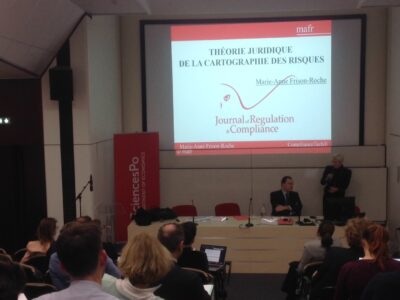
Legal theory of Risk Mapping, in “Risk Mapping, as Compliance Tool” (conference made in French)

Reference : Frison-Roche, M.-A., General presentation of the cycle of conferences on Les outils de la Compliance  (Compliance Tools) and  "Théorie générale de la cartographie des risques" (Legal Theory of Risk Mapping), conference made in French, in Département d'Economie de Sciences Po & Journal of Regulation & Compliance (JoRC),  La cartographie des risques, outil de la Compliance (Risk Mapping, as Compliance Tool), November 28th, 2019, Sciences Po, Paris.    Read the  General Presentation ot the cycle of conferences about the Compliance Tools   Read the General Presentation of the book written in English to be published   Read the General Presentation of the serie Régulations & Compliance in which the book will be published   Summary of the conference Risk mapping is both central to the obligations or practices of companies and little apprehended by the legal systems. It is not expressly referred to by the French legal system, except for the special national laws known as "Sapin 2" and "Vigilance". But if we are out of this field, because there is only a description and not a legal definition, even less a legal notion, we do not know what legal regime to apply to the action of mapping risks. It is therefore useful, indeed compelling, to define the legal concept of risk mapping. Starting from what is still the safest ground, namely these two special laws, to go towards less secure legal grounds, such as the doctrine of the authorities or the commitments of the companies, even the ISO certifications obtained in this matter. Through a few judicial decisions and legal reasoning, a legal notion of the action of mapping risks emerges. It is advisable to proceed in 5 steps (the working document follows another approach). The first, based directly on the two available laws, apprehends the action of mapping when it comes into execution of a special legal obligation. The decision rendered in 2019 by the French Commission des sanctions of the Agence Française Anticorruption (French Corruption Agency's Sanctions Commission) draws probate games as to the demonstration of the execution of the obligation and the probationary system can be extended. In the same way the decision of the French Conseil constitutionnel (Constitutional Council) in 2017 on the "Vigilance Act" shows that a mechanism referred to as a "modality" is legitimate with regard to the goal, which is, concerning this tool, the establishment of a responsibility for others. It is therefore the concern for the situation of others that can be targeted by the Law thanks to Compliance Tool, especially Risk Mapping. The second theme aims to map risks as a fact of good management for a company, while the enterprise is not constrained by a legal obligation. This fact is a paradox because the Regulatory Authority and the Judge may, where the conduct that was to be prevented occurs, for example a market abuse or an anti-competitive behavior, either qualify as an aggravating circumstance or as an attenuating circumstance. Consideration of the theory of incentives should lead to the adoption of the American solution, that is to say the qualification of an effective cartography as a mitigating fact. European case law is not yet fixed, especially in terms of Competition Law's compliance. The third theme is the mapping action carried out by an entity which, in doing so, exercises power over a third party. Because cartography is as much an obligation as a power, possibly on a third party. The Conseil d'État (French Council of State) in 2017 qualified risk mapping as an act of grievance, but doing so legitimately, since it was to prevent forest fires efficiently. This solution based on the teleology attached to Compliance Law can be transposed to other areas. Going further, one may consider transforming this action from de facto status to legal status on the part of the company, if it thus identifies risks for third parties. It would thus give third-party creditors the right to be in a position to measure the risks that weigh on them. Risk mapping would thus be part of a broader unilateral commitment by powerful companies, recognizing the existence of risks for third parties to enable them to know their nature and extent. If this responsibility Ex Ante (characteristic of Compliance Law) is fulfilled, then the Ex Post liability of the company could no longer be retained. This is the ongoing issue of the Johnson & Johnson trial (2019 American judgment), in terms of medical compliance. Because if one can argue that there exists through this kind of risk mapping that the posology a "subjective right to be worried about the risks related to the taking of the drug", the patient remains free in the use of it. The question of whether third-party education is included in the mapping, since the alert is already included in it, is an open question. For now, the answer is negative. Indeed and in a fifth time, appears the liberal definition of Compliance Law through the apprehension that the Law must make of the cartography of the risks. Beyond the rational act that any person has to control their risks for their own interest, by preventing the damaging effects of that from the crystallization of risk has in fact proved, it is a question of preserving an external interest for the preservation of which the Law must intervene because the subject of law, in particular the company will be less likely to be concerned. By the imprint of the law, risk mapping expresses the concern for an external interest, either of a system or of a third party. But this support in Ex Ante implies force (Sapin 2, Vigilance, financial market information obligation) or will (social responsibility, ethical commitment, adoption of non-financial standards) relates only to information, its constitution, its intelligibility and its hierarchy. Then it is the actors exposed to the risks, able to understand in Ex Ante the extent as far as they are concerned, either the entity itself, or the thirds, to choose to run them to no.     Consult the two sets of slides as basis of the conference:    Slides served as basis for the General Presentation of the cycle of conference on the Compliance Tools (in French)  Slides served as basis for the specific contribution "Théorie générale de la cartographie des risques / Legal Theory of Risk Mapping" (in French).   Read the working paper served as basis for the conference -

Articles

By Compliance, continental criminal justice mechanisms have come from inquisitorial procedure to adversarial system

Référence générale : Frison-Roche, M.-A., "La justice pénale est passée de l'inquisitoire à l'accusatoire" (By Compliance, Continental Criminal Justice Mechanisms have come from Inquisitorial Procedure to Adversarial System), Interview in French about the impact of the "conventions judiciaire d'intérêt public", the French equivalent of DPI, and Compliance Procedures in French Law, Lettre des juristes d'affaires, n°1416, October 14, 2019. Summary : In this interview and through the three questions asked, the answers show that we have gone from an inquisitorial system to an adversarial system, which is a  sort of Revolution especially in matter of proofw. The French legal system must be adapted, but also or, above all, this conception of Compliance efficiency is a mechanism without a judge. The expression of "deal of justice" is excessive, because precisely if there is a "deal", there is no a "judge" : the prosecutor was not a judge. These mechanisms are also handled by the administrative Independant Bodies of Regulation or Supervision, which act here as "prosecuting authorities", that is to say as prosecutor. They also "deal" the non-appearance of the judge, the opposite of "justice", in a classical conception which is the figure of the judge. It is true that in the case of the "convention judiciaire d'intérêt public" the French Law requires an approval by the judge of the CJIP: it is then that the stake moved. There is a change of culture: the prosecutor is in the center, the Regulator or the Supervisor are the "prosecuting authority" and it is as approval authority that the judge or the administrative Sanctions Committee intervenes. But later. When the essential are the proofs obtained in the first lapse of time. The firm or the person can be evaded by asserting his "right to the judge". This judge who seeks the truth while an authority to pursue wants something else: win. We must understand that.    Read the Interview (in French) and the answers to these three questions:  1. En quoi les mécanismes de justice négociée, relativement récents en France, bouleversent les concepts hexagonaux de l’ordre judiciaire ? /  How the negotiated justice mechanisms, relatively recent in France, upset the hexagonal concepts of the judiciary? 2. Les entreprises ont-elles véritablement le choix d’accepter ces « deals de justice » ? / Do companies really have the choice to accept these "deals of justice"? 3. En matière de lutte contre la corruption, les autorités de poursuite se comportent désormais comme des juges puisqu’ils exigent des engagements pour le futur. Quels sont les risques ? / In the fight against corruption, prosecution authorities now behave like judges since they demand commitments for the future. What are the risks ?

Conferences

The solutions offered by Compliance Law to fight effectively against mass counterfeiting

Generale Reference : Frison-Roche, M.-A., Les solutions offertes par le Droit de la Compliance pour lutter effectivement contre les contrefaçons de masse (The solutions offered by Compliance Law  to fight effectively against mass counterfeiting) , in Seminar of the Association des Praticiens du Droit Droit des Marques et des Modèles (APRAM), La contrefaçon de masse : va-t-on un jour réussi à y mettre un frein ? Quelques nouvelles pistes de réflexion (How to stop the mass Counterfeiting?, some new ideas), Paris, September 27, 2019.  Read the program of the Seminar. (in French) This conference is based on the report given to the French Government and published in July2019 : The contribution of Compliance Law to the Governance of Internet. It is also based on the new contribution to the new edition of the Grands Arrêts de la propriété intellectuelle : "Le maniement de la propriété intellectuelle comme outil de régulation et de compliance"(in French).  This publication is based on this Working Paper : The use of Intellectuel Property as a tool for Regulatory and Compliance Perspectives.      Summary : In this seminar devoted to new ways of reacting to "mass counterfeiting", the idea here is to start from the observation of an increase in the ineffectiveness of intellectual property rights – and thus of the I.P. Law. Law being a practical art, it is not a simple inconvenience, it is a central question. This can be remedied by improving the Ex Post legal process, but we can think of finding Ex Ante mechanisms. The Regulatory Law is Ex Ante, but digital world is not a sector, it is the world itself. A promising direction is therefore Compliance Law, in that it is both Ex Ante and non-sectoral. The contribution shows how Compliance Law is already useful, could be developed and how it could be applied so that these specific rights could be effectively protected in a digital world, where for the moment counterfactors have in fact the means to ignore them.   See the slides. (in French)