Interviews

Articles

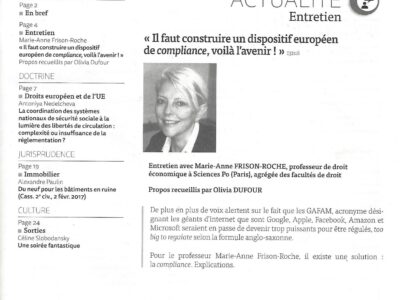
💬”Let’s Use the Power of GAFAMs in the Service of General Interest!” (“Utilisons la puissance des GAFAMs au service de l’intérêt général!”)

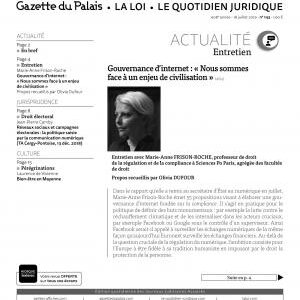
Full reference: Frison-Roche, M.-A., "Let's Use the Power of GAFAMs in the Service of General Interest!" ("Utilisons la puissance des GAFAMs au service de l'intérêt général!"), interview done by Olivia Dufour, Actu-juridiques Lextenso, 11st of January 2021 Read the interview (in French) To read the article translated in English by us, read the working paper on which this interview is based   Summary of the interview by Olivia Dufour: Marie-Anne Frison-Roche, Professor of Regulation and Compliance Law, reported to the government in 2019 about Internet governance. For this expert, giving a disciplinary power to GAFAMs is the only effective solution. And the suppression of Donald Trump's account is not likely to call this analysis into question.   The three questions (translated in English here by ourselves) asked by Olivia Dufour are:  The deletion of Donald Trump's Twitter account arouses strong emotions on social networks, and not only among his supporters. What do you think about this ? However, this incident does raise concern. Are we not giving too much power to these private companies? This raises the question in France of the relevance of the Avia system … Should we therefore resolve by default to give our freedoms to private and opaque mastodons?   Read the answers to these three questions (in French)   To go further, especially about the logics that guide the Avia system, see: Frison-Roche, M.-A., "Hate on internet: we need to responsibilize digital operators" ("Haine sur internet: il faut responsabiliser les opérateurs numériques"), 2020 Frison-Roche, M.-A., The contribution of Compliance Law to Internet Governance, report to Government, 2019

Articles

💬Facebook: Quand le Droit de la Compliance démontre sa capacité à protéger les personnes (Facebook: When Compliance Law proves its ability to protect people)

Full reference: Frison-Roche, M.-A., Facebook: Quand le Droit de la Compliance démontre sa capacité à protéger les personnes (Facebook: When Compliance Law proves its ability to protect people), interview with Olivia Dufour, Actu-juridiques Lextenso, 23rd of November 2020 Read the interview (in French) Read the news of the Newsletter MAFR – Law, Compliance, Regulation about this question

Articles

FRISON-ROCHE, Marie-Anne

💬 “Health Data Hub est un coup de maître du Conseil d’État” (“Health Data Hub is a stroke of genius of the Conseil d’État”)

Full reference: Frison-Roche, M.-A., "Health Data Hub est un coup de maître du Conseil d'État", interview realized by Olivia Dufour for Actu-juridiques, Lextenso, 22nd of October 2020 Read the news of 19th of October 2020 of the Newsletter MAFR – Law, Compliance, Regulation on which relies this interview: Conditions for the legality of a platform managed by an American company hosting European health data​: French Conseil d'État decision  To go further, on the question of Compliance Law concerning Health Data Protection, read the news of 25th of August 2020: The always in expansion "Right to be Forgotten"​: a legitimate Oxymore in Compliance Law built on Information. Example of​ Cancer Survivors Protection 

Articles

💬Et si le secret de l’avocat était l’allié de la lutte contre le blanchiment ? (Why would the attorney not be an ally in the fight against money laundering?)

Full reference: Frison-Roche, M.-A., Et si le secret de l’avocat était l’allié de la lutte contre le blanchiment ?, interview realized by Olivia Dufour for Actu-juridiques, Lextenso, 15th of October 2020 Read the interview (in French) To go deeper on the place of the attorney in Compliance Law, read Marie-Anne Frison-Roche's working paper: The Attorney, Vector of Conviction in the New Compliance System

Articles

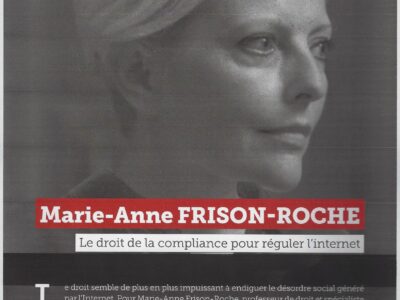
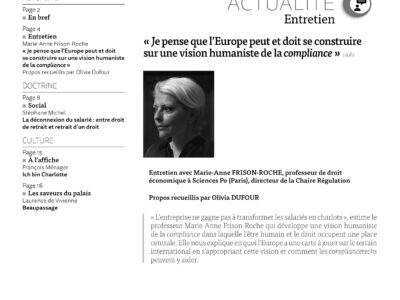
Compliance Law to Regulate the Internet

Reference Frison-Roche, M.-A., Le droit de la compliance pour réguler l'internet  (Compliance Law to Regulate the Internet), Interview given in French to Sylvie Rozenfeld, Expertises, December 2019, pp. 385-390.   Summary. Law seems increasingly powerless to stem the social disorder generated by the Internet. For Marie-Anne Frison-Roche, Law professor and specialist in Regulatory Law, the solution is to be found in Law, and more particularly in Compliance Law. This specific Law is already applied in the banking and finance sector, or in the area of ​​personal data. As it has done for green finance and through the GDPR, Europe could impose a compliance system which internalizes concern for the individual in large digital operators. It is up to them to put in place the means and bear the cost, such as the right to be forgotten erected by the CJEU. Marie-Anne Frison-Roche does not offer anything revolutionary, she is content to take elements of positive law that already exist and to correlate them.   Read the interview (in French)   Read the presentation of the official Report for the French Government about which this interview is given:: The contribution of Compliance Law to the Governance of Internet. 

Articles

By Compliance, continental criminal justice mechanisms have come from inquisitorial procedure to adversarial system

Référence générale : Frison-Roche, M.-A., "La justice pénale est passée de l'inquisitoire à l'accusatoire" (By Compliance, Continental Criminal Justice Mechanisms have come from Inquisitorial Procedure to Adversarial System), Interview in French about the impact of the "conventions judiciaire d'intérêt public", the French equivalent of DPI, and Compliance Procedures in French Law, Lettre des juristes d'affaires, n°1416, October 14, 2019. Summary : In this interview and through the three questions asked, the answers show that we have gone from an inquisitorial system to an adversarial system, which is a  sort of Revolution especially in matter of proofw. The French legal system must be adapted, but also or, above all, this conception of Compliance efficiency is a mechanism without a judge. The expression of "deal of justice" is excessive, because precisely if there is a "deal", there is no a "judge" : the prosecutor was not a judge. These mechanisms are also handled by the administrative Independant Bodies of Regulation or Supervision, which act here as "prosecuting authorities", that is to say as prosecutor. They also "deal" the non-appearance of the judge, the opposite of "justice", in a classical conception which is the figure of the judge. It is true that in the case of the "convention judiciaire d'intérêt public" the French Law requires an approval by the judge of the CJIP: it is then that the stake moved. There is a change of culture: the prosecutor is in the center, the Regulator or the Supervisor are the "prosecuting authority" and it is as approval authority that the judge or the administrative Sanctions Committee intervenes. But later. When the essential are the proofs obtained in the first lapse of time. The firm or the person can be evaded by asserting his "right to the judge". This judge who seeks the truth while an authority to pursue wants something else: win. We must understand that.    Read the Interview (in French) and the answers to these three questions:  1. En quoi les mécanismes de justice négociée, relativement récents en France, bouleversent les concepts hexagonaux de l’ordre judiciaire ? /  How the negotiated justice mechanisms, relatively recent in France, upset the hexagonal concepts of the judiciary? 2. Les entreprises ont-elles véritablement le choix d’accepter ces « deals de justice » ? / Do companies really have the choice to accept these "deals of justice"? 3. En matière de lutte contre la corruption, les autorités de poursuite se comportent désormais comme des juges puisqu’ils exigent des engagements pour le futur. Quels sont les risques ? / In the fight against corruption, prosecution authorities now behave like judges since they demand commitments for the future. What are the risks ?

Articles

Guerre larvée autour de la GPA