The recent news

Updated: Sept. 17, 2021 (Initial publication: Sept. 3, 2021)
MAFR TV

► Full Reference: Frison-Roche, M.-A., Le droit de la Compliance : un outil stratégique pour une Europe souveraine (Compliance law: a strategic tool for a sovereign Europe), interview with Jean-Philippe Denis, recorded on July 3, 2021 and broadcast on September 17, 2021
_____
🎥 Watch the interview, as broadcast on Xerfi Canal channels.
🎥Watch the interview enhanced with French subtitles
____
►Summary: Compliance Law powerfully and clearly helps to build a sovereign Europe.
Compliance Law is not the annex of Competition Law; it is another branch of Law, which aims instead to rely on the de facto power of companies, when they are in a position to achieve the "Monumental Goals" that the Political Authorities have decided to achieve, which requires an alliance between them and those companies in a position to achieve these "Monumental Goals".
Companies can do this because they are in a position to do so, in that they are well located to act, have the information, the technology and the adequate financial means.)
Compliance is a construction tool, and not, as it is still sometimes presented, a means to limit the ability of those who are concretely able to build, i.e. the companies. The architect remains and must remain the Politics. But the company remains the master of the means to achieve these goals, and free to duplicate them in its own care, via CSR, "raison d'être" and ethics.

Sept. 16, 2021
Publications

 Full Reference: Frison-Roche, M.-A., Notes pour une synthèse sur le vif pour le colloque "Les Buts Monumentaux de la Compliance : radioscopie d'une notion" (Notes for an on the fly synthesis for the Colloquium "The Compliance Monumental Goals: Radioscopy for a Notion"), September 16, 2021.
____
► Read the general programme of the Colloquium Compliance Law Monumental Goals
► Read the presentation of the synthesis Report, notably its Summary.
____
► Methodology: The topic is not treated in a strictly personal point of view, as it will be in the book on The Compliance Monumental Goals, in an article devoted to "Defining Compliance Monumental Goals and their branch of Law", more personal article. It will be even more clearly the expression of a personal vision of the definition of what is "Compliance" and what is "Compliance Law", with in particular the distinctions that should be done, in particular with "conformity" because these are these "Monumental Goals", a notion proposed in 2016!footnote-2164 which makes it possible to distinguish the procedural notion of "conformity" (just obey) and the substantive notion of "Compliance Law". This article will include the multiple academic and technical references that should be done to do this.
But in the time allotted in a day's collloquium and because the purpose of a synthesis is to highlight on the spot what was common in the contributions heard, the document is based only on the different speechs made and is not enriched with technical references, nor does it refer to personal works.
____
🔻read below the notes exhaustely taken

Sept. 16, 2021
Conferences
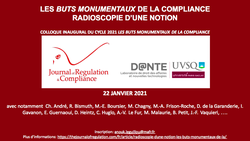
Full reference: Frison-Roche, M.-A., Rapport de synthèse (Conclusion) in André C., Frison-Roche, M.-A., Malaurie, M. and Petit, B., Les Buts monumentaux de la Compliance (Compliance Monumental Goals), Colloquium co-organised by the Journal of Regulation & Compliance (JoRC) and the Laboratoire Dante of Paris-Saclay University,
____
📅 September 16, 2021.
🧭 Maison du Barreau, 12 place Dauphine 75004 Paris
____
► Conclusions' Summary: Based on the multiple contributions of the day, the first part of this synthesis focuses on the practical interest of having Monumental Goals attached to compliance techniques.Conceptually defining these Monumental Goals as normative legal rules of Compliance Law has the first practical advantage of making clear this scattered and almost incomprehensible material, allowing us to better understand it. The second practical advantage is to bring together the various branches of law in that they all contain compliance mechanisms, the points of contact thus discerned leading to a unification of technical legal rules. The third practical advantage is to provide the various sources of law concerned with a means of applying and interpreting the law. The fourth practical advantage is to give meaning to all these technical provisions.
In the second part of this synthesis, it appeared that these practical considerations therefore justify undertaking the "conceptual adventure". This one can take three pillars, in this "cathedral" that Dominique de la Garanderie designed, this "monument" corresponding well to the adjective Monumental which is better suited to these Goals than does the adjective "Fundamental", because it is a question of building, of building for a future which is not fatal. The first conceptual pillar consists in conceptualizing the Monumental Goals so that the Compliance Law finding a substantial meaning thus gives in a normative way a meaning to all the technical provisions which serve it in an instrumental way. The second conceptual pillar consists of giving everyone their place, that of public authority, that of the company and that of the population, each concerned and each not having to take the place of the other in the determination of the monumental goals, the company being in particular free in the design of the means while the political authority being in charge of drawing the Goals, the company being able to copy them on its own account. This conception does not depend on legal systems but on goals and legitimacy, in particular on the definition chosen for what is a company. The third conceptual pillar derives precisely from the humanist conception that one can claim to have of the Compliance Monumental Goal, risk management being only a means to achieve it. Humanism effectively carried by Compliance, taken on their own account by the companies alone capable of making them concrete, is what makes it possible to distinguish texts that are nevertheless technically similar, depending on whether they apply in Rule of Law systems or in systems which are note governed by the Rule of Law Principle.
This is why the technical future of Compliance Law lies in this conceptual adventure that it is necessary to lead.
_________
📝 read the program of this colloquium
🎥 see Marie-Anne Frison-Roche's conclusion in video (in French, with English subtitles)
✏️ read the notes translated in English on which this conclusion is based
_______
📅 This colloquium is part of the Cycle of colloquium 2021 organized by the Journal of Regulation & Compliance (JoRC) and its partners around Compliance Monumental Goals.
📘 This manifestation is in French but the interventions will be part of an English collective book directed by Marie-Anne Frison-Roche, Compliance Monumental Goals, co-edited by the JoRC and Bruylant.
📕 An equivalent book in French, Les Buts Monumentaux de la Compliance, directed by Marie-Anne Frison-Roche, will be co-published by the JoRC and Dalloz.
Sept. 15, 2021
Publications

► Full Reference: M.-A. Frison-Roche, Ex Ante Responsibility, Working Paper, December 2021.
____
📝This Working Paper has been the basis for an article written in French, "La responsabilité Ex Ante", published in the Archives de Philosophie du droit (APD), in the book 📗La Responsabilité (2022).
____
► Working Paper Summary: Quel est le temps auquel s'articule la responsabilité ? La question est si classique que toutes les réponses ont été dessinées : si l'on est responsable plus aisément par rapport au temps, car l'on peut alors plus aisément faire un lien entre la situation appréhendée, sa réalisation dans le passé la rendant plus facilement connaissable, et le poids de "responsabilité" que l'on impute sur une personne, l'on peut articuler la responsabilité avec le futur. Si l'on brise le poids de cette responsabilité avec un évènement ou une situation, par exemple. Le Principe Responsabilité de Jonas ou l'Ethique de la Responsabilité font ainsi voyager la Responsabilité dans le temps, par un rapport entre le Droit et l'Ethique.
D'ailleurs l'on pourrait soutenir que le Droit peut faire ce qu'il veut et imputer une responsabilité à quiconque pour le temps qu'il désigne, par exemple désigne comme porteur d'une responsabilité, c'est-à-dire d'un poids, celui qu'il veut. Le "responsable" serait alors le titulaire d'une sorte de "poids pur", qui le charge parce que le Droit l'a voulu pour le temps qu'il veut, par exemple un devoir d'agir pour que le futur soit dessiné comme le veut le Droit, alors même que le Responsable n'a rien à se reprocher dans le passé.
Mais les Cours constitutionnelle défendent un rapport minimal entre la Responsabilité et le poids que celle-ci fait porter une personne, fut-t-elle morale, gardant ainsi le lien consubstantiel entre le Droit et la Morale, la technique juridique de la Responsabilité ne pouvant équivaloir à celle d'un prélèvement obligatoire.
Ainsi l'idée d'une Responsabilité Ex Ante est simple dans son principe (I). Elle est celle d'un poids juridiquement posé sur une personne soit par elle-même (engagement), soit par la Loi ou par le Juge sur une personne de faire quelque chose pour que n'advienne pas quelque chose qui adviendrait ou pour qu'advienne quelque chose qui n'adviendrait pas si elle ne le faisait pas.
Mais les conditions juridiques pour admettre un tel poids alors même que le lien avec une situation passée serait brisé est plus difficile (II). On continue certes continuer à voir dans le futur le passé, ce qui facilite le voyage dans le temps, et fonda par exemple le contrôle Ex Ante du contrôle des concentrations. Mais l'on peut se briser même de cette facilité et regarder non plus le rapport entre le passé et le futur, mais le présent et le futur : ce que l'on sait déjà aujourd'hui du futur, ce qui met en jeu le rapport entre le Droit et la Science ; ce que l'on observe de l'emprise de la personne présente sur le moment présent, c'est-à-dire le Pouvoir, ce qui fait en jeu le rapport entre le Droit et l'Economie politique.
Dans cette dimension-là, la contrainte de la Responsabilité Ex Ante est alors maniée par le Juge, dont l'office lui-même devient un office Ex Ante. Les pouvoirs obligés Ex Ante par une telle responsabilité maniée par le Juge étaient les personnes en situation de pouvoir, sont non seulement les entreprises, mais encore les Etats, qui perdent le privilège - partagé avec les contractants - de disposer juridiquement du futur, et notamment en leur sein le Législateur.
Une telle révolution, qui se déroule sous nos yeux, s'explique parce qu'il faut agir maintenant pour que le futur ne soit pas catastrophique. La science nous informe qu'il le sera entéléchiquement. Il est donc juridiquement requis de désigner des responsables, non pas parce qu'ils auraient fait quelque chose, la dimension Ex Post n'étant pas le sujet, mais pour qu'ils fassent quelque chose, la Responsabilité Ex Ante étant un élément central de cette nouvelle branche du Droit qu'est le Droit de la Compliance.

Sept. 15, 2021
Organization of scientific events

► co-organized between Laboratoire DANTE and the Journal of Regulation & Compliance (JoRC), this colloquium) is the core manifestation of the 2021 series of colloquia devoted to the general theme of Compliance Monumental Goals.
It will take place on 16th of September 2021, at the Maison du Barreau, in Paris.
This first work is in French but will be the basis of the book in English : Compliance Monumental Goals,
 This book will be published in the Compliance & Regulation Series, co-published by the JoRC and Bruylant.
► Presentation of the colloquium Thematic: To understand the notion of "Monumental Goals", it is firstly necessary to take crossed perspectives on them, particularly through the prism of Labor Law, Environmental Law and Enterprise Law. Many questions appear. Does the notion of “Monumental Goals” present any substance in Law? Is it uniformly understood, or do specificities appear, forged by specific cultures and disciplinary practices? What are the sources and implicit references or echoes? Because even if we admit the part of novelty, there is undoubtedly an anchoring in traditional legal concepts, like the general interest or sovereignty. How does the shift from meta-legal (prima facie introduced by the concept) to legal take place, and where do any operational difficulties lie when legal actors are called upon to act? The question of a possible categorization of "Monumental Goals" will thus be explored, through these three legal disciplines whose historicity, goals and implications for firms differ.
These reflections allow to ask why and how these "Monumental Goals" are developed. Indeed, what is the relevance of the association of "Monumental Goals" and Compliance? Beyond theoretical considerations relating to the meaning of Law, is this really an effective alloy encouraging companies to behave differently? By what ways? These questions arise in particular with regard to the imperatives of legal certainty and the operative nature of the concept. The question of "Monumental Goals" will thus be explored by the operational actors of compliance, both those who act within companies and those who act from the lato sensu State sphere, for understanding whether this notion is a pure rhetoric figure or constitutes a particularly promising lever for the evolution of market behavior.
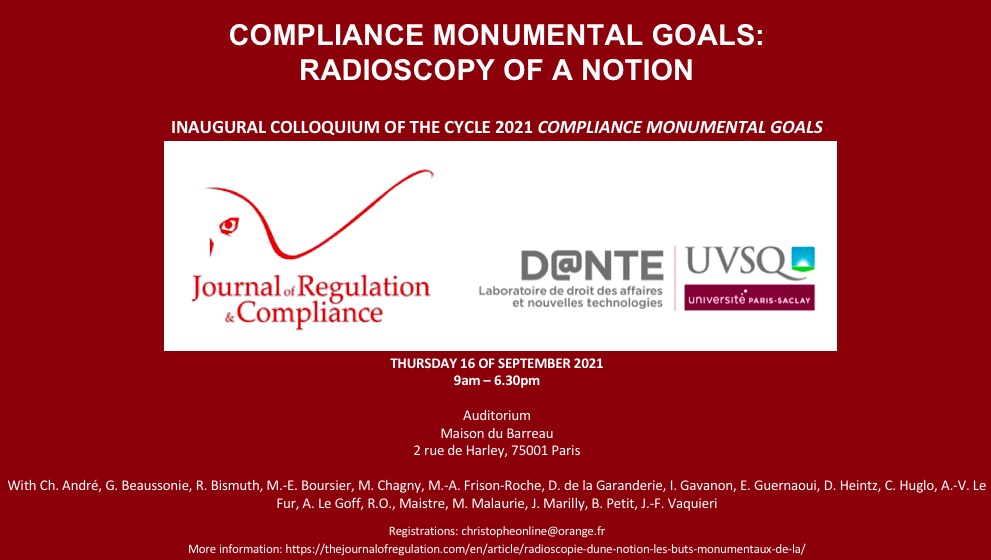
► with :
🎤 Christophe André, maître de conférences à l'Université Paris - Saclay (lecturer at the Paris-Saclay University)
🎤 Guillaume Beaussonie, professeur à l'Université Toulouse-1-Capitole (law professor at Toulouse-1-Capitole University)
🎤 Regis Bismuth, professeur de droit à Sciences po, Paris (law professor at Sciences po Paris)
🎤 Marie-Emma Boursier, doyen de l'Université Paris - Saclay (dean of the Paris-Saclay University)
🎤 Muriel Chagny, professeur l'Université Paris - Saclay, directrice du Laboratoire Dante (Professor at the Paris-Saclay University, director of the Laboratory Dante)
🎤 Marie-Anne Frison-Roche, professeur à Sciences po (Paris) (Professor at Sciences Po Paris)
🎤 Isabelle Gavanon, avocate à la Cour d'Appel de Paris (attorney before the Paris Court of Appeal)
🎤 Emma Guernaoui, ATER à l'Université Paris II Panthéon-Assas (ATER at Paris II Panthéon-Assas University)
🎤 Dominique Heintz, avocat à la Cour d' appel de Paris (attorney before the Paris Court of Appeal)
🎤 Christian Huglo, avocat à la Cour d' appel de Paris (attorney before the Paris Court of Appeal)
🎤Dominique de La Garanderie, avocat à la Cour d'appel de Paris (attorney before the Paris Court of Appeal)
🎤 Anne-Valérie Le Fur, professeur à l'Université Paris - Saclay (Professor at Paris-Saclay University)
🎤 Anne Le Goff, secrétaire générale déléguée d'Arkéa (Deputy Secretary general at Arkéa)
🎤 Roch-Olivier Maistre, président du Conseil supérieur de l'audiovisuel (President of the French audiovisual regulation authority)
🎤 Marie Malaurie, professeur à l'Université Paris-Saclay (professor at the Paris-Saclay University)
🎤 Jérôme Marilly, avocat général à la Cour d'Appel de Paris (General attorney before the Paris Court of Appeal)
🎤 Benoît Petit, maître de conférences (HDR) à l'Université Paris-Saclay (lecturer at the Paris-Saclay University)
🎤 Jean-François Vaquieri, Secrétaire Général d'Enedis (Secretary General of Enedis)
____
Read a detailed presentation below:

Sept. 15, 2021
Publications
► Full Reference: Frison-Roche, M.A., Le Droit de la concurrence : des choix politiques pour son état futur - rapport de synthèse - ( ("Competition Law: political choices for its future state - Conclusion") , in Claudel, E. (ed.), Le Droit de la concurrence dans tous ses états ("Competition in all its states"), special issue, Gaz. Pal. , 15 Sept. 2021.
This publication is in French, but the Working Paper which is the basis of this article is bilingual.
____
📅 this article follows the colloquium of the French Association Droit & Commerce in Deauville (France), the 25th et 26th June 2021.
____
✏️ It is based on the bilingual Working Paper built on the notes taken during the colloquium for establishing the conclusion which has been provided.
____
Article English Summary: All of these contributions on the issue of the "Competition in all its states" highlighted the choices available for what could be this branch of Law tomorrow: choice of a political nature between various possible definitions of Competition Law.
In method, the main thing is that this definition be clear. For this, this definition must be based on a principle and that the goal pursued by competition law is simple, so that in a second step, competition law can be easily articulated on the one hand with other branches of law. (by the care of the judge, in particular), on the other hand with "policies", such as "competition policy", then other policies (by the care of political authorities, especially European).
In essence, two conceptions of principle are opposed: either Competition Law will want to appropriate the goals of other branches, such as those of Regulatory and Compliance Law, or Competition Law will have the modesty to remain anchored in its definition as Market Law.
This is the crossroads where we are.
________
Sept. 6, 2021
Teachings : Participation à des jurys de thèses

► Référence : Frison-Roche, M.-A., présidente et membre du jury de la thèse de Mamadou Diallo, , La transposition du pouvoir administratif exorbitant en droit de la régulation économique, Université Panthéon-Sorbonne (Paris I) , Salle Duroselle, centre Sorbonne, 6 septembre 2021, 14h30-17h30.
____
🪑🪑🪑Autres membres du jury :
🕴🏻L. Vidal, maître de conférences HDR à l’Université de Paris 1 Panthéon-Sorbonne, directeur de la thèse ;
🕴🏻Th. Perroud, professeur à l’Université Paris II Panthéon-Assas, rapporteur et membre du jury ;
🕴🏻F. Marty, chargé de recherches CNRS, membre du Collège de l’Autorité de la concurrence, Professeur à l’Université de Nice, Rapporteur ;
🕴🏻B. du Marais, conseiller d’État, professeur à l’Université Paris Nanterre.
____
► Résumé de la thèse : la thèse prend la force de deux tomes pour un volume de 708 pages. Sa première partie porte sur l'action particulière de l'Etat dans l'économie, tandis que sa seconde partie porte plus particulièrement sur la façon dont le droit de la régulation, dont le droit de la concurrence n'est pas vraiment distingué, exprime cette puissance de l'Etat par rapport aux entreprises privées, exprime la légitimité de l'Etat à obtenir de celles-ci qu'elles obéissent aux règles. La dimension procédurales des institutions ainsi créées, les autorités de régulation, et leur contrôle, est plus particulièrement développée.
La thèse a été présentée et soutenue publiquement à l'Université Panthéon-Sorbonne (Paris I), au sein de l'Ecole de Droit de la Sorbonne, dans le Département de Droit public et fiscal, le 6 septembre 2021 entre 14h30 et 17h30.
Au terme de la soutenance, le candidat a obtenu le titre de docteur en droit.
____
____

Sept. 2, 2021
Interviews

► Référence complète : Frison-Roche, M.-A.,La nouvelle loi de protection des données en Chine est un « anti-RGPD », entretien avec Olivia Dufour, Actu-Juridique, 2 septembre 2021.
____
Les 3 questions posées étaient :
❓ La Chine a adopté fin août une grande loi de protection des données personnelles. Celle-ci est présenté dans les médias comme un équivalent de notre RGPD. Est-ce le cas ?
La réponse est : non.
(lire la réponse développée dans l'entretien)
____
❓ S'agit-il de simples effets indésirables ou bien du but poursuivi par le Législateur ?
La réponse est : Le but du Législateur n'est pas d'armer l'individu contre le pouvoir de l'Etat, c'est au contraire d'accroître le pouvoir de l'Etat, éventuellement contre lui.
(lire la réponse développée dans l'entretien)
____
❓ Si la compliance peut servir les intérêts d'Etats non-démocratiques, c'est donc qu'elle est potentiellement dangereuse ?
La réponse est : elle n'est dangereuse que définie comme "méthode d'efficacité des règles ; il faut définir le Droit de la Compliance par son "but monumental" qui est la protection des personnes. La contradiction de la loi chinoise nouvelle apparaît alors.
(lire la réponse développée dans l'entretien)
____