Organisation of events

Organisation of events

🏗️Cycle of colloquia 2023: Compliance and Contract

🧮 Compliance et droit commun des contrats (Compliance and General Contract Law), in 🏗️Compliance and Contract

► Full reference: Journal of Regulation & Compliance (JoRC) and Panthéon-Sorbonne University (Paris I), Institut de Recherche juridique de la Sorbonne -IRJS (Sorbonne Legal Research Institute), Compliance et droit commun des contrats (Compliance and General Contract Law), 7 October 2026. - 🏗️ This symposium is part of the series of symposiums organised by the Journal of Regulation & Compliance (JoRC) and its partner universities, focusing in 2026 on the general theme of Compliance and Contract. - The symposium is under the scientific responsibility of Nicolas Bargue, 🕴️Marie-Anne Frison-Roche and 🕴️Julia Heinich. - To register: - 🧮The event will take place at Panthéon-Sorbonne University (Paris I) on 15 October 2026. Il will be held in French. - Presentation of the topic:  While Contract Law, in its common rules expressed by the “general theory of contracts”, is often considered to be the most developed branch of Law in practice and the most studied at university, at first glance it seems to be given little consideration when it comes to compliance matter. This is undoubtedly due to the fact that the company, which is at the heart of the action expected of it—action that is expected to be powerful (since it affects the collective future) and diversified (since it concerns all systems beyond the company’s direct activity)—seems above all to have the status of a subject of law. This is exacerbated if, by mistakenly confusing the latter terms, we only talk about “conformity” and assert that it is simply for businesses a matter of “complying with the regulations that apply to them”, which then leaves little room for contractual initiative. This would be associated only with Ethics, a normative order that also differs from a contract, which is a binding legal act. The relationship between Contract and many sorts of documents, standards and ethical acts that are so numerous in compliance techniques, to which we can add the soft law produced by courts, regulators, supervisors and the companies themselves, is therefore an open question. This delicate reconciliation, which the terms “CSR” and “Governance” express without referring to very precise legal definitions, can cause difficulties in relation to general Contract Law: thus, the “commitments” that punctuate the techniques and behaviours that make up the “culture of compliance” have a central place in Compliance Law. However, their place, if not their equivalence with the contract, is not established, and may even be excluded. This too is an open question. Based on these initial questions, it appears that in order to gain a firmer footing in the analysis of the practices of companies that include compliance clauses into multiple contracts, we must observe that compliance may consist of a comprehensive service that is the very subject of a specific contract, the “compliance contract, or even assist in the conception that judges may, or must, develop in their office when they are seized of “contractual litigation involving Compliance”, we must return to common contract law. Indeed, if we stop viewing Compliance Law solely through the prism of punishment, if we do not limit it to the “detection and prevention” of fraudulent behaviour which, if it occurred, would be punished, the contract does not have the same place in practice. In this initial restrictive conception of Compliance Law based on sanctions, simply by moving from ex post to ex ante, the company remains subject to the regulations that apply to it, and the contract would be just one of the ways in which it fulfils its legal compliance obligation. However, the obligation of compliance can also be considered to have its legitimate source in the Contract, which in general termes is based on the autonomy of will and all its consequences (contractual freedom, binding force, effect on third parties, etc.), with the Principle of Compliance fitting into it as a second pillar linked to the first pillar, which is the Principle of free Competition. It is therefore very useful to better understand practices by comparing the technical principles of general Contract Law with Compliance Principles, such as concern for others that contractors may pursue independently of any regulatory requirement (these others who are distant in space and time), preservation of systems, the obligation to provide evidence, etc. This is the subject of this symposium which, according to the classic dichotomy of contractual formation and contractual execution, revisits the contractual thread based on the founding principles of autonomy and freedoms, binding force and its relativity, the meeting of consents, groups of contracts, and regulatory contracts often drawn up to implement compliance policies. Enforcement and contractual liability under general Contract Law are themselves coloured in a unique way when a compliance concern or goal has been included in the contract or is implied by it. - The proceedings of this symposium will form the basis of a specific chapter in the following publications: 📕Compliance and Contracts, forthcoming in the series 📚Regulations & Compliance, co-published by the Journal of Regulation & Compliance (JoRC) and Dalloz. 📘Compliance and Contract, to be published in the 📚Compliance & Regulation Serie, co-published by the Journal of Regulation & Compliance (JoRC) and Bruylant.   🔻 Read the schedule for the event below ⤵️  
Organisation of events

🧱⚙️Scientific coordination and co-hosting of the colloquia series 🧮Compliance and Contract

► Full reference : M.-A. Frison-Roche, Scientific coprdination and co-hosting of the colloquia series Compliance and Contract, organised on the initiative of the Journal of Regulation & Compliance (JoRC) and its academic partners - - ► The Symposium Series in a nutshell : As a direct continuation of the previous symposium series co-organised by the Journal of Regulation & Compliance and its partner universities on "Compliance Obligation", which served as the basis for the publication of the book 📘Compliance Obligation,  The series, some elements of which began in 2024 and others are already present in this book, explored in depth the specific theme of the links between compliance law and contracts. Indeed, compliance law is often analysed as the construction of laws and regulations to achieve "📘 Monumental Goals " of a political nature desired by States and public authorities, to the achievement of which systemic economic operations contribute through 📘Compliance Tools that are now well documented. Contracts are still relatively little studied, or even developed, in compliance systems that are often perceived through the orders issued, the technologies put in place and the 📘sanctions to be avoided or endured. On the contrary, the future of compliance law, particularly in its European conception, which places human beings at the centre of concerns for the sustainability of systems and the use of contracts, is the new conception that we must adopt. Contracts then appear to be both the means by which the subject company fulfils its legal obligations, forges relationships with other actors and deploys the necessary innovations. Contract law is both used and renewed as a result. The series of symposiums will examine various aspects of this general issue. It will result in the publication of a 📘book Compliance and Contrat. - ► Presentation of symposiums in development :  29 May 2026🧮THE JUDGE CONFRONTED WITH CONTRACTS OF COMPLIANCE AND COMPLIANCE CLAUSES: read the presentation   12 June 2026🧮THE "CONTRACT OF COMPLIANCE" : read the presentation   25  Septembre 2026🧮COMPLIANCE: CLAUSE BY CLAUSE: read the presentation   2 October 2026🧮COMPLIANCE AND COMMON CONTRACT LAW : read the presentation   September 2026🧮COMPLIANCE, VALUE CHAINS AND CONTRACT: read the presentation   2 November 2026 🧮COMPLIANCE AND THE STRATEGIC CONTRACTUAL ORGANISATION OF CHAINS VALUE BY ENTERPRISES: read the presentation  -

Organisation of events

⚙️Co-organisation of the symposium 🧮Durabilité de l’Internet : le rôle des opérateurs du système des noms de domaine. Compliance et Régulation de l’espace numérique (Sustainability of the Internet: the role of the operators of the domain name system. Compliance and regulation of the digital space)

  - ► Full Reference: M.-A. Frison-Roche & G. Loiseau (dir.), Durabilité de l'Internet : le rôle des opérateurs du système des noms de domaine. Compliance et régulation de l'espace numérique (Sustainability of the Internet: the role of the operators of the domain name system. Compliance and regulation of the digital space), Journal of Regulation & Compliance (JoRC) and Institut de Recherche Juridique de la Sorbonne (André Tunc – IRJS), Paris 1 Panthéon-Sorbonne University, 21 Fabruary 2025 - ► General presentation of this symposium: The digital space has been built on and as a system. Its primary interest is of a negative nature: it consists of to be preserved against the prospect of systemic failure, of not collapsing. Like all other systems, this 'Monumental Goal' specific to the digital system justifies resources that incorporate this concern for the future. As with all systems, it integrates and relies on the specific technical nature of this system. The digital space is largely based on the invention, technology and architecture of domain names. Domain names, as an addressing system, enable users to enter the digital space and find other Internet users. The uniqueness and solidity of the domain name system, entrusted to a single root and decentralisation, makes this community possible for those who use the digital space and ensures the technical durability required, without which the digital space would be compromised. The architecture, operation, operators and what they do under the control of legislators, regulators, judges and legal subjects are therefore examined from a dual technical and legal perspective, in the light of the imperative of sustainability. This allows to progress in 4 stages. Firstly, to examine the permanence in time and space of the domain name system, insofar as it is the foundation of the Internet and the digital system. This technical construction gives rise to legal qualifications, not only for the present but also for the future, since the Web3 offers new technical solutions. Secondly, this technical sustainability is an imperative that is built into the operators of the domain names themselves, which are inter-linked not only at national level but also at global level, this cross-linking being necessary for the security of the system. The State is present through public law techniques that enable surveillance, control and possible recovery. Thirdly, it imposes constraints on the operators subject to them in order to serve this monumental goal of technical sustainability, and these constraints themselves generate as many powers as they need to usefully achieve this mission. This proportionality must be at the heart of the method and the requirements. The relationship between constraints and powers also stems from it. Fourthly, this imperative of technical sustainability, which is global in nature, gives way to imperatives of societal sustainability, more localised in space and time, when domain name operators are called upon by the legitimate authors of binding standards, legislators in the first instance, to express concerns such as the protection of people involved in the digital space and whose rights are compromised or who are in danger. This second type of sustainability, which is more localised and less inherent in the architecture of the Internet, is justified by the available power of the operators concerned and their adherence to social imperatives. The resulting constraints and powers are therefore not the same. The 2 sustainabilities must then be articulated in a conception that is both teleological and pragmatic. - - ► Speakers (they will speak in French, but the book to be published will be in English):  🎤Pierre Bonis, Chief Executive Officer of the Association française pour le nommage Internet en coopération (Afnic) 🎤Lucien Castex, Adviser of the Afnic Chief Executive Officer for Research internet and society and Internet governance 🎤Marie-Anne Frison-Roche, Full Professor of Regulatory and Compliance Law, Director of the Journal of Regulation & Compliance (JoRC) 🎤Claire Leveneur, Senior Lecturer at Paris-Est Créteil University 🎤Grégoire Loiseau, Full Professor at Paris 1 Panthéon-Sorbonne University 🎤Samir Merabet, Full Professor at the University of West Indies 🎤Antoine Oumedjkane, Senior Lecturer at Lille University 🎤Frédéric Sardain, attorney at law, Jeantet law firm - read below a detailed presentation of this event⤵️ - 🌐follow Marie-Anne Frison-Roche on LinkedIn 🌐follow Marie-Anne Frison-Roche on Instagram 🌐subscribe to the Newsletter MAFR. Regulation, Compliance, Law 🌐subscribe to the Newsletter Surplomb, par MAFR

Organisation of events

🧱⚙️scientific organisation of 🧮L’expérience des juridictions dans le Contentieux Systémique Émergent (Courts Experience in Emerging Systemic Litigation), in cycle of conference-debates “Contentieux Systémique Émergent” (“Emerging Systemic Litigation”)

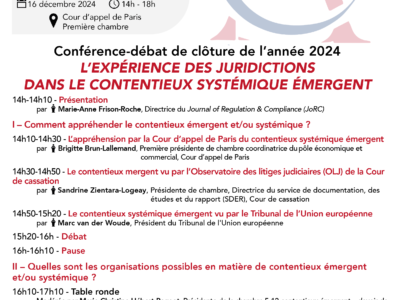
► Full Reference: L’expérience des juridictions dans le Contentieux Systémique Émergent (Courts Experience in Emerging Systemic Litigation), in cycle of conference-debates "Contentieux Systémique Émergent" ("Emerging Systemic Litigation"), organised on the initiative of the Cour d'appel de Paris (Paris Cour of Appeal), with the Cour de cassation (French Court of cassation), the Cour d'appel de Versailles (Versailles Court of Appeal), the École nationale de la magistrature – ENM (French National School for the Judiciary) and the École de formation des barreaux du ressort de la Cour d'appel de Paris – EFB (Paris Bar School), under the scientific direction of Marie-Anne Frison-Roche, 16 December 2024, 2pm.-6pm., Cour d'appel de Paris, Première Chambre (First Chamber) - ► Presentation of the conference:  - 🧮Programme of this event:  Closing conference-debate of 2024 L'EXPÉRIENCE DES JURIDICTIONS DANS LE CONTENTIEUX SYSTÉMIQUE ÉMERGENT  (COURTS EXPERIENCE IN EMERGING SYSTEMIC LITIGATION) Paris Court of Appeal, First Chamber   🕰️2pm.-2.10pm. Présentation (Introduction), by 🕴️Marie-Anne Frison-Roche, Professor of Regulatory Law and  Compliance Law, Director of the Journal of Regulation & Compliance (JoRC), Scientific Director of the Cycle of conferences-debates on the Emerging Systemic Litigation – ESL)   I – Comment appréhender le contentieux émergent et/ou systémique ?  (I – How to deal with Emerging and/or Systemic Litigation?) 🕰️2.10pm.-2.30pm. 🎤L’appréhension par la Cour d’appel de Paris du Contentieux Systémique Émergent (The Paris Court of Appeal's approach to Emerging Systemic Litigation), by 🕴️Brigitte Brun-Lallemand, Première présidente de chambre coordinatrice du pôle économique et commercial, Cour d’appel de Paris (First President of Chamber, Coordinator of the Economic and Commercial Division, Paris Court of Appeal) 🕰️2.30pm.-2.50pm. 🎤Le contentieux émergent vu par l’Observatoire des litiges judiciaires (OLJ) de la Cour de cassation, par 🕴️Sandrine Zientara-Logeay, Présidente de chambre, Directrice du service de documentation, des études et du rapport – SDER, Cour de cassation (President of Chamber, Director of the Department of Documentation, Studies and Reports – SDER, French Court of cassation)  🕰️2.50pm.-3.20pm. 🎤Le contentieux systémique Eémergent vu par le Tribunal de l’Union européenne (Emerging Systemic Litigation as seen by the General Court of the European Union), par 🕴️Marc van der Woude, President of the General Court of the European Union  🕰️3.20pm.-4pm. Debate 🕰️4pm.-4.20pm. Break   II – Quelles sont les organisations possibles en matière de contentieux émergent et/ou systémique ?  (II – How to organise with Emerging and/or Systemic Litigation?) 🕰️4.10pm.-5.10pm. 🎤Table ronde (Round Table) Moderated by 🕴️Marie-Christine Hébert-Pageot, Présidente de la chambre 5-12 contentieux émergent – devoir de vigilance et responsabilité écologique, Cour d‘appel de Paris (President of the 5-12 Chamber emerging litigation – duty of vigilance and ecological liability, Paris Court of Appeal) Speakers: 🕴️Stéphane Noël, Président du Tribunal judiciaire de Paris (President of the Paris First Instance Civil Court) 🕴️Patrick Sayer, Président du Tribunal de commerce de Paris (President of the Paris First Instance Commercial Court) 🕴️Jean-François Beynel, Premier président de la Cour d’appel de Versailles (First President of the Versailles Court of Appeal) and 🕴️Benjamin Deparis, Président du Tribunal judiciaire de Nanterre (President of the Nanterre First Instance Civil Court) 🕰️5.10pm.-5.40pm. Debate   🕰️5.40pm.-6pm. 🎤Conclusion. Le Contentieux Systémique Émergent : dialogues (Conclusion. Emerging Systemic Litigation: Dialogues), by 🕴️Jacques Boulard, Premier Président de la Cour d’appel de Paris (First President of the Paris Court of Appeal) - 🔴Registrations and information requests can be sent to: inscriptionscse@gmail.com 🔴For the attorneys, registrations have to be sent to the following address: https://evenium.events/cycle-de-conferences-contentieux-systemique-emergent/  ⚠️The conference-debates are held in person only, in the Cour d’appel de Paris (Paris Court of Appeal). -

Organisation of events

🧱⚙️Coordination of the conference 🧮Dans l’espace de justice, les pratiques juridictionnelles au service du futur (In the Space of Justice, Jurisdictional Practices at the Service of the Future)

► Full Reference: M.-A. Frison-Roche, coordination of the conference Dans l’espace de justice, les pratiques juridictionnelles au service du futur (In the Space of Justice, Jurisdictional Practices at the Service of the Future), in Cour de cassation, cycle of conferences "Penser les pratiques juridictionnelles au service d’un espace de justice" ("Thinking jurisdictional practices in the service of a Space of Justice"), 21 November 2023, 4pm.-6.30pm. - ► General presentation of the conference: The conception of the conference takes account of the fact that the event comes almost last in the cycle. Previous themes have been ‘jurisdictional practices’ insofar as they are ‘at the service of a European area of justice’ (February 2023), ‘enlightened’ (March 2023), ‘attractive’ (June 2023), ‘interactive’ (September 2023) and ‘peacemaking’ (December 2023). The conference's problematic stems from an observation: today, judges are facing claims that relate directly to the future. Of course, in their traditional office judges deal with the future of disputed situations, but today it is the future of systems in their entirety that is sometimes submitted to them through a dispute or a request, and a solution is sought. The possible presence of future generations is just one sign of this. The space of justice may seem unsuitable for such gigantic trials, both in terms of their subject matter and their impact. No doubt a distinction must be made between judges, and some judges may seem more familiar than others with the systemic issues that the future brings with it. Perhaps the judge's prudence should lead him not to use his power over the future, for example in the handling of sanctions, forgetting that the future by its very nature contains an element of the unknown, a fundamental prudence which the principle of the legality of offences and penalties expresses. But the future is not a blank page either and the judge, without inventing it, can check the coherence of those who write the law, if he is a constitutional judge, those who write contracts and commitments, if he is a civil or commercial judge. In order to fulfil their office, which the stakeholders are demanding, judges need to think about and deal with this new systemic object before them: the future. To understand it, judges draw on available jurisdictional practices, adjust others, and link them together using new methods. - 🧮read the programme of the cycle of conférences in 2023 (in French) -

Organisation of events

🧱⚙️scientifi organisation and moderation of 🧮Le Droit processuel de la Vigilance (Vigilance General Procedural Law), in cycle de conférences-débats “Contentieux Systémique Émergent”

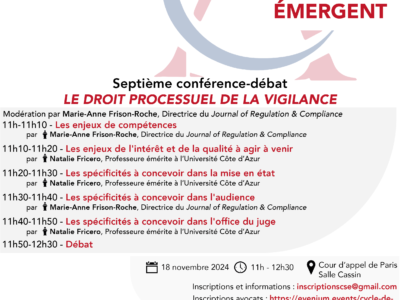
► Full Reference: Le Droit processuel de la Vigilance (Vigilance General Procedural Law), in cycle of conference-debates "Contentieux Systémique Émergent" ("Emerging Systemic Litigation"), organised on the initiative of the Cour d'appel de Paris (Paris Cour of Appeal), with the Cour de cassation (French Court of cassation), the Cour d'appel de Versailles (Versailles Court of Appeal), the École nationale de la magistrature – ENM (French National School for the Judiciary) and the École de formation des barreaux du ressort de la Cour d'appel de Paris – EFB (Paris Bar School), under the scientific direction of Marie-Anne Frison-Roche, November 18, 2024, 11h-12h30, Cour d'appel de Paris, Cassin courtroom - ► Presentation of the conférence:  - 🧮Programme of this event:  Seventh conference-debate LE DROIT PROCESSUEL DE LA VIGILANCE (VIGILANCE GENERAL PROCEDURAL LAW) Paris Court of Appeal, Cassin courtroom Presentation and moderation par Marie-Anne Frison-Roche, Professor of Regulatory and Compliance Law, Director ot the Journal of Regulation & Compliance (JoRC) 🕰️11h-11h20. 🎤, by 🕴️Marie-Anne Frison-Roche, Professor of Regulatory and Compliance Law, Director ot the Journal of Regulation & Compliance (JoRC) 🕰️11h20-11h40. 🎤, by 🕴️Natalie Fricero, Emeritus Professor of Law at Côte d'Azur University 🕰️11h40-12h30. Debate - 🔴Registrations and information requests can be sent to: inscriptionscse@gmail.com 🔴For the attorneys, registrations have to be sent to the following address: https://evenium.events/cycle-de-conferences-contentieux-systemique-emergent/  ⚠️The conference-debates are held in person only, in the Cour d’appel de Paris (Paris Court of Appeal). -

Organisation of events

⚙️ scientific organisation of a public manifestation

🧱⚙️scientific organisation and moderation of 🧮Les techniques probatoires adéquates dans le Contentieux Systémique Émergent (Appropriate Evidentiary Techniques in Emerging Systemic Litigation), in cycle of conference-debates “Contentieux Systémique Émergent” (“Emerging Systemic Litigation”)

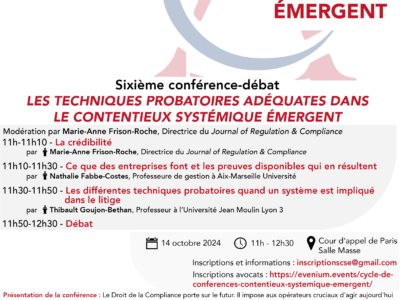
► Full Reference: Les techniques probatoires adéquates dans le Contentieux Systémique Émergent (Appropriate Evidentiary Techniques in Emerging Systemic Litigation), in cycle of conference-debates "Contentieux Systémique Émergent" ("Emerging Systemic Litigation"), organised on the initiative of the Cour d'appel de Paris (Paris Cour of Appeal), with the Cour de cassation (French Court of cassation), the Cour d'appel de Versailles (Versailles Court of Appeal), the École nationale de la magistrature – ENM (French National School for the Judiciary) and the École de formation des barreaux du ressort de la Cour d'appel de Paris – EFB (Paris Bar School), under the scientific direction of Marie-Anne Frison-Roche, October 14, 2024, 11am.-12.30pm., Paris Court of Appeal, Masse courtroom - ► Presentation of the conference:  - 🧮Programme of this event:  Sixth conference-debate LES TECHNIQUES PROBATOIRES ADÉQUATES DANS LE CONTENTIEUX SYSTÉMIQUE ÉMERGENT  (APPROPRIATE EVIDENTIARY TECHNIQUES IN EMERGING SYSTEMIC LITIGATION) Cour d’appel de Paris, salle Masse Presentation and moderation by 🕴️Marie-Anne Frison-Roche, Professor of Regulatory and Compliance Law, Director of the Journal of Regulation & Compliance (JoRC) 🕰️11am.-11.10am. 🎤La crédibilité (Credibility), by 🕴️Marie-Anne Frison-Roche, Professor of Regulatory and Compliance Law, Director of the Journal of Regulation & Compliance (JoRC) 🕰️11.10am.-11.30am. 🎤Ce que des entreprises font et les preuves disponibles qui en résultent (What firms are doing and evidence available as a result), by 🕴️Nathalie Fabbe-Costes, Professor of management at Aix-Marseille University  🕰️11.30am-11.50am. 🎤Les différentes techniques probatoires quand un système est impliqué dans un litige (The various evidential techniques when a system is involved in a dispute), by 🕴️Thibault Goujon-Bethan, Professor of Law at Jean-Moulin Lyon 3 University, director of the Centre patrimoine et contrats, director of the IEJ de Lyon 🕰️11.50am.-12h30pm. Debate - 🔴Registrations and information requests can be sent to: inscriptionscse@gmail.com 🔴For the attorneys, registrations have to be sent to the following address: https://evenium.events/cycle-de-conferences-contentieux-systemique-emergent/  ⚠️The conference-debates are held in person only, in the Cour d’appel de Paris (Paris Court of Appeal). -

Organisation of events

🧱⚙️scientific organisation of 🧮L’incidence du devoir de vigilance sur les litiges commerciaux (The impact of the duty of vigilance on commercial litigation)

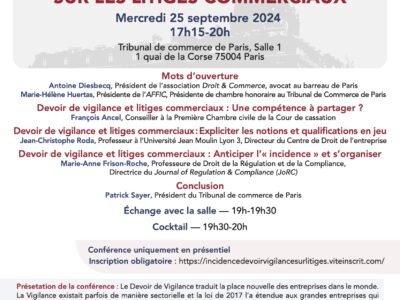
► Full Reference: M.-A. Frison-Roche, coordination of the conference L'incidence du devoir de vigilance sur les litiges commerciaux (The impact of the duty of vigilance on commercial litigation), Tribunal de commerce de Paris (Paris Commercial Court), Droit & Commerce and Association Française en Faveur de l'Institution Consulaire (AFFIC), Tribunal de commerce de Paris, 25 September 2024, 5.15p.m. to 8p.m. - 🧮see the full programme of this event - 🌐consult on LinkedIn a general présentation of this event (in French) - ► General presentation of the conference: The Duty of Vigilance reflects the new role of firms in the world. Vigilance sometimes existed on a sectoral basis, but the 2017 French law extended it to large companies that control value chains. The French so-called "confiance" law gave the Tribunal judiciaire de Paris (Paris First Instance Civil Court) jurisdiction to hear "actions relatives" ("actions relating") to this duty. This does not mean, however, that the commercial courts will no longer have jurisdiction. Firstly, vigilance may go beyond the scope of the 2017 French law. Secondly, vigilance may concern not only the plan drawn up by the firm, but also Commercial Contract Law or Liability Law, special Distribution Law, etc. Commercial courts will have to develop a doctrine for dividing up and coordinating disputes, in particular by staying proceedings within certain disputes. To build a unified or at least non-contradictory case law on vigilance, we need to imagine a dialogue between judges and new procedures. - 🧮Programme of this event:  L'INCIDENCE DU DEVOIR DE VIGILANCE SUR LES LITIGES COMMERCIAUX (THE IMPACT OF THE DUTY OF VIGILANCE ON COMMERCIAL LITIGATION) Paris First Instance Commercial Court, room 1 🕰️5.15pm.-5.30pm. Welcome 🕰️5.30pm.-5.40pm. 🎤Mots d'ouverture (Opening words), by 🕴️Antoine Diesbecq, President of Droit & Commerce, attorney at the Paris Bar and 🕴️Marie-Hélène Huertas, President of AFFIC, Honorary President of Chamber of the Paris First Instance Commercial Court 🕰️5.40pm.-6pm. 🎤Devoir de vigilance et litiges commerciaux : Une compétence à partager ? (Duty of Vigilance and Commercial Litigation: A jurisdiction to share?), by 🕴️François Ancel, Judge at the Première Chambre civile de la Cour de cassation (First Civil Chamber of the French Court of cassation) 🕰️6pm.-6.20pm. 🎤Devoir de vigilance et litiges commerciaux : Expliciter les notions et qualifications en jeu (Duty of Vigilance and Commercial Litigation: Explain the concepts and qualifications involved?), by 🕴️Jean-Christophe Roda, Full Professor at Jean Moulin Lyon 3 University, Director of the Centre de Droit de l’entreprise 🕰️6.20pm.-6.40pm. 🎤Devoir de vigilance et litiges commerciaux : Anticiper l''incidence" et s’organiser (Duty of Vigilance and Commercial Litigation: Anticipating the "impact" and getting organised), by 🕴️Marie-Anne Frison-Roche, Professor of Regulatory Law and Compliance Law, Director of the Journal of Regulation & Compliance (JoRC) 🕰️6.40pm.-7pm. 🎤Conclusion (Conclusion), by 🕴️Patrick Sayer, President of the Tribunal de commerce de Paris (Paris First Instance Commercial Court) 🕰️7pm.-7.30pm. Discussion with the audience 🕰️7.30pm.-8pm. Cocktail - 🌐follow Marie-Anne Frison-Roche on LinkedIn 🌐follow Marie-Anne Frison-Roche on Instagram 🌐subscribe to the Newsletter MAFR Regulation, Compliance, Law

Organisation of events

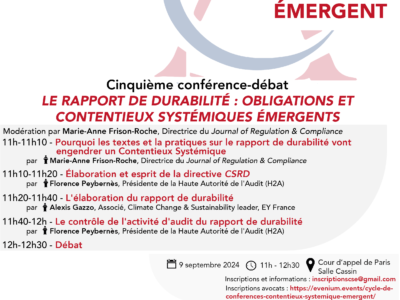
🧱⚙️scientific organisation and moderation of 🧮Le rapport de durabilité : obligation et Contentieux Systémiques Émergents (The Sustainability Report: Emerging Systemic Obligation and Litigation), in cycle of conference-debates “Contentieux Systémique Émergent” (“Emerging Systemic Litigation”)

► Full Reference: M.-A. Frison-Roche, Scientific direction of the conference Le rapport de durabilité : obligation et Contentieux Systémiques Émergents (The Sustainability Report: Emerging Systemic Obligations and Litigation), in cycle of conference-debates "Contentieux Systémique Émergent" ("Emerging Systemic Litigation"), organised on the initiative of the Cour d'appel de Paris (Paris Cour of Appeal), with the Cour de cassation (French Court of cassation), the Cour d'appel de Versailles (Versailles Court of Appeal), the École nationale de la magistrature – ENM (French National School for the Judiciary) and the École de formation des barreaux du ressort de la Cour d'appel de Paris – EFB (Paris Bar School) and MAFR, September 19, 2024, 11h-12h30, Cour d'appel de Paris, Cassin courtroom - ► Presentation of the conférence: Sustainability is a new legal concept, the lineaments of which can be found in certain sectors and branches of Law, and which today has both multiple resulting obligations and a definition that is sufficiently unified to allow it to be grasped through the technique and the requirement of the "Sustainability Report", which translates a requirement linked to the systems themselves. The dual materiality mechanism illustrates this. The Litigation that will ensue shall be imbued with this systemic dimension, since this report was required from this perspective, and the notion of Sustainability itself was conceived in the same way. What is commonly referred to as "ESG" reflects this perspective, which is both structural and long-term: Information is central here, since it is a Report, anchored in  the new conception of Corporate Law that is imbued with Governance, where internal and external stakeholders are present. The various Supervisors and Regulators, who go beyond supervising professionals to regulate activities, are also bound to have a role to play in this Emerging Systemic Litigation. In order to understand and anticipate this, this conference is built around an analysis of the construction of the Sustainability Report and an analysis of the role of the Regulatory and Supervisory Authority, the French Audit Authority, the Haute Autorité de l'Audit – H2A. These analyses are carried out with a view to the Systemic Litigation that will arise from these new requirements and practices, in correlation with Litigation linked to other fields of Systemic Litigation such as Vigilance field. - 🧮Programme of this event:  Fith conference-debate LE RAPPORT DE DURABILITÉ : OBLIGATIONS ET CONTENTIEUX SYSTÉMIQUES ÉMERGENTS (THE SUSTAINABILITY REPORT: EMERGING SYSTEMIC OBLIGATIONS AND LITIGATION) Paris Court of Appeal, Cassin courtroom 🕰️11am.-11.10am. 🎤Pourquoi les textes et la pratiques sur le rapport de durabilité vont engendrer un Contentieux Systémique (Why the texts and practices on sustainability reporting will give rise to Systemic Litigation), by 🕴️Marie-Anne Frison-Roche, Professor of Regulatory Law and Compliance Law, Director of the Journal of Regulation & Compliance (JoRC) ➡️read the presentation of this speech 🕰️11.10am.-11.20am. 🎤Élaboration et esprit de la directive CSRD (Elaboration and spirit of the CSRD), by 🕴️Florence Peybernès, President of the Haute Autorité de l'Audit – H2A (French High Audit Authority) 🕰️11.20am.-11.40am. 🎤Comment construire un rapport de durabilité ? (How to build a sustainability report?), by 🕴️Alexis Gazzo, Partner, Climate Change & Sustainability leader, EY France 🕰️11.40am.-12pm. 🎤Le contrôle de l'activité d'audit du rapport de durabilité (The control of the audit of the sustainability report), by 🕴️Florence Peybernès, President of the Haute Autorité de l'Audit – H2A (French High Audit Authority) 🕰️12pm.-12.30pm. Debate - 🔴Registrations and information requests can be sent to: inscriptionscse@gmail.com 🔴For the attorneys, registrations have to be sent to the following address: https://evenium.events/cycle-de-conferences-contentieux-systemique-emergent/  ⚠️The conference-debates are held in person only, in the Cour d’appel de Paris (Paris Court of Appeal). -

Organisation of events

🧮L’intelligence artificielle, nouveau champ de contentieux systémique (“Artificial intelligence, new field of systemic litigation”), in cycle de conférences-débats “Contentieux Systémique Émergent” (“Emerging Systemic Litigation”)

► Full Reference: L’intelligence artificielle, nouveau champ de Contentieux Systémique (Artificial intelligence, new field of Systemic Litigation), in cycle of conferences-debates "Contentieux Systémique Émergent" ("Emerging Systemic Litigation"), organised on the initiative of the Cour d'appel de Paris (Paris Cour of Appeal), with the Cour de cassation (French Court of cassation), the Cour d'appel de Versailles (Versailles Court of Appeal), the École nationale de la magistrature – ENM (French National School for the Judiciary) and the École de formation des barreaux du ressort de la Cour d'appel de Paris – EFB (Paris Bar School), under the scientific direction of Marie-Anne Frison-Roche, June 24, 2024, 11am-12.30pm, Cour d'appel de Paris, Cassin courtroom. - 🌐see on LinkedIn the report made of this event - ► Presentation of this conference-debate:  Artificial intelligence has enabled the creation of an algorithmic system. This develops its own logic, which is essentially technological in nature. It generates computing power based on the correlation of information to produce possible causalities and build probabilities that are sometimes likened to "predictions", with the mass processed eventually generating a qualitative change. This change is linked to the digital space itself, which by its very nature gives rise to systemic disputes and litigation, to which the conference-debate on 27 May 2024 was devoted. There are three ways in which this Emerging Systemic Litigation is involved, and it is important to anticipate these, as the litigation is either in its infancy or still to come, but will undoubtedly arise suddenly. Firstly, it is possible that the technological tool will make it possible to deal with certain cases where the technical nature of either the concepts or the requests, or the multitude of requests, however simple, require this ability to deal with the mass, which leads to an increase in both the mechanical power of algorithms and the greater presence of human beings, in particular through the increase in adversarial proceedings, pre-trial proceedings, mediation, etc. Secondly, in the face of this change linked to the digital environment, 'texts' have appeared to 'regulate' the use or the very invention of this or that algorithmic tool, texts of a very diverse nature, from the most soft to the hardest (this gradation between soft and hard law is the theme taken up in the conference-debate of 19 September 2024). These may be measures taken by the firms that produce the tools, those that use them, or those that disseminate them, with the people affected by the information being relatively active. This last point explains why systemic disputes are already underway, concerning the subjective rights that would be violated either by the very nature of artificial intelligence, in this case the rights of content producers, or the rights to privacy, or protection of other Monumental Goals. The systemic and extra-territorial dimension of these disputes has already been established. The third point is the role of Politics, since the European Union, through the texts currently being adopted, has established that the Goal is not only the sustainability of the technical system, the innovation market and European sovereignty, but also the primacy of people and individuals, through a method that is the Ex Ante ranking of risks. This conception is also contested. This methodological issue also applies to judges. This Emerging Systemic Litigation is and will be brought before various regulatory or supervisory Authorities, but also before the administrative and judiciary courts, in particular through Contract Law, Tort Law, Company Law, Labour Law, General Procedural Law, etc. The aim here is to measure and anticipate the way in which the systemic dimension of these disputes will be incorporated into future litigation. - 🧮Program of this manifestation:  Fourth conference-debate L’INTELLIGENCE ARTIFICIELLE, NOUVEAU CHAMP DE CONTENTIEUX SYSTÉMIQUE (ARTIFICIAL INTELLIGENCE, NEW FIELD OF SYSTEMIC LITIGATION) Paris Court of Appeal, Cassin courtroom Presentation and moderation by 🕴️Marie-Anne Frison-Roche, Professor of Regulatory & Compliance Law, Director of the Journal of Regulation & Compliance (JoRC) 🕰️11am.-11.10am. 🎤Les deux rencontres entre l'intelligence artificielle et le Contentieux Systémique (The two meetings between Artificial Intelligence and Systemic Litigation), by 🕴️Marie-Anne Frison-Roche, Professor of Regulatory & Compliance Law, Director of the Journal of Regulation & Compliance (JoRC) 🕰️11.10am-11.30am. 🎤Les premiers contentieux systémiques observables impliquant l’intelligence artificielle (The first observable Systemic Litigations involving artificial intelligence), by 🕴️Sonia Cissé, Partner, Linklaters Paris 🕰️11.30am-11.50am. 🎤L’influence des nouveaux textes et des textes à venir sur les contentieux systémiques émergents impliquant l’intelligence artificielle (The influence of new and forthcoming legislation on Emerging Systemic Litigation involving artificial intelligence), by 🕴️Emmanuel Netter, Professor of Law at Strasbourg University  🕰️11.50am-12.30pm. Debate - 🔴Registrations and information requests can be sent to: inscriptionscse@gmail.com 🔴For the attorneys, registrations have to be sent to the following address: https://evenium.events/cycle-de-conferences-contentieux-systemique-emergent/  ⚠️The conference-debates are held in person only, in the Cour d’appel de Paris (Paris Court of Appeal). - 🧮Read below the report made of this event by Marie-Anne Frison-Roche⤵️

Organisation of events

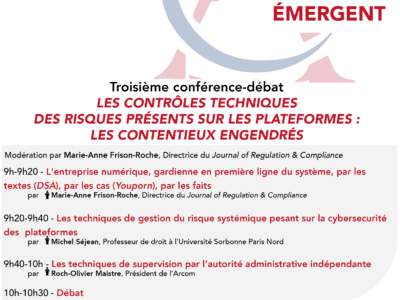
🧮Les techniques de supervision des contenus numériques disponibles sur les plateformes (Technical risks controls on platforms and disputes arising from them), in cycle de conférences-débats “Contentieux Systémique Émergent” (“Emerging Systemic Litigation”)

► Full Reference: Les contrôles techniques des risques présents sur les plateformes et les contentieux engendrés (Technical risks controls on platforms and disputes arising from them), in cycle of conference-debates "Contentieux Systémique Émergent" ("Emerging Systemic Litigation"), organised on the initiative of the Cour d'appel de Paris (Paris Cour of Appeal), with the Cour de cassation (French Court of cassation), the Cour d'appel de Versailles (Versailles Court of Appeal), the École nationale de la magistrature – ENM (French National School for the Judiciary) and the École de formation des barreaux du ressort de la Cour d'appel de Paris – EFB (Paris Bar School), under the scientific direction of Marie-Anne Frison-Roche, May 27, 2024, 9h-10h30, Cour d'appel de Paris, Cassin courtroom - 🧮see the full programme of the cycle Contentieux Systémique Émergent (Emerging Systemic Litigation) - 🌐see on LinkedIn the report of this event - 🧱read below the report of this event⤵️ - ► Presentation of the conference: The digital space is full of risks. Some are naturally associated with it, because it is an area of freedom, while others must be countered because they are associated with generally prohibited behaviour, such as money laundering. But the digital space has developed risks which, because of their scale, have been transformed in their very nature: this is particularly true of the distortion permeating certain content and the insecurity that can threaten the entire system itself. Law has therefore entrusted operators themselves with vigilance over what have become ‘cyber-risks’, such as the risk of disinformation, the risk of destruction of communication infrastructures, and the risk of data theft, a systemic prospect that can lead to the collapse of societies themselves.   New legislations has been drafted, in particular the Digital Services Act (DSA), to increase the burdens and powers of firms in this area, with digital companies in the front line, but also supervisory authorities such as the Autorité de régulation de la communication audiovisuelle et numérique – Arcom (French Regulatory Authority for Audiovisual and Digital Communication). The resulting disputes, in which firms and regulators may be allies or opponents, are systemic in nature.   The judge's handling of these "systemic cases", through the procedure and the solutions, must respond to this systemic dimension. The "pornographic websites" case, which is currently unfolding, provides an opportunity to observe in vivo the dialogue between judges when a "systemic case" imposes itself on them.   - 🧮Programme of this event:  Third conference-debate LES CONTRÔLES TECHNIQUES DES RISQUES PRÉSENTS SUR LES PLATEFORMES ET LES CONTENTIEUX ENGENDRÉS (TECHNICAL RISKS CONTROLS ON PLATFORMS AND DISPUTES ARISING FROM THEM) Paris Court of Appeal, Cassin courtroom Moderated by 🕴️Marie-Anne Frison-Roche, Professor of Regulatory and Compliance Law, Director of the Journal of Regulation & Compliance (JoRC) 🕰️9h-9h10. 🎤Le contentieux Systémique Emergent du fait du système numériqué (Systemic Litigation Emerging from the Digital System), 🕴️Marie-Anne Frison-Roche 🕰️9h10-9h30. 🎤Les techniques de gestion du risque systémique pesant sur la cybersécurité  des plateformes (The Systemic Obligation of Security on Platforms and associated Litigation), 🕴️Michel Séjean, Professor of Law at Sorbonne Paris Nord University 🕰️9h30-9h50. 🎤Un cas systémique in vivo : le cas dit des sites pornographiques (An in vivo Systemic Case: the so-called case of pornographic websites),🕴️Marie-Anne Frison-Roche 🕰️9h50-10h10. 🎤Les obligations systémiques des opérateurs numériques à travers le Règlement sur les Services Numériques (RSN/DSA) et le rôle des régulateurs (Systemic Obligations of Operators (DSA) and the role of Regulators), 🕴️Roch-Olivier Maistre, Chair of the Autorité de régulation de la communication audiovisuelle et numérique – Arcom (French Regulatory Authority for Audiovisual and Digital Communication) 🕰️10h10-10h30. Debate - 🔴Registrations and information requests can be sent to: inscriptionscse@gmail.com 🔴For the attorneys, registrations have to be sent to the following address: https://evenium.events/cycle-de-conferences-contentieux-systemique-emergent/  ⚠️The conference-debates are held in person only, in the Cour d’appel de Paris (Paris Court of Appeal). - 🧱read below a detailed presentation of this event⤵️ -

Organisation of events

Second conference-debate of the cycle "Contentieux Systémique Émergent" ("Emerging Systemic Litigation")

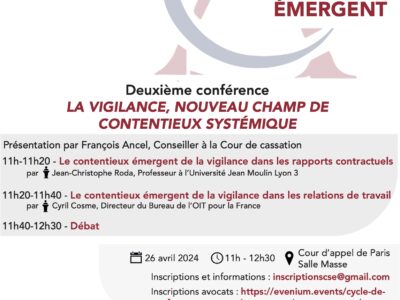
🧮La vigilance, nouveau champ de contentieux systémique (Vigilance, new field of Systemic Litigation), in cycle of conference-debates “Contentieux Systémique Émergent” (Emerging Systemic Litigation)

► Full Reference: La vigilance, nouveau champ de contentieux systémique (Vigilance, new field of Systemic Ligation), in cycle of conference-debates "Contentieux Systémique Émergent" ("Emerging Systemic Litigation"), organised on the initiative of the Cour d'appel de Paris (Paris Cour of Appeal), with the Cour de cassation (French Court of cassation), the Cour d'appel de Versailles (Versailles Court of Appeal), the École nationale de la magistrature – ENM (French National School for the Judiciary) and the École de formation des barreaux du ressort de la Cour d'appel de Paris – EFB (Paris Bar School), under the scientific direction of Marie-Anne Frison-Roche, 26 April 2024, 11am.-12.30am., Cour d'appel de Paris, Massé courtroom - 🧮see the full programme of the cycle Contentieux Systémique Émergent (Emerging Systemic Litigation) - 🌐see on LinkedIn the report of this event - 🧱read below the report of this event⤵️ - ► Presentation of the conference: The duty of vigilance imposed by the 2017 French law is being contractualised, either by ad hoc contracts or by stipulations that reproduce the legal provisions, adjust them or go beyond them. This adoption by the Contract and Tort Law is valuable but not without risk. The systemic scope of the underlying law on the one hand and of economic structures on the other, the firm or the value chain, will permeate litigation. The example of labour relations is instructive in this respect. - 🧮Programme of this event:  Second conference-debate LA VIGILANCE, NOUVEAU CHAMP DE CONTENTIEUX SYSTÉMIQUE (VIGILANCE, NEW FIELD OF SYSTEMIC LITIGATION)   Paris Court of Appeal, Massé courtroom General presentation of the topic and moderation by 🕴️François Ancel, Judge at the Première Chambre civile de la Cour de cassation (First Civil Chamber of the French Court of cassation) 🕰️11am.-11.20am. 🎤Le contentieux émergent de la Vigilance dans les rapports contractuels (Emerging Vigilance Litigation in Contractual Relationships), by 🕴️Jean-Christophe Roda, Full Professor at Jean-Moulin Lyon 3 University 🕰️11.20am.-11.40am. 🎤Le contentieux émergent de la Vigilance dans les relations de travail (Emerging Vigilance Litigation in Employment Relationships), by 🕴️Cyril Cosme, Director of the French Office of the International Labour Organization (ILO) 🕰️11.40am.-12.30am. Debate - 🔴Registrations and information requests can be sent to: inscriptionscse@gmail.com 🔴For the attorneys, registrations have to be sent to the following address: https://evenium.events/cycle-de-conferences-contentieux-systemique-emergent/  ⚠️The conference-debates are held in person only, in the Cour d’appel de Paris (Paris Court of Appeal). - 🧱read below a detailed presentation of this event⤵️ -

Organisation of events

1st conference-debate of the cycle "Contentieux Systémique Émergent" ("Emerging Systemic Licigation")

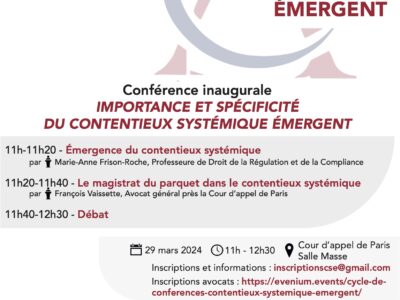
🧮Importance et spécificité du Contentieux Systémique Émergent (Importance and specificity of the Emerging Systemic Litigation), in cycle of conferences-debates “Contentieux Systémique Émergent” (“Emerging Systemic Litigation”)

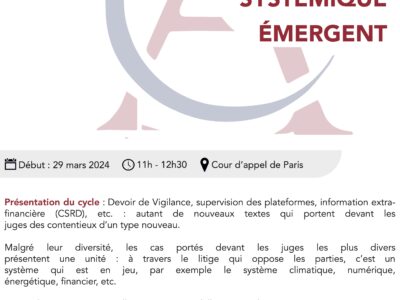
► Full Reference: Importance et spécificité du Contentieux Systémique Émergent (Importance and specificity of the Emerging Systemic Litigation), in cycle of conference-debates "Contentieux Systémique Émergent" ("Emerging Systemic Litigation"), organised on the initiative of the Cour d'appel de Paris (Paris Cour of Appeal), with the Cour de cassation (French Court of cassation), the Cour d'appel de Versailles (Versailles Court of Appeal), the École nationale de la magistrature – ENM (French National School for the Judiciary) and the École de formation des barreaux du ressort de la Cour d'appel de Paris – EFB (Paris Bar School), under the scientific direction of Marie-Anne Frison-Roche, March 29, 2024, 11h-12h30, Cour d'appel de Paris, Masse room - ► Presentation of the conference-debate: The "Systemic Litigation" is emerging. Through and beyond the dispute, a system is involved: the banking, financial, digital, health and climate systems. How can such litigation be recognised? How do you make room for a system in a court of law? What can be done when several systems are in conflict? Who represents these systems and their interests? How can the temporality of systems and litigation be reconciled? In practical terms, the magistrate has a new role. Whether they are prosecutors or judges, they deal with systemic litigation in criminal, civil, commercial and other areas.   - 🎤see the detailed presentation of the first speech of 🕴️Marie-Anne Frison-Roche : L'émergence du Contentieux Systémique (The Emergence of Systemic Litigation) - 🧮Programme of this event:  Inaugural Conference IMPORTANCE ET SPÉCIFICITÉ DU CONTENTIEUX SYSTÉMIQUE ÉMERGENT (IMPORTANCE AND SPECIFICITY OF THE EMERGING SYSTEMIC LITIGATION)   Cour d’appel de Paris (Paris Court of Appeal), Masse room 🕰️11h-11h20. 🎤L’émergence du contentieux systémique (The Emergence of the Systemic Litigation), by 🕴️Marie-Anne Frison-Roche, Professor of Regulatory and Compliance Law, Director if the Journal of Regulation & Compliance (JoRC)   🕰️11h20-11h40. 🎤L’office du magistrat du parquet dans le contentieux systémique (The role of the Public Prosecutor in Systemic Litigation), by 🕴️François Vaissette, Avocat général près la Cour d’appel de Paris (Advocate General at the Paris Court of Appeal)   🕰️11h40-12h30. Debate - 🔴Registrations and information requests can be sent to: inscriptionscse@gmail.com 🔴For the attorneys, registrations have to be sent to the following address: https://evenium.events/cycle-de-conferences-contentieux-systemique-emergent/  ⚠️The conference-debates are held in person only, in the Cour d’appel de Paris (Paris Court of Appeal). - 🧮Read below a detailed presentation of this event⤵️ -

Organisation of events

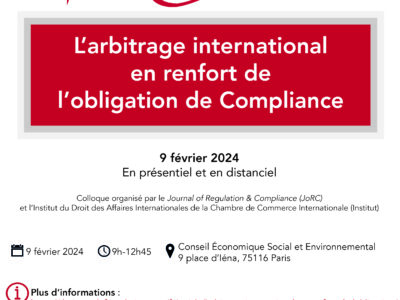
🧱Co-organisation of the Symposium 🧮L’arbitrage international en renfort de l’Obligation de Compliance (International Arbitration in support of the Compliance Obligation)

► Full Reference: L. Aynès, M.-A. Frison-Roche, J.-B. Racine and E. Silva-Romero (dir.), L'arbitrage international en renfort de l'obligation de Compliance (International Arbitration in support of the Compliance Obligation), Journal of Regulation & Compliance (JoRC) and Institute of World Business Law of the ICC (Institute), Conseil Économique Social et Environnemental (CESE), Paris, February 9, 2024 - 🌐consult on LinkedIn a general présentation of this event, which links to a presentation and a report of each speech  - 🏗️This symposium takes place in the cycle of symposiums organised by the Journal of Regulation & Compliance (JoRC) and its partners Universities, focusing in 2023-2024 on the general theme of the Compliance Obligation - 📚The works will then be inserted in the books:  📕L'obligation de Compliance, to be published in the 📚Régulations & Compliance Serie, co-published by the Journal of Regulation & Compliance (JoRC) and Dalloz, published in French. 📘Compliance Obligation, to be published on the 📚Compliance & Regulation Serie, co-published by the Journal of Regulation & Compliance (JoRC) and Dalloz, published in English. - ► General presentation of the symposium: "Compliance Obligation" appears to be far from International Arbitration if Compliance Law is only understood in terms of binding regulations or even Criminal Law. Arbitration would only have contact with Compliance Obligation in a repulsive way, when a person claims to have enforced a contract before an arbitration court that disregards a compliance prohibition, e.g. corruption or money laundering. It is therefore from a negative angle that the cross-over has taken place. The fact that Arbitration Law respects the requisite of Criminal Law is nothing new.  Moreover, the power of Compliance in its detection and prevention tools, particularly in terms of evidence, no doubt increases the global efficiency. But Compliance Obligation is based on Monumental Goals, notably linked to global human rights and active ambitions about environment and climate which, particularly in the value chain economy, take the legal form of compliance clauses, or even compliance contracts, or various commitments and plans, which the parties can ask the international arbitrator to enforce. They will do so even more as arbitrators are often the only international, or even global, judges available. The use they will do of Contract Law, Quasi-Contract Law, Enforcement Law, Tort Law, reinforces Compliance Law in a global dimension. - - ► Interviennent :  🎤 Laurent Aynès, emeritus Professor at Paris 1 Panthéon-Sorbonne University, Attorney, Darrois Villey Maillot Brochier (Paris) 🎤 Marie-Anne Frison-Roche, Professor of Regulatory and Compliance Law, Director of the Journal of Regulation & Compliance (JoRC) 🎤 Jean-François Guillemin, former General Secretary of the Bouygues Group 🎤 Christophe Lapp, Attorney, Advant Altana (Paris) 🎤 Jean-Baptiste Racine, Full Professor at Paris Panthéon-Assas University (Paris 2) 🎤 Eduardo Silva-Romero, President of the Institute of World Business Law of the ICC (Institute), Attorney, Wordstone (Paris) - 🧮Read a detailed presentation of the event below⤵️ - 🌐follow Marie-Anne Frison-Roche on LinkedIn 🌐follow Marie-Anne Frison-Roche on Instagram 🌐subscribe to the Newsletter MAFR Regulation, Compliance, Law

Organisation of events

🧱Co-organisation of the Symposium 🧮Compliance et contrats publics (Compliance and public contracts)

► Full Reference: M.-A. Frison-Roche, C. Gilles and A. Oumedjkane (dir.), Compliance et contrats publics (Compliance and public contracts), Journal of Regulation & Compliance (JoRC), Centre de recherches et d’études administratives de Montpellier (CREAM) and Centre d’Études et de Recherches Comparatives Constitutionnelles et Politiques (CERCOP) of the Montpellier University, Faculté de droit et de science politique de Montpellier, January 12, 2024 - 🌐consult a general presentation of this event on LinkedIn, linking to a presentation of each speech (in French) - 🏗️This symposium takes place in the cycle of symposiums organised by the Journal of Regulation & Compliance (JoRC) and its partners Universities, focusing in 2023-2024 on the general theme of the Compliance Obligation - 📚The works will then be inserted in the books:  📕Compliance et contrat, to be published in the 📚Régulations & Compliance Serie, co-published by the Journal of Regulation & Compliance (JoRC) and Dalloz, published in French. 📘Compliance & Contract, to be published on the 📚Compliance & Regulation Serie, co-published by the Journal of Regulation & Compliance (JoRC) and Dalloz, published in English. - ► General presentation of the symposium: Compliance is developing throughout the legal system, through both Public and Private Law techniques. Public Contract Law bears witness to this in two ways: through its scope, in that Compliance applies to economic relationships entered into by public bodies, and through its object, which internalises a reconciliation between their economic interests and a set of other general interest objectives, or "Monumental Goals", a reconciliation for which public bodies have traditionally been responsible. In addition to unilateral acts, contracts have their rightful place as a practical means of achieving this reconciliation. Its flexibility allows for negotiation and adjustment of the burdens to be placed on the co-contracting parties. The aim of this symposium is to link the different manifestations of the Compliance Obligation in public contracts and thus give coherence to policies which are still too often considered in a watertight manner because they relate to very different aims and areas. Firstly, at the procurement stage, the promotion of responsible or innovative procurement, particularly from an environmental point of view, is one of the signs of Compliance's presence. On a completely different note, the same is true of the CJEU's challenge to the automatic application of bans on tendering, which prevent contracting authorities from ruling on a candidate's reliability by taking into account the compliance programmes implemented by companies since their conviction. Secondly, at the litigation stage, the Conseil d'État's (French Council of State) recent broad recognition of the illegality of an administrative contract on the grounds of a breach of ethical obligations has tempered the drive to make contracts more secure, drawing the consequences of the major drive for transparency in public life that has been underway since 2013. The aim of the morning session will be to understand the various forms of the Compliance Obligation in public contracts. This overview will make it possible, in the afternoon, to aim to unify the Compliance Obligation in public contracts. - - ► Speakers:  🎤Ugo Assouad, PhD student at the Montpellier University, CREAM 🎤Philippe Augé, President of the Montpellier University 🎤Clémence Ballay-Petizon, PhD student at the Montpellier University, CREAM  🎤Yannisse Benrahou, PhD student at Paris-Nanterre University, CRDP 🎤Léon Boijout, PhD student at the Montpellier University, CREAM 🎤Julien Bonnet, Full Professor at the Montpellier University, CERCOP 🎤Guylain Clamour, Dean of the Montpellier Faculty of Law and Political Science 🎤Marie-Anne Frison-Roche, Professor of Regulatory and Compliance Law, Director of the Journal of Regulation & Compliance (JoRC) 🎤Pierre-Yves Gadhoun, Professor at the Montpellier University, CERCOP 🎤Pascale Idoux, Professor at the at the Montpellier University, CREAM 🎤Nedjma Kontoukas, PhD student at the Montpellier University, CREAM 🎤Valentin Lamy, Senior Lecturer at the Lorraine University, IRENEE 🎤Antoine Oumedjkane, Senior Lecturer at Lille University, ERDP 🎤Lucien Rapp, Emeritus Professor at Toulouse Capitole University 🎤Marion Ubaud-Bergeron, Full Professor at the Montpellier University, CREAM  - 🧮Read a detailed presentation of the event below⤵️ - 🌐follow Marie-Anne Frison-Roche on LinkedIn 🌐follow Marie-Anne Frison-Roche on Instagram 🌐subscribe to the Newsletter MAFR Regulation, Compliance, Law

Organisation of events

🧱⚙️Coordination of the cycle of conference-debates 🧮Contentieux Systémique Émergent – CSE (Emerging Systemic Litigation – ESL)

► Full Reference: M.-A. Frison-Roche, Coordination of the cycle of conference-debates Contentieux Systémique Émergent (Emerging Systemic Litigation), organised on the initiative of the Cour d'appel de Paris (Paris Cour of Appeal), with the Cour de cassation (French Court of cassation), the Cour d'appel de Versailles (Versailles Court of Appeal), the École nationale de la magistrature – ENM (French National School for the Judiciary) and the École de formation des barreaux du ressort de la Cour d'appel de Paris – EFB (Paris Bar School), under the scientific direction of Marie-Anne Frison-Roche - ► This Cycle in few words: Duty of vigilance, supervision of platforms, non-financial information (CSRD), etc.: as many new texts that bring new types of disputes before the courts. Despite their diversity, the cases brought before the most diverse judges present a unity: through the dispute that pits the parties against each other, it is a system that is at stake, for example the climate system, digital system, energy system, financial system, etc. New regulations are just the illustration of this "Emerging Systemic Litigation"; the conference-debates aiming at showing the new fields, new techniques, new standards, etc., in relation to the scale and diversity of stakeholders' expectations. This cycle is designed to encourage cross-fertilisation, so as to provide judges with food for thought ahead of the litigation they will be called upon to deal with. Les réglementations nouvelles ne sont que l’illustration de ce « contentieux systémique émergent » dont la formation a pour objet de montrer les nouveaux champs, les nouvelles techniques, les nouvelles normes, etc., en lien avec l’ampleur et la diversité des attentes des parties prenantes. Le cycle vise à favoriser les échanges croisés, afin d’alimenter la réflexion des magistrats en amont des litiges qui leurs seront soumis. - 🔴Registrations and information requests can be sent to: inscriptionscse@gmail.com 🔴For the attorneys, registrations have to be sent to the following address: https://evenium.events/cycle-de-conferences-contentieux-systemique-emergent/  ⚠️The conference-debates are held in person only, in the Cour d’appel de Paris (Paris Court of Appeal). - ► General Presentation of the Cycle: In 2024, the Cour d’appel de Paris (Paris Court of Appeal) created a new specialised chamber: chamber 5-12 Contentieux émergent – Devoir de vigilance et responsabilité écologique (Emerging litigation – Duty of vigilance and environmental liability). Vigilance litigation is an example of what is emerging more generally: Systemic Litigation, often linked to technologies. This calls for a new way of judging, organising procedures and relations between professionals. A series of conference-debates on Emerging Systemic Litigation (ESL) is being organised jointly by the Paris Court of Appeal, the Versailles Court of Appeal, the Cour de cassation (French Court of cassation), the École nationale de la magistrature – ENM (French National School for the Judiciary) and the École de formation des barreaux du ressort de la Cour d'appel de Paris – EFB (Paris Bar School), under the scientific responsibility of Professor Marie-Anne Frison-Roche. In this context, a series of conference-debates involving professionals from a wide range of backgrounds is being proposed on the following themes: 🧮the very notion of "Emerging Systemic Litigation" and the role of the judiciary in it (29 March 2024): read the report of this event   🧮vigilance, insofar as it gives rise to Systemic Litigation, notably because it takes legal form in numerous contracts, for example in employment relationships (26 April 2024): read the report of this event   🧮the inclusion in Emerging Systemic Litigation of information reliability techniques, particularly with regard to content available on platforms (27 May 2024): read the report of this event   🧮the way in which artificial intelligence is generating Systemic Litigation and the influence of new specific texts (24 June 2024): read the report of this event   🧮sustainability, a principle of systems found in reports and transitively in disputes concerning their development, their standards and even their control (9 September 2024): read the programme of this event   🧮new evidentiary techniques required by Emerging Systemic Litigation, to account for systemic needs, e.g. climate and digital systems, and how firms respond to them (14 October 2024): read the programme of this event   🧮Vigilance General Procedural Law, in that it incorporates the Systemic dimension of Vigilance Litigation (18 November 2024): read the programme of this event   🧮institutional and case law feedback from courts on Emerging Systemic Litigation (16 December 2024): read the programme of this event - 🧮read below the full programme of this cycle of conference-debates⤵️