Glossary

Glossary

Impartiality

Impartiality is the quality, maybe the virtue, that is demanded of the judge, not only the one who is called like that but also the one who has the function to judge the others (maybe without this name). It can not be defined as the absolute positive aptitude, namely the total absence of prejudice, the heroic aptitude for a person to totally ignore his or her personal opinions and personal history. This heroic virtue is nonsense because not only is it inaccurate, impossible but it is also not desirable because a person is not a machine. It must not be so because good justice is human justice. In this respect, impartiality refers to a philosophical conception of what is justice and what is Regulation, not machines, but systems that must keep the human person in their center (Sunstein). Thus Impartiality is articulated with the subjective nature of the assessment not only inevitable but also desirable that the judge makes of situations. Because Law is reasonable, Impartiality is defined only negatively: the absence of bias. Impartiality is defined first and foremost as a subjective and individual quality, namely, the prohibition on the person who makes a decision affecting the situation of others (as is the case of a judge) to a a personal interest in this situation. The constitutional prohibition of being "judge and party" is thus the expression of the principle of impartiality. This definition is in line with the otherwise general requirement of no conflict of interests. Impartiality is defined secondly as an objective and individual quality, namely the prohibition for a person who has already known of the case to know again (because he or she has already had an opinion about it, this having constituted an objective pre-judgment). Impartiality is defined thirdly as an objective and structural quality, which obliges the organ which takes judgments to "give to see" a structure that makes it fit for this impartiality, objective impartiality that third parties can see and which generates confidence in its ability to judge without bias. This theory of English origin has been taken up by European law in the interpretation given to the European Convention on Human Rights. The expression "apparent impartiality" has sometimes given rise to misunderstandings. Indeed, far from being less demanding (in that it is "only" to be satisfied with an appearance of impartiality and not of a true impartiality), it is rather a matter of demanding more, not only of a true impartiality, but also of an impartiality which can be seen by all. This leads in particular to the obligation of transparency, to which the institutions, notably the State, were not necessarily bound by the law. For a long time the Regulator, in that it took the form of an Administrative Authority, was not considered a jurisdiction, it was long considered that it was not directly subject to this requirement. It is clear from the case law that the national courts now consider that the regulatory authorities are courts "in the European sense", which implies a fundamental procedural guarantee for the operators concerned


Glossary

Breach 🔤

The term "breach" is new in Law. In the legal order, the term "fault" is that which is retained to designate the behavior of a person who deviates from a rule and must be sanctioned, because by this act he has manifested a fraudulent intention which may is reproached to him. But the legal notion of fault, which was central in the classic Law of civil liability and was essential in criminal liability Law has the major drawback of calling for proof: that of the intention to "do wrong". This seems all the less adequate when it comes to assessing the behavior of organizations, such as companies, whose behavior and power must be controlled more than the faulty behavior of their leaders sanctioned. This is why both to lighten the burden of proof concerning natural persons, in particular those with the power and the function of deciding for others (managers, "senior executives") and to better correspond to the distribution of the power of The action, which is now held by organizations, in particular companies, are "failures" and no longer faults or negligence which constitute the triggering events triggering their liability or justifying repression. It is more particularly an administrative repression, the end of which is not to sanction misconduct but to effectively protect the regulated sectors. The sanction for breaches is therefore both easier, because it is always necessary to prove the intention, and more violent, because the sanctions attached can relate to a share of the profits withdrawn, to a share of the turnover. business of the operator or can take the form of commitments by the operator for the future, a very restrictive and new form of sanction that the compliance technique has inserted into the law. Thus the breach can be defined as a behavior, even an organization which is away from the behavior or the situation that the author of a text has posed as being that which he posits as adequate. This definition, which is at the same time broad, abstract, teleological and prescription, which makes it possible to apprehend not only behaviors but also structures, makes the sanction of breaches a daily tool of Regulatory Law.

Glossary

Administrative Repression

On the one hand, repression is the prerogative of the State which expresses it through the Criminal Law. Even though the administration has always exercised a power of sanction, the constitution of a kind of new branch of law, the "Repressive Administrative Law" was born from the regulatory Law. Indeed, it was necessary that the Economic and Financial Regulatory Authorities should be established so that the idea of ​​an administrative police, whose deployment must be effective, implies a continuum between the Ex Ante and the Ex Post, this Ex Post taking the first form of repression (next to the fonction of the  dispute resolution). The repression exercised by the Regulator, which itself has the institutional form of an Independent Administrative Authority (IAA), is expressed by Repressive Administrative Law. This Repressive Administrative Law is of a different conception of Criminal Law since it aims to reinforce the effectiveness of the Regulation of the sectors. Therefore, the French Constitutional Council (Conseil constitutionnel) was able to state in 1981 that criminal and administrative penalties were not like "in nature", the first aiming at punishing wrongdoing while the latter were aimed at yo regulate economic systems, except to respect the principle of proportionality. But this Constitutional Council in 2015 conceived rather the identity of the two repression and concluded the prohibition of punishing twice the same operator for the same fact (Non bis in idem). The two rules bodies are therefore mirrored. The administrative power of sanction is essential for a regulator, ensures the effectiveness of the prescriptions it issues and the legislator keeps increasing this power. At the same time, it has become possible for operatoirs in recent years to agree on commitments and to avoid sanctions. This mechanism of "administrative composition" is not contradictory because, as the repression, which it arrests nevertheless, it ensures the effectiveness of the Regulation.

Glossary

Criminal Law

Criminal law is a very special branch of law. While it expresses in the highest degree the "legitimate monopoly of State violence”, which cannot develop beyond the borders because it is intimate to the regalian power, and should in this respect be governed by Public Law, it is traditionally inserted in Private Law. This is due to the fact that Criminal Law is conceived as a legitimate exception to the liberty of persons (to act as they wish – to which the criminal prohibitions are opposed – to come and go – Imprisonment contravenes). The judicial judge in so far as he is constitutionally the guarantor of the freedom of persons is therefore the natural criminal judge. Criminal Law can therefore be applied only through the office of the judge, which is inseparable from criminal proceedings, whereas other substantive branchs of law (Civil Law, administrative Law, Commercial Law, etc.) applies apart from the corresponding procedure (civil procedure, administrative litigation, commercial procedure, etc.), or even to apply without trial. Because it is an exception, Criminal Law is constitutionally limited, by the principle of legality of offenses and penalties, of by the principle ot strict interpretation, of interpretation in favorem. Because it has a logic of its own, it constitutes within the legal system a branch of the so-called "autonomous" law, which does not take account of other branches. Moreover, it takes precedence over them, the criminal decisions having absolute authority, the criminal holding the civilian in a state. But economic law, and even more the regulatory law, has completely challenged this powerful classical conception. Indeed, the teleological Regulatory Law aims at achieving its goal: to balance the principle of competition and other concerns, such as access to common goods or the prevention of systemic risks. In this very dynamic and systemic conception, law is only an instrument. It is sought only in its ability to produce the desired effect. The criminal law then both enhanced and will fall from its pedestal. Indeed, sanctioning power, including fines and prohibitions, is considered the necessary and ordinary core of what must be effective regulatory system. Thus the laws increased the amounts incurred. But because the issue is effectiveness with regard to the goals, Criminal Law becoming an instrument, it thus loses its autonomy. Its interpretation is made in the light of the other rules which it ensures the effectiveness, rules of Public Law, Company Law, Civil Law, system of proofs, etc. Moreover, because it must be effective, its interpretation ceases to be strict: teleology often involves a broad interpretation. Its intimacy with the State dissolves and the emergence of a criminal law from the markets imposes itself, whose contours follow the markets themselves. Thus, the repression of market abuse is organized on a European scale and most often a decal of American Law. Global Criminal Law is being put in place. It applies outside the trial, notably through the transaction or settlement, which flows the criminal law into the contract. To apply more broadly, the evidence changes in nature, admits presumptions Criminal law is dissolved in the law of repression, which is better conceived in a repressive administrative rules, applying objectively to breaches. The passage from one to the other, the cohabitation of one with the other, is done with difficulty, as shown in the European saga Non bis in idem. Whatever the country, constitutional courts, whose office is to defend the rights and freedoms of individuals, tend to defend the classical conception of Criminal Law, while regulators tend to defend the regulatory conception of the objective sanction of failures.

Glossary

efficiency

In classical law, efficiency is a quality but it is not the only one and it does not sum up Law. Indeed, if we define effectiveness as the quality of a person or a thing, material or immaterial (such as a law or a judgment, for example) to produce the effect one is looking for, then it is better for the Law to be effective rather than not. Beyond this truism, Law, being a practical art, is particularly sensitive to this quality. But Law is not reduced to that. It expresses values, virtues, symbols, social rules. It institutes human beings as persons. It wants to make these rules effective, but on the one hand it balances this concern with others and, on the other hand, it seeks to express the very nature of what it poses, for example the attribution of prerogatives, of rights for the benefit of a particular person, if necessary in a costly and ineffective manner (eg social rights or procedural guarantees). Regulatory theories, often based on the economic analysis of law, consider law as a "tool", an instrument that must be the most flexible, the simplest and the most secure Possible to achieve a goal that economic theory draws: for example, effectively building competition or preventing banking crises. The concern for the goal becomes the first, it becomes the center: efficiency becomes the center of Law, while the latter becomes teleological. Law is reduced to being an instrument. This instrumental conception, which can be supported but which does not correspond to the classical conception of Law because it breaks its conceptual autonomy, permeates the regulatory law, in particular because it was thought by economists more than by of lawyers. The transformation is particularly strong in matter of repression. The legal system has traditionally constituted criminal law as an autonomous branch. The regulatory repressive rules today tend to be used to increase the effectiveness of the ordinary regulatory rules, whether they are themselves corporate law (governance), civil law or public law. In this, repressive punishment is only intended to render effective a rule which is external to it. This primary concern for efficiency removes the guarantees and increases repression, which is now at the heart of the regulatory systems, which, to be effective, cease to be national, while criminal law is synonymous with the state and the regalian.

Glossary

Compliance

Compliance is a concept born mainly in the United States and it is difficult to translate it, for instance into French, as the term "conformité" is not entirely adequate. Compliance is not only the obligation of certain professionals, such as investment service providers (ISPs) to comply with their professional obligations, nor does it extend to the general obligation to comply to all laws and regulations, this obligation to submit to the Law targeting all persons and characterizing the very power of Law. Compliance is rather the internalization in some companies of specific obligations, resulting from regulatory systems. Thus compliance consists in internalizing the regulatory systems themselves in operators. In order to ensure the effectiveness of this internalization, the companies in question become transparent, the Regulator, or even the criminal judge, who can permanently and in Ex Ante check the proper functioning of the company for the implementation of the rules. The supervision of the company thus allows the effectiveness of the internalization of regulation in the company. The company is then forced, including by criminal law, to use its power to achieve goals that are a priori external to it, such as the fight against money laundering, the fight against international terrorism and even the protection of human rights. The State thus enacts the aims and the enterprise implements them, the State having the legitimacy to do so but being too weak, in particular because it is enclosed within its borders, the enterprise having the power to do so. This implies that compliance refers only to a very specific and legally new category of companies: companies with an international activity and having the power to structure themselves to achieve their goals. Law constructs a companie duty to structure itself in this sense: compliance is inseparable from governance. But these companies thus newly constrained by the consideration by the Law of the globalization do not remain passive. They are actively involved in the normative creation of compliance and, in particular, through ethical charters and codes of conduct, demand the issuance of standards of behavior for all persons who depend on them, both internally and externally, A new culture of compliance, in which respect for meaning is essential and goes beyond the technical differences between legal systems. The emergence of a Global Law can take this path.  

Glossary

Public Service

The State's traditional view is that it serves the general interest through its public services, either directly (by its administrations, or even by public enterprises), or by delegation (eg through the concession mechanism). Public service is generally defined in a functional way, ie through public service missions that the organization must perform, such as providing public transport or caring for the population whatever (Eg in France by the public firm the SNCF). The liberalization of those public sectors, the primary reference to the market as a means of achieving the general interest, the primary reference to competition and the play of the European Law has destroyed this intimacy between public service, general interest, public enterprise and State. Today, in a dialectical game, the Regulation keeps this concern for public service missions in balance with the competition, in a competitive context and under the control of a Regulator. The system is more complex and challenging because it creates new difficulties, such as information asymmetry or less easy integration of long-term planning, but it is better suited to an open and globalized economy.

Glossary

Office of Communications (Ofcom)

The Office of Communications (Ofcom) is the UK's communications regulator. This independent regulator is competent both for television, radio and television services, but also for the post office. In addition, there are very diverse missions, such as not only the allocation of licenses but also data protection or public policies of diversity and equality. We can consider that these are the broadest competences that can be conferred on a regulator with regard to "communication" activities1On the website : "We regulate the TV, radio and video on demand sectors, fixed line telecoms, mobiles, postal services, plus the airwaves over which wireless devices operate.".

Glossary

Federal Communications Commission (FCC)

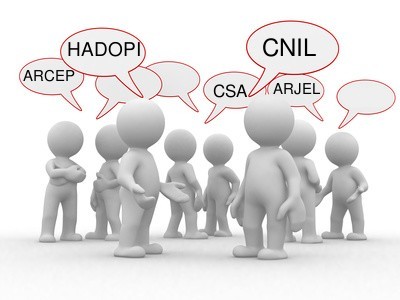
The Federal Communications Commission (FCC) is the independent regulatory authority in the United States that regulates at the federal level both the container and the content of telecommunications. In this, the United States differs from the European Union, a legal space in which most often the regulatory institutions of the container and the content are distinct (for example in France ARCEP / CSA / CNIL) and in which the regulations of communications remain substantially at the level of the Member States of the Union. Like other audiovisual regulators, it ensures pluralism of information by limiting the concentration of capital – and therefore of power – in the television and radio sector. We can thus see that the American system is not in principle different from the European system. In addition, the FCC is characterized first of all by a very great power, imposing at the same time substantial principles on the operators, like that of the "decency", going in the name of this principle until sanctioning television channels which had let show a bare breast of a woman. The control is therefore more substantial than in Europe, this control weighing against the constitutional freedom of expression which is more powerful in the United States than in Europe. It is true that today the leading digital companies tend to formulate for us what is beautiful, good and decent, in place of public authorities. The FCC continued to develop the major principles of the public communication system, as in 2015 that of the Open Internet (Open Internet) or to formulate the principle of "digital neutrality", adopted by a federal law, this principle having considerable economic and political implications. But at the same time, a general mark of American law, the judge moderates this power, according to the principle of Check and Balance. Thus the Supreme Court of the United States in FCC v. Pacifica Foundation in 1978 this power of direct control of the content but also operates the control of the control. The election in 2016 of a new president who is, among other things, totally hostile to the very idea of ​​Regulation is a test in the probative sense of the term. In January 2017, he appointed a new president of the FCC, hostile to any regulation and in particular to the principle of neutrality. The question which arises is to know if technically a regulation already established on these principles can resist, how and for how long, a political will violently and expressly contrary. And what will the judges do.

Glossary

Market Abuse

In principle, the very mechanism of the market is governed by freedom, the freedoms of the agents themselves – the freedom to undertake and contract – and the competitive freedom that marks the market itself, the convergence of these freedoms allowing the self-regulated functioning of The "market law", namely the massive encounter of offers and demands that generates the right price ("fair price"). For this to work, it is necessary but it is enough that there is no barrier to entry the market and there is no behavior by which operators can hinder this competitive market law, by abuse of dominant position and cartel.   But in the case of financial markets, which are regulated markets, "market abuses" are sanctioned at the very heart of regulation. Indeed, the regulation of the financial markets presupposes that the information is distributed there for the benefit of investors, or even other stakeholders, possibly information not exclusively financial. This integrity of the financial markets which, beyond the integrity of information, must achieve transparency, justifies that information is fully and equally shared. That is why those who hold or must hold information that is not shared by others (privileged information) must not use it in the market until they have made it public. Similarly, they should not send bad information to the market. Neither should they manipulate stock market prices. These sanctions were essentially conceived by the American financial theory, concretized by the American courts, then taken back in Europe. To the extent that they sanction both reproachable behavior and constitute a public policy instrument of direction and protection of markets, the question of cumulation of criminal law and administrative repressive law can only be posed with difficulty in Europe.  

Glossary

Independent Public Authority

Formally, the legal system had constructed the regulatory authorities in the form of Independent Administrative Authorities (AAI). The stake being to build their independence in an institutional and consubstantial way, the Legislator conferred a new status: that of Independent Public Authority (API). Thus, the Autorité des Marchés Financiers (AMF), the Commission Nationale Informatique et Libertés (CNIL), the Haute Autorité de Santé (HAS) or HADOPI are classified among APIs and not only among IAAs. We must therefore see two distinct legal categories, AAI on the one hand and APIs on the other. Thus the two laws of January 20, 2017 relate, to better supervise them, both on AAIs and on APIs, but reading the preparatory work shows that the two categories show that they are treated in a fairly common way. Even more if one consults the sites of certain regulatory authorities themselves, such as HADOPI, for example, it presents itself as an "Independent Public Authority" but defines this legal category as being that which targets the Authorities. Independent Administrative ….. It thus appears that the category of Independent Public Authorities is above all marked by the symbol of a greater dignity than that of the category of "simply" Administrative Independent Authorities. From a technical point of view, the two categories are essentially distinguished from a budgetary point of view, financial autonomy being the nerve of independence. This is how the AMF's budget is based on the size of market operations, through tax mechanisms that are not included in the LOLF. Independence does not extend to autonomy, the API does not negotiate its budget with Parliament, since an Independent Public Authority is not a Constitutional Authority.

Glossary

Independant Administrative Authority (IAA)

The Independent Administrative Authority (IAA) is the legal form that the legislator has most often chosen to build regulatory authorities. The IAA is only its legal form, but French law has attached great importance to it, following the often formalistic tradition of public law. They are thus independent administrative authorities, especially in the legal systems of continental law like France, Germany or Italy. The essential element is in the last adjective: the "independent" character of the organism. This means that this organ, which is only administrative so has a vocation to be placed in the executive hierarchy, does not obey the Government. In this, regulators have often been presented as free electrons, which posed the problem of their legitimacy, since they could no longer draw upstream in the legitimacy of the Government. This independence also poses the difficulty of their responsibility, the responsibility of the State for their actions, and the accountability of their use of their powers. Moreover, the independence of regulators is sometimes questioned if it is the government that retains the power to appoint the leaders of the regulatory authority. Finally, the budgetary autonomy of the regulator is crucial to ensure its independence, although the authorities having the privilege of benefiting from a budget – which is not included in the LOLF – are very few in number. They are no longer referred to as "independent administrative authorities" but as "Independent Public Authorities", the legislator making a distinction between the two (French Law of 20 January 2017). The second point concerns the second adjective: that it is an "administrative" body. This corresponds to the traditional idea that regulation is the mechanism by which the State intervenes in the economy, in the image of a kind of deconcentration of ministries, in the Scandinavian model of the agency. If we allow ourselves to be enclosed in this vocabulary, we conclude that this administrative body makes an administrative decision which is the subject of an appeal before a judge. Thus, in the first place, this would be a first instance appeal and not a judgment since the administrative authority is not a court. Secondly, the natural judge of the appeal should be the administrative judge since it is an administrative decision issued by an administrative authority. But in France the Ordinance of 1 December 1986 sur la concurrence et la libéralisation des prix (on competition and price liberalization), because it intended precisely to break the idea of ​​an administered economy in order to impose price freedom on the idea of ​​economic liberalism, required that attacks against the decisions of economic regulators taking the form of IAA are brought before the Court of Appeal of Paris, judicial jurisdiction. Some great authors were even able to conclude that the Paris Court of Appeal had become an administrative court. But today the procedural system has become extremely complex, because according to the IAA and according to the different kinds of decisions adopted, they are subject to an appeal either to the Court of Appeal of Paris or to the Conseil d'État (Council of State) . If one observes the successive laws that modify the system, one finds that after this great position of principle of 1986, the administrative judge gradually takes again its place in the system, in particular in the financial regulation. Is it logical to conclude that we are returning to a spirit of regulation defined as an administrative police and an economy administered by the State? Finally, the third term is the name itself: "authority". It means in the first place an entity whose power holds before in its "authority". But it marks that it is not a jurisdiction, that it takes unilateral decisions. It was without counting the European Court of Human Rights (ECHR) and the judicial judge! Indeed, Article 6§1 of the European Convention on Human Rights states that everyone has the right to an impartial tribunal in civil and criminal matters. The notion of "criminal matter" does not coincide with the formal traditional concept of criminal law but refers to the broad and concrete factual concept of repression. Thus, by a reasoning which goes backwards, an organization, whatever the qualification that a State has formally conferred on it, which has an activity of repression, acts "in criminal matters". From this alone, in the European sense, it is a "tribunal". This automatically triggers a series of fundamental procedural guarantees for the benefit of the person who is likely to be the subject of a decision on his part. In France, a series of jurisprudence, both of the Cour de cassation (Court of Cassation), the Conseil d'État (Council of State) or the Conseil constitutionnel (Constitutional Council) has confirmed this juridictionnalization of the AAI.

Glossary

Economic Analysis of Law

Regulation Law presupposes moving from a political conception of acts (that is to say, a collective decision expressed by the State) or a civilist one (that is, a will expressed by one or several individuals in one Contract) to an economic vision of  organizations whose action is the expression of the market. If one relies on the adjustment of supply and demand, that is to say, the meeting of desires and interests, there will be "self-regulation", which is the "law of the Market ", referring to Competition Law. The act of the operators is only a reflection of this sort of natural law, in action. Regulation is then more complex because it integrates this economic rationality of the actors and systems in which the first onese are agents (homo economicus), but Regulation aims at something other than this mechanical rationality, either because of a market failure (for example in case of natural monopoly) or because the author of the standard, eg the State or the Regulator wants to obtain more than the market can give (eg access to common goods such as health) , even for insolvent claimants). In this case, special written norms are drawn up, ex ante interventions designated in English by the term of "regulations" (and in French by the term of "réglementation"). The Regulation Law, the regulatory system, is adequate if it constitutes an incitation for economic agents to adopt behaviors that concretize the aim sought by the author of the regulatory mechanisms. The Regulation Law will then rely on economic science to produce the right "incentives", leaving agents – producers, supplyers, claimants, consumers, taxpayers, the most diverse stakeholders – free to make choices, but inciting them to make choices that will produce in isolation or in a comprehensive or cross-breeding way, immediately or in the long term, a result corresponding to that which was intended from the outset by the person who designed the standard. In this respect, the Law of Regulation is highly strategic, whether of a technical nature, aimed at mitigating a market failure or more political. In this, it is also of a liberal nature, since it is not orders formulated to obedient people, but spaces of freedoms constructed for the benefit of persons. This strategic use of Law then requires the necessary detour through the economic analysis of Law, that is to say the analysis of Law in its economic effects. It presupposes, among those who use the norm, not only the Legislator but also the Judge, a knowledge of the economic mechanisms, for example the theory of incentives, incomplete contracts or behavioral economics, three liberal theories on which are based the interventions Ex Ante of the public authorities and which the judgments of the Courts extend. That is why the Economic Analysis of Law is a fully discipline. It was created in the United States by Ronald Coase (Nobel Prize for Economics in 1991). It may be merely descriptive and reveal what economic effects the Law has produced. This conception, in particular that of Richard Posner, makes the economic analysis of the law an instrument of expertise for the political decision-maker who can take it into account in order to modify the norms, and for the judge, who can take it into account for Interpreting them. A more radical conception of the so-called normative economic analysis of law is to argue that the conclusions of the analysis would oblige the decision-maker and the judge to adopt the "efficient" interpretation designated by the economic analysis without being legitimate for adopting others. Philosophical in nature, this issue is decisive because in the first case the law and the jurists – in particular the Legislator and the Judge – still have an autonomous existence, in the second case they no longer exist really, are only the formal and explicit binding of the "law of the market" whose nature is non-legal. Law then is a way of execution, a pure and simple effectiveness of a another essential Law that is external to it, that of the "Law of Market, which is the adjustment of the offer and the demand. Common law systems tend to fall into the normative excess of confusing what is merely a description of choice and to adopt what would be a "decision" taken by the economists themselves: Law then, as a normative system, is only  what gives the enforceability and legal certainty of what becomes truly normative, e.g. the economic value of the adjustment of supply and demand. Civil Law systems integrate the Economic Analysis of Law in a manner more in keeping with the thinking of founders or current theorists such as Cass. Sunstein, allowing Legislators and Courts to integrate the economic dimension of situations without their economic reasoning implying the solution to be retained, as choices remain in Law, expressing values, and in legal systems being governed by their own legal notions and rules, at a distance from the Economy. Even in its descriptive form, the economic analysis of the law is generally rejected in France as it disregards the role of the law in that it carries moral values. It is in reality to ignore its  merely descriptive, instructive and useful function, and the fact that it opens instead the amplitude of the rational choice offered to political decision-makers and courts. Moreover, regulation is not only a technical discipline, it is also a political and philosophical issue. Descriptive economic analysis is more appropriate than the normative economic analysis of the law, which claims to vassalize and even destroy the other disciplines, which are substantially ignored.  

Glossary

Asymmetry: asymmetric regulation / asymmetry of information

Asymmetry is a key concept of regulation. Indeed, a competitive market works well when operators are in symmetrical relationships, ie there is no structural obstacle which prevents an agent from increasing his power solely on his merits (" competition by merits "). If there is an asymmetry, for example because a sector is monopolistic and the legislator has just declared it open to competition, there is a temporary asymmetry between the installed companies, the incumbent operators and the willing companies to enter this new market, the "new entrants". Historical operators, such as in the telecommunications or energy sector, when they were opened to competition by European directives, transposed by national laws (in french Law in 1996 for telecommunications and gas, in 2000 for electricity), benefit (sometimes referred to as grandfather clause), in particular because they have all the clients or all the know-how or all the patents, and that, in fact, the competitors can not enter the market. It is then necessary to establish a regulator also a priori temporary itself  to establish to forceps the competition, by an asymmetrical regulation.   Asymmetric regulation, particularly applied in Great Britain at the time of the liberalization of the aforementioned sectors, means that the regulator will systematically favor new entrants, for example by dispossessing the incumbents for their benefit to make them on the market. Today, in the telecommunications sector, competition, notably on mobiles, is established, but the regulator does not intend to leave its place to disappear and today supports "symmetric regulation" …. Instead, it acts as a specialized competition authority.   Asymmetry may not be temporary but definitive, when inequality between operators, regardless of merit, does not come from a context of liberalization but from a structural failure of the market. For example, there are transport networks, transport of passengers or goods, railways or airstrip for airplanes, data or voice communication networks, pipes where gas or electricity circulate, etc., which belong to a single operator because they constitute economically natural monopolies. Under these conditions, the competitors of the monopoly must nevertheless have fair and effective access to this service and a regulator must necessarily be established for the effectiveness of that right (see Access).   Moreover, the Nobel Prize of Joseph Stiglitz (2001) was justified by his work on the asymmetry of information on certain markets, in particular the financial markets on which companies offer securities. Through the theory of the agency, it appears that the ordinary partners or ordinary investors have less information than the managers, even though the latter have the function of making decisions that bring the most to the former. But information asymmetry offers managers an "information rent" that allows them to offer many benefits and transfer risks to others. Regulators, in particular banking and financial regulators, are needed to combat information asymmetry. Transparency is one of the procedural means to combat this asymmetry. The financial and banking crisis of 2008 showed the extent of this asymmetry and, in fact, the inability of regulators to remedy it, for example, the British government estimated in 2010 that it was the financial regulator itself that was responsible for the crisis for not having sufficiently watched over conflicts of interest. In general, the global financial crisis was often later characterized as a crisis of regulators and regulation.    

Glossary

Bank (Banking Regulation)

Banks are regulated because they do not engage in an ordinary economic activity, as their are likely to create systemic risk. In the real economy indeed, banks play the role of providing credit to entrepreneurs who operate on the markets for goods and services. These credits are mainly financed through deposits made by depositors and, to a lesser extent, by shareholders (i.e., capitalists). That is how liberalism and capitalism are bound up. However, banks also have the power to create money by the book entries they make when they grant loans ('book money'). As such, the banks share with the State this extraordinary power to exercise monetary authority, which some describe as sovereign power. It is possible that the digital eventually calls this power into question, since the Regulation currently hesitates to seize control over new instruments that are called "virtual currency" and that are used as proper "currency" or as an ordinary instrument for cooperative relation. Banks' prominent sovereign character justifies, first and foremost, that the State is granted the power to choose the institutions which benefit from the privilege of creating book money- in this regard, the banking industry has always been a monopoly. Hence, Banking Regulation is first an ex ante control to enter the profession, and also a careful monitor of the people and institutions that claim they are in. In addition, banks and credit institutions lend more money than their own funds can allow: the whole banking system is necessarily based on the trust that each creditors place within the bank, including depositaries who leave their funds at the banks' disposal for it to use them. That is where Bank Regulation intervenes to establish what is called 'prudential ratios', i.e., ratios that ensure the soundness of the institution by determining the amount of money that banks can lend based on the equity and quasi-equity they actually have. Moreover, banks are constantly monitored by their supervisory Regulator, the Central Bank (in France, the Banque de France) that ensures the safety of the whole system by setting the State as the lender of last resort. This can, however, incentivize a large financial institution to take excessive risks based on its reliance on the fact that the State will save it eventually- that is what the 'moral hazard' theory systematized. All monetary and financial systems are built on these central banks that are independent from governments, which are far too reliant on political strategies and which cannot generate the same trust that a Central Bank inspires. Since the missions of central banks have increased over the years, and since the notions of Regulation and Supervision have come together, we tend to consider that Central Banks are now fully fledged Regulators. Besides, Banking Regulation has become all the more central since banking is no longer primarily about loaning but rather about financial intermediation.  Banking Regulation and Financial Regulation are mixing. In Europe , European Central Bank is in the center.

Glossary

Agency

The concept of 'Agency', sometimes confused with the one of 'Regulator', designates a way of deconcentrating the State. Away from a French Jacobin outlook, states have indeed gradually devolved their sovereign responsibilities to other institutions, which are often geographically distant from the state's political capital city. These agencies are a form of technical decentralization because they are in charge of operational tasks and specific expertise, e.g., as regards employment, environment or health issues. This model, which is very common in Scandinavian countries, is often associated with federal structures, like in the United States. It is still fairly remote to the French model that remains to this day built on the idea of a centralized and unified State. So far, France has only developed a few agencies (e.g., France Trésor, tasked with managing France's government debt and cash positions). In a different perspective, although the two notions are homonyms, the American financial theory developed the notion of 'agency' to describe the relationship between the corporate officer (the agent) and the shareholder (the principal), who empowers the first to act on his behalf to serve his interest. Information asymmetry and conflict of interest mark this relationship, which explains that this theory helped developing multiple safeguards, conveyed by the Financial Regulation.

Glossary

Rating Agency

Rating agencies are private companies that assess the risk of defaulting payment by debtors. As such, the rating of a borrower affects the value of the debt security it issued and that is to circulate in the markets. That is why the activity of credit rating agencies is critical to the security of financial instruments and the functioning of financial markets, but also to the whole global credit system. For instance, an AAA rating guarantees security to investors. Rating agencies helps building trust in financial markets and in the banking system. Henceforth, since everyone relies on them as they save people's time from seeking on their own information on securities or on those who issue them on the marks, international rating agencies have become crucial operators. 'Rating' has also become a business, which is now concentrated within the hands of three undertakings (two American and one French). It has often been said that these three are conflicted. Some have indeed brought up the fact as they have provided the markets with unreliable information (especially about subprime and securitization) prevented them to self-discipline, which eventually participated in the global spread of risks and defaults. The difficult history between the rating agencies, whether they are considered as mere businesses, crucial operators or as companies undertaking a public service, which eventually led to implement a specific Regulation in the immediate aftermath of the financial crisis, shows how the information is a public common. This justifies the intervention of the Financial Regulator, namely to better protect the consumer. Should we go further on? Some have mentioned the idea of ​​nationalizing the business and hand it over to Government institutions (or at least public ones). This is, however, no longer on the agenda, as many conflicts of interests may arise since rating agencies keep on rating the paradoxical debtors that States are.

Glossary

Supervision

Market regulation is defined as the set of mechanisms that allow markets to establish and maintain long-term balances that they cannot establish and maintain in the long term by their own forces. It is therefore a set of institutions and rules that relate to the markets and against which they are "black boxes". On the other hand, it may happen that certain companies, because they are "crucial operators", justify that a public authority looks in transparency and controls its structure and its functioning. It is then a supervisory function. It may happen that this supervisory function is exercised by the Regulatory Authority, when it ensures the solidity of a crucial operator, which the sector absolutely needs, for example because it manages a monopoly network. natural. It also happens that it is a separate Supervisory Authority, as is often the case in banking matters, supervision being provided by central bankers. Supervision then takes the form of prudential supervision, ensures the solidity of the operators, that is to say enters into the operators and thus controls the adequacy of equity and quasi-equity , the organization of the company (rule of "four eyes" for the, which assumes that they not only a Chairman but also a CEO), control of managers etc. Thus prudential standards are indifferent to the market context. Regulation is for the outside, prudential is for the inside.   This opposition has turned out to be catastrophic since precisely there is communication between the inside and the outside when it comes to financial markets, since the financial market is a market of and information is designed inside. companies issuing the securities. Therefore, there can only be effective regulation if there is a well-designed prudential framework, and the opposition itself does not make sense, which is why many countries first identified the internal organs. to companies as soon as they emit information, thus feeding the markets and influencing the behavior of investors and other operators, as falling under regulation. This was the case with banks or investment service providers which are fully subject to financial regulation. The 2008 law gave full awareness of this continuum between prudential and regulatory and justified the creation of the Autorité de Control Prudentiel, which later became the Autorité de Control Prudential et de Résolution (ACPR), the integrity of the markets implying that the control of the reliability of the internal organization of certain operators with regard to their organization, the confidence that one can have in them and their way of exercising power, being the pledge of the solidity of the market itself. This is why the new reflections on financial regulation, then on Regulation in general, highlight the notion of “”, which we could also call “crucial operators”, and which sets apart operators whose weight is so important. important on the market (regulatory criterion) that their internal organization must be special or particularly supervised (prudential criterion). Thus, regulation and governance, which were opposed, have become inseparable. This is aimed at all operators that a sector cannot do without. They become transparent to the public authority which supervises them.

Glossary

Market Failure

The market is normally self-regulated. It suffers from one-time failures when economic agents engage in anti-competitive behavior, mainly the abuse of dominant positions in the ordinary markets, or the abuse of markets in the financial markets, sanctioned ex post by the authorities in individual decisions. But some sectors suffer from structural failures, which prevent them, even without malicious intent of agents, from reaching this mechanism of adjustment of supply and demand. The existence of an economically natural monopoly, for example a transport network, constitutes a structural failure. Another agent will not duplicate once the first network has been built, which prevents competition. An a-competitive regulation, either by nationalization, by a state control or by a control by a regulatory authority, is needed to ensure everyone's access to an essential facility. Also constitutes a market failure asymmetry of information, theorized through the notion of agency that hinders the availability and circulation of exhaustive and reliable information on markets, especially financial markets. This market failure carries with it a systemic risk, against which regulation is definitely built and entrusted to financial regulators and central banks. In these cases, the implementation of regulations is a reaction of the State not so much by political rejection of the Market, but because the competitive economy is unfit to function. This has nothing to do with the hypothesis that the State is distancing itself from the Market, not because it is structurally flawed in relation to its own model, but because politics wants to impose higher values, expressed By the public service, whose market does not always satisfy the missions.    

Glossary

Check and balance

The expression is always left in the English language even when it is used in other languages because it is not translatable. It refers to the basic institutional and political mechanism of the American system. Regulatory theorists and practitioners often refer to it as the right political and institutional framework on which to base an economic organization of Regulation. This would mean a need to reform the political systems built on another mode of separation of powers. This strong basis conforts the fact that the system of Regulation is not neutral, it is the reflection of a political organization. The shock between these different philosophical and political conceptions explains why economic regulation has been difficult to accept in Europe, and especially in France for a long time. Indeed, according to the French political scheme resulting from the Revolution, there are two powers: the executive and the legislative, the judiciary being only an authority. The executive is built on the hierarchical principle of which the head is constituted by the government, any administration ultimately coming from a minister. It is therefore a vertical system, which has the merit of simplicity. Regulatory authorities have been imposed by European directives since the 1990s, in the form of bodies which may be administrative and Under this title of the State but must be necessarily independent of the government from the moment that operated on the market of the public enterprises which also obeyed the government through the theory of the state shareholder.   Le choc entre les deux conceptions philosophiques et politiques  explique que la régulation économique ait eu du mal à être acceptée en France pendant une longue période. En effet, selon le schéma politique français issu de la Révolution, il existe deux pouvoirs : l’exécutif et le législatif, le judiciaire n’étant qu’une autorité. L’exécutif est construit sur le principe hiérarchique dont la tête est constituée par le gouvernement, toute administration relevant finalement d’un ministre. Il s’agit donc d’un système vertical, qui a pour lui le mérite de la simplicité.Les autorités de régulation ont été imposées par des directives européennes à partir des années 90, sous la forme d’organes pouvant être de nature administrative et relevant à ce titre de l’État mais devant être nécessairement indépendants du gouvernement dès l’instant qu’opéraient sur le marché des entreprises publiques qui elles aussi obéissaient au gouvernement à travers la théorie de l’État-actionnaire. This is the fundamental European rule of the impossibility of cumulation of the regulatory / operator state, a situation constituting a conflict of interests. The French State, which intends to remain owner of public operators, in particular EDF, has preferred to relax control of regulation by creating independent administrative authorities (AAI). Consequently, the vertical model of the hierarchy of the executive has been disrupted since these authorities no longer report (as free electrons) of it. For them to be held accountable, judicial review of the authorities through appeals has been increased. In the same way, through public reports to Parliament, the IAAs began reporting directly to the IAA. The political model becomes horizontal. This then refers to a completely different tradition: that of the United States. Indeed, in the United States, the executive (the White House) has both the Parliament (the Congress) and a very powerful judiciary (the Supreme Court); No one has taken over the others, each however being able to hold the others accountable. This is called Check and Balance. Not least because the Regulation has been institutionalized by economists who, through the current Law and Economics, have perceived what they consider to be the most appropriate right as American law, which must impose itself almost "by nature". Thus, through this small corner in the door that is the institutional reform introduced by regulation, the French political system evolves towards this American system of check and balance, being observed that the United States were the first historically to put in Regulators. This rapprochement of the systems can be carried out all the more so as in Europe the organs in charge of the control of the constitutionality control do not stop increasing in power. Thus, in France, since the constitutional reform of 23 July 2008, the Constitutional Council can assess the constitutionality of laws not only before their promulgation but even when they have entered the legal order, It is becoming a "Supreme Court" on the American model. The political models remain very different, in particular because the French Parliament does not have the same blocking power as the US Congress, and the Constitutional Council does not have the same doctrinal power as the US Supreme Court. Leaves France in the place of a presidential system virtually without balance, face to face Regulators and the system of the European Union, Europe more and more a Europe of Regulation.