
Breaking news

Breaking news

💬GPA : “Il faut cesser de passer la femme par pertes et profits” (Surrogacy: “We have to stop writing off women”)

► Full Reference: M.-A. Frison-Roche, "GPA : "Il faut cesser de passer la femme par pertes et profits"" ("Surrogacy: "We have to stop writing off women""), interview with Olivia Dufour, Actu-Juridique, April 30, 2024 - 💬read the interview (in French) - ► Presentation of the interview by the journal: "Le 23 avril 2024, les députés européens ont adopté une loi élargissant le champ d’application des mesures actuelles pour combattre et prévenir la traite des êtres humains et mieux soutenir ses victimes, par 563 voix pour, 7 contre et 17 abstentions. La maternité de substitution, ou GPA, entre désormais dans le champ de la traite des êtres humains. Mais depuis quelques jours, la polémique fait rage. Le nouveau texte réprime-t-il uniquement la GPA contrainte organisée par une association criminelle, ou toute forme de GPA ? Nous avons demandé au professeur Marie-Anne Frison-Roche, auteur d’un ouvrage intitulé « GPA : dire Oui ou dire Non » publié chez Dalloz en 2018, de nous éclairer sur les enjeux attachés à cette question et sur la position de l’Europe.". (Free translation: "On April 23, 2024, Members of the European Parliament adopted a law extending the scope of existing measures to combat and prevent human trafficking and provide better support for its victims, by 563 votes to 7 with 17 abstentions. Surrogacy (gestation pour autrui – GPA in French), now falls within the scope of human trafficking. But in recent days, controversy has been raging. Does the new text punish only forced surrogate motherhood organised by a criminal association, or all forms of surrogacy? We asked Professor Marie-Anne Frison-Roche, author of a book entitled "GPA: dire Oui ou dire Non" ("Surrogacy: say Yes or say No") published by Dalloz in 2018, to shed some light on the issues surrounding this question and on Europe's position".) - 🕴️M.-A. Frison-Roche, 📕GPA : dire Oui ou dire Non (Surrogacy: say Yes or say No), 2018 - ► Questions asked, answers given: Actu Juridique. Question : La GPA est une pratique ancienne même si elle est longtemps restée marginale, qu’est-ce qui a changé et nécessite aujourd’hui l’attention des pouvoirs publics et du législateur ?   Surrogacy is a long-standing practice, even if it was marginal for a long time. What has changed that now requires the attention of public authorities and legislators?   Marie-Anne Frison-Roche. Answer. : Two things have changed this practice. The first is the possibility of introducing a man's gametes and a woman's oocyte into a woman's body, thus reducing her to being a "carrier" and providing this service, which is very much in demand. The second is the transformation of the desire for a child, an eternal desire shared by many, into a "right to a child". This right to a child would need to be put into practice by any means, for the benefit of any holder who is unable or unwilling to suffer the inconvenience of pregnancy. This is how the practice developed. The legislator intervened, following case law, by declaring, as the Cour de cassation (French Court of cassation) had done, that this practice was contrary to the dignity of the human being, punishable under both the Code civil (French Civil Code) and the Code pénal (French Criminal Code).     A.J. Q. : Autrement dit, les innovations techniques couplées à l’émergence d’un sentiment de droit à l’enfant ont fait exploser la demande de maternité de substitution… In other words, technical innovations coupled with the emergence of a sense of entitlement to a right to a child have led to an explosion in demand for surrogacy… MaFR. A. : Yes, but this demand has to be matched by an offer. There are few fertile women prepared to bear children for others. The desire to have children is not matched by a desire to bear them for others without compensation. And the few women who are willing to do so are in countries far removed from the people who want them. The practice has only developed because of the very prosperous agencies on which everything depends. Without this intermediation, towards Ukraine for example, the practice could not have spread.   A.J. Q. : L’Europe avait-elle déjà pris position sur la GPA et si oui, par quels textes et dans quel sens ? Has Europe already taken a position on surrogacy and, if so, in what texts and in what direction?   MaFR. A. : In Europe, it was the case law of the ECHR which in 2014 (Mennesson judgments) broke with French jurisprudence to impose that the filiation of a child born as a result of a surrogacy carried out abroad in a country where surrogacy is lawful can be established with regard to the father whose gametes had been used. All that remained was for the child to be adopted by the father's spouse. This did not change domestic legislation, but the way civil status works means that the prohibition can be rendered ineffective. But this meant saying Yes and No at the same time… The challenge was therefore to amend the texts, either to exclude surrogacy more strongly, or to admit it more openly.     A.J. Q. : Dans ce contexte, quelle nouveauté apporte le texte adopté par le Parlement européen le 23 avril dernier ? Against this backdrop, what is new about the text adopted by the European Parliament on 23 April? MaFR. A. : It depends on how you interpret it. When the text of the directive was being discussed, no one disputed that its adoption would result in the effective prohibition of surrogacy throughout the European Union and the strengthening of the basis of this prohibition in that surrogacy constitutes trafficking in human beings, the woman who carries the child and who legally remains the mother since she gives birth to the child, and that child. But once voted, the text gives rise to another interpretation, supported by some. It is argued that trafficking in human beings is not the "legal category" into which surrogacy falls, but the "condition" under which surrogacy is punishable; So, if surrogacy is practised without "trade" (trafficking is a trade), if there is no money involved, if there is only altruism and concern for the other person, then not only is surrogacy not punished, but what is more, this so-called "altruistic" surrogacy becomes legitimate by the very fact of this directive! The scope is therefore quite simply the opposite… This could give rise to litigation.   A.J. Q. : Dans l’ouvrage que vous avez consacré à la GPA en 2018 chez Lefebvre-Dalloz préfacé par Éliette Abécassis, vous montrez qu’on peut dire Oui ou Non à la GPA, mais qu’il faut répondre et surtout vous mettez en lumière les implications de ces choix. Pourquoi faut-il forcément répondre à cette question ? In your book on GPA published by Lefebvre-Dalloz in 2018, with a preface by Éliette Abécassis, you show that we can say Yes or No to surrogacy, but that we must answer, and above all you highlight the implications of these choices. Why do we have to answer this question? MaFR. A. : The question of whether or not to allow surrogacy must be answered (say Yes or say No), because it is a question of society. Not to answer it, to say neither yes nor no, to say yes and no at the same time, is not to choose the society in which we want to live.   A.J. Q. : Imaginons que l’on choisisse le Oui. Qu’implique-t-il sur les valeurs de la société et l’état du droit ? What does this mean for the values of society and the Rule of Law? MaFR. A. : If we accept that surrogacy is legal, then it is the will of the people involved that gives birth to the child. The agreement between the person or persons planning to have a child and the woman who agrees to carry the child, with the agent acting as intermediary. It is the society of the contract, because the State is nothing, it is only the scribe who copies the stipulations onto the civil status register. Parentage ceases to be the institution guarded by the State through which the individual is anchored in the social group. Parentage becomes a private matter. This contract-based society is in fact a market society.    A.J. Q. : Et si l’on dit Non à la GPA, on le fait sur quel fondement et pourquoi ? And if we say No to GPA, on what grounds and why? MaFR. A. : If we maintain the prohibition of surrogacy and seek to make it effective, in particular by taking action against agencies, we are referring to a society where the State, through public order, watches over human beings and where the law controls power and protects women. - 🌐follow Marie-Anne Frison-Roche on LinkedIn 🌐follow Marie-Anne Frison-Roche on Instagram 🌐subscribe to the Newsletter MAFR Regulation, Compliance, Law

Breaking news

💬La profession investit le Droit de la compliance et détermine sa Raison d’être

🌐follow Marie-Anne Frison-Roche on LinkedIn 🌐subscribe to the Newsletter MAFR Regulation, Compliance, Law - ► Full Reference: M.-A. Frison-Roche & S. Vernet, "La profession investit le Droit de la compliance et détermine sa Raison d’être" ("The profession invests Compliance Law and determines its Raison d'être"), Actualités, Ordre des Géomètres-Experts, July 28, 2023 - 💬read the interview (in French) - ► Presentation of the interview by the Ordre des Géomètres-Experts: "Pour mieux répondre aux défis d’une société en pleine mutation, ainsi qu’aux attentes de ses clients et concitoyens, la profession détermine sa Raison d’être. Séverine Vernet, première Vice-présidente de l’Ordre des géomètres-experts et Marie-Anne Frison-Roche, professeur de droit économique et spécialiste du droit de la régulation et de la compliance, nous expliquent cette démarche innovante." ("To better meet the challenges of a rapidly changing society and the expectations of its customers and fellow citizens, the profession is defining its raison d'être. Séverine Vernet, First Vice-President of the Ordre des géomètres-experts, and Marie-Anne Frison-Roche, Professor of Economic Law and specialist in Regulatory and Compliance Law, explain this innovative approach."). - ► Questions asked (in French):  Séverine Vernet, vous êtes la première Vice-présidente de l’OGE et présidente de la nouvelle commission compliance. Permettez-moi tout d’abord de vous féliciter pour votre réélection. Quels seront les prochains chantiers du mandat qui démarre ? Et votre ambition pour ce nouveau mandat ?​ Marie-Anne Frison-Roche (mafr), vous êtes professeur d’université, spécialiste de droit économique et plus particulièrement du droit de la régulation et de la compliance, vous accompagnez l’Ordre dans la mise en place de cette démarche. Séverine Vernet parle de compliance. Pourriez-vous nous en proposer une définition ?   L’OGE a créé une commission compliance spécifique que vous présidez. Pouvez-vous nous en dire un peu plus ?   Comment passe-t-on d’un organisme de régulation à un acteur de la compliance ? En quoi est-ce innovant pour un Ordre professionnel ?   Comment allez-vous vous y prendre pour engager la profession ?   Quelles seront les étapes pour passer de la régulation à la compliance ? -

Breaking news

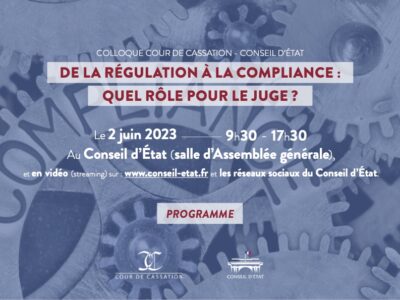
💬Compliance : les cours suprêmes s’emparent de la question de ses enjeux juridictionnels (Compliance : the Supreme Courts take up the issue of its jurisdictional implications)

🌐follow Marie-Anne Frison-Roche on LinkedIn 🌐subscribe to the Newsletter MAFR Regulation, Compliance, Law  - ► Full Reference:  M.-A. Frison-Roche et A. Seban, "Compliance : les cours suprêmes s’emparent de la question de ses enjeux juridictionnels" ("Compliance : the Supreme Courts take up the issue of its jurisdictional implications"), interview with Olivia Dufour, Actu-Juridique, 5 July 2023. - 💬read the interview (in French) - ► Presentation of the interview by the journal (in French): "Le 2 juin dernier s’est tenu au Conseil d’État un colloque fondateur sur le rôle du juge dans la compliance. Le professeur Marie-Anne Frison-Roche et le conseiller d’État Alain Seban, qui ont tout deux contribué aux débats, ont accepté de commenter les principaux enseignements des travaux de cette journée." - ► Questions asked (in French):  Le colloque « De la régulation à la compliance, quel rôle pour les juges » qui s’est tenu au Conseil d’État le 2 juin dernier a rassemblé juges civils et administratifs. En quoi le juge administratif est-il concerné par la compliance qui semble plutôt une affaire d’entreprises et donc de justice civile et commerciale ?  ​Vincent Vigneau, président de la chambre commerciale de la Cour de cassation rappelle que la compliance a plutôt vocation à éviter le juge en se situant ex ante, pourtant on découvre que le juge lui-même accepte de plus en plus de se prononcer en ex ante… qu’en est-il ?  Quel peut donc être le rôle du juge dans la compliance ? Peut-il contribuer à faire émerger un droit de la compliance et à l’harmoniser ?  ​ ​François Ancel semble considérer que le rôle juge va devoir adapter son office à la compliance, il évoque trois concepts : téléologique, soutenabilité et efficacité… Le juge dispose-t-il en l’état de tous les outils nécessaires ? Si tel n’est pas le cas, que faut-il créer ? En quoi le dialogue des juges, civil/administratif, national/européen, national/international, est-il important ? Que veut dire F. Ancel quand il déclare que le juge doit évoluer du constat à la trajectoire ? Existe-t-il des domaines où la compliance entre en conflit avec des principes processuels, par exemple le principe de légalité des peines ? En quoi la notion de « buts monumentaux », que vous avez créée en 2016, a-t-elle trouvé sa place dans le droit ? -

Breaking news

📧Message personnel

Breaking news

📧Le PNF devrait avoir ouvertement compétence en matière de CJIP environnementale : la CJIP “Guy Dauphin Environnement” du 17 mai 2023

🌐 follow Marie-Anne Frison-Roche on LinkedIn 🌐 subscribe to the Newsletter MAFR Regulation, Compliance, Law - ► Full Reference: M.-A. Frison-Roche, "Le PNF devrait avoir ouvertement compétence en matière de CJIP environnementale : la CJIP "Guy Dauphin Environnement" du 17 mai 2023" ("The French National Financial Prosecutor’s Office should have open jurisdiction over environmental Judicial Public Interest Agreement: the "Guy Dauphin Environnement" Judicial Public Interest Agreement of 17 May 2023"), Newsletter MAFR Law, Compliance, Regulation, 20 May 2023. - 📧Read by freely subscribing other news of the Newsletter MAFR – Law, Compliance, Regulation - 🔴 The Judicial Public Interest Agreement GDE of 15 May 2023 or how the French National Prosecutor's Office is rightly meddling in Environmental Compliance The Parquet National Financier (French National Financial Prosecutor’s Office) does not have jurisdiction over environmental matters, and this is regrettable. For it is very well placed to obtain, in particular for the benefit of associations, adequate measures for the future, which refers to the definition of Compliance Law. This is what he is actually achieving through the Convention judiciaire d'intérêt public – CJIP (Judicial Public Interest Agreement) GDE. - 📧read the article ⤵️

Breaking news

💬Enquêtes internes : une activité en plein développement pour les avocats (“Internal investigations: a growing business for attorneys”)

🌐follow Marie-Anne Frison-Roche on LinkedIn 🌐subscribe to the Newsletter MAFR Regulation, Compliance, Law - ► Full Reference: M.-A. Frison-Roche & M. Boissavy, "Enquêtes internes : une activité en plein développement pour les avocats" ("Internal investigations: a growing business for attorneys"), interview with Miren Lartigue, Gazette du Palais, 25 April 2023. - 💬read the interview (in French) - ► Presentation of the interview by the journal (in French): "Inspirées des Anglo-saxons et boostées par la loi Sapin II du 9 décembre 2016, les enquêtes internes sont de plus en plus utilisées par les entreprises françaises pour vérifier la réalité de pratiques douteuses en leur sein, découvertes ou alléguées. Parce qu’il s’agit d’un nouveau champ d’activité pour les avocats, le Conseil national des barreaux (CNB) y a consacré une journée lors de son colloque organisé les 20 et 21 avril 2023 sur le thème « Avocat et droits de la défense dans les enquêtes internes et la justice négociée », qui a réuni 750 participants sur deux jours. Matthieu Boissavy et Marie-Anne Frison-Roche, qui ont participé à l’organisation de cet évènement, nous expliquent les contours de ce nouveau métier." - ► Questions asked (in French):  Quels sont la place et le rôle de l’avocat dans les enquêtes internes et pourquoi le CNB a-t-il souhaité organiser une journée consacrée à ce sujet ?   ​​​Quel est leur rôle dans la réception des alertes ?   Et dans l’enquête interne proprement dite ?   Quelle est la complémentarité de l’avocat avec le juriste interne ?   Quels sont outils utilisés pour le calcul des préjudices, la collecte et le traitement des données ?   Comment s’applique la déontologie de l’avocat ?   Et qu’en est-il des droits de la défense ?   Quelle est l’étendue du secret professionnel de l’avocat ? -
Breaking news

💬Avocat et droits de la défense dans les enquêtes internes et la justice négociée

🌐follow Marie-Anne Frison-Roche on LinkedIn 🌐subscribe to the Newsletter MAFR Regulation, Compliance, Law  - ► Full Reference: M.-A. Frison-Roche & M. Boissavy, "Avocat et droits de la défense dans les enquêtes internes et la justice négociée" ("Attorneys and rights of the defence in internal investigations and negociated justice"), interview with Marina Brillié-Champaux, Dalloz Actu Étudiant, 6 April 2023. - 💬read the interview (in French) - ► Presentation of the interview by the journal (in French): "Futurs avocats, c’est à vous que s’adresse cette interview de Marie-Anne Frison-Roche, agrégée des Facultés de Droit, directrice du Journal of Regulation & Compliance (JoRC) et de Matthieu Boissavy, avocat aux barreaux de Paris et de New York, médiateur, membre du Conseil National des Barreaux, vice-président de la commission Libertés et droits de l’Homme. Les 20 et 21 avril 2023 le Conseil national des barreaux, sous l’impulsion de ses commissions Libertés et droits de l’Homme et Droit et Entreprise, organise un colloque sur le thème « Avocat et droits de la défense dans les enquêtes internes et la justice négociée ». Si vous êtes déjà dans la profession, il se peut que leurs réponses vous intéressent pour le respect du droit à la justice !" - ► Questions asked (in French):  En quoi consistent les enquêtes internes ?   Qu’appelle-t-on la justice négociée ?   Qu’attendez-vous de ce colloque ?   Le questionnaire de Désiré Dalloz Quel est votre meilleur souvenir d’étudiant ? Quels sont votre héros et votre héroïne de fiction préférés ? Quel est votre droit de l’Homme préféré ? -

Breaking news

💬Colloque : « Avocat et droits de la défense dans les enquêtes internes et la justice négociée »

🌐follow Marie-Anne Frison-Roche on LinkedIn 🌐subscribe to the Newsletter MAFR Regulation, Compliance, Law  - ► Full Reference: M.-A. Frison-Roche & M. Boissavy, "Colloque : « Avocat et droits de la défense dans les enquêtes internes et la justice négociée »" ("Symposium: "Lawyers and rights of the defence in internal investigations""), interview with Olivia Dufour, Actu-Juridique, 3rd April 2023. - 💬read the interview (in French) - ► Presentation of the interview by the journal (in French): "Le Conseil national des barreaux (CNB) organise les 20 et 21 avril prochains un colloque intitulé « Avocat et droits de la défense dans les enquêtes internes et la justice négociée ». Matthieu Boissavy, avocat aux barreaux de Paris et de New York, médiateur et vice-président de la commission Libertés et droits de l’Homme du Conseil national des barreaux et Marie-Anne Frison-Roche, professeure de droit, directrice du Journal of Regulation and Compliance nous expliquent les enjeux de ces nouvelles pratiques judiciaires qui bousculent le rôle traditionnel des acteurs de la justice, qu’il s’agisse des avocats ou des magistrats." - ► Questions asked (in French):  Le CNB organise les 20 et 21 avril prochains un colloque sur le thème : Avocats et droits de la défense dans les enquêtes internes et la justice négociée. Pourquoi ce choix ?​ La compliance n’est-elle pas en train de bouleverser le métier d’avocat ? ​​​ Comment cela se traduit-il en pratique ?​ Quelles sont les implications déontologiques, ne faut-il pas inventer de nouvelles règles ? Qu’est-ce que la CJIP a changé dans le métier d’avocat ? Quels sont les nouveaux risques pour l’avocat ? Cela modifie-t-il les relations entre avocats, parquet et juges du siège ? -