Victim

Couverture – Compliance et droits de la défense

Articles in a JoRC book

📝Défendre les intérêts des victimes dans la justice pénale économique négociée, in 🕴️M.-A. Frison-Roche et 🕴️M. Boissavy (dir.), 📕Compliance et droits de la défense. Enquête interne – CJIP – CRPC

► Full reference : J. Karsenti, « Défendre les intérêts des victimes dans la justice pénale économique négociée » (Defending the Interests of Victims in Negotiated Economic Criminal Justice), in M.-A. Frison-Roche and M. Boissavy (eds.), Compliance et droits de la défense. Enquête interne – CJIP – CRPC, Journal of Regulation & Compliance (JoRC) and Dalloz, coll. “Régulations & Compliance“, 2024, pp. 339-349. - ► English Summary of this article (made by the Journal of Regulation & Compliance – JoRC) : The article opens with a general presentation of the birth of negotiated criminal justice, which the author attributes above all to a desire for efficiency, whereas justice should not be negotiated and guilt is proven, not settled. But the flow of litigation and its management decided otherwise, with the revolution of the CRPC, then of the CJIP. The latter also brings France into line with international standards that weigh on and benefit companies, legal persons, the whole placing these alternative modes of prosecution at the heart of criminal procedure. The increasingly economic nature of these procedures, specific to large economic players, means that they stand alone before prosecutors whose sole authority in fact prevails, the article asserting that neither the judge nor the victims are truly present. The author’s severe judgment becomes more radical regarding the CJIP. The author criticises this lack of place both for natural persons, in particular the corporate officers of legal persons, and for the victims of their actions, the legal persons likely to defend the interests of victims having little access and few rights. The result is a random compensation of victims. This negotiated justice would therefore run counter to ordinary criminal procedure, which, for its part, is increasingly open to victims.
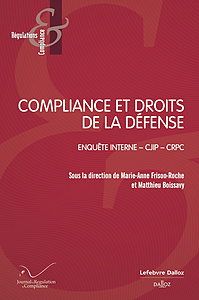
Couverture – Compliance et droits de la défense

Articles in a JoRC book

📝Défendre les intérêts de la personne physique confrontée à la justice négociée : préserver l’effectivité des droits de la défense et le respect de la présomption d’innocence, in 🕴️M.-A. Frison-Roche et 🕴️M. Boissavy (dir.), Collection Régulations & Compliance Compliance et droits de la défense. Enquête interne – CJIP – CRPC

► Full reference : C. Lanta de Bérard & P. Dufourq, « Défendre les intérêts de la personne physique confrontée à la justice négociée : préserver l’effectivité des droits de la défense et le respect de la présomption d’innocence » (Defending the Interests of the Natural Person Facing Negotiated Justice: Preserving the Effectiveness of the Rights of the Defence and Respect for the Presumption of Innocence), in M.-A. Frison-Roche and M. Boissavy (eds.), Compliance et droits de la défense. Enquête interne – CJIP – CRPC, Journal of Regulation & Compliance (JoRC) and Dalloz, coll. “Régulations & Compliance“, 2024, pp. 329-337. - ► English Summary of this article (made by the Journal of Regulation & Compliance – JoRC) : For the authors of the contribution, natural persons, in particular the corporate officers of legal persons, are the “poor relations” of negotiated justice, even though it presents many risks for them. This would be due first to the fact that the CRPC is inadequate for them, in particular because it is not the equivalent of the CJIP and involves an admission of liability, whereas the CJIP precisely excludes it, while the CJIP, like the internal investigation that often precedes it, targets natural persons, facts directly attributable to corporate officers who have no room for manoeuvre left when the time of their own trial comes. The so-called Bolloré case clearly showed this. The internal investigation is thus at once an object of cooperation and a basis for the prosecution of the natural person, and the company may negotiate against its employees, natural persons, without them even knowing, the presumption of innocence hardly operating in what is nevertheless a delegated criminal investigation. Solutions are listed by the authors to remedy this unfavourable situation: a legislative reform so that the negotiated settlement covers globally both the legal person and the natural persons involved; a firmer framework for internal investigations, for better respect of the principles of criminal procedure for the benefit of the persons interviewed and involved; more effective respect for the presumption of innocence when entering into negotiations for a CJIP; and, borrowing from British Law, a prohibition on using before a judge any information resulting from a CJIP.

Conferences

🎤The temporal dimension: imminence and intertemporally, in 📅Climate Change Cases before National and International Courts Cross-fertilization and Convergence”

► Full Reference: Frison-Roche, M.-A., Chair for "The temporal dimension: Imminence and Intertemporally", in Climate Change Cases before National and International Courts Cross-fertilization and Convergence", November 27, 2021, Paris.  -   read the program   Summary of the panel presentation: The specific topic of our panel is the “temporal dimension” of the judicial cases of Climate change. We shall listen to two great experts on this topic, which is Time. Listening the other previous speakers, I understand how this topic is important, because Climate Change requires an immediate action and it create a political issue, because everyone comes before courts. A basis and fundamental problem, because the times are not adjusted.  let's come back to basic notions, to have three times : “past, present, future”.   The issue of Climate Change is in the Future, the necessity of Action is in the Present and the basis temporal question is to know if Courts are the bodies adequate to responde ; maybe it is inevitable that Judge must be recreate their office because the time of the classical judicial office is the Past. Immediately, this simple et huge problem appears : in a classical repartition, the judge is the legal character to intervenir for the Past, the present (maybe is for you and me), and the future is the time for the State, and more precisely for the Parliament. But the climate change is a huge topic, not in the past, not in the present, but in the future. Therefore a gap exists between the time of the topic and the time of the court before the case is explained for obtaining a solution : how to give a good answer ? Judge maybe must travel in time, from past to future …. Maybe, he must, but might he? Classically, the judge can anticipate a very next future, but not the more distant and systemic future. Climate change belongs to the second one. This is why the title of this panel is non only about the necessity to take in consideration the “imminence” but also the “intertemporally” : maybe court are the sole able to create this intertemporality between Past and Future, and by this way to obtain from States and companies to do something immediately !   By two legal ways.    Courts can stay in Past, supervising States, if they dispose of effective legal decisions taken by States in the past about Climate Change (essentially Paris Agreement, for instance transposed in the French legal system by a formal law). This is why an efficient judicial solution would be the possibility for the courts to oblige State to implement their more or less committment they had taken in the past for the future (as the Conseil d’État did in the Commune de Grande-Synthe Cas Law). Even for that, the courts must adopt a creative notion of what is a commitment from a State through a Law… ; as they must do about private companies comitment (in their codes of conduct or soft law of corporate social responsability).    But what to do if States didn’t take such commitment ? Some can allege Courts are not Parliaments and are not legitimate to rule for the future … It is a political issue, a very classical one but very accurate for Climate change (where States and companies are face to courts…) and maybe  And as our colleague said, judicial system is quite technically weak to concretize human rights.   Therefore, the second way, more innovative, est the new use of Tort Law : no more a liability Ex Post, but a responsibility Ex Ante. In every legal system, even in Civil Law systems, Tort Law is conceived by courts (for instance in French Law).  If the new reasoning is conveived in Ex Ante, Tort Law must be a set of legal tools to reach the monumental tools to reach the "Monumental Goal" (being by nature future) which is the Climate Change stopping.  In this teleological reasoning, the admissibility and the choice remedies, must be adapted to obtain what is central : the effectivity and the efficiencicy.  In this sens, the judgement between two parties (which was an Ex Post act) may be conceived as an systemic efficient action (which was an Ex Ante act), because it must be.  -        
Working papers

Sophistique et GPA