Systemic Litigation

Conferences

conference

🎤Le Droit de la Compliance, voie de la transition vers une égalité effective, efficace et efficiente entre les êtres humains (Compliance Law, for the transition towards the effectiveness, efficacy and efficiency of the equality between human beings), in 🧮Les banques coopératives et les transitions

► Full reference : M.-A. Frison-Roche, "Le Droit de la Compliance, voie de la transition vers une égalité effective, efficace et efficiente entre les êtres humains (Compliance Law, for the transition towards the effectiveness, efficacy and efficiency of the equality between human beings)", in Chair "Mutualist and cooperative banking at the service of the economy", ESCP, Les banques coopératives et les transitions​ (Cooperative Banks and Transitions), 29 January 2026. - 🧮view the general programme for the conference Cooperative banks and transitions (in French) - 📶see the slides (in French) - ► Presentation of this conference: The conference is not specifically aimed at lawyers, and even less so at specialists in Compliance Law. That is why it is divided into three parts, in order to show how Compliance Law is relevant in practice for creating effective, efficace and efficient equality between human beings. The first part of the lecture sets out the ambition of equality between human beings. As this is a political principle and not a natural one. As it is an ambition, it justifies being placed first and after that this ambition must be concretised, in a sort of second place. This second place is built bay a tro : that of effectiveness (real application of the norm), efficacy (that the goal for which the norm was established is achieved) and efficiency (that the system is transformed so that, having become robust, it endures through sustainabily). The second part of the conference will present the new branch of law known as Compliance Law. This should be distinguished from simple conformity, which consists of mechanically obeying a body of regulations that are constantly growing and becoming more complex. Compliance Law's Goal is to protect systems from risks that could cause them to disappear (all systems). "Sustainability" is the key principle, which is not limited to the climatic system (also digital system, banking system, and so on) and imposes the future as its object and the long term as its relevant time frame (unlike the market and Competition Law). "Transition" is also a key concept, as it involves moving from one state to another, from an expressed ambition to its realisation, through collaboration with others. These Goals are "Monumental" and are the normative legal basis of Compliance Law. In Europe, the Compliance Monumental Goal is to preserve systems for that the human beings who are involved in them, willingly or unwillingly, are not crushed by them, but rather benefit from them (for instance in banking sector). This is a "Monumental Negative Goal", to which is added a "Monumental Positive Goal", which a new conception of the "Ex Ante Responsability" (not liabily). Dialectically, the third part of the conference explains how Compliance Law internalises the political ambition of equality between human beings, which develops in the three concentric circles of effectiveness, efficacy and efficiency, among the operators best placed to contribute to it. Mutual banks belong to these circles more than the others. Firstly, because they are structured around the principle of taking human beings into consideration. Secondly, because they are rooted in their local areas. Thirdly, because they are driven by the long term, duration and sustainable. The transition est easer. The dificulty is the necessity to proof the effective and efficient will to do this transition. - ⛏️Go further  : 🕴🏻M.-A. Frison-Roche, 📝Drawing the circles of Compliance Law, 2017 🕴🏻M.-A. Frison-Roche, 📝Monumental goals, the beating heart of compliance law, 2021 🕴🏻C. Peicuti and 🕴🏻J. Beyssade, 📝The feminisation of management positions in companies as a compliance objective. The example of the banking sector, in 🕴🏻M. -A. Frison-Roche, 📘The Monumental Goals of Compliance, 2022  🕴🏻M.-A. Frison-Roche, 📝Births of a New Branch of Law: Compliance Law, 2024 - 🌐Follow Marie-Anne Frison-Roche on LinkedIn 🌐follow Marie-Anne Frison-Roche on Instagram 🌐Subscribe to the Newsletter MAFR Regulation, Compliance, Law 🌐Subscribe to the video newsletter MAFR Overhang 🌐Subscribe to the Newsletter MaFR Law & Art

MAFR Chronicles Compliance Law

article forming part of a thematic column

📝Droit de la compliance et Contentieux systémique (Compliance Law and Systemic Litigation)

►Full Reference: M.-A. Frison-Roche, "Droit de la compliance et Contentieux systémique" (Compliance Law and Systemic Litigation), in Chroniques Droit de la Compliance (Compliance Law Chronicles), Recueil Dalloz, 30 October 2025, No. 38, p. 1849 - 🚧read the bilingual Working Paper on which this article is based, with additional developments, technical references and hyperlinks -   ►read the English presentation of the previous chronicles: "Compliance and conformity: Distinguish them in order to articulate them", 2024 "Regulations, Compliance, Contracts, and Judges: places and alliances", 2023 "Contract of compliance, stipulations fo compliance", 2022 "The Adventure of the Compliance", 2020 "Compliance and Legal Personality", 2019 "TLegal Theory of Risk Mapping", 2019 ►read the English presentation of the whole chroniques - ►English summary of this article: Legal systems have changed, and Compliance Law, in its uniqueness, reflects this change and plays a powerful role in it. Through new sets of compliance rules, particularly at European level, in areas such as data protection (GDPR), anti-money laundering (AMLA), climate balance protection (CS3D) and banking and financial system sustainability (Banking Union), techniques (always the same) have been developed and imposed on large companies, which must implement them: alerts, mapping, assessment, sanctions, etc. These new regulatory frameworks only make sense in relation to their ‘Monumental Goals’: to detect systemic risks Ex Ante and prevent crises so that the systems in question do not collapse, but ‘sustain". All the legal instruments in the corpus are normatively rooted in these Monumental Goals, which are the core that unifies Compliance Law (I). Judges are the guardians (II) of this new and highly ambiguous normative framework, which relies on the practical ability of companies to do just that. They ensure that the technical provisions are applied teleologically in each of these compliance blocks, and that the regulatory frameworks are mutually supportive, for it is always the same systemic goal that all compliance regulations serve: to ensure that systems (banking, financial, climate, digital, energy, etc.) do not collapse, that they are sustainable, and that present and future human beings are not crushed by them but, on the contrary, benefit from them. This unity is still little perceived, as regulations pulverize this profound unity of compliance law in the myriad of changing provisions. Entrusting the "regulatory mass" to algorithms increases this pulverization, making the whole increasingly incomprehensible and therefore impossible to handle.  Acknowledging the judge's rightful place, i.e. at the heart of the matter, will enable us to master this new branch of law. But it's not the judge's job alone to restore clarity to a whole covered in the dust of his own technicality. The systemic object of Compliance Law is transferred to Litigation. Indeed, the Litigation that emerges from the new Compliance Law is also fundamentally new, by transitivity. Indeed, the aim of Compliance Law is to make systems sustainable (or sustainable, or resilient, the vocabulary varies). The result is litigation which is itself "systemic litigation" (III), most often initiated by an organization against a systemic operator. The place and role of each are transformed (IV).   -

Working papers

Working Paper, basis for an article (in French)

🚧Compliance Law and Systemic Litigation

► Full Reference: M.-A. Frison-Roche, Compliance Law and Systemic Litigation, Working Paper, August 2025. - 📝 This bilingual Working Paper is the basis of the article published in French "Droit de la compliance et contentieux systémique" - ► Summary of this Working Paper: Legal systems have changed, and Compliance Law, in its uniqueness, reflects this change and plays a powerful role in it. New sets of compliance rules, particularly at European Union level, covering data protection (GDPR), anti-money laundering (AMLA), climate balance protection (CS3D) and banking and financial system sustainability (Banking Union), have been developed and imposed on large companies, which must implement them: alerts, mapping, assessment, sanctions, etc. These new regulatory frameworks only make sense in relation to their ‘Monumental Goals’: to detect systemic risks ex ante and prevent crises so that the systems in question do not collapse, but ‘last’. All the legal instruments in the corpus are normatively rooted in these monumental goals, which are the core that unifies Compliance Law (I). The judge is the guardian of this new and highly ambitious regulatory framework, which relies on the practical ability of companies to implement it (II). Courts ensure that the legal technical provisions are applied in a teleological manner in each of these compliance blocks and that the regulations support each other, because all compliance regulations serve the same systemic goal: to ensure that the systems (banking, financial, climate, digital, energy, etc.) do not collapse, but sustains, and that present and future human beings are not crushed by them, but rather benefit from them. This unity is still little perceived because so meticulous regulations pulverise this profound unity of Compliance Law into a myriad of changing provisions. Entrusting the ‘regulatory mass’ to algorithms increases this fragmentation, making the whole even more incomprehensible and therefore impossible to handle. On the contrary, recognising the judge's place, i.e. at the centre, makes it possible to master this new branch of law. But the judge's sole function is not to restore clarity to a body of law covered by the dust of its own technicality. There is a transfer to Litigation of the systemic object of Compliance Law. Indeed, the litigation that emerges from the new Compliance Law is itself fundamentally new, by transitivity. Indeed, the purpose of Compliance Law is to make systems sustainable (or resilient, or robust, depending on the terminology used). This results in litigation that is itself ‘Systemic Litigation’ (III), most often brought by an organisation against a systemic operator. The place and role of each party are transformed (IV). - 🔓read the developments below⤵️ - 🌐follow Marie-Anne Frison-Roche on LinkedIn 🌐follow Marie-Anne Frison-Roche on Instagram 🌐subscribe to the Newsletter MAFR Regulation, Compliance, Law 🌐subscribe to the Video Newsletter MAFR Surplomb 🌐subscribe to the Newsletter MaFR Droit & Art

Working papers

🚧The part of Non-contentious in the judicial treatment of Compliance cases

► Full reference : M.-A. Frison-Roche, The role of Discretionary Jurisdictio in the judicial treatment of Compliance cases, working paper, August 2025.   - 📗This working document was prepared as a contribution to the collective book offered to Professor Dominique d'Ambra, published  in June 2026. - ► Summary of the working document  : Based on the definition of Judicial Office, the procedural principles that derive from it and the consequent powers that judges exercise, the objet of this study is to measure the degree of discretion that exists in the judicial treatment of compliance, without direct consideration for the dispute between litigants. This part is very ignored, when it should be given top priority. Indeed, because Systems are involved in compliance cases brought before civil or commercial judges, we are seeing a development of this discretionary element in judicial fonction. Discretionary matters differ from unilateral discretionary procedures, and this discretionary element relates to what the judge examines, possibly in the context of a dispute. The first part of this contribution therefore aims to describe the natural development of the discretionary power of the judge to deal with compliance cases brought before them. This role stems from the fact that, even when triggered by a dispute, what is submitted to the judge is a situation composed of a system, which cannot defend its interests before the civil or commercial judge in this Systemic Litigation arising from the very nature of Compliance Law and the Compliance Obligations it engenders on systemic entites. Moreover, it is the Future whose interests must be considered and protected, which the judge must do directly. This leads to the second part of the contribution, calling for a rethinking of the procedure and the role of the Compliance Judge, so that ex gratia matters can be dealt with. The judge must therefore verify that there are no conflicts of interest between the litigants, including hidden ones, and must learn about the systems involved. The inquisitorial principle must therefore be strengthened. But at the same time, since the primary aim is not to settle a dispute but to resolve a systemic problematic situation, the judge must facilitate the movements of the parties, and the adversarial principle must also be strengthened. Must be encouraged this activation of a powerful and discretionary approach, not as an exception but as a principle fully articulated with a contentious principle, with the dispute being only a means used by the necessary parties to enable systemic compliance situations to be resolved. - 🌐Follow Marie-Anne Frison-Roche on LinkedIn 🌐follow Marie-Anne Frison-Roche on Instagram 🌐Subscribe to the Newsletter MAFR Regulation, Compliance, Law  🌐Subscribe to the video newsletter MAFR Overhang

Conferences

Conference

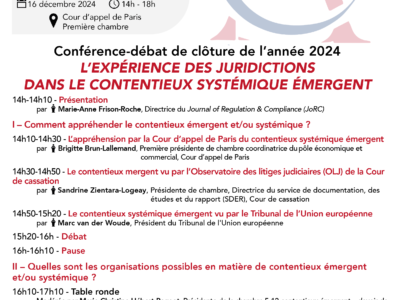
🎤Identifier et anticiper la pratique du Contentieux Systémique Émergent ; Présentation de 🧮L’expérience des juridictions dans le Contentieux Systémique Émergent

► Full Reference: M.-A. Frison-Roche, Identifier et anticiper la pratique du Contentieux Systémique Émergent (Identifying and anticipating the practice of Emerging Systemic Litigation) ; Presentation of L’expérience des juridictions dans le Contentieux Systémique Émergent (Courts Experience in Emerging Systemic Litigation), in cycle of conference-debates "Contentieux Systémique Émergent" ("Emerging Systemic Litigation"), organised on the initiative of the Cour d'appel de Paris (Paris Cour of Appeal), with the Cour de cassation (French Court of cassation), the Cour d'appel de Versailles (Versailles Court of Appeal), the École nationale de la magistrature – ENM (French National School for the Judiciary) and the École de formation des barreaux du ressort de la Cour d'appel de Paris – EFB (Paris Bar School), under the scientific direction of Marie-Anne Frison-Roche, 16 December 2024, 2pm.-6pm., Cour d'appel de Paris, Première Chambre (First Chamber). - 🧮see the full programme of this event - ⚙️This event has been conceived as a part of the cycle of conference-debates "Contentieux Systémique Émergent" ("Emerging Systemic Litigation"), organised on the initiative of the Cour d'appel de Paris (Paris Cour of Appeal), with the Cour de cassation (French Court of cassation), the Cour d'appel de Versailles (Versailles Court of Appeal), the École nationale de la magistrature – ENM (French National School for the Judiciary) and the École de formation des barreaux du ressort de la Cour d'appel de Paris – EFB (Paris Bar School), under the scientific direction of Marie-Anne Frison-Roche - ► English Summary of the conference:  - 🌐follow Marie-Anne Frison-Roche on LinkedIn 🌐follow Marie-Anne Frison-Roche on Instagram 🌐subscribe to the Newsletter MAFR Regulation, Compliance, Law 🌐subscribe to the Newsletter Surplomb, par MAFR

Articles

📝Antitrust, natural field of Systemic Litigation

► Full Reference: M.-A. Frison-Roche, "Antitrust, natural field of Systemic Litigation", Concurrences, November 2024, No. 4, Art. No. 120776. - 📝read the article (in English) - 🚧read the bilingual Working Paper which is the basis of this article, with additional developments, technical references and hyperlinks - ► English Summary of this article: Systemic Litigation is a specific category of Litigation in which beyond the dispute between the parties the interest of a System is involved, in particular its future. Competition Law is a natural and long-standing field for this category, which is now emerging strongly for information, climate and energy systems.  It should be remembered that a market is not self-regulating and cannot continue to function in the long term unless it has the benefit of a judge, a figure who is specific in that he/she is both external to it and yet apprehends its specific interest. In order to satisfy this double requirement, liberal legal organisations often entrust the competition authority with jurisdiction over this Systemic Litigation. Ordinary courts will also hear such cases, either on appeal or in other proceedings, and it cannot be claimed that courts are excluded, the systemic dimension of the dispute being expressed by the presence of the competition authority in the proceedings. This explains the procedural rules that are hard to justify otherwise. The Authority, the European Commission for example, must be able to develop and express the specific interests of the competition system. This special role of the competition authority in this type of litigation, because it is systemic, has been in place for decades and should serve as a model for Systemic Litigation, which is being developed for other systems whose sustainability is now referred to the courts. - 🌐follow Marie-Anne Frison-Roche on LinkedIn 🌐follow Marie-Anne Frison-Roche on Instagram 🌐subscribe to the Newsletter MAFR Regulation, Compliance, Law 🌐subscribe to the Newsletter Surplomb, par MAFR

Conferences

Conference

🎤Choix et embranchements de compétences lorsqu’un enjeu de vigilance est allégué (Choice and Branching of Jurisdiction when a Vigilance issue is Alleged), in 🧮Le Droit processuel de la Vigilance (Vigilance General Procedural Law)

► Full Reference: M.-A. Frison-Roche, "Choix et embranchements de compétences lorsqu'un enjeu de vigilance est allégué" ("Choice and Branching of Jurisdiction when a Vigilance issue is Alleged"), in Le Droit processuel de la Vigilance (Vigilance General Procedural Law), in cycle of conference-debates "Contentieux Systémique Émergent" ("Emerging Systemic Litigation"), organised on the initiative of the Cour d'appel de Paris (Paris Cour of Appeal), with the Cour de cassation (French Court of cassation), the Cour d'appel de Versailles (Versailles Court of Appeal), the École nationale de la magistrature – ENM (French National School for the Judiciary) and the École de formation des barreaux du ressort de la Cour d'appel de Paris – EFB (Paris Bar School), under the scientific direction of Marie-Anne Frison-Roche, November 18, 2024, 11h-12h30, Cour d'appel de Paris, Cassin courtroom - 🕴️An other speaker to this conference is Natalie Fricero, Emeritus Professor at Côte d'Azur University 🧮see the full programme of this event - ⚙️This event was conceived as part of the "Emerging Systemic Litigation" cycle of conference-debates, organized by the Paris Court of appeal, in conjunction with the French Court of cassation, the Versailles Court of appeal, the French National School for the Judiciary and the Paris Bar School, under the scientific direction of Marie-Anne Frison-Roche. - ► English Summary of the conference: This speech opens the conference. It therefore logically focuses on the question of "jurisdictional competence". It is divided into successive points which are progressively linked to each other. The first point consists to insist on this rule : the organisation of the courts and their jurisdiction can never be detached from the substance of the matter in dispute. This explains why the issue of jurisdiction is such a source of passion for as long as the very definition of Vigilance remains so contentious, and why the 2021 legislature's belief that it could put out the fire has only served to exacerbate it. The second point relates to the first proposed solution, i.e. maintaining the exclusivity of the Paris First Judicial Court, which is acceptable in principle because by specialising judges acquire a "technical competence" but which presents a very damaging "Bibendum risk". The third point relates to the second solution proposed, namely the reference to the Motulskian notion of the 'basis of demand', which provokes a fork in the road, with the risk of interminable conflicts and divergent interpretations. The fourth point is the need to find the best solution, i.e. the least bad solution, consisting above all of forming practical alliances, without requiring new texts, for this particular type of litigation which does not come under any branch of Law and which justifies a dialogue between the heads of the courts.           - 🔓read the key points of this speech below ⤵️ - 🌐follow Marie-Anne Frison-Roche on LinkedIn 🌐follow Marie-Anne Frison-Roche on Instagram 🌐subscribe to the Newsletter MAFR Regulation, Compliance, Law 🌐subscribe to the Newsletter Surplomb, par MAFR

Conferences

Conference

🎤Les spécificités à concevoir dans l’audience publique des contentieux systémiques de vigilance (The Specific Features of Public Hearings to conceive on Vigilance Systemic Litigation), in 🧮Le Droit processuel de la Vigilance (Vigilance General Procedural Law)

► Full Reference: M.-A. Frison-Roche, "Les spécificités à concevoir dans l'audience publique des contentieux systémiques de vigilance" ("The Specific Features of Public Hearings to conceive on Vigilance Systemic Litigation"), in Le Droit processuel de la Vigilance (Vigilance General Procedural Law), in cycle of conference-debates "Contentieux Systémique Émergent" ("Emerging Systemic Litigation"), organised on the initiative of the Cour d'appel de Paris (Paris Cour of Appeal), with the Cour de cassation (French Court of cassation), the Cour d'appel de Versailles (Versailles Court of Appeal), the École nationale de la magistrature – ENM (French National School for the Judiciary) and the École de formation des barreaux du ressort de la Cour d'appel de Paris – EFB (Paris Bar School), under the scientific direction of Marie-Anne Frison-Roche, November 18, 2024, 11h-12h30, Cour d'appel de Paris, Cassin courtroom - 🕴️An other speaker to this conference is Natalie Fricero, Emeritus Professor at Côte d'Azur University 🧮see the full programme of this event - ⚙️This event was conceived as part of the "Emerging Systemic Litigation" cycle of conference-debates, organized by the Paris Court of appeal, in conjunction with the French Court of cassation, the Versailles Court of appeal, the French National School for the Judiciary and the Paris Bar School, under the scientific direction of Marie-Anne Frison-Roche. - ► English Summary of the conference:  - 🌐follow Marie-Anne Frison-Roche on LinkedIn 🌐follow Marie-Anne Frison-Roche on Instagram 🌐subscribe to the Newsletter MAFR Regulation, Compliance, Law 🌐subscribe to the Newsletter Surplomb, par MAFR

Surplomb - Notion

🎬Procedural Law of Regulation and Compliance

Monographs

📝Le contentieux systémique (The Systemic Litigation)

► Full Reference: M.-A. Frison-Roche, "Le contentieux systémique" ("The Systemic Litigation"), D. 2024, chron., pp. 1633-1635 - 📝read the article (in French) - 🚧read the bilingual Working Paper which is the basis of this article, with additional developments, technical references and hyperlinks - ► English Summary of the article: We are seeing the Emergence of a category of its own and must be designated by a singular expression: 'Systemic Litigation' (I). This category is composed of concrete cases, "Systemic Cases", in which a system is entirely involved. The interest in these systems, insofar as they are all a system, unifies the category and justifies its own procedural, institutional and jurisdictional treatment. This type of Litigation is Emerging for three reasons, which are recorded in the Systemic Cases (II). Systemic Litigation must be dealt with in a way that is both specific and unified. This is beginning to happen and must be expanded (III). - 🌐follow Marie-Anne Frison-Roche on LinkedIn 🌐follow Marie-Anne Frison-Roche on Instagram 🌐subscribe to the Newsletter MAFR Regulation, Compliance, Law 🌐subscribe to the Newsletter Surplomb, par MAFR

Working papers

Working Paper

🚧Antitrust, natural field of Systemic Litigation

► Full Reference: M.-A. Frison-Roche, Antitrust, natural field of Systemic Litigation, Working Paper, July 2024 - 📝This working paper has been prepared as a basis for the article to be published "Antitrust, natural field of Systemic Litigation" in the Review Concurrences in September 2024 - ► Summary of this Working Paper: Systemic Litigation is a specific category of Litigation in which beyond the dispute between the parties the interest of a System is involved, in particular its future. Competition Law is a natural and long-standing field for this category, which is now emerging strongly for information, climate and energy systems.  It should be remembered that a market is not self-regulating and cannot continue to function in the long term unless it has the benefit of a judge, a figure who is specific in that he/she is both external to it and yet apprehends its specific interest. In order to satisfy this double requirement, liberal legal organisations often entrust the competition authority with jurisdiction over this Systemic Litigation. Ordinary courts will also hear such cases, either on appeal or in other proceedings, and it cannot be claimed that courts are excluded, the systemic dimension of the dispute being expressed by the presence of the competition authority in the proceedings. This explains the procedural rules that are hard to justify otherwise. The Authority, the European Commission for example, must be able to develop and express the specific interests of the competition system. This special role of the competition authority in this type of litigation, because it is systemic, has been in place for decades and should serve as a model for Systemic Litigation, which is being developed for other systems whose sustainability is now referred to the courts. - 🔓read the developments below⤵️ - 🌐follow Marie-Anne Frison-Roche sur LinkedIn 🌐follow Marie-Anne Frison-Roche on Instagram 🌐subscribe to the Newsletter MAFR Regulation, Compliance, Law 🌐subscribe to the Video Newsletter MAFR Surplomb

Working papers

Working Paper

🚧Systemic Litigation

► Full Reference: M.-A. Frison-Roche, Systemic Litigation, Working Paper, July 2024. - 📝Ce This Working Paper has been the basis for an article tot be published in French in the Recueil Dalloz. - ► Summary of this Working Paper: We are seeing the Emergence of a category of its own and must be designated by a singular expression: 'Systemic Litigation' (I). This category is composed of concrete cases, "Systemic Cases", in which a system is entirely involved. The interest in these systems, insofar as they are all a system, unifies the category and justifies its own procedural, institutional and jurisdictional treatment. This type of Litigation is Emerging for three reasons, which are recorded in the Systemic Cases (II). Systemic Litigation must be dealt with in a way that is both specific and unified. This is beginning to happen and must be expanded (III). - 🔓read the developments below - 🌐follow Marie-Anne Frison-Roche sur LinkedIn 🌐follow Marie-Anne Frison-Roche on Instagram 🌐subscribe to the Newsletter MAFR Regulation, Compliance, Law 🌐subscribe to the Video Newsletter MAFR Surplomb