Systemic case

Organisation of events

1st conference-debate of the cycle "Contentieux Systémique Émergent" ("Emerging Systemic Licigation")

🧮Importance et spécificité du Contentieux Systémique Émergent (Importance and specificity of the Emerging Systemic Litigation), in cycle of conferences-debates “Contentieux Systémique Émergent” (“Emerging Systemic Litigation”)

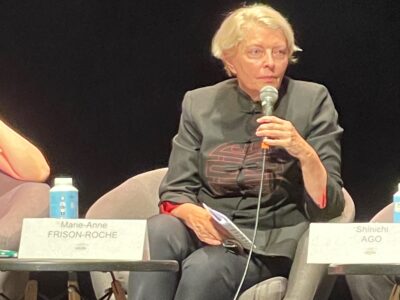
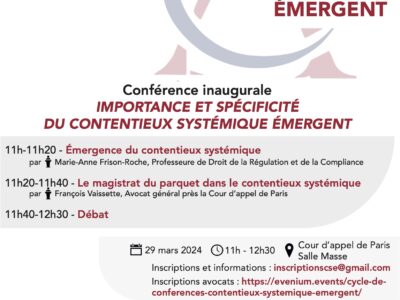
► Full Reference: Importance et spécificité du Contentieux Systémique Émergent (Importance and specificity of the Emerging Systemic Litigation), in cycle of conference-debates "Contentieux Systémique Émergent" ("Emerging Systemic Litigation"), organised on the initiative of the Cour d'appel de Paris (Paris Cour of Appeal), with the Cour de cassation (French Court of cassation), the Cour d'appel de Versailles (Versailles Court of Appeal), the École nationale de la magistrature – ENM (French National School for the Judiciary) and the École de formation des barreaux du ressort de la Cour d'appel de Paris – EFB (Paris Bar School), under the scientific direction of Marie-Anne Frison-Roche, March 29, 2024, 11h-12h30, Cour d'appel de Paris, Masse room - ► Presentation of the conference-debate: The "Systemic Litigation" is emerging. Through and beyond the dispute, a system is involved: the banking, financial, digital, health and climate systems. How can such litigation be recognised? How do you make room for a system in a court of law? What can be done when several systems are in conflict? Who represents these systems and their interests? How can the temporality of systems and litigation be reconciled? In practical terms, the magistrate has a new role. Whether they are prosecutors or judges, they deal with systemic litigation in criminal, civil, commercial and other areas.   - 🎤see the detailed presentation of the first speech of 🕴️Marie-Anne Frison-Roche : L'émergence du Contentieux Systémique (The Emergence of Systemic Litigation) - 🧮Programme of this event:  Inaugural Conference IMPORTANCE ET SPÉCIFICITÉ DU CONTENTIEUX SYSTÉMIQUE ÉMERGENT (IMPORTANCE AND SPECIFICITY OF THE EMERGING SYSTEMIC LITIGATION)   Cour d’appel de Paris (Paris Court of Appeal), Masse room 🕰️11h-11h20. 🎤L’émergence du contentieux systémique (The Emergence of the Systemic Litigation), by 🕴️Marie-Anne Frison-Roche, Professor of Regulatory and Compliance Law, Director if the Journal of Regulation & Compliance (JoRC)   🕰️11h20-11h40. 🎤L’office du magistrat du parquet dans le contentieux systémique (The role of the Public Prosecutor in Systemic Litigation), by 🕴️François Vaissette, Avocat général près la Cour d’appel de Paris (Advocate General at the Paris Court of Appeal)   🕰️11h40-12h30. Debate - 🔴Registrations and information requests can be sent to: inscriptionscse@gmail.com 🔴For the attorneys, registrations have to be sent to the following address: https://evenium.events/cycle-de-conferences-contentieux-systemique-emergent/  ⚠️The conference-debates are held in person only, in the Cour d’appel de Paris (Paris Court of Appeal). - 🧮Read below a detailed presentation of this event⤵️ -

Conferences

🎤L’émergence du contentieux systémique (Emergence of the Systemic Litigation), in 🧮Importance et spécificité du Contentieux Systémique Émergent, cycle of conference-debates “Contentieux Systémique Émergent”

► Full Reference: M.-A. Frison-Roche, "L’émergence du Contentieux Systémique" ("Emergence of the Systemic Litigation"), in Importance et spécificité du Contentieux Systémique Émergent (Importance and specificity of the Emerging Systemic Litigation), in cycle of conferences-debates "Contentieux Systémique Émergent" ("Emerging Systemic Litigation"), organised on the initiative of the Cour d'appel de Paris (Paris Cour of Appeal), with the Cour de cassation (French Court of cassation), the Cour d'appel de Versailles (Versailles Court of Appeal), the École nationale de la magistrature – ENM (French National School for the Judiciary) and the École de formation des barreaux du ressort de la Cour d'appel de Paris – EFB (Paris Bar School), under the scientific direction of Marie-Anne Frison-Roche, March 29, 2024, 11h-12h30, Cour d'appel de Paris, salle Masse - 🧮see the full programme of this event - 🧮see the programme of the entire cycle Contentieux Systémique Émergent - 🌐consult on LinkedIn the report of this speech (in French) - 🌐consult on LinkedIn a general présentation of this event, which links to a presentation and a report of each speech (in French) - 🧱consult the scientific coordination sheet of this event, which gives an account of the various speeches made - 🔲see the slides used to support this intervention (in French) - 🚧read the bilingual Working Paper which is the basis of this speech - ► English Summary of the conference: We are seeing the emergence of what should be referred to as a category of its own: the "Systemic Litigation". This concept, proposed in 2021📎1🕴️M.-A. Frison-Roche, 🚧The hypothesis of Systemic Cases brought before the Judge, 2021., refers to the hypothesis in which a system is 'involved' in a particular 'case' submitted to the judge. The presence of a system should not be confused with a systemic analysis of a phenomenon. The term 'cause' must be understood in the procedural sense, as used in article 5 of the Code civil (French Civil Code). Specifically, the prohibition contained in article 5 of the French Civil Code does not apply because a system thus involved calls for factual responses and solutions and not necessarily general and abstract solutions: the solution of a systemic nature and scope, that the presence of a system in a cause calls for, may be a factual solution, even if it radiates out from the system as a whole. But precisely because the presence of a system in the case often gives rise to a question that is itself systemic, the judge, if he wishes to comply with article 4 of the French Civil Code, must respond not only a minima by not evading the question, for example of systemic risks, but also fully by providing systemic solutions, for example remedies to preserve in the future the solidity and durability of the systems involved in the case.    These systems may be of different kinds: banking, financial, transport, health, energy, digital, algorithmic or climatic. Their presence in cases brought to the attention of judges, the variety and difficulties of which will be seen in later contributions, leads to basic questions relating to the emergence of Systemic Litigation: firstly, how can Systemic Litigation be defined? Secondly, what makes this category of litigation emerge? The answers to these two questions have essential practical consequences.  The new solutions must be based on a classic distinction, used in particular in criminal and administrative proceedings, which are more objective, but also in civil proceedings, notably by Hébraud, namely the distinction between the "party to the dispute/litigation" and the "party to the proceedings". Depending on whether it is accepted that the system should be considered as a "party to the litigation", which would allow it, through an entity that is legitimate in expressing it, to allege claims and formulate demands against an adversary, or as a "party to the proceedings", a much broader category, which would allow the judge to hear the interests of the systems involved without individuals being able, on behalf of a system, to formulate claims against or for the benefit of a party to the litigation.     This makes it possible to innovate while preserving the measure of which the judge is the guardian.   - 🌐follow Marie-Anne Frison-Roche on LinkedIn 🌐follow Marie-Anne Frison-Roche on Instagram 🌐subscribe to the Newsletter MAFR Regulation, Compliance, Law

Articles

💬”Nous voyons émerger aujourd’hui le contentieux systémique”, contrepoint à l’entretien du Premier Président de la Cour d’appel de Paris Jacques Boulard, 💬Contentieux systémique : “Il est important, pour les magistrats, de rester au plus près des réalités”

► Full Reference: M.-A. Frison-Roche, ""Nous voyons émerger aujourd’hui le contentieux systémique"" (""We are now seeing the emergence of the Systemic Litigation""), interview with Olivia Dufour, counterpoint to the interview with the Premier Président de la Cour d'appel de Paris (First President of the Paris Court of Appeal) Jacques Boulard, "Contentieux systémique : "Il est important, pour les magistrats, de rester au plus près des réalités"" ("Systemic litigation: "It is important for judges to remain as close as possible to reality""), Actu-Juridique, March 28, 2024 - 💬read the interview (in French) - This interview is a counterpoint to the interview conducted with Jacques Boulard, Premier Président de la Cour d'appel de Paris (First President of the Paris Court of Appeal), on the Court of Appeal's threefold initiative in establishing the Conseil de Justice Économique – CJE (Economic Justice Council), the additional chamber (5-12) to hear vigilance litigation in particular  and the setting up of the series of conference-debates on the Contentieux Systémique Émergent (Emerging Systemic Litigation): read the interview (in French). This interview highlights Marie-Anne Frison-Roche's position at the Conseil de Justice Économique and her role as scientific director of the series of conference-debates.  As a counterpoint, the journal conducts a specific interview with Marie-Anne Frison-Roche on the specific issue of the Contentieux Systémique Émergent (Emerging Systemic Litigation) cycle. - ► Presentation of the interview by the journal : "Marie-Anne Frison-Roche, professeur de droit de la régulation et de la compliance et responsable scientifique du cycle « Contentieux systémique émergent » nous explique la notion de contentieux systémique et l’importance de la démarche engagée par le Premier président." (Free translation : "Marie-Anne Frison-Roche, Professor of Regulatory Law and Compliance Law and Scientific Director of the "Contentieux systémique émergent" ("Emerging Systemic Litigation") cycle, explains the concept of Systemic Litigation and the importance of the approach adopted by the First President.") - For the record, the 2024 conference-debates of the "Contentieux systémique émergent" ("Emerging Systemic Litigation") cycle: Conférence inaugurale – Vendredi 29 mars 2024, de 11h à 12h30, IMPORTANCE ET SPÉCIFICITÉ DU CONTENTIEUX SYSTÉMIQUE ÉMERGENT   Deuxième conférence – Vendredi 26 avril 2024, de 11h à 12h30, LA VIGILANCE, NOUVEAU CHAMP DE CONTENTIEUX SYSTÉMIQUE   Troisième conférence – Lundi 27 mai 2024, de 11h à 12h30, LES TECHNIQUES DE SUPERVISION DES CONTENUS NUMÉRIQUES DISPONIBLES SUR LES PLATEFORMES   Quatrième conférence – Lundi 24 juin 2024, de 11h à 12h30, L’INTELLIGENCE ARTIFICIELLE, NOUVEAU CHAMP DE CONTENTIEUX SYSTÉMIQUE   Cinquième conférence – Lundi 9 septembre 2024, de 11h à 12h30, LA PORTÉE DES NORMES DE DROIT DUR, DE DROIT SOUPLE ET DES NORMES TECHNIQUES DANS LE CONTENTIEUX SYSTÉMIQUE ÉMERGENT   Sixième conférence – Lundi 14 octobre 2024, de 11h à 12h30, LES TECHNIQUES PROBATOIRES ADÉQUATES DANS LE CONTENTIEUX SYSTÉMIQUE ÉMERGENT   Septième conférence – Lundi 18 novembre 2024, de 11h à 12h30, DISCUSSION OUVERTE   Conférence de clôture de l’année 2024 – Lundi 16 décembre 2024, de 16h à 18h, L’EXPÉRIENCE DES JURIDICTIONS DANS LE CONTENTIEUX SYSTÉMIQUE ÉMERGENT - ► For the record, presentation of the interview of the Premier Président (First President) by the journal (in French): "Vendredi 29 mars aura lieu la première conférence-débat du cycle de formation « Contentieux systémique émergent » à la Cour d’appel de Paris. Cette initiative s’inscrit dans le cadre d’une politique qui a menée à la création d’un Conseil de justice économique ainsi qu’à la mise en place d’une nouvelle chambre dédiée au devoir de vigilance et à la responsabilité écologique. Le Premier président de la Cour d’appel de Paris, Jacques Boulard, nous explique les objectifs et les enjeux de ces innovations.". - - 🌐follow Marie-Anne Frison-Roche on LinkedIn 🌐follow Marie-Anne Frison-Roche on Instagram 🌐subscribe to the Newsletter MAFR Regulation, Compliance, Law

Articles

💬You Porn : La CJUE face au défi de la protection des mineurs

► Full Reference: M.-A. Frison-Roche, "You Porn : La CJUE face au défi de la protection des mineurs" ("You Porn: The CJEU faces the challenge of protecting minors"), interview with Olivia Dufour, Actu-Juridique, March 11, 2024 - 💬read the interview (in French) - ► Presentation of the interview by the journal (in French): "Depuis bientôt deux ans, l’Arcom tente de contraindre les sites pornographiques à mettre en place des procédés techniques sérieux de contrôle d’âge des internautes qui accèdent à leurs sites, afin que la protection des mineurs organisée par le droit pénal soit effective. Il y a à la fois une procédure civile en cours, basée notamment sur le décret qui met en œuvre ce dispositif, et un recours administratif, contestant la légalité du décret sur lequel s’appuie le régulateur pour mettre en demeure les sites d’adopter ces dispositifs techniques. Dans ce dernier contentieux, le Conseil d’État a, par sa décision du 6 mars 2024, adressé plusieurs questions préjudicielles à la CJUE pour déterminer quelle était la marge de manœuvre des États membres à l’encontre des sites qui ne respectent pas leur législation. Nous avons demandé au professeur Marie-Anne Frison-Roche, spécialiste de droit de la compliance, de nous éclairer sur les enjeux de ce contentieux hors normes.". - ► Questions asked (in French):  Pouvez-vous nous rappeler brièvement la genèse de ce cas manifestement complexe ? C’est la première fois qu’apparaît dans une décision de justice la notion de « cause systémique » dont vous êtes l’auteure. De quoi s’agit-il exactement ? Sur ces entrefaites, une décision de la CJUE est venue bouleverser la donne… Revenons au recours devant le Conseil d’État contre le décret, il semble que le Conseil d’État avait donc le choix entre deux solutions : suivre la CJUE et donc renoncer à protéger les enfants de la pornographie en France ou bien s’émanciper de cette jurisprudence européenne au risque de se le voir reprocher. Qu’a-t-il décidé finalement ? - 🌐follow Marie-Anne Frison-Roche on LinkedIn 🌐follow Marie-Anne Frison-Roche on Instagram 🌐subscribe to the Newsletter MAFR Regulation, Compliance, Law

Articles in The Journal of Regulation & Compliance « JoRC »

📝Adjusting General Procedural Law to Compliance Law by the nature of things, in🕴️M.-A. Frison-Roche (ed.), 📘Compliance Jurisdictionalisation

► Full Reference: M.-A. Frison-Roche, "Adjusting General Procedural Law to Compliance Law by the Nature of things", in M.-A. Frison-Roche (ed.), Compliance Jurisdictionalisation, Journal of Regulation & Compliance (JoRC) and Bruylant, "Compliance & Regulation" Serie, 2024, pp. 273-28.  - 📝read the article - 🚧read the bilingual Working Paper which is the basis of this article, with additional developments, technical references and hyperlinks - 📘read a general presentation of the book, Compliance Jurisdictionalisation, in which this article is published - The principal elements of this articles had been presented during the scientific manifestation held on September 23, 2021, at Dauphine University in Paris, coorganised by the Journal of Regulation & Compliance (JoRC) and the Institute Droit Dauphine.  In the book this article is placed in the chapter II about the General Procedural Law in the Compliance Law.   - ► Summary of the article (done by the Journal of regulation & Compliance – JoRC): General Procedural Law is an invention, essentially due to Professor Motulsky, going well beyond the gain that one always has in comparing types of procedures with each other. As he asserted, there is Natural Law in General Procedural Law, in that as soon as there is the Rule of Law Principle there cannot be, whatever the "procedure", even the "process", such and such way of doing things: for example, to decide, to seize the one who decides, to listen before deciding, to contest the one who has decided. General Procedural Law therefore depends on the nature of things. However, Compliance Law organizes things in a new way. Therefore, both the simple and iron principles of General Procedural Law creep in where we do not expect them at first sight, because there is no judge, this character around whom ordinary procedures fit together. The principles of General Procedural Law are essential in companies. Even if the regulations do not breathe a word about it, it is up to the Judges, in particular the Supreme Courts, to recognize this nature of things because on this effect of nature that  General Procedural Law is built: when compliance mechanisms oblige companies to strike, General Procedural law must oblige, even in the silence of the texts, to arm those who can be hit, even stand up against devices that would set aside too much these defenses that are easily considered contrary to efficiency (I). But because it is a question of making room for this nature of the things of which the Rule of Law Principle entrusts the custody to the Judge and the Lawyer, the General Procedural Law must also adjust itself to what the extraordinary new branch of Law Compliance Law is. Indeed, Compliance Law is extraordinary in that it expresses the political pretention to act now so that the future will not be catastrophic, by detecting and preventing the realization of systemic risks, or even that it is better, by building effective equality or real concern for others. Because it is the Monumental Goals that defines this new branch of Law, a disputed systemic issue, possibly disputed by several parties before a judge, the procedural principles used by the court must be broadened considerably: they must then include civil society and the future (II). General Procedural Law thus naturally acquires an even more place than in the classic branches of Law since on the one hand it imposes itself outside of trials, particularly in companies and on the other before the courts it involves people who had hardly any place to speak and thinks themselves, especially the systems entering the "causes" of Compliance now debated before the Judge. - 🌐follow Marie-Anne Frison-Roche on LinkedIn 🌐follow Marie-Anne Frison-Roche on Instagram 🌐subscribe to the Newsletter MAFR Regulation, Compliance, Law

Organisation of events

🧱⚙️Coordination of the cycle of conference-debates 🧮Contentieux Systémique Émergent – CSE (Emerging Systemic Litigation – ESL)

► Full Reference: M.-A. Frison-Roche, Coordination of the cycle of conference-debates Contentieux Systémique Émergent (Emerging Systemic Litigation), organised on the initiative of the Cour d'appel de Paris (Paris Cour of Appeal), with the Cour de cassation (French Court of cassation), the Cour d'appel de Versailles (Versailles Court of Appeal), the École nationale de la magistrature – ENM (French National School for the Judiciary) and the École de formation des barreaux du ressort de la Cour d'appel de Paris – EFB (Paris Bar School), under the scientific direction of Marie-Anne Frison-Roche - ► This Cycle in few words: Duty of vigilance, supervision of platforms, non-financial information (CSRD), etc.: as many new texts that bring new types of disputes before the courts. Despite their diversity, the cases brought before the most diverse judges present a unity: through the dispute that pits the parties against each other, it is a system that is at stake, for example the climate system, digital system, energy system, financial system, etc. New regulations are just the illustration of this "Emerging Systemic Litigation"; the conference-debates aiming at showing the new fields, new techniques, new standards, etc., in relation to the scale and diversity of stakeholders' expectations. This cycle is designed to encourage cross-fertilisation, so as to provide judges with food for thought ahead of the litigation they will be called upon to deal with. Les réglementations nouvelles ne sont que l’illustration de ce « contentieux systémique émergent » dont la formation a pour objet de montrer les nouveaux champs, les nouvelles techniques, les nouvelles normes, etc., en lien avec l’ampleur et la diversité des attentes des parties prenantes. Le cycle vise à favoriser les échanges croisés, afin d’alimenter la réflexion des magistrats en amont des litiges qui leurs seront soumis. - 🔴Registrations and information requests can be sent to: inscriptionscse@gmail.com 🔴For the attorneys, registrations have to be sent to the following address: https://evenium.events/cycle-de-conferences-contentieux-systemique-emergent/  ⚠️The conference-debates are held in person only, in the Cour d’appel de Paris (Paris Court of Appeal). - ► General Presentation of the Cycle: In 2024, the Cour d’appel de Paris (Paris Court of Appeal) created a new specialised chamber: chamber 5-12 Contentieux émergent – Devoir de vigilance et responsabilité écologique (Emerging litigation – Duty of vigilance and environmental liability). Vigilance litigation is an example of what is emerging more generally: Systemic Litigation, often linked to technologies. This calls for a new way of judging, organising procedures and relations between professionals. A series of conference-debates on Emerging Systemic Litigation (ESL) is being organised jointly by the Paris Court of Appeal, the Versailles Court of Appeal, the Cour de cassation (French Court of cassation), the École nationale de la magistrature – ENM (French National School for the Judiciary) and the École de formation des barreaux du ressort de la Cour d'appel de Paris – EFB (Paris Bar School), under the scientific responsibility of Professor Marie-Anne Frison-Roche. In this context, a series of conference-debates involving professionals from a wide range of backgrounds is being proposed on the following themes: 🧮the very notion of "Emerging Systemic Litigation" and the role of the judiciary in it (29 March 2024): read the report of this event   🧮vigilance, insofar as it gives rise to Systemic Litigation, notably because it takes legal form in numerous contracts, for example in employment relationships (26 April 2024): read the report of this event   🧮the inclusion in Emerging Systemic Litigation of information reliability techniques, particularly with regard to content available on platforms (27 May 2024): read the report of this event   🧮the way in which artificial intelligence is generating Systemic Litigation and the influence of new specific texts (24 June 2024): read the report of this event   🧮sustainability, a principle of systems found in reports and transitively in disputes concerning their development, their standards and even their control (9 September 2024): read the programme of this event   🧮new evidentiary techniques required by Emerging Systemic Litigation, to account for systemic needs, e.g. climate and digital systems, and how firms respond to them (14 October 2024): read the programme of this event   🧮Vigilance General Procedural Law, in that it incorporates the Systemic dimension of Vigilance Litigation (18 November 2024): read the programme of this event   🧮institutional and case law feedback from courts on Emerging Systemic Litigation (16 December 2024): read the programme of this event - 🧮read below the full programme of this cycle of conference-debates⤵️

Videos

🎥L’avenir du Droit de la compliance (The futur of Compliance Law), in🧮 Nuit du Droit

► Full Reference: M.-A. Frison-Roche, "L'avenir du Droit de la compliance" (The futur of Compliance Law), in Cour de cassation (French Court of cassation), La Nuit du Droit 2023, October 4, 2023.  - 🎥 Watch the video (in French) - 🧮read the full programme of this event The Cour de cassation (French Court of cassation) had presented 4 successive themes insofar as they affect the future of Law: filiation, artificial intelligence, the environment and compliance. The President of the Chambre sociale de la Cour de cassation (Social Chamber of the Court of Cassation) gave a presentation on Compliance and the essential role played by the Judge. Then, the Parquet général (Prosecutor General's Office) then asked Fabien Raynaud, Conseiller d'État, about the importance of 'systemic cases' in Compliance Law and the dialogue between judges that it implies, using the Youporn case currently being examined by the judges. - ► General presentation of the speech: As my work has been seminal for Compliance Law, I was asked about the future of Compliance Law. - 🌐follow Marie-Anne Frison-Roche on LinkedIn 🌐follow Marie-Anne Frison-Roche on Instagram 🌐subscribe to the Newsletter MAFR Regulation, Compliance, Law

Monographs

📝Compliance : demandez le programme ! (Compliance: ask for the programme!)

► Full Reference: M.-A. Frison-Roche, "Compliance : demandez le programme !" ("Compliance: ask for the programme!), J.D.E., 2023/7, No. 301, p. 349. - 📝read the article (in French) - 🌐see the LinkedIn post presenting this article - ► Summary of the article: Compliance programmes are neither constraints imposed by a 'mad regulator' forcing companies to show in advance that they comply with all the regulations applicable to them, nor are they a delegation by the State of tasks it is incapable of accomplishing, such as eradicating corruption or stopping global warming. On the contrary, they are a tool in the service of the alliance between public authorities and companies in the pursuit of the Monumental Goals of Compliance Law. Through them, the company implements actions to prevent the systemic risks associated with its activity. It thus assists the authorities in regulating new areas (digital, space) while adopting a sustainable strategy. As a result, it does not suffer from regulations, but participates in shaping the future. In this future, the judge plays a central role in shaping the compliance programmes that will be raised or challenged in 'systemic cases'. - 🌐follow Marie-Anne Frison-Roche on LinkedIn 🌐follow Marie-Anne Frison-Roche on Instagram 🌐subscribe to the Newsletter MAFR Regulation, Compliance, Law

Monographs

📝Le cas Petrobras, une juste adéquation de la responsabilité pour protéger les personnes impliquées dans des systèmes globaux (The Petrobras case: the right balance of responsibility to protect those involved in global systems)

► Full Reference: M.-A. Frison-Roche & Arnoldo Wald, "Le cas Petrobras, une juste adéquation de la responsabilité pour protéger les personnes impliquées dans des systèmes globaux" ("The Petrobras case: the right balance of responsibility to protect those involved in global systems"), RIDC, July-September 2023, No. 3, pp. 563-582. - ► Summary of the article: This article briefly outlines the main aspects of corporate liability in the capital market under Brazilian law, arising from the company’s duty to inform shareholders and investors, followed by a commentary on the recent partial award in an arbitration brought by minority shareholders against Petrobras, which underlines the legitimacy of the minority shareholders to engage the company’s liability. - 🌐follow Marie-Anne Frison-Roche on LinkedIn 🌐follow Marie-Anne Frison-Roche on Instagram 🌐subscribe to the Newsletter MAFR Regulation, Compliance, Law

Conferences

🎤Participation in the panel “Vigilance (due diligence)”, in 🧮150th Anniversary Symposium of the ILA/ADI

🌐 follow Marie-Anne Frison-Roche sur LinkedIn 🌐subscribe to the Newsletter MAFR Regulation, Compliance, Law  - ► Full Reference: M.-A. Frison-Roche, participation in the panel "Vigilance (due diligence)", in International Law Association (ILA), 150th Anniversary Symposium of the ILA/ADI, Paris, 19 June 2023. - 🧮See the full programme of this event -

Working papers

Working Paper

🚧The role of the Judge in the deployment of Regulatory Law through Compliance Law

► Full Reference: M.-A. Frison-Roche, The role of the Judge in the deployment of Regulatory Law through Compliance Law, Working Paper, April  2023. - 🎤 This working paper was drawn up to serve as the basis for the concluding summary session of the colloquium organised by the Conseil d'État (French Administrative Supreme Court) and the Cour de cassation (French Judicial Supreme Court), De la régulation à la compliance: quel rôle pour le juge? ("From Regulation to Compliance: what role for the Judge?") held on 2 June 2023 at the Conseil d'État.  - 📝 This working paper also served as the basis for the article that concludes the book De la régulation à la compliance : quel rôle pour le juge, published by the La Documentation Française, 2024. - ► Working Paper Summary: It is remarkable to note the unity of conception and practice between professionals who tend to work in administrative jurisdictions and professionals who tend to work in judicial jurisdictions: they all note, in similar terms, an essential movement: what Regulatory Law is, how it has been transformed into Compliance Law, and how in one and even more so in the other the Judge is at the centre of it. Judges, as well as regulators and European officials, explain this and use different examples to illustrate the profound transformation this has brought about for the law and for the companies responsible for increasing the systemic effectiveness of the rules through the practice and dissemination of a culture of compliance. The role of the judge participating in this Ex Ante transformation is renewed, whether he is a public law judge or a private law judge, in a greater unity of the legal system.   - 🔓read the Working Paper below⤵️ - 🌐follow Marie-Anne Frison-Roche on LinkedIn 🌐follow Marie-Anne Frison-Roche on Instagram 🌐subscribe to the Newsletter MAFR Regulation, Compliance, Law

Working papers

Working Paper

🚧The Hypothesis of the category of Systemic Cases brought before the Judge

► Full Reference: M.-A. Frison-Roche, The Hypothesis of the category of Systemic Cases brought before the Judge, Working Paper, October 2021 and April 2022. - ► This working paper has served as the basis for an introductory speech 🎤L'hypothèse de la catégorie des causes systémiques (The Hypothesis of the cateory of Systemic Cases), in a more general conference which I coordinated and moderated, 🧱L'office du juge et les causes systémiques, which is part of a general cycle covering Penser l'office du juge, specific conference attending the 9th May 2002 into the Grand Chamber of the Cour de cassation.   This Working Paper was drawn up in October 2021 to build the conference on the assumption that among the diversity of "cases" brought to the courts by litigants, some constitute a specific category: "systemic cases", justifying treatment that is both specific (in that they are systemic, calling in particular for procedural solutions common to all and distinguishable from the treatment of non-systemic cases) and common treatment beyond the diversity of judges who deal with them (judicial and administrative judges, criminal and non-criminal judges, French and non-French judges, judges of the member-States legal orders and European Union judges, etc.).  This working paper does not aim to deal with the whole subject, i.e. both to determine this category of "systemic causes" and the consequences that must be drawn from it for the judge's office, since that is the very purpose of the conference, which is built around several presentations: it aims to deal with the first part of the subject, i.e. the very existence of this new processual category, which is "systemic causes", leaving for other work the practical consequences to be drawn from it in the processual treatment that it calls for. - 📝This Working Paper is also the basis of a forthcoming article - ► Summary of the Working Paper: xx - Read below the developments⤵️ - 🌐follow Marie-Anne Frison-Roche on LinkedIn 🌐follow Marie-Anne Frison-Roche on Instagram 🌐subscribe to the Newsletter MAFR. Regulation, Compliance, Law