Sustainability report

MAFR Chronicles Compliance Law

article forming part of a thematic column

📝Droit de la compliance et Contentieux systémique (Compliance Law and Systemic Litigation)

►Full Reference: M.-A. Frison-Roche, "Droit de la compliance et Contentieux systémique" (Compliance Law and Systemic Litigation), in Chroniques Droit de la Compliance (Compliance Law Chronicles), Recueil Dalloz, 30 October 2025, No. 38, p. 1849 - 🚧read the bilingual Working Paper on which this article is based, with additional developments, technical references and hyperlinks -   ►read the English presentation of the previous chronicles: "Compliance and conformity: Distinguish them in order to articulate them", 2024 "Regulations, Compliance, Contracts, and Judges: places and alliances", 2023 "Contract of compliance, stipulations fo compliance", 2022 "The Adventure of the Compliance", 2020 "Compliance and Legal Personality", 2019 "TLegal Theory of Risk Mapping", 2019 ►read the English presentation of the whole chroniques - ►English summary of this article: Legal systems have changed, and Compliance Law, in its uniqueness, reflects this change and plays a powerful role in it. Through new sets of compliance rules, particularly at European level, in areas such as data protection (GDPR), anti-money laundering (AMLA), climate balance protection (CS3D) and banking and financial system sustainability (Banking Union), techniques (always the same) have been developed and imposed on large companies, which must implement them: alerts, mapping, assessment, sanctions, etc. These new regulatory frameworks only make sense in relation to their ‘Monumental Goals’: to detect systemic risks Ex Ante and prevent crises so that the systems in question do not collapse, but ‘sustain". All the legal instruments in the corpus are normatively rooted in these Monumental Goals, which are the core that unifies Compliance Law (I). Judges are the guardians (II) of this new and highly ambiguous normative framework, which relies on the practical ability of companies to do just that. They ensure that the technical provisions are applied teleologically in each of these compliance blocks, and that the regulatory frameworks are mutually supportive, for it is always the same systemic goal that all compliance regulations serve: to ensure that systems (banking, financial, climate, digital, energy, etc.) do not collapse, that they are sustainable, and that present and future human beings are not crushed by them but, on the contrary, benefit from them. This unity is still little perceived, as regulations pulverize this profound unity of compliance law in the myriad of changing provisions. Entrusting the "regulatory mass" to algorithms increases this pulverization, making the whole increasingly incomprehensible and therefore impossible to handle.  Acknowledging the judge's rightful place, i.e. at the heart of the matter, will enable us to master this new branch of law. But it's not the judge's job alone to restore clarity to a whole covered in the dust of his own technicality. The systemic object of Compliance Law is transferred to Litigation. Indeed, the Litigation that emerges from the new Compliance Law is also fundamentally new, by transitivity. Indeed, the aim of Compliance Law is to make systems sustainable (or sustainable, or resilient, the vocabulary varies). The result is litigation which is itself "systemic litigation" (III), most often initiated by an organization against a systemic operator. The place and role of each are transformed (IV).   -
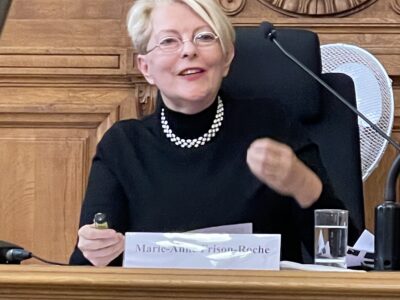
Marie-Anne Frison-Roche intervenant aux Rencontres de la Haute Autorité de l’Audit (H2A), 2 juillet 2025

Conferences

🎥L’enjeu de la crédibilité des rapports de durabilité. Temps long, Simplicité et Stratégie (The credibility of sustainability reports. Time, Simplicity and Strategy), in 🧮Mise en œuvre de la directive CSRD. Premiers constats et perspectives (Implementation of the CSRD directive. Initial findings and outlook)

► Full Reference: M.-A. Frison-Roche, "L'enjeu de la crédibilité des rapports de durabilité. Temps long, Simplicité et Stratégie" (The credibility of sustainability reports. Time, Simplicity and Strategy), concluding speech, in Rencontres de la Haute Autorité de l'Audit (H2A), 2025,  Mise en œuvre de la directive CSRD. Premiers constats et perspectives (Annual Manifestation of the French Audit Regulatory Body Haute Autorité de l'Audit – H2A, Implementation of the CSRD directive. Initial findings and outlook),, 2 July 2025, La Défense, 1pm-6pm - This manifestation, which takes place face-to-face with simultaneous translation, begins with a presentation by Florence Peybernès, President of the French High Audit Authority ( Haute Autorité de l'Audit -H2A). It is followed by 3 round-table discussions: 🪑🪑🪑 Round table 1: Feedback on the first appointments 🪑🪑🪑 Round table 2: Cross-perspectives between preparers, verifiers and stakeholders 🪑🪑🪑 Round table 3: Perspectives for CSRD   It is following on from this that the more legal, more judicial perspective, in an articulation between Ex Ante and Ex Post, will take shape. - ► English summary of the speech, as prepared : n view of the information available at the time of preparation for this event, the considerable interest aroused by the CSRD, and also its contestation, which led to its modification, is it counter-intuitive in view of the technicality of the remarks, the flood of criticism and the number of pages one reads, the impression of the weight, constraints and uselessness of the thing which would deprive companies of their freedom, but what emerges rather is Simplicity. Why: because the sustainability report is only a tool and it is the goal it serves that needs to be considered (more generally that's how the judge looks at it), a tool that serves a European strategy (Green Deal, sustainable finance). It is this strategy that needs to be identified, and the company has a free hand in it. What we are looking at the company in its contribution to this goal that is simple, a contribution which it can, in information that is admittedly standardised, draw the outlines of Long-term and Strategy: Investors and stakeholders are not hostile to this approach: the key is the credibility of the information made available. Because Long-Term Thinking puts the future at the centre, and we don't know what that future will be. This essential element, which the courts have recalled in relation to Vigilance Obligation, must also be borne in mind, because it is first and foremost a question of providing information about the future. To express the Information they want to give on this subject, companies need to understand the Goal of the European Plan (where Simplicity lies), to adjust their own plan to it (under the more familiar term of "Strategy") the councils and lawyers need to help them with this; to blend their strategies with the European strategy, to rely on the authorities and the auditors so that what they say is credible. Credibility is at the heart of it, which is why auditors are at the heart of it. Because the only obligation they have is to say. Not to do. The CSRD should not be interpreted as imposing obligations on the companies subject to it to do things (such as the obligation of vigilance generates); the CSRD only imposes an obligation on them to say things. The CSRD imposes on them only an obligation to inform. While this may be onerous, standardised and certified, there is no obligation to do or disclose anything. Moreover, that is part of the company's own strategy, a strategy over which the company retains full control. In this respect, although standardised, the information is free and it is the credibility of the information that is crucial, but not participation in a plan whose terms would be written by the Authorities or the stakeholders. Therefore, after learning from each other, it seems that there are three fairly simple things that are sometimes buried under the complication of the details accumulated and the violence of the arguments exchanged around the European Omnibus package. These three points will be developed at the end of the round-tables.   The first is the simplicity of the breadcrumb trail of credible, accessible information imposed by the European Union to put the Green Deal into practice. This breadcrumb trail is held in particular by the various regulators. The second is the existence of a single, simple obligation on the part of the company: to say what it has done, is doing and plans to do, without being obliged to do anything in the European Action Plan (the CRSD does not forcibly enroll companies in the European action plan). This limitation to an obligation to say is essential. Its articulation with obligations to act, arising in particular from texts on Vigilance, or even identical terms, must not lead to confusion in qualifications. The third is the benefit that the company derives from the articulation of a double "singular strategy": that of the European Union, which wants to build its future, a strategy of the Union to which it is free to contribute or not to contribute, and that of its own strategy which is articulated with the first and in which green gives way to many other colours according to the will of the company.   ► English Summary of speech, as made with regard to what effectively was said during the 2 round tables:  During the event itself, I preferred to place myself rather in the direct continuation of what had been said.  In the fifteen minutes allotted, this was the reason for not proceeding in this way, but rather to highlight the fact that what has emerged, all these efforts, uncertainty, trial and error and goodwill to elaborate that went into drawing up the first sustainability reports, runs the risk of being erased because in retrospect, in 2 or 5 years' time, particularly if a lawsuit were be brought, we will have the impression that everything was self-evident, that we knew everything, that everything was clear and decided. And it's that future, which will be the future of the judge who will be called upon by a stakeholder, a regulator, a prosecutor, who always takes the past for granted, that we have to think about. We need to think in terms of evidence. Evidence of uncertainty. And always remember that the sustainability report is also a piece of evidence. Which will fuel liability claims, disputes over information, and so on. Plus encore, parce que le report de durabilité n'est qu'un outil, pour une stratégie, qui est une stratégie d'ensemble, où la CSRD n'est qu'un élément du puzzle, des éléments du rapport de durabilité peuvent être pris pour être utilisés plus tard pour alimenter d'autres documents et rapports, et d'autres litiges. Cela est notamment le cas du plan de vigilance, puisque la cartographie des risques est souvent commune au rapport de durabilité et au plan de vigilance, ce qui est logique puisque la CSRD et la CS3D se font miroir dans le grand plan d'action de l'Union que constitue le Pacte vert. Mais cela est amplifié par les entreprises, qui parfois confondent l'un et l'autre, dans la présentation même au sein du rapport de gestion. Il est pourtant essentielle de distinguer nettement l'obligation de dire (rapport de durabilité) et l'obligation de faire (plan de vigilance). L'ambiguïté des "engagements" accroît cela. Il est essentiel de veiller à un travail ex ante entre expert de la gestion, de la finance, de l'audit et du droit pour éviter que les points de contact ne se transforment en confusions, maintenant et /ou plus tard, confusions qui pourraient être préjudiciables à tous. - 🌐follow Marie-Anne Frison-Roche on LinkedIn 🌐follow Marie-Anne Frison-Roche on Instagram 🌐subscribe to the Newsletter MAFR Regulation, Compliance, Law 🌐subscribe to the Video Newsletter MAFR Surplomb 🌐subscribe to the Newsletter MaFR Droit & Art
Conferences

conference

🎤Pourquoi les textes et la pratiques sur le rapport de durabilité vont engendrer un Contentieux Systémique (Why the texts and practices on sustainability reporting will give rise to Systemic Litigation), in 🧮Le rapport de durabilité : obligation et Contentieux Systémiques Émergents (The Sustainability Report: Emerging Systemic Obligation and Litigation), in cycle of conference-debates “Contentieux Systémique Émergent” (“Emerging Systemic Litigation”)

► Full Reference: M.-A. Frison-Roche, "Pourquoi les textes et la pratiques sur le rapport de durabilité vont engendrer un Contentieux Systémique" ("Why the texts and practices on sustainability reporting will give rise to Systemic Litigation"), in Le rapport de durabilité : obligation et Contentieux Systémiques Émergents (The Sustainability Report: Emerging Systemic Obligation and Litigation), in cycle of conference-debates "Contentieux Systémique Émergent" ("Emerging Systemic Litigation"), organised on the initiative of the Cour d'appel de Paris (Paris Cour of Appeal), with the Cour de cassation (French Court of cassation), the Cour d'appel de Versailles (Versailles Court of Appeal), the École nationale de la magistrature – ENM (French National School for the Judiciary) and the École de formation des barreaux du ressort de la Cour d'appel de Paris – EFB (Paris Bar School), under the scientific direction of Marie-Anne Frison-Roche, September 19, 2024, 11h-12h30, Cour d'appel de Paris, Cassin courtroom - 🧮see the full programme of this event - ► English summary of the conference: Systemic Litigation refers to a specific category whose proposed category in 2021 refers to "cases" brought before the courts, sometimes specialised, sometimes under ordinary law courts: these are cases in which not only are the parties involved in their dispute but also a system is itself involved, with the procedure and the judge having to allow the interests of the system to be taken into consideration. However, what is also the subject of new terminology, namely the "Sustainability Report", reflects the same legal revolution: the company must be able to assess not only its economic and financial performance, which is the subject of accounting, but also its development in terms of what it does externally in terms of ESG and what the outside world does about it. In this perspective, the whole Information System is being transformed, and in different ways depending on the standards adopted, in the United States, Europe or elsewhere, either it is sufficient to obtain Information, no more, so that third parties can adjust their behaviour, mainly investments, or, as in Europe, Law includes a more substantial perspective, so that the company itself adjusts its own behaviour, its Governance, its position in the world, in a renewed relationship with its stakeholders. In Europe, saying and doing are intertwined, CSRD being twinned with CS3D. Moreover, we can therefore consider that non-financial information, through the sustainability report, its assurance of credibility and the regulation of the audit carried out on it, is itself a system. The sustainability report, inside the sustainability system, is then interwoven with other systems, which are themselves the subject of Emerging Systemic Litigation: firstly Vigilance, which has been studied as a field of systemic litigation, and then artificial intelligence field, which has been studied in the same way. The Sustainability Report, insofar as it intersects with the sustainability obligation implied by the duty of Vigilance, may be attracted to the Systemic Litigation to which Vigilance gives rise. In the same way, algorithms can be a tool for data accumulating and matching ESG criteria, which could have the same attraction effect. If this happens, this dimension will have to be present and understood, for example through amici curiae mechanism, in conjunction with the Regulators and the professions concerned. In addition, as in any emerging mechanism, and as we have seen for example in relation to rating agencies, Tort Law may interfere if the liability of either the company or the person who carried out the audit were to be appreciated, the systemic perspective then having to be integrated into the handling of the case, even before the non-specialised judge.   - 🌐follow Marie-Anne Frison-Roche on LinkedIn 🌐follow Marie-Anne Frison-Roche on Instagram 🌐subscribe to the Newsletter MAFR Regulation, Compliance, Law